- Forecast Value (2036): 7.1 Bn
- CAGR (2036): 12.8%
Functional Coating Material Market Forecast and Outlook 2026 to 2036
Global demand for functional coating materials is projected to grow steadily from USD 2.1 billion in 2026 to nearly USD 7.1 billion by 2036, expanding at a 12.8% CAGR.
Key Takeaways from the Functional Coating Material Market
- Functional Coating Material Market Value (2026): USD 2.1 billion
- Functional Coating Material Market Forecast Value (2036): USD 7.1 billion
- Functional Coating Material Market Forecast CAGR (2026-2036): 12.8%
- Leading End-Use Application: Electronics & Automotive (44%)
- Key Market Participants: BASF, AkzoNobel, PPG Industries, Nippon Paint, Asian Paints
- Key Growth Regions: Asia Pacific, North America, Europe, India, China
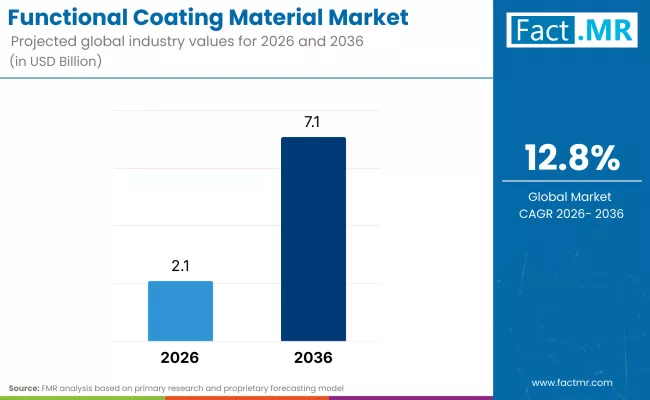
Functional Coating Material Market By Industry | Source: Fact.MR
This growth is driven by the rising use of advanced surface technologies across electronics, automotive manufacturing, industrial equipment, and infrastructure. Functional coatings are no longer just protective layers. They are engineered systems designed to deliver added value. Modern formulations offer properties such as anti-corrosion resistance, UV protection, anti-fingerprint behavior, and even self-healing capabilities. These features help extend product lifecycles and reduce long-term operating costs.
Sustainability is reshaping the market. Manufacturers are moving away from solvent-based coatings toward waterborne, powder, and high-solids systems. This shift supports global decarbonization goals and tighter environmental regulations.
According to Dr. Maria Hendricks, Vice President of Sustainable Coatings Research at BASF, functional coatings are evolving into active performance enablers. Advances in materials science and nanotechnology are allowing surfaces to respond to stress, repair micro-damage, and meet strict sustainability targets. Growth will continue as electrification, renewable energy projects, and sustainable packaging gain momentum. Policy support is also accelerating adoption. Regulations in Europe encourage recyclable and low-impact coating solutions, while industrial programs in the United States and India promote localized production of high-performance coatings for semiconductors, batteries, and electric vehicles.
Functional Coating Material Market
| Metric | Value |
|---|---|
| Estimated Value in (2026) | USD 2.1 billion |
| Forecast Value in (2036) | USD 7.1 billion |
| Forecast CAGR (2026 to 2036) | 12.8 % |
Source: Fact.MR analysis. Updated Feb 7, 2026
Category
| Category | Segments |
|---|---|
| End-Use | Electronics & Automotive, Industrial Coatings, Construction Coatings, Packaging Coatings, Consumer Goods Coatings |
| Coating Function | Anti-corrosion, Anti-smudge, UV Resistance, Anti-fingerprint, Functional Finishes |
| Base Material | PE / PET, Polycarbonate, PP / PVC, Coated Films, Nano-enabled Polymers |
| Region | North America; Europe; Asia Pacific; Latin America; Middle East & Africa |
Source: Fact.MR analysis. Updated Feb 7, 2026
Segmental Analysis
What drives Electronics & Automotive to dominate with 44% market share?
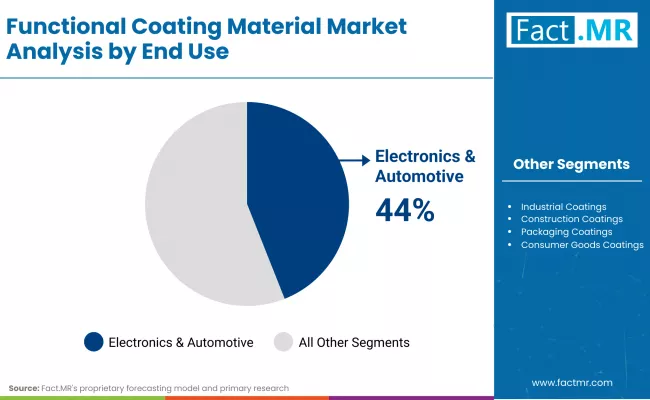
Functional Coating Material Market By End Use | Source: Fact.MR
Electronics and automotive together account for 44% of demand because both sectors are electrifying fast. Devices are becoming smaller, smarter, and more complex. Electric vehicle batteries need thermal management coatings. These coatings dissipate heat and protect against chemical breakdown. Semiconductor plants rely on ultra-clean dielectric coatings. These protect wafer surfaces during sensitive lithography and etching steps. Inside vehicles, touchscreens and control panels use anti-fingerprint and antimicrobial coatings. These improve hygiene and user comfort. Consumer electronics brands apply hydrophobic and oleophobic treatments to displays and housings. This improves durability and everyday user experience. These industries prioritize performance and reliability over cost. This sustains strong demand for premium functional coatings.
What establishes Anti-corrosion coating leadership at 46% market share?
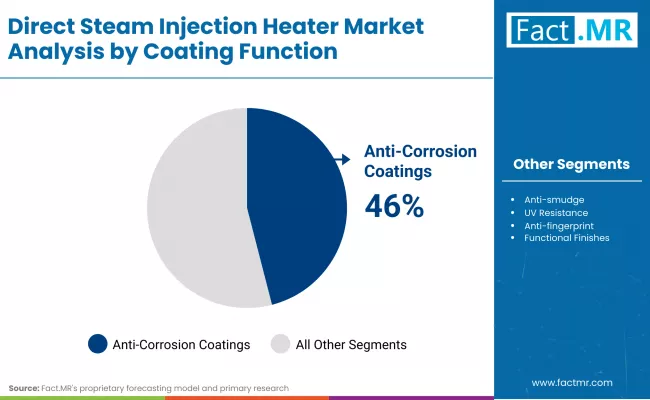
Functional Coating Material Market By Coating Function | Source: Fact.MR
Anti-corrosion coatings lead the market with a 46% share because asset protection is critical. Infrastructure, transport, and industrial equipment depend on long-term corrosion resistance. Marine structures, pipelines, and offshore wind foundations face aggressive environments. They require multi-layer systems with primers, intermediates, and durable topcoats. Modern formulations use active corrosion inhibitors. These include phosphates, molybdates, and organic complexing agents. Asset owners focus on lifecycle cost savings. Advanced coatings can extend maintenance cycles from five years to twenty years. Regulations restricting chromate-based inhibitors are also shaping the market. This has accelerated adoption of eco-friendly alternatives such as lanthanide compounds and conductive polymers.
Market Dynamics
- Drivers: Global decarbonization goals are pushing adoption of waterborne and powder coatings. These systems reduce or eliminate VOC emissions. Government incentives for electric vehicles are increasing demand for battery thermal management and EMI shielding coatings. Infrastructure renewal programs require long-lasting anti-corrosion solutions for bridges, railways, and water systems. Consumer demand for sustainable packaging is driving development of compostable barrier coatings. These replace traditional polyethylene laminates. Advances in nanotechnology are improving coating performance. Additives such as graphene oxide, carbon nanotubes, and ceramic nanoparticles enhance strength and thermal conductivity at very low loadings.
- Restraints :High-performance coatings need specialized equipment. This includes electrostatic spray systems and vacuum deposition chambers. Setting up automated coating lines requires high capital investment. Costs often exceed ten million dollars. Lack of technical expertise in some regions slows adoption of advanced formulations. Certain additives face regulatory scrutiny. Fluoropolymers and siloxanes raise concerns about persistence and bioaccumulation. Raw material price volatility also impacts margins. Key inputs include titanium dioxide, epoxy resins, and specialty amines. Many users hesitate to move away from solvent-based systems. Requalification costs and performance concerns slow the shift to waterborne alternatives.
- Trend 1: Integration of Self-Healing Capabilities Manufacturers are adding microcapsules with healing agents to coatings. These release when the surface is damaged. This self-repair mechanism extends service life. It is especially valuable for automotive exteriors and industrial flooring.
- Trend 2: Adoption of In-Mold Coating Technologies In-mold coating applies the coating during injection molding. This removes the need for secondary painting steps. The process cuts energy use and emissions. It also reduces labor costs and improves surface finish consistency.
Functional Coating Material Market Analysis by Key Country
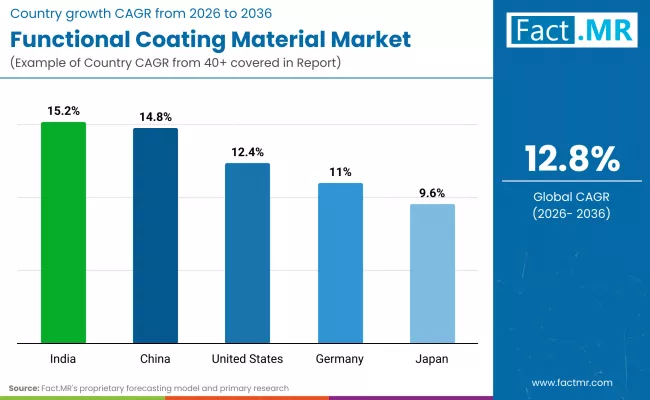
Functional Coating Material Market By Country | Source: Fact.MR
| Country | CAGR (2026-2036) |
|---|---|
| India | 15.2% |
| China | 14.8% |
| United States | 12.4% |
| Germany | 11.0% |
| Japan | 9.6% |
Source: Fact.MR analysis. Updated Feb 7, 2026
What policy and packaging shifts are accelerating functional coating adoption in India?
India shows the fastest growth at 15.2% CAGR. Government policy is the main driver. Subsidies encourage manufacturers to replace imported multilayer plastic laminates. Water-based barrier coatings on paper and cardboard are being adopted instead. Asian Paints has introduced LamiBak Flex technology. This allows pharmaceutical firms to shift from aluminum-plastic blisters to coated paperboard while maintaining moisture protection. Urbanization and rising middle-class income are boosting demand for packaged foods, personal care products, and e-commerce packaging. Coating suppliers are setting up regional technical centers. These develop products suited for high humidity and elevated temperatures across Indian supply chains.
How are carbon neutrality mandates and infrastructure investments shaping China’s market?
China is growing at 14.8% CAGR due to national carbon neutrality mandates. Provinces are required to adopt waterborne industrial coatings for transportation infrastructure. Domestic manufacturers are vertically integrating operations from petrochemical feedstock to final coating formulation. This lowers costs and supports renewable energy applications. Solar panel producers have standardized anti-reflective coatings. These improve module efficiency by more than 0.5 percentage points. Government procurement favors suppliers that comply with GB standards for VOC limits and hazardous substance restrictions.
What industrial reshoring and safety regulations are driving U.S. market momentum?
The U.S. market is expanding at 12.4% CAGR. Growth is supported by CHIPS Act incentives for domestic semiconductor manufacturing. Fabrication plants require advanced EMI shielding and thermal management coatings. Performance standards are strict. PPG Industries invested USD 380 million in a new aerospace coatings facility in North Carolina. The plant became operational in May 2025 and produces dielectric materials for aircraft avionics. Federal EV battery safety rules are also increasing demand. Thermal runaway protection coatings now incorporate ceramic microspheres and intumescent additives. Reshoring initiatives are driving demand for locally produced coatings that comply with Buy America requirements.
How do circular economy regulations and engineering expertise support growth in Germany?
Germany is advancing at 11.0% CAGR due to circular economy compliance. PPWR regulations take effect in August 2026 and require compostable food packaging coatings. German expertise in precision coating equipment gives domestic suppliers a strong export advantage. Turnkey systems are being deployed across EU markets. Chemical companies are reformulating polyethylene coatings using bio-based polyesters derived from agricultural waste. These coatings achieve industrial composability certification under EN 13432 within twelve weeks.
What role do automation goals and emissions targets play in Japan’s market growth?
Japan is expanding at 9.6% CAGR under Industry 5.0 Net-Zero commitments. Heavy industry is required to cut carbon emissions by 60%. Japanese suppliers are integrating AI-driven quality control systems. These monitor coating thickness, adhesion, and surface defects in real time. Export demand is rising as Southeast Asian manufacturers adopt Japanese production models focused on efficiency and sustainability.
Competitive Landscape
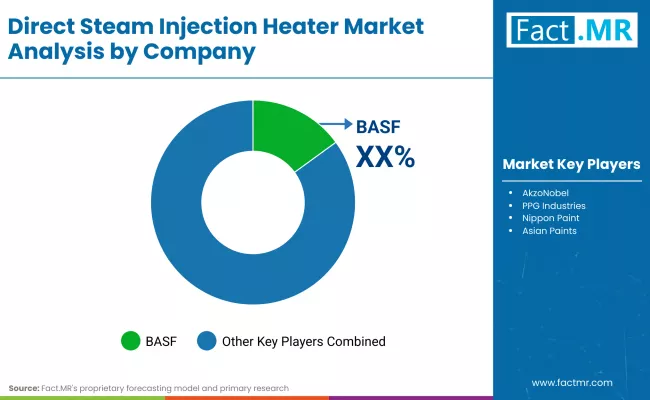
Functional Coating Material Market By Company | Source: Fact.MR
The functional coating material market is moderately consolidated, with a small group of global chemical leaders setting the pace. These companies maintain their advantage through long-term R&D investment, scale-driven manufacturing efficiency, and worldwide production networks that support regional customization.BASF benefits from tightly integrated resin synthesis and coating formulation facilities across Germany, China, and the United States. This structure allows the company to rapidly adapt products to local regulatory frameworks and customer performance requirements.
In South Asia, Asian Paints holds a strong position by tailoring products to local conditions. Its coatings are designed for tropical climates and priced for cost-sensitive customers without sacrificing essential performance. Nippon Paint stands out through innovation in in-mold coating technologies. By integrating surface treatment directly into manufacturing processes, the company reduces energy use, emissions, and production steps.
Across the market, competition is shifting away from single-function products. Customers increasingly expect coatings to deliver multiple benefits at once, including corrosion protection, long-term durability, chemical resistance, and environmental compliance. Strategic partnerships are becoming more common. Collaboration between coating suppliers and equipment manufacturers enables end-to-end solutions that combine advanced materials with precision application systems, optimized for specific substrates and high-throughput production environments.
Recent Development
- In September 2025, Heidelberg Machinery and Solenis launched inline barrier coating systems. These allow corrugated board producers to apply moisture- and grease-resistant coatings at full production speed.
- In March 2025, Nippon Paint commercialized in-mold coating technology. Automotive components are coated during injection molding. This eliminates paint booths and curing ovens. Energy use and VOC emissions drop significantly.
Key Market Players in Functional Coating Material Market
- BASF
- AkzoNobel
- PPG Industries
- Nippon Paint
- Asian Paints
Bibliography
- BASF SE. 2026. Advanced functional coating materials for electronics, automotive, and industrial applications. Official company publications and technical documentation.
- PPG Industries. 2026. High-performance aerospace and automotive functional coating technologies. Corporate press releases and product technical briefs.
- Nippon Paint Holdings. 2025. In-mold coating technologies and sustainable industrial coating solutions. Company announcements and technical white papers.
- European Union. 2026. PPWR implementation guidelines for sustainable packaging and circular economy compliance. Official EU regulatory publications.
- Government of India. 2025. Production Linked Incentive 2.0 scheme documentation for pharmaceutical and packaging sectors. Department for Promotion of Industry and Internal Trade publications.
- United States Congress. 2025. CHIPS and Science Act implementation guidelines for domestic semiconductor manufacturing. Official legislative documentation.
Segmentation
Scope of Report
| Items | Values |
|---|---|
| Quantitative Units (2026) | USD 2.1 Billion |
| End-Use | Electronics & Automotive, Industrial Coatings, Construction Coatings, Packaging Coatings, Consumer Goods Coatings |
| Coating Function | Anti-corrosion, Anti-smudge, UV Resistance, Anti-fingerprint, Functional Finishes |
| Base Material | PE / PET, Polycarbonate, PP / PVC, Coated Films, Nano-enabled Polymers |
| Regions Covered | North America, Europe, Asia Pacific, Latin America, Middle East & Africa |
| Countries Covered | U.S., Canada, Germany, Italy, UK, France, Japan, Australia, and other countries |
| Key Companies Profiled | BASF, AkzoNobel, PPG Industries, Nippon Paint, Asian Paints |
| Additional Attributes | Dollar revenue in the functional coating material market is segmented by end-use (electronics & automotive, industrial coatings, construction coatings, packaging coatings, consumer goods coatings), coating function (anti-corrosion, anti-smudge, UV resistance, anti-fingerprint, functional finishes), base material (PE/PET, polycarbonate, PP/PVC, coated films, nano-enabled polymers), and region. |
Source: Fact.MR analysis. Updated Feb 7, 2026
Functional Coating Material Market by Segments
-
End-Use :
- Electronics & Automotive
- Industrial Coatings
- Construction Coatings
- Packaging Coatings
- Consumer Goods Coatings
-
Coating Function :
- Anti-corrosion
- Anti-smudge
- UV Resistance
- Anti-fingerprint
- Functional Finishes
-
Base Material :
- PE / PET
- Polycarbonate
- PP / PVC
- Coated Films
- Nano-enabled Polymers
-
Region :
- Asia Pacific
- China
- India
- Japan
- South Korea
- Australia
- Rest of Asia Pacific
- North America
- United States
- Canada
- Mexico
- Europe
- Germany
- France
- UK
- Italy
- Spain
- Rest of Europe
- Latin America
- Brazil
- Mexico
- Argentina
- Rest of Latin America
- Asia Pacific
Frequently Asked Questions
How big is the global functional coating material market in 2026?
What will be the size of the functional coating material market in 2036?
How fast will the functional coating material market grow between 2026 and 2036?
Which end-use application dominates the functional coating material market?
Which coating function holds the largest share in the functional coating material market?
Who worked on this report


Preview the report firsthand - request a free sample
Free SampleGet the brochure for pricing and purchase details
Download PDF