- Market Value (2025): USD 2.1 Bn
- Estimated Value (2026): USD 2.4 Bn
- Forecast Value (2036): USD 9.5 Bn
- CAGR (2026-2036): 14.9%
What is the Functional Soda Fibers Market forecast to be worth by 2036?
USD 2.4 billion in 2026 to USD 9.5 billion by 2036 at a 14.9% CAGR.
- The Functional Soda Fibers Market reached USD 2.1 billion in 2025.
- Demand is projected to increase from USD 2.4 billion in 2026 to USD 9.5 billion by 2036.
- The market is forecast to record 14.9% CAGR from 2026 to 2036 as soda brands and ingredient formulators use fiber for gut health positioning.
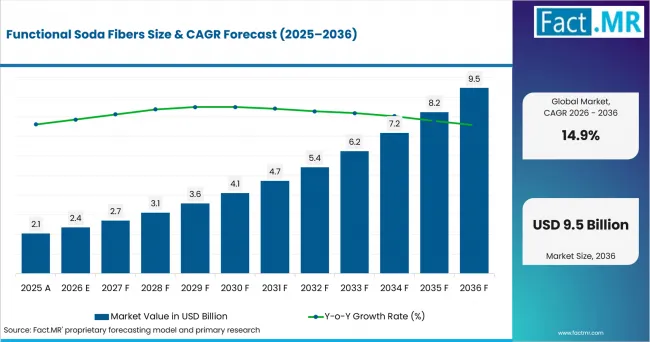
Functional Soda Fibers Value Analysis | Source: Fact.MR
What are the defining numbers behind Functional Soda Fibers Market growth?
An absolute opportunity of USD 7.1 billion is expected between 2026 and 2036.
- Demand Drivers in the Market
- Beverage formulators need soluble fibers that withstand carbonation and acidity while keeping clear soda systems bright.
- Soda brands need reduced-sugar recipes with body and clean sweetness as shoppers compare functional soda with ordinary diet soda.
- Retail beverage managers need shelf-stable functional drinks that explain digestive benefit quickly during a short aisle decision.
- Regulatory teams need pack language that links fiber content to permitted claims across each country of sale.
- Key Segments Analyzed
- By Fiber Type: Soluble corn fiber is expected to hold 31.0% share in 2026 owing to its water solubility and neutral taste in reduced-sugar carbonated drinks.
- By Soda Format: Prebiotic soda is projected to account for 38.0% share in 2026 because digestive-health positioning gives fiber a clear role in soda.
- By Consumer Benefit: Gut / digestive health is anticipated to capture 44.0% share in 2026 as brands connect fiber with a benefit shoppers understand.
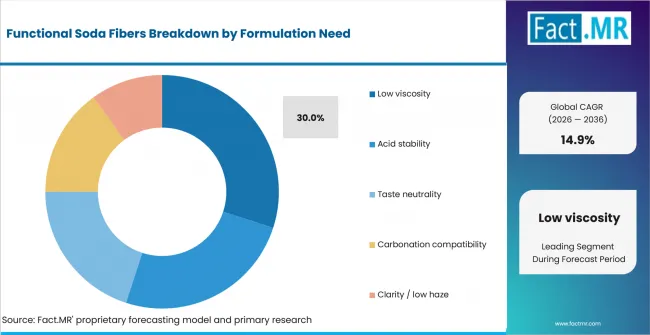
- By Formulation Need: Low viscosity is estimated to represent 30.0% share in 2026 due to its role in preserving a light soda mouthfeel.
- Analyst Opinion at Fact.MR
- Shambhu Nath Jha, Principal Consultant at Fact.MR, states, “Functional soda fibers are drawing attention because the ingredient must do two jobs at once. It must support a nutrition claim and still behave like a beverage ingredient in acidic carbonated liquid. Suppliers are expected to gain preference when they combine label-ready fiber content, clean taste and application support for clear or low-sugar soda.”
- Strategic Implications
- Ingredient suppliers should document fiber percentage, pH stability and clarity behavior for cola, fruit soda and sparkling water bases.
- Beverage brands should test serving size early so fiber claims align with taste, sweetness and digestive comfort.
- Nutrition teams should link reformulation work to intake gaps; the CDC reported in August 2025 that ultra-processed foods accounted for 55.0% of U.S. calories for people aged 1 year and older during August 2021 to August 2023.
- Contract developers should build prototype libraries that compare corn fiber, resistant dextrin, inulin and acacia fiber in the same base.
Australia is projected to post 15.5% CAGR through 2036, led by low-sugar soda reformulation and functional beverage experimentation. The USA is expected to record 15.1% CAGR as front-of-pack nutrition scrutiny and high packaged-food spending keep reformulation active. Germany is anticipated to advance at 14.7% CAGR owing to light-drink production and pressure on sugary soft drinks. The UK is estimated to hold 14.4% CAGR because fiber shortfalls and soft-drink levy economics shape beverage development. France is forecast to reach 13.9% CAGR as Nutri-Score revisions strengthen the case for lower-sugar fiber-bearing drinks.
How does the Functional Soda Fibers Market break down by segment?
Prebiotic soda leads Soda Format at 38.0%; gut / digestive health leads Consumer Benefit at 44.0%.
Which Fiber Type dominates?
Soluble corn fiber holds 31.0% share in 2026.
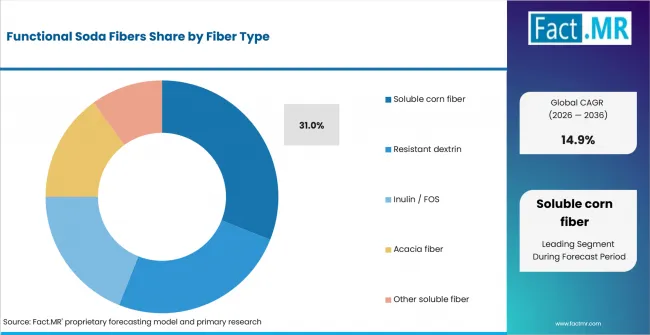
Functional Soda Fibers Analysis By Fiber Type | Source: Fact.MR
Soluble corn fiber leads because it adds dietary fiber without forcing a heavy texture into carbonated beverages. It fits clear and low-sugar recipes where the main product promise remains refreshment. For soda developers, the main advantage is practical: a fiber that dissolves cleanly and keeps viscosity low reduces reformulation risk.
This ingredient route also gives brands room to balance sweetness after sugar reduction. Prebiotic soda and sparkling functional drinks depend on clarity and mouthfeel, so application teams often start with fibers that protect a light pour and a clean finish.
What leads the Soda Format segment?
Prebiotic soda holds 38.0% share in 2026.
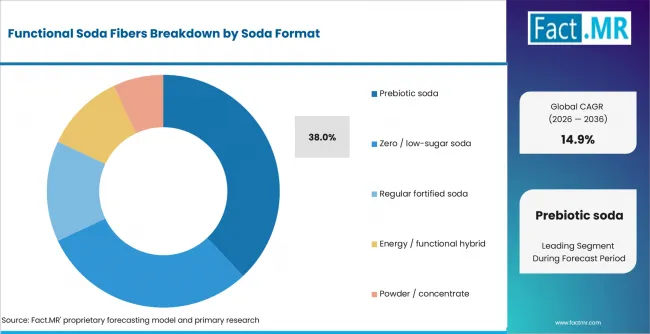
Functional Soda Fibers Analysis By Soda Format | Source: Fact.MR
Prebiotic soda leads because it gives consumers a simple reason to choose a functional carbonated drink. The format allows brands to connect digestive wellness with a familiar can, which reduces the education burden compared with powders or clinical nutrition products.
BENEO received Thai FDA approval in September 2025 for an exclusive prebiotic claim for Orafti® Inulin. The approval gives food and drink manufacturers a clearer claim route in that market and shows how prebiotic science is moving into beverage-ready label language.
How does Consumer Benefit shape demand?
Gut / digestive health leads with 44.0% share in 2026.
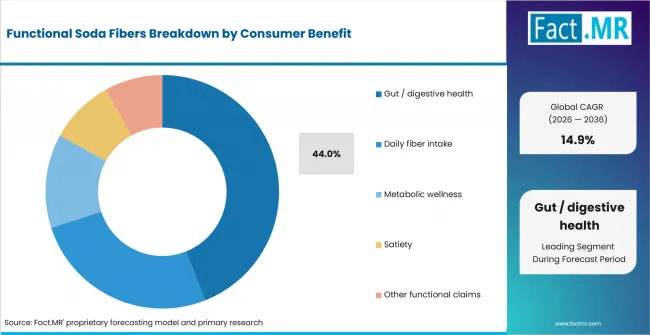
Functional Soda Fibers Analysis By Consumer Benefit | Source: Fact.MR
Gut and digestive health leads because fiber has a clearer consumer meaning than many functional soda claims. Brands can explain the benefit in a few words, while formulators choose fibers based on serving size, tolerance and taste impact.
The UK National Diet and Nutrition Survey reported in June 2025 that 96% of children aged 11 to 18 years and adults fell short of government fiber recommendations during 2019 to 2023. That intake gap gives beverage brands a practical reason to add fiber into everyday drink occasions.
What supports demand for Low Viscosity within Formulation Need?
Low viscosity holds 30.0% share in 2026.
Functional Soda Fibers Analysis By Formulation Need | Source: Fact.MR
Low viscosity leads because soda consumers expect a light pour, sharp carbonation and a clean finish. Thickening can make fortified soda feel closer to a supplement drink, which weakens the category fit and makes taste testing more difficult.
Ingredion highlighted a Berry Good Soda concept at IFT FIRST in July 2025. Ingredion described it as a reduced-sugar, effervescent drink that maintains body and fizz with texture-enhancing ingredients. The example is used here as adjacent reduced-sugar formulation evidence, while Ingredion’s soluble-fiber portfolio provides separate relevance to fiber fortification.
What is accelerating Functional Soda Fibers Market adoption, and what is holding it back?
Demand is expected to rise through fiber gaps and low-sugar soda reformulation. Growth is constrained by taste, tolerance and claim limits.
Drivers Impact Analysis
| DRIVER | (~) % IMPACT ON CAGR | GEOGRAPHIC RELEVANCE | IMPACT TIMELINE |
|---|---|---|---|
| Fiber gap in everyday diets | +1.8% | North America, Europe, Australia | Short term (<= 2 years) |
| Low-sugar soda reformulation | +1.5% | United States, United Kingdom, Germany | Medium term (2-4 years) |
| Prebiotic positioning in carbonated drinks | +1.1% | Global | Medium term (2-4 years) |
| Clear beverage formulation needs | +0.8% | Global | Long term (>= 4 years) |
- Fiber gap in everyday diets: Many consumers struggle to reach recommended fiber intake, so beverage brands can use familiar soda occasions to add a measurable nutrition benefit.
- Low-sugar soda reformulation: Sugar levies, label scrutiny and calorie awareness push brands to rebuild mouthfeel after sugar reduction. Soluble fibers can support that texture need.
- Prebiotic positioning in carbonated drinks: Digestive wellness gives functional soda a direct claim pathway when the ingredient dose and local label rules align.
- Clear beverage formulation needs: Clear or lightly colored sodas require fibers that dissolve well, limit haze and maintain appearance during distribution.
Opportunity Impact Analysis
| OPPORTUNITY | (~) % IMPACT ON CAGR | GEOGRAPHIC RELEVANCE | IMPACT TIMELINE |
|---|---|---|---|
| Low-viscosity fibers for clear soda | +1.2% | Global | Medium term (2-4 years) |
| Claim-ready prebiotic blends | +0.9% | Europe, North America, Asia Pacific | Medium term (2-4 years) |
| Powder and concentrate beverage bases | +0.6% | Global | Long term (>= 4 years) |
- Low-viscosity fibers for clear soda: Suppliers can gain share by proving that fiber fortification preserves carbonation and keeps clear soda visually clean.
- Claim-ready prebiotic blends: Ingredient makers can support brand launches by pairing clinical evidence with formulation guides for acidic carbonated drinks.
- Powder and concentrate beverage bases: Dry formats allow smaller brands to test fiber soda concepts before investing in full ready-to-drink distribution.
Restraints Impact Analysis
| RESTRAINT | (~) % IMPACT ON CAGR | GEOGRAPHIC RELEVANCE | IMPACT TIMELINE |
|---|---|---|---|
| Cost sensitivity in mainstream soda aisles | -0.6% | Global | Short term (<= 2 years) |
| Digestive tolerance at higher doses | -0.5% | Global | Medium term (2-4 years) |
| Regional label and claim differences | -0.4% | Europe, North America, Asia Pacific | Long term (>= 4 years) |
- Cost sensitivity in mainstream soda aisles: Functional fibers add ingredient cost, so brands need clear benefit communication to justify premium pricing.
- Digestive tolerance at higher doses: Serving-size decisions can slow development when a product needs a meaningful fiber level with comfortable consumption.
- Regional label and claim differences: Brands must adapt fiber naming, prebiotic language and sugar claims by market, which adds review time before launch.
Which countries are scaling the Functional Soda Fibers Market through 2036?
- The country comparison spans 1.6 percentage points and forms a narrow growth band across the forecast period.
- Australia remains 0.4 percentage point above the USA through low-sugar soft drink reformulation and functional beverage trials.
- The USA remains 0.4 percentage point above Germany as packaged food spending and label review keep reformulation active.
- Germany remains 0.3 percentage point above the UK through reduced-calorie drink output and sugar-reduction activity.
- The UK remains 0.5 percentage point above France as fiber shortfalls and soft-drink levy economics shape beverage development.
- France closes the displayed range through Nutri-Score revisions and demand for cleaner sugar-reduced beverage labels.
Comparable CAGRs create different entry conditions because each country combines beverage consumption, sugar policy, pricing and claim review in a different way. Full report coverage includes North America, Latin America, Western Europe, Eastern Europe, East Asia, South Asia & Pacific, Middle East & Africa.
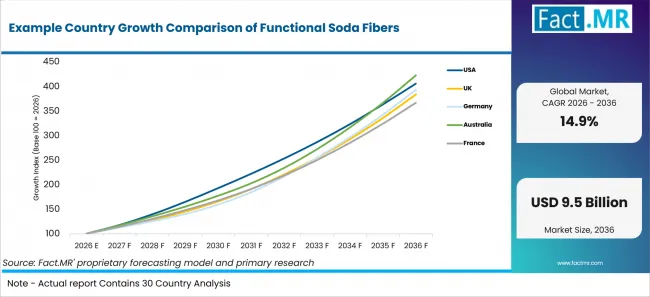
Example Country Growth Comparison Of Functional Soda Fibers | Source: Fact.MR
| Country | CAGR (2026-2036) |
|---|---|
| Australia | 15.5% |
| United States | 15.1% |
| Germany | 14.7% |
| United Kingdom | 14.4% |
| France | 13.9% |
What supports Australia adoption?
15.5% CAGR, supported by low-sugar soft drink reformulation.
Australia has a clear low-sugar soda pathway for fiber fortification. The Australian Bureau of Statistics reported in March 2025 that 43.1% of soft drink apparent consumption was intense-sweetened in 2023-24. Beverage developers can use soluble fibers to rebuild body and mouthfeel as sugar falls, especially in prebiotic soda and sparkling functional drinks.
What supports USA adoption?
15.1% CAGR, backed by packaged food spending and label scrutiny.
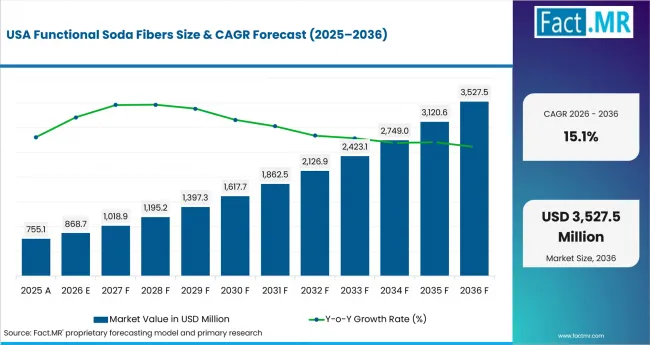
Functional Soda Fibers Country Value Analysis | Source: Fact.MR
The USA gives functional soda fiber brands a large retail base and a reformulation motive. USDA Economic Research Service reported in June 2026 that U.S. food spending reached USD 2.51 trillion in 2025. That scale supports frequent beverage launches, while added-sugar label review encourages formulators to use fiber for texture and digestive-health positioning.
What supports Germany adoption?
14.7% CAGR, supported by reduced-calorie drink output.
Germany is suited to fiber-added soda because light-drink production already has scale. Destatis reported in February 2026 that Germany produced 1.5 billion liters of reduced-calorie cola and lemonade in 2024. Ingredient teams can place low-viscosity fibers into this reformulation base where sugar reduction, taste and clarity need to work together.
What supports the United Kingdom growth?
14.4% CAGR, shaped by fiber shortfalls and soft-drink levy economics.
The UK market links fiber shortfalls with a commercial reason to reduce sugar. HM Revenue & Customs reported on January 30, 2026 that provisional Soft Drinks Industry Levy receipts reached GBP 327 million for the 2024-25 financial year. This keeps sugar reduction visible for beverage brands, and fiber can help protect mouthfeel in low-sugar soda formats.
How does France perform?
13.9% CAGR, led by Nutri-Score reformulation pressure.
France has a label environment that pushes beverage brands to review sugar and nutrition quality together. Santé publique France reported in March 2026 that 30% to 40% of products are estimated to change score under the revised Nutri-Score algorithm introduced in France in March 2025. Functional soda fibers fit when brands need cleaner sugar reduction and simple digestive-health communication.
Who leads the Functional Soda Fibers Market?
Tate & Lyle PLC is active through PROMITOR® Soluble Fibre and broader fiber and texturizing systems used in beverages. At IFT FIRST in July 2025, its Tropical Mystic Elixir beverage prototype incorporated PROMITOR® Soluble Fibre for fiber enrichment alongside KELCOGEL® Gellan Gum for stabilization and Stevia Reb M for sweetness. Tate & Lyle separately positions PROMITOR® soluble fiber for beverage formulations where fiber enrichment, sugar reduction and mouthfeel are important formulation considerations.
Ingredion Incorporated participates through soluble-fiber and texture systems for beverages. Its July 2025 Berry Good Soda concept demonstrated a reduced-sugar, effervescent formulation that maintained body and fizz using texture-enhancing ingredients. The prototype provides adjacent soda-formulation evidence, while Ingredion’s soluble-fiber portfolio provides direct relevance to fiber fortification in beverages, including carbonated applications.
BENEO GmbH participates through Orafti® Inulin and related prebiotic chicory-root fibers used for fiber enrichment in ready-to-drink and other beverage applications. Nexira supports the market through Fibregum™ and inavea™ acacia-fiber systems; its IFT FIRST 2025 material explicitly included a prebiotic soda enriched with acacia fiber. Roquette participates through NUTRIOSE® soluble fiber, which is positioned for fiber enrichment and sugar management in beverages and non-alcoholic drinks. Matsutani Chemical Industry participates through FIBERSOL-2™ soluble dietary fiber, and its August 2026 beverage update described material proposals using Fibersol-2 and Fibersol-2H for beverage applications including carbonated water and tea.
Ingredion and Tate & Lyle remain listed separately because Tate & Lyle shareholders approved the Scheme-related resolutions for Ingredion’s recommended cash acquisition on July 28, 2026, but completion remains subject to additional conditions. Subject to those conditions, the Scheme is expected to become effective during the second half of 2027.
Which companies are the key providers?
Key ingredient include Tate & Lyle PLC; Ingredion Incorporated; BENEO GmbH; Nexira SAS; Roquette Frères; and Matsutani Chemical Industry Co., Ltd.
- Tate & Lyle PLC
- Ingredion Incorporated
- BENEO GmbH
- Nexira SAS
- Roquette Frères
- Matsutani Chemical Industry Co., Ltd.
Bibliography
- Australian Bureau of Statistics. (2025, March 28). Apparent Consumption of Selected Foodstuffs, Australia.
- BENEO. (2025, September 18). BENEO secures first-ever Thai FDA approval for exclusive prebiotic claim.
- Williams, A. M., Couch, C. A., Emmerich, S. D., & Ogburn, D. F. (2025, August). Ultra-processed food consumption in youth and adults: United States, August 2021–August 2023 (NCHS Data Brief No. 536). National Center for Health Statistics.
- Statistisches Bundesamt (Destatis). (2026, February 12). 93 Liter zuckerhaltige Erfrischungsgetränke 2024 pro Kopf produziert.
- HM Revenue & Customs. (2026, January 30). Soft Drinks Industry Levy statistics commentary 2026.
- Ingredion. (2025, July 22). Ingredion at IFT FIRST 2025 — Connecting texture, health and innovation.
- Tate & Lyle PLC. (2026, July 28). Recommended cash acquisition of Tate & Lyle PLC by Ingredion Incorporated – Results of Shareholder Meetings.
- Office for Health Improvement and Disparities. (2025, June 11). National Diet and Nutrition Survey 2019 to 2023: Report.
- Nexira. (2025, June 23). Nexira showcases natural innovations for functional beverages at IFT FIRST 2025.
- Roquette. (2026, February 3). NUTRIOSE® Soluble Fibers: NutraStrong™ Prebiotic Verified.
- Ducrot, P., & Serry, A.-J. (2026, March 19). Évaluation de la campagne Nutri-Score 2025. Santé publique France.
- Tate & Lyle. (2025, July 7). Tate & Lyle debuts expanded portfolio and mouthfeel leadership at IFT FIRST 2025.
- Zeballos, E., & Sinclair, W. (2026, June 11). Total U.S. food spending reached $2.51 trillion in 2025. U.S. Department of Agriculture, Economic Research Service.
- U.S. Food and Drug Administration. (2025, January 14). FDA proposes requiring at-a-glance nutrition information on the front of packaged foods.
This Report Answers
- The report explains where functional soda fibers are used across fiber type, soda format, consumer benefit and formulation need.
- Segment analysis identifies the leading subsegments and the formulation reasons beverage developers prioritize them.
- Country analysis examines the listed markets and the nutrition, pricing or policy mechanisms supporting functional soda development.
- Competitive analysis reviews active ingredient suppliers across soluble corn fiber, resistant dextrin, inulin, FOS and acacia fiber systems.
- Application analysis assesses how taste, haze, viscosity and digestive tolerance influence ingredient selection in carbonated beverages.
What does the Functional Soda Fibers Market cover?
The Functional Soda Fibers Market covers soluble fiber ingredients used to add measurable fiber into carbonated soda formats. It includes fibers used in prebiotic soda, zero or low-sugar soda, regular fortified soda, energy or functional hybrid drinks, and powder or concentrate formats.
The assessment covers fiber choices that influence taste, acidity tolerance, clarity and viscosity. It also considers adjacent functional beverage formulations, dietary fibers, functional soda and prebiotic cola fibers where they help define the market boundary.
What is included in the scope?
The scope includes soluble corn fiber, resistant dextrin, inulin / FOS, acacia fiber and other soluble fiber systems when they are used in carbonated functional soda. It includes branded ingredient systems, customer prototypes, dry concentrate formats and finished-drink applications where fiber is central to the proposition.
It also includes probiotic soda, prebiotic fiber, soluble corn fiber ingredients and fiber-forward formulations where the formulation reasoning overlaps with functional soda fibers. The scope is limited to ingredients and applications that directly support fiber addition in soda-like drinks.
What is excluded from the scope?
The scope excludes ordinary carbonated soft drinks without added dietary fiber. It also excludes non-carbonated juices, dairy drinks, protein shakes, kombucha-only products and general sweetener systems when they are sold outside a functional fiber role.
General gut-health supplements are outside the scope when they are sold as capsules, gummies or powders with no soda application. Low-fermentability dietary fibers and non-alcoholic beverages are covered only when the ingredient is positioned inside a functional soda formulation.
How Was the Analysis Built?
The analysis draws on 120+ sources, 35+ company portfolios, 25+ countries, and more than 20 industry interviews.
- Primary Research: Primary research includes discussions with manufacturers, service providers, technology developers, distributors, end users, and subject-matter experts. These conversations examine purchasing priorities, product adoption, operational challenges, approval requirements, competitive positioning, and the factors that influence wider market acceptance.
- Desk Research: Desk research covers government statistics, regulatory publications, company filings, trade data, technical studies, industry associations, standards, public policy, and other authoritative sources. Every source used in the analysis is documented in the bibliography.
- Market Sizing and Forecasting: Market estimates combine historical performance, demand indicators, pricing and volume trends, segment shares, company participation, country-level growth, adoption patterns, investment activity, and barriers to market expansion.
- Data Validation and Update Cycle: Findings are validated by comparing primary interviews with public data, company activity, regulatory changes, trade patterns, and industry developments. Regular updates review new product launches, capacity changes, partnerships, approvals, and shifts in commercial adoption.
What is the report’s scope and coverage?
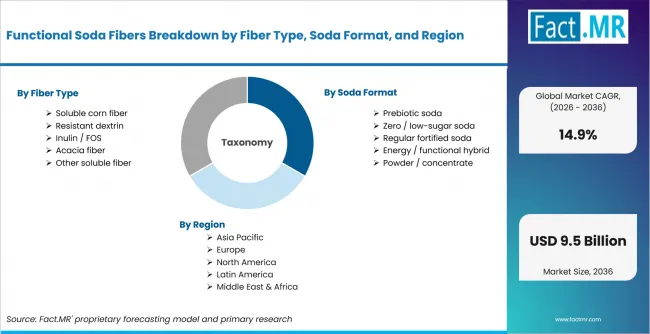
Functional Soda Fibers Breakdown By Fiber Type, Soda Format, And Region | Source: Fact.MR
| Attribute | Details |
|---|---|
| Quantitative Units | USD billion |
| Market Definition | Soluble dietary fibers used in carbonated functional soda, including fibers added for digestive health, daily fiber intake, metabolic wellness and satiety claims. |
| Fiber Type | Soluble corn fiber; Resistant dextrin; Inulin / FOS; Acacia fiber; Other soluble fiber |
| Soda Format | Prebiotic soda; Zero / low-sugar soda; Regular fortified soda; Energy / functional hybrid; Powder / concentrate |
| Consumer Benefit | Gut / digestive health; Daily fiber intake; Metabolic wellness; Satiety; Other functional claims |
| Formulation Need | Low viscosity; Acid stability; Taste neutrality; Carbonation compatibility; Clarity / low haze |
| Regions Covered | North America; Latin America; Western Europe; Eastern Europe; East Asia; South Asia & Pacific; Middle East & Africa |
| Countries Covered | United States; United Kingdom; Germany; Australia; France |
| Key Companies Profiled | Tate & Lyle PLC; Ingredion Incorporated; BENEO GmbH; Nexira SAS; Roquette Frères; Matsutani Chemical Industry Co., Ltd. |
| Forecast Period | 2026 to 2036 |
| Approach | Hybrid top-down and bottom-up approach using beverage formulation need, functional soda adoption, fiber ingredient portfolios, country-level reformulation signals and provider activity review. |
How is the market segmented?
-
By Fiber Type
- Soluble corn fiber
- Resistant dextrin
- Inulin / FOS
- Acacia fiber
- Other soluble fiber
-
By Soda Format
- Prebiotic soda
- Zero / low-sugar soda
- Regular fortified soda
- Energy / functional hybrid
- Powder / concentrate
-
By Consumer Benefit
- Gut / digestive health
- Daily fiber intake
- Metabolic wellness
- Satiety
- Other functional claims
-
By Formulation Need
- Low viscosity
- Acid stability
- Taste neutrality
- Carbonation compatibility
- Clarity / low haze
-
By Region
- North America
- Latin America
- Western Europe
- Eastern Europe
- East Asia
- South Asia & Pacific
- Middle East & Africa