- Market Value (2025): USD 1.6 Bn
- Estimated Value (2026): USD 1.8 Bn
- Forecast Value (2036): USD 7.2 Bn
- CAGR (2026-2036): 14.9%
What is the Prebiotic Cola Fibers Market forecast to be worth by 2036?
USD 1.8 Billion in 2026 to USD 7.2 Billion by 2036 at a 14.9% CAGR.
- The Prebiotic Cola Fibers Market was valued at USD 1.6 Billion in 2025.
- Demand is projected to increase from USD 1.8 Billion in 2026 to USD 7.2 Billion by 2036.
- The market is forecast to record 14.9% CAGR from 2026 to 2036 as beverage brands and ingredient formulators use fiber to support lower-sugar cola refreshment.
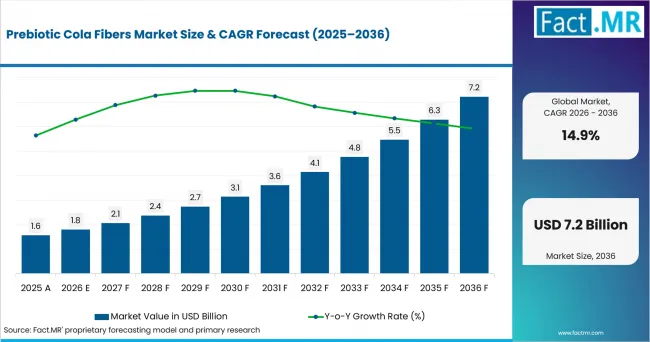
Prebiotic Cola Fibers Market Value Analysis | Source: Fact.MR
What are the defining numbers behind Prebiotic Cola Fibers Market growth?
An absolute opportunity of USD 5.4 Billion is expected between 2026 and 2036.
- Demand Drivers in the Market
- Beverage brands need soluble fiber that restores body after sugar reduction and keeps the drink clear. USDA ERS reported on June 11, 2026 that inflation-adjusted U.S. food spending reached USD 2.51 trillion in 2025.
- Formulators need sugar-reduction systems that preserve taste and mouthfeel in acidic cola. USDA ERS reported on April 30, 2026 that average annual U.S. food-at-home prices for nonalcoholic beverages were 3.8% higher in 2025 than in 2024.
- Retail category teams need digestive and gut health cues that fit mainstream soft drink aisles. The shift connects with adjacent functional beverage systems where wellness cues are built into everyday drinks.
- Contract manufacturers need fiber systems that dissolve quickly in concentrates and ready-to-drink formats. Clean hydration, low haze and stable sweetness guide scale-up decisions for prebiotic cola formulas.
- Key Segments Analyzed
- By Fiber Platform: Soluble corn fiber is expected to hold 30.00% share in 2026, supported by neutral taste and reduced-sugar texture work.
- By Cola Format: Zero and low-sugar ready-to-drink is projected to account for 46.00% share in 2026, driven by mainstream cola reformulation.
- By Formulation Challenge: Low viscosity at effective dose is anticipated to capture 31.00% share in 2026, due to drinkable texture requirements.
- By Consumer Positioning: Digestive and gut health is estimated to represent 45.00% share in 2026, reinforced by prebiotic claim appeal.
- Analyst Opinion at Fact.MR
- Shambhu Nath Jha, Principal Consultant at Fact.MR, states, "Prebiotic cola fibers draw attention because they solve a beverage problem that sweeteners alone leave unresolved. The market is expected to reward ingredients that balance fiber dose, low viscosity and clean taste in carbonated formats. Suppliers with application labs, claim files and regional regulatory support are better placed to support retail launches."
- Strategic Implications
- Ingredient suppliers should show dose behavior in acidic cola systems and align technical work with sugar-reduction taste optimization.
- Cola brand owners should test fiber addition together with sweetness systems before shelf-life validation and sensory panels.
- Regulatory teams should review ingredient-use boundaries early. FDA GRAS Notice 1242, for short-chain fructooligosaccharides, closed on July 14, 2025. The notice lists beverages and juices among the intended uses, with use levels across the listed food categories ranging from 0.4% to 15%.
- Retailers should group digestive-positioned cola near lower-sugar functional drinks when shopper education is needed.
The USA is projected to record 16.8% CAGR through 2036, led by low-sugar cola reformulation and a large functional beverage channel. Mexico is anticipated to advance at 15.9% CAGR, shaped by soda consumption pressure and the 2026 IEPS framework. The UK is estimated to post 15.6% CAGR, supported by levy-led sugar reformulation. Brazil is forecast to hold 14.9% CAGR, attributable to mass soft drink consumption and beverage manufacturing scale. Germany is expected to reach 14.2% CAGR, reinforced by high soft drink output and product-reduction policy attention.
How does the Prebiotic Cola Fibers Market break down by segment?
Soluble corn fiber is projected to lead Fiber Platform at 30.00% share in 2026; zero and low-sugar ready-to-drink is projected to lead Cola Format at 46.00% share.
Which Fiber Platform dominates?
Soluble corn fiber is expected to hold 30.0% share in 2026.
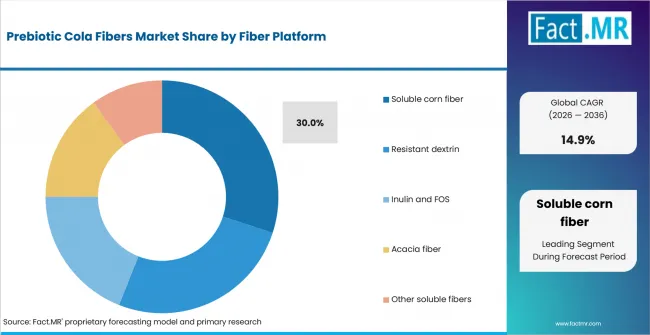
Prebiotic Cola Fibers Market Analysis By Fiber Platform | Source: Fact.MR
Soluble corn fiber accounts for the main fiber platform share because cola formulators need high solubility and low flavor impact. It helps rebuild mouthfeel after sugar is reduced. The segment connects with broader soluble corn fiber ingredients used in beverage and nutrition applications.
What leads the Cola Format segment?
Zero and low-sugar ready-to-drink is projected to account for 46.0% share in 2026.
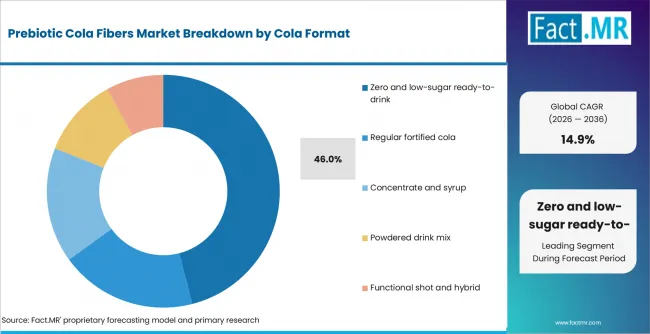
Prebiotic Cola Fibers Market Analysis By Cola Format | Source: Fact.MR
Zero and low-sugar ready-to-drink cola is expected to stay ahead because it reaches consumers without preparation. Ready-to-drink formats expose haze and aftertaste quickly across shelves. The fit with functional soda formulations improves when digestive positioning is clear on pack.
How does Formulation Challenge shape demand?
Low viscosity at effective dose is anticipated to hold 31.0% share in 2026.
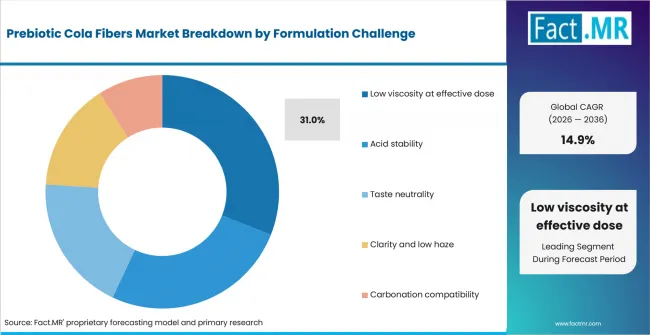
Prebiotic Cola Fibers Market Analysis By Formulation Challenge | Source: Fact.MR
Low viscosity at effective dose is central because cola must remain light and easy to drink. Fiber that makes the beverage heavy is expected to move it away from cola expectations. The same issue is visible in label-friendly bulking agents, where texture replacement must avoid a thick finish.
What supports Digestive and gut health within Consumer Positioning?
Digestive and gut health is estimated to hold 45.0% share in 2026.
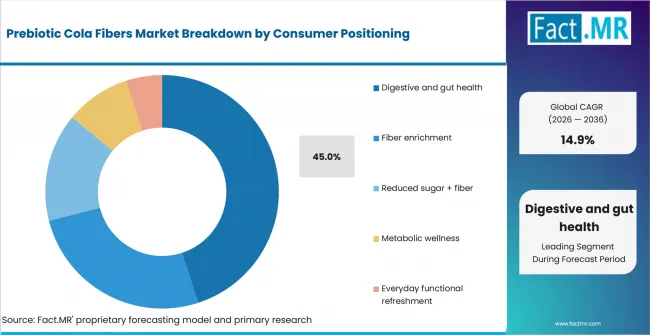
Prebiotic Cola Fibers Market Analysis By Consumer Positioning | Source: Fact.MR
Digestive and gut health is expected to lead consumer positioning because the prebiotic claim gives fortified cola a clear purpose. Consumers understand cola as refreshment first, so the health message needs simple wording. The positioning connects with functional foods that use digestive claims to guide purchase intent.
What is accelerating Prebiotic Cola Fibers Market adoption, and what is holding it back?
Demand is expected to rise through sugar-reduction reformulation and digestive positioning. Growth is constrained by formulation limits, claim control and validation cost.
Drivers Impact Analysis
| DRIVER | (~) % IMPACT ON CAGR | GEOGRAPHIC RELEVANCE | IMPACT TIMELINE |
|---|---|---|---|
| Low-sugar cola reformulation requiring fiber-backed mouthfeel | +2.1% | North America, Europe, Latin America | Short term (<= 2 years) |
| Prebiotic positioning in familiar carbonated refreshment | +1.5% | Global | Medium term (2-4 years) |
| Acid-stable soluble fibers for RTD and concentrate systems | +1.2% | Global | Medium term (2-4 years) |
Source: Fact.MR analysis. Updated Sep 5, 2026
- Low-sugar cola reformulation changes body and flavor release. Fiber is expected to replace part of that sensory loss when the selected grade remains soluble and neutral.
- Prebiotic positioning gives cola brands a differentiated route into functional refreshment while keeping a familiar cola experience.
- Acid-stable soluble fibers reduce scale-up risk because carbonated cola requires ingredients that tolerate low pH and processing.
Opportunity Impact Analysis
| OPPORTUNITY | (~) % IMPACT ON CAGR | GEOGRAPHIC RELEVANCE | IMPACT TIMELINE |
|---|---|---|---|
| Reduced sugar plus fiber line extensions | +1.3% | USA, UK, Mexico | Short term (<= 2 years) |
| Concentrate and syrup systems for dispensing | +0.8% | North America, Western Europe | Medium term (2-4 years) |
| Powdered and hybrid cola mixes for portion control | +0.6% | Latin America, Europe | Long term (>= 4 years) |
Source: Fact.MR analysis. Updated Sep 5, 2026
- Reduced sugar plus fiber line extensions let existing cola brands test digestive positioning before rebuilding a full product range.
- Concentrate and syrup systems create room for fiber platforms that dissolve cleanly before carbonation or dilution.
- Powdered and hybrid mixes support fiber delivery where ready-to-drink logistics or pricing limits frequent purchase.
Restraints Impact Analysis
| RESTRAINT | (~) % IMPACT ON CAGR | GEOGRAPHIC RELEVANCE | IMPACT TIMELINE |
|---|---|---|---|
| Haze, sediment and viscosity risk at meaningful fiber dose | -0.7% | Global | Short term (<= 2 years) |
| Variation in prebiotic and fiber claim rules by country | -0.5% | Europe, North America, Latin America | Medium term (2-4 years) |
| Higher ingredient and validation cost versus standard diet cola | -0.4% | Global | Long term (>= 4 years) |
Source: Fact.MR analysis. Updated Sep 5, 2026
- Haze and viscosity risk slow approval because cola is judged visually and texturally during product panels.
- Claim-rule variation requires local label review before brands use prebiotic, fiber and sugar claims together.
- Validation cost is expected to delay rollout when sensory, stability and claim review exceed early retail demand.
Which countries are scaling the Prebiotic Cola Fibers Market through 2036?
- The country comparison spans 2.68 percentage points and forms three practical growth bands across the forecast period.
- The USA remains 0.90 percentage point above Mexico through functional beverage retail scale and reformulation work.
- Mexico remains 0.30 percentage point above the UK as soda consumption pressure and IEPS rules push reformulation.
- The UK remains 0.74 percentage point above Brazil due to levy economics and retailer attention to lower-sugar drinks.
- Brazil remains 0.74 percentage point above Germany owing to beverage manufacturing scale and mainstream soft drink occasions.
- Germany closes the displayed range through high soft drink output and public attention to sugar reduction.
Comparable CAGRs create different entry conditions due to soda habits, tax design, approved claims and local manufacturing scale. Full report coverage includes North America, Latin America, Western Europe, Eastern Europe, East Asia, South Asia and Pacific, Middle East and Africa.
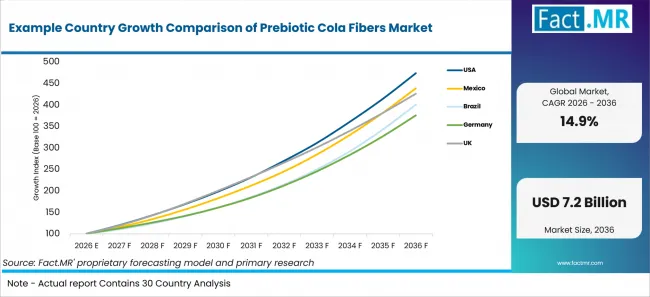
Example Country Growth Comparison Of Prebiotic Cola Fibers Market | Source: Fact.MR
| Country | CAGR (2026-2036) |
|---|---|
| United States | 16.8% |
| Mexico | 15.9% |
| United Kingdom | 15.6% |
| Brazil | 14.9% |
| Germany | 14.2% |
Source: Fact.MR analysis. Updated Sep 5, 2026
What supports USA adoption?
16.8% CAGR, supported by low-sugar cola reformulation and digestive beverage positioning.
USA adoption is expected to benefit from a broad retail food base and continued pressure to reduce added sugar in drinks. USDA ERS updated its Retail Trends page on August 17, 2026, reporting inflation-adjusted U.S. grocery-store food sales of USD 617 billion in 2025. CDC reported on April 29, 2026 that, based on 2021-2023 National Survey of Children’s Health data, 55.9% of U.S. children aged 1 to 5 had consumed at least one sugar-sweetened beverage in the past seven days.
How is Mexico scaling demand?
15.9% CAGR, shaped by soda consumption pressure and the 2026 IEPS framework.
Mexico demand is shaped by a high soda-consumption base and direct tax pressure on sweetened drinks. Mexico’s Secretaría de Salud reported on August 19, 2025 that average soft-drink consumption was 166 liters per person per year. The Diario Oficial de la Federación established IEPS rates effective January 1, 2026 of MXN 3.0818 per liter for flavored beverages containing added sugars and MXN 1.5000 per liter for flavored beverages containing added sweeteners.
What supports the United Kingdom’s growth?
15.6% CAGR, backed by sugar-levy pressure and food manufacturing scale.
The United Kingdom is expected to scale through levy-led reformulation and a sizable food manufacturing base. ONS reported in July 2026 that food manufacture represented 22.9% of total UK manufacturers' sales in 2025. HMRC reported in January 2026 that provisional Soft Drinks Industry Levy receipts reached GBP 327 million for financial year 2024 to 2025.
How is Brazil developing demand?
14.9% CAGR, attributable to beverage manufacturing scale and everyday soft drink occasions.
Brazil demand is expected to develop around manufacturing scale and frequent soft drink occasions. IBGE reported on June 24, 2026 that Brazilian industry's net sales revenue reached approximately R$5.3 trillion in 2024, generated from approximately 3,400 industrial products and services. IBGE reported on August 1, 2025 that beverage production declined 5.0% year over year in June 2025.
What is supporting Germany’s adoption?
14.2% CAGR, reinforced by soft drink output and sugar-reduction attention.
Germany adoption is expected to reflect high soft drink output and growing scrutiny of sugar consumption. Destatis reported on February 12, 2026 that Germany produced 7.7 billion liters of sugar-sweetened cola, lemonade and other soft drinks in 2024, equivalent to just under 93 liters per person. The Robert Koch Institute reported on March 26, 2025 that adult obesity prevalence in Germany increased from 12.2% in 2003 to 19.7% in 2023.
Who leads the Prebiotic Cola Fibers Market?
Tate & Lyle is active through PROMITOR® Soluble Fibre and broader beverage mouthfeel capabilities. Its July 2025 IFT FIRST program featured a Tropical Mystic Elixir beverage formulated with PROMITOR® Soluble Fibre, KELCOGEL® Gellan Gum and Stevia Reb M, combining fiber fortification, stabilization and sweetening in a beverage prototype.
Ingredion participates through NUTRAFLORA® soluble prebiotic fiber and its broader food and beverage ingredient platform. Its September 2025 Investor Day materials identified texture and healthful solutions as strategic growth areas and highlighted continued investment in texture science and related formulation capabilities.
BENEO supplies Orafti® Inulin and Oligofructose for fiber enrichment and digestive-health applications. In September 2025, BENEO announced Thai FDA approval for an exclusive prebiotic claim for Orafti® Inulin following scientific evaluation.
Roquette strengthens the competitive set through NUTRIOSE® soluble fibers. In February 2026, Roquette announced that NUTRIOSE® FM 06, NUTRIOSE® FB 06 and NUTRIOSE® FM 15S had achieved NutraStrong™ Prebiotic Verified certification from SGS NutraSource.
Nexira adds acacia-fiber capabilities for prebiotic beverage formulations. Its IFT FIRST 2025 program included a prebiotic soda enriched with acacia fiber and highlighted Fibregum™ and inavea™ prebiotic-fiber solutions for food and beverage applications.
Matsutani Chemical Industry remains relevant through Fibersol-2 resistant dextrin. In August 2026, Matsutani highlighted Fibersol-2, Fibersol-2H and ASTRAEA in ingredient proposals for the beverage market, including carbonated-water and tea applications.
Competition is increasingly shaped by science-backed ingredient positioning and formulation capabilities across fiber enrichment, sweetness management, digestive-health positioning and beverage texture. Suppliers with documented application expertise can support beverage developers in balancing solubility, stability, sweetness and sensory performance.
Which companies are the key providers?
Key companies include Tate & Lyle, Ingredion, BENEO, Roquette, Nexira and Matsutani Chemical Industry.
- Tate & Lyle
- Ingredion
- BENEO
- Roquette
- Nexira
- Matsutani Chemical Industry
Bibliography
- BENEO. (2025, September 18). BENEO secures first-ever Thai FDA approval for exclusive prebiotic claim.
- Centers for Disease Control and Prevention. (2026, April 29). Get the facts: Added sugars.
- Secretaría de Hacienda y Crédito Público. (2025, December 22). Acuerdo por el que se actualizan las cuotas que se especifican en materia del impuesto especial sobre producción y servicios para 2026. Diario Oficial de la Federación.
- Statistisches Bundesamt (Destatis). (2026, February 12). 93 Liter zuckerhaltige Erfrischungsgetränke 2024 pro Kopf produziert.
- HM Revenue & Customs. (2026, January 30). Soft Drinks Industry Levy statistics commentary 2026. GOV.UK.
- Inácio, B. (2026, June 24). In 2024, crude petroleum oils were the leading industrial product for the third consecutive year. IBGE News Agency.
- Ingredion Incorporated. (2025, September 17). Ingredion Investor Day.
- Renaux, P. (2025, August 1). After two drops in a row, industry changes 0.1% in June. IBGE News Agency.
- Nexira. (2025, June 23). Nexira showcases natural innovations for functional beverages at IFT FIRST 2025.
- Office for National Statistics. (2026, July 24). UK manufacturers' sales by product: 2025.
- Starker, A., Schienkiewitz, A., Damerow, S., & Kuhnert, R. (2025). Prevalence of obesity and smoking among adults in Germany – trends from 2003 to 2023. Journal of Health Monitoring, 10(1), e13038.
- Roquette. (2026, February 3). NUTRIOSE® soluble fibers: NutraStrong™ Prebiotic Verified.
- Secretaría de Salud. (2025, August 19). 154. Secretaría de Salud alerta sobre efectos a la salud de la población mexicana por consumo excesivo de refrescos.
- Tate & Lyle. (2025, July 7). Tate & Lyle debuts expanded portfolio and mouthfeel leadership at IFT FIRST 2025.
- Zeballos, E., & Sinclair, W. (2026, June 11). Total U.S. food spending reached $2.51 trillion in 2025. Economic Research Service, U.S. Department of Agriculture.
- Economic Research Service, U.S. Department of Agriculture. (2026, June 1). Food prices and spending.
- Economic Research Service, U.S. Department of Agriculture. (2026, August 17). Retailing & wholesaling - Retail trends.
- U.S. Food and Drug Administration. (2026, September 2). GRN No. 1242: Short-chain fructooligosaccharides.
This Report Answers
- The report explains where prebiotic cola fibers are used across fiber platform and cola format. It also covers formulation challenge and consumer positioning.
- Segment analysis identifies the leading subsegments and the formulation reasons behind supplier selection.
- Country analysis examines the consumption, tax and manufacturing signals that support fortified cola launches.
- Competitive analysis reviews ingredient suppliers across soluble corn fiber, resistant dextrin, inulin, FOS and acacia fiber platforms.
- Application analysis assesses how viscosity, acid stability, taste neutrality and clarity affect purchase decisions.
What does the Prebiotic Cola Fibers Market cover?
The Prebiotic Cola Fibers Market covers soluble dietary fibers used to add fiber, prebiotic positioning and texture support to cola. It includes ingredients used in zero and low-sugar ready-to-drink cola, regular fortified cola, concentrates, syrups, powdered mixes and hybrid functional shots.
The assessment covers prebiotic fiber demand across cola formats and formulation challenges. It also considers how ingredient platforms fit fiber-forward formulations when brands need nutrition claims and familiar sensory performance.
What is included in the scope?
The scope includes commercial soluble fiber ingredients sold to beverage brands, flavor houses and contract manufacturers for cola applications. It includes corn-based soluble fiber, resistant dextrin, inulin and FOS, acacia fiber and other soluble fibers when the intended use is cola or cola-adjacent functional refreshment.
It includes RTD beverages, concentrates, syrups and mixes where fiber is part of the product design. Adjacent dietary fiber applications, non-alcoholic beverage formats and soft drink concentrates are considered when they inform cola fiber formulation choices.
What is excluded from the scope?
Outside the scope are standard cola formats lacking fiber addition, probiotic-only sodas, energy drinks separate from cola positioning and general soft drinks lacking a prebiotic or soluble fiber role. Raw sweeteners, flavors and carbon dioxide are outside the scope when sold as standalone inputs.
General beverage concentrates are covered only when the concentrate is designed for fiber-enriched cola. Dietary supplements are covered only when consumed in cola or cola-style beverages.
How Was the Analysis Built?
The analysis draws on 120+ sources, 35+ company portfolios, 25+ countries, and more than 20 industry interviews.
- Primary Research: Primary research includes discussions with manufacturers, service providers, technology developers, distributors, end users, and subject-matter experts. These conversations examine purchasing priorities, product adoption, operational challenges, approval requirements, competitive positioning, and the factors that influence wider market acceptance.
- Desk Research: Desk research covers government statistics, regulatory publications, company filings, trade data, technical studies, industry associations, standards, public policy, and other authoritative sources. Every source used in the analysis is documented in the bibliography.
- Market Sizing and Forecasting: Market estimates combine historical performance, demand indicators, pricing and volume trends, segment shares, company participation, country-level growth, adoption patterns, investment activity, and barriers to market expansion.
- Data Validation and Update Cycle: Findings are validated by comparing primary interviews with public data, company activity, regulatory changes, trade patterns, and industry developments. Regular updates review new product launches, capacity changes, partnerships, approvals, and shifts in commercial adoption.
Segmentation
What is the report’s scope and coverage?
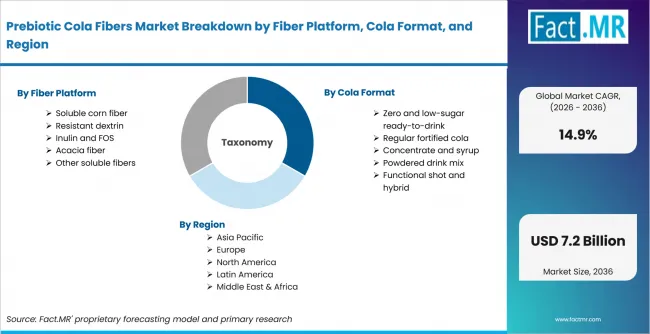
Prebiotic Cola Fibers Market Breakdown By Fiber Platform, Cola Format, And Region | Source: Fact.MR
| Attribute | Details |
|---|---|
| Quantitative Units | USD Billion |
| Market Definition | Soluble dietary fibers used in cola formats to support fiber enrichment, digestive positioning, texture and drinkability. |
| Fiber Platform | Soluble corn fiber; Resistant dextrin; Inulin and FOS; Acacia fiber; Other soluble fibers |
| Cola Format | Zero and low-sugar ready-to-drink; Regular fortified cola; Concentrate and syrup; Powdered drink mix; Functional shot and hybrid |
| Formulation Challenge | Low viscosity at effective dose; Acid stability; Taste neutrality; Clarity and low haze; Carbonation compatibility |
| Consumer Positioning | Digestive and gut health; Fiber enrichment; Reduced sugar + fiber; Metabolic wellness; Everyday functional refreshment |
| Regions Covered | North America; Latin America; Western Europe; Eastern Europe; East Asia; South Asia and Pacific; Middle East and Africa |
| Countries Covered | United States; Mexico; United Kingdom; Brazil; Germany |
| Key Companies Profiled | Tate & Lyle; Ingredion; BENEO; Roquette; Nexira; Matsutani Chemical Industry |
| Forecast Period | 2026 to 2036 |
| Approach | Hybrid top-down and bottom-up approach using cola reformulation activity, soluble fiber portfolios, beverage-format adoption, claim requirements and country-level soft drink indicators. |
Source: Fact.MR analysis. Updated Sep 5, 2026
How is the market segmented?
-
By Fiber Platform
- Soluble corn fiber
- Resistant dextrin
- Inulin and FOS
- Acacia fiber
- Other soluble fibers
-
By Cola Format
- Zero and low-sugar ready-to-drink
- Regular fortified cola
- Concentrate and syrup
- Powdered drink mix
- Functional shot and hybrid
-
By Formulation Challenge
- Low viscosity at effective dose
- Acid stability
- Taste neutrality
- Clarity and low haze
- Carbonation compatibility
-
By Consumer Positioning
- Digestive and gut health
- Fiber enrichment
- Reduced sugar + fiber
- Metabolic wellness
- Everyday functional refreshment
-
By Region
- North America
- Latin America
- Western Europe
- Eastern Europe
- East Asia
- South Asia and Pacific
- Middle East and Africa
Frequently Asked Questions
How big is the Prebiotic Cola Fibers Market in 2026?
What is the CAGR of the Prebiotic Cola Fibers Market from 2026 to 2036?
Which cola format leads the Prebiotic Cola Fibers Market?
Which consumer positioning leads the market?
Who are the leading companies in the Prebiotic Cola Fibers Market?
Who worked on this report


Preview the report firsthand - request a free sample
Free SampleGet the brochure for pricing and purchase details
Download PDF