- Market Value (2025): USD 3037.8 Mn
- Estimated Value (2026): USD 3979.5 Mn
- Forecast Value (2036): USD 59230.0 Mn
- CAGR (2026-2036): 31.0%
What is the Generative AI in Financial Services Market forecast to be worth by 2036?
USD 3,979.5 million in 2026 to USD 59230.0 million by 2036, at 31.0% CAGR.
- The Generative AI in Financial Services Market crossed a valuation of USD 3037.8 million in 2025 after banks widened controlled experimentation.
- Demand is projected to increase from USD 3,979.5 million in 2026 to USD 59230.0 million by 2036 across regulated financial workflows.
- The market is forecast to record a 31.0% CAGR from 2026 to 2036 because banks and insurers are moving governed assistants into daily operations.
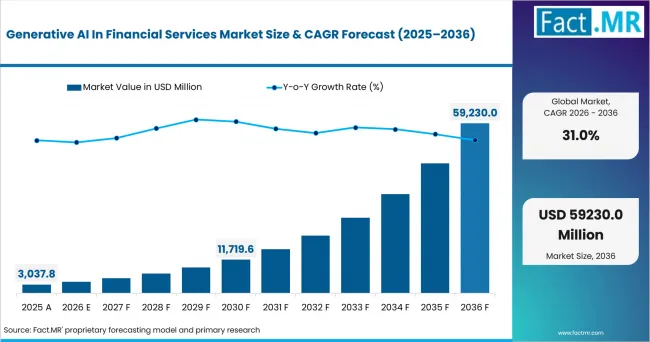
Generative Ai In Financial Services Market Market Value Analysis | Source: Fact.MR
What are the defining numbers behind Generative AI in Financial Services Market growth?
USD 55.25 billion absolute opportunity by 2036 led by Software and Cloud alongside BFSI demand.
- Demand Drivers in the Market
- Bank operations teams need evidence-grounded generation because payment exceptions and service requests often span several internal systems before resolution.
- Compliance teams need source-linked outputs supported by approval logs that let reviewers trace generated narratives back to policy and case evidence.
- Insurance claims teams need document synthesis owing to long case files that combine correspondence and forms before a human reviewer makes decisions.
- Asset management research teams need controlled summarization shaped by permission rules so analysts keep restricted content inside approved research environments.
- Key Segments Analyzed
- By Component: Software is expected to account for 50.5% share in 2026, driven by embedded copilots and workflow-specific orchestration layers.
- By Deployment: Cloud is projected to garner 43.8% share in 2026, supported by managed model access and elastic inference capacity.
- By Organization Size: SME is anticipated to record 48.3% share in 2026, attributable to packaged services that reduce internal model-engineering requirements.
- By Application: Workflow Automation is estimated to hold 47.1% share in 2026, owing to repeated document and service tasks suited to supervised generation.
- By End Use: BFSI is forecast to capture 38.1% share in 2026, reinforced by direct workflow use across service operations and compliance review.
- Analyst Opinion at Fact.MR
- Shambhu Nath Jha, Senior Analyst at Fact.MR states, “Financial institutions are paying less attention to raw model access and more attention to evidence trails with clear approval ownership. Adoption is expected to favor products that fit existing case systems without weakening review controls. Providers should combine retrieval controls with model evaluation and detailed knowledge of financial workflows before seeking production approval.”
- Strategic Implications
- Bank technology teams should rank use cases by evidence availability before selecting models for customer service or internal operations workflows.
- Compliance leaders should require citation trails and reviewer checkpoints before generated case narratives move into formal regulatory reporting processes.
- Insurers should test document extraction and generation together because a fluent answer remains weak when source fields are incomplete or misread.
- Platform providers should publish model-routing and data-residency controls so procurement teams map each control directly into third-party risk assessments.
FIS launched Treasury GPT in March 2025 as a product-support tool using Microsoft Azure OpenAI Service for questions about usability and client configuration. The tool also covers policies and best practices inside documented product support. The development connects generation with treasury-product knowledge and reflects demand for controlled assistants in financial workflows.
India is projected to record 32.8% CAGR during the forecast period, driven by shared credit-data rails that support AI and automation in banking. China is estimated to post 32.1% CAGR by 2036, supported by scaled credit analytics and high-volume mobile banking channels. Australia is anticipated to advance at 30.8% CAGR over the assessment period, attributable to licensee experimentation under active governance review. The United Kingdom is forecast to expand at 30.5% CAGR between 2026 and 2036, owing to broad bank and insurer adoption. The United States is expected to record 30.3% CAGR across the forecast horizon, reinforced by deep financial technology talent and enterprise platform availability.
How does the Generative AI in Financial Services Market break down by segment?
Software is projected to account for 50.5% share in 2026; Cloud is estimated to garner 43.8% share in 2026.
Which Component category dominates?
Software is expected to hold 50.5% share in 2026
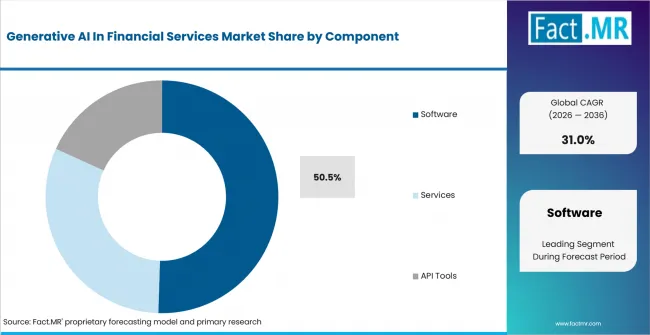
Generative Ai In Financial Services Market Analysis By Component | Source: Fact.MR
Software is forecast to represent 50.5% share in 2026 because institutions purchase orchestration and monitoring around models alongside base access. Services follow when institutions need integration support and evaluation design across regulated workflows that touch several existing systems. API Tools remain relevant for development teams building custom retrieval and action layers around protected financial information. In November 2024, the Bank of England and FCA reported that foundation models represented 17% of surveyed financial-service AI use cases. Commercial value therefore shifts toward software layers that manage prompts and retrieval behavior under institution-specific controls.
What leads the Deployment segment?
Cloud is projected to garner 43.8% share in 2026
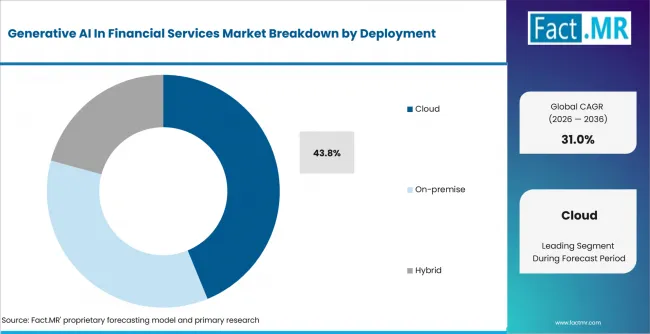
Generative Ai In Financial Services Market Analysis By Deployment | Source: Fact.MR
Cloud is anticipated to capture 43.8% share in 2026 because managed services shorten model deployment and evaluation cycles. On-premise environments remain relevant for workloads tied to strict data locality and established core-system controls. Hybrid designs connect selected model services to protected data planes while keeping sensitive records under local governance. In November 2024, the Bank of England and FCA reported that one third of surveyed AI use cases used third-party implementations. Procurement teams therefore examine provider dependency and exit planning more closely before expanding sensitive production workloads across core financial systems.
How does Organization Size shape demand?
SME is expected to account for 48.3% share in 2026
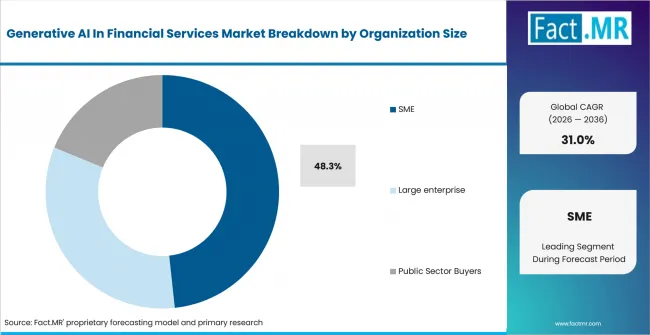
Generative Ai In Financial Services Market Analysis By Organization Size | Source: Fact.MR
SME is estimated to represent 48.3% share in 2026 because packaged cloud assistants reduce the need for large internal model teams. Large Enterprise demand follows where cross-business governance and core-system integration require wider technical programs. Public Sector Buyers use controlled generation in public finance and citizen-service workflows that require documented access and review rules. In May 2026, the Press Information Bureau reported that more than 2.6 billion accounts were enabled for consent-based data sharing by December 2025. Standardized access infrastructure gives smaller organizations a firmer base for connected lending and account-service workflows.
What supports Workflow Automation within Application?
Workflow Automation is estimated to hold 47.1% share in 2026
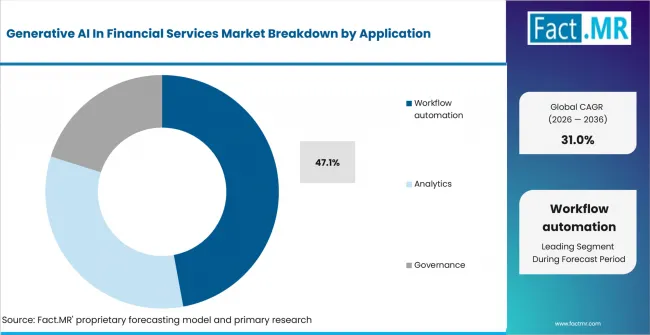
Generative Ai In Financial Services Market Analysis By Application | Source: Fact.MR
Workflow Automation is projected to account for 47.1% share in 2026 because institutions insert generation into repeatable case and document steps. Analytics follows where financial analytics teams combine narrative explanation with quantitative outputs used by risk and finance reviewers. Governance tools support evaluation tests and approval records before generated results enter production inside regulated workflows. Cloud-delivered business process as a service models provide a nearby commercial pattern for packaging repeatable finance operations into managed workflows. In November 2024, the Bank of England and FCA reported that operations and IT represented around 22% of surveyed AI use cases. The use-case concentration supports applications that fit existing operational systems while maintaining measurable review stages across production workflows.
What supports BFSI within End Use?
BFSI is forecast to capture 38.1% share in 2026
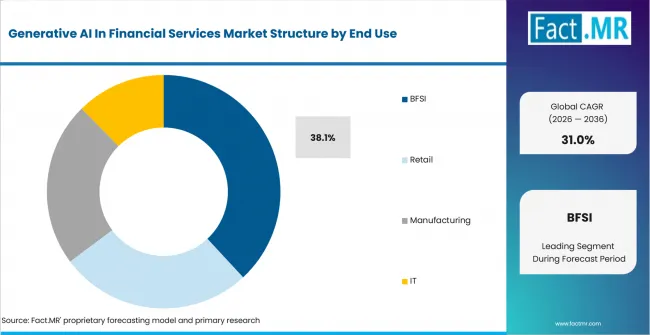
Generative Ai In Financial Services Market Analysis By End Use | Source: Fact.MR
BFSI is expected to represent 38.1% share in 2026 because banks and insurers have direct use cases across service and compliance work. Retail follows through payment support and credit-service workflows that combine customer context with controlled response generation. Manufacturing organizations apply GenAI to treasury operations and trade-finance documents while IT firms integrate models into fintech platforms and managed services. In June 2026, the European Central Bank reported that more than 85% of supervised banks used AI. That institutional base gives GenAI providers a broad route into controlled production workflows.
What is accelerating Generative AI in Financial Services Market adoption, and what is holding it back?
Controlled workflow automation drives adoption across financial institutions, while governance gaps and model-risk validation requirements continue to restrain production deployment.
Drivers Impact Analysis
| Driver | (~) % Impact on CAGR | Geographic Relevance | Impact Timeline |
|---|---|---|---|
| Controlled workflow automation | +4.8% | Global banks and insurers | Medium term (2-4 years) |
| Compliance and reporting copilots | +3.9% | Europe, UK and North America | Short term (<= 2 years) |
| Financial crime investigation | +3.3% | North America, Asia Pacific and Europe | Medium term (2-4 years) |
| Customer and advisor assistance | +2.8% | Global retail banking and wealth | Medium term (2-4 years) |
| Managed model and API access | +2.1% | Global financial institutions | Short term (<= 2 years) |
Source: Fact.MR analysis. Updated Jul 10, 2026
- Controlled workflow automation: Financial institutions are moving from single-prompt tasks into linked case steps that include retrieval and human approval. In November 2024, the Bank of England and FCA reported that respondents expected median AI use cases to reach 21 within three years. Adoption is projected to concentrate first on repeatable work where evidence and escalation routes are already defined.
- Compliance and reporting copilots: Regulatory teams spend substantial time locating policy text and drafting case narratives before formal review. In November 2024, the Bank of England and FCA reported that 32% of respondents expected additional AI use for regulatory compliance and reporting. Demand is anticipated to favor assistants that preserve source references and reviewer accountability across drafting and formal submission stages.
- Financial crime investigation: Generated case summaries reduce reading time when transaction alerts require investigators to assemble records from several systems. In November 2024, the Bank of England and FCA reported that 31% of respondents expected additional AI use in fraud detection. Providers are estimated to gain approval where generated narratives remain subordinate to investigator decisions and case evidence.
- Customer and advisor assistance: Service teams are testing assistants that summarize account context and prepare responses before staff approval. In November 2024, the Bank of England and FCA reported that 36% of respondents expected additional AI use for customer support. Expansion is forecast to favor narrow service domains where policy retrieval and escalation paths are measurable.
- Managed model and API access: Financial institutions use model gateways to compare performance without rebuilding the surrounding application stack. In June 2024, the Bank for International Settlements reported that around 70% of financial services firms globally used AI across financial tasks. GenAI demand is expected to build on that installed workflow and data foundation as institutions add governed language interfaces.
Opportunity Impact Analysis
| Opportunity | (~) % Impact on CAGR | Geographic Relevance | Impact Timeline |
|---|---|---|---|
| Agentic operations with approval checkpoints | +2.4% | North America, Europe and Asia Pacific | Medium term (2-4 years) |
| Evidence-grounded retrieval and document intelligence | +1.9% | Global regulated finance | Short term (<= 2 years) |
| Multilingual financial interfaces | +1.5% | India and multilingual markets | Medium term (2-4 years) |
| Governance observability and evaluation | +1.2% | Europe, UK and Australia | Long term (>= 4 years) |
Source: Fact.MR analysis. Updated Jul 10, 2026
- Agentic operations with approval checkpoints: Multi-step agents create room for systems that gather evidence and propose actions inside bounded workflows. Financial institutions are projected to favor designs that separate model reasoning from transaction authority and keep human approval for material actions. Commercial value concentrates where the agent reduces handoffs without obscuring who approved the final outcome.
- Evidence-grounded retrieval and document intelligence: Financial services work contains policy manuals and contracts that provide a natural base for retrieval-grounded generation. Providers are anticipated to gain deeper account access when they test citation accuracy and permission filtering before production rollout. The opportunity extends beyond chat interfaces into underwriting packs and research preparation where source evidence shapes reviewer trust.
- Multilingual financial interfaces: Language-specific banking models create room for service assistants that understand local terminology and regulatory wording. In May 2026, the Press Information Bureau reported that the BHASHINI banking initiative covered all 22 scheduled Indian languages. Adoption is estimated to expand where providers pair language models with local product rules and carefully designed escalation paths.
- Governance observability and evaluation: Financial institutions need continuous checks for retrieval failures and policy drift after an assistant enters production. Procurement is forecast to reward platforms that expose evaluation results and model changes in forms risk teams understand. A recurring evaluation layer gains commercial value when institutions operate several models across separate business lines.
Restraints Impact Analysis
| Restraint | (~) % Impact on CAGR | Geographic Relevance | Impact Timeline |
|---|---|---|---|
| Output hallucination and evidence gaps | -2.6% | Global regulated finance | Short term (<= 2 years) |
| Third-party concentration and data residency | -2.1% | Europe, UK and Asia Pacific | Medium term (2-4 years) |
| Model risk inventory and validation burden | -1.7% | Global banks and insurers | Medium term (2-4 years) |
| Legacy data and core-system integration | -1.3% | Large banks and insurers | Long term (>= 4 years) |
Source: Fact.MR analysis. Updated Jul 10, 2026
- Output hallucination and evidence gaps: Fluent language is insufficient when generated content influences a regulated customer or formal filing. Institutions are expected to restrict use cases where source evidence is weak or evaluation sets fail to represent real case variation. Providers face slower approvals when they fail to show reliable refusal behavior and traceable retrieval results.
- Third-party concentration and data residency: Managed models simplify access but increase dependency on providers that sit outside the institution. Financial firms are projected to request clearer portability and regional processing choices before expanding sensitive workloads. Procurement cycles lengthen when exit planning and subcontractor visibility require separate review across technology and operational risk teams.
- Model risk inventory and validation burden: GenAI applications introduce prompts and retrieval layers that change system behavior beyond the base model. In November 2024, the Bank of England and FCA reported that 16% of surveyed AI use cases were rated high materiality. Adoption is anticipated to slow where institutions lack clear ownership for mapping configuration changes into validation and testing cycles.
- Legacy data and core-system integration: Many financial processes still depend on records spread across old systems and document stores. Institutions are estimated to delay broader GenAI use when data access remains inconsistent or permission rules differ between repositories. Integration providers gain a clearer role where they normalize access without moving protected records into unnecessary data copies.
Which countries are scaling Generative AI in Financial Services fastest?
India 32.8%; China 32.1%; Australia 30.8%; United Kingdom 30.5%; United States 30.3%.
.webp "Top Country Growth Comparison Generative Ai In Financial Services Market Cagr (2026 2036)")
Top Country Growth Comparison Generative Ai In Financial Services Market Cagr (2026 2036) | Source: Fact.MR
Generative AI in Financial Services Market is segmented into North America, Europe, Asia Pacific, Latin America, and the Middle East & Africa.
| Country | CAGR |
|---|---|
| India | 32.8% |
| China | 32.1% |
| Australia | 30.8% |
| United Kingdom | 30.5% |
| United States | 30.3% |
Source: Fact.MR analysis. Updated Jul 10, 2026
What is powering India's expansion?
32.8% CAGR , driven by shared credit-data rails and multilingual banking infrastructure.
India’s credit infrastructure gives financial-service GenAI vendors a broad set of consented data connections and standardized lending journeys. Demand is projected to record 32.8% CAGR across the forecast horizon because banks and fintech firms connect assistants to controlled data access. In May 2026, the Press Information Bureau reported that ULI had onboarded 64 lenders by December 2025 and the expanded network reduced interface work for connected credit workflows.
How is China scaling financial GenAI demand?
32.1% CAGR, supported by scaled credit analytics and high-volume mobile banking operations.
China offers high-volume lending environments where document review and risk narratives create repeatable language-system tasks. A July 2025 FDIC-hosted study found a 29.6% reduction in loan default rates after integrated AI and big-data adoption. The market is estimated to post 32.1% CAGR by 2036 because institutions are extending controlled generation around established analytics and credit workflows.
What supports the Australia outlook?
30.8% CAGR, attributable to licensee experimentation and active governance review.
Australia’s financial institutions are testing AI across banking and insurance while the regulator examines whether governance keeps pace with deployment. Demand is anticipated to advance at 30.8% CAGR over the assessment period because licensees are formalizing review controls around production use. In October 2024, ASIC reported that its review analyzed 624 AI use cases and the findings gave providers clear governance questions for controlled workflow deployment.
What underpins United Kingdom growth?
30.5% CAGR, owing to broad bank and insurer adoption across regulated workflows.
The United Kingdom has a broad financial-services testing base that spans operations and customer service under close supervisory attention. In November 2024, the Bank of England and FCA reported that 75% of surveyed firms already used AI. Demand is forecast to record 30.5% CAGR between 2026 and 2036 because institutions are moving experiments into monitored workflows with clear approval ownership.
How is the United States building market depth?
30.3% CAGR, reinforced by financial technology talent and enterprise platform availability.
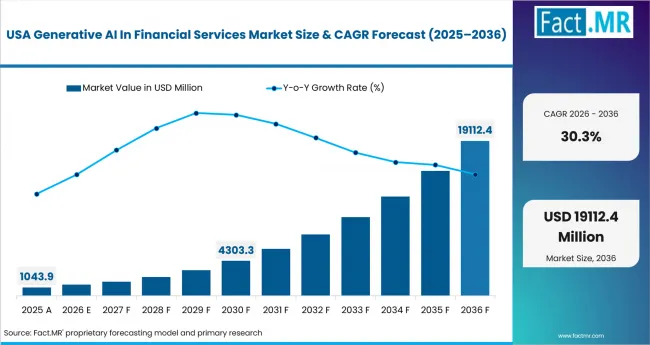
Generative Ai In Financial Services Market Country Value Analysis | Source: Fact.MR
United States demand is supported by deep technology teams inside banks and a broad provider ecosystem spanning models and workflow software. The market is expected to expand at 30.3% CAGR across the forecast because institutions are recruiting skills for governed deployment and evaluation. In November 2025, the Federal Reserve reported that one in ten financial-sector job postings mentioned AI and the evidence signals a growing workforce base for production systems.
Who leads the Generative AI in Financial Services Market?
Companies such as JPMorgan Chase Goldman Sachs and Microsoft strengthen institution-led and platform-led GenAI deployment.
JPMorgan Chase operates LLM Suite as an internal generative AI platform for employees across business workflows and research tasks. Goldman Sachs uses GS AI Assistant to provide controlled access to multiple models inside the firm. Microsoft supports financial institutions through Azure OpenAI and related enterprise identity controls. Competition among these firms reflects a split between institutions building proprietary operating capability and platforms supplying governed model access.
IBM combines watsonx capabilities with governance tooling for regulated financial workflows. FIS applies generative AI across treasury support and banking operations while Finastra uses Assist.AI in lending and trade-finance workflows. Temenos integrates GenAI with core-banking products and reporting tools that let bank staff query data in natural language. Competition during the forecast period is expected to depend on workflow depth and evidence controls. Providers that reduce integration effort without weakening review ownership are expected to gain easier access to production accounts.
Which companies are the key providers?
Some of the key players profiled include JPMorgan Chase, Goldman Sachs, Microsoft (Azure OpenAI), IBM, FIS, Finastra, Temenos.
- JPMorgan Chase
- Goldman Sachs
- Microsoft (Azure OpenAI)
- IBM
- FIS
- Finastra
- Temenos
Bibliography
- Australian Securities and Investments Commission. (2024, October 29). REP 798 Beware the gap: Governance arrangements in the face of AI innovation. Australian Securities and Investments Commission.
- Bank for International Settlements. (2024, June 25). III. Artificial intelligence and the economy: implications for central banks. Bank for International Settlements.
- Bank of England & Financial Conduct Authority. (2024, November 21). Artificial intelligence in UK financial services - 2024. Bank of England.
- Chen, B., Guo, D., Xia, J., & Zhang, Z. (2025, July 28). The transformative role of artificial intelligence and big data in banking. Federal Deposit Insurance Corporation Center for Financial Research.
- European Central Bank. (2026, June 3). Strengthening operational resilience for the age of AI. European Central Bank.
- Federal Reserve Board. (2025, November 11). AI and central banking. Board of Governors of the Federal Reserve System.
- Finastra. (2025, November 11). How AI is rewriting the rules of corporate banking in Southeast Asia. Finastra.
- FIS. (2025, February 4). How AI is transforming the future of banking. FIS.
- FIS. (2025, March 10). FIS launches Treasury GPT, a pioneering AI-based product support tool. FIS.
- Goldman Sachs. (2025, February 4). AI Exchanges: Will falling costs drive new opportunities? Goldman Sachs.
- IBM. (2025, May 6). IBM accelerates enterprise Gen AI revolution with hybrid capabilities. IBM Newsroom.
- JPMorganChase. (2025, June 3). LLM Suite named 2025 “Innovation of the Year” by American Banker. JPMorganChase.
- Microsoft. (2026, January 28). First West Credit Union accelerates service with Microsoft Copilot and AI agents. Microsoft.
- Press Information Bureau, Government of India. (2026, May 13). AI-powered financial inclusion in India. Government of India.
- Temenos. (2025, May 20). Temenos launches Gen AI Copilot for banks to deliver better products faster. Temenos.
This Report Addresses
- The report provides strategic intelligence on the Generative AI in Financial Services market across technology, deployment, application, and end-user segments shaping digital transformation strategies in the financial sector.
- Segment analysis covers Software and Services as the principal market components supporting AI-enabled automation, content generation, customer engagement, and operational efficiency.
- Regional outlook evaluates North America and Europe alongside Asia-Pacific. The assessment also covers Latin America and the Middle East & Africa, with country-level analysis including the United States, Canada, Germany, the United Kingdom, China, Japan, and India.
- Competitive analysis profiles Microsoft and Google alongside OpenAI. The competitive landscape also covers IBM, Amazon Web Services, NVIDIA, Oracle, Salesforce, Baidu, and other leading AI technology providers serving financial institutions.
- Component assessment covers Software Platforms and Services alongside AI Models, Infrastructure, and Integration Solutions supporting generative AI deployment.
- Deployment assessment covers Cloud-Based and On-Premises solutions, evaluating scalability, security, compliance, and performance considerations across financial institutions.
- Application assessment covers Customer Service & Virtual Assistants and Fraud Detection & Risk Management alongside Personalized Financial Advisory, Regulatory Compliance, Credit Assessment, Claims Processing, and Document Automation.
- Technology assessment covers Large Language Models (LLMs) and Natural Language Processing (NLP) alongside Machine Learning, Deep Learning, and Multimodal AI technologies.
- End User assessment covers Banking and Insurance alongside Wealth Management, Capital Markets, FinTech Companies, and Other Financial Service Providers.
- Market dynamics analysis evaluates growth drivers, regulatory developments, adoption trends, investment activity, cybersecurity considerations, and technological advancements influencing market expansion.
- The report examines emerging opportunities in AI-powered financial advisory services, intelligent document processing, automated compliance monitoring, fraud prevention, hyper-personalized banking experiences, and next-generation financial operations.
What does the Generative AI in Financial Services Market cover?
Software, Services, API Tools, and governed deployment systems used to generate and review financial workflow content inside regulated institutions.
The market covers generative-model software and integration services used to create summaries and narratives inside banking and financial workflows. Coverage also includes API Tools that connect models with controlled data retrieval and approved business actions.
The market boundary is narrower than the full artificial-intelligence category because predictive scoring alone does not create generated content. Traditional fraud models and credit scores remain outside scope unless a generative layer produces workflow content or investigator assistance inside the same commercial system.
What is included in the scope?
Generative AI systems used across BFSI and finance-facing workflows in Retail, Manufacturing and IT organizations.
Coverage includes Software and Services alongside API Tools used to build production GenAI applications for financial institutions. Deployment analysis covers Cloud and On-premise environments while Hybrid designs keep selected data under local control. Organization Size compares SME demand with Large Enterprise procurement and Public Sector Buyers. Application coverage includes Workflow Automation and Analytics while Governance evaluates generated outputs before production use. End Use analysis covers BFSI and Retail demand. Manufacturing and IT complete the framework through treasury, trade-finance and financial-software workflows.
What is excluded from the scope?
Standalone predictive AI systems and general-purpose consumer chat services remain outside the report scope unless integrated into governed financial workflows.
Traditional machine-learning systems used only for scoring or classification remain outside scope when they do not generate financial workflow content. General consumer chat services are also excluded unless they are commercially integrated into a financial institution workflow with controlled data access and institutional governance.
How was the analysis built?
120+ sources, 40+ company portfolios, 25+ countries, 20+ interviews.
- Primary Research
- Primary research includes interviews with financial institutions, banking technology leaders, insurance executives, wealth management professionals and fintech solution providers. It also includes input from AI platform vendors, data science teams, compliance specialists and digital transformation managers involved in deploying generative AI across financial services operations.
- Desk Research
- Desk research reviews financial industry statistics, banking technology reports, AI adoption studies, regulatory guidance, company product portfolios and provider announcements. Industry publications, enterprise case studies, technology documentation and fintech ecosystem developments are also assessed to evaluate market trends and competitive positioning.
- Market-Sizing and Forecasting
- Forecasting uses financial technology spending, generative AI adoption trends, digital banking investments, automation initiatives and enterprise AI deployment activity across major regions. Models consider demand for customer service automation, fraud detection support, risk analysis, document processing, personalized financial services and operational efficiency improvements.
- Data Validation and Update Cycle
- Forecasts are validated through industry interviews that test assumptions on AI adoption, investment priorities and financial institution deployment trends. End-user assessment and stakeholder feedback help confirm market direction, while ongoing reviews of regulatory developments, product launches and technology investments support forecast updates.
Segmentation
What is the report’s scope and coverage?
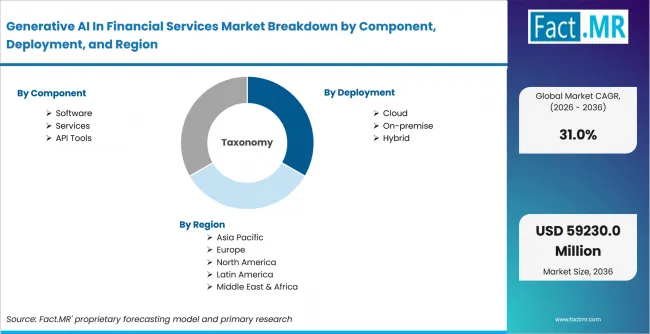
Generative Ai In Financial Services Market Breakdown By Component, Deployment, And Region | Source: Fact.MR
| Attribute | Details |
|---|---|
| Quantitative Units | USD Billion |
| Market Definition | Software, services and API tooling that use generative models to create or transform content across financial-service workflows and finance-facing use cases under defined operational controls. |
| Component | Software; Services; API Tools |
| Deployment | Cloud; On-premise; Hybrid |
| Organization Size | SME; Large Enterprise; Public Sector Buyers |
| Application | Workflow Automation; Analytics; Governance |
| End Use | BFSI; Retail; Manufacturing; IT |
| Regions Covered | North America; Europe; Asia Pacific; Latin America; Middle East & Africa |
| Countries Covered | United States; Canada; Germany; United Kingdom; France; Italy; Spain; India; China; Japan; South Korea; Australia; Brazil; Argentina; Mexico; Chile; UAE; Saudi Arabia; South Africa |
| Key Companies Profiled | JPMorgan Chase; Goldman Sachs; Microsoft (Azure OpenAI); IBM; FIS; Finastra; Temenos |
| Forecast Period | 2026 to 2036 |
| Approach | Hybrid top-down and bottom-up approach using financial-institution adoption evidence; use-case counts; workflow penetration; deployment mix; service attachment; organization-size mix; end-use structure; |
Source: Fact.MR analysis. Updated Jul 10, 2026
How is the market segmented?
-
By Component
- Software
- Services
- API Tools
-
By Deployment
- Cloud
- On-premise
- Hybrid
-
By Organization Size
- SME
- Large Enterprise
- Public Sector Buyers
-
By Application
- Workflow Automation
- Analytics
- Governance
-
By End Use
- BFSI
- Retail
- Manufacturing
- IT
-
By Region
- North America
- United States
- Canada
- Europe
- Germany
- United Kingdom
- France
- Italy
- Spain
- Asia Pacific
- India
- China
- Japan
- South Korea
- Australia
- Latin America
- Brazil
- Argentina
- Mexico
- Chile
- Middle East & Africa
- UAE
- Saudi Arabia
- South Africa
- North America
Frequently Asked Questions
How is Software positioned within the Generative AI in Financial Services Market?
What role does Cloud play in the Generative AI in Financial Services Market?
How prominent are SMEs in the Generative AI in Financial Services Market?
What contribution does Workflow Automation make to application demand?
How are BFSI organizations represented in the Generative AI in Financial Services Market?
Which country demonstrates strong growth potential in the Generative AI in Financial Services Market?
How is the Generative AI in Financial Services Market expected to evolve in China?
What outlook is anticipated for Australia in the Generative AI in Financial Services Market?
How is demand projected to develop in the United Kingdom?
What trend characterizes the United States Generative AI in Financial Services Market?
What factor primarily supports market adoption?
Which challenge continues to influence production deployment?
Why does Software remain important in the Generative AI in Financial Services Market?
What supports demand from bank operations teams?
Who worked on this report


Preview the report firsthand - request a free sample
Free SampleGet the brochure for pricing and purchase details
Download PDF