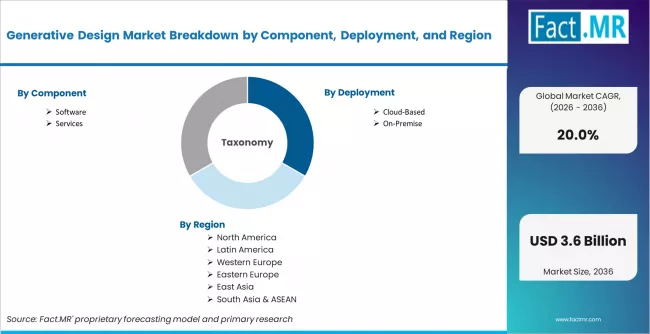
The Generative Design Market is analyzed by component, including software and services, along with deployment, with the study covering market dynamics and demand outlook across regions, forecast 2026 to 2036.
By Fact.MR Technology DeskLead analyst:
Ganesh PaiPublished :
14 min read
Fact-checked under the Fact.MR editorial process
Generative Design Market Forecast and Outlook By Fact.MR
In 2025, the generative design market was valued at USD 0.3 billion.
Based on Fact.MR analysis, demand for generative design software and services is estimated to grow to USD 0.4 billion in 2026 and USD 2.9 billion by 2036.
FACT.MR projects a CAGR of 20.0% during the forecast period.
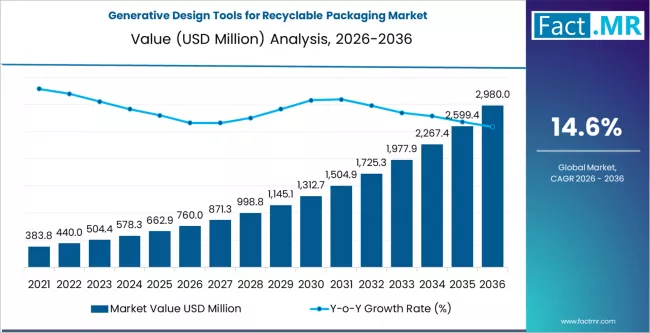
Generative Design Tools For Recyclable Packaging Market Market Value Analysis | Source: Fact.MR
Metric
Value
Estimated Value in 2026
USD 0.4 billion
Forecast Value in 2036
USD 2.9 billion
Forecast CAGR (2026 to 2036)
20.0%
Source: Fact.MR analysis. Updated May 15, 2026
Summary of Generative Design Market
Market Definition
Market covers AI-driven generative design software and optimisation services enabling automated geometry generation under engineering constraints for aerospace, automotive, industrial, and healthcare product development globally.
Demand Drivers
Aerospace and defence OEMs are mandating lightweighting across structural components, driving adoption of topology optimisation tools validated against FAA and EASA material specifications.
Automotive EV platform development is increasing demand for generative design in battery enclosure and structural frame optimisation, reducing component weight without compromising crash performance.
PLM platform integration by Autodesk, Siemens, and Dassault Systèmes is embedding generative design into standard engineering workflows, accelerating enterprise procurement cycles.
Key Segments Analyzed
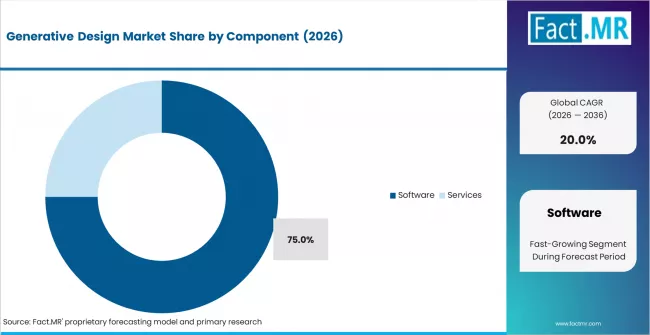
By Component: Software leads with approximately 75% share in 2026, driven by subscription platform growth and enterprise PLM integration across aerospace and automotive design teams.
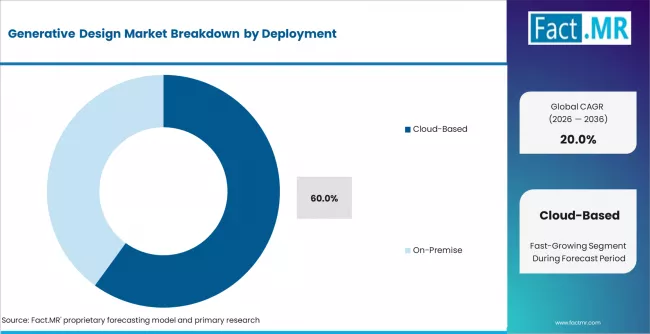
By Deployment: Cloud-based deployment leads at approximately 60% share in 2026 due to scalable compute access and multi-site collaboration requirements in global OEM design workflows.
By Technology: Topology optimisation holds approximately 47% share in 2026. AI-driven generative optimisation is the fastest-growing sub-segment as embedded AI tools expand across CAD ecosystems.
By Geography: India leads growth at 23.8% CAGR through 2036, supported by engineering services expansion and manufacturing digitisation programme incentives.
Analyst Opinion at FACT.MR
Shambhu Nath Jha, Principal Consultant at Fact.MR, opines, 'CXOs will find that the winning position in generative design belongs to vendors embedded in PLM procurement cycles rather than those selling standalone optimisation tools. Platform lock-in is forming rapidly through 2026 and 2027.'
Strategic Implications
Prioritise PLM ecosystem integration partnerships with Autodesk, Siemens, and Dassault Systèmes to secure inclusion in enterprise design platform procurement bundles.
Develop AI-driven generative optimisation capabilities targeting automotive EV and aerospace structural programmes where light weighting mandates create validated commercial demand.
Target India and China manufacturing digitization programmes early with localised deployment configurations and government-aligned pricing to capture fastest-growth CAGR markets.
Methodology
Market sizing based on software licence revenues and service contract values, validated against Autodesk, Siemens, and Dassault Systèmes revenue disclosures and CAD platform adoption benchmarks.
Incorporates FAA and EASA lightweighting mandate timelines, EU automotive CO2 regulation updates, and government manufacturing digitisation programme data from 2024 and 2025 filings.
Forecasts factor in PLM integration cycles, cloud adoption rates, AI tool embedding timelines, and primary interviews with design engineering and procurement executives.
The market is projected to generate USD 2.5 billion in absolute opportunity between 2026 and 2036. Growth is transformational. Adoption is expanding from aerospace prototyping into automotive, industrial, and healthcare manufacturing workflows. Primary constraints include computational cost, CAD integration complexity, and skilled workforce gaps in AI-assisted design.
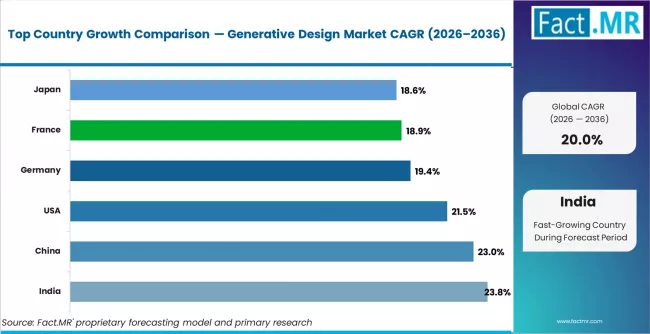
India leads with 23.8% CAGR through 2036, driven by manufacturing digitisation incentives and engineering services expansion. China follows at 23.0%, anchored by domestic aerospace and electric vehicle platform adoption. The United States posts 21.5%, underpinned by aerospace and defence programme integration. Germany records 19.4%, supported by automotive lightweighting mandates. France grows at 18.9%, driven by aerospace supply chain digitalisation. Japan grows at 18.6%, reflecting steady precision manufacturing adoption constrained by conservative CAD platform migration timelines.
Segmental Analysis
Generative Design Market Analysis by Component
Generative Design Market Analysis By Component | Source: Fact.MR
Based on FACT.MR, software holds approximately 75% share in 2026. It leads due to subscription platform growth and PLM ecosystem integration across enterprise design teams. Services account for the remainder, driven by implementation, training, and workflow integration support for industrial and aerospace customers.
Autodesk Investment: Autodesk Inc. invested USD 300 million in AI and generative design capability expansion in 2024, integrating advanced topology and AI-driven optimisation into Fusion 360 and Inventor. Design wins include Boeing and Ford engineering departments. [4]
Siemens Technology: Siemens AG launched the NX Generative Design module update in Q3 2024, embedding cloud-based AI optimisation directly within NX CAD. The module targets automotive and aerospace OEM programmes requiring mass-market topology capability. [5]
Services Adoption Trend: Dassault Systèmes reported a 22% increase in generative design services revenue in 2024, driven by aerospace and automotive OEM demand for PLM integration and workflow deployment support across global design teams. [6]
Generative Design Market Analysis by Deployment
Generative Design Market Analysis By Deployment | Source: Fact.MR
Based on FACT.MR, cloud-based deployment holds approximately 60% share in 2026. It leads due to scalable compute access and multi-site collaboration requirements in global OEM design workflows. On-premise deployment retains share in aerospace and defence programmes with data sovereignty and security requirements.
PTC Cloud Expansion: PTC Inc. expanded its Onshape cloud CAD platform with generative design modules in 2024, securing enterprise licence agreements with industrial manufacturing OEMs. Cloud-native deployment reduced implementation timelines for mid-market customers. [7]
Altair Technology: Altair Engineering launched OptiStruct cloud deployment in 2025, enabling on-demand topology and generative optimisation for automotive and aerospace design teams without on-premise infrastructure investment. [8]
On-Premise Security Trend: U.S. Department of Defense procurement guidelines updated in 2024 require on-premise or sovereign cloud deployment for design tools used in classified aerospace and defence programmes. This sustains on-premise segment demand among defence-contracted engineering teams. [9]
Drivers, Restraints, and Opportunities
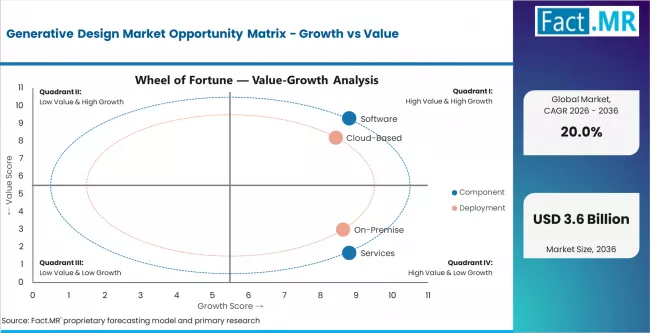
Generative Design Market Opportunity Matrix Growth Vs Value | Source: Fact.MR
FACT.MR analysts observe that the generative design market is shifting from an early-adopter phase into a mainstream engineering software category. Initial adoption was concentrated in aerospace prototyping. The market scaled as topology optimisation proved ROI in weight reduction and material savings. This expanded usage into automotive programmes.
The core tension is between standalone optimisation tools and integrated CAD platforms. Standalone vendors are losing share. Native capabilities in Autodesk Fusion, Siemens NX, and Dassault CATIA are becoming standard.
EU Automotive Lightweighting Mandates: EU CO₂ regulations updated in 2025 are accelerating lightweighting in EV platforms. OEMs like BMW AG and Stellantis N.V. increased generative design budgets in 2024. Siemens AG reported higher NX generative licence demand from European OEMs. [1]
India Manufacturing Digitisation: Government programmes are driving CAD adoption across SMEs and suppliers. Autodesk, Inc. reported 31% growth in Fusion 360 licences in India in 2024. This is accelerating generative design adoption in mid-market manufacturing. [2]
AI Integration in CAD Platforms: Autodesk, Inc. embedded AI-driven generative optimisation in Fusion 360 and Revit in 2024. PTC Inc. reported 27% growth in Creo generative module adoption in 2025. AI integration is lowering skill barriers and enabling guided workflows. [3]
Regional Analysis
The generative design market is assessed across Asia Pacific, North America, Europe, Latin America, and Middle East and Africa, covering 40+ countries segmented by manufacturing digitization maturity, aerospace and automotive programme scale, and PLM platform adoption depth. The full report offers market attractiveness analysis by region and country.
Top Country Growth Comparison Generative Design Market Cagr (2026 2036) | Source: Fact.MR
Country
CAGR (2026 to 2036)
India
23.8%
China
23.0%
United States
21.5%
Germany
19.4%
France
18.9%
Japan
18.6%
Source: Fact.MR analysis. Updated May 15, 2026
Source: Fact.MR (FACT.MR) analysis, based on proprietary forecasting model and primary research
Generative Design Market Cagr Analysis By Country | Source: Fact.MR
Asia Pacific Generative Design Market Analysis
Asia Pacific is the volume growth and policy-led adoption epicentre for generative design. India drives the fastest CAGR through PLI-linked manufacturing digitisation. China anchors scale through domestic aerospace and EV platform adoption. Autodesk and Siemens are strengthening regional enterprise partnerships. Procurement is increasingly tied to government manufacturing programme eligibility and engineering services outsourcing growth.
China: Domestic aerospace programme scale and NEV platform adoption support 23.0% CAGR through 2036. China's COMAC C919 and C929 programmes drove expanded topology optimisation tool procurement in 2024, with AVIC Group and COMAC suppliers integrating Siemens NX and Dassault CATIA generative modules into structural design workflows.
India: PLI-linked manufacturing investment and engineering services growth support 23.8% CAGR through 2036, the fastest among all profiled countries. India's National Manufacturing Competitiveness Programme funded CAD and simulation tool adoption for SME tier suppliers in 2024, with Autodesk reporting a 31% increase in Fusion 360 subscriptions. HAL and Tata Advanced Systems expanded generative design workflows for aerospace structural components in 2024 and 2025, driven by domestic defence procurement under Make in India.
Japan: Precision manufacturing integration and Tier-1 automotive supplier adoption support 18.6% CAGR through 2036. Japan's conservative CAD platform migration timelines create a structural constraint relative to faster-growing Asia Pacific peers. Toyota and Honda expanded generative design use in 2024 for EV platform powertrain bracket and suspension component optimisation, deploying Altair OptiStruct and Siemens NX modules.
FACT.MR's analysis of the generative design market in Asia Pacific consists of country-wise assessment that includes China, India, Japan, South Korea, ASEAN, and ANZ. Readers can find manufacturing digitisation incentive impacts, aerospace and EV platform adoption trends, CAD platform migration timelines, and enterprise software procurement benchmarks by country.
North America Generative Design Market Analysis
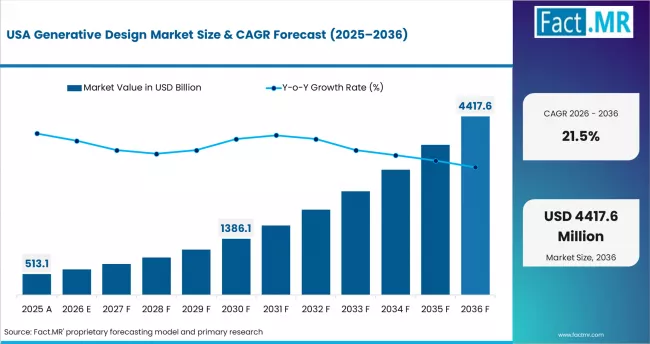
Generative Design Market Country Value Analysis | Source: Fact.MR
North America is the aerospace, defence, and innovation leadership hub for generative design. U.S. programme scale and defence procurement frameworks anchor high-value enterprise adoption. Autodesk and PTC lead regional supply. Long-cycle aerospace qualification and data sovereignty requirements sustain premium on-premise and secure cloud deployments alongside mainstream cloud growth.
United States: Aerospace and defence programme integration and PLM platform scale support 21.5% CAGR through 2036. The U.S. Department of Defense Advanced Manufacturing Office expanded generative design programme funding in 2024, targeting structural bracket and enclosure lightweighting for next-generation military aircraft. Boeing disclosed expanded Autodesk generative design deployment across commercial aircraft structural component programmes in 2024, validating topology-optimised brackets under FAA airworthiness guidance.
FACT.MR's analysis of the generative design market in North America consists of country-wise assessment that includes the United States, Canada, and Mexico. Readers can find aerospace certification data, DoD programme adoption trends, PLM platform procurement benchmarks, and cloud versus on-premise deployment dynamics.
Europe Generative Design Market Analysis
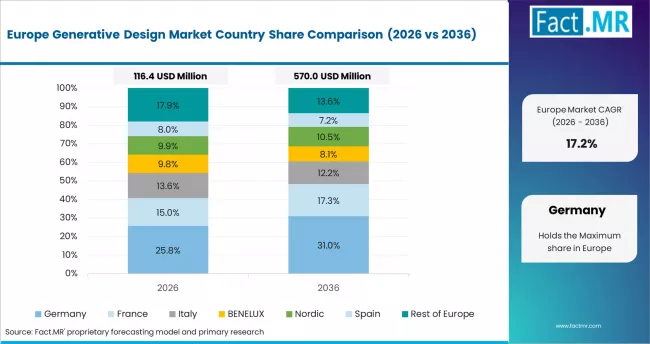
Generative Design Market Europe Country Market Share Analysis, 2026 & 2036 | Source: Fact.MR
Europe is the regulatory and automotive lightweighting benchmark for generative design adoption. EU CO2 mandates and EASA certification frameworks drive programme investment. Siemens and Dassault Systèmes lead regional PLM supply. Premium automotive OEMs in Germany and France anchor enterprise procurement through multi-year PLM platform contracts tied to vehicle development cycles.
Germany: Automotive lightweighting mandates and premium OEM PLM investment support 19.4% CAGR through 2036. BMW Group disclosed expanded use of Siemens NX generative design modules across its Neue Klasse EV platform structural development in 2024, targeting 25% mass reduction versus equivalent combustion models. Volkswagen Group expanded Dassault CATIA generative design tool deployment across body structure and chassis programmes in 2024, integrating topology outputs directly into production tooling workflows.
France: Aerospace supply chain digitalisation and industrial manufacturing programme funding support 18.9% CAGR through 2036. Airbus expanded internal generative design programme coverage in Toulouse in 2024, applying topology optimisation to A320 family structural brackets and A350 interior component development. Safran Group disclosed adoption of Dassault CATIA generative modules for engine nacelle structural optimisation in 2024, reducing design iteration cycles and material waste in complex aerospace assemblies.
FACT.MR's analysis of the generative design market in Europe consists of country-wise assessment that includes Germany, France, the United Kingdom, Italy, Spain, and Rest of Europe. Readers can find EU CO2 regulation impacts, EASA certification framework updates, automotive OEM PLM programme timelines, and industrial digitisation funding benchmarks.
Competitive Aligners for Market Players
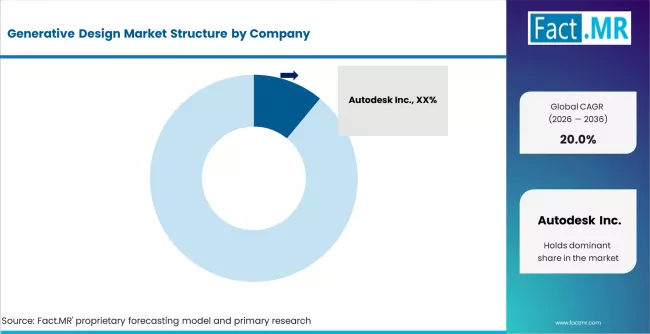
Generative Design Market Analysis By Company | Source: Fact.MR
The generative design market is becoming platform-driven. Competition is shifting from standalone tools to integrated ecosystems. Vendors must align with this structural change to remain relevant.
Platform integration is the first priority. Companies like Autodesk, Inc., Dassault Systèmes, and Siemens AG are embedding generative design directly into CAD and PLM suites. This creates workflow lock-in and increases user retention. Vendors without integration capabilities risk marginalisation.
AI capability is the second key lever. Generative design is evolving into AI-assisted design automation. Players such as PTC Inc. are expanding AI-driven optimisation features. The focus is on reducing user complexity and enabling non-specialist engineers to adopt these tools. Cloud deployment is becoming essential. Subscription-based SaaS models are replacing perpetual licensing. This improves recurring revenue but requires continuous updates and infrastructure investment. Vendors must scale cloud-native platforms to stay competitive.
Industry-specific solutions are gaining importance. Aerospace and automotive remain anchor segments. Vendors are developing pre-configured workflows tailored to lightweighting, topology optimisation, and compliance requirements. This improves adoption in production environments. Partnerships and ecosystem expansion are also critical. Integration with simulation, PLM, and manufacturing tools enhances value. Vendors that build strong ecosystems will capture larger enterprise contracts. Entry-level access is often bundled within CAD platforms. Advanced features are monetised through premium modules. This tiered approach balances adoption and revenue growth.
Key Players
Autodesk Inc.
Dassault Systèmes SE
Siemens AG
PTC Inc.
Altair Engineering Inc.
nTopology Inc.
ANSYS Inc.
Bibliography
[1] European Commission. (2025). EU CO2 Emission Performance Standards for Passenger Cars Regulation Update 2025: Revised Fleet Average Targets Driving Structural Lightweighting Investment Across European Automotive OEM Platforms. January 2025. ec.europa.eu/clima/policies/transport/vehicles/cars_en
[2] Autodesk Inc. (2024). Annual Report FY2024: Fusion 360 Subscription Growth in India and Manufacturing Digitisation Programme Alignment with Government PLI and NMCP Incentives for CAD and Simulation Tool Adoption. October 2024. investors.autodesk.com
[3] PTC Inc. (2025). Q1 FY2025 Earnings Call Transcript: Creo Generative Design Module Adoption Growth Among Aerospace and Industrial Customers and AI Integration Strategy for Onshape Cloud Platform. January 2025. ptc.com/investor-relations
[4] Autodesk Inc. (2024). Press Release: USD 300 Million AI and Generative Design Investment Programme Including Fusion 360 and Inventor Platform Upgrades with Boeing and Ford Design Win Disclosures. March 2024. investors.autodesk.com
[5] Siemens AG. (Q3 2024). Product Launch: NX Generative Design Cloud Module with AI Topology Optimisation for Automotive and Aerospace Enterprise OEM Programmes Integrated Within NX CAD Platform. August 2024. siemens.com/press
[6] Dassault Systèmes SE. (2024). Annual Report 2024: Generative Design Services Revenue Growth of 22% Driven by Aerospace and Automotive OEM PLM Integration and Workflow Deployment Support. April 2024. investor.3ds.com
[7] PTC Inc. (2024). Press Release: Onshape Cloud CAD Platform Generative Design Module Launch with Enterprise Licence Agreements for Industrial Manufacturing OEM Customers. June 2024. ptc.com/news
[8] Altair Engineering Inc. (2025). Product Announcement: OptiStruct Cloud Deployment Launch Enabling On-Demand Topology and Generative Optimisation for Automotive and Aerospace Design Teams. February 2025. altair.com/newsroom
[9] U.S. Department of Defense. (2024). Cybersecurity Maturity Model Certification Update: On-Premise and Sovereign Cloud Deployment Requirements for Design and Engineering Tools in Classified Aerospace and Defence Programmes. September 2024. dodcio.defense.gov
This Report Addresses
Strategic intelligence on generative design software and services demand across aerospace, automotive, industrial, and healthcare product development programmes globally.
Market forecast from USD 0.4 billion in 2026 to USD 2.9 billion by 2036 at a CAGR of 20.0%.
Growth opportunity mapping across India PLI-linked manufacturing digitisation, China aerospace and NEV platform adoption, U.S. aerospace and defence programme integration, Germany automotive lightweighting, and France aerospace supply chain digitalisation.
Segment analysis by component (software, services), deployment (cloud-based, on-premise), and technology (topology optimisation, AI-driven generative optimisation).
Regional outlook covering Asia Pacific policy-led volume growth, North America aerospace and defence certification demand, and Europe automotive regulatory and PLM programme adoption.
Competitive analysis of Autodesk, Siemens, Dassault Systèmes, PTC, Altair, nTopology, and ANSYS covering PLM integration depth, AI embedding strategy, OEM programme positions, and cloud versus on-premise deployment dynamics.
Regulatory analysis covering EU CO2 lightweighting mandates, FAA additive manufacturing airworthiness guidance, EASA certification frameworks, and India PLI and NMCP manufacturing digitisation incentives.
Report delivered in PDF, Excel, and presentation formats supported by validated vendor revenue data, OEM procurement benchmarks, and engineering software adoption inputs.
Market Breakdown
Segmentation
Scope of Report
Generative Design Market Breakdown By Component, Deployment, And Region | Source: Fact.MR
Attribute
Details
Quantitative Units
USD 0.4 billion (2026) to USD 2.9 billion (2036), at a CAGR of 20.0%
Market Definition
Generative design software platforms and services using AI and algorithmic optimisation to automate geometry generation under engineering constraints for aerospace, automotive, industrial, and healthcare product development globally.
Aerospace structural lightweighting, automotive EV frame and enclosure optimisation, industrial equipment component design, healthcare device geometry generation, and defence structural programme integration.
Regions Covered
North America, Europe, Asia Pacific, Latin America, Middle East and Africa
Countries Covered
USA, Canada, Mexico, Germany, UK, France, Italy, Spain, Nordic, BENELUX, China, Japan, South Korea, India, ASEAN, Australia and New Zealand, Brazil, Argentina, Chile, Saudi Arabia, UAE, South Africa, Rest of MEA
Key Companies Profiled
Autodesk Inc., Dassault Systèmes SE, Siemens AG, PTC Inc., Altair Engineering Inc., nTopology Inc., ANSYS Inc.
Forecast Period
2026 to 2036
Approach
Hybrid top-down and bottom-up model using software licence revenues, subscription volumes, service contract values, PLM platform adoption rates, and primary interviews with design engineering and enterprise procurement executives.
Source: Fact.MR analysis. Updated May 15, 2026
Generative Design Market by Segments
By Component:
Software
Services
By Deployment:
Cloud-Based
On-Premise
By Technology:
Topology Optimization
AI-Driven Generative Optimization
By Region:
North America
United States
Canada
Mexico
Latin America
Brazil
Argentina
Chile
Rest of Latin America
Western Europe
Germany
United Kingdom
France
Italy
Spain
Nordic Countries
BENELUX
Rest of Western Europe
Eastern Europe
Russia
Poland
Hungary
Balkan and Baltic
Rest of Eastern Europe
East Asia
China
Japan
South Korea
South Asia and Pacific
India
ASEAN
Australia and New Zealand
Rest of South Asia and Pacific
Middle East and Africa
Kingdom of Saudi Arabia
UAE
South Africa
Rest of Middle East and Africa
Questions Answered
Frequently Asked Questions
How large is the global generative design market in 2025?
The global generative design market was valued at USD 0.3 billion in 2025.
What will the market size be in 2026?
Based on Fact.MR analysis, demand is estimated to grow to USD 0.4 billion in 2026.
What is the projected market size by 2036?
The market is projected to reach USD 2.9 billion by 2036, generating USD 2.5 billion in absolute dollar opportunity over the forecast period.
What is the expected CAGR from 2026 to 2036?
FACT.MR projects a CAGR of 20.0% for the global generative design market during the 2026 to 2036 forecast period.
Which component segment leads the market?
Software leads with approximately 75% share in 2026, driven by subscription platform growth and PLM ecosystem integration across enterprise aerospace and automotive design teams.
Which deployment type holds the largest share?
Cloud-based deployment leads at approximately 60% share in 2026, reflecting scalable compute access and multi-site collaboration demand across global OEM engineering workflows.
Which technology segment is the fastest growing?
AI-driven generative optimisation is the fastest-growing sub-segment, expanding rapidly as embedded AI tools within Autodesk, Siemens, and Dassault platforms reduce specialist skill barriers and broaden the enterprise buyer base
Which country shows the fastest growth in the market?
India leads at 23.8% CAGR through 2036, driven by PLI manufacturing incentives, HAL and Tata Advanced Systems aerospace programme adoption, and engineering services outsourcing growth in generative simulation.
.webp "Top Country Growth Comparison Generative Design Market Cagr (2026 2036)")