- Base Value(2025): 1.1 Bn
- Forecast Value (2036): 35.0 Bn
- CAGR (2036): 37.0%
What is the GLP-1 aftercare and metabolic continuity services market forecast to be worth by 2036?
USD 1.5 billion in 2026 to USD 35.0 billion by 2036, at 37.0% CAGR.
- The GLP-1 aftercare and metabolic continuity services market was valued at USD 1.1 billion in 2025.
- Demand is set to rise from USD 1.5 billion in 2026 to USD 35.0 billion by 2036.
- The market is forecast to record 37.0% CAGR during 2026 to 2036 as employers and digital weight-care platforms fund support beyond the prescription phase.
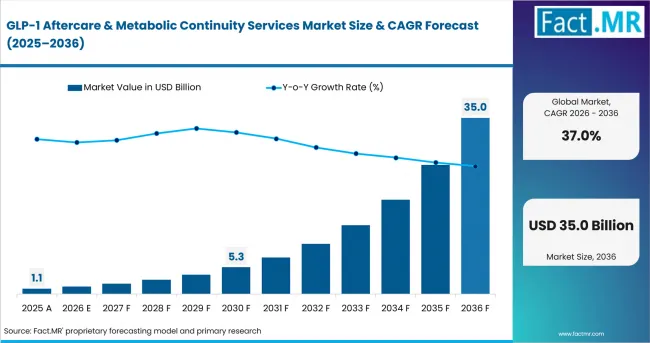
Glp 1 Aftercare & Metabolic Continuity Services Market Value Analysis | Source: Fact.MR
What are the defining numbers behind GLP-1 aftercare and metabolic continuity services growth?
USD 33.5 billion absolute opportunity by 2036, led by the United States and the United Kingdom.
- Demand Drivers in the Market
- Patients need muscle-preservation support because rapid weight loss can reduce lean mass.
- Employers need aftercare programs to protect the cost of GLP-1 coverage.
- Payers need continuity services that reduce stop-start medication cycles.
- Digital clinics need maintenance coaching after patients reach dose changes or pause treatment.
- Key Segments Analyzed
- By Service Type: Weight-Maintenance Coaching is expected to hold 34.0% share in 2026 because behavioral continuity starts after medication change.
- By Care Component: Registered Dietitian Support lead because patients need food strategies during appetite change. The share is projected at 31.8% in 2026.
- By Customer Type: Current and Former GLP-1 Users are likely to account for 42.0% share in 2026 as they directly need maintenance support.
- By Delivery Model: Digital Clinic and App-Based Programs lead as GLP-1 care shifts into virtual models. The model is projected to hold 39.0% share in 2026.
- By End Use: Weight Maintenance is expected to hold 38.0% share in 2026 as maintaining lost weight is the main post-medication goal.
- By Geography: The United States is projected to record 40.8% CAGR through 2036 as employer-funded GLP-1 programs and digital clinics expand.
- Analyst Opinion at Fact.MR
- Shambhu Nath Jha, Senior Analyst at Fact.MR, states, “GLP-1 care is moving beyond prescription access into metabolic continuity. We see employers and patients asking what happens after dose change, side effects or discontinuation. Providers that combine medical oversight, nutrition and muscle-preservation coaching will gain stronger access to long-term weight-care budgets.”
- Strategic Implications
- Digital clinics should add maintenance pathways before users stop medication.
- Employers need GLP-1 aftercare to protect pharmacy spend and workforce health outcomes.
- Nutrition providers should build protein and muscle-preservation plans for GLP-1 users.
- Payers should track weight maintenance and adherence instead of prescription starts alone.
Post-GLP-1 support services form the core of this market. These services help people keep weight off after using GLP-1 drugs through muscle preservation, nutrition therapy, dose-reduction support and weight-maintenance coaching. A 2025 JAMA Network Open cohort study found that most patients with overweight or obesity stopped dual-labeled GLP-1 receptor agonist therapy within 1 year. [1] This creates demand for structured follow-up programs that help patients manage weight, muscle health and eating habits after treatment.
Weight regain risk strengthens the need for these services. A 2026 EClinicalMedicine analysis found that people who stopped GLP-1 receptor agonist therapy regained much of the weight they had lost during treatment. [2] This makes post-medication coaching, nutrition support and weight-maintenance planning important for long-term results.
The United States is projected to record 40.8% CAGR from 2026 to 2036 as employer-funded GLP-1 programs and digital clinics expand. The United Kingdom is likely to post 38.9% CAGR as private weight-care platforms and GLP-1 companion programs scale. Canada is expected to register 37.6% CAGR as employer health plans seek maintenance support. Germany is forecast to advance at 36.5% CAGR by 2036 because obesity-care access and payer scrutiny increase. Australia is set to record 35.4% CAGR as telehealth weight-care programs and metabolic coaching demand expand.
How does the GLP-1 aftercare and metabolic continuity services market break down by segment?
Weight-Maintenance Coaching leads at 34.0%; Registered Dietitian Support leads at 31.8%.
Which service type dominates?
Weight-Maintenance Coaching holds 34.0% share in 2026.
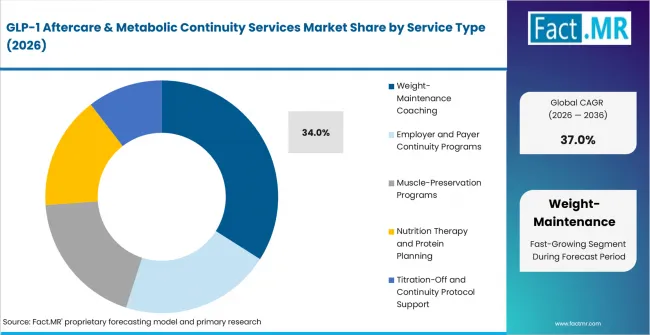
Glp 1 Aftercare & Metabolic Continuity Services Market Analysis By Service Type | Source: Fact.MR
Weight-Maintenance Coaching is expected to hold 34.0% share in 2026 because behavioral continuity starts after medication change. Patients need support for appetite return, food routines and activity consistency. A 2024 review on health and well-being coaching noted that coaching can be used alongside GLP-1 prescriptions. [3] Demand is strongest where users discontinue medication or move into long-term maintenance.
Which care component dominates?
Registered Dietitian Support holds 31.8% share in 2026.
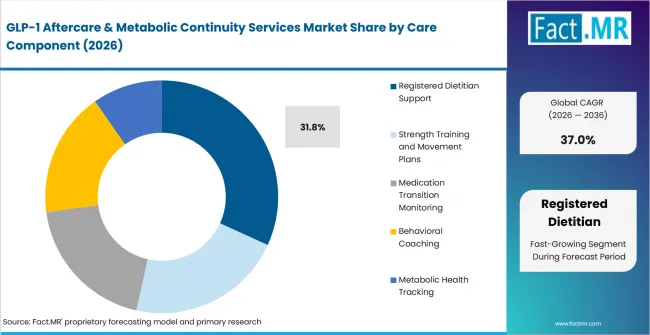
Glp 1 Aftercare & Metabolic Continuity Services Market Analysis By Care Component | Source: Fact.MR
Registered Dietitian Support is likely to account for 31.8% share in 2026 because patients need structured nutrition guidance after GLP-1 therapy changes. Weight-loss medications can reduce appetite quickly, which makes protein intake and nutrient balance harder to maintain without expert support. Dietitian-led care helps manage lean-mass protection, meal planning and long-term metabolic continuity. The segment leads because aftercare programs need clinical nutrition support to reduce rebound weight gain and keep patients engaged after medication tapering or discontinuation.
Which customer type dominates?
Current and Former GLP-1 Users hold 42.0% share in 2026.
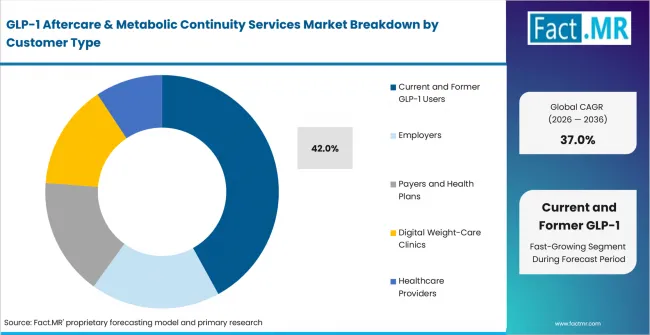
Glp 1 Aftercare & Metabolic Continuity Services Market Analysis By Customer Type | Source: Fact.MR
Current and Former GLP-1 Users are likely to account for 42.0% share in 2026 because they directly need maintenance support. Users who stop or pause treatment may need coaching, monitoring and nutrition therapy. This customer group leads because service demand starts with the patient’s transition risk.
Which delivery model dominates?
Digital Clinic and App-Based Programs lead because GLP-1 care is becoming virtual.
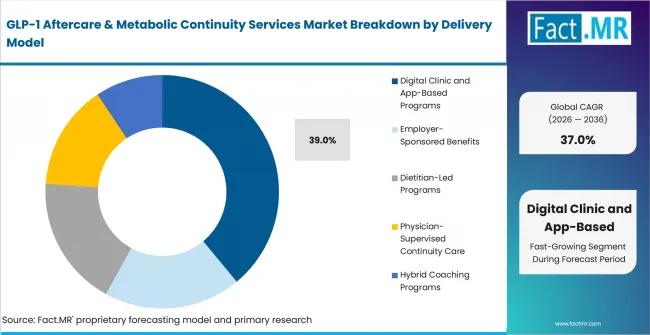
Glp 1 Aftercare & Metabolic Continuity Services Market Analysis By Delivery Model | Source: Fact.MR
Digital Clinic and App-Based Programs lead because users need ongoing support without frequent in-person visits. The model is projected to hold 39.0% share in 2026 as digital platforms connect clinicians, coaches and dietitians. Digital delivery leads because aftercare requires frequent check-ins and behavior support.
Which end use dominates?
Weight Maintenance holds 38.0% share in 2026.
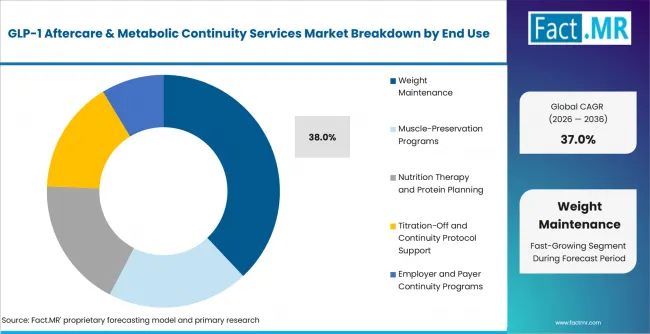
Glp 1 Aftercare & Metabolic Continuity Services Market Analysis By End Use 1 | Source: Fact.MR
Weight Maintenance leads because preserving treatment benefit is the main post-GLP-1 goal. The end use is expected to hold 38.0% share in 2026 as patients and payers focus on preventing regain. Aftercare services support this end use through coaching and medical follow-up.
What is accelerating GLP-1 aftercare demand, and what is holding it back?
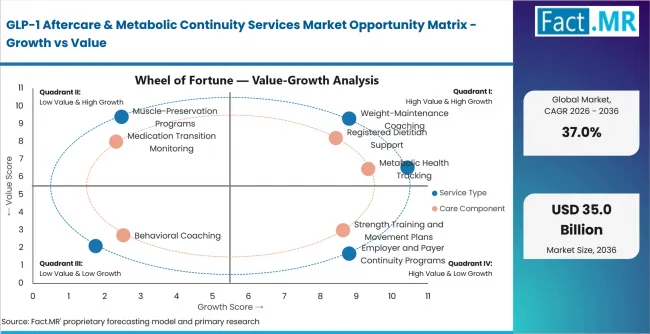
Glp 1 Aftercare & Metabolic Continuity Services Market Opportunity Matrix Growth Vs Value | Source: Fact.MR
Discontinuation, weight regain and employer cost pressure drive demand; affordability and care fragmentation restrain adoption.
Discontinuation is the main driver. A 2025 systematic review and meta-analysis in Obesity Reviews found that significant weight is regained after GLP-1 receptor agonist treatment is discontinued, which supports the need for continuity planning before therapy ends [5]. This creates a large transition population that may need medically supervised continuity support.
The main restraint is affordability. Many patients pay for GLP-1 medications out of pocket and may resist paying extra for aftercare. Employer and payer coverage is uneven. Providers must prove that aftercare reduces regain and protects treatment investment before reimbursement becomes routine.
Where do the biggest GLP-1 aftercare and metabolic continuity opportunities sit?
Weight maintenance and employer-funded continuity programs.
- Weight Maintenance: Platforms can support users after medication pause, dose reduction or treatment exit.
- Muscle Preservation: Providers can combine protein planning and resistance training with metabolic monitoring.
- Employer-Funded Continuity: Benefits teams can fund aftercare to protect GLP-1 drug spend and health outcomes.
Which countries are scaling GLP-1 aftercare and metabolic continuity services fastest?
United States 40.8%, United Kingdom 38.9%, Canada 37.6%, Germany 36.5%, Australia 35.4%.
Based on regional analysis, the GLP-1 aftercare and metabolic continuity services market is segmented into North America, Western Europe, Asia Pacific, Latin America, and Middle East and Africa.
.webp "Top Country Growth Comparison Glp 1 Aftercare & Metabolic Continuity Services Market Cagr (2026 2036)")
Top Country Growth Comparison Glp 1 Aftercare & Metabolic Continuity Services Market Cagr (2026 2036) | Source: Fact.MR
| Country | CAGR |
|---|---|
| United States | 40.8% |
| United Kingdom | 38.9% |
| Canada | 37.6% |
| Germany | 36.5% |
| Australia | 35.4% |
Source: Fact.MR analysis. Updated Jun 22, 2026
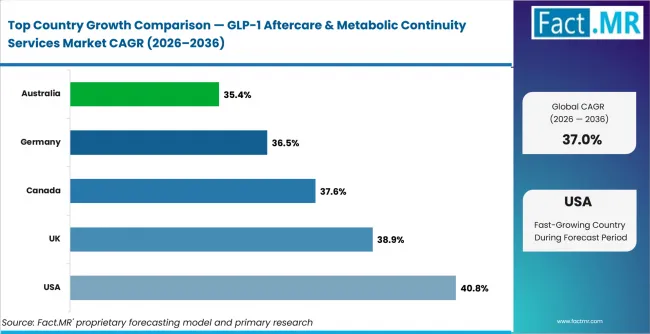
Glp 1 Aftercare & Metabolic Continuity Services Market Cagr Analysis By Country | Source: Fact.MR
What is powering the United States lead?
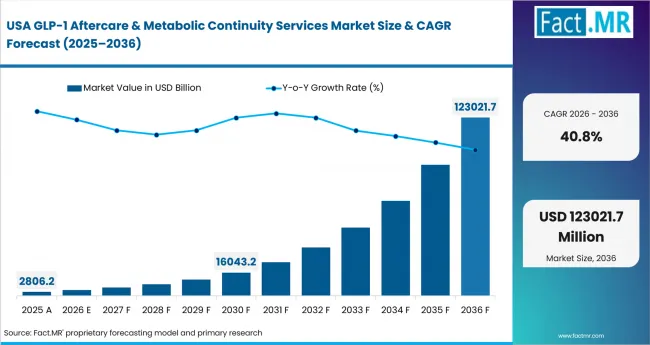
Glp 1 Aftercare & Metabolic Continuity Services Market Country Value Analysis | Source: Fact.MR
The United States is projected to record 40.8% CAGR through 2036 as employer-funded GLP-1 programs and digital clinics expand. High GLP-1 utilization creates a large group of users who may pause or discontinue treatment. Noom, Found and Calibrate give the market strong digital-care provider depth. Employers need aftercare to protect drug spend and reduce weight regain. Demand will favor providers that combine clinical oversight, coaching and dietitian support in one program.
How is the United Kingdom scaling GLP-1 aftercare demand?
The United Kingdom is likely to post 38.9% CAGR by 2036 as private weight-care platforms and GLP-1 companion programs scale. Private-pay users need support after medication changes because NHS access may be limited and waiting times can be long. Demand will favor services that combine muscle preservation and medical screening. UK employers may also add continuity programs as GLP-1 use expands among working-age adults.
What underpins Canada’s growth?
Canada is expected to register 37.6% CAGR from 2026 to 2036 as employer health plans seek maintenance support. GLP-1 coverage decisions are creating pressure to show long-term outcomes. Patients need nutrition and activity programs that support weight maintenance after dose changes. Digital care models can help reach users across provinces. Demand will favor employer-backed programs that track adherence and metabolic markers.
What supports Germany’s outlook?
Germany is forecast to advance at 36.5% CAGR through 2036 as obesity-care access and payer scrutiny increase. Medical weight management programs will need stronger evidence before broad reimbursement expands. Patients discontinuing GLP-1 treatment may need structured maintenance and dietitian-led support. German providers will emphasize clinical governance and data protection. Demand will favor medically supervised aftercare that can work alongside physicians and digital health pathways.
How is Australia scaling GLP-1 aftercare services?
Australia is set to record 35.4% CAGR by 2036 as telehealth weight-care programs and metabolic coaching demand expand. Private obesity-care platforms are reaching patients seeking medication access and long-term weight support. Users need practical help with protein intake, strength training and habit consistency after medication change. Employers and health insurers may fund programs as GLP-1 costs rise. Demand will favor digital aftercare models that combine clinician access with lifestyle support.
Who leads the GLP-1 aftercare and metabolic continuity services landscape?
Noom and Form Health lead through digital coaching and medical weight management.
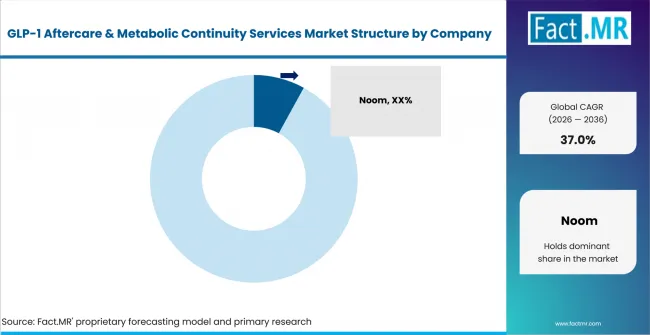
Glp 1 Aftercare & Metabolic Continuity Services Market Analysis By Company | Source: Fact.MR
GLP-1 aftercare and metabolic continuity services are used by patients and payers that need support beyond prescription access. Noom offers GLP-1 Companion with habit coaching and muscle-focused movement. Found offers personalized metabolic care with clinician review and ongoing support. Form Health provides medical weight loss care through physicians and registered dietitians.
WeightWatchers Clinic combines clinical weight-care access with coaching and community support. Juniper supports UK users with GLP-1 treatment and coaching. Calibrate programs created early models for medication-supported metabolic care and coaching.
Competition through 2036 will depend on clinical oversight and measurable maintenance outcomes. Providers that combine medical supervision with nutrition and muscle-preservation support will be better placed. App-led platforms can scale coaching. Digital clinics can manage medication transitions. Employer-focused providers can win benefits programs if they show lower regain and better long-term health outcomes.
Which companies are the key players?
Noom, Found, Form Health, WeightWatchers Clinic, Juniper and Calibrate.
- Noom
- Found
- Form Health
- WeightWatchers Clinic
- Juniper (UK)
- Calibrate
Bibliography
- [1] Rodriguez, P. J., Zhang, V., Gratzl, S., Do, D., Goodwin Cartwright, B., Baker, C., Gluckman, T. J., Stucky, N., & Emanuel, E. J. (2025). Discontinuation and reinitiation of dual-labeled GLP-1 receptor agonists among U.S. adults with overweight or obesity. JAMA Network Open, 8(1), Article e2457349.
- [2] Budini, B., Luo, S., Tam, M. G. Z., Stead, I., Lee, A., Akrami, A., Vidal-Puig, A., & Park, A. (2026). Trajectory of weight regain after cessation of GLP-1 receptor agonists: A systematic review and nonlinear meta-regression. EClinicalMedicine, 93, Article 103796.
- [3] Sforzo, G. A., Gordon, N. F., Peeke, P. M., & Moore, M. (2025). Health and well-being coaching adjuvant to GLP-1 induced weight loss. American Journal of Lifestyle Medicine, 19(4), 652–660.
- [4] Mozaffarian, D., Agarwal, M., Aggarwal, M., Alexander, L., Apovian, C. M., Bindlish, S., Bonnet, J., Butsch, W. S., Christensen, S., Gianos, E., Gulati, M., Gupta, A., Horn, D., Kane, R. M., Saluja, J., Sannidhi, D., Stanford, F. C., & Callahan, E. A. (2025). Nutritional priorities to support GLP-1 therapy for obesity: A joint advisory from the American College of Lifestyle Medicine, the American Society for Nutrition, the Obesity Medicine Association, and The Obesity Society. The American Journal of Clinical Nutrition, 122(1), 344–367.
- [5] Berg, S., Stickle, H., Rose, S. J., & Nemec, E. C. (2025). Discontinuing glucagon-like peptide-1 receptor agonists and body habitus: A systematic review and meta-analysis. Obesity Reviews, 26(8), Article e13929.
This Report Addresses
- Strategic intelligence on GLP-1 aftercare and metabolic continuity services across service type, care component and customer type.
- Segment analysis covering Weight-Maintenance Coaching, Nutrition Therapy and Protein Planning, Current and Former GLP-1 Users, Digital Clinic and App-Based Programs and Weight Maintenance.
- Regional outlook covering the United States, United Kingdom, Canada, Germany and Australia.
- Competitive analysis of Noom, Found, Form Health, WeightWatchers Clinic, Juniper and Calibrate.
- Service assessment covering muscle preservation, nutrition therapy, medication transition support and employer continuity programs.
- Care assessment covering dietitian support, strength training, behavioral coaching and metabolic tracking.
- Primary interviews, provider checks, official source review and GLP-1 continuity validation support the forecast.
What does the GLP-1 aftercare and metabolic continuity services market cover?
Services that support patients after GLP-1 dose change or maintenance transition.
The GLP-1 aftercare and metabolic continuity services market covers clinical and coaching services that help users preserve weight-loss benefits after GLP-1 medication changes. It includes muscle-preservation programs and employer-funded maintenance programs. The market differs from GLP-1 drug sales because the service focus is continuity and metabolic risk control.
What is included in the scope?
Muscle preservation and medication-transition follow-up.
The scope includes post-GLP-1 weight-maintenance coaching and nutrition therapy. It covers dietitian support and metabolic health monitoring. It includes medically supervised tapering support when clinically appropriate. It also includes employer and payer programs that help protect GLP-1 treatment investment.
What is excluded from the scope?
GLP-1 drug manufacturing and prescription fulfillment without aftercare support.
The scope excludes drug manufacturing, pharmacy distribution and standalone prescription access. It excludes general weight-loss coaching unless GLP-1 continuity or aftercare support is included. It excludes fitness programs with no metabolic continuity or nutrition component. It also excludes clinical treatment decisions that are not delivered through an aftercare service model.
How was the analysis built?
100+ sources, 45+ company portfolios, 25+ countries, 20+ interviews.
- Primary Research: Primary research includes interviews with obesity-care clinicians and employer benefits leaders. It includes input from digital health platforms and registered dietitian networks.
- Desk Research: Desk research reviews GLP-1 discontinuation evidence and official platform service disclosures. It covers payer and digital weight-care program activity.
- Market-Sizing and Forecasting: Forecasting uses current and former GLP-1 user pools, discontinuation patterns and aftercare attachment rates. Employer health spending and digital clinic adoption support the market assessment.
- Data Validation and Update Cycle: Forecasts are validated through provider checks and benefits-market feedback. GLP-1 utilization trends and payer coverage updates help confirm market direction.
Segmentation
What is the report’s scope and coverage?
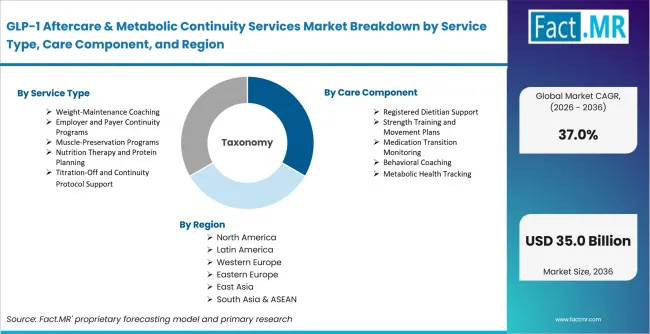
GLP 1 Aftercare & Metabolic Continuity Services Market Breakdown By Service Type, Care Component, And Region | Source: Fact.MR
| Attribute | Details |
|---|---|
| Quantitative Units | USD Billion in 2026 to USD Billion by 2036 |
| Market Definition | Services for the post-GLP-1 phase, including muscle preservation, nutrition therapy and weight-maintenance coaching |
| Service Type | Muscle-Preservation Programs, Nutrition Therapy and Protein Planning, Titration-Off and Continuity Protocol Support, Weight-Maintenance Coaching, Employer and Payer Continuity Programs |
| Care Component | Registered Dietitian Support, Strength Training and Movement Plans, Medication Transition Monitoring, Behavioral Coaching, Metabolic Health Tracking |
| Customer Type | Current and Former GLP-1 Users, Employers, Payers and Health Plans, Digital Weight-Care Clinics, Healthcare Providers |
| Delivery Model | Digital Clinic and App-Based Programs, Employer-Sponsored Benefits, Dietitian-Led Programs, Physician-Supervised Continuity Care, Hybrid Coaching Programs |
| End Use | Weight Maintenance, Muscle Preservation, Medication Transition Support, Side-Effect and Adherence Support, Employer ROI Protection |
| Regions Covered | North America, Western Europe, Asia Pacific, Latin America, Middle East and Africa |
| Countries Covered | United States, United Kingdom, Canada, Germany, Australia |
| Key Companies Profiled | Noom, Found, Form Health, WeightWatchers Clinic, Juniper and Calibrate |
| Forecast Period | 2026 to 2036 |
| Approach | Hybrid top-down and bottom-up approach using GLP-1 user counts, discontinuation patterns, aftercare attachment rates, employer benefit adoption and provider validation |
Source: Fact.MR analysis. Updated Jun 22, 2026
How is the market segmented?
-
By Service Type:
- Muscle-Preservation Programs
- Nutrition Therapy and Protein Planning
- Titration-Off and Continuity Protocol Support
- Weight-Maintenance Coaching
- Employer and Payer Continuity Programs
-
By Care Component:
- Registered Dietitian Support
- Strength Training and Movement Plans
- Medication Transition Monitoring
- Behavioral Coaching
- Metabolic Health Tracking
-
By Customer Type:
- Current and Former GLP-1 Users
- Employers
- Payers and Health Plans
- Digital Weight-Care Clinics
- Healthcare Providers
-
By Delivery Model:
- Digital Clinic and App-Based Programs
- Employer-Sponsored Benefits
- Dietitian-Led Programs
- Physician-Supervised Continuity Care
- Hybrid Coaching Programs
-
By End Use:
- Weight Maintenance
- Muscle Preservation
- Medication Transition Support
- Side-Effect and Adherence Support
- Employer ROI Protection
-
By Region:
- North America
- United States
- Canada
- Europe
- United Kingdom
- Germany
- France
- Italy
- Spain
- Asia Pacific
- Australia
- Japan
- South Korea
- Singapore
- India
- Latin America
- Brazil
- Mexico
- Chile
- Middle East & Africa
- GCC Countries
- South Africa
- Israel
- North America
Frequently Asked Questions
Which service type leads the GLP-1 Aftercare & Metabolic Continuity Services Market?
Which country expands faster in the GLP-1 Aftercare & Metabolic Continuity Services Market?
How does the United Kingdom perform in the GLP-1 Aftercare & Metabolic Continuity Services Market?
How does Canada perform in the GLP-1 Aftercare & Metabolic Continuity Services Market?
How does Germany perform in the GLP-1 Aftercare & Metabolic Continuity Services Market?
How does Australia perform in the GLP-1 Aftercare & Metabolic Continuity Services Market?
What is the primary driver in the GLP-1 Aftercare & Metabolic Continuity Services Market?
What is the main restraint in the GLP-1 Aftercare & Metabolic Continuity Services Market?
Why is nutrition therapy important in this market?
Who worked on this report


Preview the report firsthand - request a free sample
Free SampleGet the brochure for pricing and purchase details
Download PDF