- Market Value (2025): USD 187.0 Mn
- Estimated Value (2026): USD 220.7 Mn
- Forecast Value (2036): USD 1150.0 Mn
- CAGR (2026-2036): 18.0%
What is the GLP-1 Adherence Platforms Market forecast to be worth by 2036?
USD 220.7 million in 2026 to USD 1,150.0 million by 2036 at a 18.0% CAGR.
- The GLP-1 adherence platforms market was valued at USD 187.0 million in 2025 as obesity care programs added medication support to digital weight-management services.
- Demand is projected to increase from USD 220.7 million in 2026 to USD 1,150.0 million by 2036.
- The market is forecast to record a 18.0% CAGR from 2026 to 2036 as titration support and side-effect management become part of routine care.
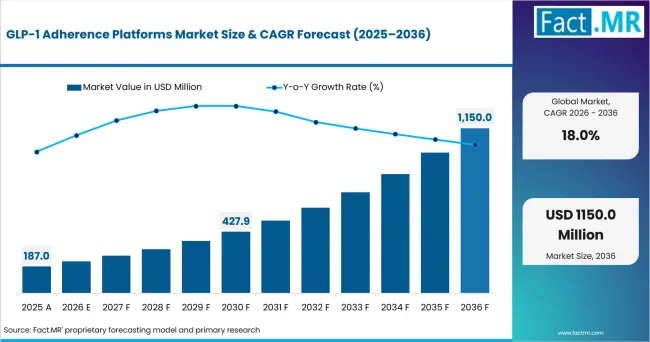
Glp 1 Adherence Platforms Market Value Analysis | Source: Fact.MR
What are the defining numbers behind GLP-1 Adherence Platforms Market growth?
USD 929.3 million in absolute opportunity is expected between 2026 and 2036, led by Mobile adherence apps and Dose reminders and tracking alongside Direct-to-consumer deployment and Health plans.
- Demand Drivers in the Market
- GLP-1 treatment requires repeated decisions after the first prescription. Dose escalation and tolerance checks are expected to make patient education more valuable than a basic reminder.
- Real-world treatment gaps are expected to make follow-up support more visible. Platforms can help patients record missed doses and prepare for restart discussions.
- Obesity medicine is moving toward care that combines medication with behavior support. This gives adherence tools a clearer role between clinical visits.
- Coverage rules create refill friction. Prior authorization and eligibility checks are anticipated to raise demand for benefit navigation and renewal tracking.
- Key Segments Analyzed
- By Platform Type: Mobile adherence apps are expected to hold 33.9% share in 2026 because reminders and education remain close to the patient.
- By Adherence Mechanism: Dose reminders and tracking are projected to account for 42.3% share in 2026 due to repeated weekly actions across many injectable therapies.
- By Deployment Model: Direct-to-consumer platforms are anticipated to capture 30.8% share in 2026 as patients often look for help before formal sponsor support starts.
- By End User: Health plans are forecast to represent 54.4% share in 2026 as sponsors need structured engagement and medication-access support.
- Analyst Opinion at Fact.MR
- Shambhu Nath Jha, Senior Analyst at Fact.MR, states, “GLP-1 adherence platforms must manage the steps between prescription and persistence. Customers are expected to judge platforms on dose-step support and refill continuity. They need safeguards that keep clinical judgment with licensed care teams.”
- Strategic Implications
- Platform selection by health plans is likely to depend on clear engagement records. Refill completion and documented clinical escalation may carry more weight than app-login figures.
- Employers benefit from a firm boundary between access support and medical decision-making. Digital platforms can guide members through available benefits while prescribing remains under qualified clinical oversight.
- Pharmacy chains gain more value from services that identify refill delays early. The workflow becomes stronger when home-delivery support, follow-up and safety escalation are connected within the same care pathway.
The USA is projected to record a 19.4% CAGR from 2026 to 2036 as coverage pathways and high treatment need create demand for coordinated support. Germany is expected to post a 19.0% CAGR as digital applications face clearer evidence and data-security requirements. The UK is forecast to advance at 18.7% through obesity-medicine pathways with wraparound care. Canada is anticipated to grow at 18.4% through licensed supply and refill navigation. Japan is projected to record a 17.9% CAGR as treatment eligibility and structured health guidance keep clinical oversight central.
How does the GLP-1 Adherence Platforms Market break down by segment?
Mobile adherence apps are expected to lead Platform Type at 33.9%. Dose reminders and tracking are projected to lead Adherence Mechanism at 42.3% share in 2026.
Why do Mobile Adherence Apps lead Platform Type?
Mobile adherence apps are projected to account for 33.9% share in 2026.
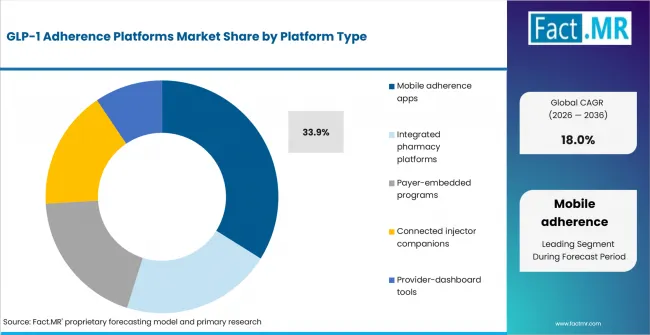
Glp 1 Adherence Platforms Market Analysis By Platform Type | Source: Fact.MR
Most patients already carry the device needed to receive a reminder or record a dose. This lowers the setup burden when treatment begins. A mobile app can place side-effect education beside the dosing schedule. Interactive features help a patient share information with a coach or care team. These features make mobile apps a practical starting point for GLP-1 support and broader mHealth tools.
Why do Dose Reminders and Tracking Lead Adherence Mechanism?
Dose reminders and tracking are expected to hold 42.3% share in 2026.
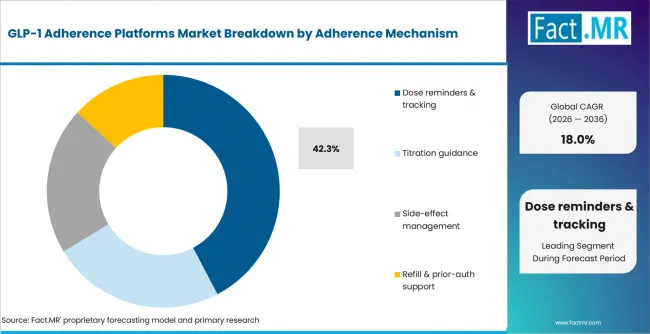
Glp 1 Adherence Platforms Market Analysis By Adherence Mechanism | Source: Fact.MR
Many injectable GLP-1 medicines follow a weekly schedule. A missed action can interrupt medication use and dose-escalation planning. A reminder reduces simple forgetfulness. The tracking record gives the patient a clearer history before a follow-up call. This mechanism remains simple for broad use and still connects to clinical decisions.
Why does Direct-to-Consumer Lead Deployment Model?
Direct-to-consumer deployment is projected to represent 30.8% share in 2026.
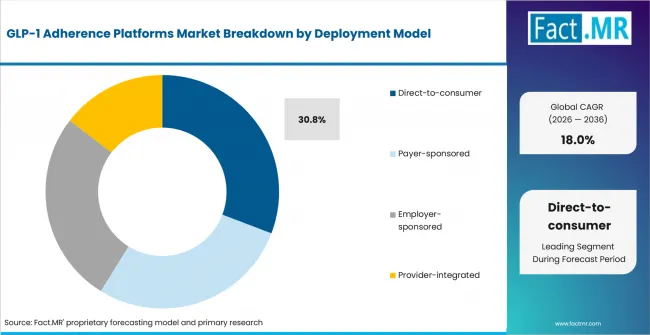
Glp 1 Adherence Platforms Market Analysis By Deployment Model | Source: Fact.MR
Consumers often search for support before an employer or health plan offers a formal program. Direct-to-consumer care can combine education and tracking with access to a clinical team. It can help the patient understand whether insurance documents or self-pay steps are required. Trust is expected to depend on transparent prescribing and careful escalation of safety concerns.
Why do Health Plans lead End User demand?
Health plans are expected to account for 54.4% share in 2026.
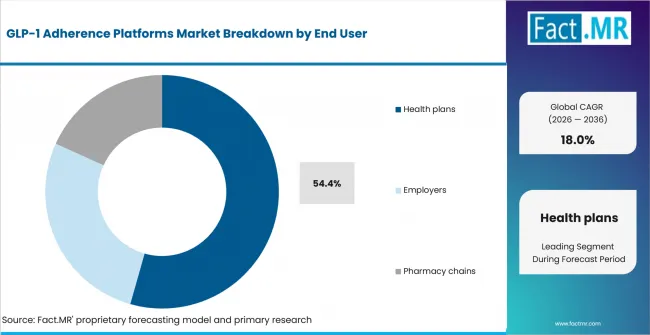
Glp 1 Adherence Platforms Market Analysis By End User | Source: Fact.MR
Health plans carry the cost of treatment for covered members. They manage eligibility rules and prior authorization. A platform can help members complete administrative steps and record whether support was offered. Plans can use this information to see where people stop before a prescription is filled. The value comes from fewer avoidable breaks in treatment.
What is accelerating GLP-1 Adherence Platforms Market adoption, and what is holding it back?
Structured wraparound care is expected to accelerate adoption. Fragmented coverage and uneven program-specific evidence are anticipated to hold back wider use.
Drivers Impact Analysis
| DRIVER | QUALITATIVE IMPACT | GEOGRAPHIC RELEVANCE | IMPACT TIMELINE |
|---|---|---|---|
| Dose-escalation complexity | High | Global | Short term (<=2 years) |
| Real-world persistence gap | High | USA and other insured markets | Short term (<=2 years) |
| Wraparound-care requirements | High | UK and organized care pathways | Medium term (2-4 years) |
| Sponsor demand for engagement records | Medium | USA and Germany | Medium term (2-4 years) |
Source: Fact.MR analysis. Updated Jul 27, 2026
- Dose-escalation complexity: GLP-1 initiation can involve several dose steps. Platforms can keep education and clinical check-ins aligned with that schedule.
- Real-world persistence gap: Claims-based studies show that some patients pause treatment before a full year. This makes persistence support a visible care problem.
- Wraparound-care requirements: Medicine access is expected to require behavioral and clinical support in organized care pathways. Platforms can help deliver that support between appointments.
- Sponsor demand for engagement records: Payers and employers need proof that members receive navigation and follow-up. Useful records can support program review without replacing outcomes.
Opportunity Impact Analysis
| OPPORTUNITY | QUALITATIVE IMPACT | GEOGRAPHIC RELEVANCE | IMPACT TIMELINE |
|---|---|---|---|
| Integrated pharmacy and refill support | High | USA and Canada | Short term (<=2 years) |
| Provider dashboards with escalation rules | Medium | Germany and UK | Medium term (2-4 years) |
| Localized guidance and safety content | Medium | Japan and multilingual markets | Medium term (2-4 years) |
Source: Fact.MR analysis. Updated Jul 27, 2026
- Integrated pharmacy and refill support: A platform can surface authorization tasks and refill status before medication runs out. This is useful where coverage rules change by plan.
- Provider dashboards with escalation rules: Care teams need concise information instead of low-value alerts. A dashboard can highlight missed doses or persistent side effects.
- Localized guidance and safety content: Treatment rules differ by country. Platforms that reflect local labels and referral pathways can reduce patient confusion.
Restraints Impact Analysis
| RESTRAINT | QUALITATIVE IMPACT | GEOGRAPHIC RELEVANCE | IMPACT TIMELINE |
|---|---|---|---|
| Fragmented reimbursement | High | USA and Canada | Short term (<=2 years) |
| Limited outcome evidence for individual platforms | High | Germany and health-plan procurement | Medium term (2-4 years) |
| Privacy and interoperability burden | Medium | Germany and provider-integrated models | Medium term (2-4 years) |
Source: Fact.MR analysis. Updated Jul 27, 2026
- Fragmented reimbursement: A patient may receive support and still face a coverage denial. Engagement alone cannot solve a benefit exclusion.
- Limited outcome evidence for individual platforms: General evidence for mobile adherence does not prove that every GLP-1 platform works. Customers are expected to ask for program-specific outcomes.
- Privacy and interoperability burden: Medication and weight data are sensitive. Security requirements and clinical-system integration can lengthen implementation.
Which countries are scaling GLP-1 Adherence Platforms Market fastest?
The country comparison is defined more by care pathways than by the narrow CAGR spread. The USA leads through payer and employer workflows. Germany follows an evidence-led digital-health route. The UK depends on medicine access with wraparound care. Canada emphasizes licensed supply and pharmacy confidence. Japan remains tied to regulated eligibility and clinician-led guidance.
- The USA shows the highest listed CAGR through payer authorization and employer benefits. Refill support adds another operational trigger.
- Germany remains close to the USA as reimbursable digital-health applications require evidence and data security. These requirements define the care role.
- The UK advances through obesity-medicine pathways where behavioral support and monitoring are expected to remain part of treatment access.
- Canada reflects licensed medication navigation and pharmacy-based adherence support. Online supply concerns are expected to influence patient behavior.
- Japan stays aligned with the global rate because treatment eligibility keeps platform value tied to clinical oversight. Structured health guidance adds the patient-support route.
Comparable CAGRs can therefore require different market-entry choices. Deployment timing depends on benefit rules and prescribing safeguards. Local data expectations affect the handoff between patient reminders and clinical escalation.
The full report provides country-level CAGR analysis across North America and Europe. East Asia and other markets are represented in the global estimate.
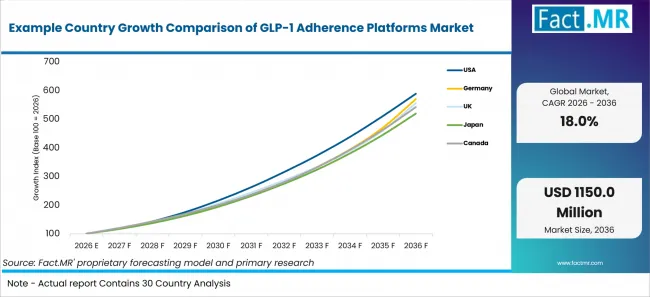
Example Country Growth Comparison Of Glp 1 Adherence Platforms Market | Source: Fact.MR
| Country | CAGR (2026-2036) |
|---|---|
| USA | 19.4% |
| Germany | 19.0% |
| UK | 18.7% |
| Canada | 18.4% |
| Japan | 17.9% |
Source: Fact.MR analysis. Updated Jul 27, 2026
What supports USA adoption?
19.4% CAGR, supported by payer coordination and employer benefit pathways.
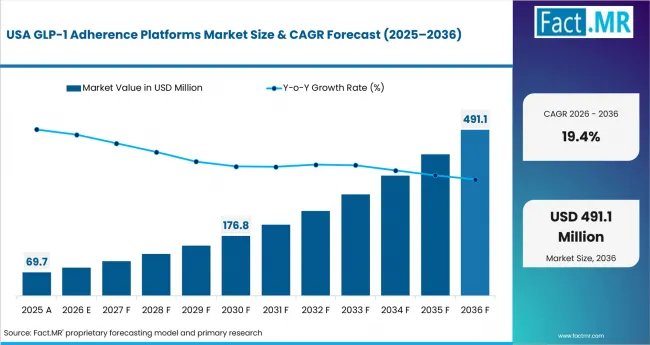
Glp 1 Adherence Platforms Market Country Value Analysis | Source: Fact.MR
USA growth is linked to the administrative work surrounding GLP-1 treatment. Platforms can help patients manage prior authorization, refill timing and benefit questions while keeping prescribing decisions with licensed clinicians. Demand is likely to favor services that document follow-up clearly and connect medication access with ongoing treatment support.
How is Germany shaping platform demand?
19.0% CAGR, influenced by evidence requirements and strict data governance.
Germany’s market is developing around platforms that can demonstrate a defined role in patient care. Buyers are expected to examine clinical relevance, security controls and escalation procedures before adoption. Solutions that record meaningful adherence events and fit established digital-health standards are likely to gain stronger acceptance.
Why is the UK market expanding?
18.7% CAGR, backed by structured obesity-treatment pathways and wraparound support.
UK demand reflects the integration of medication with behavioral guidance and clinical monitoring. Platforms can extend support between appointments by helping patients follow dose instructions, understand side effects and remain connected to the wider care pathway. Adoption will depend more on pathway compatibility than on reminder functions alone.
What is shaping Canada’s growth?
18.4% CAGR, driven by licensed medication access and pharmacy-based navigation.
Canada’s outlook is connected to the need for trusted supply and clearer refill coordination. Digital platforms can guide patients toward authorized providers, identify medication-access problems and support communication with pharmacies or clinicians. Services that separate clinical assistance from general wellness content are likely to perform better.
How does Japan approach market development?
17.9% CAGR, guided by treatment eligibility and clinician-led health support.
Japan’s market is expected to advance through platforms that reinforce professional medical guidance rather than replace it. Localized education, safety messaging and clear referral routes can help patients follow treatment requirements correctly. Demand is likely to concentrate on tools that fit regulated care practices and preserve clinician oversight.
Who leads the GLP-1 Adherence Platforms Market?
Omada Health and Noom show the clearest direct relevance. Teladoc Health and WeightWatchers Clinic strengthen the wider virtual-care and structured-support field. Calibrate Health and Found Health remain relevant because their services combine clinical oversight with coaching and patient follow-up. Medication access remains part of the service reasoning.
Omada Health supports GLP-1 users through coaching and side-effect guidance. It provides prescribing support and medication-access coordination. Noom combines behavior-change content with GLP-1 companion tools for people using GLP-1 medicines.
Teladoc Health offers GLP-1 support inside a broader weight-management service. The model combines coaching with digital tools and telehealth therapy support. WeightWatchers Clinic connects obesity-trained clinical care with behavioral support through the WeightWatchers platform. Competition is expected to center on persistence support and clinical escalation. Providers that document metabolic continuity services may gain stronger demand than platforms that only measure app activity.
Which companies are the key providers?
Key companies include Omada Health, Noom, Calibrate Health, Found Health, Teladoc Health, and WeightWatchers Clinic.
- Omada Health
- Noom
- Calibrate Health
- Found Health
- Teladoc Health
- WeightWatchers Clinic
Bibliography
- Health Canada. (2026, January 21). Thinking about buying GLP-1 drugs like Ozempic or Mounjaro? Beware of fake or unauthorized products. Government of Canada.
- National Health Service England. (2026, January). Tirzepatide (Mounjaro) in primary care for weight management: Information on wraparound care. NHS England.
- Omada Health. (2025, November 6). Omada Health announces GLP-1 prescribing capability to support growing member population. Omada Health.
- Noom. GLP-1 Companion. Noom.
- Calibrate. Calibrate weight loss medication: Prescription GLP-1s. Calibrate.
- Found. (2025, May 14). Found expands GLP-1 access with industry-leading formulary and affordability. Business Wire.
- Teladoc Health. (2024, March 7). Teladoc Health expands obesity and weight management capabilities. Teladoc Health.
- WeightWatchers. (2025, December 16). Weight Watchers launches a fully integrated platform for the GLP-1 era. WW International.
This Report Answers
- The report provides strategic intelligence on the GLP-1 Adherence Platforms Market across Platform Type and Adherence Mechanism choices that shape patient support programs.
- Segment analysis covers Mobile adherence apps and Dose reminders and tracking as the share leaders within the 2026 market.
- Country outlook evaluates the USA and Germany alongside the UK and Canada. Japan completes the growth comparison across the profiled markets.
- Competitive analysis profiles Omada Health and Noom alongside Calibrate Health and Found Health. Teladoc Health and WeightWatchers Clinic complete the provider set.
- Adherence assessment covers refill coordination and side-effect education. Coaching and prior-authorization support complete the mechanism view alongside dose reminders and tracking.
What does the GLP-1 Adherence Platforms Market cover?
GLP-1 adherence platforms support patients who need help staying on a prescribed treatment plan over time.
The GLP-1 Adherence Platforms Market covers mobile apps and web portals. Integrated telehealth platforms are included. Pharmacy support tools and health-plan portals complete the platform boundary. Coverage extends to reminders and refill coordination. Side-effect education and coaching remain included. Prior-authorization support completes the service scope. The market includes payer and employer use cases. Provider and pharmacy programs are included when support helps medication persistence. Life-science use cases follow the same treatment-support rule.
The market differs from general weight-loss applications because commercial value comes from treatment continuity and safer escalation. Wellness-only nutrition apps remain outside the boundary. General pharmacy dispensing software is excluded unless it includes GLP-1-specific adherence support. Unrelated telehealth services are excluded unless they directly support GLP-1 treatment follow-up.
What is included in the scope?
GLP-1 adherence platforms are used across health plans and employers. Telehealth providers and pharmacies are included. Life-science support programs complete the end-user scope.
The scope includes Platform Type and Adherence Mechanism. It includes Deployment Model and End User. Region completes the framework. Coverage spans mobile adherence apps and web portals. Integrated telehealth platforms are included. Pharmacy support platforms and health-plan portals complete the platform scope. The mechanism scope includes dose reminders and tracking. Refill coordination and side-effect education are included. Coaching and prior-authorization support complete the mechanism view. Deployment coverage includes direct-to-consumer and employer-sponsored models. Payer-sponsored and provider-integrated models are included. Pharmacy-integrated models complete the deployment scope.
What is excluded from the scope?
General wellness apps and unrelated telehealth platforms remain outside the scope of this market.
The scope excludes platforms that do not address GLP-1 treatment support. Standalone diet trackers and fitness applications are excluded. General pharmacy software is excluded unless it supports GLP-1 refill coordination or adherence services. Company revenue without a clear connection to GLP-1 treatment follow-up is excluded.
How Was the Analysis Built?
The analysis draws on 120+ sources, 35+ company portfolios, 25+ countries, and more than 20 industry interviews.
- Primary Research: Primary research includes discussions with manufacturers, service providers, technology developers, distributors, end users, procurement teams, and subject-matter experts. These conversations examine purchasing priorities, product adoption, operational challenges, approval requirements, competitive positioning, and the factors that influence wider market acceptance.
- Desk Research: Desk research covers government statistics, regulatory publications, company filings, trade data, technical studies, industry associations, standards, public policy, and other authoritative sources. Every source used in the analysis is documented in the bibliography.
- Market Sizing and Forecasting: Market estimates combine historical performance, demand indicators, pricing and volume trends, segment shares, company participation, country-level growth, adoption patterns, investment activity, and barriers to market expansion.
- Data Validation and Update Cycle: Findings are validated by comparing primary interviews with public data, company activity, regulatory changes, trade patterns, and industry developments. Regular updates review new product launches, capacity changes, partnerships, approvals, procurement trends, and shifts in commercial adoption.
Segmentation
What is the report’s scope and coverage?
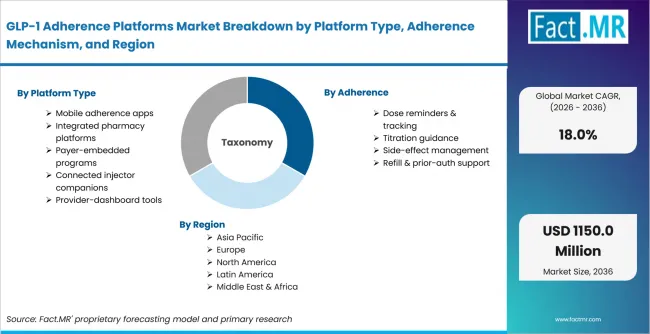
Glp 1 Adherence Platforms Market Breakdown By Platform Type, Adherence Mechanism, And Region | Source: Fact.MR
| Attribute | Details |
|---|---|
| Quantitative Units | USD 220.7 million in 2026 to USD 1,150.0 million by 2036 at 18.0% CAGR |
| Market Definition | Platforms that support GLP-1 treatment continuity through dose reminders, refill support, coaching, side-effect education, benefit navigation and care-team escalation. |
| Platform Type | Mobile adherence apps; Web portals; Integrated telehealth platforms; Pharmacy support platforms; Health-plan portals |
| Adherence Mechanism | Dose reminders and tracking; Refill coordination; Side-effect education; Coaching and behavioral nudges; Prior authorization support |
| Deployment Model | Direct-to-consumer; Employer-sponsored; Payer-sponsored; Provider-integrated; Pharmacy-integrated |
| End User | Health plans; Employers; Telehealth providers; Pharmacies; Life-science companies |
| Regions Covered | North America; Latin America; Europe; East Asia; South Asia and Pacific; Middle East and Africa |
| Countries Covered | USA; Germany; UK; Canada; Japan |
| Key Companies Profiled | Omada Health; Noom; Calibrate Health; Found Health; Teladoc Health; WeightWatchers Clinic |
| Forecast Period | 2026 to 2036 |
| Approach | Hybrid top-down and bottom-up approach using obesity-care pathways; GLP-1 treatment support needs; payer and employer program review; refill and prior-authorization workflows; provider escalation rules; country adoption patterns; company portfolio review and segment share modeling |
Source: Fact.MR analysis. Updated Jul 27, 2026
How is the market segmented?
-
By Platform Type:
- Mobile adherence apps
- Web portals
- Integrated telehealth platforms
- Pharmacy support platforms
- Health-plan portals
-
By Adherence Mechanism:
- Dose reminders and tracking
- Refill coordination
- Side-effect education
- Coaching and behavioral nudges
- Prior authorization support
-
By Deployment Model:
- Direct-to-consumer
- Employer-sponsored
- Payer-sponsored
- Provider-integrated
- Pharmacy-integrated
-
By End User:
- Health plans
- Employers
- Telehealth providers
- Pharmacies
- Life-science companies
-
By Region:
- North America
- Europe
- East Asia
Frequently Asked Questions
Which Platform Type leads the market?
Which Adherence Mechanism leads the market?
Which Deployment Model leads the market?
Which End User leads the market?
Which country records the highest listed CAGR?
What is the primary driver in this market?
What is the main restraint?
Why do health plans lead demand?
Who worked on this report


Preview the report firsthand - request a free sample
Free SampleGet the brochure for pricing and purchase details
Download PDF