- Market Value (2025): USD 461.9 Mn
- Estimated Value (2026): USD 545.0 Mn
- Forecast Value (2036): USD 2850.0 Mn
- CAGR (2026-2036): 18.0%
What is the GLP-1 Patient Support Market forecast to be worth by 2036?
USD 545.0 million in 2026 to USD 2,850.0 million by 2036 at a 18.0% CAGR.
- The GLP-1 Patient Support Market crossed a valuation of USD 461.9 million in 2025.
- Demand is projected to increase from USD 545.0 million in 2026 to USD 2,850.0 million by 2036.
- The market is forecast to record a 18.0% CAGR from 2026 to 2036 as support programs extend beyond prescription approval.
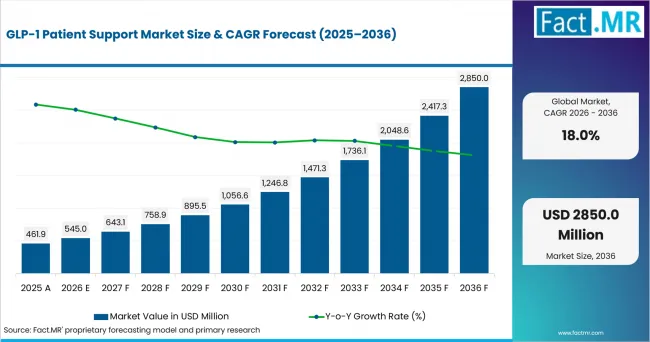
Glp 1 Patient Support Market Value Analysis | Source: Fact.MR
What are the defining numbers behind GLP-1 Patient Support Market growth?
USD 2,305.0 million absolute opportunity is expected between 2026 and 2036. Onboarding & injection training and manufacturer-sponsored programs form the main commercial base.
- Demand Drivers in the Market
- Patients need clear injection instruction before the first dose. Training is expected to reduce errors linked to device use and storage during treatment initiation.
- Coverage checks and copay navigation are expected to prevent avoidable delays. These services matter when prior authorization or benefit rules interrupt a prescribed start.
- Sponsors are anticipated to require outcome records that connect support activity with treatment continuity. The record must keep clinical judgment separate from promotional communication.
- Key Segments Analyzed
- By Program Component: Onboarding & injection training is expected to hold 37.9% share in 2026. The segment addresses device technique and the rules patients follow during dose escalation.
- By Sponsor Type: Pharma manufacturer is projected to account for 54.5% share in 2026. Manufacturers have a direct interest in access support and appropriate persistence activity for approved products.
- By Delivery Mode: Digital-first hub is anticipated to capture 34.7% share in 2026. A single program interface helps patients track enrollment and case status while retaining access to human support.
- By End User: Pharma manufacturers are estimated to represent 43.3% share in 2026. These organizations fund large programs and require consistent safety and compliance controls.
- Analyst Opinion at Fact.MR
- Shambhu Nath Jha, Senior Analyst at Fact.MR, states, “Program value depends on whether support becomes part of a dependable care workflow. Sponsors are projected to favor visible escalation rules and measurable onboarding completion over engagement volume alone.”
- Strategic Implications
- Program owners can evaluate onboarding measures before signing a contract. Injection education works best when completion standards and clinical support routes are clearly defined.
- A shared case record connects app-based tools with human support. It limits repeated questions and keeps patient status visible across channels.
- Clear ownership of access issues and safety escalation prevents confusion. Pharmacies and health plans create problems when patients receive separate messages without knowing who is responsible.
The USA is expected to record a 17.5% CAGR from 2026 to 2036, supported by broad manufacturer programs, access navigation and specialty-pharmacy coordination. Germany is projected to post 17.1% as structured reimbursement and information governance shape adoption. France is anticipated to grow at 16.8% through national care pathways and pharmacy participation. The UK is estimated to register 16.5% through NHS alignment and remote-care experience, while Japan is forecast at 16.0%, supported by clinician oversight, pharmacy counseling and localized service design.
How does the GLP-1 Patient Support Market break down by segment?
Onboarding & injection training leads Program Component at 37.9% share in 2026. Pharma manufacturer leads Sponsor Type at 54.5%.
Why does Onboarding & injection training lead Program Component?
Onboarding & injection training is projected to account for 37.9% share in 2026.
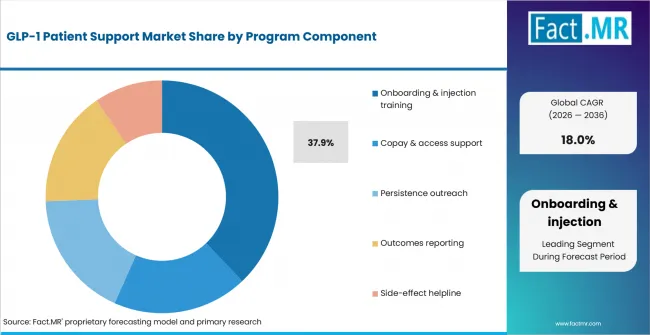
Glp 1 Patient Support Market Analysis By Program Component | Source: Fact.MR
The first stage of therapy requires patients to understand injection technique, storage and dose-escalation rules before treatment becomes routine. Copay and access support remains important when coverage delays a prescribed start. Persistence outreach helps identify refill gaps after initiation. Outcomes reporting and side-effect helplines complete the service mix by supporting continuity without replacing clinical judgment.
Why does Pharma manufacturer lead Sponsor Type?
Pharma manufacturer is expected to hold 54.5% share in 2026.
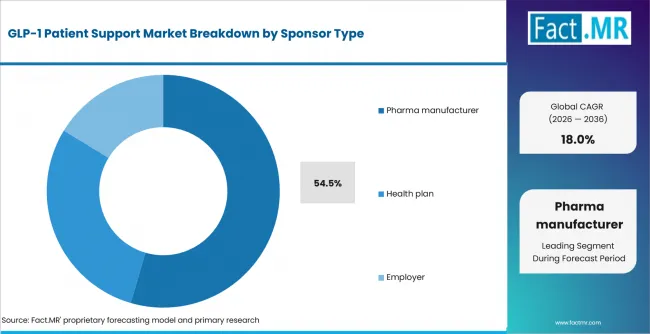
Glp 1 Patient Support Market Analysis By Sponsor Type | Source: Fact.MR
Manufacturers fund large programs that address access barriers around approved products. They also require consistent safety routing and clear evidence that support reaches the intended patient group. Health plans focus more closely on utilization and covered outcomes. Employers use these services when GLP-1 support forms part of a broader metabolic-care benefit.
Why does Digital-first hub lead Delivery Mode?
Digital-first hub is anticipated to represent 34.7% share in 2026.
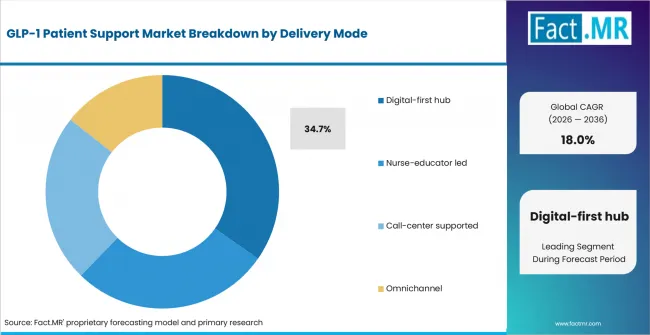
Glp 1 Patient Support Market Analysis By Delivery Mode | Source: Fact.MR
A central digital hub keeps enrollment, case progress and support status visible through one interface. Human assistance remains available when affordability questions or safety concerns require escalation. Nurse-educator programs provide more clinical contact. Call-center services handle routine access questions at scale. Omnichannel models combine these routes for patient groups that need several forms of contact during treatment initiation and follow-up.
Why do Pharma manufacturers lead End User?
Pharma manufacturers are estimated to account for 43.3% share in 2026.
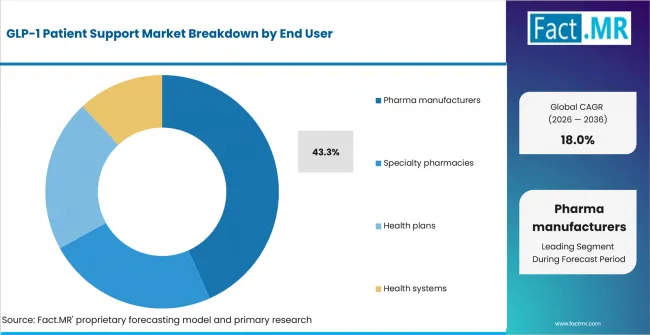
Glp 1 Patient Support Market Analysis By End User | Source: Fact.MR
Manufacturers support large patient populations and require one operating framework across channels. They also need proof that access work and safety escalation follow approved rules. Specialty pharmacies focus on dispensing and refill coordination. Health plans manage coverage and utilization. Health systems connect support with clinical pathways. Each group values a different service function, but manufacturers create the broadest demand for standardized programs.
What is accelerating GLP-1 Patient Support Market adoption, and what is holding it back?
Demand is expected to be led by complex onboarding and access friction. Persistence concerns add a second commercial need. Adoption is constrained by separate program ownership and the difficulty of linking support activity to sustained treatment value.
Drivers Impact Analysis
| DRIVER | QUALITATIVE IMPACT | GEOGRAPHIC RELEVANCE | IMPACT TIMELINE |
|---|---|---|---|
| Complex onboarding | High | Global | Short term (<= 2 years) |
| Affordability and access friction | High | Global | Short term (<= 2 years) |
| Persistence concerns | Medium | Global | Medium term (2-4 years) |
| Demand for patient-reported insight | Medium | USA and enterprise markets | Medium term (2-4 years) |
Source: Fact.MR analysis. Updated Jul 27, 2026
- Complex onboarding: Patients must learn device use and storage before treatment becomes routine. Dose changes and missed-dose questions create further demand for structured education.
- Affordability and access friction: Copay rules and prior authorization can delay treatment before benefit is established. Support programs are expected to coordinate these steps with the prescribing office.
- Persistence concerns: Sponsors need early signals when refill activity stops. Timely outreach helps distinguish an access problem from a tolerability question that needs clinical review.
- Patient-reported insight: Support contacts reveal recurring access barriers between visits. The information is most useful when reporting rules and consent boundaries are defined in advance.
Opportunity Impact Analysis
| OPPORTUNITY | QUALITATIVE IMPACT | GEOGRAPHIC RELEVANCE | IMPACT TIMELINE |
|---|---|---|---|
| Omnichannel support hubs | High | Global | Short term (<= 2 years) |
| Specialty-pharmacy integration | Medium | USA and Germany | Medium term (2-4 years) |
| Localized safety education | Medium | Global | Medium term (2-4 years) |
Source: Fact.MR analysis. Updated Jul 27, 2026
- Omnichannel support hubs: A shared case record is expected to reduce repeated enrollment work. Patients can move between online contact and human help without losing program context.
- Specialty-pharmacy integration: Shared status information is projected to expose authorization and refill delays sooner.
- Localized safety education: Country-specific wording is anticipated to reduce ambiguity in global programs. Escalation routes must match the local clinical and regulatory setting.
Restraints Impact Analysis
| RESTRAINT | QUALITATIVE IMPACT | GEOGRAPHIC RELEVANCE | IMPACT TIMELINE |
|---|---|---|---|
| Program fragmentation | High | Global | Short term (<= 2 years) |
| Promotional compliance risk | High | Regulated and payer-funded markets | Medium term (2-4 years) |
| Outcome attribution | Medium | Global | Medium term (2-4 years) |
Source: Fact.MR analysis. Updated Jul 27, 2026
- Program fragmentation: Patients may receive separate instructions from the manufacturer and pharmacy. Conflicting messages reduce confidence and increase avoidable contacts.
- Promotional compliance risk: Manufacturer-sponsored education requires clear review controls. The program must distinguish approved support content from independent medical advice.
- Outcome attribution: Coverage and medicine availability can change treatment continuity. This makes it difficult to isolate the effect of support activity on persistence.
Which countries are scaling GLP-1 Patient Support Market fastest?
The country comparison is defined more by close spacing than by a wide separation in growth rates. The full range between the USA and Japan is 1.50 percentage points. The USA and Germany form a compact upper pair with only a 0.40-point difference. France and the UK create a closely aligned middle group. Japan sits at a measured distance from that cluster. This pattern reflects different patient-support structures rather than a simple divide in healthcare demand.
- The USA occupies a notable position because manufacturers and health plans can connect benefit verification with copay support and specialty-pharmacy coordination.
- Germany remains close to the USA in CAGR terms but follows a more structured route through documented workflows and controlled information sharing.
- France sits near the middle of the comparison through national care pathways and pharmacy-based contact during treatment initiation.
- The UK remains closely spaced with France yet develops through NHS alignment and a mix of telephone support with digital follow-up.
- Japan is positioned outside the main cluster because adoption places greater emphasis on clinician visibility and pharmacy-led education.
Comparable CAGRs can still produce different commercial entry conditions. Providers may face different timelines for contracting and service integration across the five markets. Training design and reporting requirements may also vary even when the projected rates appear compressed. These differences matter because GLP-1 support programs depend on coordination across sponsors and pharmacies. They also depend on clear escalation routes during treatment initiation and continuation.
The full report provides country-level CAGR analysis across North America, Latin America, Europe, East Asia, South Asia, Oceania and the Middle East and Africa.
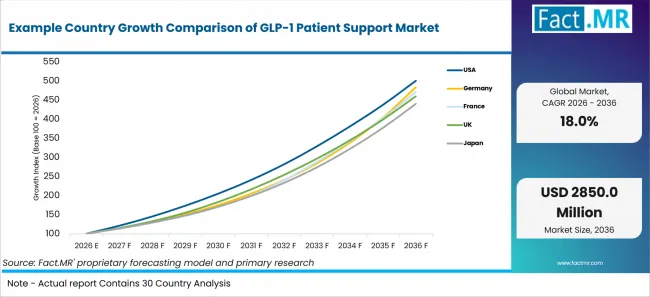
Example Country Growth Comparison Of Glp 1 Patient Support Market | Source: Fact.MR
| Country | CAGR (2026-2036) |
|---|---|
| USA | 17.5% |
| Germany | 17.1% |
| France | 16.8% |
| UK | 16.5% |
| Japan | 16.0% |
Source: Fact.MR analysis. Updated Jul 27, 2026
What supports USA adoption?
17.5% CAGR, supported by coordinated access services and treatment-start assistance.
Glp 1 Patient Support Market Value Analysis | Source: Fact.MR
The USA market benefits from services that connect insurance review, copay support, pharmacy coordination and patient education within one pathway. These programs help patients move more smoothly from prescription to treatment initiation. Strong participation from manufacturers, health plans and specialty pharmacies also creates a broad commercial base. Providers that offer visible case progress and timely human support are well placed to capture demand.
How is Germany developing demand?
17.1% CAGR, driven by structured care processes and strong information governance.
Germany favors patient-support programs with clearly defined service roles, documented workflows and secure information handling. This environment creates opportunities for providers that connect pharmacies, prescribers and patients through an organized support model. Local-language education and measurable program outcomes can strengthen acceptance among healthcare organizations. Providers with strong governance capabilities are positioned to build long-term partnerships across the market.
What shapes France growth?
16.8% CAGR, led by national care pathways and pharmacy-led patient contact.
France offers a clear route for programs that align with established reimbursement and treatment pathways. Community and specialty pharmacies can support injection education, refill visibility and routine patient guidance close to the point of dispensing. French-language communication also improves service usability. This combination gives providers an opportunity to connect national healthcare structures with practical support during treatment initiation and continuation.
What supports UK adoption?
16.5% CAGR, backed by NHS alignment and flexible patient-contact channels.
The UK market benefits from programs that complement existing NHS pathways and provide practical support between clinical appointments. Telephone services, online tools and community-pharmacy involvement can work together to improve treatment education and refill follow-up. Clear reporting also helps service owners assess program value. Providers that combine digital convenience with accessible human support can serve a wider patient population.
How is Japan developing demand?
16.0% CAGR, supported by clinician involvement and pharmacy-based education.
Japan offers strong potential for programs that keep physicians and pharmacists closely involved in the patient journey. Pharmacists can reinforce storage, injection and refill guidance, while clinicians remain visible throughout treatment. Japanese-language materials and familiar contact channels can improve patient confidence. Providers that build carefully coordinated clinic-and-pharmacy models are positioned to support steady market expansion.
Who leads the GLP-1 Patient Support Market?
EVERSANA and CareMetx show the broadest direct relevance, while Valeris and CoverMyMeds strengthen access, affordability and patient-services coverage.
EVERSANA supports manufacturer-sponsored programs through patient access, onboarding and hub-service capabilities. CareMetx contributes reimbursement support, benefit verification and case-management infrastructure. Valeris brings patient access, affordability, adherence, nursing support and hub-service capabilities through the combined Mercalis and PharmaCord platform. CoverMyMeds contributes patient-support and specialty-access workflows. Phil contributes digital prescription access and patient engagement, while AssistRx supports enrollment, reimbursement workflows and ongoing coordination across the treatment journey.
From 2026 to 2036, competition is expected to depend on how effectively providers connect injection training, coverage navigation, refill follow-up and safety escalation within one service model. Sponsors are also likely to compare case visibility, pharmacy coordination, reporting quality and the ability to offer both digital and human support. Providers that create a smooth path from enrollment to continued therapy may gain stronger demand from pharma manufacturers, health plans, specialty pharmacies and health systems.
Which companies are the key providers?
Key companies include EVERSANA; CareMetx; Valeris; CoverMyMeds; Phil; AssistRx.
- EVERSANA
- CareMetx
- Valeris
- CoverMyMeds
- Phil
- AssistRx
Bibliography
- Centers for Disease Control and Prevention. (2025, December 3). Adult obesity prevalence maps.
- EVERSANA. (2026, March 6). Building a scalable GLP-1 care model.
- CareMetx. (2026, March 31). CareMetx launches next-generation patient access platform.
- Valeris. (2025, May 27). Valeris launches with a fully integrated vision for life sciences companies.
- CoverMyMeds. Patient support services and assistance programs.
- PHIL. Medication access, simplified.
- AssistRx. Patient solutions.
- World Health Organization. (2025, December 1). WHO issues global guideline on the use of GLP-1 medicines in treating obesity.
- European Medicines Agency. (2025). Warning about sharp rise in illegal medicines sold in the EU.
This Report Answers
- The report examines the GLP-1 Patient Support Market across Program Component, Sponsor Type, Delivery Mode and End User categories that define how support is funded, delivered and used.
- Segment analysis identifies Onboarding & injection training and Pharma manufacturer as the leading 2026 categories, with Digital-first hub and Pharma manufacturers completing the principal market structure.
- Country outlook compares the USA with Germany and France. The UK and Japan complete the growth view across the five profiled national markets.
- Competitive analysis profiles EVERSANA and CareMetx alongside Valeris and CoverMyMeds. Phil and AssistRx complete the selected provider group.
- Service assessment covers copay and access support, persistence outreach and side-effect helplines. Outcomes reporting and coordinated case management complete the view of patient-support activity.
What does the GLP-1 Patient Support Market cover?
Structured support programs help patients begin and continue prescribed GLP-1 therapy through education, access assistance and treatment follow-up.
The GLP-1 Patient Support Market covers services used for onboarding, injection training, copay support and coverage navigation. Persistence outreach and side-effect helplines are included when they form part of an organized treatment-support pathway. The market also includes outcomes reporting and case-status management. Manufacturer-sponsored programs are covered alongside services funded by health plans and employers. Digital hubs, nurse educators, call centers and omnichannel programs are included across specialty pharmacies and health systems.
The market differs from general weight-management services because commercial value comes from helping patients start and remain on prescribed GLP-1 therapy. Drug manufacturing and prescription revenue remain outside the boundary. Independent diagnosis and treatment decisions are excluded. General wellness coaching is excluded unless it operates within a defined GLP-1 support pathway. Prescription fulfillment alone is also excluded unless structured education, access assistance or persistence support is provided.
What is included in the scope?
GLP-1 patient-support programs are used by pharma manufacturers, specialty pharmacies, health plans and health systems. Employer-sponsored services are also included.
The scope includes Program Component and Sponsor Type alongside Delivery Mode and End User. Program Component covers onboarding and injection training, copay and access support, persistence outreach, outcomes reporting and side-effect helplines. Sponsor Type includes pharma manufacturers, health plans and employers. Delivery Mode covers digital-first hubs, nurse-educator programs, call-center support and omnichannel delivery. End User includes pharma manufacturers, specialty pharmacies, health plans and health systems.
What is excluded from the scope?
Drug manufacturing, prescription-only revenue and independent clinical treatment remain outside the scope of this market.
The scope excludes services that do not support a defined GLP-1 treatment pathway. General wellness coaching and unrelated weight-management programs are excluded. Independent diagnosis, prescribing and dose-selection services remain outside the market. Prescription fulfillment is excluded when it does not include structured education, access navigation or persistence support. Company revenue without a clear connection to organized GLP-1 patient support is also excluded.
How Was the Analysis Built?
The analysis draws on 120+ sources, 35+ company portfolios, 25+ countries, and more than 20 industry interviews.
- Primary Research: Primary research includes discussions with manufacturers, service providers, technology developers, distributors, end users, procurement teams, and subject-matter experts. These conversations examine purchasing priorities, product adoption, operational challenges, approval requirements, competitive positioning, and the factors that influence wider market acceptance.
- Desk Research: Desk research covers government statistics, regulatory publications, company filings, trade data, technical studies, industry associations, standards, public policy, and other authoritative sources. Every source used in the analysis is documented in the bibliography.
- Market Sizing and Forecasting: Market estimates combine historical performance, demand indicators, pricing and volume trends, segment shares, company participation, country-level growth, adoption patterns, investment activity, and barriers to market expansion.
- Data Validation and Update Cycle: Findings are validated by comparing primary interviews with public data, company activity, regulatory changes, trade patterns, and industry developments. Regular updates review new product launches, capacity changes, partnerships, approvals, procurement trends, and shifts in commercial adoption.
Segmentation
What is the report's scope and coverage?
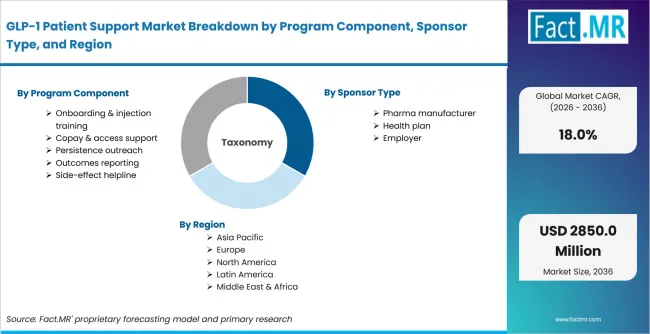
Glp 1 Patient Support Market Breakdown By Program Component, Sponsor Type, And Region | Source: Fact.MR
| Attribute | Details |
|---|---|
| Quantitative Units | USD 545.0 million in 2026 to USD 2,850.0 million by 2036 at 18.0% CAGR |
| Market Definition | Programs that help patients start and continue GLP-1 therapy through injection education, access navigation, persistence outreach, side-effect triage and outcomes reporting |
| Program Component | Onboarding & injection training; Copay & access support; Persistence outreach; Outcomes reporting; Side-effect helpline |
| Sponsor Type | Pharma manufacturer; Health plan; Employer |
| Delivery Mode | Digital-first hub; Nurse-educator led; Call-center supported; Omnichannel |
| End User | Pharma manufacturers; Specialty pharmacies; Health plans; Health systems |
| Regions Covered | North America; Latin America; Europe; East Asia; South Asia and Pacific; Middle East and Africa |
| Countries Covered | USA; Germany; France; UK; Japan |
| Key Companies Profiled | EVERSANA; CareMetx; Valeris; CoverMyMeds; Phil; AssistRx |
| Forecast Period | 2026 to 2036 |
| Approach | Hybrid top-down and bottom-up interpretation of the approved market series. External sources explain care pathways and provider capabilities without replacing protected market figures. |
Source: Fact.MR analysis. Updated Jul 27, 2026
How is the market segmented?
-
By Program Component:
- Onboarding & injection training
- Copay & access support
- Persistence outreach
- Outcomes reporting
- Side-effect helpline
-
By Sponsor Type:
- Pharma manufacturer
- Health plan
- Employer
-
By Delivery Mode:
- Digital-first hub
- Nurse-educator led
- Call-center supported
- Omnichannel
-
By End User:
- Pharma manufacturers
- Specialty pharmacies
- Health plans
- Health systems
-
By Region:
- North America
- Latin America
- Europe
- East Asia
- South Asia and Pacific
- Middle East and Africa
Frequently Asked Questions
Which Program Component leads the market?
Which Sponsor Type leads the market?
Which Delivery Mode leads the market?
Which End User leads the market?
Which country records the highest listed CAGR?
What is the primary driver in this market?
What is the main restraint?
Why does onboarding and injection training lead demand?
Who worked on this report


Preview the report firsthand - request a free sample
Free SampleGet the brochure for pricing and purchase details
Download PDF