- Market Value (2025): USD 105.3 Mn
- Estimated Value (2026): USD 124.8 Mn
- Forecast Value (2036): USD 680.0 Mn
- CAGR (2026-2036): 18.5%
What is the GLP-1 Nutrition Coaching Market forecast to be worth by 2036?
USD 124.8 million in 2026 to USD 680.0 million by 2036 at 18.5% CAGR.
- The GLP-1 Nutrition Coaching Market reached USD 105.3 million in 2025 as medication users and sponsors began looking for structured nutrition support.
- Demand is projected to increase from USD 124.8 million in 2026 to USD 680.0 million by 2036.
- The market is forecast to record 18.5% CAGR from 2026 to 2036 owing to appetite changes and weight-maintenance needs.
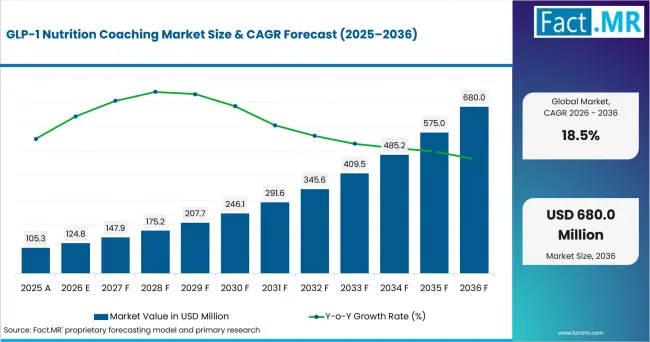
Glp 1 Nutrition Coaching Market Value Analysis | Source: Fact.MR
What are the defining numbers behind GLP-1 Nutrition Coaching Market growth?
USD 555.2 million absolute opportunity is expected by 2036.
- Demand Drivers in the Market
- Medication users need protein plans when appetite falls. Coaching programs are expected to help users protect diet quality while GLP-1 treatment changes meal size.
- Employers and health plans are expected to fund services that reduce unsafe self-management. GLP-1 obesity home delivery injectables are expected to make follow-up nutrition support more visible outside the clinic.
- Technology providers are expected to use apps and messaging to extend dietitian capacity. The value is clearer when digital transformation in healthcare improves handoffs instead of adding wellness content.
- Key Segments Analyzed
- By Coaching Model: Registered dietitian-led is expected to hold 38.3% share in 2026 because licensed dietitians can adjust guidance when symptoms and medication changes affect intake.
- By Nutrition Focus: Protein & muscle preservation is projected to account for 40.8% share in 2026 as care teams pay closer attention to weight-loss quality.
- By Delivery Channel: Mobile app is anticipated to capture 37.4% share in 2026 since users need food guidance and message access during daily meal decisions.
- By End User: Employers are estimated to represent 36.2% share in 2026 due to benefit programs that combine GLP-1 access with wellbeing support.
- Analyst Opinion at Fact.MR
- Shambhu Nath Jha, Sr. Consultant at Fact.MR, states, “GLP-1 nutrition coaching has to prove that lower appetite does not reduce diet quality. Commercial acceptance is expected to depend on dietitian access, escalation rules and maintenance support after early weight loss slows.”
- Strategic Implications
- Care providers should establish clear points for starting dietitian support and escalating symptoms. Telehealth therapy services can make nutrition visits easier to integrate into the wider care plan.
- Program sponsors can assess protein intake and hydration alongside weight change. The mobile application layer adds value when users receive practical support between dietitian sessions.
- Platform operators should prepare for weight regain after dose reduction or discontinuation. GLP-1 aftercare and metabolic continuity services become more effective when maintenance coaching begins before routine support ends.
The USA is expected to record an 18.7% CAGR from 2026 to 2036 with employer benefit design and virtual dietitian access. The UK is projected to record an 18.3% CAGR as NHS pathway expectations shape evidence review. Germany is anticipated to grow at 18.0% during the same period through privacy and reimbursement checks. Canada is estimated to post a 17.7% CAGR where provincial benefit variation affects access. Australia is forecast at 17.4% supported by remote-care demand and professional oversight.
How does the GLP-1 Nutrition Coaching Market break down by segment?
Registered dietitian-led is expected to lead Coaching Model at 38.3% share in 2026. Protein & muscle preservation is projected to lead Nutrition Focus at 40.8% share in 2026.
Which coaching model dominates?
Registered dietitian-led is projected to account for 38.3% share in 2026.
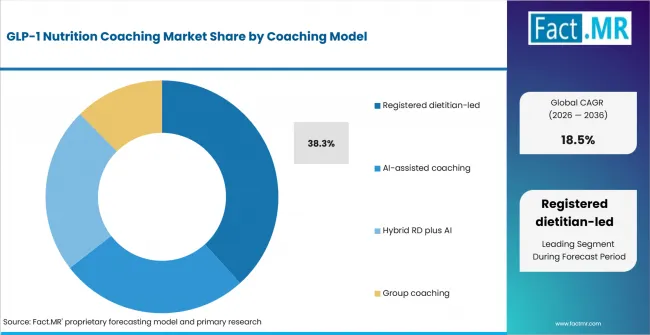
Glp 1 Nutrition Coaching Market Analysis By Coaching Model | Source: Fact.MR
Licensed dietitians lead because GLP-1 users often need support that changes with treatment. Appetite loss and digestive symptoms can affect food intake during the program. Dietitians can adjust meal plans and identify when clinical review is appropriate. AI-assisted coaching remains useful for routine reminders and basic follow-up. Hybrid RD plus AI models help providers extend service capacity. Group coaching offers a lower-cost route for users who require education and accountability rather than intensive clinical support.
What leads the Nutrition Focus segment?
Protein & muscle preservation is expected to hold 40.8% share in 2026.
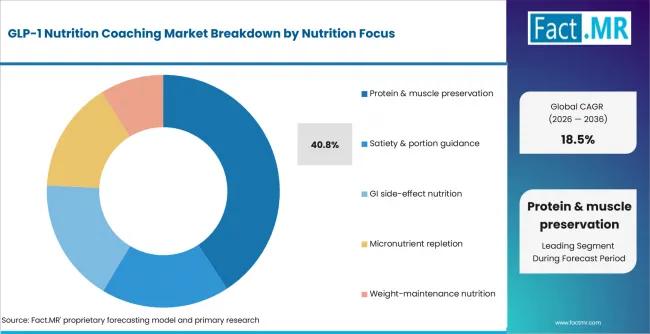
Glp 1 Nutrition Coaching Market Analysis By Nutrition Focus | Source: Fact.MR
Rapid weight loss can increase the risk of lean-tissue loss and reduced strength. Protein planning therefore becomes a core part of nutrition support. Users with lower appetite may struggle to meet daily intake targets. Satiety guidance remains relevant when meal portions change during treatment. GI side-effect nutrition supports users dealing with nausea or constipation.
How does Delivery Channel shape demand?
Mobile app is anticipated to lead with 37.4% share in 2026.
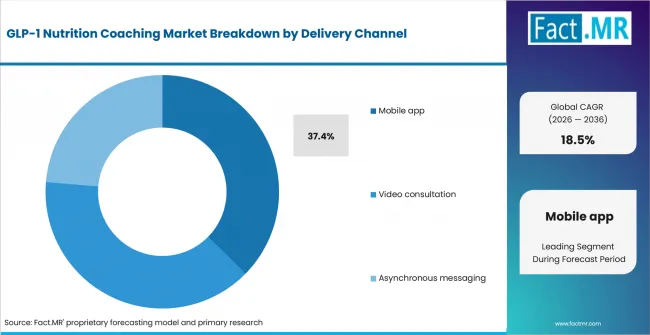
Glp 1 Nutrition Coaching Market Analysis By Delivery Channel | Source: Fact.MR
Mobile apps keep nutrition support available during daily food decisions. Users can review meal plans and record symptoms without waiting for the next session. Progress tracking also helps coaches identify changes between appointments. Video consultation remains important for detailed clinical review and personalized planning. Asynchronous messaging supports quick questions and minor adjustments.
What supports Employers within End User?
Employers are estimated to represent 36.2% share in 2026.
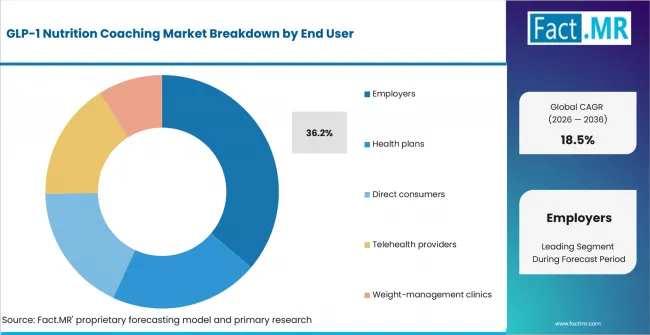
Glp 1 Nutrition Coaching Market Analysis By End User | Source: Fact.MR
Employer-funded programs can link nutrition coaching with wider weight-management benefits. This approach helps sponsors support treatment while keeping medication spending under review. Programs may also include metabolic monitoring and long-term maintenance guidance. Health plans remain important because coverage rules influence access and reimbursement. Direct consumers add self-pay demand when faster entry is preferred.
What is accelerating GLP-1 Nutrition Coaching Market adoption, and what is holding it back?
Demand is expected to be driven by lean-mass protection and nutrition-related side effects. Adoption is expected to be held back by dietitian shortages and unclear boundaries with medical care.
Drivers Impact Analysis
| DRIVER | QUALITATIVE IMPACT | GEOGRAPHIC RELEVANCE | IMPACT TIMELINE |
|---|---|---|---|
| Need to preserve lean mass | High | Global | Short term (<= 2 years) |
| Nutrition-related side effects | High | Global | Short term (<= 2 years) |
| Wraparound obesity care | Medium | Global | Medium term (2-4 years) |
| Employer and payer interest | Medium | USA and enterprise markets | Medium term (2-4 years) |
Source: Fact.MR analysis. Updated Jul 27, 2026
- Need to preserve lean mass: GLP-1 users often need a clear protein plan while food intake falls. Programs that monitor diet quality are expected to receive stronger review than engagement-only home healthcare tools.
- Nutrition-related side effects: Nausea and constipation change how people eat during dose changes. Practical hydration and meal-timing advice therefore becomes part of safer medication support.
- Wraparound obesity care: Medicines are expected to perform better when diet and activity support are part of the plan. Coaching gives clinical teams a repeatable pathway for users who need more than a prescription.
- Employer and payer interest: Sponsors want services that help members use high-cost therapy safely. The service case improves when coaching continues after early weight loss slows.
Opportunity Impact Analysis
| OPPORTUNITY | QUALITATIVE IMPACT | GEOGRAPHIC RELEVANCE | IMPACT TIMELINE |
|---|---|---|---|
| Dietitian capacity extension | High | Global | Short term (<= 2 years) |
| Muscle-preservation pathways | Medium | USA and UK | Medium term (2-4 years) |
| Maintenance coaching | Medium | Global | Medium term (2-4 years) |
Source: Fact.MR analysis. Updated Jul 27, 2026
- Dietitian capacity extension: AI-assisted preparation and asynchronous messaging are expected to reduce low-value admin work. Dietitians can then spend more time on complex cases and escalation decisions.
- Muscle-preservation pathways: Programs that combine protein goals with movement prompts can stand out with GLP-1 users. This expands demand beyond weight tracking toward practical coaching for strength and function.
- Maintenance coaching: Support after dose reduction or discontinuation can address appetite return. Providers that plan this stage early are expected to reduce churn risk and improve long-term program value.
Restraints Impact Analysis
| RESTRAINT | QUALITATIVE IMPACT | GEOGRAPHIC RELEVANCE | IMPACT TIMELINE |
|---|---|---|---|
| Shortage of qualified dietitians | High | Global | Short term (<= 2 years) |
| Unclear boundary with medical care | High | Regulated and payer-funded markets | Medium term (2-4 years) |
| Engagement fatigue | Medium | Global | Medium term (2-4 years) |
Source: Fact.MR analysis. Updated Jul 27, 2026
- Shortage of qualified dietitians: Licensed nutrition professionals remain difficult to recruit in some markets. Capacity limits are expected to raise waiting times and pressure platforms to use triage carefully.
- Unclear boundary with medical care: Nutrition advice must not replace medication decisions or management of severe adverse effects. Vendors need escalation rules that protect users and keep clinical responsibility visible.
- Engagement fatigue: Frequent tracking can become burdensome when users already manage medication and clinical appointments. Programs need lighter workflows that keep support useful without adding daily friction.
Which countries are scaling GLP-1 Nutrition Coaching Market fastest?
The country comparison is shaped by service coverage and reimbursement fit. The total spread between the USA and Australia is 1.30% points. The USA and UK form the upper pair. Germany follows close behind through evidence and privacy requirements. Canada and Australia remain slightly lower as local funding and professional access shape scale.
- The USA shows the highest listed rate because employer programs and virtual care channels make nutrition support easier to attach to GLP-1 treatment.
- The UK remains close to the USA because pathway discipline favors coaching models that work beside medicine access and preserve non-digital support options.
- Germany holds a measured position where evidence review and information security shape procurement for digital nutrition services.
- Canada’s rate reflects provincial delivery differences that reward platforms able to localize referrals and insurance access.
- Australia stands slightly below Canada because remote-care demand helps access while professional oversight still shapes adoption speed.
Comparable CAGRs can therefore produce different market entry conditions across these countries. Deployment timing depends on benefit design and service localization. Commercial readiness still reflects dietitian capacity and clinical escalation rules.
The full report provides country-level CAGR analysis across North America, Latin America, Europe, East Asia, South Asia, Oceania and the Middle East and Africa.
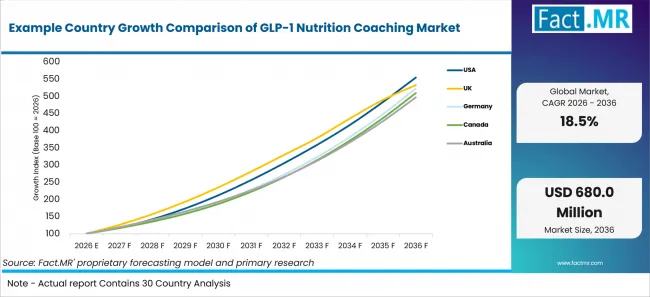
Example Country Growth Comparison Of Glp 1 Nutrition Coaching Market | Source: Fact.MR
| Country | CAGR (2026-2036) |
|---|---|
| USA | 18.7% |
| UK | 18.3% |
| Germany | 18.0% |
| Canada | 17.7% |
| Australia | 17.4% |
Source: Fact.MR analysis. Updated Jul 27, 2026
What supports USA adoption?
18.7% CAGR, supported by employer purchasing and virtual dietitian access.
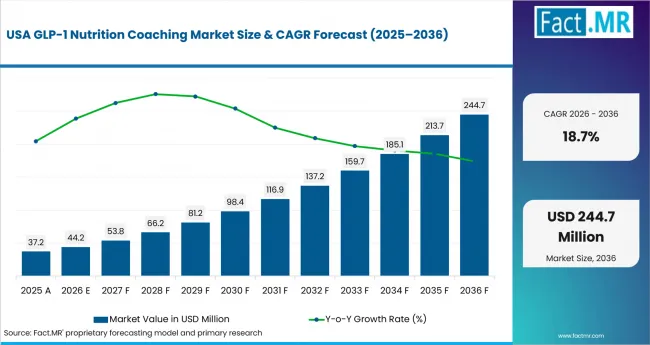
Glp 1 Nutrition Coaching Market Country Value Analysis | Source: Fact.MR
The USA’s growth reflects a benefits market where employers can connect GLP-1 access with structured nutrition support. Virtual dietitian networks make it easier to serve members across large and dispersed workforces. Platforms that combine professional guidance with app-based follow-up are expected to gain stronger acceptance among employers and health plans.
How is the UK scaling demand?
18.3% CAGR, driven by pathway discipline and evidence expectations.
The UK’s growth is supported by structured obesity-care pathways that connect medicine use with nutrition guidance. Providers can strengthen their role by documenting dietitian input and supporting users through appetite changes. Services that combine digital access with professional review are expected to fit more naturally into wider weight-management programs.
What is driving Germany’s growth from 2026 to 2036?
18.0% CAGR, backed by privacy controls and structured reimbursement review.
Germany’s growth reflects demand for evidence-based digital health services with strong data protection. Providers can build trust by showing how dietitian records and care updates move securely through the treatment pathway. Structured reimbursement review also creates a clear route for platforms that demonstrate measurable value and professional oversight.
How is Canada developing demand?
17.7% CAGR, driven by provincial delivery and benefit variation.
Canada’s growth is shaped by flexible service models that can adapt to provincial coverage and local dietitian availability. Virtual coaching helps extend support beyond major urban centers and across large geographic areas. Platforms that localize referral pathways and insurance navigation are expected to strengthen adoption across different provincial markets.
How does Australia perform?
17.4% CAGR, led by remote-care demand and professional oversight.
Australia’s growth reflects the value of virtual nutrition support across widely dispersed populations. Remote consultations make accredited dietitian guidance more accessible during GLP-1 treatment. Platforms that combine telehealth delivery with clear maintenance pathways are expected to support wider use across metropolitan and regional areas.
Who leads the GLP-1 Nutrition Coaching Market?
Nourish and Fay Nutrition show the clearest direct nutrition-care focus. Noom strengthens the wider behavior-change and GLP-1 companion field.
Nourish and Fay Nutrition operate through registered dietitian access and virtual nutrition counseling. Season Health contributes a food-as-medicine and nutrition-care model. Berry Street and Culina Health extend the field through licensed dietitian networks and insurance-connected nutrition therapy.
Which companies are the key providers?
Key companies include Nourish, Fay Nutrition, Season Health, Noom, Berry Street, and Culina Health.
- Nourish
- Fay Nutrition
- Season Health
- Noom
- Berry Street
- Culina Health
Bibliography
- Noom. (2026, June 24). Noom launches free version of its powerful GLP-1 Companion.
- World Health Organization. (2025, December 1). WHO issues global guideline on the use of GLP-1 medicines in treating obesity.
- NHS England. (2025, March 27). Interim commissioning guidance: Implementation of NICE technology appraisal TA1026 and the NICE funding variation for tirzepatide for the management of obesity.
- U.S. Food and Drug Administration. (2025, January). Obesity and overweight: Developing drugs and biological products for weight reduction.
- Fay Nutrition. (2025, October 9). 7-day semaglutide diet plan: Dietitian approved.
This Report Answers
- The report provides strategic intelligence on the GLP-1 Nutrition Coaching Market across Coaching Model and Nutrition Focus choices that shape digital obesity-care support.
- Segment analysis covers Registered dietitian-led coaching and Protein & muscle preservation as the share leaders within the 2026 market.
- Country outlook evaluates the USA and UK alongside Germany and Canada. Australia completes the growth comparison across the profiled markets.
- Competitive analysis profiles Nourish and Fay Nutrition alongside Season Health and Noom. Berry Street and Culina Health complete the provider set.
- Care-model assessment covers Mobile app delivery and employer-funded access. Video consultation and asynchronous messaging complete the delivery view alongside health-plan and direct-consumer channels.
What does the GLP-1 Nutrition Coaching Market cover?
Digital and virtual nutrition coaching services support people using GLP-1 medicines when appetite and meal tolerance change during treatment.
The GLP-1 Nutrition Coaching Market covers registered dietitian-led care and AI-assisted coaching. Hybrid RD plus AI models and group coaching are included. Coverage extends to protein and muscle preservation. Satiety guidance and GI side-effect nutrition are included. Micronutrient repletion and weight-maintenance nutrition complete the service boundary.
The market differs from general wellness apps because commercial value comes from GLP-1-specific nutrition support and clear escalation into clinical care. General calorie tracking remains outside the boundary. Drug prescribing and pharmacy fulfillment are excluded. Unrelated fitness and food delivery services are excluded unless they directly support a GLP-1 nutrition coaching program.
What is included in the scope?
GLP-1 nutrition coaching services are used across employers and health plans. Direct consumers, telehealth providers and weight-management clinics are included.
The scope includes Coaching Model and Nutrition Focus alongside Delivery Channel, End User and Region. Coverage spans registered dietitian-led and AI-assisted coaching. Hybrid RD plus AI and group coaching complete the coaching model scope. Protein preservation, GI side-effect support and weight maintenance are included. Mobile app, video consultation and asynchronous messaging follow the same structured-coaching rule.
What is excluded from the scope?
Medication sales, prescribing revenue and standalone wellness content remain outside the scope of this market.
The scope excludes services that do not address GLP-1-specific nutrition needs. Standalone meal logging and generic diet plans are excluded. Pharmacy fulfillment and drug delivery are excluded unless demand depends on attached nutrition coaching. General telehealth spending remains outside the scope unless demand depends on GLP-1 nutrition support. Company revenue without a clear role in structured GLP-1 nutrition coaching is excluded.
How Was the Analysis Built?
The analysis draws on 120+ sources, 35+ company portfolios, 25+ countries, and more than 20 industry interviews.
- Primary Research: Primary research includes discussions with manufacturers, service providers, technology developers, distributors, end users, procurement teams, and subject-matter experts. These conversations examine purchasing priorities, product adoption, operational challenges, approval requirements, competitive positioning, and the factors that influence wider market acceptance.
- Desk Research: Desk research covers government statistics, regulatory publications, company filings, trade data, technical studies, industry associations, standards, public policy, and other authoritative sources. Every source used in the analysis is documented in the bibliography.
- Market Sizing and Forecasting: Market estimates combine historical performance, demand indicators, pricing and volume trends, segment shares, company participation, country-level growth, adoption patterns, investment activity, and barriers to market expansion.
- Data Validation and Update Cycle: Findings are validated by comparing primary interviews with public data, company activity, regulatory changes, trade patterns, and industry developments. Regular updates review new product launches, capacity changes, partnerships, approvals, procurement trends, and shifts in commercial adoption.
Segmentation
What is the report’s scope and coverage?
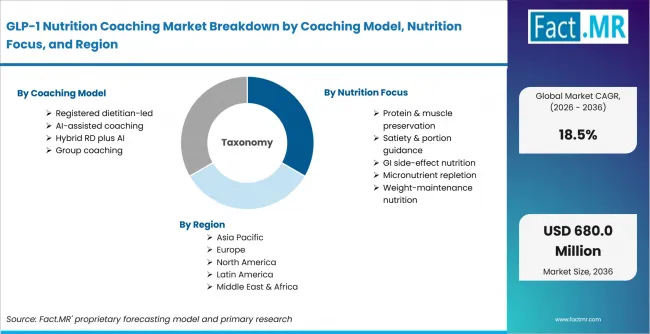
Glp 1 Nutrition Coaching Market Breakdown By Coaching Model, Nutrition Focus, And Region | Source: Fact.MR
| Attribute | Details |
|---|---|
| Quantitative Units | USD 124.8 million in 2026 to USD 680.0 million by 2036 at 18.5% CAGR |
| Market Definition | Digital and virtual services that provide structured nutrition guidance to people using GLP-1 medicines. The scope includes dietitian-led care and AI-assisted support. Protein guidance, micronutrient guidance, gastrointestinal symptom nutrition and weight-maintenance planning are included. |
| Coaching Model | Registered dietitian-led; AI-assisted coaching; Hybrid RD plus AI; Group coaching |
| Nutrition Focus | Protein & muscle preservation; Satiety & portion guidance; GI side-effect nutrition; Micronutrient repletion; Weight-maintenance nutrition |
| Delivery Channel | Mobile app; Video consultation; Asynchronous messaging |
| End User | Employers; Health plans; Direct consumers; Telehealth providers; Weight-management clinics |
| Regions Covered | North America; Latin America; Europe; East Asia; South Asia and Pacific; Middle East and Africa |
| Countries Covered | USA; UK; Germany; Canada; Australia |
| Key Companies Profiled | Nourish; Fay Nutrition; Season Health; Noom; Berry Street; Culina Health |
| Forecast Period | 2026 to 2036 |
| Approach | Hybrid top-down and bottom-up approach using service adoption signals; GLP-1 care pathway requirements; registered dietitian capacity; nutrition-focus needs; delivery-channel use; employer and health-plan access; country adoption patterns and company portfolio review |
Source: Fact.MR analysis. Updated Jul 27, 2026
How is the market segmented?
-
By Coaching Model:
- Registered dietitian-led
- AI-assisted coaching
- Hybrid RD plus AI
- Group coaching
-
By Nutrition Focus:
- Protein & muscle preservation
- Satiety & portion guidance
- GI side-effect nutrition
- Micronutrient repletion
- Weight-maintenance nutrition
-
By Delivery Channel:
- Mobile app
- Video consultation
- Asynchronous messaging
-
By End User:
- Employers
- Health plans
- Direct consumers
- Telehealth providers
- Weight-management clinics
-
By Region:
- North America
- Europe
- South Asia & Oceania
Frequently Asked Questions
Which Coaching Model leads the market?
Which Nutrition Focus leads the market?
Which Delivery Channel leads the market?
Which End User leads the market?
Which country records the highest listed CAGR?
What is the primary driver in this market?
What is the main restraint?
Why do employers lead demand?
Which companies are included in the named provider set?
Who worked on this report


Preview the report firsthand - request a free sample
Free SampleGet the brochure for pricing and purchase details
Download PDF