- Market Value (2025): USD 106.3 Mn
- Estimated Value (2026): USD 126.1 Mn
- Forecast Value (2036): USD 699.0 Mn
- CAGR (2026-2036): 18.7%
What is the GLP-1 Integrated Gyms Market forecast to be worth by 2036?
USD 126.1 million in 2026 to USD 699.0 million by 2036, registering a CAGR of 18.7%.
- Fact.MR estimates that the GLP-1 integrated gyms market was valued at USD 106.3 million in 2025.
- Demand is forecast to increase from USD 126.1 million in 2026 to USD 699.0 million by 2036.
- The market is forecast to grow at a 18.7% CAGR during 2026–2036 as fitness providers develop services for people using GLP-1 medications.
| Year | Basis | Market Value (USD million) |
|---|---|---|
| 2025 | Actual* | 106.3 |
| 2026 | Estimate | 126.1 |
| 2036 | Forecast | 699.0 |
| CAGR 2026 to 2036 | Forecast period | 18.7% |
Source: Fact.MR analysis. Updated Nov 11, 2026
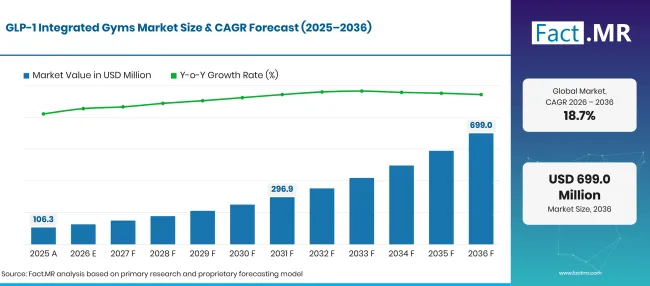
Glp 1 Integrated Gyms Market Forecast Global | Source: Fact.MR
What are the defining numbers behind GLP-1 Integrated Gyms Market growth?
the forecast represents an increase of USD 572.9 million between 2026 and 2036.
- Demand Drivers in the Market
- Clinical guidance increasingly recommends combining obesity medication with adequate nutrition and muscle-strengthening activity. The American Diabetes Association recommends adequate protein intake and muscle-strengthening activity to help minimize muscle loss during weight reduction among adults treated with obesity medications.
- The World Health Organization conditionally recommends offering intensive behavioral interventions, including structured healthy eating and physical activity programs, to adults living with obesity who are prescribed GLP-1 therapies, based on low-certainty evidence. This supports demand for fitness providers that can complement medical weight-management plans with supervised exercise.
- Gyms are exploring clinical referral arrangements and in-club wellness services to support members using weight-management medication. Life Time and Equinox have introduced initiatives connected to GLP-1 users, illustrating how fitness operators are developing services beyond conventional gym access.
- Employers and consumers are showing interest in programs that combine exercise with nutrition and behavior support.
- Key Segments Analyzed
- By GLP-1 Gym Support Program: Resistance / Lean Mass leads with a 31.4% share in 2026, reflecting the focus on strength training during medication-assisted weight reduction.
- By Access / Commercial Model: Monthly Membership accounts for 26.2% of the market in 2026, supported by recurring access to fitness facilities and ongoing coaching.
- By Operating Setting: Outdoor / Nature Venue is assigned a 30.4% share in the Fact.MR 2026 forecast. This estimate requires confirmation from the underlying segment dataset.
- By Core Visitor Group: Working Professionals account for 32.6% of the market in 2026, reflecting demand for structured fitness support that can fit around work schedules.
- Analyst Opinion at Fact.MR
- Shambhu Nath Jha, Principal Consultant at Fact.MR, states, “GLP-1 integrated gyms are creating a more specialized role for fitness providers within weight-management journeys. Operators that combine resistance training with nutrition guidance and appropriate clinical referral pathways can address member needs beyond weight reduction. Consistent coaching and flexible access will be important to sustaining participation.”
- Strategic Implications
- Gym operators should develop structured resistance-training programs that can be adjusted to members’ fitness levels and changing exercise capacity during GLP-1 treatment.
- Fitness professionals need to receive training on the exercise considerations relevant to medication-assisted weight management and know when a member needs guidance from a qualified healthcare professional.
- Wellness platforms can build partnerships with gyms and nutrition providers to make fitness access and ongoing behavior support easier to coordinate.
- Commercial fitness chains should offer flexible membership options and measurable progress tracking to encourage continued participation beyond the initial weight-loss phase.
- Clinical partners must establish clear referral and communication processes while keeping medication decisions and clinical monitoring under the responsibility of qualified healthcare professionals.
The USA is projected to record an 18.2% CAGR through 2036. China is set to grow at 20.8%, followed by South Korea at 19.6%. Germany is forecast to expand at 17.4%, while Japan is expected to record a 17.1% CAGR.
How does the GLP-1 Integrated Gyms Market break down by segment?
Fact.MR finds that Resistance / Lean Mass leads the GLP-1 Gym Support Program segment at 31.4%; Monthly Membership leads Access / Commercial Model at 26.2%; Outdoor / Nature Venue Leads Operating Setting at 30.4%; and Working Professionals Lead Core Visitor Group at 32.6%.
Which GLP-1 Gym Support Program dominates?
Resistance / Lean Mass is set to hold a 31.4% share in 2026.
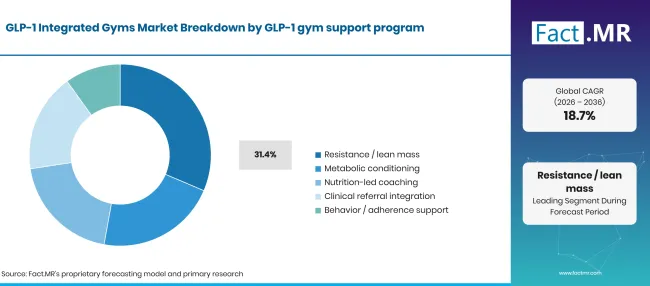
Glp 1 Integrated Gyms Market Breakdown Glp 1 Gym Support Program | Source: Fact.MR
| GLP-1 Gym Support Program | Share (2026) |
|---|---|
| Resistance / Lean Mass (Leading segment) | 31.4% |
| Other segments combined | 68.6%* |
| Total | 100.0% |
Source: Fact.MR analysis. Updated Nov 11, 2026
Resistance and lean-mass support leads because preserving strength and physical function has become an important consideration during medication-assisted weight reduction. The American Diabetes Association recommends muscle-strengthening activity alongside adequate protein intake for people using obesity medications. Gyms can respond through supervised strength programs with progression suited to individual ability.
What leads the Access / Commercial Model segment?
Monthly Membership is set to represent a 26.2% share in 2026.
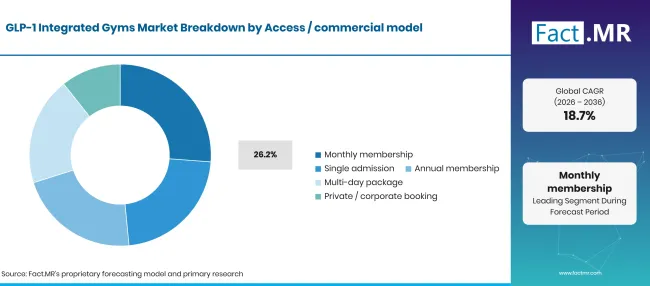
Glp 1 Integrated Gyms Market Breakdown Access Commercial Model | Source: Fact.MR
| Access / Commercial Model | Share (2026) |
|---|---|
| Monthly Membership (Leading segment) | 26.2% |
| Other segments combined | 73.8%* |
| Total | 100.0% |
Source: Fact.MR analysis. Updated Nov 11, 2026
Monthly membership supports repeated access to gym facilities and coaching rather than limiting participation to occasional sessions. Members following a longer-term weight-management plan may value continuity in exercise routines and progress reviews. Operators can strengthen this model by including optional personal training and nutrition support within membership tiers.
How does Operating Setting shape demand?
Outdoor / Nature Venue is likely to account for a 30.4% share in 2026.
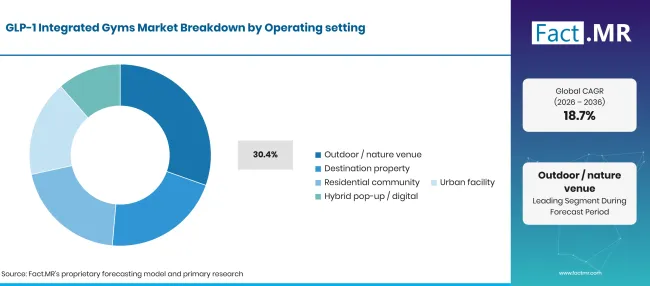
Glp 1 Integrated Gyms Market Breakdown Operating Setting 1 | Source: Fact.MR
| Operating Setting | Share (2026) |
|---|---|
| Outdoor / Nature Venue (Leading segment) | 30.4% |
| Other segments combined | 69.6%* |
| Total | 100.0% |
Source: Fact.MR analysis. Updated Nov 11, 2026
Outdoor and nature-based venues provide options for walking and group conditioning in addition to conventional gym workouts. These settings can appeal to members seeking varied activity formats and lower-intensity exercise options. Urban facilities remain important because they offer access to equipment and supervised resistance training, while hybrid models can combine in-person sessions with digital support.
Which Core Visitor Group accounts for the largest share?
Working Professionals are set to account for a 32.6% share in 2026.
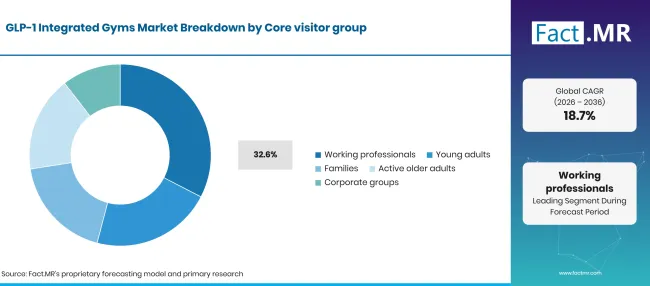
Glp 1 Integrated Gyms Market Breakdown Core Visitor Group | Source: Fact.MR
| Core Visitor Group | Share (2026) |
|---|---|
| Working Professionals (Leading segment) | 32.6% |
| Other segments combined | 67.4%* |
| Total | 100.0% |
Source: Fact.MR analysis. Updated Nov 11, 2026
Working professionals form the leading visitor group because structured fitness services can be scheduled around employment commitments. Monthly memberships and private or corporate bookings can provide access to recurring sessions. Gyms can improve engagement through flexible class timings and progress tracking, while avoiding assumptions that all members using GLP-1 medication have the same fitness requirements.
What is accelerating GLP-1 Integrated Gyms Market adoption, and what is holding it back?
Demand is supported by the need to combine medication-assisted weight reduction with strength training and lifestyle support. However, affordability and the need for qualified coaching can limit access.
Drivers Impact Analysis
| DRIVER | Approx. % IMPACT ON CAGR | GEOGRAPHIC RELEVANCE | IMPACT TIMELINE |
|---|---|---|---|
| Demand for resistance training during GLP-1 treatment | +1.2% | North America, Europe | Short term (≤ 2 years) |
| Expansion of integrated weight-management programs | +1.0% | North America, Asia | Medium term (2–4 years) |
| Growth in clinical referral partnerships | +0.8% | North America, Europe | Medium term (2–4 years) |
| Nutrition and behavior coaching integration | +0.7% | Global | Medium term (2–4 years) |
| Corporate wellness and fitness benefits | +0.5% | North America, Europe, Asia | Long term (≥ 4 years) |
Source: Fact.MR analysis. Updated Nov 11, 2026
Opportunity Impact Analysis
| OPPORTUNITY | Approx. % IMPACT ON CAGR | GEOGRAPHIC RELEVANCE | IMPACT TIMELINE |
|---|---|---|---|
| Physician and clinic referral networks | +0.9% | North America, Europe | Medium term (2–4 years) |
| Specialized lean-mass training packages | +0.8% | Global | Short term (≤ 2 years) |
| Corporate GLP-1 wellness support programs | +0.7% | North America, Asia | Medium term (2–4 years) |
| Digital progress tracking and coaching | +0.6% | Global | Long term (≥ 4 years) |
| Outdoor and hybrid fitness formats | +0.4% | Europe, Asia | Long term (≥ 4 years) |
Source: Fact.MR analysis. Updated Nov 11, 2026
Restraints Impact Analysis
| RESTRAINT | Approx. % IMPACT ON CAGR | GEOGRAPHIC RELEVANCE | IMPACT TIMELINE |
|---|---|---|---|
| High cost of premium gym memberships and coaching | -0.8% | North America, Europe | Short term (≤ 2 years) |
| Limited availability of GLP-1-informed trainers | -0.6% | Global | Medium term (2–4 years) |
| Uncertainty around long-term medication use | -0.5% | Global | Medium term (2–4 years) |
| Clinical liability and referral coordination | -0.4% | North America, Europe | Long term (≥ 4 years) |
Source: Fact.MR analysis. Updated Nov 11, 2026
Which countries are scaling the GLP-1 Integrated Gyms Market through 2036?
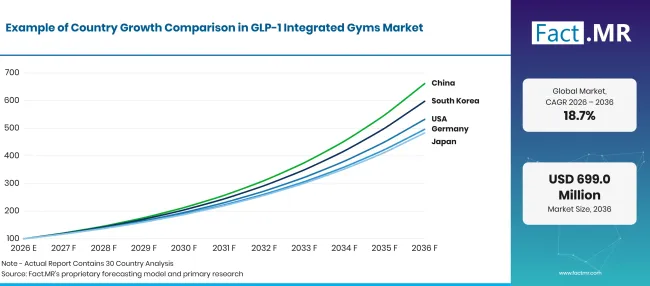
Glp 1 Integrated Gyms Market Growth Index | Source: Fact.MR
| Country | CAGR (2026–2036) |
|---|---|
| China | 20.8% |
| South Korea | 19.6% |
| USA | 18.2% |
| Germany | 17.4% |
| Japan | 17.1% |
Source: Fact.MR analysis. Updated Nov 11, 2026
What supports China’s market growth?
20.8% CAGR, supported by rising weight-management needs and opportunities for structured fitness services.
China's adult obesity burden and expanding focus on weight management create opportunities for fitness providers to develop specialized exercise services. A 2026 analysis published in China CDC Weekly found that the age-standardized prevalence of obesity among adults increased to 18.1% in 2024, compared with 3.7% in 1991. Gyms can respond through accessible strength-training programs and nutrition-led coaching, with clinical referrals where appropriate.
How is South Korea developing the market?
19.6% CAGR, driven by rising obesity levels and demand for personalized fitness support.
South Korea's growing obesity burden is increasing the relevance of structured weight-management services. The Korea Disease Control and Prevention Agency reported a self-reported adult obesity prevalence of 34.4% in the 2024 Community Health Survey, using a body mass index threshold of 25 kg/m². Fitness operators can address this need through strength-focused programs and flexible membership plans, while adapting exercise intensity to individual capacity.
What supports United States market growth?
18.2% CAGR, shaped by established fitness chains and emerging GLP-1-specific services.
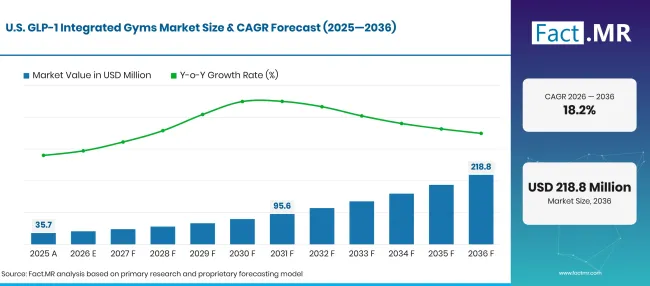
Glp 1 Integrated Gyms Market Forecast Usa | Source: Fact.MR
The United States has an established market for gym memberships and personal training, while fitness operators are beginning to adapt services for people using weight-management medications. The CDC's 2025 adult obesity maps show that obesity prevalence remained above 25% in nearly all states and territories with available data. Life Time and Equinox have introduced initiatives for GLP-1 users, including clinical wellness services and coach training.
How is Germany building market demand?
17.4% CAGR, led by health-conscious consumers and demand for structured physical activity.
Germany's market opportunity is supported by the need for preventive health services and personalized exercise programs. OECD data for 2025 indicate that 15% of adults in Germany did not perform sufficient physical activity, while self-reported obesity prevalence stood at 17%. Fitness providers can strengthen their offerings through supervised resistance training and programs that connect exercise with broader wellness support.
What supports Japan market development?
17.1% CAGR, backed by demand for strength maintenance and accessible fitness services.
Japan's aging population and focus on maintaining physical function create opportunities for gyms to offer individualized strength and conditioning programs. The country's 2024 National Health and Nutrition Survey provides a recent basis for monitoring adult weight-related health indicators. Fitness operators can focus on gradual resistance training and coaching suited to different age groups, while supporting members who require additional clinical guidance.
Who leads the GLP-1 Integrated Gyms Market?
Fact.MR profiles Life Time, Equinox, F45 Training, Planet Fitness and UFC GYM across the fitness and wellness ecosystem serving consumers interested in GLP-1-related weight management. Their roles differ: Life Time and Equinox have identifiable GLP-1-related initiatives. Life Time has incorporated GLP-1 access into its MIORA performance and longevity offering, connecting medical guidance with fitness and wellness services.
Commercial competition will depend on the ability to deliver safe and consistent exercise support. Gym operators need trained professionals and suitable resistance-training equipment. Wellness platforms can expand access through employer partnerships, while technology providers can support workout personalization and progress tracking. Clinical partnerships may help connect fitness services with appropriate medical oversight.
Which companies are the key providers?
The companies covered in this market include: Life Time, Inc., Equinox, F45 Training, Planet Fitness, and UFC GYM.
- Life Time, Inc.
- Equinox
- F45 Training
- Planet Fitness
- UFC GYM
Bibliography
- American Diabetes Association Professional Practice Committee for Obesity. (2026, January 13). Pharmacologic treatment of obesity in adults: Standards of care in overweight and obesity. Diabetes, Obesity, and CardioMetabolic CARE, 1(1), 5–36. https://doi.org/10.2337/doci25-0008.
- Centers for Disease Control and Prevention. (2026, September 24). Adult Obesity Prevalence Maps.
- China CDC Weekly. (2026, October 8). Long-Term Trends and Regional Heterogeneity in Overweight and Obesity Among Adults — 11 Intermittent Surveys in China, 1991–2024..
- Korea Disease Control and Prevention Agency. (2025, November 25). One in Three Korean Adults Is Obese, a 30.8% Increase Over the Past Decade.
- Life Time. (n.d.). MIORA Performance & Longevity..
- Life Time Group Holdings, Inc. (2025). MIORA Performance & Longevity.
- Ministry of Health, Labour and Welfare, Japan. (2025, December 2). 令和6年国民健康・栄養調査の結果 [Results of the 2024 National Health and Nutrition Survey]..
- Organisation for Economic Co-operation and Development. (2025, November 13). Health at a Glance 2025: Germany..
- World Health Organization. (2025, December 1). WHO issues global guideline on the use of GLP-1 medicines in treating obesity..
This Report Answers
- The report examines how gyms and wellness providers are adapting fitness services for people using GLP-1-based weight-management medications.
- Segment analysis compares the specified exercise support programs and commercial access models.
- Country analysis covers the USA, China, Japan, Germany and South Korea.
- The competitive overview profiles Life Time, Equinox, F45 Training, Planet Fitness and UFC GYM.
- Operating-setting analysis compares outdoor venues, destination properties, residential communities, urban facilities and hybrid formats.
What does the GLP-1 Integrated Gyms Market cover?
The market covers gym-based fitness services and wellness programs designed to complement GLP-1-assisted weight management. It includes resistance training and metabolic conditioning alongside nutrition-led coaching and behavior support. It also considers clinical referral integration and commercial access models that enable individuals to participate in structured fitness activities during their weight-management journey.
What is included in the scope?
Included services are fitness programs and gym-based support specifically positioned for individuals using GLP-1 medications or seeking related weight-management assistance.
The scope includes supervised strength training and metabolic conditioning as well as nutrition-led guidance and adherence support. It also covers relevant membership models and fitness delivery settings.
What is excluded from the scope?
The analysis excludes revenue from GLP-1 medicines and pharmaceutical manufacturing.
It also excludes standalone medical consultations and prescription services that are not part of a gym or fitness support offering. General gym memberships without a relevant GLP-1-related service proposition are not automatically classified as part of this market. Medical treatment and medication decisions remain outside the fitness provider's role.
How Was the Analysis Built?
The analysis draws on 120+ sources, 35+ company portfolios, 25+ countries and more than 20 industry interviews.
- Primary Research: Primary research includes discussions with gym operators and fitness service providers as well as wellness platforms, trainers, clinical partners and industry experts. These conversations examine program design and purchasing priorities alongside member engagement, commercial models, referral arrangements and operational challenges.
- Desk Research: Desk research covers clinical guidance and public health statistics as well as company disclosures, fitness industry developments, wellness platforms and relevant research publications. Sources used in the analysis are documented in the bibliography.
- Market Sizing and Forecasting: Market estimates combine historical performance and demand indicators with segment shares, pricing models, company participation and country-level growth. The analysis also considers GLP-1-related fitness services and the adoption of integrated wellness programs.
- Data Validation and Update Cycle: Findings are validated by comparing primary interviews with public data and company activity. Regular updates review new fitness programs and partnerships alongside service expansions and changes in commercial adoption.
Segmentation
What is the report’s scope and coverage?
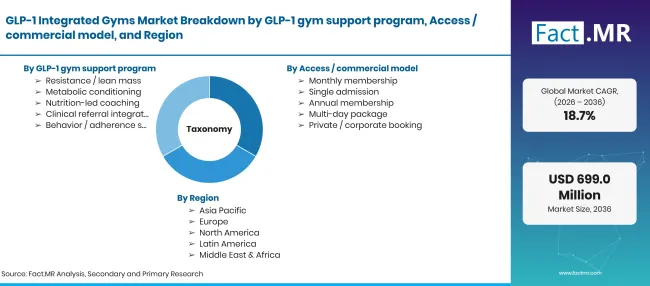
Glp 1 Integrated Gyms Market Taxonomy | Source: Fact.MR
| Attribute | Details |
|---|---|
| Quantitative Units | USD million |
| Market Definition | GLP-1 integrated gyms are specialized fitness facilities and wellness programs designed to complement medication-assisted weight management through structured exercise and lifestyle support. These offerings combine resistance training with metabolic conditioning and may include nutrition guidance and behavior coaching to help individuals maintain lean muscle mass and support long-term physical fitness during weight reduction. |
| GLP-1 Gym Support Program | Resistance / Lean Mass; Metabolic Conditioning; Nutrition-Led Coaching; Clinical Referral Integration; Behavior / Adherence Support |
| Access / Commercial Model | Monthly Membership; Single Admission; Annual Membership; Multi-Day Package; Private / Corporate Booking |
| Operating Setting | Outdoor / Nature Venue; Destination Property; Residential Community; Urban Facility; Hybrid Pop-Up / Digital |
| Core Visitor Group | Working Professionals; Young Adults; Families; Active Older Adults; Corporate Groups |
| Regions Covered | North America; Latin America; Western Europe; Eastern Europe; East Asia; South Asia & Pacific; Middle East & Africa |
| Countries Covered | USA; China; Japan; Germany; South Korea |
| Companies Profiled | Life Time, Inc.; Equinox; F45 Training; Planet Fitness; UFC GYM |
| Forecast Period | 2026 to 2036 |
| Approach | Market segmentation and scenario-based analysis supported by company disclosures, clinical guidance and country-level health indicators |
Source: Fact.MR analysis. Updated Nov 11, 2026
How is the market segmented?
-
By GLP-1 Gym Support Program
- Resistance / Lean Mass
- Metabolic Conditioning
- Nutrition-Led Coaching
- Clinical Referral Integration
- Behavior / Adherence Support
-
By Access / Commercial Model
- Monthly Membership
- Single Admission
- Annual Membership
- Multi-Day Package
- Private / Corporate Booking
-
By Operating Setting
- Outdoor / Nature Venue
- Destination Property
- Residential Community
- Urban Facility
- Hybrid Pop-Up / Digital
-
By Core Visitor Group
- Working Professionals
- Young Adults
- Families
- Active Older Adults
- Corporate Groups
-
By Region
- North America
- Latin America
- Western Europe
- Eastern Europe
- East Asia
- South Asia & Pacific
- Middle East & Africa
Frequently Asked Questions
How big is the GLP-1 Integrated Gyms Market in 2026?
What is the CAGR from 2026 to 2036?
Which GLP-1 Gym Support Program has the largest share?
Which commercial model leads the market?
Which operating setting has the largest share?
Which visitor group dominates the market?
Which countries are covered in the report?
Which companies are profiled?
Who worked on this report


Preview the report firsthand - request a free sample
Free SampleGet the brochure for pricing and purchase details
Download PDF