- Market Value (2025): USD 68.0 Mn
- Estimated Value (2026): USD 77.8 Mn
- Forecast Value (2036): USD 300.3 Mn
- CAGR (2026-2036): 14.5%
What is the Longevity Fitness Events Market forecast to be worth by 2036?
USD 77.8 million in 2026 to USD 300.3 million by 2036 at a 14.5% CAGR.
- Event organisers and participants put USD 68.0 million into longevity fitness events in 2025, with ticketed challenges and recurring community programs carrying most of that spend.
- Revenue will expand from USD 77.8 million in 2026 to USD 300.3 million by 2036 as festivals add repeat editions and membership formats spread into housing and workplace settings.
- A 14.5% CAGR reflects a young category scaling from a small base, where each new city edition or community program adds visible revenue.
| Year | Basis | Market Value (USD million) |
|---|---|---|
| 2025 | Actual | 68.0 |
| 2026 | Estimate | 77.8 |
| 2036 | Forecast | 300.3 |
| CAGR 2026 to 2036 | Forecast period | 14.5% |
Source: Fact.MR analysis. Updated Nov 12, 2026
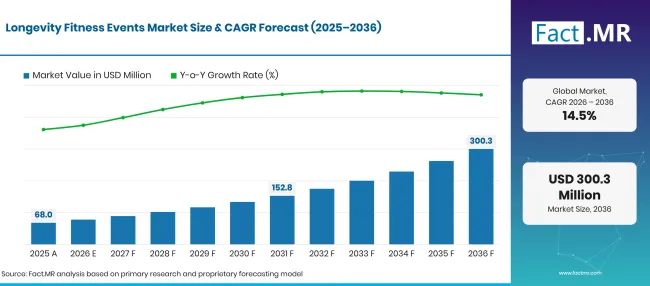
Longevity Fitness Events Market Forecast Global | Source: Fact.MR
What are the defining numbers behind Longevity Fitness Events Market growth?
An absolute opportunity of USD 222.5 million will open between 2026 and 2036, led by measurable challenge formats and recurring memberships.
- Demand Drivers in the Market
- Physical inactivity remains a wide public health gap that event formats can address. About 31% of adults do not meet recommended activity levels, and WHO notes that activity drops after age 60. Organizers can turn that gap into demand by offering strength, mobility and balance sessions that people can repeat and track over time.
- Participants want proof of progress, which favors events built around measurable tests. Grip strength, VO2 max, balance and functional strength trials give attendees a score they can try to beat at the next edition. Sponsors gain a clear stage for testing equipment and recovery tools.
- Employers are adding physical activity and preventive education to their wellness budgets. Private longevity sessions, team challenges and multi-session packages give organizers a source of booked revenue that does not rely on public ticket sales.
- Wearables, body scans and recovery technologies are widening what an event can offer. Organizers can stage live assessments and product demonstrations, which attract technology brands as exhibitors and commercial partners.
- Membership-based wellness communities keep participants returning between headline events. Subscription models, exclusive classes and ongoing training plans give organizers steadier income and better retention.
- Key Segments Analyzed
- By Event Format: Fitness Challenge will hold 26.0% share in 2026, since scored trials give participants a clear goal and a reason to return.
- By Access / Commercial Model: Monthly Membership will account for 27.5% of 2026 revenue as recurring access suits people who train between events.
- By Operating Setting: Residential Community will capture 29.2% in 2026, helped by on-site programs that remove travel from the decision to attend.
- By Core Visitor Group: Working Professionals will represent 27.5% of 2026 spend, given their interest in fitness, stress control and long-term health within tight schedules.
- Analyst Opinion at Fact.MR
- Shambhu Nath Jha, Principal Consultant at Fact.MR, states, “Longevity fitness events are moving away from lecture-led health conferences toward formats where people test their strength, balance and endurance and then come back to improve the score. Organizers that pair credible expert input with recurring programs will hold participants for longer than those relying on a single annual show. Pricing that keeps entry within reach of working adults and older participants will decide how far the category spreads beyond early adopters.”
- Strategic Implications
- Event organizers should design challenges with tiered difficulty so that first-time participants and seasoned athletes can compete on the same day.
- Wellness and recovery providers should partner with organizers to run assessments on site, explaining what each test shows and where its limits lie.
- Venue operators and residential developers should build flexible spaces for group workouts, testing stations and recovery zones that can host recurring programs.
- Corporate wellness buyers should favor multi-session packages with measurable outcomes so that employee programs show progress across a full year.
South Korea leads the country set at 17.9%, where a rising share of adults already exercise and an aging population is shifting attention to healthspan. China follows closely at 17.2%, with a vast older population and fast-growing venue capacity opening room for organized events. The United States, at 15.8%, starts from a mature fitness industry, so gains come from converting existing exercisers into paying event participants. Japan reaches 15.4% as its older population reaches a record share, though weekly sport participation has stayed flat for several years. Germany closes the range at 13.6%, since a developed gym culture absorbs part of the demand that would otherwise flow to standalone events.
How does the Longevity Fitness Events Market break down by segment?
Fitness Challenge will lead Event Format at 26.0%; Monthly Membership will head Access / Commercial Model at 27.5%; Residential Community will hold Operating Setting at 29.2%; Working Professionals will lead Core Visitor Group at 27.5% in 2026.
Which Event Format leads?
Fitness Challenge holds 26.0% of 2026 sales.
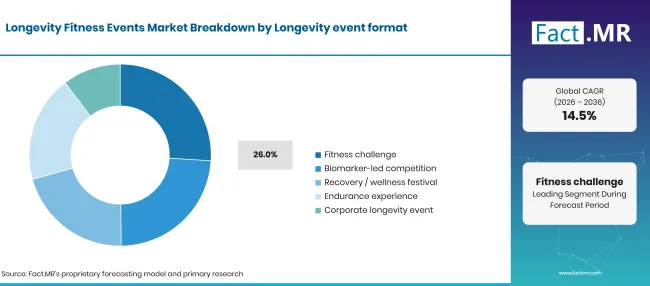
Longevity Fitness Events Market Breakdown Longevity Event Format | Source: Fact.MR
| Event Format | Share (2026) |
|---|---|
| Fitness Challenge (Leading segment) | 26.0% |
| Other segments combined | 74.0%* |
| Total | 100.0% |
Source: Fact.MR analysis. Updated Nov 12, 2026
Scored physical trials give participants something concrete to train toward. The Super Age Games in New York, for example, run eight trials covering agility, VO2 max, cognitive capacity under load, balance, grip strength and endurance. Formats like this let sponsors demonstrate equipment and testing tools in front of a motivated crowd, and many participants arrive already using smart fitness equipment at home. Biomarker-led competitions are the next format to watch, since they add lab or wearable data to physical scores. Recovery and wellness festivals draw a broader audience with classes, breathwork and testing zones. Endurance experiences appeal to experienced athletes, while corporate longevity events serve employers who want a private format for staff.
What supports Monthly Membership within Access / Commercial Model?
Monthly Membership takes 27.5% of 2026 revenue.
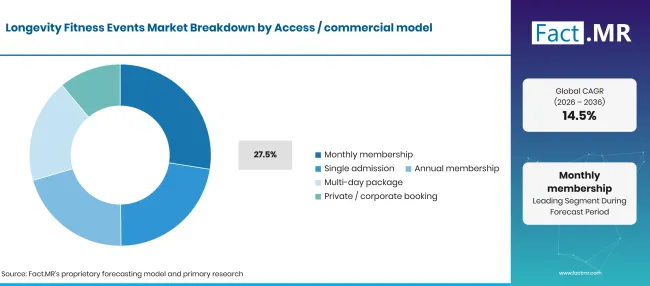
Longevity Fitness Events Market Breakdown Access Commercial Model | Source: Fact.MR
| Access / Commercial Model | Share (2026) |
|---|---|
| Monthly Membership (Leading segment) | 27.5% |
| Other segments combined | 72.5%* |
| Total | 100.0% |
Source: Fact.MR analysis. Updated Nov 12, 2026
People who want to improve a test score need regular sessions between headline events, and a monthly plan gives them that access. Organizers gain predictable income and can track each member’s progress across the year. Many members also log their training through fitness applications, which helps operators link sessions to results. Single admissions remain the entry point for first-time participants and festival visitors. Annual memberships suit committed members who want a lower monthly cost. Multi-day packages bundle travel, testing and classes, while private and corporate bookings cover team events and closed sessions.
How does Operating Setting shape demand?
Residential Community accounts for 29.2% of 2026 value.
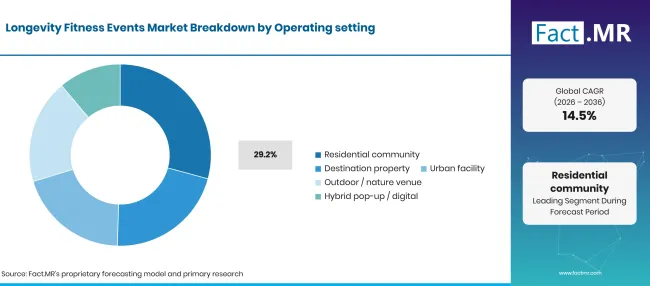
Longevity Fitness Events Market Breakdown Operating Setting | Source: Fact.MR
| Operating Setting | Share (2026) |
|---|---|
| Residential Community (Leading segment) | 29.2% |
| Other segments combined | 70.8%* |
| Total | 100.0% |
Source: Fact.MR analysis. Updated Nov 12, 2026
Residents are more likely to join a session that runs a short walk from home, and developers use these programs to set their amenities apart. Group challenges, mobility classes and recovery sessions fit well into clubhouse and community spaces. Operators often borrow layouts and staffing models from the health and fitness club sector. Urban facilities host technology-heavy programs. Upgrade Labs, for instance, runs centers in the United States and Canada that combine performance training, recovery technology and body scans. Destination properties sell multi-day stays, and outdoor venues host endurance formats. Hybrid pop-up and digital events extend reach between physical editions.
Which Core Visitor Group leads?
Working Professionals represent 27.5% of 2026 spending.
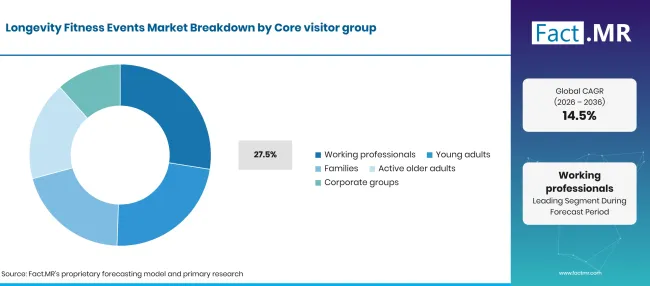
Longevity Fitness Events Market Breakdown Core Visitor Group | Source: Fact.MR
| Core Visitor Group | Share (2026) |
|---|---|
| Working Professionals (Leading segment) | 27.5% |
| Other segments combined | 72.5%* |
| Total | 100.0% |
Source: Fact.MR analysis. Updated Nov 12, 2026
Busy adults look for formats that combine exercise, stress relief and health education in a single booking. Evening and weekend sessions fit around work, and employers often fund part of the cost through corporate wellness programs. Networking during group challenges adds a social reason to attend. Active older adults form a committed audience for competitive formats. The National Senior Games Association runs national and state games for adults aged 50 and older, with the next national edition scheduled for Tulsa in 2027. Young adults, families and corporate groups round out the visitor base.
What is accelerating Longevity Fitness Events Market adoption, and what is holding it back?
Interest in preventive health, measurable fitness and community training is drawing new participants each year, and repeat editions are giving organizers a steadier calendar. High ticket and venue costs limit who can attend. Some longevity claims still lack strong scientific backing, and attendance can fall away once the novelty of a first event fades, so retention remains the main test for operators.
Drivers Impact Analysis
| DRIVER | (~) % IMPACT ON CAGR | GEOGRAPHIC RELEVANCE | IMPACT TIMELINE |
|---|---|---|---|
| Interest in preventive health and healthy aging | +1.0% | North America, Western Europe | Medium term (2-4 years) |
| Growth of scored fitness challenges | +0.9% | Global | Short term (<=2 years) |
| Corporate wellness and private longevity events | +0.7% | North America, East Asia | Medium term (2-4 years) |
| On-site assessments and recovery technologies | +0.5% | Global | Medium term (2-4 years) |
| Membership-based wellness communities | +0.4% | Western Europe, East Asia | Long term (>=4 years) |
Source: Fact.MR analysis. Updated Nov 12, 2026
Opportunity Impact Analysis
| OPPORTUNITY | (~) % IMPACT ON CAGR | GEOGRAPHIC RELEVANCE | IMPACT TIMELINE |
|---|---|---|---|
| Biomarker-led fitness and longevity competitions | +0.8% | North America, Western Europe | Medium term (2-4 years) |
| Residential community longevity programs | +0.6% | North America, East Asia | Medium term (2-4 years) |
| Corporate longevity and employee wellness packages | +0.5% | Global | Long term (>=4 years) |
| Destination recovery and wellness festivals | +0.4% | Western Europe, East Asia | Medium term (2-4 years) |
Source: Fact.MR analysis. Updated Nov 12, 2026
Restraints Impact Analysis
| RESTRAINT | (~) % IMPACT ON CAGR | GEOGRAPHIC RELEVANCE | IMPACT TIMELINE |
|---|---|---|---|
| High event organization and participation costs | -0.8% | Global | Short term (<=2 years) |
| Limited scientific validation of some longevity activities | -0.6% | Global | Medium term (2-4 years) |
| Seasonal attendance and weak participant retention | -0.5% | Western Europe, North America | Short term (<=2 years) |
| Reliance on specialized venues and qualified coaches | -0.4% | Global | Medium term (2-4 years) |
Source: Fact.MR analysis. Updated Nov 12, 2026
Which countries are scaling the Longevity Fitness Events Market through 2036?
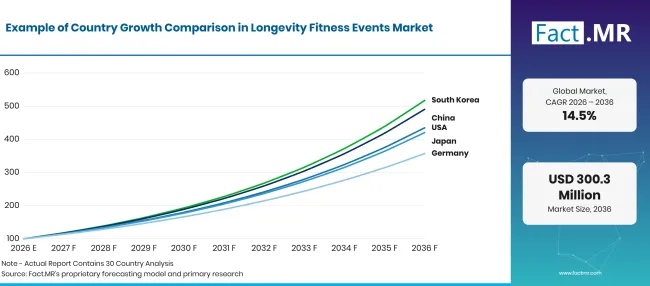
Longevity Fitness Events Market Growth Index | Source: Fact.MR
| Country | CAGR (2026 to 2036) |
|---|---|
| South Korea | 17.9% |
| China | 17.2% |
| United States | 15.8% |
| Japan | 15.4% |
| Germany | 13.6% |
Source: Fact.MR analysis. Updated Nov 12, 2026
What is driving South Korea’s market growth?
17.9% CAGR, driven by rising adult sports participation and strong interest in organized fitness.
South Korea already has a large base of people who exercise regularly. The Ministry of Culture, Sports and Tourism reported a national sports participation rate of 62.9% in 2025, up 2.2 percentage points from the previous year. Organizers can build on this habit with scored challenges, endurance formats and recovery festivals in Seoul and other large cities.
Why is China emerging as a high-growth market?
17.2% CAGR, backed by a large older population and expanding sports venues.
China’s aging profile is widening the audience for healthy aging programs. The National Bureau of Statistics counted about 323.38 million people aged 60 and above at the end of 2025, or 23.0% of the population. The same communiqué reported about 5.004 million sports venues, giving organizers more space to run community challenges and endurance events.
What is supporting market expansion in the United States?
15.8% CAGR, helped by a mature fitness culture and demand for preventive health experiences.
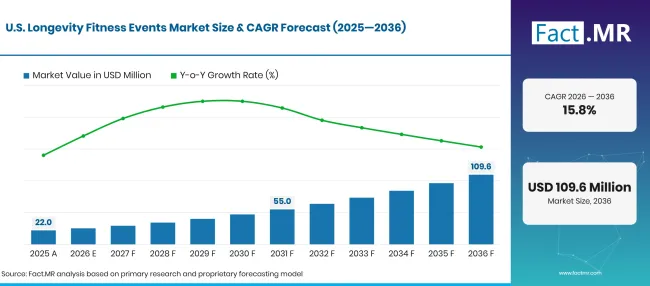
Longevity Fitness Events Market Forecast Usa | Source: Fact.MR
A sizable share of Americans already exercise on any given day. The Bureau of Labor Statistics found that 23.4% of people aged 15 and over took part in sports, exercise or recreation on an average day in 2025. That habit gives organizers a ready audience for biomarker-led competitions, longevity games and corporate wellness events.
How is Japan’s focus on healthy aging creating market opportunities?
15.4% CAGR, reflecting a record share of residents aged 65 and over and steady adult sport habits.
Japan offers a deep pool of older adults who want to stay mobile and independent. The Statistics Bureau counted 36.19 million people aged 65 and over in 2025, a record 29.4% of the population. The Japan Sports Agency reported that 51.7% of adults aged 20 and over played sport at least once a week in its FY2025 survey. Mobility challenges and strength programs aimed at active seniors fit this market well.
What is strengthening Germany’s longevity fitness events market?
13.6% CAGR, as an aging population adds demand within an established fitness sector.
Germany’s population is aging steadily, which raises interest in programs that protect strength and balance. Destatis reported that people aged 60 and over formed 31% of the population at the end of 2025, after rising by 387,000 in a year. Organizers can partner with gyms and health clubs to add longevity challenges to existing membership programs.
Who leads the Longevity Fitness Events Market?
Three groups shape this young market. Festival organizers compete on scale, speaker quality and the physical programming they offer. The Longevity Show runs its London edition at Tobacco Dock on 26 to 27 June 2026, with a studio for strength, boxing and yoga classes alongside testing zones.
The Human Upgrade Fest will stage its first Mumbai edition on 15 November 2026, combining workshops with recovery and fitness zones. Competition-led brands such as Super Age and the National Senior Games Association win on scored formats and loyal athlete communities. A third group links events to permanent venues: Upgrade Labs operates performance and recovery centers, while the BEYOND Biohacking Conference hosted by Dave Asprey adds movement and performance speakers to its program. Over the next decade, the organizers that keep participants training between editions, and that show credible results from each test, will gain ground.
Which companies are the key providers?
Key companies in the Longevity Fitness Events Market include Super Age, The Longevity Show, The Human Upgrade Fest, National Senior Games Association, Upgrade Labs and BEYOND Biohacking Conference.
- Super Age
- The Longevity Show
- The Human Upgrade Fest
- National Senior Games Association
- Upgrade Labs
- BEYOND Biohacking Conference
Bibliography
- BEYOND Biohacking Conference. (2026). BEYOND Biohacking Conference: By Dave Asprey.
- Japan Sports Agency. (2026, March 11).
- Ministry of Culture, Sports and Tourism, Republic of Korea. (2026, January 19).
- National Bureau of Statistics of China. (2026, February 28). Statistical Communiqué of the People’s Republic of China on the 2025 National Economic and Social Development.
- National Senior Games Association. (2026). National Senior Games Association: Long Live the Challenge.
- Statistics Bureau of Japan. (2025, September 14).
- Statistisches Bundesamt (Destatis). (2026, June 16). Bevölkerung Deutschlands sinkt im Jahr 2025 um 0,1 %.
- Super Age. (2026). Super Age Games 2026: A Challenge Worth Training For.
- The Human Upgrade Fest. (2026). The Human Upgrade Fest: Longevity & Biohacking Festival.
- The Longevity Show Ltd. (2026). The Longevity Show: UK’s #1 Longevity Festival.
- U.S. Bureau of Labor Statistics. (2026, June 25). American Time Use Survey: 2025 Results.
- Upgrade Labs. (2026, October 14). Upgrade Labs: Human Upgrade Center.
- World Health Organization. (2026, November 4). Physical activity.
This Report Answers
- How large the longevity fitness events market was in 2025 and how far it will grow by 2036.
- Which event formats, access models, settings and visitor groups bring in the most revenue, and why.
- Why South Korea and China outpace the United States, Japan and Germany on growth.
- Which drivers, opportunities and restraints carry the most weight for organizers.
- How festival, competition and venue-led organizers differ in what they offer.
- Where corporate, residential and destination programs open new revenue.
What does the Longevity Fitness Events Market cover?
Coverage spans organized experiences that combine fitness, physical performance, recovery and healthy aging activities. Ticketed fitness challenges, biomarker-led competitions, recovery festivals, endurance experiences and corporate longevity events all count toward market value.
Valuation follows participant and buyer spending through monthly memberships, annual memberships, single admissions, multi-day packages and private bookings. Sponsorship income tied directly to an event is counted, while venue rental paid to third parties is not.
What is included in the scope?
Longevity-focused fitness and wellness events held in residential communities, destination properties, urban facilities, outdoor venues and hybrid formats.
Participant admissions, recurring event memberships and multi-day participation packages.
Corporate bookings for private longevity sessions and team challenges, including programs sold alongside wellness tourism stays.
On-site fitness assessments, endurance activities, recovery sessions and longevity education delivered as part of an event.
What is excluded from the scope?
Standard gym memberships without a defined longevity event component.
Standalone sales of fitness equipment, wearables and general wellness products.
Routine medical consultations, pharmaceutical treatments and clinical services.
Subscriptions to on-demand wellness software and conventional sporting competitions with no longevity or wellness focus.
How Was the Analysis Built?
The analysis draws on 120+ sources, 35+ company portfolios, 25+ countries, and more than 20 industry interviews.
- Primary Research: Primary research includes discussions with manufacturers, service providers, technology developers, distributors, end users, and subject-matter experts. These conversations examine purchasing priorities, product adoption, operational challenges, approval requirements, competitive positioning, and the factors that influence wider market acceptance.
- Desk Research: Desk research covers government statistics, regulatory publications, company filings, trade data, technical studies, industry associations, standards, public policy, and other authoritative sources. Every source used in the analysis is documented in the bibliography.
- Market Sizing and Forecasting: Market estimates combine historical performance, demand indicators, pricing and volume trends, segment shares, company participation, country-level growth, adoption patterns, investment activity, and barriers to market expansion.
- Data Validation and Update Cycle: Findings are validated by comparing primary interviews with public data, company activity, regulatory changes, trade patterns, and industry developments. Regular updates review new product launches, capacity changes, partnerships, approvals, and shifts in commercial adoption.
Segmentation
What is the report’s scope and coverage?
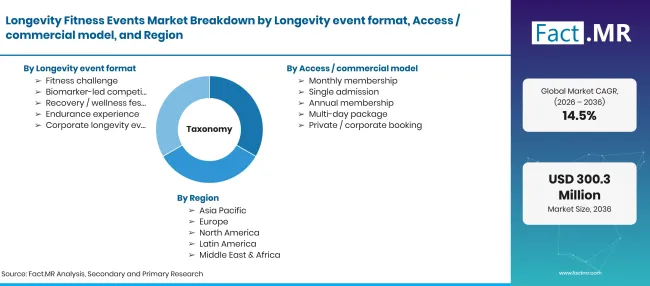
Longevity Fitness Events Market Taxonomy | Source: Fact.MR
| Attribute | Details |
|---|---|
| Quantitative Units | USD million |
| Market Definition | The longevity fitness events market comprises organized events and programs that support healthy aging through physical fitness, recovery and preventive wellness education. |
| Event Format | Fitness Challenge; Biomarker-led Competition; Recovery / Wellness Festival; Endurance Experience; Corporate Longevity Event |
| Access / Commercial Model | Monthly Membership; Single Admission; Annual Membership; Multi-day Package; Private / Corporate Booking |
| Operating Setting | Residential Community; Destination Property; Urban Facility; Outdoor / Nature Venue; Hybrid Pop-up / Digital |
| Core Visitor Group | Working Professionals; Young Adults; Families; Active Older Adults; Corporate Groups |
| Regions Covered | North America; Latin America; Western Europe; Eastern Europe; East Asia; South Asia & Pacific; Middle East & Africa |
| Countries Covered | South Korea; China; United States; Japan; Germany |
| Companies Profiled | Super Age; The Longevity Show; The Human Upgrade Fest; National Senior Games Association; Upgrade Labs; BEYOND Biohacking Conference |
| Forecast Period | 2026 to 2036 |
| Approach | Segment and country analysis built on official sport participation and population statistics, event programs and organizer information. |
Source: Fact.MR analysis. Updated Nov 12, 2026
How is the market segmented?
-
By Event Format
- Fitness Challenge
- Biomarker-led Competition
- Recovery / Wellness Festival
- Endurance Experience
- Corporate Longevity Event
-
By Access / Commercial Model
- Monthly Membership
- Single Admission
- Annual Membership
- Multi-day Package
- Private / Corporate Booking
-
By Operating Setting
- Residential Community
- Destination Property
- Urban Facility
- Outdoor / Nature Venue
- Hybrid Pop-up / Digital
-
By Core Visitor Group
- Working Professionals
- Young Adults
- Families
- Active Older Adults
- Corporate Groups
-
By Region
- North America
- Latin America
- Western Europe
- Eastern Europe
- East Asia
- South Asia & Pacific
- Middle East & Africa
Frequently Asked Questions
How large is the longevity fitness events market in 2026?
What growth rate will the longevity fitness events market record?
Which event format leads?
Which access model leads?
Which operating setting leads?
Which visitor group leads?
Which country will grow quickest?
Who are the main companies?
What holds the market back?
Who worked on this report


Preview the report firsthand - request a free sample
Free SampleGet the brochure for pricing and purchase details
Download PDF