- Market Value (2025): USD 122.5 Mn
- Estimated Value (2026): USD 126.6 Mn
- Forecast Value (2036): USD 176.2 Mn
- CAGR (2026-2036): 3.4%
What is the Benztropine Mesylate Market forecast to be worth by 2036?
USD 126.61 million in 2026 to USD 176.19 million by 2036, at a 3.36% CAGR.
- As per Fact.MR analysis, the benztropine mesylate market reached USD 122.5 million in 2025.
- Demand will increase from USD 126.6 million in 2026 to USD 176.2 million in 2036.
- The market is forecast to grow at 3.4% CAGR from 2026 to 2036, supported by continuing tablet prescriptions for selected patients and hospital demand for injectable supplies.
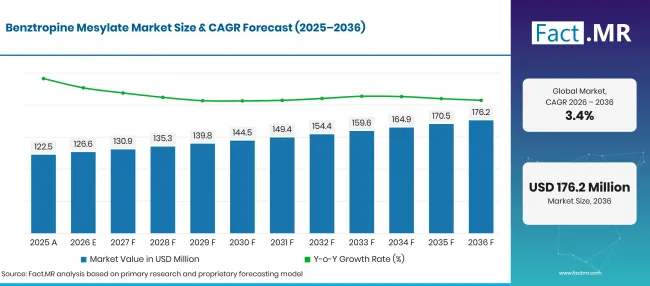
Factmr Benztropine Mesylate Market Forecast Global | Source: Fact.MR
| Year | Basis | Market Value (USD million) |
|---|---|---|
| 2025 | Actual | 122.5 |
| 2026 | Estimate | 126.6 |
| 2036 | Forecast | 176.2 |
| CAGR 2026 to 2036 | Forecast period | 3.4% |
Source: Fact.MR analysis. Updated Oct 15, 2026
What are the defining numbers behind Benztropine Mesylate Market growth?
USD 49.58 million absolute opportunity between 2026 and 2036, with tablets and hospital-pharmacy distribution forming the largest specified product and channel segments.
- Demand Drivers in the Market
- Prescribers sometimes use benztropine for movement problems caused by antipsychotic drugs. Guidance distinguishes drug-induced parkinsonism and acute dystonia from other reactions, so treatment cannot follow a single rule for every patient. The opportunity linked to antipsychotic drugs is real but limited to situations where the medicine is clinically suitable. [9]
- Tablets allow patients to continue oral treatment when their clinician considers it appropriate. DailyMed provides strength and labelling information for marketed products. For suppliers, the priority is keeping those strengths available. Benztropine participates in CNS therapeutics, but its sales cannot be inferred from growth in the entire category. [1]
- Hospitals also need injectable benztropine for selected acute-care situations. Labelling covers intramuscular and intravenous routes, so the right presentation has to be stocked and handled correctly. This is a different procurement need from a patient's regular tablets. Buyers generally plan the two forms separately. [7]
- Prescribing decisions are constrained by adverse effects, especially in older patients. The Parkinson's Foundation notes that anticholinergics may suit selected symptoms and patients. That makes clinical suitability a stronger guide to demand than population ageing. A larger Parkinson's patient population does not necessarily mean more benztropine prescriptions. [6]
- Key Segments Analyzed
- By Product Type: Tablets account for 54.7% of the 2026 market. They are prescribed when ongoing oral treatment is suitable.
- By Application: Parkinson's Disease makes up 47.3% of 2026 sales, although benztropine is used selectively rather than for every patient.
- By Distribution Channel: Hospital Pharmacies lead with 47.8% of 2026 sales, supporting institutional dispensing and injectable stock.
- Analyst Opinion at Fact.MR
- Shambhu Nath Jha, Lead Consultant, Fact.MR says, “This is an established medicine with defined uses, so dependable supply matters more than claims of a new treatment market. Tablet and injection availability will shape purchasing, while clinical review will continue to restrict inappropriate long-term use. Sales forecasts should follow prescribing practice rather than broad neurological prevalence estimates.” [9] [6]
- Strategic Implications
- Suppliers should clearly separate tablets from the injectable presentation in pricing, labelling and stock records. The connection with drug delivery systems concerns how the medicine is supplied, not an unproven change in how it works. Hospital teams need the authorised form and accurate handling instructions. [1] [7]
- Hospital pharmacies can plan stock more accurately by reviewing the departments and prescribers that actually use benztropine. Distinct product codes and packaging help avoid confusion between strengths and presentations. Replenishment should reflect dispensing records, not the total number of patients admitted to psychiatric services.
- Prescribers need clear information on anticholinergic adverse effects and when to reassess treatment. Monitoring symptoms may include cognitive assessment, particularly where the patient reports new problems. Such assessment informs a clinician's decision; it is not a test that automatically determines whether benztropine should be prescribed. [9] [6]
- Country-specific prescribing rules should be checked before suppliers pursue new business. Benztropine treats symptoms; it is not a neuroprotection therapy that changes disease progression. Product registration, formulary access and accepted indications will determine where prescriptions can grow. [1] [6]
Brazil has the highest projected growth at 4.10%, ahead of the United States at 3.60% and Germany at 3.26%. The United Kingdom reaches 2.85% and Japan 2.53%. Differences in treatment guidance and the availability of particular anticholinergic drugs make these five markets difficult to compare through prevalence figures alone.
How does the Benztropine Mesylate Market break down by segment?
Tablets 54.7%; Parkinson's Disease 47.3%; Hospital Pharmacies 47.8% in 2026.
Which Product Type dominates?
The Tablets segment holds 54.7% share in 2026.
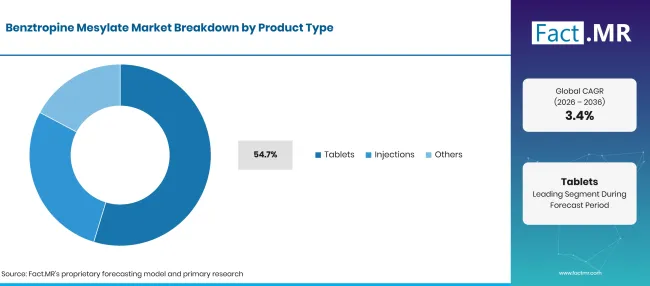
Factmr Benztropine Mesylate Market Breakdown Product Type | Source: Fact.MR
| Product Type | Share (2026) |
|---|---|
| Tablets (Leading segment) | 54.7% |
| Other segments combined | 45.3%* |
| Total | 100.0% |
Source: Fact.MR analysis. Updated Oct 15, 2026
Tablets account for 54.7% of revenue in the product split. They serve people whose symptoms and treatment plan justify an oral medicine. Injectable benztropine is used in different clinical circumstances and needs trained administration. Neither format can replace the other simply because it contains the same active ingredient. [1] [7]
Which Application accounts for the largest share?
The Parkinson's Disease segment holds 47.3% share in 2026.
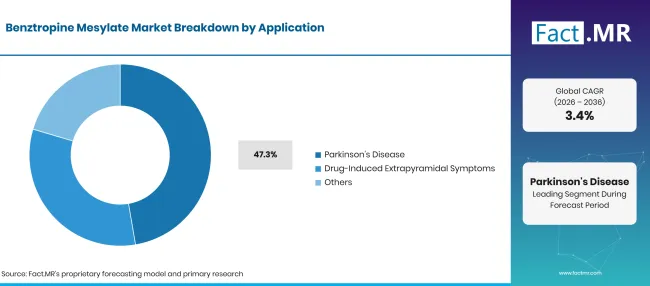
Factmr Benztropine Mesylate Market Breakdown Application | Source: Fact.MR
| Application | Share (2026) |
|---|---|
| Parkinson's Disease (Leading segment) | 47.3% |
| Other segments combined | 52.7%* |
| Total | 100.0% |
Source: Fact.MR analysis. Updated Oct 15, 2026
Parkinson's disease is the leading application in the forecast, but benztropine remains an adjunct for suitable patients. Prescribing for drug-induced movement symptoms is another source of demand. Within that group, parkinsonism and acute dystonia need to be distinguished from tardive dyskinesia, for which the treatment approach differs. [1] [9]
Which Distribution Channel leads dispensing?
The Hospital Pharmacies segment holds 47.8% share in 2026.
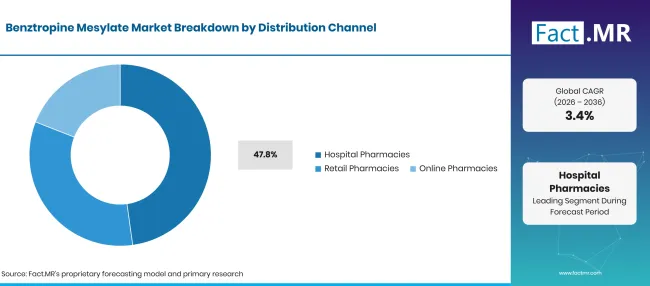
Factmr Benztropine Mesylate Market Breakdown Distribution Channel | Source: Fact.MR
| Distribution Channel | Share (2026) |
|---|---|
| Hospital Pharmacies (Leading segment) | 47.8% |
| Other segments combined | 52.2%* |
| Total | 100.0% |
Source: Fact.MR analysis. Updated Oct 15, 2026
Hospital pharmacies hold the largest channel share and are particularly important for access to injections. Retail pharmacies meet suitable outpatient prescriptions; online dispensing is another fulfilment channel where permitted. Procurement staff still need to check strength, packaging and prescription requirements before treating different offers as equivalent. [1] [7]
What is accelerating Benztropine Mesylate Market adoption, and what is holding it back?
The market has a dependable but limited prescribing base. Demand for appropriate oral and injectable treatment supports sales, while adverse effects and other treatment options curb wider use. Future revenue is likely to follow clinical practice and product availability more closely than headline Parkinson's prevalence. [9] [6]
Drivers Impact Analysis
| DRIVER | (~) % IMPACT ON CAGR | GEOGRAPHIC RELEVANCE | IMPACT TIMELINE |
|---|---|---|---|
| Selected drug-induced movement symptoms | +0.7% | Markets with product access | Short term (up to 2 years) |
| Continuity of appropriate oral treatment | +0.6% | Global | Short term (up to 2 years) |
| Institutional injectable availability | +0.2% | Hospitals with relevant protocols | Short term (up to 2 years) |
| Specialist-led symptom management | +0.3% | Global | Medium term (2 to 4 years) |
| Product-specific distribution access | +0.3% | Selected countries | Medium term (2 to 4 years) |
Source: Fact.MR analysis. Updated Oct 15, 2026
Opportunity Impact Analysis
| OPPORTUNITY | (~) % IMPACT ON CAGR | GEOGRAPHIC RELEVANCE | IMPACT TIMELINE |
|---|---|---|---|
| Reliable tablet replenishment | +0.3% | Authorised markets | Short term (up to 2 years) |
| Consistent injectable supply | +0.2% | Institutional channels | Short term (up to 2 years) |
| Clear presentation identification | +0.2% | Global | Short term (up to 2 years) |
| Accurate prescribing information | +0.2% | Global | Medium term (2 to 4 years) |
Source: Fact.MR analysis. Updated Oct 15, 2026
Restraints Impact Analysis
| RESTRAINT | (~) % IMPACT ON CAGR | GEOGRAPHIC RELEVANCE | IMPACT TIMELINE |
|---|---|---|---|
| Anticholinergic adverse effects | -0.7% | Global | Short term (up to 2 years) |
| Restrictions in older patients | -0.4% | Global | Long term (4 years or more) |
| Alternative treatment choices | -0.5% | Global | Medium term (2 to 4 years) |
| Country-specific access limitations | -0.2% | Selected countries | Medium term (2 to 4 years) |
Source: Fact.MR analysis. Updated Oct 15, 2026
Which countries are scaling the Benztropine Mesylate Market through 2036?
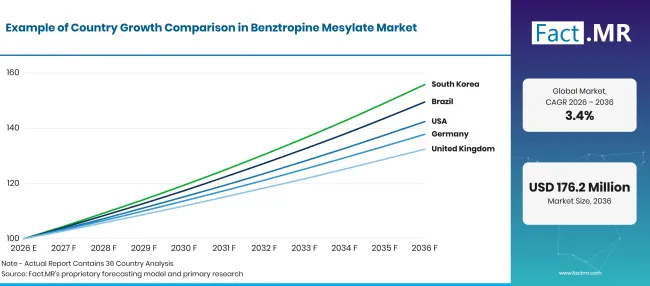
Factmr Benztropine Mesylate Market Growth Index | Source: Fact.MR
| Country | CAGR (2026 to 2036) |
|---|---|
| Germany | 3.26% |
| Brazil | 4.10% |
| United States | 3.60% |
| United Kingdom | 2.85% |
| Japan | 2.53% |
Source: Fact.MR analysis. Updated Oct 15, 2026
Why is Germany a selective prescribing market?
3.26% CAGR. Treatment guidance limits the scope for broad anticholinergic expansion.
Germany's Parkinson's guideline restricts anticholinergics to selected circumstances. For suppliers, the immediate questions are whether benztropine itself is available locally and which prescribers use it. Disease prevalence gives little indication of the size of that customer base. The 3.26% forecast should be read against these practical prescribing limits. [2]
What determines the opportunity in Brazil?
4.10% CAGR. Local protocols and competing anticholinergic medicines shape access.
Brazil updated its national Parkinson's treatment protocol in August 2025. The list includes biperiden and trihexyphenidyl, not benztropine. This matters for the 4.10% forecast: more patients receiving treatment do not automatically create orders for this particular medicine. Sales growth would require suitable product access and acceptance within local prescribing practice. [3]
Why does the United States provide clearer product visibility?
3.60% CAGR. Public labels document both tablet and injectable presentations.
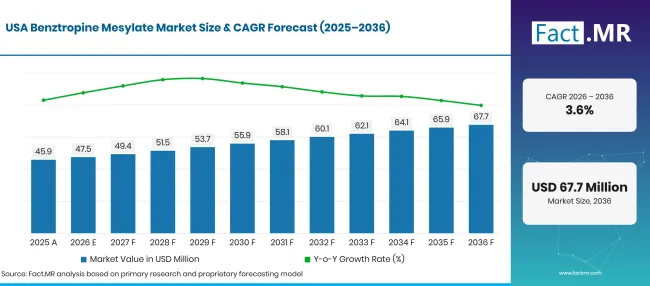
Factmr Benztropine Mesylate Market Forecast Usa | Source: Fact.MR
DailyMed records U.S. benztropine tablet products packaged by Cipla USA and injectable products associated with Hikma and Fresenius Kabi USA. These listings establish which presentations have documented labels. They are not measures of sales or a guarantee of stock at a particular pharmacy. Buyers still have to confirm availability with suppliers. [8]
How do UK treatment recommendations affect demand?
2.85% CAGR. Clinical guidance constrains use in some Parkinson's treatment settings.
NICE advises against anticholinergics for Parkinson's patients who develop dyskinesia or motor fluctuations. That recommendation limits one potential prescribing route without ruling out every use of the drug class. UK market prospects for benztropine depend on specific indications and product access, not on the total amount spent on Parkinson's treatment. [5]
What shapes Japan's more cautious outlook?
2.53% CAGR. Recognition of drug-induced parkinsonism does not establish demand for one medicine.
Japan's health ministry revised its guidance on drug-induced parkinsonism in February 2022. The document, available through PMDA, discusses movement symptoms associated with some psychiatric and gastrointestinal medicines. It establishes a clinical need for recognition and review, but does not demonstrate that benztropine is widely supplied in Japan. That distinction matters to the 2.53% outlook. [4]
Who leads the Benztropine Mesylate Market?
U.S. labels identify Cipla USA tablet products and injectable preparations associated with Hikma Pharmaceuticals USA and Fresenius Kabi USA. These are verifiable product examples, not a ranking of sales leaders. A listed label says nothing by itself about current inventory or market share. [8]
Suppliers compete mainly on whether buyers can obtain the required presentation without interruption. Many large pharmaceutical groups appear in broader market comparisons, but their overall therapeutic portfolios do not establish current benztropine participation. Product-by-product evidence is needed before assigning any company a leading position.
Which companies are the key providers?
Documented U.S. product-label examples include Cipla USA, Hikma Pharmaceuticals USA and Fresenius Kabi USA. The following names form the broader pharmaceutical comparison set, not a verified list of active benztropine suppliers. [8]
- Pfizer Inc.
- Novartis AG
- Sanofi S.A.
- GlaxoSmithKline plc
- Boehringer Ingelheim GmbH
- Merck and Co. Inc.
- AstraZeneca plc
- Johnson & Johnson
- Bayer AG
- Eli Lilly and Company
Bibliography
- [1] American Health Packaging. (2025, November 18). Benztropine mesylate tablet [Prescribing information]. DailyMed.
- [2] Höglinger, G., German Parkinson’s Guidelines Committee, & Trenkwalder, C. (2024). Diagnosis and treatment of Parkinson’s disease (guideline of the German Society for Neurology). Neurological Research and Practice, 6, Article 30.
- [3] Ministério da Saúde. (2025, August 1). Protocolo clínico e diretrizes terapêuticas da doença de Parkinson [Portaria Conjunta SAES/SECTICS No. 16].
- [4] Ministry of Health, Labour and Welfare. (2022, February). Manual for handling disorders due to adverse drug reactions: Drug-induced parkinsonism. Pharmaceuticals and Medical Devices Agency.
- [5] National Institute for Health and Care Excellence. (n.d.). Parkinson’s disease in adults: Recommendations [NICE guideline NG71].
- [7] TYA Pharmaceuticals. (2013, May 31). Benztropine mesylate injection [Prescribing information]. DailyMed.
- [8] U.S. National Library of Medicine. (n.d.). Benztropine [Drug-label search results]. DailyMed.
- [9] Vanegas-Arroyave, N., Caroff, S. N., Citrome, L., Crasta, J., McIntyre, R. S., Meyer, J. M., Patel, A., Smith, J. M., Farahmand, K., Manahan, R., Lundt, L., & Cicero, S. A. (2024). An evidence-based update on anticholinergic use for drug-induced movement disorders. CNS Drugs, 38(4), 239–254.
This Report Answers
- How tablet and injection demand differ in procurement and clinical use.
- Why Parkinson's disease prevalence is not an adequate stand-alone measure of benztropine demand.
- Which drug-induced movement symptoms belong in the appropriate-use discussion.
- How country treatment protocols and product access affect the commercial outlook.
- Why documented product participation must be distinguished from a broad pharmaceutical company list.
What does the Benztropine Mesylate Market cover?
The market covers finished benztropine mesylate medicines prescribed for appropriate clinical use. Tablet and injection sales are assessed by their formulation, medical application and dispensing route. Sales of other Parkinson's medicines or broader neurological services are not included.
What is included in the scope?
Included products are tablets and injectable preparations, along with any other finished benztropine formulations within the stated product categories. Revenue is counted when the medicine is sold, without separately adding pharmacy services or treatment costs.
What is excluded from the scope?
Other anticholinergics, non-benztropine Parkinson's medicines and treatment-service charges are excluded. Revenue from unrelated neurological products is outside the market even when the same manufacturer supplies them.
How Was the Analysis Built?
The analysis draws on 120+ sources, 35+ company portfolios, 25+ countries, and more than 20 industry interviews.
- Primary Research: Primary research includes discussions with manufacturers, service providers, technology developers, distributors, end users, and subject-matter experts. These conversations examine purchasing priorities, product adoption, operational challenges, approval requirements, competitive positioning, and the factors that influence wider market acceptance.
- Desk Research: Desk research covers government statistics, regulatory publications, company filings, trade data, technical studies, industry associations, standards, public policy, and other authoritative sources. Every source used in the analysis is documented in the bibliography.
- Market Sizing and Forecasting: Market estimates combine historical performance, demand indicators, pricing and volume trends, segment shares, company participation, country-level growth, adoption patterns, investment activity, and barriers to market expansion.
- Data Validation and Update Cycle: Findings are validated by comparing primary interviews with public data, company activity, regulatory changes, trade patterns, and industry developments. Regular updates review new product launches, capacity changes, partnerships, approvals, and shifts in commercial adoption.
Segmentation
What is the report’s scope and coverage?
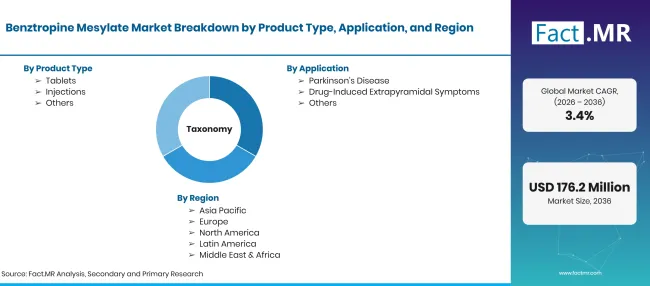
Factmr Benztropine Mesylate Market Taxonomy | Source: Fact.MR
| Attribute | Details |
|---|---|
| Quantitative Units | USD million in 2026 and 2036; CAGR for 2026 to 2036 |
| Market Definition | Finished benztropine mesylate medicines supplied in oral and injectable presentations for relevant clinical indications. |
| Product Type | Tablets; Injections; Others |
| Application | Parkinson's Disease; Drug-Induced Extrapyramidal Symptoms; Others |
| Distribution Channel | Hospital Pharmacies; Retail Pharmacies; Online Pharmacies |
| Regions Covered | North America; Latin America; Western Europe; Eastern Europe; East Asia; South Asia & Pacific; Middle East & Africa |
| Countries Covered | Germany; Brazil; United States; United Kingdom; Japan |
| Companies Profiled | Pfizer Inc.; Novartis AG; Sanofi S.A.; GlaxoSmithKline plc; Boehringer Ingelheim GmbH; Merck and Co. Inc.; AstraZeneca plc; Johnson & Johnson; Bayer AG; Eli Lilly and Company Broad pharmaceutical comparison set; inclusion does not confirm active benztropine supply. |
| Forecast Period | 2026 to 2036 |
| Approach | Formulation-level analysis, prescribing guidance, local access considerations and verification of publicly listed product presentations. |
Source: Fact.MR analysis. Updated Oct 15, 2026
How is the market segmented?
-
By Product Type
- Tablets
- Injections
- Others
-
By Application
- Parkinson's Disease
- Drug-Induced Extrapyramidal Symptoms
- Others
-
By Distribution Channel
- Hospital Pharmacies
- Retail Pharmacies
- Online Pharmacies
-
By Region
- North America
- Latin America
- Western Europe
- Eastern Europe
- East Asia
- South Asia & Pacific
- Middle East & Africa
Frequently Asked Questions
How big is the benztropine mesylate market in 2026?
What is the CAGR from 2026 to 2036?
Which product type leads?
Which application leads?
Which suppliers have documented product listings?
Who worked on this report


Preview the report firsthand - request a free sample
Free SampleGet the brochure for pricing and purchase details
Download PDF