- Market Value (2025): USD 3.52 Bn
- Estimated Value (2026): USD 3.77 Bn
- Forecast Value (2036): USD 7.4 Bn
- CAGR (2026-2036): 7.0%
What is the Drug of Abuse (DOA) Testing Consumables Market forecast to be worth by 2036?
USD 3.77 billion in 2026 to USD 7.40 billion by 2036, at a 6.98% CAGR.
- As per Fact.MR analysis, the drug of abuse testing consumables market reached USD 3.52 billion in 2025.
- Demand will increase from USD 3.77 billion in 2026 to USD 7.4 billion in 2036.
- The market is forecast to grow at 7.0% CAGR from 2026 to 2036. Repeat screening will sustain purchases of single-use kits, reagents and laboratory control materials.
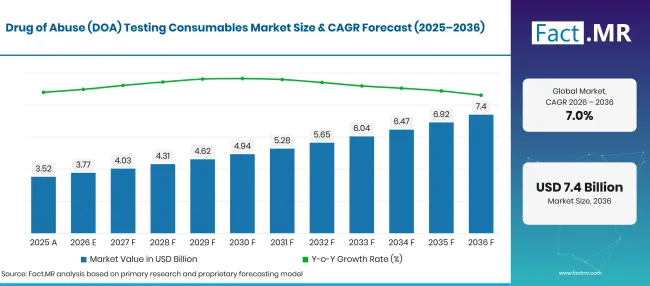
Factmr Drug Of Abuse Doa Testing Consumables Market Forecast Global | Source: Fact.MR
| Year | Basis | Market Value (USD billion) |
|---|---|---|
| 2025 | Actual | 3.52 |
| 2026 | Estimate | 3.77 |
| 2036 | Forecast | 7.4 |
| CAGR 2026 to 2036 | Forecast period | 7.0% |
Source: Fact.MR analysis. Updated Oct 15, 2026
What are the defining numbers behind Drug of Abuse (DOA) Testing Consumables Market growth?
USD 3.63 billion absolute opportunity between 2026 and 2036, with assay kits and urine-based testing forming the largest specified product and specimen segments.
- Demand Drivers in the Market
- Every new round of testing uses fresh collection and assay materials. A positive result from an initial screen may also lead to laboratory confirmation. FDA's guidance on drug screening makes the distinction clear, particularly for home tests. Procurement teams therefore need to plan for both the routine test and any follow-up work. [12]
- Clinical laboratories often prefer assays that work with equipment they already own. Thermo Fisher's DRI urine calibrators are made for clinical chemistry systems. Once a laboratory adopts an assay, it also needs the matching calibration and control supplies for routine quality checks.
- Regulated workplace programmes cannot buy on convenience alone. SAMHSA sets out federal testing procedures and publishes certified-laboratory information. Suppliers must document the specimen, method and collection process accepted for each programme. A device suitable for general screening may not meet those requirements. [8]
- Key Segments Analyzed
- By Product Type: Assay Kits account for 38.2% of 2026 sales. Customers reorder these packaged tests as screening volumes recur.
- By Sample Type: Urine contributes 60.3% of 2026 demand. Familiar collection and laboratory procedures keep it widely used.
- By End-User: Hospitals represent 41.7% of the 2026 market, combining patient screening with laboratory purchases.
- By Distribution Channel: Pharmacies take a 52.1% share in the specified 2026 channel split. Larger institutions also source tests through other routes.
- Analyst Opinion at Fact.MR
- Shambhu Nath Jha, Lead Consultant at Fact.MR says, “For most buyers, reliability matters more than the number of drugs listed on the pack. A test must work with the sample collected and give a result that staff can interpret correctly. Suppliers that document assay performance and keep consumables available will be better placed to retain accounts. Screening claims should never be confused with confirmatory findings. [11] [12]
- Strategic Implications
- Kit makers need clear labels showing the intended sample and the limits of each result. Instructions should say when a positive screen calls for further analysis. A home test cannot be presented as a clinical diagnosis or a forensic laboratory finding. [12]
- Laboratory buyers usually order controls and calibrators with the assays they support. Suppliers should show the full recurring material requirement before a lab changes products. Savings on the reagent itself may disappear if staff have to repeat verification work or interrupt a familiar testing process. [9]
- Collection design matters most when a sample has to be handled quickly and without mistakes. Combined urine cups can cut handling steps. Buyers still need to check the product instructions and the specimen rules that apply to their testing programme. [1]
- A distributor's catalogue should separate home-use products from kits intended for clinical, workplace or forensic testing. Buyers need reliable expiry dates, clear product identifiers and the correct intended-use documentation. A rapid test sold online is not automatically appropriate for a regulated programme. [11] [8]
Germany leads the five-country forecast at 8.51%, followed by Brazil at 7.77% and the United States at 7.03%. The United Kingdom is projected at 6.29% and Japan at 5.55%. These markets have different customers: some are driven by regulated driver testing, while others draw more heavily on hospital laboratories and workplace programmes.
How does the Drug of Abuse (DOA) Testing Consumables Market break down by segment?
Assay Kits 38.2%; Urine 60.3%; Hospitals 41.7%; Pharmacies 52.1% in 2026.
Which Product Type dominates?
The Assay Kits segment holds 38.2% share in 2026.
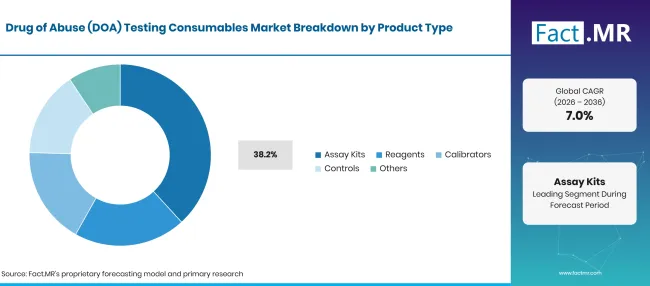
Factmr Drug Of Abuse Doa Testing Consumables Market Breakdown Product Type | Source: Fact.MR
| Product Type | Share (2026) |
|---|---|
| Assay Kits (Leading segment) | 38.2% |
| Other segments combined | 61.8%* |
| Total | 100.0% |
Source: Fact.MR analysis. Updated Oct 15, 2026
Assay kits account for the largest product share because laboratories and screening centres need repeatable test panels. Separate Reagents, calibrators and controls are purchased for different stages of laboratory work. Immunoassays are useful for initial screening, but the chemistry used in a kit cannot make a preliminary result definitive. Confirmation remains a separate decision. [12] [9]
Which Sample Type leads testing demand?
The Urine segment holds 60.3% share in 2026.
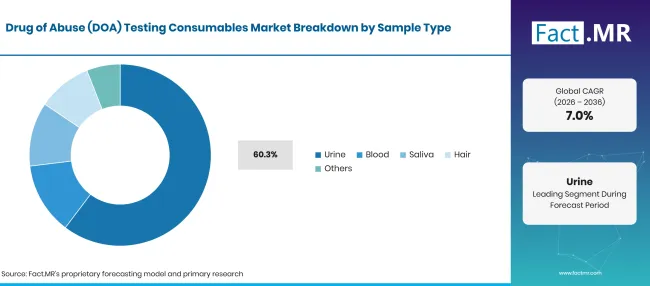
Factmr Drug Of Abuse Doa Testing Consumables Market Breakdown Sample Type | Source: Fact.MR
| Sample Type | Share (2026) |
|---|---|
| Urine (Leading segment) | 60.3% |
| Other segments combined | 39.7%* |
| Total | 100.0% |
Source: Fact.MR analysis. Updated Oct 15, 2026
Urine is familiar to hospitals and workplace programmes, which helps explain its 60.3% share. Blood, saliva and hair testing remain important when collection conditions or the period of detection differ. FDA guidance describes several collection options. The right specimen follows the purpose of the test and the method the laboratory has validated. [10]
How does End-User purchasing shape sales?
The Hospitals segment holds 41.7% share in 2026.
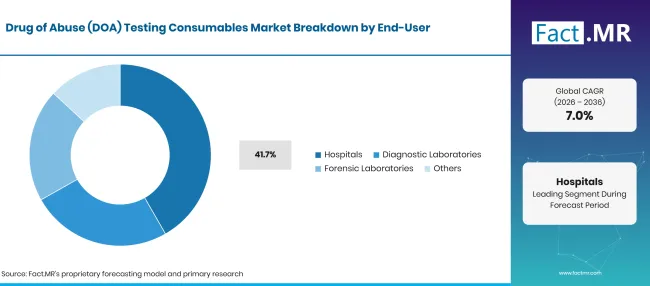
Factmr Drug Of Abuse Doa Testing Consumables Market Breakdown End User | Source: Fact.MR
| End-User | Share (2026) |
|---|---|
| Hospitals (Leading segment) | 41.7% |
| Other segments combined | 58.3%* |
| Total | 100.0% |
Source: Fact.MR analysis. Updated Oct 15, 2026
Hospital laboratories need a steady supply of screening consumables. Forensic work may add evidence-handling and confirmation requirements, while diagnostic laboratories can test specimens collected at other locations. Therapeutic drug monitoring is another laboratory service, but its clinical purpose differs from drugs-of-abuse screening. The two should remain separate in the sales figures. [11] [10]
Which Distribution Channel serves the largest share?
The Pharmacies segment holds 52.1% share in 2026.
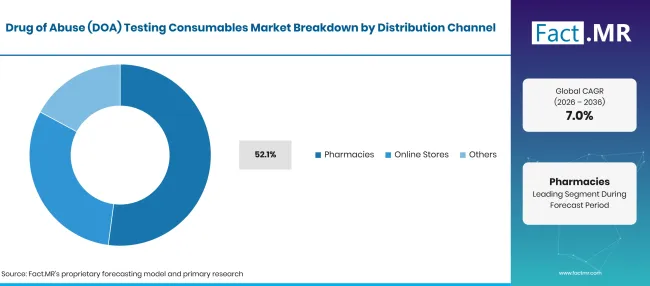
Factmr Drug Of Abuse Doa Testing Consumables Market Breakdown Distribution Channel | Source: Fact.MR
| Distribution Channel | Share (2026) |
|---|---|
| Pharmacies (Leading segment) | 52.1% |
| Other segments combined | 47.9%* |
| Total | 100.0% |
Source: Fact.MR analysis. Updated Oct 15, 2026
Pharmacies are an important route for consumer screening products, alongside online sellers. Hospitals and forensic laboratories, however, often buy through institutional contracts. The 52.1% pharmacy share describes the report's channel classification, not how every professional laboratory obtains its supplies. Users also need access to confirmatory testing when indicated. [12]
What is accelerating Drug of Abuse (DOA) Testing Consumables Market adoption, and what is holding it back?
A dependable stream of repeat tests supports sales, provided the kits match the drugs and specimens in each programme. Unclear results, unsuitable panels and laboratory follow-up costs can slow purchasing. The practical question for buyers is what it takes to complete a test properly, from collection through interpretation. [11] [12]
Drivers Impact Analysis
| DRIVER | (~) % IMPACT ON CAGR | GEOGRAPHIC RELEVANCE | IMPACT TIMELINE |
|---|---|---|---|
| Routine screening replenishment | +1.1% | Global | Short term (up to 2 years) |
| Laboratory assay continuity | +0.8% | Global | Medium term (2 to 4 years) |
| Regulated workplace programmes | +0.6% | United States | Medium term (2 to 4 years) |
| Driver-testing requirements | +0.4% | Brazil, Europe | Medium term (2 to 4 years) |
| On-site specimen collection | +0.4% | Global | Short term (up to 2 years) |
Source: Fact.MR analysis. Updated Oct 15, 2026
Opportunity Impact Analysis
| OPPORTUNITY | (~) % IMPACT ON CAGR | GEOGRAPHIC RELEVANCE | IMPACT TIMELINE |
|---|---|---|---|
| Compatible controls and calibrators | +0.6% | Global | Short term (up to 2 years) |
| Application-specific assay panels | +0.6% | Global | Medium term (2 to 4 years) |
| Oral-fluid collection formats | +0.3% | Selected approved settings | Medium term (2 to 4 years) |
| Clearer specimen handling | +0.3% | Global | Short term (up to 2 years) |
Source: Fact.MR analysis. Updated Oct 15, 2026
Restraints Impact Analysis
| RESTRAINT | (~) % IMPACT ON CAGR | GEOGRAPHIC RELEVANCE | IMPACT TIMELINE |
|---|---|---|---|
| False or misinterpreted screening results | -0.6% | Global | Short term (up to 2 years) |
| Confirmatory testing cost | -0.5% | Global | Short term (up to 2 years) |
| Programme-specific qualification | -0.5% | Regulated markets | Medium term (2 to 4 years) |
| Expiry and stock wastage | -0.3% | Global | Short term (up to 2 years) |
Source: Fact.MR analysis. Updated Oct 15, 2026
Which countries are scaling the Drug of Abuse (DOA) Testing Consumables Market through 2036?
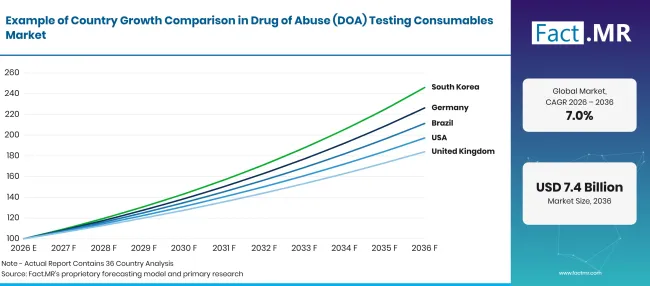
Factmr Drug Of Abuse Doa Testing Consumables Market Growth Index | Source: Fact.MR
| Country | CAGR (2026 to 2036) |
|---|---|
| Germany | 8.51% |
| Brazil | 7.77% |
| United States | 7.03% |
| United Kingdom | 6.29% |
| Japan | 5.55% |
Source: Fact.MR analysis. Updated Oct 15, 2026
Why does Germany offer a distinct forensic testing opportunity?
8.51% CAGR. Roadside screening and laboratory evidence create separate consumable requirements.
Germany introduced a blood-serum THC threshold for driving in 2024. The rule concerns evidential testing, which requires different materials from an initial roadside screen. Dräger's oral-fluid system illustrates the screening side of the process. Laboratories and enforcement buyers must budget for the appropriate stage instead of treating traffic violations as a direct count of consumables sold. [2] [3]
How does Brazil support recurring testing demand?
7.77% CAGR. Driver-licensing rules create an identifiable testing requirement.
Brazil requires toxicological testing for drivers in licence categories C, D and E. The rules include specimens such as hair, which can provide a longer detection window. This gives testing providers a defined customer group and a specific sample requirement. Suppliers cannot assume that the products used here follow the global urine-testing mix. [5]
What sustains purchasing in the United States?
7.03% CAGR. Federal workplace processes coexist with clinical and consumer testing.
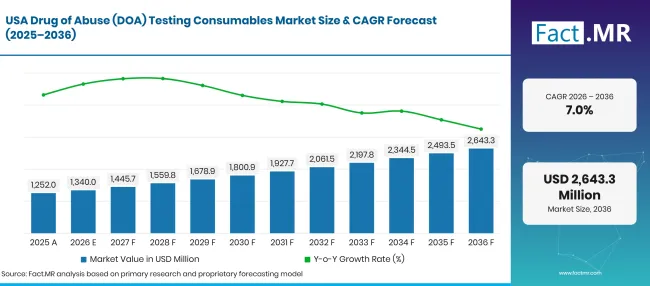
Factmr Drug Of Abuse Doa Testing Consumables Market Forecast Usa | Source: Fact.MR
The U.S. market has several established routes to repeat purchases. SAMHSA oversees federal workplace-testing requirements and certified laboratories, while FDA guidance addresses clinical and home-use devices. Suppliers may operate across these groups, but each has different documentation and testing rules. The 7.03% outlook covers that mix of applications. [11] [12] [8]
How is the United Kingdom shaping demand?
6.29% CAGR. Drug-driving enforcement links initial screening with further evidential testing.
UK drug-driving procedures begin with roadside screening and may continue with testing at a police station. The two stages create different needs for collection materials and laboratory work. Suppliers must meet the approved procedures before competing for this business. Clinical testing also contributes to sales, though police activity itself cannot be treated as a measure of kit revenue. [13]
Why does Japan provide a measurable procurement example?
5.55% CAGR. Police procurement demonstrates a direct purchase of urine-testing consumables.
Japan's National Police Agency recorded purchases of 42,035 urine-test reagent units for fiscal 2022 in its June 2023 spending review. The report lists these separately from equipment used to analyse seized drugs. Although the purchase predates the forecast, it gives suppliers a concrete example of institutional consumables procurement and replacement planning. [6]
Who leads the Drug of Abuse (DOA) Testing Consumables Market?
Abbott focuses on combined urine-collection and screening products. Dräger supplies oral-fluid kits, while Thermo Fisher offers DRI laboratory calibration materials. Their customers assess different things: ease of collection in the field, assay compatibility in the laboratory and continuity of supply. Those product details tell buyers more than the size of each company's diagnostics business. [9] [1] [2]
Quest Diagnostics and LabCorp also appear in the industry comparison, but their primary role here is testing services. They should not be grouped automatically with companies manufacturing the consumables. A fair comparison identifies whether the customer is buying a kit, an assay material or a completed laboratory service. [7] [4]
Which companies are the key providers?
Documented product examples include Abbott Laboratories, Thermo Fisher Scientific and Drägerwerk AG. The wider company coverage below includes diagnostics suppliers and testing-service organisations; their roles are not interchangeable. [9] [1] [2] [7] [4]
- Abbott Laboratories
- Quest Diagnostics
- Thermo Fisher Scientific
- Siemens Healthineers
- Roche Diagnostics
- Bio-Rad Laboratories
- OraSure Technologies
- Psychemedics
- LabCorp
- Drägerwerk AG
Bibliography
- [1] Abbott. (n.d.). iCUP drug screening device.
- [2] Dräger. (n.d.). DrugTest 5000 test kit.
- [3] Federal Ministry of Transport. (2024, August 21). Sechstes Gesetz zur Änderung des Straßenverkehrsgesetzes verkündet.
- [4] Labcorp. (n.d.). Pre-employment drug testing.
- [5] Ministério dos Transportes. (n.d.). Exame toxicológico.
- [6] National Police Agency. (2023, June). Promotion of drug crime investigations [Expenditure-review reference materials].
- [7] Quest Diagnostics. (n.d.). Drug testing.
- [8] Substance Abuse and Mental Health Services Administration. (2026, May 21). Drug testing resources.
- [9] Thermo Fisher Scientific. (n.d.). DRI multidrug urine calibrators [Product No. 1588].
- [10] U.S. Food and Drug Administration. (n.d.-a). Drugs of abuse (collection kit).
- [11] U.S. Food and Drug Administration. (n.d.-b). Drugs of abuse tests.
- [12] U.S. Food and Drug Administration. (2018, September 27). Drugs of abuse home use test.
- [13] UK Government. (n.d.). Drug driving law. GOV.UK.
This Report Answers
- How assay kits differ commercially from reagents and laboratory quality-control materials.
- Why urine leads the specimen comparison without replacing blood, saliva or hair in every application.
- How hospital procurement differs from forensic and regulated workplace purchasing.
- Which country requirements create identifiable consumable purchasing needs.
- How product manufacturers and testing-service providers participate in different parts of the market.
What does the Drug of Abuse (DOA) Testing Consumables Market cover?
This market includes materials consumed when biological specimens are collected and tested for drugs of abuse. It covers screening kits, collection products and the relevant reagents and control materials used by laboratories. The unit of analysis is the consumable sold, not the full cost of a medical examination or enforcement activity.
What is included in the scope?
Assay kits, reagents, calibrators, controls and specimen-collection products are included. Where a collection cup contains its own screening kit, the combined item is counted once at sale. This avoids assigning separate revenue to parts of the same purchase.
What is excluded from the scope?
Reusable analysers, independent laboratory equipment and testing-service fees fall outside this market. Treatment medicines are excluded, as are field tests designed solely to identify seized powders instead of drugs in biological specimens.
How Was the Analysis Built?
The analysis draws on 120+ sources, 35+ company portfolios, 25+ countries, and more than 20 industry interviews.
- Primary Research: Primary research includes discussions with manufacturers, service providers, technology developers, distributors, end users, and subject-matter experts. These conversations examine purchasing priorities, product adoption, operational challenges, approval requirements, competitive positioning, and the factors that influence wider market acceptance.
- Desk Research: Desk research covers government statistics, regulatory publications, company filings, trade data, technical studies, industry associations, standards, public policy, and other authoritative sources. Every source used in the analysis is documented in the bibliography.
- Market Sizing and Forecasting: Market estimates combine historical performance, demand indicators, pricing and volume trends, segment shares, company participation, country-level growth, adoption patterns, investment activity, and barriers to market expansion.
- Data Validation and Update Cycle: Findings are validated by comparing primary interviews with public data, company activity, regulatory changes, trade patterns, and industry developments. Regular updates review new product launches, capacity changes, partnerships, approvals, and shifts in commercial adoption.
Segmentation
What is the report’s scope and coverage?
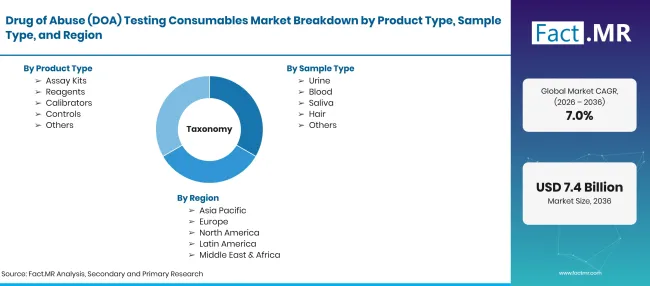
Factmr Drug Of Abuse Doa Testing Consumables Market Taxonomy | Source: Fact.MR
| Attribute | Details |
|---|---|
| Quantitative Units | USD billion in 2026 and 2036; CAGR for 2026 to 2036 |
| Market Definition | Single-use products and recurring laboratory materials used to collect or analyse biological specimens for drugs-of-abuse testing. |
| Product Type | Assay Kits; Reagents; Calibrators; Controls; Others |
| Sample Type | Urine; Blood; Saliva; Hair; Others |
| End-User | Hospitals; Diagnostic Laboratories; Forensic Laboratories; Others |
| Distribution Channel | Pharmacies; Online Stores; Others |
| Regions Covered | North America; Latin America; Western Europe; Eastern Europe; East Asia; South Asia & Pacific; Middle East & Africa |
| Countries Covered | Germany; Brazil; United States; United Kingdom; Japan |
| Companies Profiled | Abbott Laboratories; Quest Diagnostics; Thermo Fisher Scientific; Siemens Healthineers; Roche Diagnostics; Bio-Rad Laboratories; OraSure Technologies; Psychemedics; LabCorp; Drägerwerk AG |
| Forecast Period | 2026 to 2036 |
| Approach | Product and specimen assessment, testing-programme requirements, country procurement evidence and manufacturer documentation. |
Source: Fact.MR analysis. Updated Oct 15, 2026
How is the market segmented?
-
By Product Type
- Assay Kits
- Reagents
- Calibrators
- Controls
- Others
-
By Sample Type
- Urine
- Blood
- Saliva
- Hair
- Others
-
By End-User
- Hospitals
- Diagnostic Laboratories
- Forensic Laboratories
- Others
-
By Distribution Channel
- Pharmacies
- Online Stores
- Others
-
By Region
- North America
- Latin America
- Western Europe
- Eastern Europe
- East Asia
- South Asia & Pacific
- Middle East & Africa
Frequently Asked Questions
How big is the drug of abuse testing consumables market in 2026?
What is the CAGR from 2026 to 2036?
Which product type leads?
Which sample type leads?
Who participates in the market?
Who worked on this report


Preview the report firsthand - request a free sample
Free SampleGet the brochure for pricing and purchase details
Download PDF