- Market Value (2025): USD 258.3 million
- Estimated Value (2026): USD 278.1 million
- Forecast Value (2036):USD 848.4 million
- CAGR (2026-2036): 11.8%
What is the glucose gummies market forecast to be worth by 2036?
USD 278.1 million in 2026 to USD 848.4 million by 2036, at 11.80% CAGR.
- The glucose gummies market crossed a valuation of USD 258.3 million in 2025. Demand is expected to increase from USD 278.1 million in 2026 to USD 848.4 million by 2036.
- The market is forecast to record 11.8% CAGR from 2026 to 2036 as consumers use gummy formats for post-meal wellness, satiety and sugar-balance routines.
- Glucose gummies sit inside the wider gummy vitamins category because the format depends on chewable supplement acceptance.
- The category differs from children’s multivitamin gummies because the purchase is driven by metabolic wellness, carb-conscious behavior and low-sugar positioning.
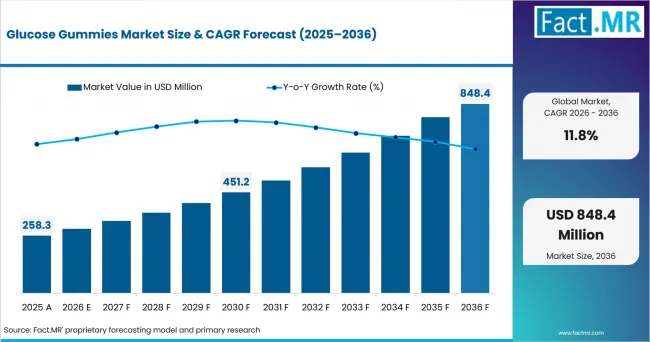
Glucose Gummies Market Market Value Analysis | Source: Fact.MR
What are the defining numbers behind glucose gummies market growth?
USD 570.3 million absolute opportunity by 2036, led by chewable supplement adoption and metabolic wellness positioning.
- Demand Drivers in the Market
- Metabolic wellness users need chewable formats that fit daily post-meal routines.
- Weight-management consumers need satiety support without stimulant-led positioning.
- Pharmacy category managers need products that stay within compliant wellness language.
- DTC brands need a gummy format that supports subscription and flavor-led repeat purchase.
- Key Segments Analyzed
- By Active Base: Fiber-led gummies are expected to hold 37.0% share in 2026 because brands can link fiber with satiety and digestive wellness.
- By Ingredient: Soluble fiber leads because it is familiar and easy to explain. The segment is projected to capture 40.0% share in 2026.
- By Consumer Cohort: Metabolic wellness users are likely to account for 35.0% share in 2026 because they seek non-prescription support before clinical intervention.
- By Channel: Amazon leads because consumers compare reviews and trial packs before subscription. The segment is expected to hold 34.0% share in 2026.
- By Claim Territory: Post-meal support is projected to record 41.0% share in 2026 because it is practical and less risky than disease-oriented claims.
- Analyst Opinion at Fact.MR
- Shambhu Nath Jha, Senior Analyst at Fact.MR, states, states, “Glucose gummies are daily routine products used after meals or snacks when brands keep claims disciplined. We see consumers using them as daily routine products after meals or snacks. Brands that keep claims disciplined, reduce sugar load and make the gummy pleasant enough for repeat use will be better positioned than brands that overstate glucose control.”
- Strategic Implications
- Gummy brands should define the use occasion around meals rather than broad wellness.
- Pharmacy retailers should separate glucose gummies from emergency glucose products.
- Nutrition clinics can use gummies as behavior-support products for carb-conscious adults.
- DTC operators should build repeat-purchase plans around taste, tolerance and compliant claim language.
FDA’s 2024 dietary fiber guidance defines dietary fiber through non-digestible carbohydrates that have beneficial physiological effects. [1] This supports the product boundary because fiber-led glucose gummies must be positioned around recognized fiber function, not disease treatment.
The United States is projected to record 12.8% CAGR through 2036 as DTC wellness brands, Amazon listings and pharmacy shelves support sugar-balance gummies. Germany is expected to post 12.2% CAGR through 2036 as low-sugar wellness and pharmacy-led supplement choices expand. Japan is likely to record 11.8% CAGR as portion-controlled gummies fit daily nutrition routines. China is forecast to advance at 11.4% CAGR as e-commerce channels scale metabolic wellness products. India is set to record 10.9% CAGR as urban consumers adopt satiety and post-meal support claims.
How does the glucose gummies market break down by segment?
Fiber-led gummies lead at 37.0%; soluble fiber leads at 40.0%.
Which active base dominates?
Fiber-led gummies hold 37.0% share in 2026.
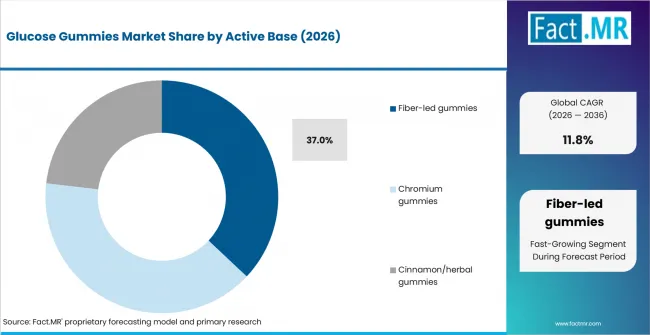
Glucose Gummies Market Analysis By Active Base | Source: Fact.MR
Fiber-led gummies are expected to hold 37.0% share in 2026 because consumers understand fiber through fullness, digestion and meal support. The format also gives brands a safer claim route than drug-like glucose control. Chromium gummies are important where sugar-balance language is used carefully. Cinnamon/herbal gummies build botanical appeal. Sugar-free pectin gummies gain traction where consumers want chewable formats without heavy sugar. The segment connects with adult vitamin gummies because adult consumers are already comfortable with gummies as daily supplements.
Which ingredient dominates?
Soluble fiber lead with 40.0% share in 2026.
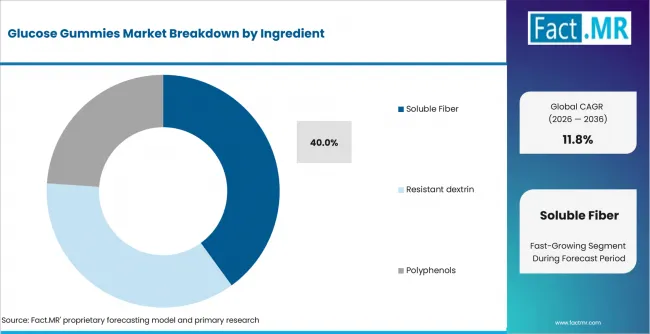
Glucose Gummies Market Analysis By Ingredient | Source: Fact.MR
Soluble fiber leads because brands can explain it easily and use it across satiety, digestive regularity and post-meal support claims. The segment is projected to capture 40.0% share in 2026 as brands look for a label-friendly base. Resistant dextrin supports lower-sugar gummies with better texture control. Polyphenols help brands add plant-based differentiation. Chromium supports sugar-balance positioning, but claim wording must remain careful. Botanical extracts support flavor and wellness storytelling.
Which consumer cohort dominates?
Metabolic wellness users hold 35.0% share in 2026.
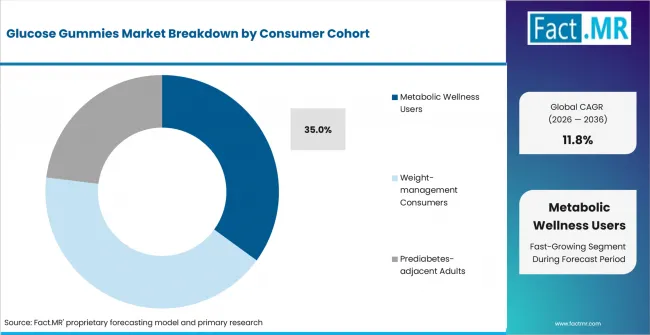
Glucose Gummies Market Analysis By Consumer Cohort | Source: Fact.MR
Metabolic wellness users lead because they want post-meal support before they enter disease-management pathways. The cohort is likely to account for 35.0% share in 2026 as glucose-awareness content and low-sugar routines influence supplement discovery. Weight-management consumers use gummies for satiety support. Prediabetes-adjacent adults seek products that feel practical and non-prescription. Brands must avoid treatment claims. The opportunity connects with nutraceutical products because consumers are blending food, supplements and daily health routines.
Which channel dominates?
Amazon accounts for 34.0% share in 2026.
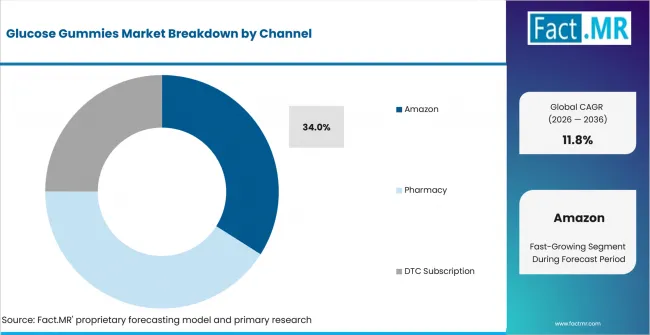
Glucose Gummies Market Analysis By Channel | Source: Fact.MR
Amazon leads because consumers compare gummies through reviews, bundle options and flavor choices. The channel is expected to hold 34.0% share in 2026 as trial packs and repeat orders support early adoption. Pharmacy supports trust where sugar-balance claims need credibility. DTC subscription becomes stronger after the consumer accepts taste and tolerance. Health stores help shoppers compare clean-label options. Nutrition clinics support coach-guided use. YUM-V’S lists glucose gummies and diabetic care gummies inside blood sugar support and gummy supplement assortments, showing how retailer shelves already carry adjacent chewable formats. [2]
Which claim territory dominates?
Post-meal support holds 41.0% share in 2026.
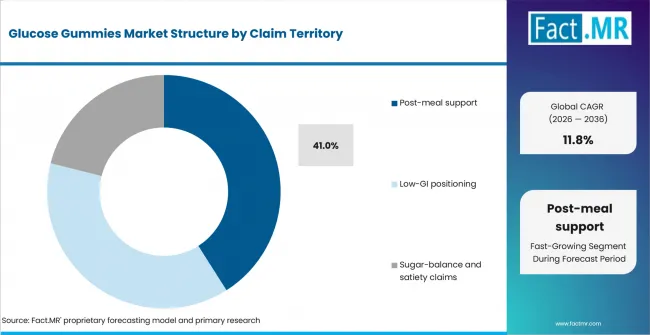
Glucose Gummies Market Analysis By Claim Territory | Source: Fact.MR
Post-meal support leads because the wording is practical and easier to manage than disease-oriented claims. The claim territory is projected to record 41.0% share in 2026 as brands position gummies for use after carb-heavy meals or evening snacks. Low-GI positioning works where products connect with sugar-conscious eating. Sugar-balance claims need careful substantiation. Satiety claims are useful when gummies are tied to weight-management behavior. This segment connects with prebiotic fiber because fiber tolerance shapes daily-use credibility.
What is accelerating glucose gummy adoption, and what is holding it back?
Chewable metabolic wellness routines and Amazon-led trial packs drive it, while glucose-claim compliance risk and sugar-content conflict restrain it.
Drivers Impact Analysis
| DRIVER | (~) % IMPACT ON CAGR | GEOGRAPHIC RELEVANCE | IMPACT TIMELINE |
|---|---|---|---|
| Consumer shift toward chewable metabolic wellness formats | +1.0% | North America, Europe, East Asia | Medium term (2–4 years) |
| Fiber and chromium positioning for sugar-balance routines | +0.9% | United States, Germany, Japan, China | Medium term (2–4 years) |
| Amazon and DTC channels supporting flavor-led trial | +0.8% | United States, United Kingdom, urban Asia | Short term (≤ 2 years) |
| Weight-management consumers adopting satiety claims | +0.6% | Global, strongest in urban consumers | Medium term (2–4 years) |
| Sugar-free pectin formats improving gummy acceptability | +0.5% | North America, Europe, India | Long term (≥ 4 years) |
Source: Fact.MR analysis. Updated Jun 30, 2026
Chewable metabolic wellness
Chewable metabolic wellness is the strongest driver because consumers want supplements that feel easy and familiar. Gummies reduce the barrier linked with capsules and powders. This is important for daily routines where taste and texture influence repeat purchase. Glucose gummies benefit when the product feels like a wellness habit instead of a clinical product.
Fiber and chromium positioning
Fiber and chromium positioning supports demand because both ingredients are easy to connect with sugar-balance routines. Fiber helps brands build a safer wellness story around fullness and digestion. Chromium supports normal macronutrient metabolism claims in many markets, but brands must avoid drug-like language. This driver favors disciplined labels and clear serving guidance.
Amazon and DTC trial
Amazon and DTC channels help consumers test gummies before subscribing. Flavor, texture and tolerance matter more in gummies than in capsules. Reviews create trust when the product category is unfamiliar. Trial packs are important because consumers may hesitate to buy a full subscription before tasting the product.
Satiety claims
Satiety claims support glucose gummies because weight-management consumers want softer alternatives to harsh diet products. A gummy positioned around fullness can feel approachable. This makes the format suitable for adults who want after-meal support without stimulant cues. Stronger brands will connect satiety with fiber instead of overpromising glucose change.
Sugar-free pectin formats
Sugar-free pectin formats improve category credibility because ordinary gummies can conflict with low-sugar positioning. Pectin also helps brands appeal to vegetarian and clean-label consumers. This driver is long-term because taste and stability must be solved before sugar-free pectin gummies scale widely.
Opportunity Impact Analysis
| OPPORTUNITY | (~) % IMPACT ON CAGR | GEOGRAPHIC RELEVANCE | IMPACT TIMELINE |
|---|---|---|---|
| Sugar-free pectin gummies for carb-conscious adults | +0.8% | United States, Europe, India | Medium term (2–4 years) |
| Chromium and cinnamon gummies for sugar-balance shelves | +0.7% | North America, Europe, Japan | Medium term (2–4 years) |
| Amazon trial packs converting into DTC subscriptions | +0.6% | Global, strongest in urban e-commerce markets | Short term (≤ 2 years) |
| Wearable-adjacent bundles for metabolic wellness users | +0.5% | United States, China, India | Long term (≥ 4 years) |
Source: Fact.MR analysis. Updated Jun 30, 2026
Sugar-free pectin gummies
Sugar-free pectin gummies create opportunity because the format aligns better with sugar-balance positioning than conventional sugar-heavy gummies. Consumers who track carbs will expect the gummy itself to fit the claim. Brands that solve taste without excess sugar can charge a premium. This opportunity is strongest in pharmacy and DTC channels.
Chromium and cinnamon gummies
Chromium and cinnamon gummies can gain space on sugar-balance shelves where retailers already stock glucose-support capsules. Gummy delivery may attract consumers who dislike tablets. BOOST glucose control daily support contains cinnamon and chromium and states that it is not a substitute for medication, showing why claim discipline matters when metabolic wellness products move closer to pharmacy shelves. [4]
Amazon trial packs
Amazon trial packs can convert curious shoppers into repeat DTC users. Gummies depend on taste acceptance, so smaller packs lower risk for first-time buyers. Reviews can also show whether consumers tolerate fiber-led formulas. The opportunity connects with nutraceutical confectionery because functional sweets are becoming a serious supplement delivery format.
Wearable-adjacent bundles
Wearable-adjacent bundles can connect glucose gummies with meal journaling, coaching and habit tracking. These bundles should remain non-medical when they do not include regulated devices. The opportunity connects with personalized nutrition because consumers increasingly want products matched to daily routines and food choices.
Restraints Impact Analysis
| RESTRAINT | (~) % IMPACT ON CAGR | GEOGRAPHIC RELEVANCE | IMPACT TIMELINE |
|---|---|---|---|
| Claim compliance risk around glucose language | -0.8% | United States, Europe, Japan | Medium term (2–4 years) |
| Sugar content conflict in gummy formats | -0.6% | Global | Short term (≤ 2 years) |
| Competition from capsules, powders and nutrition drinks | -0.5% | Global, strongest in pharmacy and Amazon | Medium term (2–4 years) |
| Consumer confusion with diabetes products | -0.4% | North America, Europe, urban Asia | Long term (≥ 4 years) |
Source: Fact.MR analysis. Updated Jun 30, 2026
Claim compliance risk
Claim compliance is the main restraint because glucose wording can move too close to disease management. Brands must avoid implying that a gummy treats diabetes or replaces medical care. Poorly controlled claims can create retailer caution and platform review issues. This restraint is strongest in pharmacy and marketplace channels.
Sugar content conflict
Sugar content conflict can slow adoption because gummies are often associated with sweetness. A glucose-positioned gummy that contains too much sugar can weaken consumer trust. YUM-V’S diabetic care gummy listing shows a sugar-free gummy format with chromium, thiamine and magnesium, which supports the need for low-sugar formulation discipline in this category. [3]
Competing formats
Glucose gummies compete with capsules, powders and nutrition drinks. Some consumers prefer capsules because they feel more clinical. Others prefer powders because the serving can be adjusted. Gummies must prove convenience and taste without confusing the claim. The challenge is stronger when retailers compare gummies against lower-cost non-chewable formats.
Consumer confusion
Consumer confusion can slow adoption because glucose gummies may be mistaken for emergency sugar products or diabetes treatment. Glucose gummy brands need clear packaging so shoppers understand the product as a non-prescription wellness format.
Which countries are scaling glucose gummies fastest?
United States 12.8%; Germany 12.2%; Japan 11.8%; China 11.4%; India 10.9%.
Based on regional analysis, the glucose gummies market is segmented into North America, Europe, East Asia, South Asia, Latin America, and Middle East and Africa.
| Country | CAGR |
|---|---|
| United States | 12.8% |
| Germany | 12.2% |
| Japan | 11.8% |
| China | 11.4% |
| India | 10.9% |
Source: Fact.MR analysis. Updated Jun 30, 2026
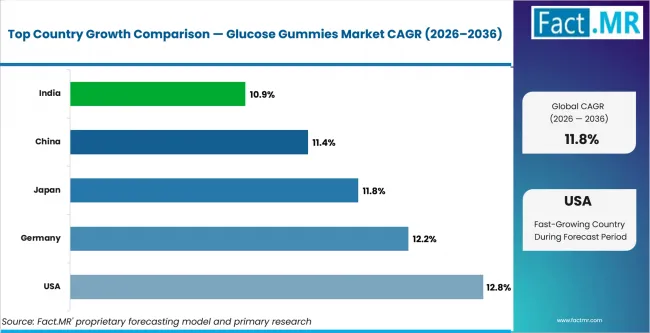
Glucose Gummies Market Cagr Analysis By Country | Source: Fact.MR
What is powering the United States lead?
12.8% CAGR, driven by YUM-V’S and Amazon-led metabolic wellness discovery.
The United States is projected to record 12.8% CAGR from 2026 to 2036 as consumers adopt gummies for post-meal support, satiety and sugar-balance routines. Amazon discovery and DTC subscriptions will support repeat use. Growth will favor brands that keep glucose claims compliant and make the gummy format low in sugar.
How is Germany scaling glucose gummy demand?
12.2% CAGR, driven by pharmacy-led wellness and low-sugar supplement behavior.
Consumers are using fiber and chromium products as part of daily nutrition planning. Germany is expected to post 12.2% CAGR through 2036 as pharmacy channels and health stores give glucose gummies more credibility. Growth will favor products with clean labels and careful sugar-balance wording.
What supports Japan’s outlook?
11.8% CAGR, driven by compact supplement routines and portion-controlled formats.
Japan is likely to record 11.8% CAGR by 2036 as consumers adopt small functional servings that fit daily routines. Gummies can appeal where post-meal support and digestive regularity overlap. Brands with mild taste, low sugar and clear serving timing will be better placed.
What underpins China’s growth?
11.4% CAGR, driven by e-commerce wellness and low-sugar consumer interest.
China is forecast to advance at 11.4% CAGR through 2036 as online platforms expand access to metabolic wellness products. Glucose gummies will gain traction where brands connect fiber, satiety and carb-conscious behavior. Localized flavors and e-commerce education will shape adoption.
How is India scaling glucose gummy adoption?
10.9% CAGR, driven by urban weight-management users and pharmacy access.
India is set to record 10.9% CAGR through 2036 as urban consumers look for chewable products that support fullness and digestive regularity. Pharmacy and nutrition clinic channels will help explain the category. Affordable gummy packs will matter for repeat purchase.
Who leads the glucose gummies market?
Lifeable and ReliOn / Walmart lead through supplement retail and glucose-management supplement credibility.
Glucose gummies are supplied by supplement companies, functional confectionery brands and metabolic wellness ecosystems. YUM-V’Sis relevant through supplement retail access and glucose-related nutrition positioning.Lifeableadds strength through blood sugar metabolism and fiber-led supplement trust.
Glow Gummiesshape adjacent glucose-support nutrition. Vitamaticsupports the metabolic wellness ecosystem through microbiome and glucose-positioned products. Competition also connects with liquid dietary supplements because gummies must prove convenience against ready-to-drink formats.
Competition through 2036 will depend on claim discipline, sugar load, texture and channel trust. Brands that sound too clinical will face compliance risk. Brands that only sell generic gummies with glucose language may struggle to justify premium pricing. Stronger positions will come from post-meal timing, low-sugar formulation and repeat-use programs. The market also connects with powder dietary supplements because gummies must defend value against lower-cost powder formats.
Which companies are the key providers?
Lifeableand ReliOn / Walmartare key providers. YUM-V’Sand Glow Gummiesare also profiled. Vitamaticcomplete the company set.
- Lifeable
- ReliOn / Walmart
- YUM-V’S
- Glow Gummies
- Vitamatic
Bibliography
- U.S. Food and Drug Administration. (2024, July 25). Questions and answers on dietary fiber. FDA.
- Centers for Disease Control and Prevention. (2024, May 14). Treatment of low blood sugar (hypoglycemia).
- U.S. Food and Drug Administration. (2024, March 5). Daily value on the Nutrition and Supplement Facts labels.
- Centers for Disease Control and Prevention. (2026, January 21). Diabetes data and statistics.
This Report Addresses
- Strategic intelligence on glucose gummies across active base and ingredient.
- Segment analysis covering Fiber-led Gummies and Soluble Fiber.
- Regional outlook covering the United States, Germany, Japan, China, and India.
- Competitive analysis of Lifeable, ReliOn / Walmart, YUM-V’S, Glow Gummies, Vitamatic.
- Technology assessment covering fiber-led gummies, chromium, pectin texture, botanicals, and sugar-free formulation.
- Use case assessment covering post-meal support, low-GI positioning, sugar-balance claims and satiety claims.
- Primary interviews, provider checks and official source review support the forecast.
What does the glucose gummies market cover?
Non-prescription gummy supplements positioned for post-meal and sugar-balance wellness.
The glucose gummies market covers fiber-led gummies and sugar-free pectin gummies. These products use soluble fiber, resistant dextrin, polyphenols, chromium and botanical extracts to support post-meal wellness, satiety and low-sugar routines.
The market differs from broad dietary supplements because it focuses on gummy delivery and glucose-adjacent wellness positioning. It excludes regulated diabetes drugs, clinical glucose monitors, emergency glucose candies or gummies for hypoglycemia, and disease-treatment products.
What is included in the scope?
Chewable gummies used by metabolic wellness and weight-management consumers.
The scope includes fiber-led gummies and sugar-free pectin gummies. Ingredient coverage includes soluble fiber, resistant dextrin, polyphenols, chromium, and botanical extracts. Consumer cohorts include metabolic wellness users, weight-management consumers and prediabetes-adjacent adults.
The scope includes pharmacy, DTC subscription, Amazon, health stores and nutrition clinics. Claim territory covers post-meal support, low-GI positioning, sugar-balance claims and satiety claims. The category connects with dietary fibers because fiber type and tolerance shape product credibility.
What is excluded from the scope?
Medical diabetes products and rapid glucose rescue products are outside the scope.
The scope excludes prescription diabetes drugs, insulin products, medical glucose meters, CGMs, clinical nutrition products and emergency hypoglycemia glucose gummies. It also excludes general multivitamin gummies unless they carry post-meal, sugar-balance or metabolic wellness positioning. Broader functional foods are outside scope when they do not use gummy delivery.
How was the analysis built?
100+ sources, 40+ company portfolios, 25+ countries, 20+ interviews.
- Primary Research: Primary research includes interviews with supplement brand managers and pharmacy category leads. It includes input from DTC growth heads, nutrition clinic operators and e-commerce channel teams.
- Desk Research: Desk research reviews official fiber guidance, gummy supplement labels, glucose-wellness product pages, Amazon positioning and pharmacy listings.
- Market-Sizing and Forecasting: Forecasting uses gummy supplement adoption, ingredient mix, channel split, repeat-purchase behavior and glucose-wellness claim territory.
- Data Validation and Update Cycle: Forecasts are validated through provider checks and channel feedback. SKU mapping and brand portfolio reviews help confirm market direction.
Segmentation
What is the report’s scope and coverage?
| Attribute | Details |
|---|---|
| Quantitative Units | USD Million in 2026 to USD Million by 2036 at CAGR |
| Market Definition | Non-prescription gummy supplements positioned for post-meal and sugar-balance wellness |
| Active Base | Fiber-led gummies; chromium gummies; cinnamon/herbal gummies; sugar-free pectin gummies |
| Ingredient | Soluble fiber; resistant dextrin; polyphenols; chromium; botanical extracts |
| Consumer Cohort | Metabolic wellness users; weight-management consumers; prediabetes-adjacent adults |
| Channel | Pharmacy; DTC subscription; Amazon; health stores; nutrition clinics |
| Claim Territory | Post-meal support; low-GI positioning; sugar-balance and satiety claims |
| Regions Covered | North America; Europe; East Asia; South Asia; Latin America; Middle East and Africa |
| Countries Covered | United States; Germany; Japan; China; India |
| Key Companies Profiled | Lifeable; ReliOn / Walmart; YUM-V’S; Glow Gummies; Vitamatic |
| Forecast Period | 2026 to 2036 |
| Approach | Hybrid top-down and bottom-up approach using gummy supplement adoption, active-base mix, channel split and provider validation |
Source: Fact.MR analysis. Updated Jun 30, 2026
How is the market segmented?
-
By Active Base:
- Fiber-led gummies
- Chromium gummies
- Cinnamon/herbal gummies
- Sugar-free pectin gummies
-
By Ingredient:
- Soluble fiber
- Resistant dextrin
- Polyphenols
- Chromium
- Botanical extracts
-
By Consumer Cohort:
- Metabolic wellness users
- Weight-management consumers
- Prediabetes-adjacent adults
-
By Channel:
- Pharmacy
- DTC subscription
- Amazon
- Health stores
- Nutrition clinics
-
By Claim Territory:
- Post-meal support
- Low-GI positioning
- Sugar-balance and satiety claims
-
Region:
- North America
- United States
- Canada
- Europe
- Germany
- United Kingdom
- France
- Italy
- Netherlands
- East Asia
- Japan
- China
- South Korea
- South Asia
- India
- Thailand
- Singapore
- Latin America
- Brazil
- Mexico
- Chile
- Middle East & Africa
- UAE
- Saudi Arabia
- South Africa
- North America
Frequently Asked Questions
Which active base leads the Glucose Gummies Market?
Which ingredient leads the Glucose Gummies Market?
Which consumer cohort leads the Glucose Gummies Market?
Which channel leads the Glucose Gummies Market?
Which claim territory leads the Glucose Gummies Market?
Which country expands fastest in the Glucose Gummies Market?
How does Germany perform in the Glucose Gummies Market?
How does Japan perform in the Glucose Gummies Market?
How does China perform in the Glucose Gummies Market?
How does India perform in the Glucose Gummies Market?
What is the primary driver in the Glucose Gummies Market?
What is the main restraint in the Glucose Gummies Market?
Why are fiber-led gummies important?
Why does Amazon dominate demand?
Who worked on this report


Preview the report firsthand - request a free sample
Free SampleGet the brochure for pricing and purchase details
Download PDF