- Estimated Value(2026): 88 Mn
- Forecast Value (2036): 140 Mn
- CAGR (2026 - 2036): 5.1%
Gorse Market Forecast and Outlook 2026 to 2036
In 2025, the gorse market surpassed a valuation of USD 84 million. Based on Fact.MR analysis, demand for gorse is estimated to grow to USD 88 million in 2026 and USD 140 million by 2036. Fact.MR projects a CAGR of 5.1% during the forecast period.
The market is projected to create an absolute dollar opportunity of around USD 52 million between 2026 and 2036. While this is not rapid expansion, it reflects steady and predictable growth. Gorse remains firmly positioned as the botanical source for one of the 38 Bach Original Flower Remedies, and ongoing replacement demand within established homeopathic distribution channels provides a stable revenue base.
Emer Cooke, Executive Director of the EMA, states: “In 2024, medicine shortages remained a high priority on the public health agenda. The reasons for shortages are always multifaceted but a specific case of difficult supply-and-demand dynamics emerged in 2024 with shortages of GLP-1 receptor agonist medicines. Increased demand for these medicines for both diabetes and obesity, coupled with significant supply challenges, jeopardised treatment programmes for many patients.”
Country growth reflects wellness supplement adoption, homeopathic medicine regulatory recognition, and personal care botanical ingredient demand. China leads at 6.9% CAGR, supported by integration of Western botanical supplements into mainstream health retail and e-commerce channels. India follows at 6.2% driven by expanding awareness of homeopathic and natural remedy categories alongside a growing personal care market receptive to botanical actives. Germany registers 4.9% growth underpinned by the country's legally recognised homeopathic medicine framework that generates structured institutional pharmacy procurement. The United States posts 4.3% amid growing natural supplement retail expansion through specialty and online channels. The United Kingdom registers 3.8%, reflecting steady replacement demand in the mature pharmacy and health store.
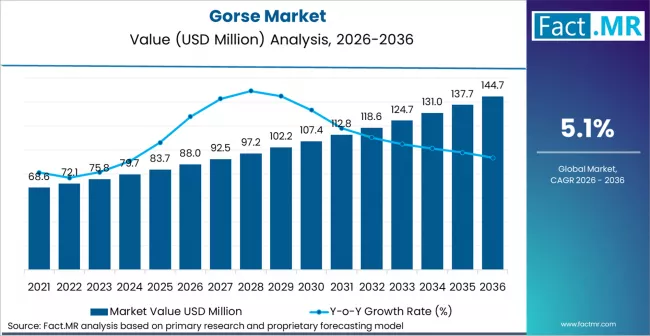
Gorse Market Market Value Analysis | Source: Fact.MR
| Metric | Value |
|---|---|
| Estimated Value in 2026 | USD 88 million |
| Forecast Value in 2036 | USD 140 million |
| Forecast CAGR (2026 to 2036) | 5.1% |
Source: Fact.MR analysis. Updated Feb 27, 2026
Market Definition
The gorse market includes botanical raw materials and extracts from Ulex europaeus used mainly in Bach flower remedies, with secondary use in personal care, food flavouring, dyes, and limited biomass applications.
Market Inclusions
Covers global and regional revenue forecasts (2026-2036) by form and application. Includes liquid and powder extracts used in pharmaceuticals, personal care, food, and bioenergy across key countries.
Market Exclusions
Excludes invasive plant control activities unless tied to extract sourcing. Omits synthetic substitutes and standalone biomass energy unless linked to extract co-products. Retail remedy sales are excluded unless broken down to gorse ingredient value.
Research Methodology
- Primary Research: Interviews with extract buyers, cosmetic formulators, supplement distributors, and sourcing specialists across Europe and Asia Pacific.
- Desk Research: Reviewed FDA, EMA, Commission E, MHRA records, company reports, and supplier catalogues.
- Market Sizing and Forecasting: Combined remedy volumes and ingredient usage with extract pricing benchmarks.
- Data Validation and Update Cycle: Cross-checked using trade data, pharmacopoeia records, and supplier disclosures. Forecasts updated annually based on regulatory and demand shifts.
Summary
- Market Definition
- The gorse market includes liquid and powder extracts from Ulex europaeus flowers used in Bach flower remedies, personal care, food flavouring, and limited biomass applications. Its core value comes from its role in the 38 Original Bach Flower Remedies.
- Demand Drivers
- Nelsons sustains steady global demand for gorse extract through its licensed Bach remedy distribution network.
- Growth in natural personal care is creating incremental demand for gorse as a botanical antioxidant and skin-conditioning ingredient.
- Invasive gorse biomass projects in Colombia, Chile, and New Zealand are opening secondary revenue opportunities through extract co-production.
- Key Segments Analyzed
- By Form: Liquid extract holds ~58% share due to its required use in certified Bach remedies.
- By Application: Pharmaceuticals and homeopathy account for ~43%, driven by structured remedy procurement.
- By Geography: High-growth Asia-Pacific versus regulatory-heavy Europe.
- Analyst Opinion at FACT.MR
- Shambhu Nath Jha notes growth depends on expanding beyond remedies into personal care and biomass, with vertically integrated suppliers best positioned to capture premium value.
- Strategic Implications / Executive Takeaways
- Suppliers should develop standardized, cosmeceutical-grade extracts with bioactivity data.
- Distributors should strengthen pharmacy channels with full compliance documentation.
- Biomass developers should integrate extract recovery into invasive plant management.
- Methodology
- Sizing based on remedy volumes, ingredient usage, and extract pricing.
- Shares validated through pharmacopoeia standards and ingredient adoption data.
- Forecasts built using regulatory, retail, and botanical demand trends.
Segmental Analysis
Gorse Market Analysis by Form
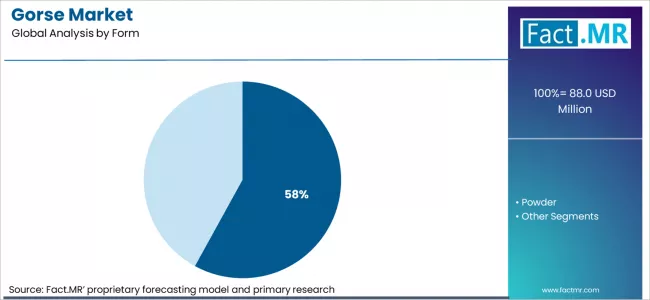
Gorse Market Analysis By Form | Source: Fact.MR
Liquid extract is projected to hold 58% share in 2026. The Bach remedy system requires grape alcohol infusion, as defined in HPUS standards. This format cannot be substituted with powder without breaking protocol. Nelsons’ FDA-registered facility in Wimbledon reinforces this format lock-in.
- Nelsons Non-Alcohol Formula Launch: Nelsons introduced a non-alcohol variant while retaining liquid format. This expanded accessibility without shifting away from extract-based production. [1]
- Crystal Herbs Organic Liquid Extract Formulation: Crystal Herbs produces organic gorse flower essences using traditional sun infusion methods. This reinforces liquid extract as the authentic commercial format. [6]
- Personal Care Liquid Extract Adoption Trend: Natural cosmetic brands in Europe are exploring gorse extract for antioxidant and botanical differentiation in premium formulations.
Gorse Market Analysis by Application
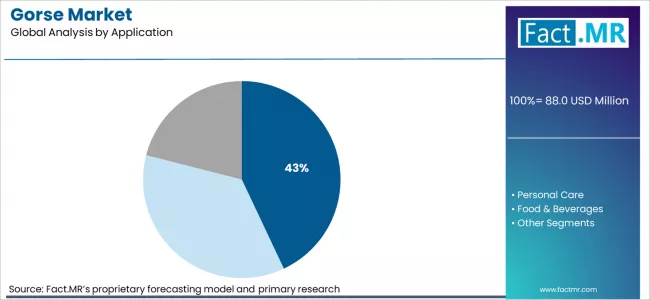
Gorse Market Analysis By Application | Source: Fact.MR
Pharmaceutical and homeopathic applications are expected to hold 43% share in 2026. The Bach remedy system provides a structured and recurring procurement channel. Each remedy occupies a fixed role, ensuring non-substitutable demand.
- Ainsworths Homeopathic Pharmacy Gorse Supply: Ainsworths continues to stock and sell gorse remedies through its specialist pharmacy and online channels, confirming ongoing institutional demand. [7]
- Healing Herbs Biodynamic Gorse Production: Healing Herbs maintains vertically integrated, biodynamic production of gorse remedies, supporting small-scale but stable supply models. [8]
- Personal Care Botanical Application Expansion Trend: 2024 research highlights rising demand for EU-origin floral extracts under COSMOS standards. This supports gorse expansion into premium personal care beyond homeopathy.
Drivers, Restraints, and Opportunities
Fact.MR estimates the gorse market at USD 84 million in 2025. The market depends heavily on one core channel: The Bach Original Flower Remedy system, produced under license by Nelsons. This concentration provides stability because repeat purchases from established users across 50+ countries create steady baseline demand. However, it also limits growth, as expansion depends largely on new consumer adoption unless gorse gains wider use in personal care or functional food.
The market is gradually splitting into two tracks. The traditional homeopathic liquid extract segment remains stable in volume and pricing. At the same time, new opportunities are emerging in personal care botanical actives and biomass co-production. High-purity, antioxidant-standardized extracts command premium pricing in cosmetics. Academic research, including a 2024 study in Revista de Biologia Tropical, highlights gorse’s bioethanol potential, expanding awareness of alternative value chains. [3]
- EU Homeopathic Medicine Regulatory Framework as Market Floor: Germany’s Arzneimittelgesetz recognizes homeopathic remedies within its pharmacy system. This ensures structured procurement for licensed suppliers. EMA botanical frameworks reinforce compliance standards, effectively excluding non-certified extract from EU pharmacy channels and protecting pricing. [4]
- Asia Pacific Natural Supplement Retail Expansion: China’s expanding wellness retail ecosystem is opening new channels for imported botanical remedies. The 2025 update to Health Food Registration Measures is expected to reduce regulatory barriers for international brands such as Nelsons. [5]
- Gorse Biomass Valorisation Research and Bio Economy Development: A 2024 peer-reviewed study confirmed gorse’s potential for bioethanol production in Colombia. This research supports biomass valorization programmes that may create new extract co-product supply chains.
Regional Analysis
The gorse market is analysed across North America, Latin America, Europe, East Asia, South Asia, Oceania and Middle East & Africa across 40+ countries. The full report also offers market attractiveness analysis based on regional trends.
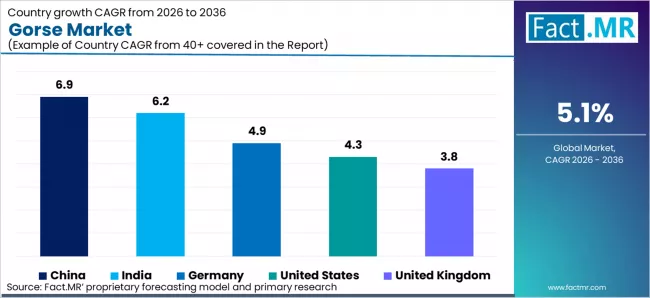
Gorse Market Cagr Analysis By Country | Source: Fact.MR
| Country | CAGR (2026-2036) |
|---|---|
| China | 6.9% |
| India | 6.2% |
| Germany | 4.9% |
| United States | 4.3% |
| United Kingdom | 3.8% |
Source: Fact.MR analysis. Updated Feb 27, 2026
Source: Fact.MR (FACT.MR) analysis, based on proprietary forecasting model and primary research
Asia Pacific Gorse Market Analysis
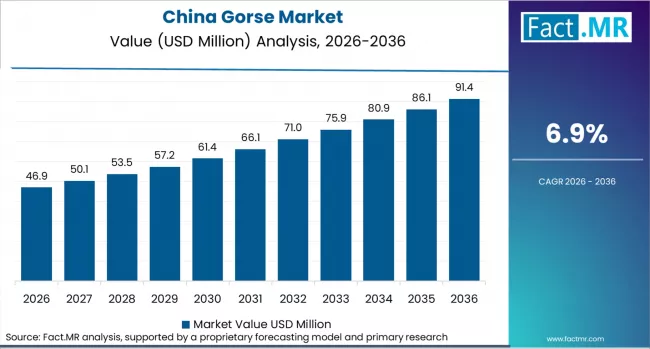
Gorse Market Country Value Analysis | Source: Fact.MR
Asia Pacific is the fastest-growing region for gorse products. Growth is driven by expanding natural supplement retail networks, rising awareness of European botanical systems such as Bach remedies, and strong e-commerce health platforms. International brands like Nelsons compete in the premium online segment, while regional distributors support growing practitioner networks in India and China.
- China: Demand is projected to grow at 6.9% CAGR through 2036. E-commerce platforms such as Tmall Global and JD International are expanding access to imported botanical remedies. In January 2025, China updated its Health Food Registration Measures (Order No. 38), streamlining approval for imported botanical products.
- India: Demand is projected to grow at 6.2% CAGR through 2036. India’s legally recognized homeopathic system supports structured pharmacy and practitioner distribution. The Ministry of AYUSH expanded funding for wellness centres in 2024, indirectly supporting remedy demand. Rapid growth in natural personal care is also creating interest in gorse extract for premium formulations.
FACT.MR covers China, Japan, South Korea, India, Australia and New Zealand, ASEAN, and Rest of Asia Pacific, highlighting e-commerce growth, regulatory structures, and botanical demand trends.
Europe Gorse Market Analysis
Europe remains the production and regulatory centre of the gorse market. The UK hosts Nelsons’ global Bach remedy facility, while Germany provides the most structured pharmacy procurement system. EU quality standards and COSMOS certification shape both remedy and personal care demand.
- Germany: Demand is projected to grow at 4.9% CAGR through 2036. Germany grants pharmaceutical status to homeopathic products under Arzneimittelgesetz, supporting structured pharmacy sales. Nelsons operates through its Hamburg subsidiary, serving a dense pharmacy network. EMA botanical assessments continue to reinforce regulatory structure and compliance expectations.
- United Kingdom: Demand is projected to grow at 3.8% CAGR through 2036. The UK is the manufacturing base for all Bach remedies. Growth is mainly replacement-driven within a mature user base. The MHRA register provides regulatory stability and protects licensed suppliers.
FACT.MR covers Germany, France, the United Kingdom, Norway, Spain, the Netherlands, Nordics, and Rest of Europe, detailing pharmacy procurement and certification trends.
North America Gorse Market Analysis
North America is an established Bach remedy market. Distribution is led by Nelsons’ U.S. subsidiary through specialty retailers and online channels. HPUS recognition provides regulatory stability.
- United States: Demand is projected to grow at 4.3% CAGR through 2036. HPUS listing allows gorse to be marketed as a recognised homeopathic ingredient. FDA’s risk-based enforcement framework supports compliant manufacturers. The broader natural supplement market expanded in 2024, benefiting botanical and flower essence products. [2]
FACT.MR covers the United States, Canada, and Mexico, including HPUS compliance data, retail adoption trends, and regulatory impacts.
Competitive Aligners for Market Players
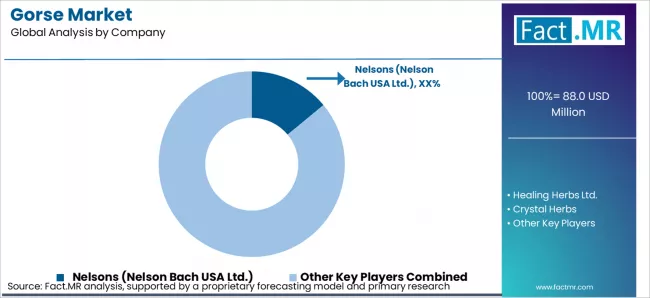
Gorse Market Analysis By Company | Source: Fact.MR
The global gorse market is highly concentrated at the remedy production level. Nelsons holds the exclusive license to manufacture the Bach Original Flower Remedies, making it the dominant buyer of commercially processed gorse liquid extract. Alongside Nelsons, a few specialist producers such as Healing Herbs, Crystal Herbs, and Ainsworths serve practitioner-led and premium consumer segments through direct and specialty retail channels. In personal care, procurement is more fragmented, with European botanical ingredient brokers supplying smaller volumes without a clear market leader. Across segments, competition is driven more by authenticity, certification, and documented provenance than by price.
Strong competitive positions are held by vertically integrated producers. Nelsons’ control of harvesting at Mount Vernon provides unmatched heritage credentials. Healing Herbs leverages biodynamic cultivation, while Crystal Herbs emphasizes organic certification and practitioner loyalty.
In pharmacy channels, compliance requirements such as HPUS listing and FDA-registered manufacturing create barriers to entry. Pricing flexibility is limited in regulated channels but more competitive in online retail, where consumers compare alternatives more directly.
Key Players
- Nelsons (Nelson Bach USA Ltd.)
- Healing Herbs Ltd.
- Crystal Herbs
- Ainsworths Homeopathic Pharmacy
- Bach Flower Remedies Limited (The Bach Centre)
- SkyNRG BV
- Circularity Fuels
- Healing Hands & Herbs
- Gracefruit Limited
- Foresta
Bibliography
- [1] Nelsons (Homeopathy) / Wikipedia. (January 9, 2026). Nelsons (Homeopathy) -Wikipedia. Available at: https://en.wikipedia.org/wiki/Nelsons_(Homeopathy); Nelsons. (2025).
- [2] U.S. Food and Drug Administration. (2024). Compliance Policy Guidance for Homeopathic Drug Products. FDA Center for Drug Evaluation and Research.
- [3] Robledo-Camacho, S. et al. (2024, April). Biomass and bioethanol production of the shrub Ulex europaeus (Fabaceae) estimated with remote sensing imagery in the Andean paramos. Revista de Biologia Tropical.
- [4] European Medicines Agency. (2024). Committee on Herbal Medicinal Products (HMPC): Community Herbal Monographs and Botanical Assessment Reports. EMA.
- [5] National Administration for Market Regulation, China. (2025, January). Health Food Registration and Record-keeping Management Measures Update (Order No. 38). SAMR.
- [6] Crystal Herbs. (2024-2025). Bach Flower Remedies: Gorse Flower Essence Organic Certified Liquid Extract Production.
- [7] Ainsworths Homeopathic Pharmacy. (2024-2025). Bach Flower Remedies: Gorse. Ainsworths Pharmacy Product Portfolio.
- [8] Healing Herbs Ltd. (2024-2025). Bach Flower Remedies:
This Report Addresses
- Strategic intelligence on gorse extract development, remedy supply chains, personal care expansion, and competitive positioning in UK and European markets.
- Market size and forecast: USD 88 million in 2026, reaching USD 140 million by 2036 at 5.1% CAGR, segmented by form, application, and region.
- Growth mapping across cosmeceutical extract adoption, China and India supplement entry pathways, and bioethanol co-production from invasive gorse.
- Country-level forecasts for China (6.9%), India (6.2%), Germany (4.9%), U.S. (4.3%), and UK (3.8%), with segment splits.
- Competitive analysis of Nelsons, Healing Herbs, Crystal Herbs, and Ainsworths, focusing on provenance, certification, and channel dynamics.
- Product tracking including non-alcohol extracts, organic certification, COSMOS qualification, and biomass co-production technology.
- Regulatory review covering MHRA, Arzneimittelgesetz, FDA guidance, China Health Food Measures, and COSMOS standards.
- Delivered in Excel datasets, PowerPoint summary, and detailed PDF with verified industry and regulatory sources.
Segmentation
Scope of Report
| Items | Values |
|---|---|
| Quantitative Units | USD 88 million (2026) to USD 140 million (2036), at a CAGR of 5.1% |
| Market Definition | The gorse market includes raw materials, liquid extracts, and powder from Ulex europaeus flowers used mainly in Bach flower remedies, with additional applications in personal care, food flavouring, and bioenergy. |
| Form | Liquid Extract, Powder |
| Application | Pharmaceuticals, Personal Care, Food & Beverages, Others |
| Regions Covered | Asia Pacific, Europe, North America, Latin America, Middle East and Africa |
| Countries Covered | China, Japan, South Korea, India, Australia and New Zealand, ASEAN, Rest of Asia Pacific, Germany, United Kingdom, France, Norway, Spain, Netherlands, Nordics, Rest of Europe, United States, Canada, Mexico, Brazil, Chile, Ecuador, Rest of Latin America, Kingdom of Saudi Arabia, United Arab Emirates, South Africa, Turkey, Rest of Middle East and Africa |
| Key Companies Profiled | Nelsons (Nelson Bach USA Ltd.), Healing Herbs Ltd., Crystal Herbs, Ainsworths Homeopathic Pharmacy, Bach Flower Remedies Limited, SkyNRG BV, Circularity Fuels, Healing Hands & Herbs, Gracefruit Limited, Foresta |
| Forecast Period | 2026 to 2036 |
| Approach | A hybrid top-down and bottom-up model was used. Top-down inputs included regional Bach remedy volumes, gorse content per unit, supplement market size, and biomass programme scale. Bottom-up inputs covered extract pricing, replacement cycles, and growth rates based on interviews with extract specialists and remedy distributors. |
Source: Fact.MR analysis. Updated Feb 27, 2026
Gorse Market by Segment
-
By Form :
- Liquid Extract
- Powder
-
By Application :
- Pharmaceuticals
- Personal Care
- Food & Beverages
- Others
-
By Region :
- North America
- United States
- Canada
- Mexico
- Europe
- Germany
- United Kingdom
- France
- Norway
- Spain
- Netherlands
- Nordics
- Rest of Europe
- Asia Pacific
- China
- Japan
- South Korea
- India
- Australia and New Zealand
- ASEAN
- Rest of Asia Pacific
- Latin America
- Brazil
- Chile
- Ecuador
- Rest of Latin America
- Middle East and Africa
- Kingdom of Saudi Arabia
- United Arab Emirates
- South Africa
- Turkey
- Rest of Middle East and Africa
- North America
Frequently Asked Questions
How large is the gorse market in 2025?
What will the market size be in 2026?
What is the projected market size by 2036?
What is the expected CAGR for the forecast period 2026 to 2036?
Which form segment is poised to lead the gorse market?
Which application segment holds the largest share?
Which country shows the fastest growth rate?
How fast is the gorse market expected to expand in India?
What is the forecast CAGR for Germany's gorse market?
What growth rate is expected for the gorse market in the United States?
How is the gorse market in the United Kingdom expected to grow?
Who worked on this report


Preview the report firsthand - request a free sample
Free SampleGet the brochure for pricing and purchase details
Download PDF