- Base Value(2025): 4.20 Bn
- Estimated Value(2026): 4.44 Bn
- Forecast Value (2036): 7.73 Bn
- CAGR (2026 - 2036): 5.7%
Granite Market Market Size, Market Forecast and Outlook By Fact.MR
The granite market was valued at USD 4.20 billion in 2025, projected to reach USD 4.44 billion in 2026, and is forecast to expand to USD 7.73 billion by 2036 at a 5.7% CAGR. Expanding residential construction activity and the revival of commercial infrastructure spending in emerging economies are accelerating the procurement of granite slabs and tiles for load-bearing facades, interior countertops, and exterior hardscaping. Quarry operators and fabricators that maintained extraction volumes through the 2023 to 2024 raw material cost cycle are now directing capital toward automated cutting lines and precision finishing equipment to meet tighter tolerances demanded by modular building contractors.
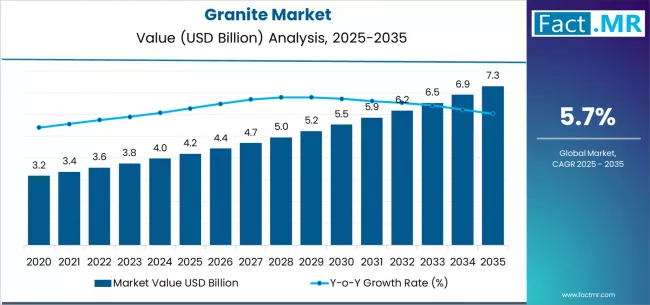
Granite Market Market Value Analysis | Source: Fact.MR
Summary of Granite Market
- Market Overview
-
The granite market is valued at USD 4.20 billion in 2025 and is projected to reach USD 7.73 billion by 2036.
-
The industry is expected to grow at a 5.7% CAGR from 2026 to 2036, creating an incremental opportunity of USD 3.29 billion.
-
The market is a volume-driven, construction-linked natural stone category where quarry extraction capacity, finishing technology, and freight logistics define competitive positioning.
-
- Demand and Growth Drivers
-
Demand is rising as residential construction activity expands across India, China, and Brazil, generating sustained procurement of granite slabs and tiles for interior and exterior applications.
-
Commercial infrastructure revival, including metro rail cladding, airport terminal finishing, and hospitality sector refurbishment, is driving specification of granite over synthetic alternatives in high-traffic installations.
-
Growth is further supported by government housing programmes and giga-project procurement in the Middle East that mandate natural stone facades in public buildings.
-
Among key countries, India leads at 6.3% CAGR, followed by China at 6.0%, Brazil at 5.5%, the USA at 5.1%, Italy at 4.7%, Saudi Arabia at 4.3%, and Japan at 3.8%.
-
- Product and Segment View
-
The market encompasses natural granite products extracted from quarries and processed into slabs, tiles, cut-to-size components, rough blocks, and dimension stone for construction and decorative applications.
-
These products are used across residential countertops, commercial flooring, exterior wall cladding, infrastructure projects, and monument fabrication.
-
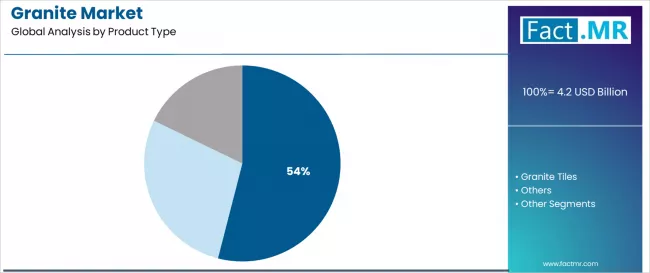
Granite Slabs lead by product type with 54.0% share in 2026, driven by direct-to-fabricator supply chains serving kitchen and bathroom countertop demand.
-
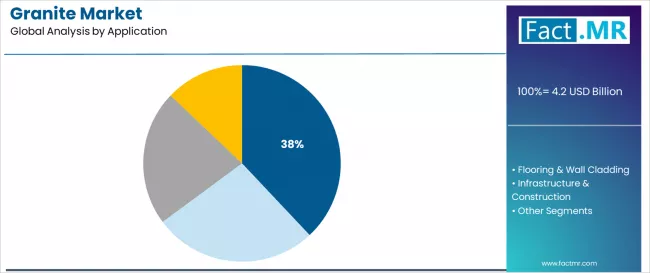
Countertops lead by application with 38.0% share in 2026, reflecting consistent specification in both new residential construction and remodeling projects.
-
The scope includes all forms of processed and unprocessed granite stone, while excluding engineered quartz, sintered stone, and porcelain slab alternatives.
-
- Geography and Competitive Outlook
-
India and China are the fastest-growing markets due to large-scale housing construction and urban renovation programmes, while Italy and Brazil function as established quarry and export hubs.
-
North America and Western Europe represent mature demand bases where replacement cycles and premium finishing drive procurement rather than volume growth.
-
Competition is shaped by quarry access, finishing technology, and freight logistics, with key players including Levantina y Asociados de Minerales, S.A.U., AbleGroup Berhad, Arizona Tile, LLC, Dakota Granite Company, and American Marazzi Tile, Inc.
-
Granite Market Key Takeaways
| Metric | Details |
|---|---|
| Industry Size (2026) | USD 4.44 billion |
| Industry Value (2036) | USD 7.73 billion |
| CAGR (2026 to 2036) | 5.7% |
Source: Fact.MR analysis. Updated Apr 2, 2026
Source: Future Market Insights, 2026.
The market is positioned to add USD 3.29 billion in absolute value between 2026 and 2036. Growth is steady rather than explosive, reflecting the mature supply chains in Italy, Brazil, and India where extraction capacity is already scaled. Freight cost volatility for heavy dimensional stone and the increasing penetration of engineered quartz in mid-tier residential countertops apply structural pressure on granite pricing. Margins concentrate in premium finished slabs sold directly to fabricators, while commodity rough blocks face compression from surplus quarry output in Rajasthan and Shandong.
India sets the pace with a 6.3% CAGR, supported by large government housing programmes and metro rail station cladding contracts. China follows at 6.0%, backed by ongoing urban renovation cycles in tier-2 cities. Brazil registers a 5.5% expansion rate as domestic quarries supply both internal construction and export markets in the Americas. The USA tracks at 5.1%, sustained by residential remodeling activity. Italy maintains a 4.7% rate, driven by heritage restoration contracts and luxury export finishing. Saudi Arabia advances at 4.3% on the back of giga-project procurement schedules. Japan records a 3.8% pace, anchored by replacement demand in ageing commercial properties.
Imperatives for Stakeholders in Granite Market
Design for durability and aesthetics, not just stone supply
- Offer complete finishing solutions: premium slab products + fabrication services + installation support + maintenance programs + design consultation platforms.
- Preconfigured application packages: residential countertop specifications, commercial flooring configurations, infrastructure construction programs, and combination finishing protocols for diverse project requirements.
Quality consistency for architectural applications
- Comprehensive color matching documentation, surface finishing systems, and quarry infrastructure (extraction traceability, processing quality assurance, inventory management protocols).
Affordability-by-design approach
- Cost-optimized product portfolios, flexible pricing models, contractor loyalty programs, and transparent total project cost documentation.
Fabricator training-focused market penetration
- Established installation workshops + comprehensive certification programs (cutting techniques, finishing methods, quality control); direct fabricator engagement for relationship development and product confidence building.
Segmental Analysis
Primary Classification: The market segments by product into granite slabs, granite tiles, and others, representing the evolution from basic stone extraction toward sophisticated finishing products with diverse surface treatments, customizable dimensions, and integrated fabrication characteristics.
Secondary Classification: The application segmentation divides the market into countertops (38.0%) with residential, commercial, and industrial installations, flooring and wall cladding, infrastructure and construction, and monuments and memorials, reflecting distinct USAge objectives for interior finishing requirements and architectural applications versus structural construction implementation and heritage preservation.
The segmentation structure reveals granite evolution from basic building material toward comprehensive architectural solutions with enhanced finishing characteristics and multi-dimensional design capabilities, while application diversity spans from interior design installations to infrastructure construction requiring specialized durability properties.
Why do Granite Slabs Command the Largest Share in the Market?
Granite Market Analysis By Product Type | Source: Fact.MR
Market Position: Granite slabs command the leading position in the granite market with a 54.0% market share through superior design flexibility characteristics, including seamless installation capabilities, customizable dimensions, and diverse finishing options that enable architects to achieve premium aesthetic outcomes across varied residential and commercial applications and diverse construction demographics.
Value Drivers: The segment benefits from fabrication advantages through precise cutting capabilities, versatile edge profiling, and established installation techniques without requiring extensive modification procedures. Advanced finishing technology enables polished surface optimization, honed texture variation, and flamed slip resistance customization, where appearance quality and durability reliability represent critical design requirements. Polished slabs hold significant share within the product segment at 27.0%, appealing to designers seeking reflective surface properties for premium interior applications.
Competitive Advantages: Granite slabs differentiate through proven performance characteristics, architectural familiarity advantages, and integration with established construction protocols that enhance project confidence while maintaining compliant aesthetic outcomes for diverse building finishing applications.
Key market characteristics:
- Advanced durability properties with scratch resistance and heat tolerance for demanding installation environments
- Superior aesthetic qualities, enabling design customization and visual continuity for architectural applications
- Comprehensive finishing options, including polished, honed, and flamed variations for diverse surface requirements
Why do Granite Tiles Represent a Specialized Installation Segment?
Granite tiles maintain specialized market position at 33.0% share through modular installation characteristics and commercial application capabilities. These products appeal to contractors and architects seeking standardized dimensions with efficient installation processes, offering cost-effective coverage patterns and maintenance-friendly configurations through tile-based systems. Market adoption is driven by flooring applications at an 18.0% share, emphasizing uniform appearance achievement and regulatory compliance progression through proven construction methodologies.
Which is the Dominant Application Segment in the Granite Market?
Granite Market Analysis By Application | Source: Fact.MR
Market Context: Countertops demonstrate application leadership in the granite market with a 38.0% share due to widespread premium kitchen requirements and established focus on food preparation surfaces, design statement creation, and property value enhancement that maximizes residential appeal while maintaining appropriate durability characteristics.
Appeal Factors: Homeowners and commercial operators prioritize countertop applications for aesthetic presentation, functional performance requirements, and integration with established kitchen design workflows that enables coordinated renovation experiences across multiple interior elements. The segment benefits from substantial residential construction activity and property improvement investment that emphasizes granite-based solutions for premium surface applications across diverse property demographics. Residential countertops capture significant share within the application segment at 21.0%, demonstrating homeowner preference for natural stone materials.
Growth Drivers: Kitchen renovation expansion incorporates granite as standard premium material for surface upgrades, while hospitality construction increases commercial installation that meets quality requirements and ensures visual impact capabilities.
What drives Flooring and Wall Cladding Adoption in Construction Applications?
Flooring and wall cladding capture substantial application share at 32.0% through comprehensive requirements in commercial installations, public space construction, and architectural finishing systems. These applications demand durable surface materials capable of achieving traffic resistance standards while providing visual consistency and maintenance efficiency, appealing to architects and contractors seeking evidence-based performance advantages beyond alternative finishing approaches.
What are the Drivers, Restraints, and Key Trends of the Granite Market?
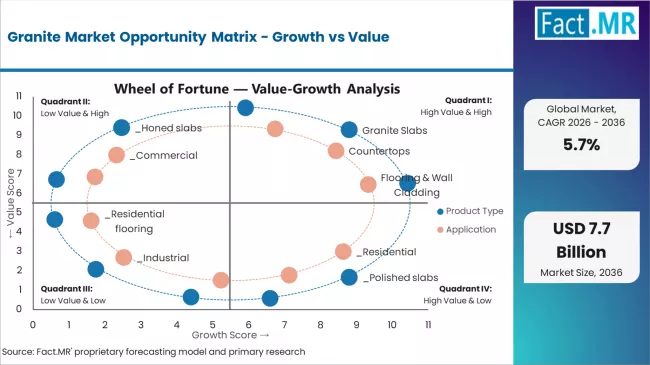
Granite Market Opportunity Matrix Growth Vs Value | Source: Fact.MR
| Category | Factor | Impact | Why It Matters |
|---|---|---|---|
| Driver | Rising residential renovation and commercial construction activity (property improvement, hospitality expansion) | ★★★★★ | Premium material requirements enable granite demand for interior finishing applications; increasing construction spending drives product adoption across residential markets and diverse commercial segments. |
| Driver | Growth in infrastructure development and urban construction projects (transportation facilities, public buildings) | ★★★★★ | Drives demand for durable finishing systems and weatherproof materials; contractors providing consistent performance outcomes gain competitive advantage in infrastructure-focused construction segments. |
| Driver | Architectural preference for natural stone materials and aesthetic differentiation (design trends, material authenticity) | ★★★★☆ | Architects demand authentic finishing materials and distinctive design solutions; natural stone positioning expanding addressable segments beyond traditional construction demographics and renovation project clientele. |
| Restraint | High material costs and installation complexity (extraction expenses, fabrication requirements) | ★★★★☆ | Cost-conscious developers face budget limitations and project pricing constraints, restricting material adoption and affecting market penetration in price-sensitive construction segments and emerging market applications. |
| Restraint | Competition from engineered surfaces and alternative materials (quartz products, ceramic options) | ★★★☆☆ | Contractors face performance comparisons and pricing pressures; increases competitive barriers and affects adoption penetration in mid-range residential projects and commercial budget applications. |
| Trend | Advanced finishing technologies and surface treatment innovations (edge profiling, texture enhancement) | ★★★★★ | Growing design customization capabilities and aesthetic variation preferences beyond traditional polished granite finishes; advanced processing becomes core differentiation strategy for premium market positioning. |
| Trend | Export market expansion and international trade development (quarry globalization, logistics optimization) | ★★★★☆ | Industry evolving beyond domestic supply toward international distribution networks; trade positioning drives geographic diversification and market access in sophisticated construction environments. |
Source: Fact.MR analysis. Updated Apr 2, 2026
Analysis of the Granite Market by Key Countries
The granite market demonstrates robust regional growth dynamics with emerging leaders including India (6.3% CAGR) and China (6.0% CAGR) driving expansion through quarrying capacity programs and construction infrastructure development. Strong performers encompass Brazil (5.5% CAGR), USA (5.1% CAGR), and Italy (4.7% CAGR), benefiting from established natural stone appreciation cultures and architectural heritage demographics. Developed markets feature Saudi Arabia (4.3% CAGR) and Japan (3.8% CAGR), where premium construction normalization and renovation activity support consistent growth patterns.
Regional synthesis reveals Asian markets leading adoption through comprehensive extraction capacity positioning and construction investment expansion, while Western countries demonstrate measured growth potential supported by heritage restoration preferences and design material influence. Latin American markets show solid development driven by export orientation integration and mining infrastructure advancement.
.webp "Top Country Growth Comparison Granite Market Cagr (2026 2036)")
Top Country Growth Comparison Granite Market Cagr (2026 2036) | Source: Fact.MR
| Region/Country | 2025 to 2035 Growth | How to win | What to watch out |
|---|---|---|---|
| India | 6.3% | Focus on export-quality portfolios | Quarry regulation changes; processing standards |
| China | 6.0% | Lead with urban construction positioning | Market saturation; environmental restrictions |
| Brazil | 5.5% | Provide premium product technologies | Economic fluctuations; logistics challenges |
| USA | 5.1% | Offer design customization strategies | Material competition; fabricator consolidation |
| Italy | 4.7% | Maintain heritage-focused positioning | Market maturity; import competition |
| Saudi Arabia | 4.3% | Deliver luxury project solutions | Project cyclicality; economic dependency |
| Japan | 3.8% | Push quality assurance programs | Population decline; construction slowdown |
Source: Fact.MR analysis. Updated Apr 2, 2026
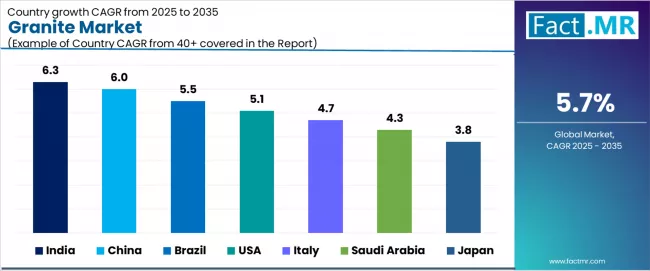
Granite Market Cagr Analysis By Country | Source: Fact.MR
India Drives Fastest Market Growth
India establishes fastest market growth through progressive quarrying expansion and comprehensive export infrastructure development, positioning granite products as essential construction materials in building projects and emerging international trade facilities. The country's 6.3% growth rate reflects rising mining investment levels supporting processing capacity and growing export manufacturing segments that encourage the deployment of quality-controlled granite products in diverse architectural settings.
Growth concentrates in major quarrying regions, including Karnataka, Tamil Nadu, and Andhra Pradesh, where extraction facilities showcase increasing capacity for international quality standard adoption that appeal to export-focused producers demanding consistent product specifications and processing excellence outcomes.
Indian granite producers are developing standardized quality protocols that combine modern extraction techniques with advanced processing partnerships, including finishing technology adoption and color consistency programs. Distribution channels through international stone distributors and architectural material suppliers expand market access, while quality certification initiatives support adoption across diverse project types and construction specialization levels.
China Emerges as Construction Application Leader
In Fujian, Shandong, and Inner Mongolia regions, construction projects and infrastructure development programs are adopting granite materials as essential finishing products for building operations, driven by increasing urban development intensity and elevation of architectural quality expectations that emphasize the importance of durable natural stone.
The market holds a 6.0% growth rate, supported by construction activity acceleration and infrastructure investment programs that promote granite adoption for large-scale applications. Chinese developers are favoring consistent quality materials that provide comprehensive finishing capabilities and long-term durability evidence, particularly appealing in urban centers where performance reliability and aesthetic consistency represent critical project factors.
Market expansion benefits from substantial construction facility investment and architectural material acceptance that enable widespread adoption of evidence-based natural stone solutions for diverse building applications. Industry adoption follows patterns established in commercial construction excellence, where material performance advantages and architectural appeal documentation drive developer confidence and project specification achievement.
Brazil Shows Export Market Leadership
Brazil establishes export market leadership through comprehensive granite reserves and established international distribution infrastructure, integrating extraction operations across mining regions, processing facilities, and export terminals. The country's 5.5% growth rate reflects established geological advantages and sophisticated export logistics that support widespread deployment of premium granite products in international and domestic applications.
Growth concentrates in established mining states, including Espirito Santo, Bahia, and Minas Gerais, where producers showcase advanced extraction practices that appeal to quality-focused buyers seeking distinctive color variations and competitive pricing outcomes.
Brazilian granite suppliers leverage established international relationships and comprehensive quality control frameworks, including color selection programs and processing documentation systems that create buyer confidence and specification assurance. The market benefits from substantial reserve diversity and favorable extraction economics that encourage premium product positioning while supporting continuous mining investments and processing technology funding.
USA Shows Commercial Design Leadership
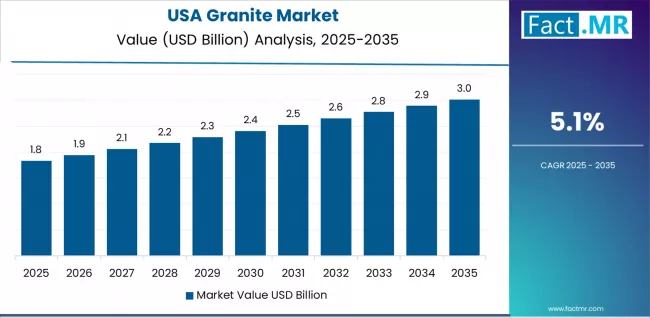
Granite Market Country Value Analysis | Source: Fact.MR
USA establishes commercial design leadership through comprehensive architectural specification infrastructure and established premium material adoption ecosystem, integrating granite products across residential renovations, commercial construction, and institutional projects.
The country's 5.1% growth rate reflects established design culture maturity and sophisticated contractor capabilities that support widespread deployment of high-end stone products in architectural and interior applications. Growth concentrates in established construction markets, including California, Texas, and Florida, where builders showcase advanced finishing adoption that appeals to quality-focused homeowners seeking distinctive interior materials and comprehensive design outcomes.
American construction providers leverage established supplier relationships and comprehensive design service frameworks, including fabrication capabilities and installation coordination programs that create project confidence and quality assurance. The market benefits from substantial renovation spending and premium construction activity that encourage quality product purchases while supporting continuous design innovation investments and material specification enhancement.
Italy Shows Heritage Architecture Integration
Italy's sophisticated construction market demonstrates progressive granite adoption with documented heritage emphasis in restoration projects and architectural preservation protocols through specialized stone craftsmen and established conservation organizations. The country maintains a 4.7% growth rate, leveraging established stone working heritage and comprehensive architectural restoration frameworks in historic building preservation.
Major architectural centers, including Tuscany, Lombardy, and Veneto regions, showcase traditional quality emphasis where granite materials integrate with established European construction standards and meticulous craftsmanship practices to optimize restoration authenticity and maintain architectural integrity under comprehensive heritage authority supervision.
Italian craftsmen prioritize historical accuracy and comprehensive restoration protocols in stone material selection, creating demand for authentic products with extensive heritage characteristics, including quarry provenance documentation, traditional finishing methods, and historical color matching. The market benefits from established architectural preservation reputation and quality-focused construction culture that provide premium positioning opportunities and comply with strict Italian heritage regulations.
Saudi Arabia Demonstrates Luxury Construction Preferences
Saudi Arabia's expanding construction market demonstrates established granite integration with documented premium emphasis in hospitality projects and architectural statement creation through specialized luxury developments and landmark construction programs. The country maintains a 4.3% growth rate, leveraging substantial construction investment and quality-focused architectural approaches in premium building projects.
Key development regions, including Riyadh, Jeddah, and NEOM areas, showcase luxury material priorities where granite products integrate with established high-end construction cultures and comprehensive finishing systems to optimize visual impact and ensure appropriate durability assessment.
The developers prioritize premium material specifications and comprehensive quality documentation in project implementation, creating demand for distinctive products with extensive aesthetic characteristics, including unique color patterns, large format capabilities, and premium finishing options. The market benefits from established luxury hospitality sectors and landmark development initiatives that provide differentiation opportunities and maintain alignment with Saudi architectural standards.
Japan Shows Renovation Market Integration
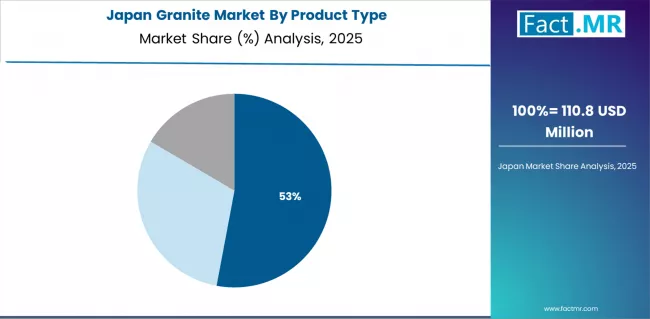
Granite Market Japan Market Share Analysis By Product Type | Source: Fact.MR
Japan's mature construction market demonstrates established granite integration with documented quality standards in renovation applications and maintenance project execution through comprehensive residential improvement facilities and specialized contractor organizations. The country maintains a 3.8% growth rate, leveraging established material quality appreciation and comprehensive construction craftsmanship traditions in building renovation.
Major metropolitan areas, including Tokyo, Osaka, and Nagoya regions, showcase precision-driven installation approaches where granite materials integrate with established Japanese construction standards and thorough quality practices to optimize renovation outcomes and maintain property value under demanding homeowner expectations.
Japanese contractors prioritize installation precision and comprehensive quality assurance in renovation program development, creating demand for consistent products with extensive specification characteristics, including dimensional accuracy, surface finishing quality, and installation compatibility documentation. The market benefits from established residential maintenance culture and quality-focused renovation practices that provide premium positioning opportunities and maintain alignment with Japanese construction standards.
Europe Market Split by Country
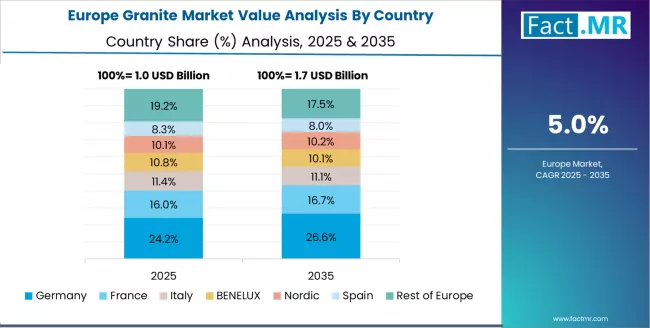
Granite Market Europe Country Market Share Analysis, 2025 & 2035 | Source: Fact.MR
The European granite market is projected to grow from USD 1.1 billion in 2025 to USD 1.9 billion by 2035, representing 26.1% of the global market in 2025 and expanding to 26.0% by 2035. Italy is expected to maintain its leadership position with USD 0.3 billion in 2025, accounting for 26.8% of the European market, supported by its established stone working heritage and comprehensive architectural restoration networks.
Spain follows with USD 0.2 billion, representing 18.9% of the European market in 2025, driven by comprehensive construction activity and granite quarrying concentration. Germany holds USD 0.2 billion with 17.3% market share through established architectural specification acceptance and construction quality density.
France commands USD 0.2 billion representing 14.2% share, while UK accounts for USD 0.1 billion or 11.6% in 2025. The rest of Europe region maintains USD 0.1 billion, representing 11.2% of the European market, attributed to increasing granite adoption in Nordic countries and emerging Eastern European construction sectors implementing natural stone programs.
Competitive Landscape of the Granite Market
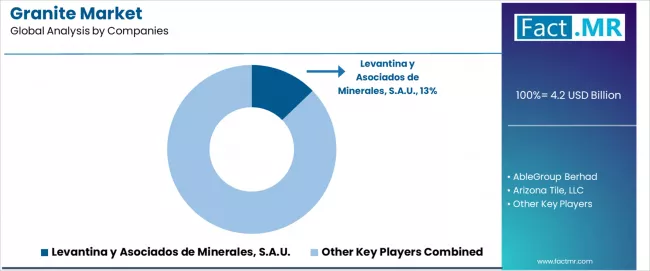
Granite Market Analysis By Company | Source: Fact.MR
The granite market exhibits a moderately fragmented competitive structure with approximately 150-200 active players operating across global extraction networks and regional processing distribution portfolios. Levantina y Asociados de Minerales, S.A.U. maintains market leadership at a 12.8% share, reflecting strong quarry positioning across diverse product offerings with sophisticated global distribution strategies.
This competitive landscape demonstrates the maturation of granite industry, where established players leverage brand recognition advantages, extensive quality documentation, and architectural relationship programs to maintain dominant positions, while emerging regional producers and specialized fabricators create niche opportunities through distinctive color offerings and competitive pricing strategies.
Market leadership is maintained through several critical competitive advantages extending beyond extraction capabilities and product portfolios. Global distribution networks enable leading players to navigate diverse architectural requirements and access varied construction segments including residential renovation, commercial development, and infrastructure projects. Technical support infrastructure and fabricator training program availability represent crucial differentiators in granite categories, where decades of installation expertise, finishing protocols, and design consultation frameworks create purchasing preference among quality-focused architects.
Processing efficiency in modern fabrication facilities, supply chain logistics management, and raw material quality control separate major suppliers from smaller competitors, while comprehensive product documentation addressing color consistency, dimensional accuracy, and performance specifications strengthen market position and buyer confidence.
The market demonstrates emerging differentiation opportunities in engineered finishing categories and surface treatment technologies, where traditional polished granite methodologies face competition from innovation-focused entrants offering customization advantages.
Significant competitive advantages persist in established natural stone categories through comprehensive quarry ownership portfolios and architectural relationship depth. Premium positioning strategies with unique color selections and large format capabilities command margin premiums through superior aesthetics and design flexibility integration.
Specialized product portfolios combining multiple finishing options with application-specific specifications create comprehensive positioning that justifies higher price points beyond commodity stone competition. Integrated solution offerings emphasizing complementary fabrication compatibility, unified technical support, and cross-application installation programs generate brand loyalty and product line preferences beyond transactional material purchases.
| Stakeholder | What they actually control | Typical strengths | Typical blind spots |
|---|---|---|---|
| Global stone corporations | Comprehensive quarry portfolios; global distribution; quality documentation | Brand recognition; reserve access; architectural relationships; logistics networks | Innovation speed; pricing flexibility; regional customization; fabricator support |
| Specialized granite producers | Quarry expertise; product consistency; color optimization | Product differentiation; extraction sophistication; quality control; regional loyalty | Market penetration; distribution infrastructure; price competitiveness; geographic coverage |
| Regional quarry operators | Local extraction; cost optimization; regional distribution; processing proximity | Affordability positioning; delivery speed; local support; cultural understanding | Quality consistency; brand recognition; international expansion; advanced processing |
| Fabrication companies | Processing delivery; finishing expertise; installation coordination | Quality assurance; customization knowledge; customer service; convenience positioning; repeat business | Product sourcing; material innovation; extraction control; premium positioning |
| Architectural specification firms | Design influence; material selection; project specification; quality standards | Aesthetic credibility; design innovation; specification influence; industry connections | Material sourcing; cost management; fabrication coordination; installation oversight |
Source: Fact.MR analysis. Updated Apr 2, 2026
Key Players in the Granite Market
- Levantina y Asociados de Minerales, S.A.U.
- AbleGroup Berhad
- Arizona Tile, LLC
- Dakota Granite Company
- American Marazzi Tile, Inc. (part of Mohawk Industries)
- Precision Tops, Inc.
- Craig Baker Marble Co., Inc.
- Granite Tops
- Precision Countertops, Inc.
- Vangura Surfacing Products, LLC
Bibliography
1. Indian Bureau of Mines. (2024). Indian Minerals Yearbook 2024: Granite (Advance Release). Ministry of Mines, Government of India.
2. Associacao Brasileira da Industria de Rochas Ornamentais (ABIROCHAS). (2024). Brazilian Natural Stone Sector: 2024 Annual Report. ABIROCHAS.
3. Confindustria Marmomacchine. (2024). Statistical Yearbook of the Italian Natural Stone Industry 2024. Confindustria Marmomacchine.
4. United States Geological Survey. (2025, January). Mineral Commodity Summaries 2025: Dimension Stone. USGS.
5. Saudi Arabian Mining Company (Maaden). (2024). 2024 Annual Report. Maaden.
6. International Organization for Standardization. (2024). ISO 12058-1:2024, Natural Stone Test Methods. ISO.
This bibliography is provided for reader reference. The full Fact.MR report contains the complete reference list with primary research documentation.
This Report Addresses
- Market sizing and quantitative forecast metrics detailing the precise procurement expenditure dedicated to granite slabs, tiles, and dimensional stone across major construction and infrastructure sectors through 2036.
- Segmentation analysis mapping the consumption velocity of specific product types and evaluating the technical and aesthetic factors governing countertop, flooring, and cladding specification decisions.
- Regional deployment intelligence comparing the aggressive quarry expansion and domestic construction strategies in India and Brazil against the mature replacement demand and premium finishing requirements prevalent in European and North American markets.
- Regulatory compliance assessment analyzing how mining permit frameworks, environmental extraction mandates, and construction material certification standards affect quarry operations and cross-border trade flows.
- Competitive posture evaluation tracking the mandatory shift toward automated slab finishing lines and precision cutting technology, and the resulting margin dynamics for integrated quarry-to-fabricator supply chains.
- Capital project strategic guidance defining the exact material specification parameters, lead times, and procurement volumes required to support large-scale residential, commercial, and infrastructure granite installations.
- Supply chain vulnerability analysis identifying the specific freight logistics bottlenecks and raw material cost fluctuations that constrain granite distribution across long-haul export corridors.
- Custom data delivery formats encompassing interactive dashboards, raw Excel datasets, and comprehensive PDF narrative reports.
Granite Market Market Definition
Granite is a coarse-grained igneous rock composed primarily of quartz, feldspar, and mica, extracted from quarries and processed into slabs, tiles, and dimensional blocks for use in construction and architectural finishing. The material is valued for its compressive strength, abrasion resistance, and aesthetic variability across colour ranges. Primary end uses include kitchen and bathroom countertops, exterior wall cladding, commercial flooring, monumental structures, and infrastructure paving. Buyers range from residential fabricators and commercial general contractors to public works procurement agencies.
Granite Market Market Inclusions
Market scope includes global and regional market sizes for all forms of processed and unprocessed granite, including slabs (polished, honed, flamed, and other finishes), tiles (flooring, outdoor, and decorative), cut-to-size products, rough blocks, and dimension stone. The report covers the forecast period from 2026 to 2036 with segment breakdowns by product type and application, along with country-level analysis across major producing and consuming regions.
Granite Market Market Exclusions
The scope excludes engineered quartz surfaces, sintered stone panels, porcelain slab alternatives, and marble unless used in hybrid granite composite products. Downstream finished goods such as pre-fabricated vanity units and modular kitchen assemblies are not covered. Mining equipment, quarry leasing, and stone waste recycling operations fall outside the analytical boundary.
Granite Market Market Research Methodology
- Primary Research
- Analysts engaged with quarry operations directors, stone fabrication plant managers, and construction procurement leads to map the specific material specification triggers and contract structures governing granite purchasing cycles.
- Desk Research
- Data collection aggregated national mining production statistics, construction material import and export registries, and government infrastructure project pipeline disclosures from India, Brazil, Italy, China, and Saudi Arabia.
- Market-Sizing and Forecasting
- Baseline values derive from a bottom-up aggregation of quarry extraction volumes and fabricator throughput data, applying region-specific construction activity growth curves to project future demand velocity.
- Data Validation and Update Cycle
- Projections are tested against publicly reported construction material expenditure guidance from national statistics offices, trade association production surveys, and major contractor procurement filings.
Segmentation
Scope of the Report
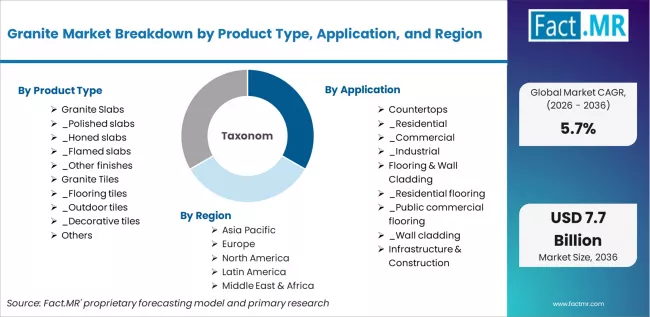
Granite Market Breakdown By Product Type, Application, And Region | Source: Fact.MR
| Metric | Value |
|---|---|
| Quantitative Units | USD 4.44 billion to USD 7.73 billion, at a CAGR of 5.7% |
| Market Definition | Granite is a coarse-grained igneous rock composed primarily of quartz, feldspar, and mica, extracted from quarries and processed into slabs, tiles, and dimensional blocks for use in construction and architectural finishing. The material is valued for its compressive strength, abrasion resistance, and aesthetic variability across colour ranges. |
| Product Type Segmentation | Granite Slabs, Granite Tiles, Others (Cut-to-size, Rough Blocks, Dimension Stone) |
| Application Segmentation | Countertops, Flooring & Wall Cladding, Infrastructure & Construction, Monuments & Memorials |
| Regions/Areas Covered | India, China, Brazil, USA, Italy, Saudi Arabia, Japan |
| Key Companies Profiled | Levantina y Asociados de Minerales, S.A.U., AbleGroup Berhad, Arizona Tile, LLC, Dakota Granite Company, American Marazzi Tile, Inc. (part of Mohawk Industries), Precision Tops, Inc., Craig Baker Marble Co., Inc. |
| Forecast Period | 2026 to 2036 |
Source: Fact.MR analysis. Updated Apr 2, 2026
Granite Market by Segments
-
Product Type :
- Granite Slabs
- Polished slabs
- Honed slabs
- Flamed slabs
- Other finishes
- Granite Tiles
- Flooring tiles
- Outdoor tiles
- Decorative tiles
- Others
- Cut-to-size products
- Rough blocks
- Dimension stone
- Granite Slabs
-
Application :
- Countertops
- Residential
- Commercial
- Industrial
- Flooring & Wall Cladding
- Residential flooring
- Public commercial flooring
- Wall cladding
- Infrastructure & Construction
- Bridges & pavements
- Airports & terminals
- Rail & public facilities
- Monuments & Memorials
- Architectural memorials
- Cultural heritage sites
- Custom carving
- Countertops
-
Region :
- North America
- USA
- Canada
- Mexico
- Europe
- Italy
- Spain
- Germany
- France
- UK
- Rest of Europe
- Asia Pacific
- India
- China
- Japan
- South Korea
- ASEAN
- Australia & New Zealand
- Rest of Asia Pacific
- Latin America
- Brazil
- Rest of Latin America
- Middle East & Africa
- Saudi Arabia
- GCC Countries
- South Africa
- Rest of Middle East & Africa
- North America
Frequently Asked Questions
How large is the demand for granite in the global market in 2026?
What will be the market size of granite in the global market by 2036?
What is the expected demand growth for granite in the global market between 2026 and 2036?
Which product type is poised to lead global sales by 2026?
How significant is the role of Countertops in driving granite market demand in 2026?
What is driving demand in India?
What is the India growth outlook in this report?
What is China's growth outlook in this report?
Who worked on this report


Preview the report firsthand - request a free sample
Free SampleGet the brochure for pricing and purchase details
Download PDF