- Market Value (2025): USD 143.9 Mn
- Estimated Value (2026): USD 190.0 Mn
- Forecast Value (2036): USD 3051.0 Mn
- CAGR (2026-2036): 32.0%
What is the Graphene ADAS Sensors Market forecast to be worth by 2036?
USD 190.0 million in 2026 to USD 3,051.0 million by 2036 at a 32.0% CAGR.
- The graphene ADAS sensors market reached USD 143.9 million in 2025.
- Demand is projected to increase from USD 190.0 million in 2026 to USD 3,051.0 million by 2036.
- The market is forecast to record 32.0% CAGR from 2026 to 2036 as vehicle engineers test graphene films for optical, cabin and battery-safety sensing.
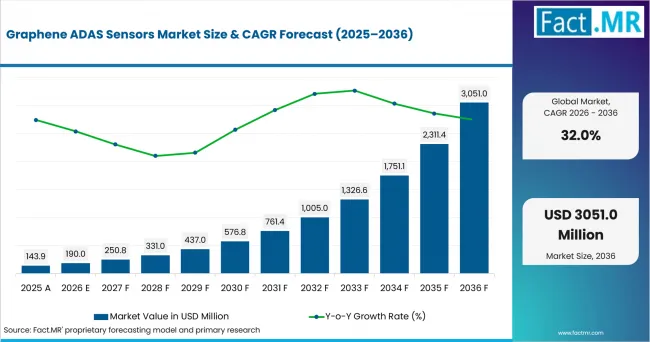
Graphene Adas Sensors Market Value Analysis | Source: Fact.MR
What are the defining numbers behind Graphene ADAS Sensors Market growth?
USD 2,861.0 million absolute opportunity is expected between 2026 and 2036.
- Demand Drivers in the Market
- Automotive OEMs need lower-noise sensing materials when ADAS stacks use more detection points around the vehicle. NHTSA estimated 36,640 U.S. traffic fatalities in 2025 in its April 1, 2026 early estimate.
- Tier-1 sensor integrators need thin functional films that fit compact modules without heavier packaging or higher power draw.
- Cabin monitoring teams need photodetectors and gas-cabin sensors that read driver state, air quality and occupant changes inside tighter interiors.
- Battery-system engineers need pressure, current and thermal response where electric platforms require early signals before safety limits are reached.
- Key Segments Analyzed
- By Sensor Function: Photodetectors are expected to hold 38.0% share in 2026 owing to optical, infrared and vision-linked ADAS functions.
- By ADAS Application: Driver monitoring is projected to account for 32.0% share in 2026 as cabin intelligence shifts toward eye, face and alertness sensing.
- By Material: CVD graphene is anticipated to capture 36.0% share in 2026 due to film uniformity needs in repeatable sensor fabrication.
- By Integration: Sensing film is estimated to represent 51.0% share in 2026 since thin layers are easier to place inside cameras, windows and compact modules.
- Analyst Opinion at Fact.MR
- Shambhu Nath Jha, Principal Consultant at Fact.MR, states, "Graphene ADAS sensors are drawing attention where the material changes a device design, not where graphene is used as a loose label. Adoption is expected to concentrate around repeatable films, verified response data and automotive qualification evidence. Suppliers should combine wafer-scale material control with packaging proof before asking OEMs to change established sensor designs."
- Strategic Implications
- Graphene material producers should document film uniformity, humidity stability and response drift under automotive thermal cycling.
- Sensor module developers should test graphene layers against incumbent silicon, MEMS and infrared devices in the same ADAS function.
- Automotive OEMs should keep qualification gates tied to the use case since cabin sensing and battery safety require different proof packages.
- Tier-1 suppliers should align graphene device roadmaps with camera, radar and battery-management platforms moving into software-defined vehicles.
Germany is projected to post 39.9% CAGR through 2036 supported by electric-platform sensing demand and EU safety requirements. Japan is forecast to advance at 39.1% CAGR owing to electronics capability and new-vehicle sensor fitment. South Korea is anticipated to record 37.9% CAGR as EV registrations deepen battery-safety opportunities. The UK is estimated to hold 22.9% CAGR through cabin monitoring and new-vehicle programs. The USA is expected to register 22.4% CAGR as vehicle miles keep ADAS validation active.
How does the Graphene ADAS Sensors Market break down by segment?
Photodetectors lead Sensor Function at 38.0%; Sensing film leads Integration at 51.0%.
Which Sensor Function leads?
Photodetectors hold 38.0% share in 2026.
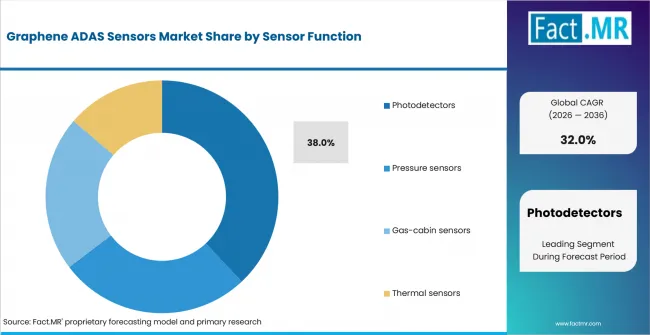
Graphene Adas Sensors Market Analysis By Sensor Function | Source: Fact.MR
Photodetectors lead in 2026 owing to ADAS platforms that need reliable light detection across camera support, night sensing and short-wave infrared use cases. Graphenea describes graphene as combining high carrier mobility, broadband optical absorption and ultrafast response, properties relevant to photodetectors. Emberion said on 15 October 2025 that it was scaling production capacity and process control for its quantum-dot-based SWIR sensing technology.
What supports Driver monitoring within ADAS Application?
Driver monitoring accounts for 32.0% share in 2026.
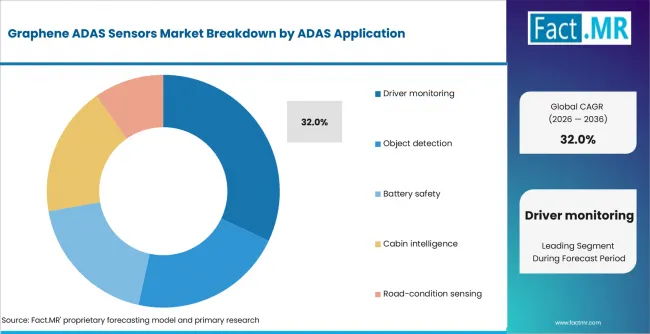
Graphene Adas Sensors Market Analysis By Adas Application | Source: Fact.MR
Driver monitoring leads the application mix as distraction detection moves from premium convenience toward safety compliance. Interior cameras and near-infrared sensing need compact detectors that read face, eye and occupant cues without raising power needs or module size. The European Commission stated in July 2026 that all new passenger cars and vans across the EU must include advanced driver-distraction warning systems from 7 July 2026.
How does Material shape demand?
CVD graphene captures 36.0% share in 2026.
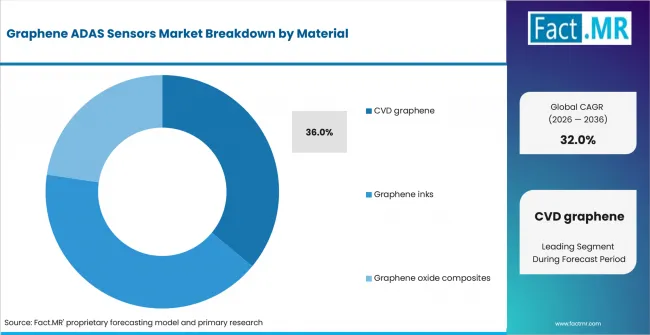
Graphene Adas Sensors Market Analysis By Material | Source: Fact.MR
CVD graphene leads the material segment since automotive sensors need repeatable films that can be patterned, contacted and tested at scale. Direct growth and clean transfer routes are useful when engineers need fewer contamination points between the material process and the device.
Paragraf Limited states that its graphene Hall sensors are intended for automotive positional, rotational and current sensing and describes steer-by-wire for automatic emergency steering as an application.
What leads the Integration segment?
Sensing film represents 51.0% share in 2026.
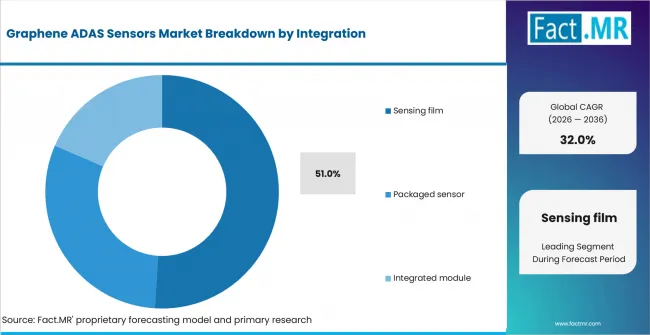
Graphene Adas Sensors Market Analysis By Integration | Source: Fact.MR
Sensing film leads as the most practical entry route for graphene in ADAS modules. Thin films can be assessed on optical windows, interior surfaces or packaged sensing elements without redesigning the full vehicle electronics architecture.
Graphenea offers CVD graphene films, GFET chips and graphene-foundry services. Grolltex Inc. offers electronics-grade graphene, sensor design, foundry services and contract manufacturing.
What is accelerating Graphene ADAS Sensors Market adoption, and what is holding it back?
Adoption is shaped by ADAS safety mandates, cabin sensing demand, EV battery monitoring and automotive qualification barriers.
Drivers Impact Analysis
| DRIVER | (~) % IMPACT ON CAGR | GEOGRAPHIC RELEVANCE | IMPACT TIMELINE |
|---|---|---|---|
| ADAS safety and driver-monitoring requirements | +2.3% | Europe, North America | Short term (<= 2 years) |
| Graphene photodetector interest for infrared and vision sensing | +1.8% | Global | Medium term (2-4 years) |
| EV battery safety demand for thermal and current sensing | +1.5% | East Asia, Europe | Medium term (2-4 years) |
| Wafer-scale graphene electronics and foundry services | +1.0% | North America, Europe | Long term (>= 4 years) |
- ADAS safety and driver-monitoring requirements: Mandatory cabin and external safety functions raise the value of sensing materials that add detection performance without larger modules.
- Graphene photodetector interest: Wider spectral response gives developers a reason to test graphene for infrared and low-light ADAS use cases.
- EV battery safety demand: Battery platforms need fast current, heat and pressure signals, giving graphene sensors a route outside camera-only ADAS stacks.
Opportunity Impact Analysis
| OPPORTUNITY | (~) % IMPACT ON CAGR | GEOGRAPHIC RELEVANCE | IMPACT TIMELINE |
|---|---|---|---|
| CVD graphene films for automotive sensor packages | +1.2% | Europe, USA | Medium term (2-4 years) |
| Cabin intelligence and driver-state sensing | +1.0% | Europe, Japan | Short term (<= 2 years) |
| Graphene current sensors for EV safety | +0.8% | East Asia, North America | Long term (>= 4 years) |
- CVD graphene films: Suppliers can gain share where wafer-scale repeatability lowers the work needed to qualify film behavior.
- Cabin intelligence: Driver monitoring and occupant sensing create a focused route for graphene photodetectors inside safety-related interiors.
- Graphene current sensors: EV battery and power electronics systems create space for graphene devices that detect current with compact geometry.
Restraints Impact Analysis
| RESTRAINT | (~) % IMPACT ON CAGR | GEOGRAPHIC RELEVANCE | IMPACT TIMELINE |
|---|---|---|---|
| Automotive qualification time for new sensor materials | -0.8% | Global | Short term (<= 2 years) |
| Competition from qualified silicon and MEMS devices | -0.6% | Global | Medium term (2-4 years) |
| Limited high-volume graphene device manufacturing history | -0.5% | Europe, North America | Long term (>= 4 years) |
- Automotive qualification time: OEMs require thermal, vibration, humidity and functional-safety evidence before changing a sensor material in ADAS modules.
- Qualified incumbent devices: Silicon, CMOS and MEMS suppliers already meet cost and reliability targets for many vehicle sensing tasks.
- Manufacturing history: Graphene device suppliers need repeatable wafer or film output before Tier-1 buyers place multi-platform sourcing commitments.
Which countries are scaling the Graphene ADAS Sensors Market through 2036?
- The country comparison spans 17.5 percentage points across the five profiled markets.
- Germany remains 0.8 percentage point above Japan due to EU safety rules and electric-platform sensing demand.
- Japan remains 1.2 percentage points above South Korea as electronics capability supports optical and cabin-sensing work.
- South Korea remains 15.0 percentage points above the UK as EV registrations deepen battery-safety opportunities.
- The UK remains 0.5 percentage point above the USA through new-vehicle programs and cabin monitoring alignment.
- The USA closes the displayed range while its vehicle-mile base keeps ADAS validation and replacement work active.
Comparable CAGRs create different entry conditions due to safety regulation, EV platform mix, sensor qualification capacity and local electronics supply. Full report coverage includes North America, Latin America, Western Europe, Eastern Europe, East Asia, South Asia & Pacific, Middle East & Africa.
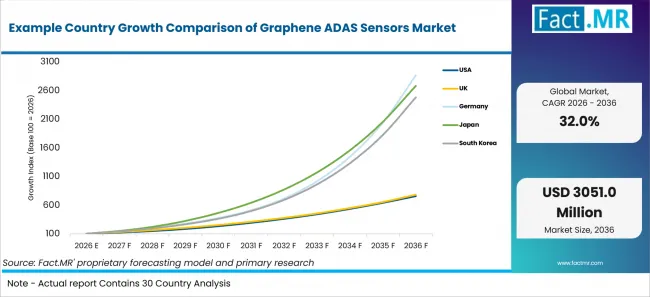
Example Country Growth Comparison Of Graphene Adas Sensors Market | Source: Fact.MR
| Country | CAGR (2026-2036) |
|---|---|
| Germany | 39.9% |
| Japan | 39.1% |
| South Korea | 37.9% |
| UK | 22.9% |
| USA | 22.4% |
What supports Germany adoption?
39.9% CAGR through 2036, supported by EV platform demand and graphene film qualification.
Germany benefits from a vehicle engineering base that evaluates sensor materials through long qualification cycles. Umweltbundesamt reported that Germany had 2.03 million electric passenger cars and 4.36 million hybrid vehicles in 2026.
How is Japan scaling demand?
39.1% CAGR through 2036, led by vehicle electronics and compact sensor integration.
Japan scales through electronics capability and automaker preference for compact sensor packages. Japan’s Statistics Dashboard recorded 417,153 new vehicle sales, covering non-mini and mini vehicles, in July 2026.
What supports South Korea adoption?
37.9% CAGR through 2036, reinforced by EV safety and packaged sensor manufacturing.
South Korea has a direct route through electric vehicles and high-volume electronics packaging. MCEE reported on April 21, 2026 that Korea had 981,321 registered EVs at the end of March and surpassed 1 million registered EVs on April 15.
How is the UK developing demand?
22.9% CAGR through 2036, supported by new-vehicle fitment and local graphene electronics activity.
The UK develops demand through vehicle renewals and local graphene device activity. DfT reported on April 29, 2026 that 2,617,000 vehicles were registered for the first time in the UK during 2025.
What supports USA adoption?
22.4% CAGR through 2036, supported by vehicle-scale validation and ADAS safety reporting.
The USA offers a large validation base where ADAS sensing must perform across many vehicle classes and driving environments. FHWA’s Table VM-1, updated in February 2026, reports 3,294,031 million vehicle-miles, or about 3.294 trillion vehicle-miles, for all U.S. motor vehicles in 2024.
Who leads the Graphene ADAS Sensors Market?
The report profiles Paragraf Limited as a direct automotive graphene-sensor company and Graphenea, Grolltex Inc., and Exosens as adjacent or enabling companies.
Paragraf Limited fits automotive ADAS sensing through graphene Hall sensors for positional, rotational and current sensing. Its automotive sensing focus supports battery and actuator monitoring where compact current and motion feedback are needed. Graphenea contributes CVD graphene and graphene field-effect transistor capability, which aligns with film and device-level experimentation.
Exosens completed the Emberion acquisition on April 24, 2026. Exosens describes Emberion’s commercial infrared sensors as quantum-dot-based; Emberion separately has graphene-transducer and GFET imaging development history.
Which companies are the key providers?
Key companies include Graphenea, Paragraf Limited, Exosens, Grolltex Inc.
- Graphenea
- Paragraf Limited
- Exosens
- Grolltex Inc.
Bibliography
- National Highway Traffic Safety Administration. (2026, April 1). Trump’s Transportation Department announces record-low traffic deaths & fatality rates in 2025.
- European Commission. (2026, July 8). Safer cars, safer roads: New rules take effect.
- Emberion. (2025, October 15). Emberion invests in scaling its production capabilities for high-volume production.
- Paragraf. (2025, December 22). Paragraf produces first 6-inch graphene wafer at new Huntingdon facility.
- Exosens. (2026, April 27). Q1 2026 Exosens results.
- German Environment Agency. (2026, May 15). Verkehrsinfrastruktur und Fahrzeugbestand [Transport infrastructure and vehicle stock].
- Statistics Bureau of Japan. (2026, August 6). Sales of new vehicles (Non-mini vehicles, mini vehicles) [Statistics Dashboard data series].
- Department for Transport. (2026, April 29). Vehicle licensing statistics, United Kingdom: 2025.
- Federal Highway Administration. (2026, February). Annual vehicle distance traveled in miles and related data—2024, by highway category and vehicle type (Table VM-1).
This Report Answers
- The report explains where graphene ADAS sensors are used across sensor function, ADAS application, material and integration format.
- Segment analysis identifies the leading subsegments and the operating reasons automakers evaluate graphene sensing materials.
- Country analysis reviews the listed markets and the safety, EV and vehicle-base factors supporting adoption.
- Competitive analysis reviews a direct automotive graphene-sensor company alongside adjacent graphene materials, imaging and sensor-service capabilities.
- Application analysis assesses how driver monitoring, object detection, battery safety and cabin intelligence shape purchasing decisions.
What does the Graphene ADAS Sensors Market cover?
The Graphene ADAS Sensors Market covers graphene-enabled devices and functional films used in ADAS sensing.
It includes photodetectors, pressure sensors, thermal sensors and gas-cabin sensors applied to driver monitoring, object detection and battery safety. The assessment considers adjacent sensors analysis and automotive electronics contexts where graphene devices support the sensing layer or module design.
What is included in the scope?
The scope includes CVD graphene films, graphene inks, graphene oxide composites and packaged graphene devices used in ADAS modules. It includes links to automotive radar sensors, forward camera sensing and lidar sensor modules only where graphene contributes to a sensor element or supporting material layer.
Relevant adjacent systems include thermal imaging sensor systems and automotive pressure sensor applications when graphene contributes to sensing performance. Broader electronic content is included only when the graphene function is tied to perception, cabin state or battery safety.
What is excluded from the scope?
The scope excludes generic graphene powders, research-only graphene samples and graphene sold for batteries, coatings or composites without a defined ADAS sensor function. It also excludes cameras, radar units, ECUs and software when they do not include a graphene sensing element.
Automotive ADAS systems that rely solely on silicon, CMOS, MEMS, radar or lidar components are excluded unless a graphene device or film is part of the sensing stack. General vehicle electronics are excluded when the graphene function is structural, thermal or conductive only.
How Was the Analysis Built?
The analysis draws on 120+ sources, 35+ company portfolios, 25+ countries, and more than 20 industry interviews.
- Primary Research: Primary research includes discussions with manufacturers, service providers, technology developers, distributors, end users, procurement teams, and subject-matter experts. These conversations examine purchasing priorities, product adoption, operational challenges, approval requirements, competitive positioning, and the factors that influence wider market acceptance.
- Desk Research: Desk research covers government statistics, regulatory publications, company filings, trade data, technical studies, industry associations, standards, public policy, and other authoritative sources. Every source used in the analysis is documented in the bibliography.
- Market Sizing and Forecasting: Market estimates combine historical performance, demand indicators, pricing and volume trends, segment shares, company participation, country-level growth, adoption patterns, investment activity, and barriers to market expansion.
- Data Validation and Update Cycle: Findings are validated by comparing primary interviews with public data, company activity, regulatory changes, trade patterns, and industry developments. Regular updates review new product launches, capacity changes, partnerships, approvals, procurement trends, and shifts in commercial adoption.
What is the report’s scope and coverage?
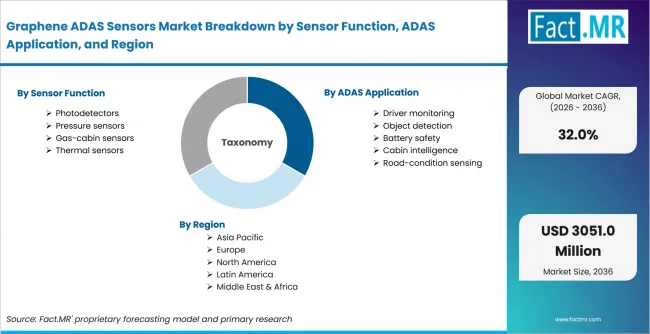
Graphene Adas Sensors Market Breakdown By Sensor Function, Adas Application, And Region | Source: Fact.MR
| Attribute | Details |
|---|---|
| Quantitative Units | USD million |
| Market Definition | Graphene ADAS sensors are sensing devices or functional graphene layers used in advanced driver assistance systems, including photodetectors, pressure sensors, gas-cabin sensors and thermal sensors. |
| Sensor Function | Photodetectors; Pressure sensors; Gas-cabin sensors; Thermal sensors |
| ADAS Application | Driver monitoring; Object detection; Battery safety; Cabin intelligence; Road-condition sensing |
| Material | CVD graphene; Graphene inks; Graphene oxide composites |
| Integration | Sensing film; Packaged sensor; Integrated module |
| Regions Covered | North America; Latin America; Western Europe; Eastern Europe; East Asia; South Asia & Pacific; Middle East & Africa |
| Countries Covered | USA; UK; Germany; Japan; South Korea |
| Companies Profiled | Graphenea, Paragraf Limited, Exosens, Grolltex Inc. |
| Forecast Period | 2026 to 2036 |
| Approach | Hybrid top-down and bottom-up approach using ADAS safety adoption, sensor-function fit, vehicle platform requirements, graphene material readiness and provider portfolio review. |
How is the market segmented?
-
By Sensor Function
- Photodetectors
- Pressure sensors
- Gas-cabin sensors
- Thermal sensors
-
By ADAS Application
- Driver monitoring
- Object detection
- Battery safety
- Cabin intelligence
- Road-condition sensing
-
By Material
- CVD graphene
- Graphene inks
- Graphene oxide composites
-
By Integration
- Sensing film
- Packaged sensor
- Integrated module
-
By Region
- North America
- Latin America
- Western Europe
- Eastern Europe
- East Asia
- South Asia & Pacific
- Middle East & Africa