- Base Value(2025): 1.4 Bn
- Estimated Value(2026): 1.5 Bn
- Forecast Value (2036): 4.3 Bn
- CAGR (2026 - 2036): 10.7%
ADAS Calibration and Alignment Equipment Systems Market Forecast and Outlook By Fact.MR
The ADAS calibration and alignment equipment systems market was valued at USD 1.4 billion in 2025. According to Fact.MR, demand is projected to reach USD 1.5 billion in 2026 and expand to USD 4.3 billion by 2036, reflecting a CAGR of 10.7% during the assessment period. The market is expected to generate an absolute opportunity of USD 2.7 billion between 2026 and 2036, supported by the increasing integration of ADAS features across vehicle platforms.
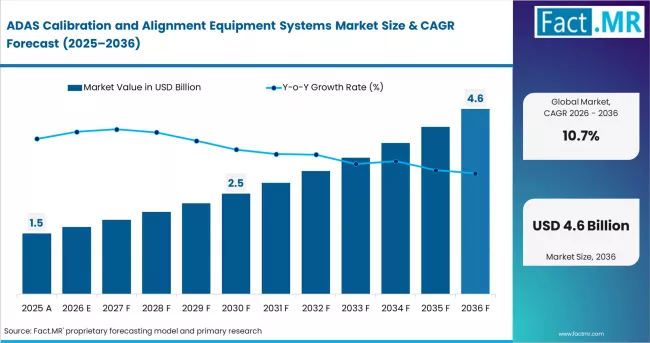
Adas Calibration And Alignment Equipment Systems Market Market Value Analysis | Source: Fact.MR
| Metric | Details |
|---|---|
| Industry Size (2026) | USD 1.5 billion |
| Industry Value (2036) | USD 4.3 billion |
| CAGR (2026 to 2036) | 10.7% |
Source: Fact.MR analysis. Updated May 8, 2026
Summary of ADAS Calibration and Alignment Equipment Systems Market
- Market Definition
- The market includes equipment systems used to calibrate and align ADAS-related cameras, radar units, and associated sensors after repair or replacement so that vehicle safety functions operate as intended.
- Demand Drivers
- OEM repair procedures increasingly require ADAS calibration after windshield replacement, collision work, and related service events.
- The installed base of vehicles carrying AEB, lane keeping, blind spot, and related ADAS functions continues to expand. [3]
- Workshops are investing in more accurate and guided systems because calibration setup error can directly affect sensor performance.
- Key Segments Analyzed
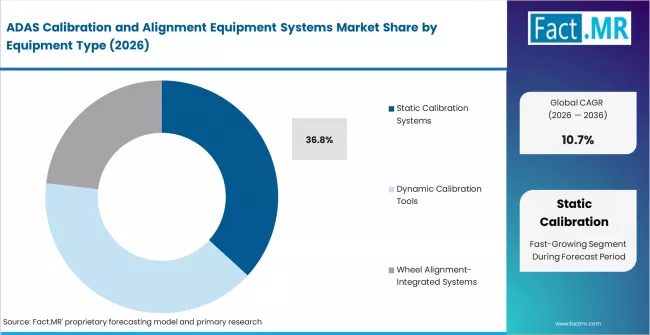
- By Equipment Type: Static Calibration Systems are expected to hold 36.8% share in 2026, supported by strong alignment with OEM repair procedures and controlled workshop calibration workflows.
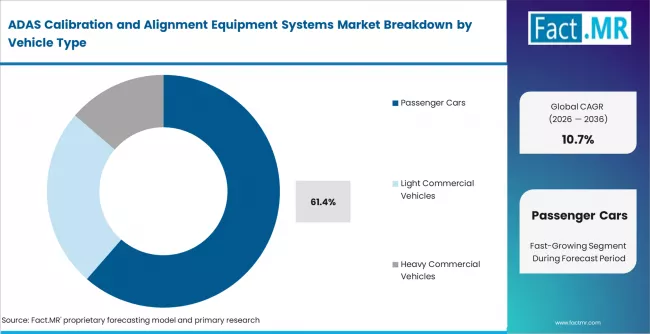
- By Vehicle Type: Passenger Cars are projected to account for 61.4% share in 2026 because the passenger-vehicle parc carries the broadest ADAS sensor base and drives most windshield and collision-related calibration demand.
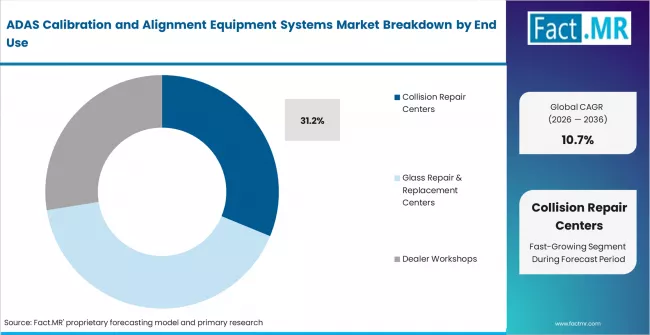
- By End Use: Collision Repair Centers are likely to capture 31.2% share in 2026 due to frequent post-repair calibration requirements after body and structural work.
- Analyst Opinion at Fact.MR
- Shambhu Nath Jha, Senior Analyst at Fact.MR, notes that this market is no longer defined by whether a shop can perform ADAS calibration at all. It is defined by whether the shop can perform it accurately, repeatedly, and profitably enough to keep pace with rising vehicle complexity. The strongest equipment systems reduce manual layout error, shorten setup time, and fit more naturally into OEM-documented procedures. That is why software guidance, digital positioning, and alignment-linked workflow are becoming more decisive than frame ownership alone.
- Strategic Implications
- Equipment vendors should deepen digital measurement, OEM-procedure support, and scan-tool integration rather than competing on frame hardware alone.
- Repairers need to prioritize calibration repeatability and documentation quality before expanding into higher-volume ADAS work.
- Providers that combine alignment, target positioning, diagnostic workflow, and reporting are better positioned than vendors selling standalone target structures.
- Methodology
- Focus on buyers responsible for post-repair workflow, calibration throughput, and workshop equipment decisions.
- Uses current official and vendor sources tied directly to ADAS calibration procedures and equipment systems.
- Connects growth in ADAS-equipped vehicles with repair-triggered calibration demand and equipment-system value layering.
- Cross-checks claims against OEM position statements, calibration workflow resources, and equipment-product updates.
Calibration is becoming a standard requirement within post-repair workflows rather than a specialized or occasional task. Industry guidance from I-CAR and OEM position statements from General Motors and Ford indicate that calibration is necessary following windshield replacement, structural repairs, and sensor realignment. This shift is increasing equipment demand across both authorized and independent workshops. Regulatory and safety frameworks are reinforcing this trend. National Highway Traffic Safety Administration continues to expand ADAS-related safety requirements, contributing to a growing installed base of sensor-dependent systems that require periodic calibration. [1]
China leads with a projected CAGR of 11.4% through 2036, driven by rapid expansion of ADAS-equipped vehicles and increasing need for structured post-repair calibration workflows. India follows at 11.0%, supported by growing vehicle complexity and rising investment in workshop modernization and calibration infrastructure. South Korea grows at 10.6%, underpinned by advanced vehicle electronics and strong adoption of sensor-based safety systems. The United States records 10.1%, with growth anchored in strict OEM calibration requirements and increasing integration of ADAS into repair workflows. Germany grows at 9.8%, driven by mature automotive service ecosystems and demand for high-precision calibration systems.
Segmental Analysis
ADAS Calibration and Alignment Equipment Systems Market Analysis by Equipment Type
Adas Calibration And Alignment Equipment Systems Market Analysis By Equipment Type | Source: Fact.MR
Static calibration systems are expected to account for 36.8% share in 2026. Their lead position is tied to strong alignment with OEM-defined repair procedures, which require controlled environments, fixed targets, and precise vehicle positioning. These systems are widely used in workshops because they ensure repeatability and accuracy, particularly for camera and radar calibration tasks where small deviations can affect system performance. Calibration guidance from I-CAR continues to emphasize adherence to OEM procedures, reinforcing the importance of structured, in-bay calibration setups. Workshops rely on static systems to meet these requirements, especially when dealing with safety-critical ADAS components that must be calibrated within tightly defined tolerances. [4]
- Procedure fit: Static systems remain dominant because many OEM procedures are built around fixed workshop calibration conditions.
- Setup control: Target placement, bay conditions, and vehicle positioning are easier to standardize in static workflows.
- Repeatability: Workshops value static equipment because it supports more consistent calibration outcomes across technicians and repair types.
ADAS Calibration and Alignment Equipment Systems Market Analysis by Vehicle Type
Adas Calibration And Alignment Equipment Systems Market Analysis By Vehicle Type | Source: Fact.MR
Passenger cars continue to dominate demand within ADAS calibration and alignment equipment systems due to their broad and growing adoption of sensor-based safety features. These vehicles integrate multiple ADAS functions, including lane assistance, automatic emergency braking, blind spot detection, and traffic sign recognition, increasing the need for accurate calibration after repair or component replacement. Passenger cars are projected to account for 61.4% share in 2026. Regulatory developments from National Highway Traffic Safety Administration, including updates to NCAP and AEB requirements, are reinforcing the widespread integration of these systems in light vehicles. [5]
- ADAS density: Passenger cars now carry a broad and growing range of camera and radar-based safety functions.
- Repair frequency: Windshield and collision repair volume in passenger vehicles generates recurring calibration demand.
- Workshop reach: Most calibration-capable shops serve passenger vehicles first, which strengthens this segment’s equipment pull.
ADAS Calibration and Alignment Equipment Systems Market Analysis by End Use
Adas Calibration And Alignment Equipment Systems Market Analysis By End Use | Source: Fact.MR
Collision Repair Centers are expected to account for 31.2% share in 2026, as post-collision repair is one of the clearest triggers for ADAS recalibration. Body repairs, bumper work, sensor replacement, structural shifts, and glass work can all affect sensor orientation or require procedural checks under OEM guidance. I-CAR’s OEM calibration search and ADAS hotspot resources are built around this exact repair challenge. Collision facilities therefore face direct pressure to either own calibration capability or build structured access to it. That makes them one of the strongest equipment-buying groups in the market, especially as calibration becomes harder to outsource without affecting cycle time or documentation flow.
- Repair trigger: Collision work frequently creates the conditions that require post-repair calibration under OEM procedures.
- Cycle-time pressure: In-house or closely linked calibration capability helps repair centers avoid workflow delays.
- Documentation need: Collision operators increasingly need clear calibration reporting to support repair completeness and liability control.
ADAS Calibration and Alignment Equipment Systems Market Drivers, Restraints, and Opportunities
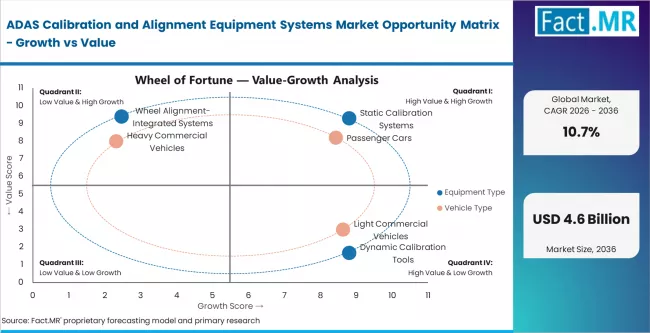
Adas Calibration And Alignment Equipment Systems Market Opportunity Matrix Growth Vs Value | Source: Fact.MR
A key driver is the steady expansion of ADAS-equipped vehicles and the direct repair implications that follow. NHTSA’s ADAS roadmap and AEB final rule both point to continued mainstreaming of sensor-dependent safety functions in light vehicles. I-CAR and OEM position statements then connect that vehicle trend to repair workflows by making calibration a procedural requirement after certain repairs and replacements. Together, these factors push more repair facilities to invest in equipment systems that can restore ADAS function in-house or within tightly managed workflows.
The main restraint is execution burden. Calibration is not a simple equipment purchase problem. Shops still need adequate bay size, level floors, trained technicians, compatible diagnostic tools, and access to OEM procedures. I-CAR explicitly notes that its search tool does not replace OEM repair information, which underlines how dependent calibration work remains on make-specific guidance. This slows market efficiency because some shops can justify the demand but still struggle to create the right physical and procedural conditions for reliable in-house calibration.
Opportunities in the ADAS Calibration and Alignment Equipment Systems Market
- Digital positioning systems: Hella Gutmann’s 2026 CSC-Tool PRO and Bosch’s positioning-linked DAS workflows show continued room for systems that reduce manual setup error and add software guidance. [6]
- Alignment integration: Hunter’s Ultimate ADAS system supports the opportunity for equipment that links alignment and calibration inside one guided repair workflow.
- OEM-approved equipment pathways: Autel’s OEM-approved positioning shows growing room for multi-brand equipment suppliers that can align themselves with stricter repair and compliance expectations.
Regional Analysis
Based on the regional analysis, the ADAS Calibration and Alignment Equipment Systems Market is segmented into North America, Europe, Asia Pacific, Latin America, and Middle East & Africa across 40 plus countries.
.webp "Top Country Growth Comparison Adas Calibration And Alignment Equipment Systems Market Cagr (2026 2036)")
Top Country Growth Comparison Adas Calibration And Alignment Equipment Systems Market Cagr (2026 2036) | Source: Fact.MR
| Country | CAGR (2026 to 2036) |
|---|---|
| China | 11.4% |
| India | 11.0% |
| South Korea | 10.6% |
| United States | 10.1% |
| Germany | 9.8% |
Source: Fact.MR analysis. Updated May 8, 2026
Source: Fact.MR analysis, based on proprietary forecasting model and primary research.
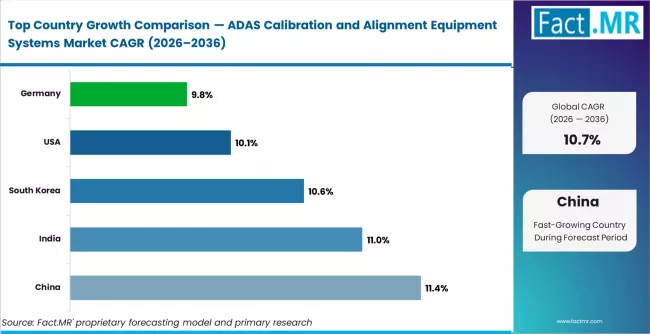
Adas Calibration And Alignment Equipment Systems Market Cagr Analysis By Country | Source: Fact.MR
Asia Pacific ADAS Calibration and Alignment Equipment Systems Market Analysis
Asia Pacific is the fastest-growing region in this study because it combines large light-vehicle production, rising ADAS fitment, and expanding workshop modernization. China, India, Japan, and South Korea all contribute from different starting points. China and South Korea benefit from strong vehicle electronics integration and manufacturing scale, while Japan remains important because of higher technical sophistication in vehicle systems and service networks. India grows from a lower installed calibration base but benefits from a rising need for more advanced post-repair workflows as the vehicle fleet modernizes. This keeps Asia Pacific at the front of equipment-system growth even though workshop maturity varies widely across the region.
- China: China continues to lead regional demand as vehicle electronics density increases and ADAS features expand across segments. The market is projected to grow at an 11.4% CAGR, reflecting strong demand for structured calibration systems in workshops handling modern vehicles. As ADAS-equipped vehicles increase, repairers are investing in equipment that ensures accurate sensor alignment and compliance with OEM requirements.
- India: India reflects rapid growth driven by rising vehicle complexity and expanding post-repair service requirements. Demand is expected to expand at 11.0% CAGR, supported by increasing adoption of ADAS features and modernization of workshop infrastructure. Calibration systems are becoming essential as repair processes evolve to include sensor validation and system recalibration.
- South Korea: South Korea shows steady adoption supported by advanced vehicle technology and high repair sophistication. The market is likely to record a 10.6% CAGR, as workshops invest in calibration systems to support increasingly complex vehicle architectures.
Fact.MR’s Asia Pacific analysis also includes Japan, where demand is influenced by high technical standards and structured service networks, reinforcing steady adoption of calibration equipment.
North America ADAS Calibration and Alignment Equipment Systems Market Analysis
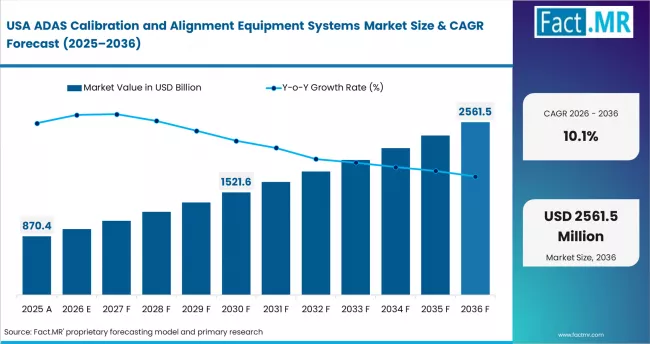
Adas Calibration And Alignment Equipment Systems Market Country Value Analysis | Source: Fact.MR
North America remains one of the most commercially important regions, where ADAS calibration is already embedded in repair workflows. Workshops, particularly in collision and glass repair segments, are under increasing pressure to follow OEM procedures and ensure accurate calibration. Demand is driven by the need to maintain compliance, improve repair quality, and manage throughput efficiently.
- United States: The U.S. market is projected to grow at 10.1% CAGR, reflecting the central role of calibration in modern repair processes. As ADAS features become standard, calibration is required after a wide range of repairs, including windshield replacement and collision work. Workshops are investing in advanced equipment to handle growing volumes and ensure proper documentation and accuracy.
Demand in North America is shaped less by awareness and more by operational necessity, as calibration becomes a standard requirement across repair workflows.
Europe ADAS Calibration and Alignment Equipment Systems Market Analysis
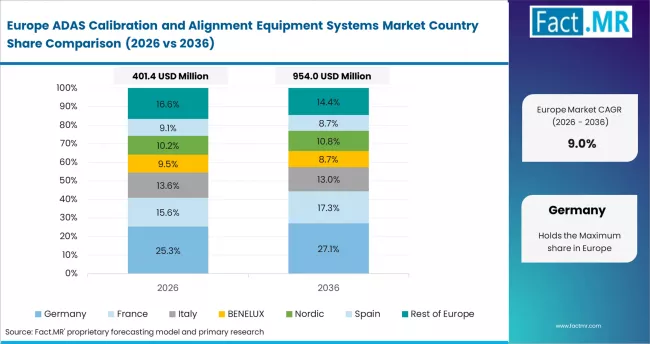
Adas Calibration And Alignment Equipment Systems Market Europe Country Market Share Analysis, 2026 & 2036 | Source: Fact.MR
Europe operates as a standards- and process-driven market, where regulatory frameworks and structured repair practices support adoption of calibration systems. Workshops in the region prioritize accuracy, documentation, and compliance with OEM guidelines, creating steady demand for advanced equipment.
- Germany: Germany leads regional demand, supported by strong automotive service infrastructure and a high concentration of ADAS-equipped vehicles. Growth is expected at a 9.8% CAGR, reflecting increasing need for advanced calibration systems that support higher throughput and digital integration. Workshops are adopting solutions that offer guided positioning, automated reporting, and seamless integration into repair workflows.
Across Europe, demand is driven by the need to upgrade existing equipment and align with evolving vehicle technologies rather than first-time adoption.
Competitive Aligners for Market Players
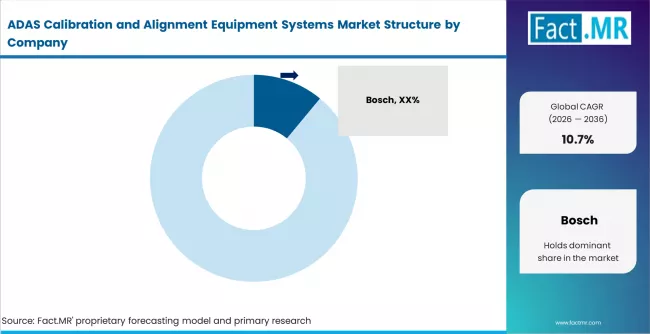
Adas Calibration And Alignment Equipment Systems Market Analysis By Company | Source: Fact.MR
The ADAS calibration equipment systems market remains moderately concentrated, with a limited group of suppliers shaping the higher-function segment. Companies such as Bosch, Hella Gutmann, Hunter Engineering, and Autel maintain strong visibility across workshop calibration solutions. Each operates with a distinct positioning strategy rather than competing on identical product terms. Bosch focuses on scan-tool-linked positioning systems and structured calibration targets, while Hella Gutmann emphasizes digital workflows and software-led calibration processes. Hunter aligns calibration with wheel alignment systems to improve shop throughput, and Autel targets flexibility with systems designed for broad workshop adoption and OEM-approved pathways.
Competitive differentiation is increasingly defined by operational fit rather than hardware ownership alone. Workshops are evaluating systems based on how effectively they support real repair environments, where speed, accuracy, and repeatability are critical. Equipment that can technically perform calibration is no longer sufficient if it cannot integrate smoothly into daily workflows. Performance expectations are shifting toward measurable efficiency gains. Digital positioning, guided measurement processes, and automated setup features are becoming essential to reduce human error and improve consistency. Broad vehicle coverage and regular software updates are also key requirements, ensuring compatibility with evolving ADAS configurations.
Key Players in ADAS Calibration and Alignment Equipment Systems Market
- Hella Gutmann
- Hunter Engineering
- Autel
- Chief Automotive Technologies
- Texa
- Ravaglioli
Bibliography
- [1] GM Genuine Parts. Windshield Replacement Position Statement.
- [2] I-CAR. OEM Calibration Requirements Search.
- [3] NHTSA. New Car Assessment Program Final Decision Notice – Advanced Driver Assistance Systems and Roadmap.
- [4] I-CAR. ADAS, Calibration, and Scanning Article Hotspot.
- [5] NHTSA. Final Rule: Automatic Emergency Braking Systems.
- [6] Hella Gutmann. CSC-Tool PRO launch announcement.
This Report Addresses
- Strategic outlook for ADAS calibration and alignment equipment system demand.
- Forecast trajectory from USD 1.58 billion in 2026 to USD 4.35 billion by 2036.
- Why calibration equipment is shifting from static frame ownership toward digitally guided workflow systems.
- Segment analysis by equipment type, vehicle type, end use, calibration type, and mobility type.
- Regional demand patterns across Asia Pacific, North America, Europe, and Latin America.
- Competitive positioning of major calibration equipment suppliers.
- The role of OEM repair procedures, alignment integration, and software-guided measurement in market expansion.
- Why calibration is becoming a routine post-repair infrastructure requirement rather than a specialty service exception.
ADAS Calibration and Alignment Equipment Systems Market Definition
ADAS Calibration and Alignment Equipment Systems Market Definition
The market includes equipment systems used to calibrate and align ADAS-related cameras, radar units, and associated sensors after repair or replacement so that vehicle safety functions operate as intended.
ADAS Calibration and Alignment Equipment Systems Market Demand Drivers
- OEM repair procedures increasingly require ADAS calibration after windshield replacement, collision work, and related service events.
- The installed base of vehicles carrying AEB, lane keeping, blind spot, and related ADAS functions continues to expand. [3]
- Workshops are investing in more accurate and guided systems because calibration setup error can directly affect sensor performance.
ADAS Calibration and Alignment Equipment Systems Market Key Segments Analyzed
- By Equipment Type: Static Calibration Systems are expected to hold 36.8% share in 2026, supported by strong alignment with OEM repair procedures and controlled workshop calibration workflows.
- By Vehicle Type: Passenger Cars are projected to account for 61.4% share in 2026 because the passenger-vehicle parc carries the broadest ADAS sensor base and drives most windshield and collision-related calibration demand.
- By End Use: Collision Repair Centers are likely to capture 31.2% share in 2026 due to frequent post-repair calibration requirements after body and structural work.
Segmentation
Scope of the Report
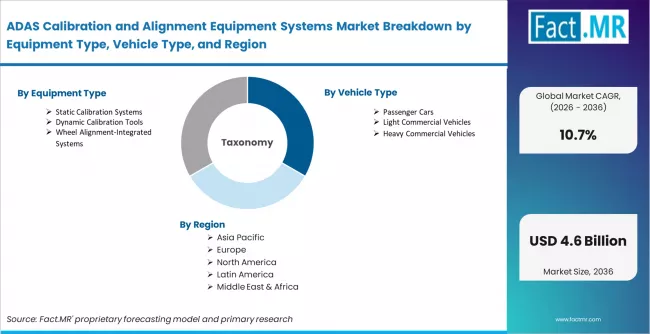
Adas Calibration And Alignment Equipment Systems Market Breakdown By Equipment Type, Vehicle Type, And Region | Source: Fact.MR
| Attribute | Details |
|---|---|
| Quantitative Units | USD 1.5 billion (2026) to USD 4.3 billion (2036), at a CAGR of 10.7% |
| Market Definition | Equipment systems used to calibrate and align ADAS cameras, radar units, and related sensors after repair or replacement |
| Equipment Type Segmentation | Static Calibration Systems, Dynamic Calibration Tools, Wheel Alignment-Integrated Systems, Target & Accessory Kits |
| Vehicle Type Segmentation | Passenger Cars, Light Commercial Vehicles, Heavy Commercial Vehicles, Electric Vehicles |
| End Use Segmentation | Collision Repair Centers, Glass Repair & Replacement Centers, Dealer Workshops, Independent Workshops, Fleet Service Facilities |
| Calibration Type Segmentation | Camera Calibration, Radar Calibration, LiDAR Support, Multi-Sensor Calibration |
| Mobility Type Segmentation | Fixed In-Bay Systems, Mobile Calibration Systems |
| Regions Covered | North America, Europe, Asia Pacific, Latin America, Middle East & Africa |
| Countries Covered | China, India, South Korea, United States, Germany, Japan, Brazil, and 40+ countries |
| Key Companies Profiled | Bosch, Hella Gutmann, Hunter Engineering, Autel, Chief Automotive Technologies, Texa, Ravaglioli |
| Forecast Period | 2026 to 2036 |
| Approach | Hybrid sizing based on ADAS-equipped vehicle growth, post-repair calibration demand, and equipment-system value across workshop categories |
Source: Fact.MR analysis. Updated May 8, 2026
ADAS Calibration and Alignment Equipment Systems Market by Segments
-
By Equipment Type:
- Static Calibration Systems
- Dynamic Calibration Tools
- Wheel Alignment-Integrated Systems
-
Target & Accessory Kits
- By Vehicle Type:
- Passenger Cars
- Light Commercial Vehicles
- Heavy Commercial Vehicles
- Electric Vehicles
-
By End Use:
- Collision Repair Centers
- Glass Repair & Replacement Centers
- Dealer Workshops
- Independent Workshops
- Fleet Service Facilities
- By Vehicle Type:
-
By Region:
- North America
- United States
- Canada
- Mexico
- Latin America
- Brazil
- Argentina
- Chile
- Rest of Latin America
- Western Europe
- Germany
- France
- United Kingdom
- Italy
- Spain
- Nordic Countries
- BENELUX
- Rest of Western Europe
- Eastern Europe
- Russia
- Poland
- Hungary
- Balkan and Baltic
- Rest of Eastern Europe
- East Asia
- China
- Japan
- South Korea
- South Asia and Pacific
- India
- ASEAN
- Australia and New Zealand
- Rest of South Asia and Pacific
- Middle East and Africa
- Kingdom of Saudi Arabia
- Other GCC Countries
- Turkey
- South Africa
- Rest of Middle East and Africa
Frequently Asked Questions
How large is the ADAS Calibration and Alignment Equipment Systems Market in 2025?
What will the market size be in 2026?
What is the projected market size by 2036?
What is the expected CAGR from 2026 to 2036?
Which equipment type segment is poised to lead the market?
Which vehicle type holds the largest share?
Which end-use segment dominates the market?
Which country shows the fastest growth?
What is driving demand in this market?
What is the key challenge in this market?
Who worked on this report


Preview the report firsthand - request a free sample
Free SampleGet the brochure for pricing and purchase details
Download PDF