ADAS and Automated Driving Central Controller Platforms Market
The ADAS and Automated Driving Central Controller Platforms Market is analyzed by platform type, including adas domain controllers, central compute platforms and sensor fusion ecus, and region, forecast 2026 to 2036.
By Fact.MR Automotive DeskLead analyst:
Shubham PatidarPublished :
14 min read
Fact-checked under the Fact.MR editorial process
ADAS and Automated Driving Central Controller Platforms Market Forecast and Outlook By Fact.MR
In 2025, the ADAS and Automated Driving Central Controller Platforms market was valued at USD 14.5 billion.
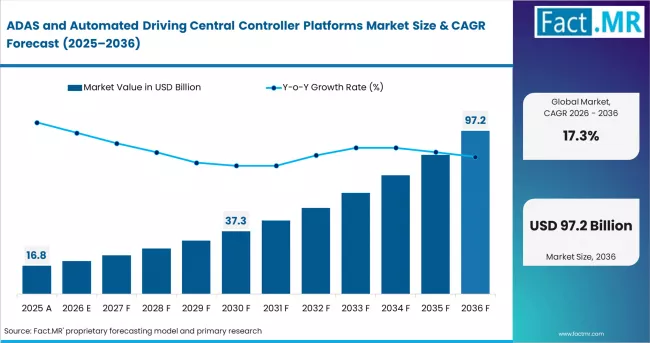
Based on Fact.MR analysis, demand is estimated to grow to USD 16.8 billion in 2026 and USD 82.4 billion by 2036. FACT.MR projects a CAGR of 17.3% during the forecast period.
Adas And Automated Driving Central Controller Platforms Market Market Value Analysis | Source: Fact.MR
Metric
Value
Estimated Value in 2026
USD 16.8 billion
Forecast Value in 2036
USD 82.4 billion
Forecast CAGR (2026 to 2036)
17.3%
Source: Fact.MR analysis. Updated May 8, 2026
Summary of ADAS and Automated Driving Central Controller Platforms Market
Market Definition
Market covers ADAS domain controllers, central compute platforms, and sensor fusion ECUs enabling driver assistance and automated driving functions from L1 through L5 in passenger and commercial vehicles globally.
Demand Drivers
Euro NCAP 2025 and NHTSA AEB mandates are compelling OEMs to adopt multi-domain controller architectures as standard fitment across mid-segment and premium vehicles.
China’s NEV platform strategy is accelerating centralized compute adoption, with state-backed OEMs integrating L2+ systems as baseline equipment in domestic EV models by 2026.
Software-defined vehicle transitions are shifting compute from distributed ECUs to consolidated AI platforms, creating structural demand for high-performance central controller hardware across all OEM tiers.
Key Segments Analyzed
By Platform Type: ADAS domain controllers lead with approximately 45% share in 2026, driven by L1–L3 deployment across high-volume passenger vehicle programmes globally.
By Autonomy Level: Level 2 / Level 2+ systems hold approximately 52% share in 2026, reflecting regulatory mandates and OEM fitment strategies across mass-market vehicle segments.
By Geography: China leads regional growth at 18.9% CAGR, supported by scale EV production, NEV policy mandates, and a dense domestic AI and semiconductor supplier ecosystem.
Analyst Opinion at FACT.MR
Shambhu Nath Jha, Principal Consultant at Fact.MR, opines, CXOs will find that the decisive competitive variable in this market is software stack control, not hardware performance. OEMs locking in silicon platform partnerships today will face high switching costs by 2028. Early supplier selection is becoming a strategic decision rather than a routine procurement choice.
Strategic Implications
Prioritize central compute platform partnerships with NVIDIA DRIVE and Qualcomm Snapdragon Ride ecosystems to secure long-term OEM integration roadmap alignment.
Build sensor fusion ECU capabilities targeting L3 commercial vehicle and robotaxi platforms, where unit economics favor consolidated compute over distributed ECU architectures.
Develop software-defined update capability to capture lifecycle revenue beyond initial hardware supply, as OEMs increasingly monetize ADAS feature activations post-delivery.
Methodology
Market sizing is based on OEM procurement volumes and ASP data by autonomy level, validated against Tier-1 supplier revenue disclosures and semiconductor shipment statistics.
Incorporates NHTSA and Euro NCAP safety mandate timelines, China GB standard updates, and company-level platform roadmap disclosures from 2024 and 2025 filings.
Forecasts factor in silicon lead times, OEM integration cycles, regulatory adoption curves, and primary interviews with platform engineers and procurement executives.
Between 2026 and 2036, the market is projected to generate an absolute dollar opportunity of USD 65.6 billion. Growth is driven by OEM mandates for higher autonomy levels, regulatory safety requirements, and the shift from distributed ECU architectures to centralized compute platforms. The primary structural constraint is the high capital cost of silicon validation and OEM integration cycles, which can extend product commercialization by 24–36 months.
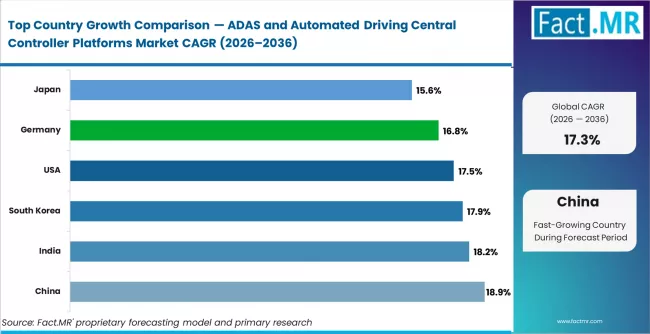
Regionally, China leads at 18.9% CAGR through 2036, supported by scale EV deployment and state-backed AI ecosystem investment. India follows at 18.2%, driven by rapid ADAS penetration from a low base and cost-optimized compute adoption. South Korea records 17.9%, anchored by Hyundai’s autonomous platform scaling and a deep electronics supply chain. The United States grows at 17.5%, underpinned by software-defined vehicle leadership and dense semiconductor capability. Germany posts 16.8%, supported by premium OEM ADAS integration mandates. Japan grows at 15.6%, reflecting a strong Tier-1 supplier base paired with gradual autonomy adoption across domestic OEM platforms.
Segmental Analysis
ADAS and Automated Driving Central Controller Platforms Market Analysis by Platform Type
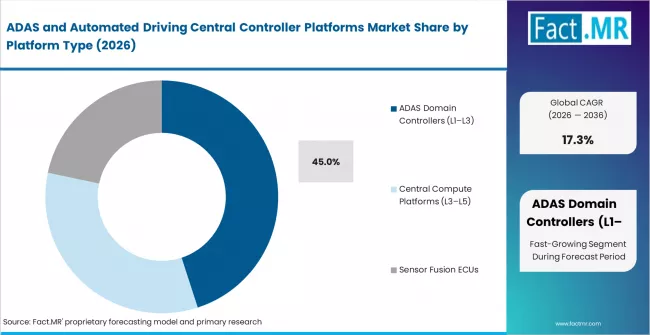
Adas And Automated Driving Central Controller Platforms Market Analysis By Platform Type | Source: Fact.MR
ADAS domain controllers (L1–L3) hold 45% share in 2026. They dominate due to mandatory safety feature integration across mass-market vehicles. High deployment volumes across Europe, China, and North America sustain consistent procurement. L4–L5 platforms remain limited to niche and pilot deployments.
Bosch Domain Controller Investment: Robert Bosch invested EUR 3 billion in 2024. The focus is on scaling L2 and L2+ domain controllers with OTA-ready software architecture. [5]
NVIDIA DRIVE Thor Platform Development: NVIDIA launched DRIVE Thor with 2,000 TOPS performance. Design wins include Toyota, BYD, and Li Auto. This highlights strong OEM alignment with centralized compute. [4]
Central Compute Adoption Trend: Continental AG reported a 34% increase in controller content per vehicle. SDV rollouts are reducing distributed ECU architectures. Compute is being concentrated into fewer, higher-value units. [6]
ADAS and Automated Driving Central Controller Platforms Market Analysis by Autonomy Level
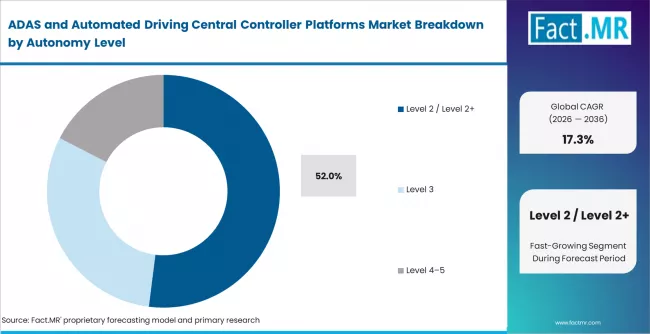
Adas And Automated Driving Central Controller Platforms Market Analysis By Autonomy Level | Source: Fact.MR
Level 2 / Level 2+ holds 52% share in 2026. It leads due to regulatory enforcement and consumer demand for assisted driving features. AEB, adaptive cruise control, and lane assist are becoming standard features globally. This segment is the primary revenue driver for platform vendors.
Mobileye L2+ Volume Expansion: Mobileye delivered over 33 million EyeQ chips in 2024. Supply agreements include Volkswagen Group and Stellantis. This reflects large-scale L2+ deployment. [7]
Qualcomm L3 Platform Technology: Qualcomm Ride Flex secured design wins with BMW Group and Renault. It supports transition from L2+ to L3 with integrated compute. [8]
L4 Commercial Vehicle Deployment Trend: Aptiv and ZF Friedrichshafen are supplying L4 platforms. DHL and DB Schenker are deploying these in logistics fleets. This reflects early commercialization in controlled environments. [9]
Drivers, Restraints, and Opportunities
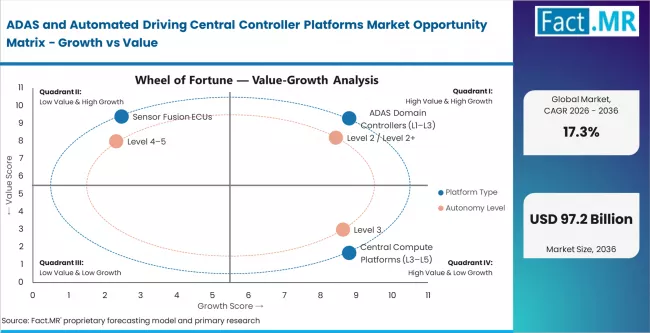
Adas And Automated Driving Central Controller Platforms Market Opportunity Matrix Growth Vs Value | Source: Fact.MR
FACT.MR analysis indicates that the ADAS and Automated Driving Central Controller Platforms market is transitioning from a fragmented ECU structure to a platform-led environment.
The core tension lies between OEM control and supplier dependency. OEMs aim to retain software ownership but rely on a narrow set of AI semiconductor vendors. This dependency is shaping long-term platform lock-in risks. L2+ standardisation is accelerating central controller adoption. OEMs are reducing wiring complexity and consolidating ECUs. OTA capability and feature monetisation are becoming key drivers.
Euro NCAP and NHTSA Safety Mandates: Euro NCAP 2025 protocols include AEB, lane centering, and driver monitoring as baseline requirements. National Highway Traffic Safety Administration proposed AEB mandates in 2024. Continental AG reported a 22% increase in ADAS controller order intake. [2]
China NEV Platform and AI Ecosystem Stimulus: Ministry of Industry and Information Technology mandated L2+ capability for subsidy eligibility. NVIDIA platforms are being adopted by BYD, NIO, and XPeng. This is creating structured, high-volume demand for central compute systems. [3]
Semiconductor Platform Consolidation: NVIDIA DRIVE Thor integrates ADAS, parking, and infotainment into a single SoC. Qualcomm Snapdragon Ride Flex offers similar consolidation capability. Per-vehicle silicon value has increased from USD 150 to over USD 500. This is expanding revenue concentration at the silicon layer. [4
Regional Analysis
The ADAS and Automated Driving Central Controller Platforms market is assessed across Asia Pacific, North America, Europe, Latin America, and Middle East and Africa, covering 40+ countries segmented by OEM production volumes, regulatory adoption curves, and autonomy level deployment depth. The full report offers market attractiveness analysis by region and country.
Top Country Growth Comparison Adas And Automated Driving Central Controller Platforms Market Cagr (2026 2036) | Source: Fact.MR
Country
CAGR (2026 to 2036)
China
18.9%
India
18.2%
South Korea
17.9%
United States
17.5%
Germany
16.8%
Japan
15.6%
Source: Fact.MR analysis. Updated May 8, 2026
Source: Fact.MR (FACT.MR) analysis, based on proprietary forecasting model and primary research
Adas And Automated Driving Central Controller Platforms Market Cagr Analysis By Country | Source: Fact.MR
Asia Pacific ADAS and Automated Driving Central Controller Platforms Market Analysis
Asia Pacific is the production and demand epicenter for ADAS controller platforms. China leads EV scale, while India drives regulatory-led growth. NVIDIA, Qualcomm, and Mobileye compete for OEM wins. Huawei and Horizon Robotics are scaling domestic chip supply.
China: Policy-driven scale and silicon localisation support 18.9% CAGR through 2036. Ministry of Industry and Information Technology mandated L2+ baseline for subsidies. BYD integrated NVIDIA DRIVE Orin across mass platforms. Huawei ADS 2.0 is deployed across multiple OEMs. Domestic compute supply is lowering cost barriers and accelerating L3 readiness.
India: Regulation-led adoption and cost optimisation support 18.2% CAGR through 2036. AIS-190 mandates AEB and lane warning systems. Tata Motors and Mahindra & Mahindra secured ADAS supply agreements. Robert Bosch and Mobileye are key partners. Local ECU assembly is expanding under PLI incentives.
FACT.MR’s analysis covers China, India, Japan, South Korea, ASEAN, and ANZ. It includes regulatory timelines and adoption forecasts.
North America ADAS and Automated Driving Central Controller Platforms Market Analysis
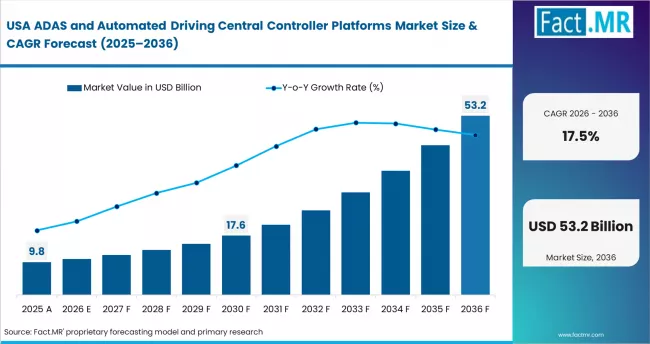
Adas And Automated Driving Central Controller Platforms Market Country Value Analysis | Source: Fact.MR
North America is the hub for autonomous software and semiconductor commercialization. General Motors, Ford, and Tesla lead OEM programmes. NVIDIA and Qualcomm anchor silicon supply. Platform contracts are long-cycle and software monetisation is rising.
United States: Innovation-led deployment and regulation support 17.5% CAGR through 2036. National Highway Traffic Safety Administration AEB mandate is creating baseline demand. Tesla Hardware 4.0 validates central compute at scale. Waymo is expanding L4 robotaxi fleets. CHIPS Act is strengthening domestic semiconductor supply.
FACT.MR’s analysis covers United States, Canada, and Mexico. It includes fleet deployment and procurement benchmarks.
Europe ADAS and Automated Driving Central Controller Platforms Market Analysis
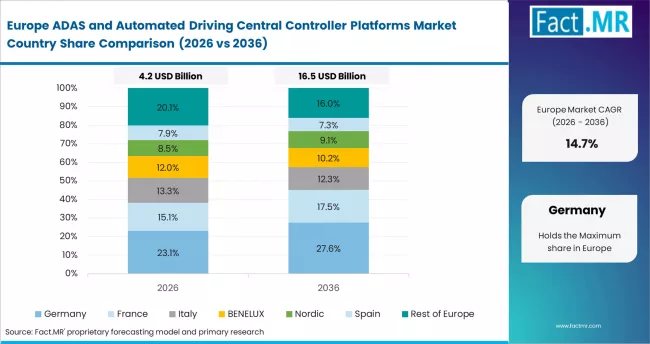
Adas And Automated Driving Central Controller Platforms Market Europe Country Market Share Analysis, 2026 & 2036 | Source: Fact.MR
Europe is the regulatory benchmark for ADAS deployment. Euro NCAP and EU mandates drive adoption. Robert Bosch, Continental AG, and ZF Friedrichshafen lead supply. Premium OEMs anchor platform integration.
Germany: Compliance-driven procurement and OEM consolidation support 16.8% CAGR through 2036. EU safety regulation mandates advanced ADAS features. Volkswagen Group awarded central compute contracts to Mobileye. Continental AG is advancing L3 controller platforms. Supplier consolidation is increasing platform value.
Japan: Gradual validation-led transition supports 15.6% CAGR through 2036. Ministry of Land, Infrastructure, Transport and Tourism defined L3 approval pathways. Toyota and Honda are targeting rollout timelines. Denso Corporation and AISIN are expanding ECU development. Adoption is steady but slower due to strict validation cycles.
FACT.MR’s analysis covers Germany, France, United Kingdom, Italy, Spain, and Rest of Europe. It includes regulatory tracking and certification timelines.
Competitive Aligners for Market Players
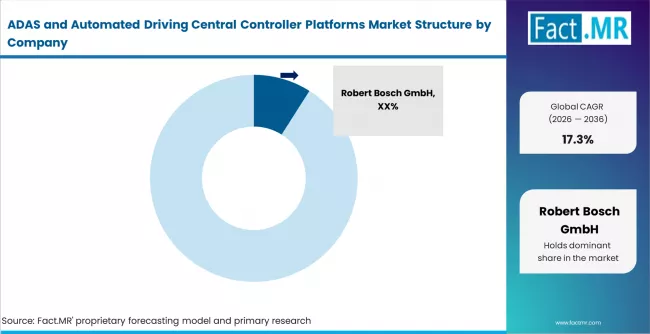
Adas And Automated Driving Central Controller Platforms Market Analysis By Company | Source: Fact.MR
The ADAS and automated driving central controller market is increasingly shaped by a clear two-layer competition, and it’s not really about who can build the cheapest hardware anymore. At the silicon level, companies like NVIDIA, Qualcomm, and Mobileye hold significant control because their platforms act as the foundation for everything else. NVIDIA’s DRIVE platform, in particular, has gained strong traction with global OEMs, largely because it offers not just chips but a full development ecosystem.
On top of that sits the Tier-1 layer, where suppliers like Robert Bosch, Continental AG, ZF Friedrichshafen, Aptiv, and Magna International integrate these silicon platforms into complete systems that automakers can actually deploy. Their advantage comes from long-standing OEM relationships and deep validation experience.
What really defines competition now is ecosystem strength. Automakers care more about software compatibility, over-the-air update capabilities, and regulatory readiness than just hardware specs. This is where vertically integrated players stand out. Mobileye, for example, controls both chip and software, making integration smoother and creating high switching costs once deployed. NVIDIA benefits similarly through its CUDA ecosystem, which speeds up development. OEMs are simplifying their supplier base, moving toward one or two key platform partners instead of several. This consolidation increases dependency but also gives selected suppliers more pricing power. Those that can offer both hardware and software as a unified platform are best positioned to win in this evolving landscape.
Key Players
Robert Bosch GmbH
Continental AG
Aptiv PLC
ZF Friedrichshafen AG
Magna International Inc.
NVIDIA Corporation
Qualcomm Technologies Inc.
Mobileye Global Inc.
Denso Corporation
Valeo SA
Bibliography
[1] Continental AG. (2024). Annual Report 2024: ADAS Domain Controller Order Intake and Regulatory Mandate Impact on Safety System Procurement Across European and North American OEM Platforms. continental.com/investor-relations
[2] China Ministry of Industry and Information Technology. (2025). New Energy Vehicle Technology Roadmap Update 2025: L2+ Capability Requirements for State Subsidy Eligibility and Central Compute Platform Adoption Mandates. miit.gov.cn/english
[3] NVIDIA Corporation. (January 2025). DRIVE Thor Production Programme Announcement: Toyota, BYD, and Li Auto Design Win Confirmation for 2025–2026 Model Year Centralized AI Compute Integration. nvidia.com/en-us/automotive
[4] Robert Bosch GmbH. (2024). Press Release: EUR 3 Billion ADAS Domain Controller Production Capacity Investment Programme Targeting L2 and L2+ OEM Fitment Programmes in Europe and North America. bosch.com/news
[5] Continental AG. (Q4 2024). Investor Presentation: ADAS Domain Controller Average Content Per Vehicle Growth and Software-Defined Vehicle Architecture Transition Impact on Tier-1 Revenue. continental.com/investor-relations
[6] Mobileye Global Inc. (2024). Annual Report 2024: EyeQ Chip Shipment Volume, OEM Customer Expansion, and L2+ Supply Agreement Commitments with Volkswagen Group and Stellantis Through 2028. mobileye.com/investors
[7] Qualcomm Technologies Inc. (2025). Press Release: Snapdragon Ride Flex SoC Design Win Confirmation with BMW Group and Renault for L2+ Through L3 Automated Highway Driving Programmes Starting 2025. qualcomm.com/news/releases
[8] ZF Friedrichshafen AG. (Q4 2024). ProAI Central Compute Platform Launch: L4 Commercial Vehicle Autonomous Driving Fleet Deployment Agreements with European Logistics Operators for Hub-to-Hub Transport. zf.com/media/news
This Report Addresses
Strategic intelligence on ADAS and Automated Driving Central Controller Platform demand across domain controllers, central compute platforms, and sensor fusion ECUs globally.
Market forecast from USD 16.8 billion in 2026 to USD 82.4 billion by 2036, at a CAGR of 17.3%.
Opportunity mapping across China NEV mandate-driven growth, U.S. AEB regulatory demand, Germany premium OEM integration, India PLI-supported ADAS adoption, and South Korea autonomous platform scaling.
Segment analysis by platform type (domain controllers, central compute, sensor fusion ECUs) and autonomy level (L2/L2+, L3, L4–5) across global and regional markets.
Regional outlook covering Asia Pacific production-led growth, North America software and semiconductor leadership, and Europe compliance-driven platform adoption.
Competitive landscape of NVIDIA, Qualcomm, Mobileye, Bosch, Continental, ZF, Aptiv, and Magna covering platform ecosystem depth, OEM design win positions, and certification coverage.
Regulatory analysis covering EU General Safety Regulation, NHTSA AEB mandate, China MIIT NEV roadmap, Japan MLIT autonomy framework, and India AIS-190 standard.
Report delivered in PDF, Excel, and presentation formats supported by validated OEM procurement data, semiconductor shipment benchmarks, and industry expert inputs.
ADAS and Automated Driving Central Controller Platforms Market Definition
The ADAS and Automated Driving Central Controller Platforms market covers domain controllers, central compute units, and sensor fusion ECUs that process perception, decision, and actuation logic for driver assistance and autonomous driving systems.
ADAS and Automated Driving Central Controller Platforms Market Inclusions
Covers global and regional forecasts from 2026 to 2036 by platform type and autonomy level. Includes ADAS domain controllers, central compute platforms, and sensor fusion ECUs. Applications span passenger vehicles, commercial vehicles, and autonomous mobility platforms across all autonomy levels from L1 to L5.
ADAS and Automated Driving Central Controller Platforms Market Exclusions
Excludes standalone radar, lidar, and camera sensor hardware unless integrated within a controller platform assembly. Omits infotainment ECUs and powertrain control modules without ADAS functionality. Also excludes simulation software and mapping data services not embedded in controller hardware.
ADAS and Automated Driving Central Controller Platforms Market Research Methodology
Primary Research:Interviews with ADAS platform architects, Tier-1 ECU integrators, OEM procurement teams, and autonomous driving software developers across key automotive markets.
Desk Research:Analysis of filings and disclosures from NVIDIA, Qualcomm, Mobileye, Bosch, and Continental, alongside NHTSA regulatory guidance, Euro NCAP safety mandates, and China GB standards for autonomous driving.
Market-Sizing and Forecasting:Hybrid approach combining OEM procurement volumes, ASP trajectories by autonomy level, Tier-1 revenue disclosures, and platform integration roadmaps from semiconductor vendors.
Data Validation and Update Cycle:Validated through OEM supplier award disclosures, semiconductor shipment data, and automotive production statistics. Updated on a rolling basis with primary expert input.
Market Breakdown
Segmentation
Scope of Report
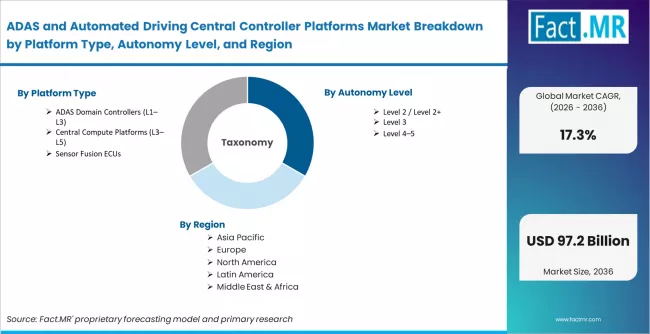
Adas And Automated Driving Central Controller Platforms Market Breakdown By Platform Type, Autonomy Level, And Region | Source: Fact.MR
Attribute
Details
Quantitative Units
USD 16.8 billion (2026) to USD 82.4 billion (2036), at a CAGR of 17.3%
Market Definition
ADAS domain controllers, central compute platforms, and sensor fusion ECUs enabling driver assistance and automated driving from L1 through L5 in passenger and commercial vehicles globally.
North America, Europe, Asia Pacific, Latin America, Middle East and Africa
Countries Covered
USA, Canada, Mexico, Germany, UK, France, Italy, Spain, Nordic, BENELUX, China, Japan, South Korea, India, ASEAN, Australia and New Zealand, Brazil, Argentina, Chile, Saudi Arabia, UAE, South Africa, Rest of MEA
Key Companies Profiled
Robert Bosch GmbH, Continental AG, Aptiv PLC, ZF Friedrichshafen AG, Magna International Inc., NVIDIA Corporation, Qualcomm Technologies Inc., Mobileye Global Inc., Denso Corporation, Valeo SA
Forecast Period
2026 to 2036
Approach
Hybrid top-down and bottom-up model using OEM procurement volumes, ASP by autonomy level, Tier-1 supplier revenue data, semiconductor shipment statistics, and primary interviews with platform engineers and procurement executives.
Source: Fact.MR analysis. Updated May 8, 2026
ADAS and Automated Driving Central Controller Platforms Market by Segments
By Platform Type:
ADAS Domain Controllers (L1–L3)
Central Compute Platforms (L3–L5)
Sensor Fusion ECUs
By Autonomy Level:
Level 2 / Level 2+
Level 3
Level 4–5
By Region:
North America
United States
Canada
Mexico
Latin America
Brazil
Argentina
Chile
Rest of Latin America
Western Europe
Germany
United Kingdom
France
Italy
Spain
Nordic Countries
BENELUX
Rest of Western Europe
Eastern Europe
Russia
Poland
Rest of Eastern Europe
East Asia
China
Japan
South Korea
South Asia and Pacific
India
ASEAN
Australia and New Zealand
Rest of South Asia and Pacific
Middle East and Africa
Kingdom of Saudi Arabia
UAE
South Africa
Rest of Middle East and Africa
Questions Answered
Frequently Asked Questions
How large is the global ADAS and Automated Driving Central Controller Platforms market in 2025?
The global ADAS and Automated Driving Central Controller Platforms market was valued at USD 14.5 billion in 2025.
What will the market size be in 2026?
Based on Fact.MR analysis, demand is estimated to grow to USD 16.8 billion in 2026.
What is the projected market size by 2036?
The market is projected to reach USD 82.4 billion by 2036, generating USD 65.6 billion in absolute dollar opportunity over the forecast period.
What is the expected CAGR from 2026 to 2036?
FACT.MR projects a CAGR of 17.3% for the global ADAS and Automated Driving Central Controller Platforms market during the 2026 to 2036 forecast period.
Which platform type segment is poised to lead the market?
ADAS domain controllers lead with approximately 45% share in 2026, driven by high-volume L1–L3 fitment mandates across passenger vehicle programmes in Europe, North America, and China.
Which autonomy level segment holds the largest share?
Level 2 / Level 2+ systems hold approximately 52% share in 2026, reflecting the scale of regulatory mandate-driven fitment and OEM standard equipment strategies across mass-market vehicles.
Which country shows the fastest growth in the market?
China leads at 18.9% CAGR through 2036, driven by NEV policy mandates, state-backed AI ecosystem investment, and scale EV OEM production integrating L2+ and above systems as baseline equipment.
What are the primary uses of ADAS central controller platforms?
These platforms process perception, planning, and actuation compute for automatic emergency braking, lane centering, highway driving assist, parking automation, and higher-level autonomous driving functions in passenger and commercial vehicles.
What drives demand in this market?
Euro NCAP and NHTSA safety mandates, China NEV subsidy eligibility requirements, software-defined vehicle transitions by major OEMs, and semiconductor platform consolidation by NVIDIA and Qualcomm are the primary demand drivers.
Who are the key players in the market?
Major players include Robert Bosch GmbH, Continental AG, Aptiv PLC, ZF Friedrichshafen AG, Magna International Inc., NVIDIA Corporation, Qualcomm Technologies Inc., and Mobileye Global Inc.
.webp "Top Country Growth Comparison Adas And Automated Driving Central Controller Platforms Market Cagr (2026 2036)")