- Market Value (2025): USD 117.4 Mn
- Estimated Value (2026): USD 124.0 Mn
- Forecast Value (2036): USD 213.0 Mn
- CAGR (2026-2036): 5.6%
What is the Grease Colorant Dyes Market forecast to be worth by 2036?
USD 124.0 million in 2026 to USD 213.0 million by 2036, at 5.6% CAGR.
- The grease colorant dyes market crossed a valuation of USD 117.4 million in 2025, supported by established use across automotive service greases and industrial bearing products.
- Demand is projected to increase from USD 124.0 million in 2026 to USD 213.0 million by 2036.
- The market is forecast to record a 5.6% CAGR from 2026 to 2036 as grease manufacturers add color-coded grades for equipment duty and thickener type. Maintenance handling is expected to remain the practical reason behind that shift.
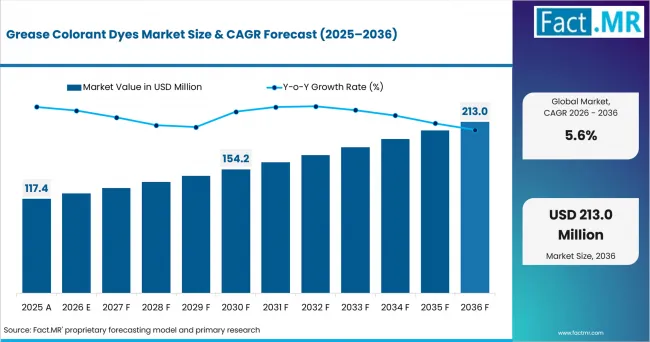
Grease Colorant Dyes Market Value Analysis | Source: Fact.MR
What are the defining numbers behind Grease Colorant Dyes Market growth?
USD 89.0 million absolute opportunity by 2036, led by Lithium complex and Automotive service within their respective segments.
- Demand Drivers in the Market
- Maintenance staff use color to tell apart greases made for bearings, chassis parts, food equipment, and outdoor machines. This is useful when several products are kept in the same service area and labels are not checked first.
- Different grease types do not react to colorants in the same way. Lithium complex, calcium sulfonate, polyurea, aluminum complex, and synthetic greases all require separate testing because each base can change the final shade.
- Heat, vibration, and long service periods make color stability more important. The dye must stay easy to recognize without spreading into seals, cartons, drums, or nearby parts during use and storage.
- Grease plants often choose ready-mixed liquid colors because they blend faster and reduce visible specks. Pre-made color packs also help workers produce the same shade in thick grease batches.
- Key Segments Analyzed
- By Grease Thickener Type: Lithium complex is expected to hold 39.0% share in 2026 because it serves a broad mix of automotive and industrial grease duties.
- By End-Use Sector: Automotive service is projected to account for 30.0% share in 2026 as workshops handle several grease grades and need quick visual separation.
- By Color Family: Red / orange is anticipated to capture 24.0% share in 2026 due to established use in product identification and brand palettes.
- By Dye Form: Oil-soluble liquid is estimated to represent 33.0% share in 2026 owing to easier dispersion through semi-solid batches with fewer visible specks.
- By Performance Need: Bleed resistance is forecast to account for 28.0% share in 2026 because migrated color stains parts and weakens the intended product appearance.
- Analyst Opinion at Fact.MR
- Shambhu Nath Jha, Senior Analyst at Fact.MR, states, “A grease colorant succeeds when the batch looks uniform after mixing and still looks intentional after storage and service. Manufacturers that understand thickener chemistry and bleeding behavior solve a plant problem, not just a shade request.”
- Strategic Implications
- Colorant companies need thickener-specific guidance for lithium complex and calcium sulfonate systems. Separate advice is also needed for polyurea and aluminum complex greases. Synthetic greases need their own checks because dispersion behavior changes by base system.
- Grease manufacturers are expected to improve first-pass yield when they add color through controlled pre-dispersions instead of loose powder addition.
- Maintenance-focused grease brands need to pair each color family with a clear product code so operators do not treat color as proof of interchangeability.
- Regional distributors gain room for small-lot custom matching where local grease plants lack a dedicated dye-development group.
The United States is forecast to post a 5.7% CAGR from 2026 to 2036 on a broad automotive service channel and diversified industrial grease production. Germany is projected to record a 5.6% CAGR through 2036 as reliability programs keep documented colorants in demand. The United Kingdom is anticipated to advance at a 5.5% CAGR by 2036 through aftermarket grease use. France is estimated to grow at a 5.4% CAGR from 2026 to 2036 through food-machinery and industrial applications. Brazil is forecast to register a 6.5% CAGR by 2036 on mobile-equipment maintenance. Agriculture and mining create much of the field-service pull, while transport and industry add recurring grease use.
How does the Grease Colorant Dyes Market break down by segment?
Lithium complex is projected to lead Grease Thickener Type with 39.0% share in 2026. Automotive service is expected to lead End-Use Sector with 30.0% share in the same year.
Which Thickener System dominates?
Lithium Complex holds 39.0% share in 2026.
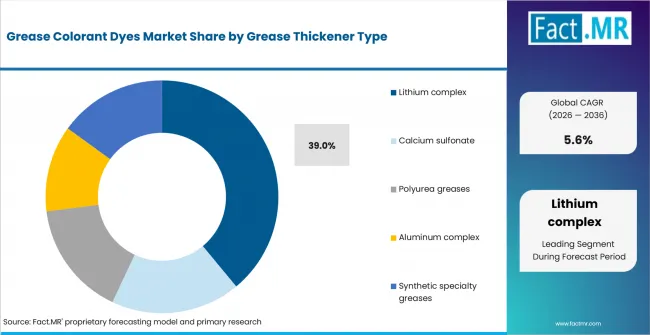
Grease Colorant Dyes Market Analysis By Grease Thickener Type | Source: Fact.MR
Lithium Complex is projected to hold 39.0% share in 2026 supported by broad use across chassis, wheel-bearing, industrial, and general-purpose greases. Calcium Sulfonate and Polyurea Greases serve more specialized formulations where dye compatibility changes with thickener chemistry and base-oil choice. Aluminum Complex and Synthetic Specialty Greases also require colorants that disperse evenly without changing grease texture.
What leads the Application segment?
Automotive Service accounts for 30.0% share in 2026.
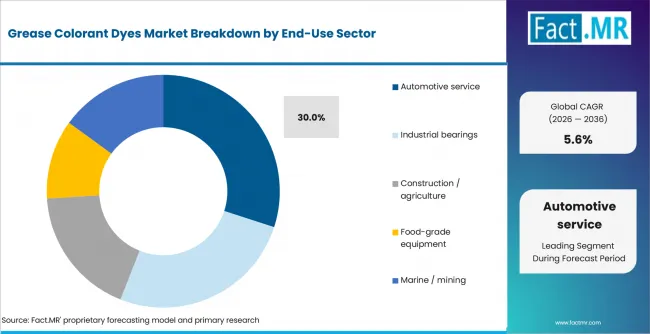
Grease Colorant Dyes Market Analysis By End Use Sector | Source: Fact.MR
Automotive Service is estimated to represent 30.0% share in 2026 because workshops, dealerships, and repair chains handle several grease products that need quick visual identification. Industrial Bearings follow where maintenance programs depend on documented lubricants for motors and pumps. Construction and Agriculture applications also require colors that remain visible after dust exposure, field use, and outdoor storage.
How does Color Family shape demand?
Red / Orange leads with 24.0% share in 2026.
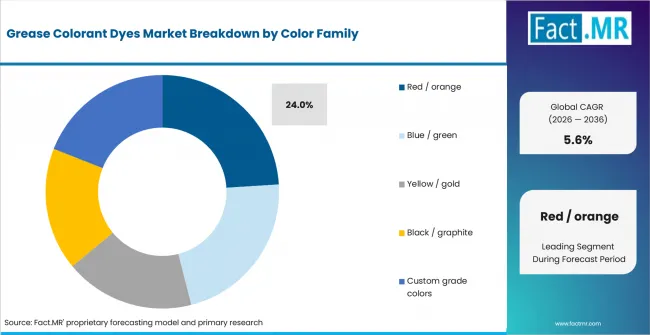
Grease Colorant Dyes Market Analysis By Color Family | Source: Fact.MR
Red / Orange is forecast to capture 24.0% share in 2026, although demand remains spread across several color families. Blue / Green and Custom Grade Colors support product differentiation and internal coding across grease lines. Yellow / Gold and Black / Graphite complete the segment, creating demand for consistent shade matching instead of one universal grease color.
Which Delivery Form leads?
Oil-Soluble Liquid holds 33.0% share in 2026.
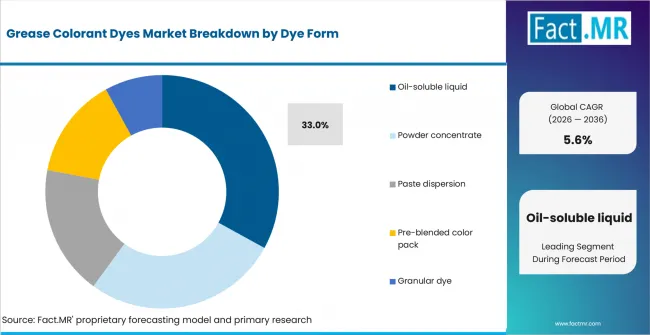
Grease Colorant Dyes Market Analysis By Dye Form | Source: Fact.MR
Oil-Soluble Liquid is anticipated to represent 33.0% share in 2026 because it disperses through heavy semi-solid grease batches without leaving visible specks. Powder Concentrate remains relevant where storage efficiency and high color strength guide purchasing. Paste Dispersion suits plants that need easier incorporation while limiting the amount of extra carrier liquid added to the finished grease.
What leads the Selection Criterion segment?
Bleed Resistance accounts for 28.0% share in 2026.
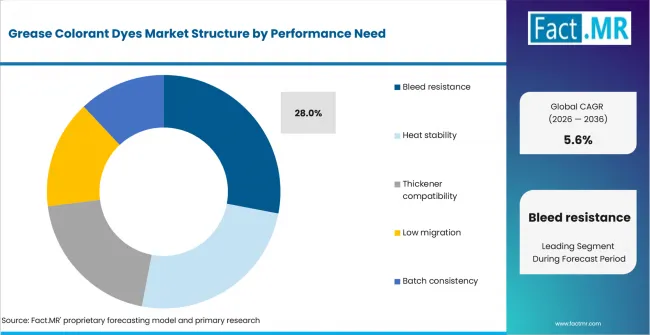
Grease Colorant Dyes Market Analysis By Performance Need | Source: Fact.MR
Bleed Resistance is expected to hold 28.0% share in 2026 as color separation can create staining on caps, seals, or packaging even when lubrication performance remains acceptable. Heat Stability also carries weight in warm storage and high-temperature service. Thickener Compatibility reinforces the need to test dye behavior inside the full grease matrix instead of base oil alone.
What is accelerating Grease Colorant Dyes Market adoption, and what is holding it back?
Color-coded grade management is expected to support adoption. Bleeding and streaking are expected to slow faster qualification. Chemical documentation creates another approval step for grease manufacturers.
Drivers Impact Analysis
| DRIVER | (~) % IMPACT ON CAGR | GEOGRAPHIC RELEVANCE | IMPACT TIMELINE |
|---|---|---|---|
| Maintenance identification | +0.8% | Global industrial sites | Short term (<= 2 years) |
| HPM performance focus | +0.7% | North America and global export markets | Medium term (2-4 years) |
| Thickener diversification | +0.6% | Europe and Japan | Long term (>= 4 years) |
| Packaged grease branding | +0.5% | USA and Brazil | Short term (<= 2 years) |
| Automated batch control | +0.4% | Germany and USA | Medium term (2-4 years) |
Source: Fact.MR analysis. Updated Jul 17, 2026
- Maintenance identification: Plants often store several grease grades near the same equipment population. A stable visual distinction supports correct handling when staff also follow labels and lubrication procedures.
- hPM performance focus: NLGI’s hPM framework keeps attention on measured grease performance. Colorants that fit validated formulations without disturbing required properties gain credibility with quality-led grease manufacturers.
- Thickener diversification: Calcium sulfonate and polyurea broaden compatibility work beyond lithium complex products. Synthetic specialty greases add another qualification route for dye makers with application testing depth.
Opportunity Impact Analysis
| OPPORTUNITY | (~) % IMPACT ON CAGR | GEOGRAPhIC RELEVANCE | IMPACT TIMELINE |
|---|---|---|---|
| Thickener-specific color packs | +0.4% | Global | Medium term (2-4 years) |
| Low-migration custom colors | +0.4% | Europe and Japan | Long term (>= 4 years) |
| Construction and agriculture grades | +0.3% | Brazil and Latin America | Short term (<= 2 years) |
| Small-batch shade matching | +0.3% | USA and Germany | Short term (<= 2 years) |
Source: Fact.MR analysis. Updated Jul 17, 2026
- Thickener-specific color packs: Pre-qualified packs are expected to help plants match colorant chemistry with lithium complex and calcium sulfonate systems. Polyurea and aluminum complex greases still need separate checks because color migration can differ by thickener.
- Low-migration custom colors: Custom grade colors already represent 19.0% of the Color Family segment. Colorant companies are expected to defend premium positions when a distinct shade is backed by bleed and heat evidence.
- Construction and agriculture grades: Greases for field equipment need a visible color after dust exposure and temperature swings. Regional application testing is expected to turn this need into repeat orders for liquids and pastes.
Restraints Impact Analysis
| RESTRAINT | (~) % IMPACT ON CAGR | GEOGRAPhIC RELEVANCE | IMPACT TIMELINE |
|---|---|---|---|
| Bleeding and migration | -0.4% | Global | Short term (<= 2 years) |
| Mixing nonuniformity | -0.3% | Small and mid-sized plants | Short term (<= 2 years) |
| False compatibility cues | -0.3% | Automotive aftermarket | Medium term (2-4 years) |
| Chemical documentation burden | -0.2% | European Union | Long term (>= 4 years) |
Source: Fact.MR analysis. Updated Jul 17, 2026
- Bleeding and migration: Color moving from grease into seals or packaging forces plants to retest dosage before approval. Adjacent material staining also pushes formulators to review carrier choice and dye chemistry.
- Mixing nonuniformity: Viscous batches trap powder agglomerates when addition is poorly controlled. Extra mixing time and rework reduce the apparent cost benefit of cheaper dye forms.
- False compatibility cues: Two greases with the same color sometimes use different thickeners and are not always safe to mix. Clear labeling remains necessary even when color coding is used.
Which countries are scaling Grease Colorant Dyes Market fastest?
United States 5.7%, Germany 5.6%, United Kingdom 5.5%, France 5.4%, Brazil 6.5%
The regional analysis covers North America, Europe, and Latin America. The country sections focus on the United States, Germany, the United Kingdom, France, and Brazil. The full report also reviews more than 30+ countries.
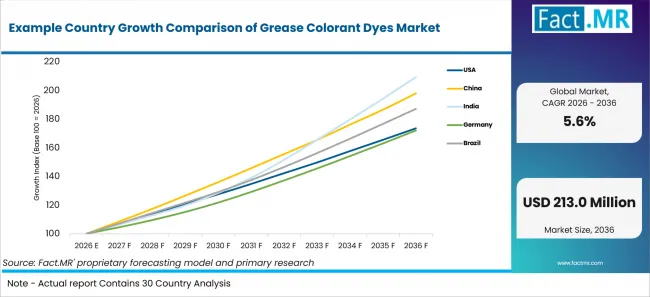
Example Country Growth Comparison Of Grease Colorant Dyes Market | Source: Fact.MR
| COUNTRY | CAGR (2026 to 2036) |
|---|---|
| United States | 5.7% |
| Germany | 5.6% |
| United Kingdom | 5.5% |
| France | 5.4% |
| Brazil | 6.5% |
Source: Fact.MR analysis. Updated Jul 17, 2026
What anchors Grease Colorant Dye demand in the United States?
5.7% CAGR, supported by heavy vehicle use and a large maintenance network.
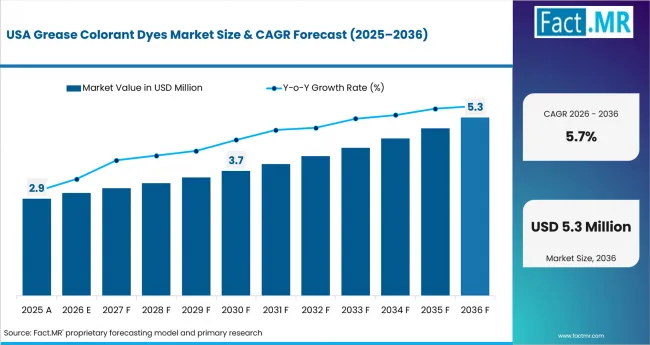
Grease Colorant Dyes Market Country Value Analysis | Source: Fact.MR
The United States has a wide base of cars, freight vehicles, workshops, factories, and service sites that use greases for many different jobs. EIA expects both light-vehicle travel and freight movement to keep rising over the long term. The market is forecast to grow at a 5.7% CAGR by 2036 as clear grease colors help workers identify the correct product during maintenance.
Where does Germany create premium demand?
5.6% CAGR, backed by machinery production and strict product control.
Germany’s demand comes from manufacturers that need grease shades to remain stable across machinery, vehicle parts, bearings, and power equipment. Destatis reported continued activity in German manufacturing during 2026, including machinery-related orders and production. The market is projected to expand at a 5.6% CAGR through 2036 as grease makers place greater value on repeatable shades, chemical records, and reliable performance inside different thickener systems.
How does the United Kingdom sustain Grease Colorant Dye sales?
5.5% CAGR, owing to a large vehicle fleet and regular service work.
The United Kingdom had 42.3 million licensed vehicles at the end of 2025, creating a broad base for repair, inspection, and maintenance activity. Grease colors help workshops separate products used for bearings, joints, marine equipment, and industrial parts. Demand is anticipated to rise at a 5.5% CAGR from 2026 to 2036 as independent blenders seek small batches, dependable shade matching, and clear product documentation.
What is France’s position in colored grease demand?
5.4% CAGR, supported by varied industrial and agricultural equipment use.
France has demand across factory machinery, food-processing equipment, farm machines, and other mechanical systems that require regular lubrication. INSEE reported that French manufacturing output in the three months through February 2026 was above the same period a year earlier. The market is estimated to post a 5.4% CAGR through 2036 as plants use color to separate food-grade, industrial, and equipment-specific grease lines.
How is Brazil’s application mix shaping demand?
6.5% CAGR, driven by farming activity and equipment used in difficult field conditions.
Brazil’s large agricultural base creates demand for greases used in tractors, harvesters, trailers, bearings, and mobile machinery exposed to heat, dust, and moisture. IBGE reported strong agricultural growth during the first quarter of 2025. The market is expected to record a 6.5% CAGR from 2026 to 2036 as grease producers seek colors that disperse quickly and remain easy to identify during field servicing.
Who leads the Grease Colorant Dyes Market?
Orco and Solar Organics lead through direct lubricant and grease colorant coverage, while Neelikon strengthens the field with certified colorants and fluorescent dye capabilities.
Orco has one of the clearest links to grease applications because its OrcoSolve range is described for fuels, lubricants, greases, and waxes in liquid and powder forms. Solar Organics also lists oil-soluble solvent dyes for lubricants and grease, making its portfolio relevant to hydrocarbon-based formulations. Neelikon adds a wider certified colorant range, although each dye still needs to be checked against the selected thickener and base-oil system. These companies compete on shade consistency, dispersion, bleed control, and support during plant trials.
Which companies are the key providers?
The company set includes Solar Organics and Neelikon alongside Orco.
- Solar Organics
- Neelikon
- Orco
Bibliography
- Department of Chemicals and Petrochemicals. (2025, February 6). Annual report 2024–25. Ministry of Chemicals and Fertilizers, Government of India.
- European Commission. (2025, July 8). A European chemicals industry action plan (COM(2025) 530 final).
- Health Canada. (2025, June 17). Chemicals management plan: 2025–26 supplementary information tables. Government of Canada.
- U.S. Environmental Protection Agency. (2025, April). List of lists: Consolidated list of chemicals subject to EPCRA, CERCLA, section 112(r) of the Clean Air Act, and section 311 of the Clean Water Act (EPA 550-B-24-001).
This Report Addresses
- The report provides strategic intelligence on Grease Colorant Dyes across Grease Thickener Type and End-Use Sector choices that shape grease identification and production control.
- Segment analysis covers Lithium complex and Automotive service as the 2026 share. Color Family and Dye Form comparisons complete the segment view. Performance Need is reviewed separately because it controls qualification priorities.
- Regional outlook evaluates the United States and Germany alongside the United Kingdom. France and Brazil complete the named country comparison. The full study covers more than 30 countries.
- Competitive analysis profiles Solar Organics and Neelikon alongside Orco.
- Performance assessment covers Bleed resistance and Heat stability across grease applications. Thickener compatibility and Low migration complete most of the performance view. Batch consistency is included because uniform color depends on mixing behavior.
- Use-case assessment connects automotive service and industrial bearings with construction / agriculture demand. Food-grade equipment and marine / mining grease applications complete the use-case view.
What does the Grease Colorant Dyes Market cover?
Soluble dyes and oil-soluble liquids purchased to color lubricating grease formulations. Powder concentrates and paste dispersions are also included when they are used for grease coloration. Pre-blended color packs and granular dyes are counted under the same use boundary.
The Grease Colorant Dyes Market covers colorants used inside automotive and industrial greases. Construction and agricultural greases are included when color is added for identification or product differentiation. Food-grade and marine greases follow the same rule. Mining greases are included when color is added to the finished grease. The scope follows the colorant decision inside formulation and batch processing. Product coding and branding are also covered. Maintenance use and technical documentation are included when they shape the colorant purchase decision.
The market differs from finished grease because commercial value comes from concentrated colorant performance and shade repeatability. Low migration and compatibility with semi-solid thickener systems are also part of the purchased function.
What is included in the scope?
Products are included when they are purchased specifically to give lubricating grease a stable and uniform identification color.
The scope counts soluble dyes and prepared dispersions used in automotive service greases and industrial bearing greases. Construction and agriculture greases are also included. Food-grade equipment and marine greases are counted when the colorant is incorporated into the grease. Mining greases follow the same inclusion rule.
What is excluded from the scope?
Non-color grease inputs and finished-grease value are outside the sizing boundary.
Base fluids and thickeners are excluded because they are grease inputs outside the colorant sizing boundary. Antiwear agents and corrosion inhibitors are also outside the sizing boundary. Tackifiers and packaging are excluded as separate product groups. Application equipment and finished grease are also outside the sizing boundary. The scope omits unrelated pigments and standalone inspection dyes that are not incorporated into grease.
How Was the Analysis Built?
The analysis draws on 120+ sources, 35+ company portfolios, 25+ countries, and more than 20 industry interviews.
- Primary Research: Primary research includes discussions with manufacturers, service providers, technology developers, distributors, end users, procurement teams, and subject-matter experts. These conversations examine purchasing priorities, product adoption, operational challenges, approval requirements, competitive positioning, and the factors that influence wider market acceptance.
- Desk Research: Desk research covers government statistics, regulatory publications, company filings, trade data, technical studies, industry associations, standards, public policy, and other authoritative sources. Every source used in the analysis is documented in the bibliography.
- Market Sizing and Forecasting: Market estimates combine historical performance, demand indicators, pricing and volume trends, segment shares, company participation, country-level growth, adoption patterns, investment activity, and barriers to market expansion.
- Data Validation and Update Cycle: Findings are validated by comparing primary interviews with public data, company activity, regulatory changes, trade patterns, and industry developments. Regular updates review new product launches, capacity changes, partnerships, approvals, procurement trends, and shifts in commercial adoption.
Segmentation
What is the report’s scope and coverage?
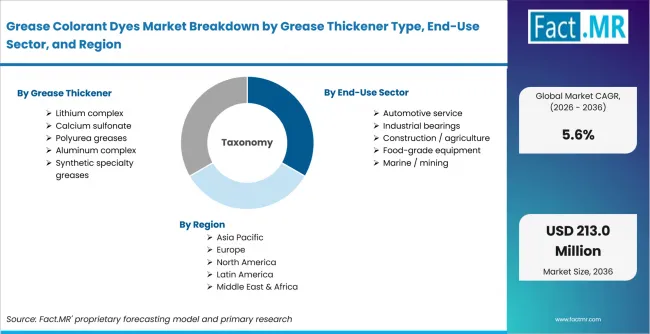
Grease Colorant Dyes Market Breakdown By Grease Thickener Type, End Use Sector, And Region | Source: Fact.MR
| ATTRIBUTE | DETAILS |
|---|---|
| Quantitative Units | USD million in 2026 to USD million by 2036 at CAGR |
| Market Definition | Grease colorant dyes are soluble dyes, concentrates, and prepared dispersions sold to give lubricating grease a stable and uniform identification color. |
| Grease Thickener Type | Lithium complex; Calcium sulfonate; Polyurea greases; Aluminum complex; Synthetic specialty greases |
| End-Use Sector | Automotive service; Industrial bearings; Construction / agriculture; Food-grade equipment; Marine / mining |
| Color Family | Red / orange; Blue / green; Yellow / gold; Black / graphite; Custom grade colors |
| Dye Form | Oil-soluble liquid; Powder concentrate; Paste dispersion; Pre-blended color pack; Granular dye |
| Performance Need | Bleed resistance; Heat stability; Thickener compatibility; Low migration; Batch consistency |
| Regions Covered | North America; Europe; Asia Pacific; Latin America; Middle East and Africa |
| Countries Covered | United States; Germany; United Kingdom; France; Brazil, and 30 countries |
| Key Companies Profiled | Solar Organics; Neelikon; Orco |
| Forecast Period | 2026 to 2036 |
| Approach | Market size is built from grease production by thickener and end use, the colored share of output, dye or concentrate dosage, and realized prices, then cross-checked against company portfolio evidence and interview feedback. |
Source: Fact.MR analysis. Updated Jul 17, 2026
How is the market segmented?
-
By Grease Thickener Type
- Lithium complex
- Calcium sulfonate
- Polyurea greases
- Aluminum complex
- Synthetic specialty greases
-
By End-Use Sector
- Automotive service
- Industrial bearings
- Construction / agriculture
- Food-grade equipment
- Marine / mining
-
By Color Family
- Red / orange
- Blue / green
- Yellow / gold
- Black / graphite
- Custom grade colors
-
By Dye Form
- Oil-soluble liquid
- Powder concentrate
- Paste dispersion
- Pre-blended color pack
- Granular dye
-
By Performance Need
- Bleed resistance
- Heat stability
- Thickener compatibility
- Low migration
- Batch consistency
-
By Region
- North America
- United States
- Europe
- Germany
- United Kingdom
- France
- Latin America
- Brazil
Frequently Asked Questions
Which Grease Thickener Type leads the Grease Colorant Dyes Market?
Which End-Use Sector leads the Grease Colorant Dyes Market?
Which Color Family leads the Grease Colorant Dyes Market?
Which Dye Form leads the Grease Colorant Dyes Market?
Which Performance Need leads the Grease Colorant Dyes Market?
Which country records the highest CAGR in the Grease Colorant Dyes Market?
What is the primary driver in the Grease Colorant Dyes Market?
What is the main restraint in the Grease Colorant Dyes Market?
Who worked on this report


Preview the report firsthand - request a free sample
Free SampleGet the brochure for pricing and purchase details
Download PDF