- Base Value(2025): 642.5 Mn
- Forecast Value (2035): 1337 Mn
- CAGR (2035): 7.8%
Gua Sha Market Outlook 2025 to 2035
The global gua sha market is expected to reach USD 1,337 million by 2035, up from USD 642.5 million in 2025. During the forecast period 2025 to 2035, the industry is projected to expand at a CAGR of 7.6%.
The gua sha market is experiencing significant relevance as consumers increasingly adopt holistic wellness and skincare practices. The demand has been driven by the trend of self-care at home, professional spa integration, and growing awareness of non-invasive and therapeutic processes. Commercial uses concentrated on rejuvenation of the face, releasing body muscles and stress management solutions landing the market as strategically important to beauty and wellness markets.
Quick Stats for Gua Sha Market
- Industry Value (2025): USD 642.5 Million
- Projected Value (2035): USD 1,337 Million
- Forecast CAGR (2025 to 2035): 7.6%
- Leading Segment (2025): Gua Sha Tools (44.0% Market Share)
- Fastest Growing Country (2025-2035): South Korea (8.9% CAGR)
- Top Key Players: Yang Face, Guashatool, Sukeauto, and Hanhe Gem
2025-to-2035.webp "Us Gua Sha Market Value(usd Million)2025 To 2035")
Us Gua Sha Market Value(usd Million)2025 To 2035 | Source: Fact.MR
What are the drivers of the Gua Sha market?
A rising consumer demand to reach their wellness goals in a non-invasive and natural way is reshaping the gua sha market ensuring natural solutions to skincare and stress-relief. The growing popularity of traditional Asian remedies and the impact of social media have helped to spur the growth among the millennials and Gen Z patients. Increasing disposable income and the availability of online retailing channels further increases the market reach and penetration.
The use of gua sha in the wellness facilities, spas and medicines contributes to the commercial demand as companies incorporate it into their beauty, body and massage treatments. The introduction of innovations in tool design, materials, and ergonomics specifics and features facilitates the increase of efficacies and safety, which motivate practitioners to use more advanced products. The collaboration of wellness with skincare means an upward chain of distribution, whereby new holistic products that provide both health and beauty advantages with relaxation benefits can be presented.
Electric gua sha devices have undergone technological advancements that comprise vibration, heat, and LED therapy segments that feature the finest product in the market. Green consumers are also becoming more influential and choose ethically collected stones and environmentally friendly materials moving manufactures to expand liberalization.
Growth is propagated through regional trading partnerships and through strategic market engagement strategies that see to it that there is continual product innovation, product penetration, and adoption among professional and consumer base within the market across geographical regions.
What are the regional trends of the Gua Sha market?
In North America strong growth has occurred due to growing awareness of wellness, premium spa ownership and direct to-consumer e-commerce platforms. Households are asking more holistic skincare products to consume Gua sha tools to encompass in their self-care practices.
Successful safe wellness devices and online marketing strategies spur adoption further because they are sustainable in the long run due to the fact that backing up resources is done by regulators. The United States and Canada have innovation clusters that are based on ergonomic designs, electric, and eco-friendly material.
The historical and cultural focus center remains Asia Pacific and with China being the manufacturing and domestic adoption leader. Integration of traditional medicine into mainstream wellness activities as well as health promotion through government activities boosts the consumption.
Japan and South Korea show the increasing interests in the convergence of beauty-tech by including gua sha in their more sophisticated facial devices and professional beauty aesthetic.
In Europe, products are highly differentiated in terms of quality, especially in Germany, France, and the United Kingdom, with the emphasis on regulatory compliance. The market is driven by wellness tourism, forefront of luxury spa, and interest towards ethically sourced material. Camps of consumer education and influencer marketing promote the demand of high-quality products with appropriate certifications.
What are the challenges and restraining factors of the Gua Sha market?
Limited standardization of the products that make gua sha practical restricts its availability among professionals, where the overall concern of its usage as a safety issue lies on the undetermined quality of the products and the authenticity of the material present in them. Regulatory compliance is different in various regions posing an obstacle to international expansion and imposes a higher cost of operations.
Due to the high price sensitivity of the mass-market consumers, premium/electric Gua Sha products have constrained penetration. The mainstream use of contemporary tools is limited by the perception of traditional tools as specialty or add-on wellness products. Natural stones, such as jade and rose quartz, have supply chain problems that affect production continuity, supply of raw materials, and supply irregularity.
Intricate technological integration issues on electric devices, such as battery strength, device robustness, and compliance with health codes can dissuade professional users and the consumers. The market is volatile due to rivalry of other wellness instruments and facial massage machines.
Firms are required to deal with intellectual property issues, technological distinction, and high rates of trend changes in order to achieve sustainable growth whilst containing factors associated with operational, regulatory, and supply limitations across the world markets.
Country-Wise Insights
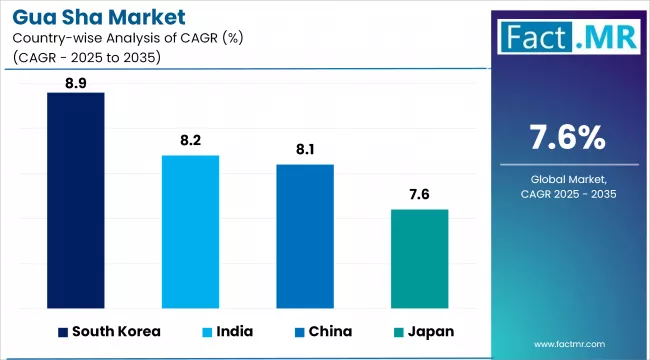
Gua Sha Market Cagr By Country | Source: Fact.MR
China is The Global Manufacturing Powerhouse for Gua Sha
China is the leader in the production due to rich sources of natural stone, low-cost production, and a well prepared supply chain. Domestic consumption is on the increase, owing to the cultural adaptation of traditional therapies by consumers into their personal wellness practice, which stimulates volume and innovation. The orientation type, in turn, is towards the premium tools and electric devices and it delivers to North Americans, Europe, and Asia-Pacific regions.
Technological innovation involves automation of stone sculpting, electrical gua sha, and redesign of devices so that they are easier to work with as a professional spa giver. Chinese manufacturing companies are investing in quality certification, internet marketing, and distribution channels in order to have an international presence and gain brand dexterity.
Strategic growth will take advantage of low costs of production and economies of scale and thus be able to price competitively. The fact that the government supports traditional medicine and wellness exports also improves international positions. Research and development helps in strengthening the differentiation of the product and it works together with the global distributors to expand the penetration of the market consistently into the consumers and the professional segment.
India is The Emerging Wellness Hub for Gua Sha
The market in India is fueled by an increased awareness of the consumers to the conventional types of wellness treatment and home-based skincare regimens. The increased incomes on the middle classes enable the use of premium and semi-premium gua sha tools. Skin care products are combined with various types of beauty tools that are facing common usage in domestic spa chains and wellness centers.
The manufacturing focuses on ethical sourcing of stones, hand-crafter tools and electric hybrid variations. Designing is a priority; Indian companies underline their individual customization and appeal to local and international markets. There is a steady production of export-oriented production, which is focused on the Asian- Pacific and European wellness markets.
Some of its growth strategies are digital marketing, influencer strategies, and partnerships with beauty brands. R&D expenditures are directed towards the use of environmental materials, ergonomics and integrating new materials with old techniques and designs.
Strategic alliances with logistics vendors and online stores drive up distribution efficiency and access to global markets, which would guarantee India the growing dominance in these global Gua Sha supply chains.
South Korea is The Innovation-Driven Skincare Integrator for Gua Sha
South Korea leverages high-tech beauty innovation, integrating Gua Sha with advanced facial devices and premium spa offerings. The trends in consumer adoption have strong wellness culture, sophistication in skincare and education through influencers. Domestic demand is purely based on efficacy, design, and material quality.
Manufacturers pay attention to electric Gua Sha tools, hybrid therapy devices, and highly technological stones. The focus of orientation is North America, Europe and Southeast Asia making South Korea a high-quality supplier.
The role of investment in R&D is to increase functionality, effectiveness in therapy, and intelligent combinations with skincare procedures. The relationships with spas, beauty tech startups, and e-commerce platforms enhance market penetration. Regulatory compliance and certifications make the entry into international wellness market easy whilst maintaining technological differentiation and competitive edge.
Category-Wise Analysis
Gua Sha Tools are The Core Driver of Consumer Engagement
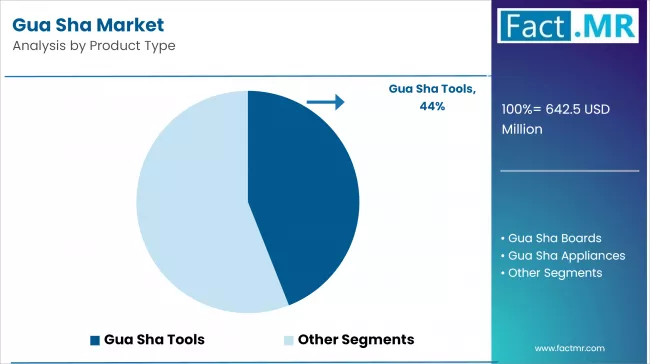
Gua Sha Market By Product Type | Source: Fact.MR
Gua sha tools dominate market share, which has been taken over by facial, body and specialty designs that are used widely at personal and professional level. They can be incorporated into almost any wellness or skincare routine and take the form of a useful component in anti-aging, stress relief and massage of tired muscles. Adoption is facilitated with the support of the web and social media education campaigns.
Its future expansion is based on ergonomics and design, electric modifications, and an increase in using high-quality materials. A collaboration with wellness brands and spa services will enhance business relevance, and continued product innovation innovativeness will make sure that the consumers remain engaged. The accessibility of the Tools, as well as their cultural credibility, continues to attract mass appeal both domestically and in other export markets worldwide.
Jade Products are The Premium Material Benchmark for Gua Sha
Jade is the material of choice based on its association with history, special powers of healing and high consumer confidence. Market leadership is portrayed in high prices, adoption by professionals, and campaigns by influencers on the lines of authenticity and therapeutic usefulness.
The next direction is becoming jade with an ethical background, a luxury brand, and connectivity with electrical gadgets. The increased awareness of wellness-minded consumers of benefits material warrants future demand. Jade producers and manufacturers of Gua Sha tools will continue to incorporate strategic collaborations, which are likely to facilitate supply stability, product differentiation and market leadership in the premium market segments.
Competitive Analysis
Key players in the Gua Sha market including Yang Face, Guashatool, Sukeauto, Hanhe Gem, MS Future Cosmetics, Deyi Gems, Blass Beauty, Corona Elite, Hayo'u Method, Zove Beauty, Biba Los Angeles, Rena Chris, PZ Cosmetics, Anlan, AROCELL
The Gua Sha Market is fragmented, but it has become highly competitive as market players differentiate by producing the authentic materials, high-quality ergonomic designs and technological advanced products. Plug-in products, technological breakthroughs and high-grade stone processing appeal to the business community and the high-end consumer base. Looking at the procuring behavior of the customers, there is an opportunity for quality manufacturers regarding verified sourcing, certification and efficacy.
The competition in North America and Europe is also rising as wellness has taken hold and digital marketing has its impact. Direct-to-consumer channels, e-commerce or influencer partnerships all help companies in increasing brand visibility. Innovation cycles are concerned with sustainability, ergonomics enrichment, and smart-device connection. The regional competency and scale of production as well as the export orientation are other competitive forces that are influenced by high-value differentiation as a key competitive strategy to gain market share in both professional and consumer-driven markets in various regions around the world.
Recent Development
- In April 2023, Blass Beauty has launched a 3-in-1 facial sculpting tool that combines vibration, heat, and LED light therapy. This micro-current facial toning device is designed to rejuvenate and restore firmness to the skin in a short period. The integration of multiple technologies aims to enhance the effectiveness of Gua Sha treatments.
Fact.MR has provided detailed information about the price points of key manufacturers of Gua Sha Market positioned across regions, sales growth, production capacity, and speculative technological expansion, in the recently published report.
Methodology and Industry Tracking Approach
The 2025 Gua Sha Market Report by Fact.MR is derived from insights collected from 1,200 stakeholders across 12 countries, maintaining a minimum of 75 respondents per country. Sixty-five percent of participants were end users including spas, wellness centers, skincare specialists, and digital health startups. The remaining 35% comprised procurement leads, clinical R&D heads, regulatory consultants, and platform integrators. Data collection spanned June 2024 to May 2025, emphasizing tool efficacy, material quality, ergonomics, integration with wellness protocols, and compliance standards.
A regionally balanced calibration model ensured representative coverage across North America, Europe, and Asia-Pacific. Insights draw from 95 validated sources, including peer-reviewed studies, investment reports, product datasheets, and annual filings from manufacturers, triangulated for accuracy and actionable intelligence across the value chain.
Fact.MR applied rigorous analytical tools such as multi-variable regression and scenario modeling to ensure data robustness. With continuous monitoring of the glass adhesives space since 2018, this report offers a comprehensive roadmap for firms seeking competitive advantage, innovation, and sustainable growth within the sector.
Segmentation
Segmentation of Gua Sha Market
-
By Product Type :
- Gua Sha Tools
- Facial Tools
- Body Tools
- Specialty Tools
- Gua Sha Boards
- Household Boards
- Professional Boards
- Gua Sha Appliances
- Manual Appliances
- Electric Appliances
- Solar-powered Appliances
- Gua Sha Tools
-
By Material :
- Jade
- Rose Quartz
- Amethyst
- Obsidian
- Ceramic
- Wood
-
By Application :
- Facial Skin Massage
- Body Massage
- Foot Massage
- Hand Massage
- By Distribution Channel :
- Online Retailers
- Offline Retailers
- Professional Channels
-
By Region :
- North America
- Latin America
- Western Europe
- Eastern Europe
- East Asia
- South Asia & Pacific
- Middle East & Africa
Frequently Asked Questions
What was the Global Gua Sha Market Size Reported by Fact.MR for 2025?
Who are the Major Players Operating in the Gua Sha Market?
What is the Estimated Valuation of the Gua Sha Market in 2035?
What Value CAGR did the Gua Sha Market Exhibit Over the Last Five Years?
Who worked on this report


Preview the report firsthand - request a free sample
Free SampleGet the brochure for pricing and purchase details
Download PDF