- Base Value(2025): 570.9 Mn
- Forecast Value (2035): 1757.4 Mn
- CAGR (2035): 12.8%
Shade Matchers Market Outlook 2025 to 2035
The global shade matchers market is expected to reach USD 1,757.4 million by 2035, up from USD 570.9 million in 2025. During the forecast period 2025 to 2035, the industry is projected to expand at a CAGR of 11.9%.
Global shade matchers market has entered transformative stage as the consumer’s preference has migrated to hyper-personalization of beauty and cosmetics. The growing awareness of the variety of skin tones, along with the diversification of product portfolio in the foundations and concealers have provided the right environment to embrace the application of technology. Devices and applications that claim to detect shade correctly are no longer viewed as a niche; they are being added to the major retail and e-commerce systems.
The emergence of applications that can be accessed by smart phones and handheld devices that are consumer friendly shows how convenience has become a major consideration in adoption. The markets in Asia, Latin America and those in the emerging economies in Europe signify the widening demand base that is far outside the traditional Western markets.
Quick Stats for Shade Matchers Market
- Industry Value (2025): USD 570.9 Million
- Projected Value (2035): USD 1,757.4 Million
- Forecast CAGR (2025 to 2035): 11.9%
- Leading Segment (2025): Handheld Devices (48.5% Market Share)
- Fastest Growing Country (2025-2035): China (14.0% CAGR)
- Top Key Players: Perfect Corp,Arbelle, Orbo AI, ShadePassport, ModiFace, BoldHue, Tryonnix, and X-Rite
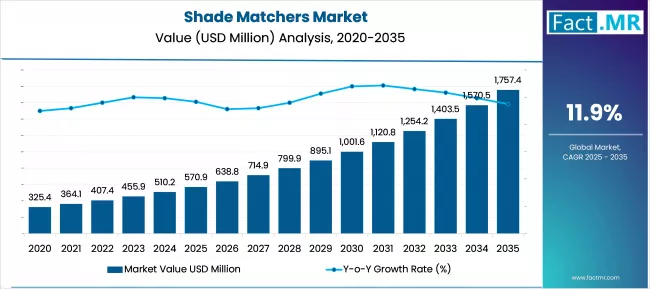
Shade Matchers Market Market Value Analysis | Source: Fact.MR
The trend of increased consumer sophistication and increased inclusivity in the product ranges will determine future growth. The younger generations, in particular Gen Z and Millennials, are driving faster adoption by insisting on accuracy and depiction of shade selections. Such demographic pressure is driving brands and technology developers to invest a lot of money in innovation, to make sure that there is a consistency in different lighting situations, and even skin undertones. The combination of inclusion, technology, and affordability will establish the tone of competition differentiation in the following decade.
What are the drivers of the shade matchers market?
The countries that are fast becoming advocates of AI-enhanced shade calibration and cloud-based personalization platforms in the shade matchers market include United States, China, Japan, Germany, and the United Kingdom.
Digital shade analysis, which has already become the key facilitator of the software-based beauty ecosystem, is especially important in the markets where the consumers expect scientifically proven inclusivity, individual product matching, and easy incorporation into omnichannel experiences of retailing. These markets have a robust R&D environment and a well-developed digital infrastructure that would fast-track the commercialization of AI shade-matching technologies, mobile apps, and intelligent mirrors, both in the mass-market and luxury segments.
This change is supported by the increasing need in certified and inclusive shade-matching systems, and the increasing usage of subscription-based personalization models in the general beauty ecosystems. In 2024 and 2025 in particular, regulatory agencies and lobby groups are putting more pressure on regulatory oversight, in terms of algorithmic transparency, inclusivity demands, and ethical uses of data.
Nations such as Japan and South Korea are proactively using their existing divisions in beauty technology to market and sell shade-matching products to provide substantiated performance claims, inclusiveness assurances, and consistent results to a variety of consumer profiles. Such undertakings make market adoption credible and scalable.
Adoption is on the rise among beauty retailers, e-commerce platforms, salons, and professional makeup segments, which all are looking to achieve quantifiable gains in their customer experience, in cuts in product returns, and in consumer trust. With AI-based personalization persistently developing, its compatibility with the future-generation AR applications, IoT-based beauty devices, and encrypted data ecosystems are placing shade-matching technologies at the heart of the future personalized beauty sector.
What are the regional trends of the shade matchers market?
Asia Pacific continues to have the highest market growth centre of shade matchers with assertive regulation in digital beauty technologies, increased investments in AI-based personalisation and the rapidly growing adoption of connected retail ecosystems.
China is moving into mass-scale implementation with national digital consumer campaigns and the emergence of Chinese-based luxury beauty brands, most of which are adopting AI shade matching and AR try-on features into their product personalization models. There are favorable policies and government subsidies on digital retail technology that favor Japan in its quest to commercialize new high-tech platforms of beauty analytics, especially in skin tone and undertone precision.
South Korea is also advancing its global presence by accelerating the innovativeness and rapid innovation cycles, especially in terms of exporting the beauty technology to the market, supported by a high level of consumer acceptance of AI shade-matching kiosk and application-based personalization devices.
In the meantime, the domestic capability in markets like India is being spurred on by programs such as Make in India and by the growing magnitude of e-commerce-based beauty sales, backed by the growing proportion of middle-income buying. The nation is becoming a competitive center of cheap AI shade-match application that can be expanded in local and international markets.
Europe is aligning shade-matching adoption to the sustainability and inclusiveness agendas. France and Germany are first movers in certified AI shade-matching integration into retail and luxury brand products, with compliance, inclusivity, and less product waste as priorities. The growth of the market in Western Europe is also facilitated by the good penetration of the omnichannel retail market and the high demand of the consumers on the scientifically validated personalization tools.
Regulatory ethics of data coupled with the level of interest in venture capital in the start-up of beauty technology in North America is speeding up the commercialization of the product. The market in the U.S. exhibits a high rate of adoption among the retailers, salons and e-commerce whereby the use of personalization services through subscriptions has become commonplace.
Canada is enhancing its potential by promoting AI-enabled foundational calibration development on the local side and by providing input on export markets with solutions that focus on inclusivity and safe data management.
What are the challenges and restraining factors of the shade matchers market?
The technological infrastructures underlying super-artificial intelligence shade-matching systems have contributed to their restricted wider usage to a large degree. Calibration systems that are accurate by high standards, inclusiveness and AR/AI integration require specific infrastructure, technical knowledge and capital. Retail large scale deployment is still concentrated in the premium beauty chains and it limits the economies of scale achievement.
Consequently, high-end smart mirrors and kiosks are still priced well above app-based or handheld options, which restricts their incursion in cost-sensitive markets even though personalized shade-matching systems are sought around the world.
Shade calibration systems are also validated and ethically approved in resource-consuming procedures. Checks of algorithmic transparency, inclusivity checks, and intensive data privacy testing are often needed during compliance, particularly in controlled markets like the EU, the U.S., Japan, and South Korea.
The models guarantee consumer safety and reliability of algorithms, yet prolong commercialization periods and increase the costs of R&D. Even a single error in precision, inclusivity mapping, or data management may damage consumer confidence especially in new markets whose testing and regulation mechanisms are still immature.
Country-Wise Insights
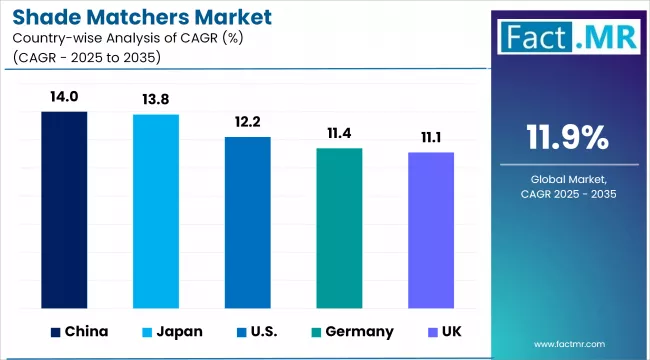
Shade Matchers Market Cagr Analysis By Country | Source: Fact.MR
Innovation, Inclusivity, and Digital Retail Make United States Drive Shade Matchers Market
The United States has been building its position as a market leader in shade matchers by integrating a high-capacity level of innovation with inclusivity-driven approaches. The beauty ecosystem in the country is fuelled by the high-tech AI applications, AR, try-on platforms, and connected smart mirrors that allow personalization in the real-time. This combination indicates a demand among the consumers on customized cosmetic solutions as well as a general technological maturity of the U.S. online retail environment.
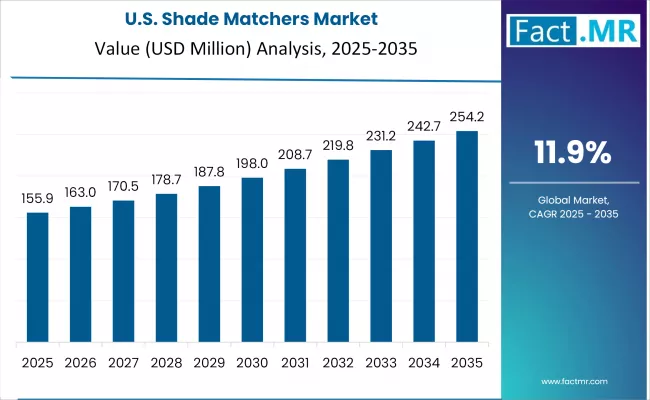
Shade Matchers Market Country Value Analysis | Source: Fact.MR
The diversity and inclusivity in the U.S. population influence the consumer expectation substantially, which has made beauty products and technology creators focus on scientifically valid shade calibration tools. The emphasis on transparency in algorithms and ethical data usage is also in favor of adoption since consumers are becoming more prone to inclusivity when dealing with authenticity and trust. This places the U.S as the world standard of performance as far as shade matching is concerned.
With the convergence of sophisticated personalization and online trading, the U.S. market will become an annual force in the years ahead. The spread of subscription models, robust investment inflows in beauty-tech startups, and regulatory openness when it comes to AI-based personalization will keep the adoption growth going. By 2035 the U.S will continue to be the world leader in innovation and inclusivity in shade matchers.
Mass Consumer Scale and Smart Beauty Platforms Position China to Drive Global Shade Matchers Market
China will eventually control the shade matchers segment owing to the huge number of consumers as well as the speed at which it has adopted smart retail technology. The growing disposable income, the growing trends of beauty awareness among younger generations, and the growing number of luxury domestic brands have formed the most ideal setting in which the mass use of AI-driven personalization tools will be achieved. Mobile-first consumer behaviour guarantees that shade-matching and AR-enabled try-on functions rapidly penetrate the market.
China is strong in terms of its scaling capability. The mainstreaming of shade-matching technologies is being driven by the integration of social media and live-commerce platforms and national efforts to advance consumer strategies through digital approaches. The beauty sector at home is integrating AI-assisted calibration into their foundation collections where multiple consumers with different categories can benefit and be encouraged to repeat the usage. This combination of mass and technological assimilation exclusively makes China a market accelerator in the world.
The position of China in the market will be increased in the future due to the government-supported smart retailing development and the collaboration between technology solutions and beauty brands.
High-levels of consumer acceptance of digital-first solutions will guarantee fast commercialization of new shade-matching formats. In the shade matchers market, China will be the largest in terms of size and rate of adoption and by 2035, it will have established benchmarks in the global growth patterns.
Category-Wise Analysis
Handheld Devices Drive the Shade Matchers Market with Portability and Accessibility
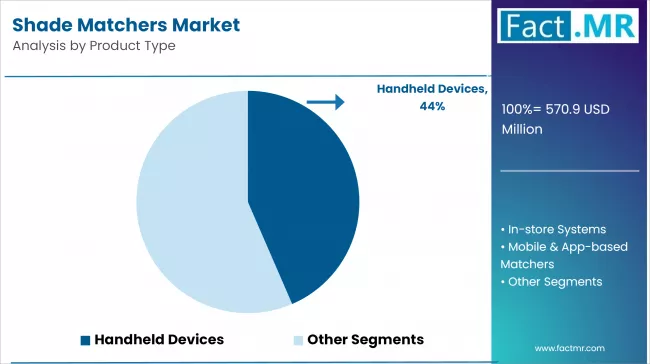
Shade Matchers Market Analysis By Product Type | Source: Fact.MR
The most popular product category in the shade matchers market is handheld devices since they provide the right combination of low costs, precision, and portability. The handheld devices can be adapted by beauty professionals as well as individuals unlike the kiosk-based systems or smart mirrors that have heavy infrastructure requirements. Their simplicity of use and the capacity to give consistent results with different conditions have seen them being a choice of the target markets both emerging and mature.
The development of handheld devices is also supported by means of its connection to mobile applications and AI calibration functions. With more consumers insisting on faster and more accurate personalization, more sensors, applications syncing and tone mapping in real-time are being packed into these devices. The innovation will guarantee a wider reach among age groups and income levels and will experience high share growth in 2025-2035.
In the future, the handheld devices will remain the leader because they could cater to both low-end and high-end markets. Since brands are developing lower-end models to serve mass markets and higher-end versions to serve beauty studios, handheld machines will continue to support adoption of shade-matching. Their superiority indicates the requirements of the market to have scalable, versatile, and high-precision solutions, which are adjustable to a variety of consumer types.
Gen Z Drives the Shade Matchers Market with Inclusivity and Digital Adoption
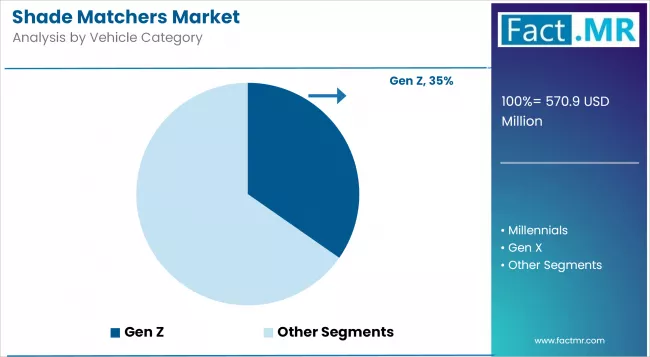
Shade Matchers Market Analysis By Vehicle Category | Source: Fact.MR
The most powerful age group in determining the future of shade matchers market is gen Z. This generation is digital native, appreciates inclusivity and wants products that represent diversity of all skin tones. The fact that they like to test AI-driven solutions, AR-based try-on systems, and mobile-first personalization apps makes them the very heart of the shade-matching technologies consumer segment.
Shade matchers are not only a functional tool of this group anymore but are linked to identity, authenticity and representation. This is why beauty brands are targeting the creation of inclusive shade assortments and utilizing AI calibration technology to provide Gen Z with products that they can identify with.
Gen Z will continue to be a significant source of growth in the coming years, and especially in Asia Pacific, North America, and Europe. The fact that they prefer personalization and are extremely comfortable in digital ecosystems will drive the use of widespread handheld devices and apps-based shade-matching systems. As of 2025, the need of Gen Z to be more inclusive and authentic will remain the trend in innovation and market growth worldwide.
Competitive Analysis
Key players in the shade matchers market are Perfect Corp,Arbelle, Orbo AI, ShadePassport, ModiFace, BoldHue, Tryonnix, Match My Makeup, Araya Solutions, Vita, PulpoAR, ShadeFinder, FoundationMatcher, 2th Shade Matching Solution, and X-Rite
There is a high volume of competition in the shade matchers market, and the rivalries revolve around the calibration algorithms, the inclusivity frameworks, AR delivery system, and the AI-based personalization engines. All of these factors outline the maximum efficiency of the shade-matching platform. The advanced data-privacy architectures, proprietary software, and dynamic calibration systems which provide real-time update are increasingly becoming the key differentiators and provide the consistency in accuracy in varying lighting and skin conditions. Early gains are being reaped in the beauty retail, salons and e-commerce integrations especially where there is a growing consumer desire to see scientifically validated personalization.
Competitors with a long history are gaining a priority relationship with major beauty retailers and international cosmetic brands, and an alliance is increasingly favoring those who own intellectual property in high-quality calibration algorithms and hybrid delivery models. The most demanded platforms are those that can avail both app-based personalization and in-store device calibration. Integrating shade matching with value-added features like undertone mapping, finish choice and AR technology that facilitates a virtual try-on is becoming an important point of differentiation with an ecosystem of enriched beauty-tech services developing.
Strategic alliances between beauty-technology creators, digital infrastructure, and research institutes have been reasked to redefine competitive positioning. End-to-end shade-matching solutions that are application-specific, such as inclusive foundation calibration to personalized lip, nail, and hair color matching are increasingly using AI-based personalization to scale to broader regions of the world more efficiently. With the pace of innovation increasing, the companies that are capable of providing credible, inclusive, and open shade calibration systems will influence the future orientation of the market.
Recent Development
- British brand, Dcypher, launched an online AI-based system to analyse skin tone in 60 seconds and mix foundations personalised by shade, including finish/coverage choices, and generating less overproduction and packaging waste in 2024.
- In Early 2025, Arbelle introduced content on Foundation Inclusivity Analysis, using the Monk Skin Tone (MST) scale to assist brands in scientifically evaluating shade range, detect shade holes and go beyond the common 3050 shade range.
Fact.MR has provided detailed information about the price points of key manufacturers of Shade Matchers Market positioned across regions, sales growth, production capacity, and speculative technological expansion, in the recently published report.
Methodology and Industry Tracking Approach
The 2025 shade matchers market report by Fact.MR is based on insights collected from 1,200 stakeholders across 12 countries, with a minimum of 75 respondents per country. Among the participants, 65% were end users including biopolymer converters, specialty chemical formulators, and FMCG sustainability teams while the remaining 35% included sourcing managers, R&D directors, environmental compliance leads, and bioeconomy consultants.
Data collection was conducted between July 2024 and June 2025, focusing on parameters such as monomer purity, conversion yield, cost per ton, end-use compatibility, feedstock availability, and regulatory alignment. A regionally weighted calibration model ensured balanced representation across North America, Europe, and Asia-Pacific.
The study triangulated over 95 validated sources, including patent databases, sustainability disclosures, process modeling datasets, and annual reports from monomer and biopolymer producers.
Fact.MR applied rigorous analytical tools such as multi-variable regression and scenario modeling to ensure data robustness. With continuous monitoring of the glass adhesives space since 2018, this report offers a comprehensive roadmap for firms seeking competitive advantage, innovation, and sustainable growth within the sector.
Segmentation
Segmentation of Shade Matchers Market
-
By Product Type :
- Handheld Devices
- In-store Systems
- Mobile & App-based Matchers
- Smart Beauty Mirrors
- Hybrid Kits
-
By Age Group :
- Gen Z
- Millennials
- Gen X
- Boomers
-
By Gender :
- Women
- Men
- Unisex
-
By Price Tier :
- Low-range
- Mid-range
- Premium
-
By Distribution Channel :
- Offline Retail
- Beauty specialty stores
- Department stores
- Drugstores and pharmacies
- Supermarkets and hypermarkets
- Salons and professional studios
- Online / E-commerce
- Brand-owned e-commerce platforms
- E-marketplaces
- Specialized beauty platforms
- Subscription-based models
- Offline Retail
-
By End User :
- Individual Consumers
- Beauty Retail Chains & Specialty Stores
- Salons & Makeup Studios
- E-commerce Platforms & D2C Brands
-
By Application :
- Foundation & Concealer Matching
- Lipstick & Lip Gloss Shade Selection
- Hair Color Matching
- Nail & Eye Makeup Shade Alignmen
-
By Region :
- North America
- Latin America
- Western Europe
- Eastern Europe
- East Asia
- South Asia & Pacific
- Middle East & Africa
Frequently Asked Questions
What was the Global Shade Matchers Market Size Reported by Fact.MR for 2025?
Who are the Major Players Operating in the Shade Matchers Market?
What is the Estimated Valuation of the Shade Matchers Market in 2035?
What Value CAGR did the Shade Matchers Market Exhibit Over the Last Five Years?
Who worked on this report


Preview the report firsthand - request a free sample
Free SampleGet the brochure for pricing and purchase details
Download PDF