- Forecast Value (2035): 8.5 Bn
- CAGR (2035): 6.4%
Shampoo Bars Market Outlook 2025 to 2035
The global shampoo bars market is expected to reach USD 8.5 Billion by 2035, up from estimated value of USD 4.7 Billion in 2025. During the forecast period 2025 to 2035, the industry is projected to expand at a CAGR of 6.2%.
The shampoo bar market is propelled by rising consumer demand for sustainable and plastic-free hair care; preference shifts toward natural and vegan formulations; and the rising awareness that water needs to be conserved by way of using waterless products. Expanding eCommerce platforms and green-conscious retail channels further become additional avenues to sell and make a choice to lean toward shampoo bars by health-aware consumers and environment-conscious buyers worldwide.
Quick Stats for Shampoo Bars Market
- Industry Value (2025): USD 4.7 Billion
- Projected Value (2035): USD 8.5 Billion
- Forecast CAGR (2025 to 2035): 6.2%
- Leading Segment (2025): Moisturizing Bars (35% Market Share)
- Fastest Growing Country (2025-2035): United Kingdom (6.0% CAGR)
- Top Key Players: Ethique, Lush Cosmetics, J.R. Liggett’s, HiBAR, Chagrin Valley Soap & Salve, and The Earthling Co.
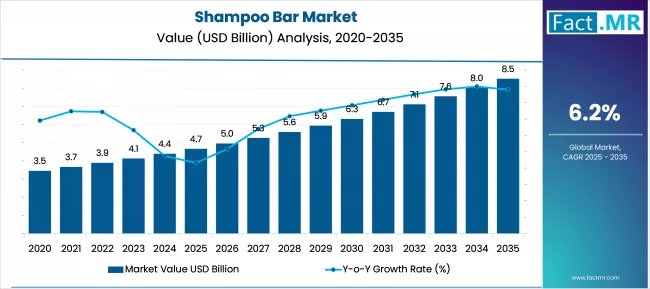
Shampoo Bar Market Market Value Analysis | Source: Fact.MR
What are the key factors driving growth in the Shampoo Bars Market?
The major market forces of the shampoo bar segment are the rising environmental issues of plastic waste and the increased demand of natural and chemical-free haircare products as well as the increased interest of consumers in compact and travel-friendly packaging. The wellness movement is also increasing the request of clean-label, cruelty-free, and vegan substitutes.
Innovation and its implementation are also being expedited with the help of global regulations on plastic reduction and sustainable packaging. Increased enlightenment in the younger age groups and the development of online stores are making shampoo bars more available, generating a robust trend in the developed and the emerging markets.
What are the key trends driving growth in the Shampoo Bars market?
The use of biodegradable packaging, focus on vegan and cruelty-free ingredients, and the emergence of herbal and ayurveda-inspired versions can be regarded as significant trends of the shampoo bar market. Brands are targeting multifunctional bars with the cleansing, conditioning and scalp care in a single product. Just in Time seasonal releases and customized selections are on the upswing.
The industry is also being influenced by digital-first marketing, influencer-based marketing, and robust e-commerce. Shampoo bars are taking center stage in sustainable beauty innovations as the waterless beauty is being integrated into the mainstream personal care portfolio.
What factors hinder the growth of the Shampoo Bars market?
The market competition includes the restraints of consumer skepticism in terms of performance as compared to liquid shampoos, low awareness in rural and emerging markets, and greater initial price of high-quality formulation. Other users note time of adjustment especially when using natural or sulfate free bars.
Product stability can be compromised by shelf-life issues, and problems with storage in damp climates. Besides, there are adoption barriers of competition by traditional liquid shampoos supported by a massive marketing campaign and existing consumption patterns. The solution to these restraints is consumer education, low cost policies, and increase in retail access.
What are the key regional trends driving the Shampoo Bars Market growth?
North America
North America has a growing market in the shampoo bar with the consumers showing a strong interest in plastic-free personal care that is environmentally friendly. Major brands focus on vegan, sulfate-free, and bio-degradable formula. The extensive e-commerce, sustainable retailing channels, and increasing awareness of zero-waste contribute to extensive adoption throughout the region.
East Asia
The shampoo bar market in East Asia continues to perform well on the basis of urban demand, sustainability trend, and plastic reduction policy by the government. Local brands focus on natural, cheap bars whereas international players focus on high-end customers. The fast penetration of e-commerce and the high level of eco-conscience of the youth makes the region a rapidly developing center.
Western Europe
The western Europe is the pioneer in the use of shampoo bar because of the level of environmental consciousness and regulation on packaging. Customers prefer organic, cruelty free and artisan bars. Well-established beauty brands, zero-waste shops, and luxurious personal care products are also on the frontline expanding portfolios, solidifying the position of the region as a sustainability leader.
Country-wise Outlook
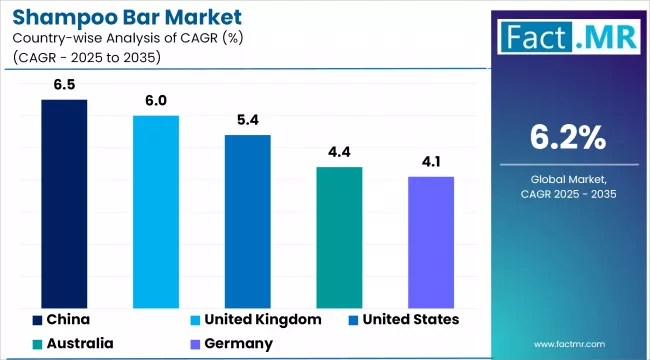
Shampoo Bar Market Cagr Analysis By Country | Source: Fact.MR
Sustainability and Ethical Choices Drive the United States’ Shampoo Bars Market
The market of the U.S. shampoo bars is growing because consumers are drawn to the idea of the environmentally friendly and zero-waste products in terms of bottled shampoos. Plant-based and plastic-free packaging, as well as ethical sourcing, appeal to health-aware consumers. It is found that established personal care brands and even indie stars are using e-commerce and specialty retail channels to market sustainable solutions.
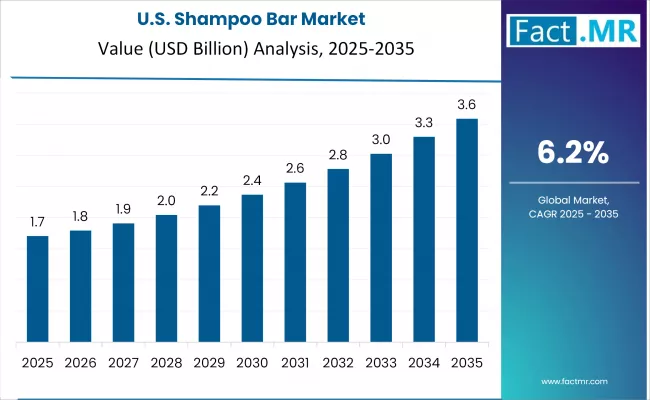
Shampoo Bar Market Country Value Analysis | Source: Fact.MR
The increased demand of products in travelable forms and the increased awareness of environmental effects makes the U.S. a major trendsetter in the global shampoo bars industry in terms of innovation and product development.
Natural Beauty and Zero-Waste Living Propel the United Kingdom’s Shampoo Bars Market
The market of shampoo bars is booming in the United Kingdom where sustainability-conscious people turn to solid solutions in haircare. Much organic, cruelty-free, and plastic-free formulation is being introduced by local and international brands, which conform to the countrywide strong movement of zero-waste.
The growth is accelerating owing to high urban adoption rates, strong retail penetration and involvement in ethical consumerism. The UK market is unique in its fusion of tradition and innovation, with natural ingredients and handicraft-style formulations and scalable and environmentally friendly commercial products that satisfy mainstream levels of personal care.
Engineering Expertise and Green Consumerism Elevate Germany’s Shampoo Bars Market
The market of the shampoo bars in Germany is also developing dynamically because Germany is one of the countries that greatly attaches importance to the segment of personal care based on natural products that are also environmentally friendly and of high quality. The chemical-free, vegan, and biodegradable haircare, which are backed by stringent regulatory measures of product safety and packaging waste, are valued by the consumers.
Sulfate-free and organic bars are being launched by domestic firms and European brands which attract the environmentally conscious homes. Having one of the most developed retail infrastructures and increasing number of consumers who are eco-conscious, Germany remains a key source of innovation and shift towards shampoo bars both domestically and internationally.
Category-Wise Market Outlook
Moisturizing Bars Gain Momentum with Hydration and Daily Use Appeal
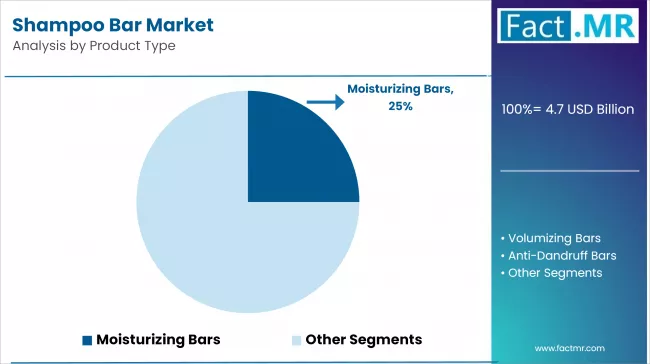
Shampoo Bar Market Analysis By Product Type | Source: Fact.MR
Moisturizing bars is the sub-segment that is expanding to conquer the dominant portion of the product type category because consumers want hydration-oriented haircare to use on a daily basis. The bars are suitable to a variety of hair and weather conditions, providing nourishing oils and butters that keep hair dry. Their wide-ranging popularity in the personal and hospitality marketplaces makes them a generalist solution to the increasingly emerging shampoo bar market.
Vegan and Cruelty-Free Formulations Accelerate with Ethical Consumerism
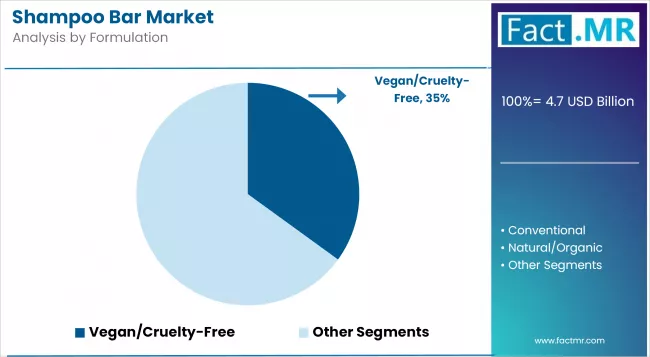
Shampoo Bar Market Analysis By Formulation | Source: Fact.MR
Vegan and Cruelty-Free shampoo bars are one of the formulations whose popularity is increasing since people are paying more attention to ethical and animal-free and plant-based products. These recipes are sustainable and wellness-related and are also an answer to the growing worldwide concern on animal welfare. They are particularly trendy in younger and environmentally sensitive groups that are the forces behind eco-friendly products.
Reusable Tins Lead with Portability and Waste Reduction Benefits
Reusable tins and containers are rapidly growing in terms of packaging because they come with a combination of both durability, portability, and reusability. They do not just reduce single use waste, but provide value to ease travel and storage. Brands that use this sustainable packaging solution build stronger consumer confidence and comply with the rising regulations that encourage a circular economy.
Competitive Analysis
Competitive Outlook: Shampoo Bars Market
The leading businesses, such as Ethique, Lush Cosmetics, J.R. Liggett, HiBAR, Chagrin Valley Soap and Salve, and The Earthling Co., influence the Shampoo Bars Market because they continue to develop sustainable innovation. These gamers are aimed at green formulations, no plastics, vegan or cruelty-free options to appeal to conscious consumers. Their compostable packing time, focused formula and waterless haircare innovation makes them the pioneers of what convenience and sustainability means in the personal care sector.
Meanwhile, competitive niches are being discovered by new and niche companies like Aadhunik Ayurveda, Biocrown Biotechnology, Poleview Biotechnology, Rustic Art, Naples Soap Company, Viori, Sabunaria, Bare Necessities, Prezerve. They tap into the appeal of ethically conscious and culturally inspired formulations, by targeting natural ingredients, ethical sourcing, small-batches craftsmanship, and capturing loyal and environmentally conscious consumers.
Basing the brand on wellness, community-related values, and artisanal are the means through which such businesses can enhance the presence of shampoo bars, on a global scale, to ensure that the latter product category is accepted as a lifestyle, as well as a sustainable haircare innovation.
Key players in the Shampoo Bars market are Ethique, Lush Cosmetics, J.R. Liggett’s, HiBAR, Chagrin Valley Soap & Salve, The Earthling Co., Aadhunik Ayurveda, Biocrown Biotechnology Co., Ltd., Poleview Biotechnology Co., Ltd., Rustic Art, Naples Soap Company, Viori, Sabunaria, Bare Necessities, Prezerve.
Recent Development:
- In 2025, The Natural Spa Soaps & More introduced the BlueBell Classic Shampoo Bar, a handcrafted, limited-edition bar infused with Alkanet Root, scented with Lavender and Ylang Ylang essential oils. Designed for all hair types, it offers a seasonal, artisan option emphasizing natural ingredients and aesthetic appeal.
- In April 2024, Aveda launched a limited-edition Shampure Nurturing Shampoo Bar, in partnership with charity: water. The bar is vegan, sulphate-free, silicone-free, housed in zero-plastic packaging made from 100 % post-consumer recycled fibre, aiming to provide long-lasting nourishment while contributing to clean water projects in developing countries.
Fact.MR has provided detailed information about the price points of key manufacturers of Shampoo Bars market positioned across regions, sales growth, production capacity, and speculative technological expansion, in the recently published report.
Methodology and Industry Tracking Approach
In the study of the Shampoo Bar Market by Fact.MR in 2025, more than 10,000 participants took part in the survey in 30 countries with a minimum of 250 in each country. Consumers, such as retail buyers, hospitality providers and personal care users, made up nearly two-thirds and the other third consisted of industry professionals such as formulation experts, packaging technologists, supply chain managers and sustainability specialists.
The information gathered in June 2024-May 2025 was dedicated to the changes in adoption, green technologies, changing consumer preferences, governmental shifts, and innovation investments. Over 250 secondary sources such as patents, product launches, sustainability reports and policy frameworks were also examined with trend forecasting and enhanced cluster modelling.
Since 2018, Fact.MR has been monitoring consumer trends, sustainable packaging, innovation of ingredients, and retail change in Shampoo Bar segment. This historical competence has endowed the report to become a reliable source of information to the interested parties and is able to make sound advice towards strategic planning and informed business decisions related to the expanding market.
Segmentation
Segmentation of Shampoo Bars Market Research
-
By Product Type :
- Moisturizing Bars
- Volumizing Bars
- Anti-Dandruff Bars
- Color-Protect Bars
- Medicated/Functional Bars
- All-in-One Bars
-
By Formulation :
- Conventional
- Natural/Organic
- Vegan/Cruelty-Free
- Sulfate & Paraben-Free
- Herbal/Ayurvedic
-
By Packaging Type :
- Paper Wraps
- Cardboard Boxes
- Reusable Tins/Containers
- Compostable Films
-
By Distribution Channel :
- Supermarkets & Hypermarkets
- Specialty Stores
- Online/E-commerce
- Pharmacies & Drugstores
- Direct-to-Consumer (D2C)
-
By Region :
- North America
- Latin America
- Western Europe
- Eastern Europe
- East Asia
- South Asia & Pacific
- Middle East & Africa
Frequently Asked Questions
What was the Global Shampoo Bars Market Size Reported by Fact.MR for 2025?
Who are the Major Players Operating in the Shampoo Bars Market?
What is the Estimated Valuation of the Shampoo Bars Market in 2035?
What Value CAGR did the Shampoo Bars Market Exhibit Over the Last Five Years?
Who worked on this report


Preview the report firsthand - request a free sample
Free SampleGet the brochure for pricing and purchase details
Download PDF