- Market Value (2025): USD 40.5 Bn
- Estimated Value (2026): USD 42.8 Bn
- Forecast Value (2036): USD 73.8 Bn
- CAGR (2026-2036): 5.6%
What is the Hair Styling Tools Market forecast to be worth by 2036?
USD 42.8 billion in 2026 to USD 73.8 billion by 2036 at 5.6% CAGR.
- The hair styling tools market reached USD 40.5 billion in 2025.
- Demand is projected to increase from USD 42.8 billion in 2026 to USD 73.8 billion by 2036.
- The market is forecast to record 5.6% CAGR from 2026 to 2036 owing to repeat personal-use purchases, salon replacement demand, and wider access through offline and online channels.
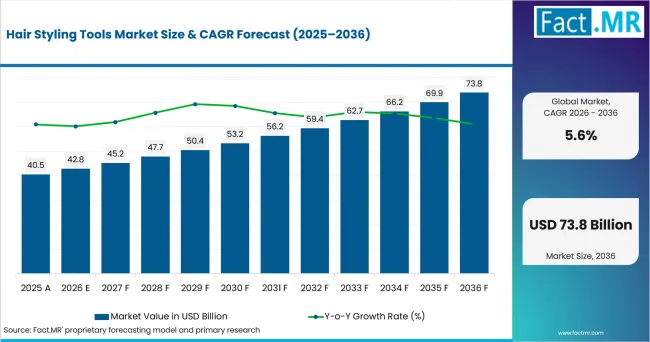
Hair Styling Tools Market Value Analysis | Source: Fact.MR
What are the defining numbers behind Hair Styling Tools Market growth?
USD 31.0 billion absolute opportunity is expected by 2036.
- Demand Drivers in the Market
- Hair dryers remain the primary entry product because buyers understand the use case and compare drying speed, heat safety, and attachment value before purchasing.
- Personal use remains the main application because households replace styling tools around grooming routines, gifting occasions, and convenience-led beauty spending.
- Offline retail keeps influence where shoppers want to compare weight, grip, noise, and heat settings before paying for a device.
- Key Segments Analyzed
- By Product Type: Hair Dryers are projected to hold 37.7% share in 2026 because they solve the broadest repeat-use need across households and salons.
- By Application: Personal Use is expected to account for 29.7% share in 2026 as grooming routines shift more styling activity into the home.
- By End User: Individual Consumers are anticipated to capture 31.6% share in 2026 due to frequent replacement and gifting demand across gender and age groups.
- By Distribution Channel: Offline Retail is estimated to represent 30.4% share in 2026 because shoppers still value in-store comparison for appliance weight and handling.
- By Technology: Ceramic Technology is forecast to hold 43.6% share in 2026 as brands position controlled heat as a safer everyday styling feature.
- Analyst Opinion at Fact.MR
- Shambhu Nath Jha, Principal Consultant at Fact.MR, states, “Hair styling tools compete on trust as much as performance. Brands that prove heat control, device safety, and practical styling value are expected to gain stronger repeat demand than brands that compete only through discounts.”
- Strategic Implications
- Retailers should arrange assortments around daily styling jobs rather than only price tiers.
- Manufacturers need to connect product claims with visible use benefits.
- Investors should separate premium multi-styler demand from basic replacement demand.
Brazil is expected at 4.5% CAGR from 2026 to 2036. The USA is projected at 7.3%, Australia at 3.9%, Japan at 6.7%, Germany at 6.1%, the UK at 5.6%, and Canada at 5.0%. This spread shows why channel depth and service coverage matter alongside product demand.
How does the Hair Styling Tools Market break down by segment?
Hair Dryers are expected to lead Product Type at 37.7% share in 2026. Personal Use is projected to lead Application at 29.7% share in 2026.
Which product type dominates?
Hair Dryers are projected to account for 37.7% share in 2026.
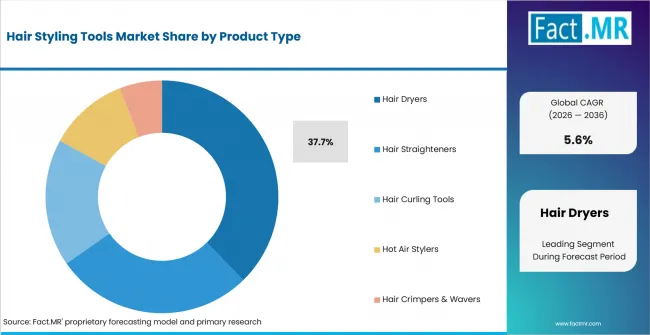
Hair Styling Tools Market Analysis By Product Type | Source: Fact.MR
Hair dryers lead because they address everyday drying needs across homes, hotels, stylists, and salons. Ionic and ceramic dryers remain important when frizz control and softer heat positioning influence selection. Straighteners, curlers, hot air stylers, and multi-stylers serve buyers seeking a more specialized finish.
Why does Personal Use lead Application?
Personal Use is expected to hold 29.7% share in 2026.
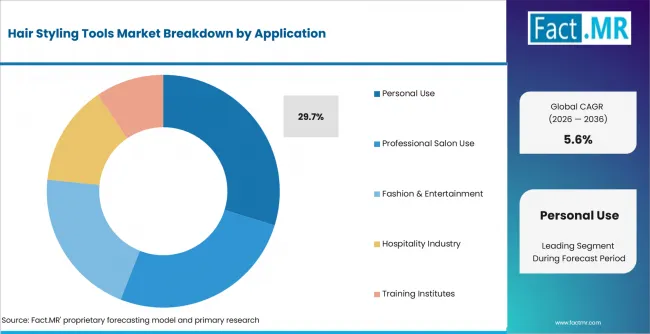
Hair Styling Tools Market Analysis By Application | Source: Fact.MR
Personal use leads because households buy tools for daily grooming, occasional styling, and gifting. Home styling and daily grooming remain close use cases. Salon, hospitality, entertainment, and training demand depends on heavier use and presentation-led needs.
What supports Individual Consumers within End User?
Individual Consumers are anticipated to represent 31.6% share in 2026.
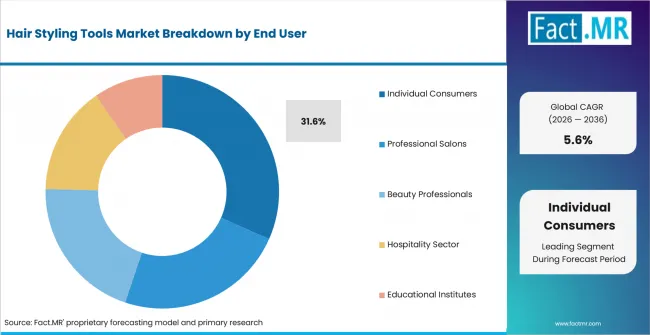
Hair Styling Tools Market Analysis By End User | Source: Fact.MR
Individual consumers lead because the category is tied to routine household ownership. Men and women compare shape, heat setting, finish, and price before buying. Salons, beauty professionals, hotels, and schools create steadier but more planned demand.
What supports Offline Retail within Distribution Channel?
Offline Retail is estimated to account for 30.4% share in 2026.
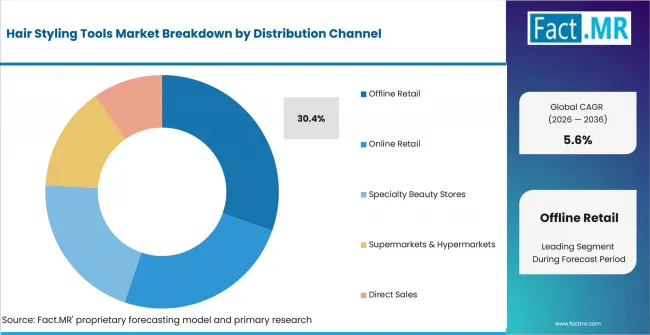
Hair Styling Tools Market Analysis By Distribution Channel | Source: Fact.MR
Offline retail leads because shoppers often handle hair styling tools before purchase. Stores help compare grip, weight, and accessories. Online retail and brand websites gain attention when shoppers already know the model and want faster fulfillment.
How does Ceramic Technology shape demand?
Ceramic Technology is forecast to hold 43.6% share in 2026.
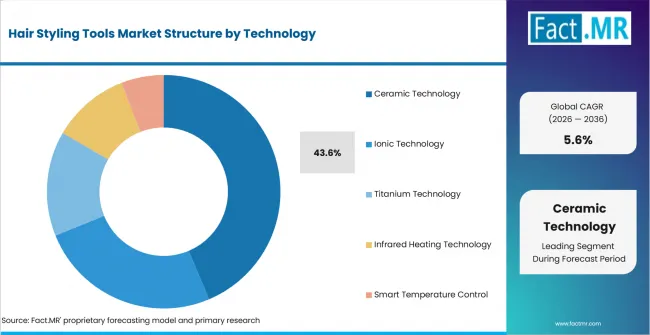
Hair Styling Tools Market Analysis By Technology | Source: Fact.MR
Ceramic technology leads because heat distribution is easy to explain at shelf. Ceramic plates and coatings remain common in straighteners and brushes. Ionic, titanium, infrared, and sensor-led controls appeal to buyers comparing finish quality and hair protection.
What is accelerating Hair Styling Tools Market adoption, and what is holding it back?
Demand is expected to rise through regular personal styling and product replacement. High prices, safety checks and private-label competition may slow adoption.
Drivers Impact Analysis
| DRIVER | (~) % IMPACT ON CAGR | GEOGRAPHIC RELEVANCE | IMPACT TIMELINE |
|---|---|---|---|
| Hair dryer replacement demand | +1.4% | Brazil, USA | Short term (<= 2 years) |
| Personal-use styling routines | +1.1% | USA, UK, Japan | Short term (<= 2 years) |
| Omnichannel retail reach | +0.9% | Brazil, Australia, Germany | Medium term (2-4 years) |
| Ceramic and ionic feature positioning | +0.7% | Japan, USA, Germany | Medium term (2-4 years) |
| Salon and beauty-service replacement | +0.5% | USA, UK, Australia | Long term (>= 4 years) |
Source: Fact.MR analysis. Updated Jul 31, 2026
- Hair dryer replacement demand: Replacement cycles are expected to keep hair dryers central because shoppers see them as basic grooming devices rather than discretionary accessories.
- Personal-use styling routines: Home styling routines are projected to favor tools that shorten grooming time and reduce the need for frequent salon visits.
- Omnichannel retail reach: Retail reach is expected to widen product discovery when shoppers compare prices online and complete purchases through stores or brand websites.
Opportunity Impact Analysis
| OPPORTUNITY | (~) % IMPACT ON CAGR | GEOGRAPHIC RELEVANCE | IMPACT TIMELINE |
|---|---|---|---|
| Multi-styler bundles | +0.8% | USA and UK | Medium term (2-4 years) |
| Premium personal-use devices | +0.7% | Japan and Germany | Medium term (2-4 years) |
| Salon-grade home formats | +0.5% | Australia and USA | Long term (>= 4 years) |
| Travel and compact devices | +0.4% | Japan, UK, Canada | Long term (>= 4 years) |
Source: Fact.MR analysis. Updated Jul 31, 2026
- Multi-styler bundles: Bundled dryers, brushes, and curling attachments are expected to improve basket value where shoppers want one device for several looks.
- Premium personal-use devices: Premium beauty demand is expected to favor tools that combine better heat control with a more comfortable styling experience.
- Salon-grade home formats: Home users are expected to trade up when brands explain how professional airflow, heat stability, and attachments improve daily results.
Restraints Impact Analysis
| RESTRAINT | (~) % IMPACT ON CAGR | GEOGRAPHIC RELEVANCE | IMPACT TIMELINE |
|---|---|---|---|
| Private-label price pressure | -0.8% | Global | Short term (<= 2 years) |
| Safety and compliance concerns | -0.6% | USA and Europe | Short term (<= 2 years) |
| Shorter product fashion cycles | -0.5% | Premium channels | Medium term (2-4 years) |
| Service and warranty friction | -0.4% | Brazil, Australia, Canada | Long term (>= 4 years) |
Source: Fact.MR analysis. Updated Jul 31, 2026
- Private-label price pressure: Lower-priced alternatives are expected to make branded tools work harder to justify claims around heat control and durability.
- Safety and compliance concerns: Electrical safety review is expected to remain important because weak device protection damages retailer confidence and raises recall risk.
- Shorter product fashion cycles: Design-led products are expected to lose shelf appeal quickly when colors, attachment sets, or influencer-led preferences change.
Which countries are scaling Hair Styling Tools Market fastest?
- Brazil leads the country comparison, followed by the USA, supported by wider distribution, premium products and replacement demand.
- Australia and Japan remain in the middle, where service access, compact design and quality checks influence purchases. Germany and the UK show steadier growth as buyers focus on durability, warranties and retail value.
- Canada records the lowest CAGR because limited service coverage outside major cities restricts wider product adoption and replacement sales.
Comparable CAGRs do not always mean similar entry conditions. Market readiness depends on channel depth, service coverage, price discipline, and simple product communication.
The full report provides country-level CAGR analysis across North America, Latin America, Europe, East Asia, South Asia and Oceania, and the Middle East and Africa.
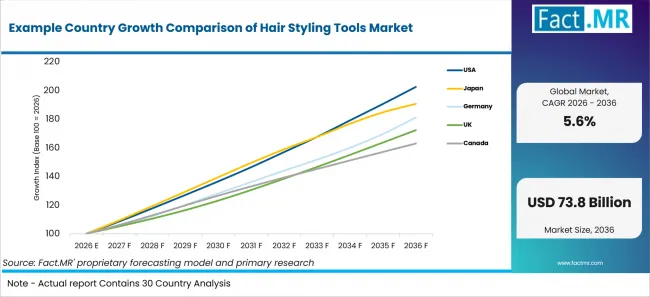
Example Country Growth Comparison Of Hair Styling Tools Market | Source: Fact.MR
| COUNTRY | CAGR (2026-2036) |
|---|---|
| Brazil | 4.5% |
| USA | 7.3% |
| Australia | 3.9% |
| Japan | 6.7% |
| Germany | 6.1% |
| UK | 5.6% |
| Canada | 5.0% |
Source: Fact.MR analysis. Updated Jul 31, 2026
What supports Brazil adoption?
6.1% CAGR, supported by distributor access and wider personal-care retail participation.
Brazil’s growth reflects a market where availability and retail presence affect purchase confidence. Brands are expected to gain through accessible pricing and reliable after-sales support.
How is the USA scaling demand?
5.8% CAGR, driven by replacement demand and premium personal-use devices.
The USA’s growth is tied to household replacement demand. Retailers are expected to favor tools with clear heat protection, easy handling, warranty confidence, and review strength.
What is driving Australia’s growth from 2026 to 2036?
5.4% CAGR, backed by omnichannel access and salon replacement demand.
Australia’s growth reflects a market where availability and service coverage shape brand choice. Salon and freelance demand adds support for dependable daily-use tools.
How does Japan perform?
5.2% CAGR, led by compact device preference and quality-led purchase behavior.
Japan’s growth is shaped by compact design, controlled heat, and reliable finish quality. Retail conversion is likely to depend on clear demonstration.
What supports Germany’s growth?
5.1% CAGR, supported by appliance quality expectations and structured retail comparison.
Germany’s growth reflects buyer focus on durability, energy use, and warranty terms. Clear safety information and dependable service are expected to strengthen retailer confidence.
How is the UK developing demand?
5.0% CAGR, driven by replacement purchases and beauty retail activity.
The UK’s growth is supported by beauty retail activity and replacement purchases. Buyers compare styling tools around value, trust, and ease of use.
What supports Canada’s growth?
4.9% CAGR, backed by household replacement needs and channel coverage across major cities.
Canada’s growth reflects a market where broad geography makes service coverage and retail availability more important. Clear warranty support is likely to improve repeat purchase confidence.
Who leads the Hair Styling Tools Market?
Dyson shows the premium technology position, while Conair LLC remains relevant in mass and mid-tier hair dryer assortments.
Panasonic Corporation and Koninklijke Philips N.V. compete through established appliance portfolios. SharkNinja has gained visibility through multi-styler formats, and Helen of Troy supports the field through Hot Tools. Wella Company, through ghd remains linked with premium salon demand.
From 2026 to 2036, competition is expected to depend on heat-control claims, attachment ecosystems, safety record, retail execution, and after-sales support. Providers that give shoppers a clear upgrade reason are expected to gain stronger demand.
Which companies are the key providers?
Key companies include Dyson, Conair LLC, Panasonic Corporation, Koninklijke Philips N.V., SharkNinja, Helen of Troy Limited, and Wella Company, through ghd.
- Dyson
- Conair LLC
- Panasonic Corporation
- Koninklijke Philips N.V.
- SharkNinja
- Helen of Troy Limited
- Wella Company, through ghd
Bibliography
- U.S. Census Bureau. (2026, May 18). Quarterly retail e-commerce sales: 1st quarter 2026.
- Office for Product Safety and Standards. (2024, April 5). Product recall: OOOOO hairdryer sold by TK Maxx (2403-0222). GOV.UK.
- Australian Bureau of Statistics. (2025, February 3). Retail trade, Australia, December 2024.
- Dyson. (2024, March 18). Introducing the Dyson Supersonic Nural hair dryer, Dyson’s most intelligent hair dryer for healthy scalp and hair.
This Report Answers
- The report provides strategic intelligence on Product Type and Application choices that shape personal-care appliance purchases.
- Segment analysis covers Hair Dryers and Personal Use as the share leaders within the 2026 market structure.
- Country outlook evaluates Brazil and the USA alongside Australia, Japan, Germany, the UK, and Canada.
- Competitive analysis profiles Dyson, Conair LLC, Panasonic Corporation, Koninklijke Philips N.V., SharkNinja, Helen of Troy, and Wella Company, through ghd.
- Technology assessment covers Ceramic Technology and Ionic Technology alongside Smart Temperature Control and infrared heating.
What does the Hair Styling Tools Market cover?
Hair styling tools cover powered devices used to dry, straighten, curl, wave, crimp, smooth, and shape hair.
The market covers dryers, straighteners, curlers, hot air stylers, brushes, multi-stylers, crimpers, and wavers across home, salon, hospitality, training, and retail channels. The market differs from hair care formulations because value comes from device performance. Consumables and manual grooming items remain outside the boundary unless bundled with a powered device.
What is included in the scope?
Hair styling tools are used across individual consumers, salons, beauty professionals, hospitality locations, and training institutes.
The scope includes Product Type, Application, End User, Distribution Channel, Technology, and Region. Demand is counted when the purchase is directly tied to powered hair styling.
What is excluded from the scope?
Hair care consumables and unrelated beauty tools remain outside the scope of this market.
The scope excludes cosmetics, consumables, manual combs, manual brushes, and unrelated beauty accessories unless they are part of a powered styling device.
How Was the Analysis Built?
The analysis draws on 120+ sources, 35+ company portfolios, 25+ countries, and more than 20 interviews.
- Primary Research: Interviews with manufacturers, retailers, salon operators, and experts examine purchase priorities, adoption, approval requirements, and competitive positioning.
- Desk Research: Desk research covers government statistics, regulatory publications, company filings, trade data, technical studies, industry associations, standards, and public policy.
- Market Sizing and Forecasting: Estimates combine historical performance, demand indicators, pricing, segment shares, company participation, country growth, adoption patterns, and barriers to expansion.
- Data Validation and Update Cycle: Findings are validated against public data, company activity, regulatory changes, product launches, recalls, and adoption shifts.
Segmentation
What is the report’s scope and coverage?
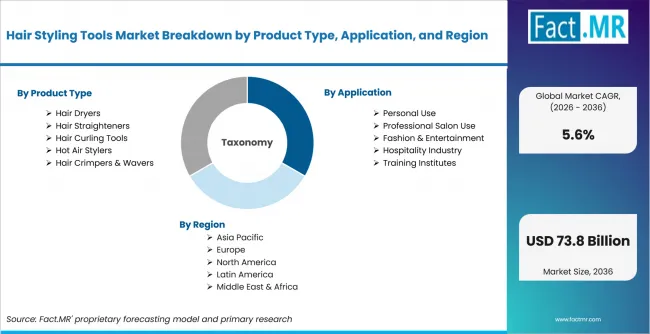
Hair Styling Tools Market Breakdown By Product Type, Application, And Region | Source: Fact.MR
| ATTRIBUTE | DETAILS |
|---|---|
| Quantitative Units | USD billion in 2026 to USD billion by 2036 at CAGR |
| Market Definition | Powered and heat-based tools used to dry, straighten, curl, wave, crimp, smooth, and shape hair. |
| Product Type | Hair Dryers; Hair Straighteners; Hair Curling Tools; Hot Air Stylers; Multi-Stylers; Hair Crimpers & Wavers. |
| Application | Personal Use; Professional Salon Use; Fashion & Entertainment; Hospitality Industry; Training Institutes. |
| End User | Individual Consumers; Professional Salons; Beauty Professionals; Hospitality Sector; Educational Institutes. |
| Distribution Channel | Offline Retail; Online Retail; Specialty Beauty Stores; Supermarkets & Hypermarkets; Direct Sales. |
| Technology | Ceramic Technology; Ionic Technology; Titanium Technology; Infrared Heating Technology; Smart Temperature Control. |
| Regions Covered | North America; Latin America; Europe; East Asia; South Asia and Oceania; Middle East and Africa |
| Countries Covered | Brazil; USA; Australia; Japan; Germany; UK; Canada |
| Key Companies Profiled | Dyson; Conair LLC; Panasonic Corporation; Koninklijke Philips N.V.; SharkNinja; Helen of Troy Limited; Wella Company, through ghd |
| Forecast Period | 2026 to 2036 |
| Approach | Hybrid top-down and bottom-up assessment using demand indicators, segment mix, country growth, company participation and public evidence relevant to the category. |
Source: Fact.MR analysis. Updated Jul 31, 2026
How is the market segmented?
-
By Product Type
- Hair Dryers
- Ionic Hair Dryers
- Ceramic Hair Dryers
- Hair Straighteners
- Ceramic Straighteners
- Titanium Straighteners
- Hair Curling Tools
- Curling Irons
- Curling Wands
- Hot Air Stylers
- Brush Stylers
- Multi-Stylers
- Hair Crimpers & Wavers
- Crimping Irons
- Deep Wavers
- Hair Dryers
-
By Application
- Personal Use
- Home Styling
- Daily Grooming
- Professional Salon Use
- Hair Salons
- Beauty Studios
- Fashion & Entertainment
- Fashion Shows
- Film & Television
- Hospitality Industry
- Hotels
- Spas
- Training Institutes
- Cosmetology Schools
- Beauty Academies
- Personal Use
-
By End User
- Individual Consumers
- Men
- Women
- Professional Salons
- Full-Service Salons
- Premium Salons
- Beauty Professionals
- Freelance Stylists
- Bridal Stylists
- Hospitality Sector
- Hotel Spas
- Wellness Centers
- Educational Institutes
- Beauty Schools
- Training Centers
- Individual Consumers
-
By Distribution Channel
- Offline Retail
- Electronics Stores
- Department Stores
- Online Retail
- E-commerce Marketplaces
- Brand Websites
- Specialty Beauty Stores
- Beauty Retail Chains
- Professional Beauty Supply Stores
- Supermarkets & Hypermarkets
- Hypermarkets
- Supermarkets
- Direct Sales
- B2B Sales
- Salon Equipment Suppliers
- Offline Retail
-
By Technology
- Ceramic Technology
- Ceramic Plates
- Ceramic Coating
- Ionic Technology
- Negative Ion Generation
- Friz Control Systems
- Titanium Technology
- Titanium Plates
- Titanium Barrels
- Infrared Heating Technology
- Infrared Heating Elements
- Uniform Heat Distribution
- Smart Temperature Control
- Automatic Heat Sensors
- AI Temperature Regulation
- Ceramic Technology
-
By Region
- North America
- Latin America
- Europe
- East Asia
- South Asia and Oceania
- Middle East and Africa
Frequently Asked Questions
Which Product Type leads the market?
Which Application leads the market?
Which End User leads the market?
Which Distribution Channel leads the market?
Which Technology leads the market?
Which country records the highest listed CAGR?
What is the primary driver in this market?
What is the main restraint?
Who worked on this report


Preview the report firsthand - request a free sample
Free SampleGet the brochure for pricing and purchase details
Download PDF