OTC Heartburn Drugs Market

OTC Heartburn Drugs Market Size and Share Forecast Outlook 2026 to 2036

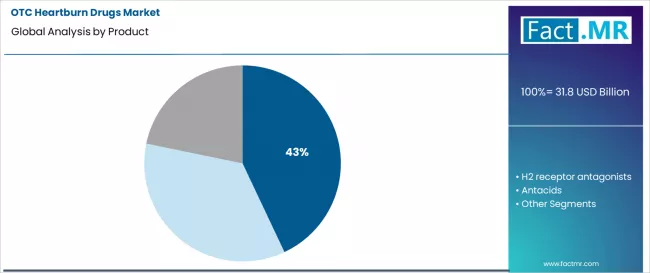
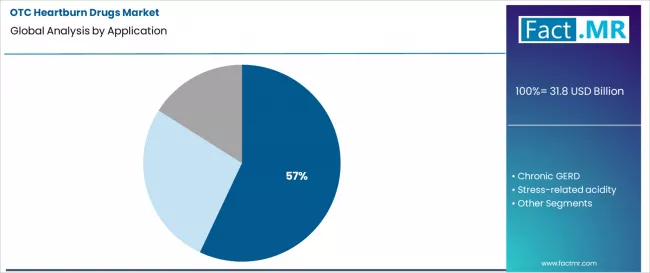
OTC heartburn drugs market is projected to grow from USD 31.8 billion in 2026 to USD 49.0 billion by 2036, at a CAGR of 4.4%. Proton pump inhibitors will dominate with a 43.0% market share, while occasional heartburn will lead the application segment with a 57.0% share.

OTC Heartburn Drugs Market Forecast and Outlook 2026 to 2036

The global OTC heartburn drugs market is projected to total USD 31.83 billion in 2026, advancing to USD 48.96 billion by 2036, achieving a compound annual growth rate of 4.4%. This steady expansion is anchored in the persistent and widespread prevalence of GERD and related acid-related disorders across global populations.

Key Takeaways from the OTC Heartburn Drugs Market

  • Market Value for 2026: USD 31.83 Billion
  • Market Value for 2036: USD 48.96 Billion
  • Forecast CAGR 2026 to 2036: 4.4%
  • Leading Product Segment (2026): Proton pump inhibitors (43.0%)
  • Leading Application Segment (2026): Occasional heartburn (57.0%)
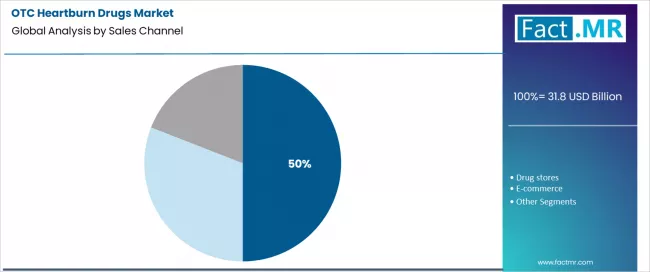
  • Leading Sales Channel Segment (2026): Retail pharmacies (50.0%)
  • Key Growth Countries: India (10.1% CAGR), China (9.9% CAGR), USA (5.6% CAGR), UK (4.5% CAGR), Germany (4.4% CAGR), France (4.3% CAGR)
  • Key Players in the Market: Pfizer Inc., Bayer AG, GSK, Johnson & Johnson, Sanofi S.A., Others
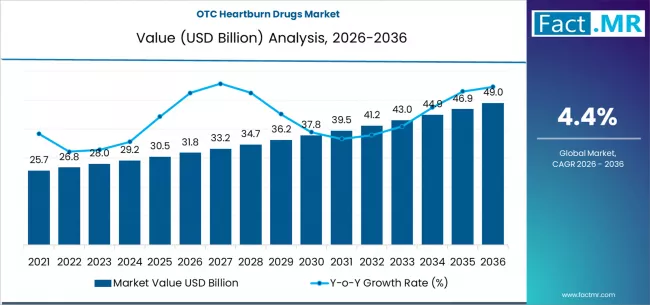
Otc Heartburn Drugs Market Market Value Analysis

Progress will likely lean on consumer trends favoring self-medication for common, recurrent conditions, supported by the widespread availability, proven efficacy, and perceived safety of well-established drug classes. The transition of key prescription drugs to OTC status has been a pivotal catalyst, empowering consumers to manage chronic symptoms directly through retail channels without necessitating a physician visit for each recurrence.

Growth is characterized by the sustained dominance of proton pump inhibitors as the product of choice for effective and lasting acid suppression, particularly for frequent symptoms. The application for occasional heartburn represents the largest consumer base, driving volume sales through convenient retail and e-commerce platforms. Expansion is likely to be most dynamic in high-growth economies with rapidly urbanizing populations, changing dietary habits, and increasing health expenditure.

Mature markets exhibit stable demand underpinned by high consumer awareness, strong brand loyalty, and continuous product innovation in delivery formats and combination therapies. The evolution of this market reflects the deepening integration of OTC pharmaceuticals into daily consumer health management, where accessibility, brand trust, and clear labeling are paramount for sustained commercial success.

Metric

Metric Value
Market Value (2026) USD 31.83 Billion
Market Forecast Value (2036) USD 48.96 Billion
Forecast CAGR 2026 to 2036 4.4%

Category

Category Segments
Product Proton pump inhibitors, H2 receptor antagonists, Antacids
Application Occasional heartburn, Chronic GERD, Stress-related acidity
Sales Channel Retail pharmacies, Drug stores, E-commerce
Region North America, Latin America, Western Europe, Eastern Europe, East Asia, South Asia & Pacific, MEA

Segmental Analysis

By Product, Which Class Delivers Superior and Sustained Acid Control?
Otc Heartburn Drugs Market Analysis By Product

Proton pump inhibitors command a leading 43.0 percent share. This dominance is attributed to their mechanism of action, which provides the most potent and long-lasting suppression of gastric acid production.

Their efficacy in managing frequent heartburn and symptoms of GERD over a 24-hour period with a single dose has cemented their position as the first-choice OTC product for consumers seeking reliable, all-day relief, following the Rx-to-OTC switch of major brands.

By Application, Which Condition Captures the Largest Consumer Cohort?
Otc Heartburn Drugs Market Analysis By Application

Occasional heartburn constitutes the dominant application with a 57.0 percent share. This segment encompasses the vast majority of consumers who experience intermittent, diet- or lifestyle-induced symptoms.

The need for fast, accessible, and effective relief for these episodic occurrences drives high-volume, repeat purchases of OTC medications, making it the foundational volume driver for the entire market.

By Sales Channel, Which Point of Purchase Offers Maximum Convenience and Trust?
Otc Heartburn Drugs Market Analysis By Sales Channel

Retail pharmacies are the primary sales channel, holding a 50.0 percent share. These outlets combine immediate product accessibility with the perceived assurance of a healthcare setting, often having a pharmacist available for consultation.

The ability to instantly obtain relief, coupled with frequent promotions and prominent shelf placement, makes retail pharmacies the cornerstone of OTC heartburn drug distribution.

What are the Principal Drivers, Constraints, and Evolving Dynamics Influencing Growth of the OTC Heartburn Drugs Market?

Attribute Analysis
Growing Prevalence of GERD and Lifestyle-Related Acidity Prevalence of sedentary lifestyles, obesity, and poor dietary habits leading to rising incidence of acid reflux, directly fueling OTC drug demand.
Risk of Misuse and Delayed Diagnosis of Serious Conditions Prolonged self-medication without medical supervision can mask symptoms of more severe gastrointestinal disorders like Barrett’s esophagus or gastric ulcers.
Development of Fast-Acting and Longer-Duration Formulations Development of next-generation medicines combining rapid onset of antacids with the prolonged efficacy of PPIs, alongside improved delivery formats like orally disintegrating tablets.
Rapid Growth of Direct-to-Consumer E-commerce Channels The trend enhances market reach and convenience, allowing for subscription models, bulk purchases, and discrete home delivery, particularly appealing to chronic users and younger demographics.

Analysis of the OTC Heartburn Drugs Market by Key Countries
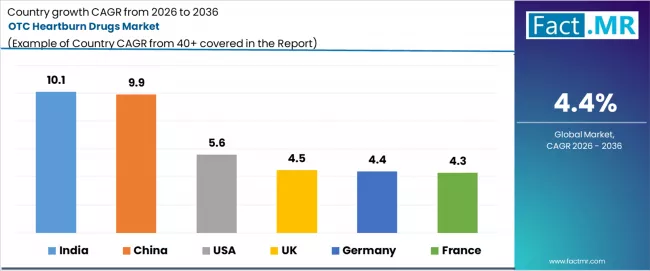
Otc Heartburn Drugs Market Cagr Analysis By Country

Country CAGR 2026 to 2036
India 10.1%
China 9.9%
USA 5.6%
UK 4.5%
Germany 4.4%
France 4.3%

What drives the USA's Mature Yet Substantial OTC Market?

The USA's 5.6% CAGR is propelled by one of the world's highest prevalences of GERD, high consumer awareness of OTC treatment options, and aggressive direct-to-consumer advertising by major pharmaceutical companies.

The market is characterized by fierce brand competition, frequent couponing, and strong penetration in mass merchandisers and club stores. Growth is sustained by brand loyalty, new product launches in the PPI category, and the widespread consumer habit of self-medication for common ailments.

How does Germany's Strict Self-Medication Guidelines Influence Market Dynamics?

Germany's 4.4% CAGR operates within a framework of strict regulations governing pharmacy-only (Apothekenpflichtig) OTC products. A significant portion of heartburn medication is sold through pharmacies, where pharmacist consultation is integral.

Growth is steady, driven by an aging population and trust in pharmacist advice, with the market favoring well-established, reliably dosed products over heavy mass-market advertising. The trend towards online pharmacies is also gaining traction within the regulated framework.

What Strategic Consumer Health Expansion Underpins France's Stable Market?

France's 4.3% CAGR is supported by a strong consumer health culture and a distribution network split between pharmacies and increasingly, para-pharmacy sections in supermarkets for certain products.

The market emphasizes quality and trusted brands, with growth driven by demographic factors and the availability of a range of products from quick-relief antacids to 14-day PPI courses, all within a highly regulated advertising environment.

How does the UK's Robust Retail Pharmacy and Grocery Channel Support Market Penetration?

The UK's 4.5% CAGR benefits from one of the most liberal OTC retail environments, where products are widely available not only in pharmacies but also on the shelves of major grocery chains and convenience stores.

This omnipresent accessibility drives impulse and routine purchases. Growth is fueled by strong private label competition, frequent promotional activity, and high consumer familiarity with major brands like Gaviscon and Nexium Control.

What Factors Underpin China's Rapid Market Expansion Amidst Dietary Shifts?

China's 9.9% CAGR is driven by the rapid westernization of diets, increasing stress, and a growing middle class with both the means and the awareness to self-treat digestive discomfort. The OTC market is expanding rapidly through both physical retail and dominant e-commerce platforms like Alibaba and JD.com.

Growth is characterized by the rising acceptance of self-care, the entry of multinational brands, and the development of local generic offerings, creating a highly dynamic competitive landscape.

How is India's Growth Trajectory Linked to Urbanization and Increasing Brand Awareness?

Accelerating urbanization, changing food habits, and a massive population experiencing rising incidences of acidity and GERD fuel India’s leading 10.1% CAGR. The expansion of modern retail and pharmaceutical chains is making branded OTC products more accessible beyond urban centers.

Growth is further propelled by aggressive marketing campaigns, the availability of low-cost generic antacids and H2 antagonists, and a growing tendency to seek instant relief for lifestyle-induced ailments.

Competitive Landscape of the OTC Heartburn Drugs Market
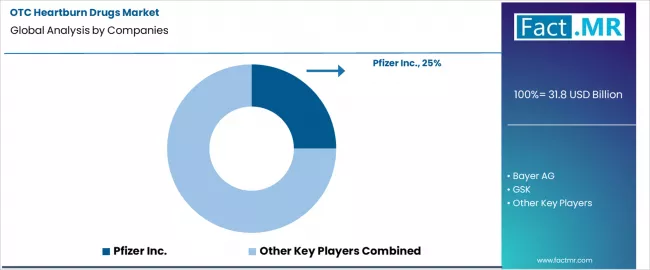
Otc Heartburn Drugs Market Analysis By Company

The competitive landscape is dominated by a handful of global consumer healthcare giants and large pharmaceutical corporations with extensive OTC portfolios. Competition is exceptionally intense and revolves around powerful brand equity, massive consumer marketing expenditures, and securing prime retail shelf space.

Success relies on dependent on maintaining top-of-mind awareness through television, digital, and print advertising that highlights brand differentiation, speed of relief, and duration of action. These companies invest significantly in consumer research to understand usage occasions and to develop targeted messaging for different demographics, from young adults with occasional heartburn to older populations managing chronic GERD.

Beyond marketing, competition extends to product innovation in delivery forms and in creating clear, consumer-friendly packaging and labeling. The threat of private label or store-brand products, which offer significant cost savings, is a constant pressure, pushing brand leaders to justify price premiums through perceived superior efficacy, trusted ingredients, or added benefits. The ability to manage complex, multi-channel supply chains that ensure product availability everywhere from hypermarkets to online marketplaces is also a critical competitive advantage in this fast-moving consumer health category.

Key Players in the OTC Heartburn Drugs Market

  • Pfizer Inc.
  • Bayer AG
  • GSK
  • Johnson & Johnson
  • Sanofi S.A.
  • Others

Scope of Report

Items Values
Quantitative Units USD Billion
Product Proton pump inhibitors, H2 receptor antagonists, Antacids
Application Occasional heartburn, Chronic GERD, Stress-related acidity
Sales Channel Retail pharmacies, Drug stores, E-commerce
Key Countries India, China, USA, UK, Germany, France
Key Companies Pfizer Inc., Bayer AG, GSK, Johnson & Johnson, Sanofi S.A., Others
Additional Analysis Comparative analysis of onset of action and duration of relief across product classes; study of consumer purchasing triggers and brand loyalty drivers; analysis of private label vs. branded market share dynamics; evaluation of regulatory pathways for Rx-to-OTC switches; assessment of digital marketing effectiveness and online sales penetration.

Market by Segments

  • Product :

    • Proton Pump Inhibitors
    • H2 Receptor Antagonists
    • Antacids
  • Application :

    • Occasional Heartburn
    • Chronic GERD
    • Stress-related Acidity
  • Sales Channel :

    • Retail Pharmacies
    • Drug Stores
    • E-commerce
  • Region :

    • North America
      • USA
      • Canada
    • Latin America
      • Brazil
      • Mexico
      • Argentina
      • Rest of Latin America
    • Western Europe
      • Germany
      • France
      • Italy
      • Spain
      • UK
      • BENELUX
      • Rest of Western Europe
    • Eastern Europe
      • Russia
      • Poland
      • Czech Republic
      • Rest of Eastern Europe
    • East Asia
      • China
      • Japan
      • South Korea
      • Rest of East Asia
    • South Asia & Pacific
      • India
      • ASEAN
      • Australia
      • Rest of South Asia & Pacific
    • MEA
      • GCC Countries
      • South Africa
      • Turkiye
      • Rest of MEA

References

  • American Gastroenterological Association. (2025). Guidelines on the management of gastroesophageal reflux disease. Gastroenterology.
  • Katz, P. O., & Dunbar, K. B. (2024). The over-the-counter use of proton pump inhibitors: Appropriate use and misuse. Alimentary Pharmacology & Therapeutics.
  • Mermelstein, J., & Chait, M. M. (2025). The evolving landscape of the OTC drug market for acid-related disorders. Journal of Clinical Gastroenterology.
  • Packaged Facts. (2024). Over-the-counter digestive remedies: The U.S. market. Market Research Report.
  • World Self-Medication Industry. (2025). The value of self-care: Reducing the burden on healthcare systems. WSMI Research Report.

Table of Content

  1. Executive Summary
    • Global Market Outlook
    • Demand to side Trends
    • Supply to side Trends
    • Technology Roadmap Analysis
    • Analysis and Recommendations
  2. Market Overview
    • Market Coverage / Taxonomy
    • Market Definition / Scope / Limitations
  3. Market Background
    • Market Dynamics
      • Drivers
      • Restraints
      • Opportunity
      • Trends
    • Scenario Forecast
      • Demand in Optimistic Scenario
      • Demand in Likely Scenario
      • Demand in Conservative Scenario
    • Opportunity Map Analysis
    • Product Life Cycle Analysis
    • Supply Chain Analysis
    • Investment Feasibility Matrix
    • Value Chain Analysis
    • PESTLE and Porter’s Analysis
    • Regulatory Landscape
    • Regional Parent Market Outlook
    • Production and Consumption Statistics
    • Import and Export Statistics
  4. Global Market Analysis 2021 to 2025 and Forecast, 2026 to 2036
    • Historical Market Size Value (USD Million) Analysis, 2021 to 2025
    • Current and Future Market Size Value (USD Million) Projections, 2026 to 2036
      • Y to o to Y Growth Trend Analysis
      • Absolute $ Opportunity Analysis
  5. Global Market Pricing Analysis 2021 to 2025 and Forecast 2026 to 2036
  6. Global Market Analysis 2021 to 2025 and Forecast 2026 to 2036, By Product
    • Introduction / Key Findings
    • Historical Market Size Value (USD Million) Analysis By Product, 2021 to 2025
    • Current and Future Market Size Value (USD Million) Analysis and Forecast By Product, 2026 to 2036
      • Proton pump inhibitors
      • H2 receptor antagonists
      • Antacids
    • Y to o to Y Growth Trend Analysis By Product, 2021 to 2025
    • Absolute $ Opportunity Analysis By Product, 2026 to 2036
  7. Global Market Analysis 2021 to 2025 and Forecast 2026 to 2036, By Application
    • Introduction / Key Findings
    • Historical Market Size Value (USD Million) Analysis By Application, 2021 to 2025
    • Current and Future Market Size Value (USD Million) Analysis and Forecast By Application, 2026 to 2036
      • Occasional heartburn
      • Chronic GERD
      • Stress-related acidity
    • Y to o to Y Growth Trend Analysis By Application, 2021 to 2025
    • Absolute $ Opportunity Analysis By Application, 2026 to 2036
  8. Global Market Analysis 2021 to 2025 and Forecast 2026 to 2036, By Sales Channel
    • Introduction / Key Findings
    • Historical Market Size Value (USD Million) Analysis By Sales Channel, 2021 to 2025
    • Current and Future Market Size Value (USD Million) Analysis and Forecast By Sales Channel, 2026 to 2036
      • Retail pharmacies
      • Drug stores
      • E-commerce
    • Y to o to Y Growth Trend Analysis By Sales Channel, 2021 to 2025
    • Absolute $ Opportunity Analysis By Sales Channel, 2026 to 2036
  9. Global Market Analysis 2021 to 2025 and Forecast 2026 to 2036, By Region
    • Introduction
    • Historical Market Size Value (USD Million) Analysis By Region, 2021 to 2025
    • Current Market Size Value (USD Million) Analysis and Forecast By Region, 2026 to 2036
      • North America
      • Latin America
      • Western Europe
      • Eastern Europe
      • East Asia
      • South Asia and Pacific
      • Middle East & Africa
    • Market Attractiveness Analysis By Region
  10. North America Market Analysis 2021 to 2025 and Forecast 2026 to 2036, By Country
    • Historical Market Size Value (USD Million) Trend Analysis By Market Taxonomy, 2021 to 2025
    • Market Size Value (USD Million) Forecast By Market Taxonomy, 2026 to 2036
      • By Country
        • USA
        • Canada
        • Mexico
      • By Product
      • By Application
      • By Sales Channel
    • Market Attractiveness Analysis
      • By Country
      • By Product
      • By Application
      • By Sales Channel
    • Key Takeaways
  11. Latin America Market Analysis 2021 to 2025 and Forecast 2026 to 2036, By Country
    • Historical Market Size Value (USD Million) Trend Analysis By Market Taxonomy, 2021 to 2025
    • Market Size Value (USD Million) Forecast By Market Taxonomy, 2026 to 2036
      • By Country
        • Brazil
        • Chile
        • Rest of Latin America
      • By Product
      • By Application
      • By Sales Channel
    • Market Attractiveness Analysis
      • By Country
      • By Product
      • By Application
      • By Sales Channel
    • Key Takeaways
  12. Western Europe Market Analysis 2021 to 2025 and Forecast 2026 to 2036, By Country
    • Historical Market Size Value (USD Million) Trend Analysis By Market Taxonomy, 2021 to 2025
    • Market Size Value (USD Million) Forecast By Market Taxonomy, 2026 to 2036
      • By Country
        • Germany
        • UK
        • Italy
        • Spain
        • France
        • Nordic
        • BENELUX
        • Rest of Western Europe
      • By Product
      • By Application
      • By Sales Channel
    • Market Attractiveness Analysis
      • By Country
      • By Product
      • By Application
      • By Sales Channel
    • Key Takeaways
  13. Eastern Europe Market Analysis 2021 to 2025 and Forecast 2026 to 2036, By Country
    • Historical Market Size Value (USD Million) Trend Analysis By Market Taxonomy, 2021 to 2025
    • Market Size Value (USD Million) Forecast By Market Taxonomy, 2026 to 2036
      • By Country
        • Russia
        • Poland
        • Hungary
        • Balkan & Baltic
        • Rest of Eastern Europe
      • By Product
      • By Application
      • By Sales Channel
    • Market Attractiveness Analysis
      • By Country
      • By Product
      • By Application
      • By Sales Channel
    • Key Takeaways
  14. East Asia Market Analysis 2021 to 2025 and Forecast 2026 to 2036, By Country
    • Historical Market Size Value (USD Million) Trend Analysis By Market Taxonomy, 2021 to 2025
    • Market Size Value (USD Million) Forecast By Market Taxonomy, 2026 to 2036
      • By Country
        • China
        • Japan
        • South Korea
      • By Product
      • By Application
      • By Sales Channel
    • Market Attractiveness Analysis
      • By Country
      • By Product
      • By Application
      • By Sales Channel
    • Key Takeaways
  15. South Asia and Pacific Market Analysis 2021 to 2025 and Forecast 2026 to 2036, By Country
    • Historical Market Size Value (USD Million) Trend Analysis By Market Taxonomy, 2021 to 2025
    • Market Size Value (USD Million) Forecast By Market Taxonomy, 2026 to 2036
      • By Country
        • India
        • ASEAN
        • Australia & New Zealand
        • Rest of South Asia and Pacific
      • By Product
      • By Application
      • By Sales Channel
    • Market Attractiveness Analysis
      • By Country
      • By Product
      • By Application
      • By Sales Channel
    • Key Takeaways
  16. Middle East & Africa Market Analysis 2021 to 2025 and Forecast 2026 to 2036, By Country
    • Historical Market Size Value (USD Million) Trend Analysis By Market Taxonomy, 2021 to 2025
    • Market Size Value (USD Million) Forecast By Market Taxonomy, 2026 to 2036
      • By Country
        • Kingdom of Saudi Arabia
        • Other GCC Countries
        • Turkiye
        • South Africa
        • Other African Union
        • Rest of Middle East & Africa
      • By Product
      • By Application
      • By Sales Channel
    • Market Attractiveness Analysis
      • By Country
      • By Product
      • By Application
      • By Sales Channel
    • Key Takeaways
  17. Key Countries Market Analysis
    • USA
      • Pricing Analysis
      • Market Share Analysis, 2025
        • By Product
        • By Application
        • By Sales Channel
    • Canada
      • Pricing Analysis
      • Market Share Analysis, 2025
        • By Product
        • By Application
        • By Sales Channel
    • Mexico
      • Pricing Analysis
      • Market Share Analysis, 2025
        • By Product
        • By Application
        • By Sales Channel
    • Brazil
      • Pricing Analysis
      • Market Share Analysis, 2025
        • By Product
        • By Application
        • By Sales Channel
    • Chile
      • Pricing Analysis
      • Market Share Analysis, 2025
        • By Product
        • By Application
        • By Sales Channel
    • Germany
      • Pricing Analysis
      • Market Share Analysis, 2025
        • By Product
        • By Application
        • By Sales Channel
    • UK
      • Pricing Analysis
      • Market Share Analysis, 2025
        • By Product
        • By Application
        • By Sales Channel
    • Italy
      • Pricing Analysis
      • Market Share Analysis, 2025
        • By Product
        • By Application
        • By Sales Channel
    • Spain
      • Pricing Analysis
      • Market Share Analysis, 2025
        • By Product
        • By Application
        • By Sales Channel
    • France
      • Pricing Analysis
      • Market Share Analysis, 2025
        • By Product
        • By Application
        • By Sales Channel
    • India
      • Pricing Analysis
      • Market Share Analysis, 2025
        • By Product
        • By Application
        • By Sales Channel
    • ASEAN
      • Pricing Analysis
      • Market Share Analysis, 2025
        • By Product
        • By Application
        • By Sales Channel
    • Australia & New Zealand
      • Pricing Analysis
      • Market Share Analysis, 2025
        • By Product
        • By Application
        • By Sales Channel
    • China
      • Pricing Analysis
      • Market Share Analysis, 2025
        • By Product
        • By Application
        • By Sales Channel
    • Japan
      • Pricing Analysis
      • Market Share Analysis, 2025
        • By Product
        • By Application
        • By Sales Channel
    • South Korea
      • Pricing Analysis
      • Market Share Analysis, 2025
        • By Product
        • By Application
        • By Sales Channel
    • Russia
      • Pricing Analysis
      • Market Share Analysis, 2025
        • By Product
        • By Application
        • By Sales Channel
    • Poland
      • Pricing Analysis
      • Market Share Analysis, 2025
        • By Product
        • By Application
        • By Sales Channel
    • Hungary
      • Pricing Analysis
      • Market Share Analysis, 2025
        • By Product
        • By Application
        • By Sales Channel
    • Kingdom of Saudi Arabia
      • Pricing Analysis
      • Market Share Analysis, 2025
        • By Product
        • By Application
        • By Sales Channel
    • Turkiye
      • Pricing Analysis
      • Market Share Analysis, 2025
        • By Product
        • By Application
        • By Sales Channel
    • South Africa
      • Pricing Analysis
      • Market Share Analysis, 2025
        • By Product
        • By Application
        • By Sales Channel
  18. Market Structure Analysis
    • Competition Dashboard
    • Competition Benchmarking
    • Market Share Analysis of Top Players
      • By Regional
      • By Product
      • By Application
      • By Sales Channel
  19. Competition Analysis
    • Competition Deep Dive
      • Pfizer Inc.
        • Overview
        • Product Portfolio
        • Profitability by Market Segments (Product/Age /Sales Channel/Region)
        • Sales Footprint
        • Strategy Overview
          • Marketing Strategy
          • Product Strategy
          • Channel Strategy
      • Bayer AG
      • GSK
      • Johnson & Johnson
      • Sanofi S.A.
      • Others
  20. Assumptions & Acronyms Used
  21. Research Methodology

List Of Table

  • Table 1: Global Market Value (USD Million) Forecast by Region, 2021 to 2036
  • Table 2: Global Market Value (USD Million) Forecast by Product, 2021 to 2036
  • Table 3: Global Market Value (USD Million) Forecast by Application, 2021 to 2036
  • Table 4: Global Market Value (USD Million) Forecast by Sales Channel, 2021 to 2036
  • Table 5: North America Market Value (USD Million) Forecast by Country, 2021 to 2036
  • Table 6: North America Market Value (USD Million) Forecast by Product, 2021 to 2036
  • Table 7: North America Market Value (USD Million) Forecast by Application, 2021 to 2036
  • Table 8: North America Market Value (USD Million) Forecast by Sales Channel, 2021 to 2036
  • Table 9: Latin America Market Value (USD Million) Forecast by Country, 2021 to 2036
  • Table 10: Latin America Market Value (USD Million) Forecast by Product, 2021 to 2036
  • Table 11: Latin America Market Value (USD Million) Forecast by Application, 2021 to 2036
  • Table 12: Latin America Market Value (USD Million) Forecast by Sales Channel, 2021 to 2036
  • Table 13: Western Europe Market Value (USD Million) Forecast by Country, 2021 to 2036
  • Table 14: Western Europe Market Value (USD Million) Forecast by Product, 2021 to 2036
  • Table 15: Western Europe Market Value (USD Million) Forecast by Application, 2021 to 2036
  • Table 16: Western Europe Market Value (USD Million) Forecast by Sales Channel, 2021 to 2036
  • Table 17: Eastern Europe Market Value (USD Million) Forecast by Country, 2021 to 2036
  • Table 18: Eastern Europe Market Value (USD Million) Forecast by Product, 2021 to 2036
  • Table 19: Eastern Europe Market Value (USD Million) Forecast by Application, 2021 to 2036
  • Table 20: Eastern Europe Market Value (USD Million) Forecast by Sales Channel, 2021 to 2036
  • Table 21: East Asia Market Value (USD Million) Forecast by Country, 2021 to 2036
  • Table 22: East Asia Market Value (USD Million) Forecast by Product, 2021 to 2036
  • Table 23: East Asia Market Value (USD Million) Forecast by Application, 2021 to 2036
  • Table 24: East Asia Market Value (USD Million) Forecast by Sales Channel, 2021 to 2036
  • Table 25: South Asia and Pacific Market Value (USD Million) Forecast by Country, 2021 to 2036
  • Table 26: South Asia and Pacific Market Value (USD Million) Forecast by Product, 2021 to 2036
  • Table 27: South Asia and Pacific Market Value (USD Million) Forecast by Application, 2021 to 2036
  • Table 28: South Asia and Pacific Market Value (USD Million) Forecast by Sales Channel, 2021 to 2036
  • Table 29: Middle East & Africa Market Value (USD Million) Forecast by Country, 2021 to 2036
  • Table 30: Middle East & Africa Market Value (USD Million) Forecast by Product, 2021 to 2036
  • Table 31: Middle East & Africa Market Value (USD Million) Forecast by Application, 2021 to 2036
  • Table 32: Middle East & Africa Market Value (USD Million) Forecast by Sales Channel, 2021 to 2036

List Of Figures

  • Figure 1: Global Market Pricing Analysis
  • Figure 2: Global Market Value (USD Million) Forecast 2021 to 2036
  • Figure 3: Global Market Value Share and BPS Analysis by Product, 2026 and 2036
  • Figure 4: Global Market Y to o to Y Growth Comparison by Product, 2026 to 2036
  • Figure 5: Global Market Attractiveness Analysis by Product
  • Figure 6: Global Market Value Share and BPS Analysis by Application, 2026 and 2036
  • Figure 7: Global Market Y to o to Y Growth Comparison by Application, 2026 to 2036
  • Figure 8: Global Market Attractiveness Analysis by Application
  • Figure 9: Global Market Value Share and BPS Analysis by Sales Channel, 2026 and 2036
  • Figure 10: Global Market Y to o to Y Growth Comparison by Sales Channel, 2026 to 2036
  • Figure 11: Global Market Attractiveness Analysis by Sales Channel
  • Figure 12: Global Market Value (USD Million) Share and BPS Analysis by Region, 2026 and 2036
  • Figure 13: Global Market Y to o to Y Growth Comparison by Region, 2026 to 2036
  • Figure 14: Global Market Attractiveness Analysis by Region
  • Figure 15: North America Market Incremental Dollar Opportunity, 2026 to 2036
  • Figure 16: Latin America Market Incremental Dollar Opportunity, 2026 to 2036
  • Figure 17: Western Europe Market Incremental Dollar Opportunity, 2026 to 2036
  • Figure 18: Eastern Europe Market Incremental Dollar Opportunity, 2026 to 2036
  • Figure 19: East Asia Market Incremental Dollar Opportunity, 2026 to 2036
  • Figure 20: South Asia and Pacific Market Incremental Dollar Opportunity, 2026 to 2036
  • Figure 21: Middle East & Africa Market Incremental Dollar Opportunity, 2026 to 2036
  • Figure 22: North America Market Value Share and BPS Analysis by Country, 2026 and 2036
  • Figure 23: North America Market Value Share and BPS Analysis by Product, 2026 and 2036
  • Figure 24: North America Market Y to o to Y Growth Comparison by Product, 2026 to 2036
  • Figure 25: North America Market Attractiveness Analysis by Product
  • Figure 26: North America Market Value Share and BPS Analysis by Application, 2026 and 2036
  • Figure 27: North America Market Y to o to Y Growth Comparison by Application, 2026 to 2036
  • Figure 28: North America Market Attractiveness Analysis by Application
  • Figure 29: North America Market Value Share and BPS Analysis by Sales Channel, 2026 and 2036
  • Figure 30: North America Market Y to o to Y Growth Comparison by Sales Channel, 2026 to 2036
  • Figure 31: North America Market Attractiveness Analysis by Sales Channel
  • Figure 32: Latin America Market Value Share and BPS Analysis by Country, 2026 and 2036
  • Figure 33: Latin America Market Value Share and BPS Analysis by Product, 2026 and 2036
  • Figure 34: Latin America Market Y to o to Y Growth Comparison by Product, 2026 to 2036
  • Figure 35: Latin America Market Attractiveness Analysis by Product
  • Figure 36: Latin America Market Value Share and BPS Analysis by Application, 2026 and 2036
  • Figure 37: Latin America Market Y to o to Y Growth Comparison by Application, 2026 to 2036
  • Figure 38: Latin America Market Attractiveness Analysis by Application
  • Figure 39: Latin America Market Value Share and BPS Analysis by Sales Channel, 2026 and 2036
  • Figure 40: Latin America Market Y to o to Y Growth Comparison by Sales Channel, 2026 to 2036
  • Figure 41: Latin America Market Attractiveness Analysis by Sales Channel
  • Figure 42: Western Europe Market Value Share and BPS Analysis by Country, 2026 and 2036
  • Figure 43: Western Europe Market Value Share and BPS Analysis by Product, 2026 and 2036
  • Figure 44: Western Europe Market Y to o to Y Growth Comparison by Product, 2026 to 2036
  • Figure 45: Western Europe Market Attractiveness Analysis by Product
  • Figure 46: Western Europe Market Value Share and BPS Analysis by Application, 2026 and 2036
  • Figure 47: Western Europe Market Y to o to Y Growth Comparison by Application, 2026 to 2036
  • Figure 48: Western Europe Market Attractiveness Analysis by Application
  • Figure 49: Western Europe Market Value Share and BPS Analysis by Sales Channel, 2026 and 2036
  • Figure 50: Western Europe Market Y to o to Y Growth Comparison by Sales Channel, 2026 to 2036
  • Figure 51: Western Europe Market Attractiveness Analysis by Sales Channel
  • Figure 52: Eastern Europe Market Value Share and BPS Analysis by Country, 2026 and 2036
  • Figure 53: Eastern Europe Market Value Share and BPS Analysis by Product, 2026 and 2036
  • Figure 54: Eastern Europe Market Y to o to Y Growth Comparison by Product, 2026 to 2036
  • Figure 55: Eastern Europe Market Attractiveness Analysis by Product
  • Figure 56: Eastern Europe Market Value Share and BPS Analysis by Application, 2026 and 2036
  • Figure 57: Eastern Europe Market Y to o to Y Growth Comparison by Application, 2026 to 2036
  • Figure 58: Eastern Europe Market Attractiveness Analysis by Application
  • Figure 59: Eastern Europe Market Value Share and BPS Analysis by Sales Channel, 2026 and 2036
  • Figure 60: Eastern Europe Market Y to o to Y Growth Comparison by Sales Channel, 2026 to 2036
  • Figure 61: Eastern Europe Market Attractiveness Analysis by Sales Channel
  • Figure 62: East Asia Market Value Share and BPS Analysis by Country, 2026 and 2036
  • Figure 63: East Asia Market Value Share and BPS Analysis by Product, 2026 and 2036
  • Figure 64: East Asia Market Y to o to Y Growth Comparison by Product, 2026 to 2036
  • Figure 65: East Asia Market Attractiveness Analysis by Product
  • Figure 66: East Asia Market Value Share and BPS Analysis by Application, 2026 and 2036
  • Figure 67: East Asia Market Y to o to Y Growth Comparison by Application, 2026 to 2036
  • Figure 68: East Asia Market Attractiveness Analysis by Application
  • Figure 69: East Asia Market Value Share and BPS Analysis by Sales Channel, 2026 and 2036
  • Figure 70: East Asia Market Y to o to Y Growth Comparison by Sales Channel, 2026 to 2036
  • Figure 71: East Asia Market Attractiveness Analysis by Sales Channel
  • Figure 72: South Asia and Pacific Market Value Share and BPS Analysis by Country, 2026 and 2036
  • Figure 73: South Asia and Pacific Market Value Share and BPS Analysis by Product, 2026 and 2036
  • Figure 74: South Asia and Pacific Market Y to o to Y Growth Comparison by Product, 2026 to 2036
  • Figure 75: South Asia and Pacific Market Attractiveness Analysis by Product
  • Figure 76: South Asia and Pacific Market Value Share and BPS Analysis by Application, 2026 and 2036
  • Figure 77: South Asia and Pacific Market Y to o to Y Growth Comparison by Application, 2026 to 2036
  • Figure 78: South Asia and Pacific Market Attractiveness Analysis by Application
  • Figure 79: South Asia and Pacific Market Value Share and BPS Analysis by Sales Channel, 2026 and 2036
  • Figure 80: South Asia and Pacific Market Y to o to Y Growth Comparison by Sales Channel, 2026 to 2036
  • Figure 81: South Asia and Pacific Market Attractiveness Analysis by Sales Channel
  • Figure 82: Middle East & Africa Market Value Share and BPS Analysis by Country, 2026 and 2036
  • Figure 83: Middle East & Africa Market Value Share and BPS Analysis by Product, 2026 and 2036
  • Figure 84: Middle East & Africa Market Y to o to Y Growth Comparison by Product, 2026 to 2036
  • Figure 85: Middle East & Africa Market Attractiveness Analysis by Product
  • Figure 86: Middle East & Africa Market Value Share and BPS Analysis by Application, 2026 and 2036
  • Figure 87: Middle East & Africa Market Y to o to Y Growth Comparison by Application, 2026 to 2036
  • Figure 88: Middle East & Africa Market Attractiveness Analysis by Application
  • Figure 89: Middle East & Africa Market Value Share and BPS Analysis by Sales Channel, 2026 and 2036
  • Figure 90: Middle East & Africa Market Y to o to Y Growth Comparison by Sales Channel, 2026 to 2036
  • Figure 91: Middle East & Africa Market Attractiveness Analysis by Sales Channel
  • Figure 92: Global Market - Tier Structure Analysis
  • Figure 93: Global Market - Company Share Analysis

- FAQs -

How big is the otc heartburn drugs market in 2026?

The global otc heartburn drugs market is estimated to be valued at USD 31.8 billion in 2026.

What will be the size of otc heartburn drugs market in 2036?

The market size for the otc heartburn drugs market is projected to reach USD 49.0 billion by 2036.

How much will be the otc heartburn drugs market growth between 2026 and 2036?

The otc heartburn drugs market is expected to grow at a 4.4% CAGR between 2026 and 2036.

What are the key product types in the otc heartburn drugs market?

The key product types in otc heartburn drugs market are proton pump inhibitors, h2 receptor antagonists and antacids.

Which application segment to contribute significant share in the otc heartburn drugs market in 2026?

In terms of application, occasional heartburn segment to command 57.0% share in the otc heartburn drugs market in 2026.

OTC Heartburn Drugs Market