- Estimated Value(2026): 1.0 Bn
- Forecast Value (2036): 2.3 Bn
- CAGR (2026 - 2036): 8.5%
Radiation-Free Fetal Heart Rate Monitor Market Forecast and Outlook By Fact.MR
In 2025, the radiation-free fetal heart rate monitor market value crossed USD 0.9 billion. Based on Fact.MR analysis, demand for radiation-free fetal heart rate monitors is estimated to grow to USD 1.0 billion in 2026 and USD 2.3 billion by 2036. Fact.MR projects a CAGR of 8.5% during the forecast period.
The global radiation-free fetal heart rate monitor market is expected to generate an absolute dollar opportunity of around USD 1.3 billion during the 2026 to 2036 period. Growth is supported by expanding antenatal care infrastructure in Asia Pacific and Latin America, rising maternal healthcare awareness, and growing adoption of home-use fetal monitors driven by telehealth integration and direct-to-consumer digital health platforms. Market expansion is moderated by reimbursement limitations for home-use devices in several public health systems and regulatory clearance timelines for next-generation photoelectric sensor monitors in major markets.
Dr. Galia Barkai, CEO of Sheba Beyond said, "The ability to perform fetal and maternal monitoring at home brings us closer to our goal to provide hospital-level services to anyone, anywhere while leveraging technology to overcome the space and time boundaries."
Country growth reflects antenatal care investment, maternal mortality reduction programmes, and home-use digital health adoption. China leads at 11.4% CAGR, driven by National Maternal and Child Health Programme expansion and rapid adoption of connected home fetal monitors. India follows at 10.5%, supported by the Pradhan Mantri Surakshit Matritva Abhiyan and growing private hospital antenatal infrastructure. Germany posts 9.9% as DiGA digital health reimbursement frameworks integrate home-use fetal monitors into statutory health insurance coverage. Brazil registers 8.5% tied to the Rede Cegonha maternal care network expansion. The United States posts 8.0% anchored by telehealth reimbursement permanence and hospital-grade Doppler upgrade cycles. The United Kingdom grows at 7.6% as NHS antenatal care pathway updates and NICE guideline implementation sustain institutional procurement volumes across maternity units.
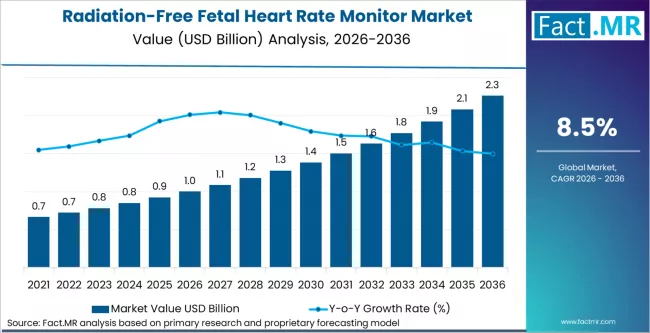
Radiation Free Fetal Heart Rate Monitor Market Market Value Analysis | Source: Fact.MR
| Metric | Value |
|---|---|
| Estimated Value in 2026 | USD 1.0 billion |
| Forecast Value in 2036 | USD 2.3 billion |
| Forecast CAGR (2026 to 2036) | 8.5% |
Source: Fact.MR analysis. Updated Mar 10, 2026
Market Definition
The radiation-free fetal heart rate monitor market includes non-ionising devices that detect fetal heartbeat during pregnancy without radiation exposure. Products include handheld Doppler ultrasound monitors and photoelectric sensor monitors used in hospitals, clinics, and home monitoring for fetal wellbeing assessment.
Market Inclusions
Includes global and regional revenue forecasts (2026-2036) by product type and end user. Covers Doppler and photoelectric fetal heart rate monitors across clinical and home-use settings, along with pricing trends, telehealth integration analysis, reimbursement frameworks, and home-use adoption trends.
Market Exclusions
Excludes cardiotocography systems monitoring uterine contractions, fetal ECG systems, general pulse oximetry devices, maternal-fetal monitoring workstations, and accessories such as probes, straps, and gels sold separately.
Research Methodology
- Primary Research: Interviews with obstetricians, midwives, hospital procurement managers, home healthcare distributors, telehealth providers, and maternal health programme administrators across major regions.
- Desk Research: Analysis of OEM earnings reports, WHO maternal health guidelines, national antenatal programme data, CMS telehealth reimbursement updates, NICE care guidelines, DiGA registry publications, and regulatory clearance databases.
- Market Sizing and Forecasting: A hybrid model combining antenatal visit volume estimates with device pricing by product type and end-use channel, incorporating telehealth adoption and home-use penetration data.
- Data Validation and Update Cycle: Forecasts validated using OEM revenues, maternal health programme participation data, device registration statistics, and reimbursement announcements, with annual updates reflecting policy changes and regulatory approvals.
Summary
- Market Definition
- Radiation-free fetal heart rate monitors are non-ionising devices using Doppler ultrasound or optical sensors to detect fetal heartbeat in clinical and home settings for antenatal monitoring.
- Demand Drivers
- Maternal health programmes in India, China, and Brazil are expanding antenatal care infrastructure, increasing procurement of clinical Doppler fetal monitors.
- Telehealth reimbursement in the United States and Germany’s DiGA framework are supporting adoption of home-use fetal monitors.
- Growing maternal awareness and pregnancy apps are driving direct consumer demand for home monitoring devices.
- Key Segments Analyzed
- By Product Type: Doppler monitors hold about 62% share in 2026 due to established clinical use and real-time audio feedback.
- By End User: Clinics account for around 67% share in 2026 due to routine antenatal monitoring and hospital procurement.
- By Geography: Asia Pacific leads growth, with China showing the highest CAGR at 11.4% due to expanding maternal health programmes.
- Analyst Opinion at FACT.MR
- Shambhu Nath Jha states that the market’s 8.5% CAGR through 2036 is driven by government maternal care procurement in emerging markets and expanding home-use adoption in the United States and Germany.
- Strategic Implications
- Manufacturers should develop Bluetooth-enabled monitors for telehealth integration and digital health reimbursement eligibility.
- Companies should strengthen government tender participation in India, China, and Brazil maternal health programmes.
- OEMs should obtain FDA and CE approvals for connected home-use fetal monitors to access premium markets.
- Methodology
- Market sizing used antenatal visit volumes combined with device selling prices by product and end-user channel.
- Telehealth reimbursement policies, WHO guidelines, and maternal health programme data informed demand projections.
- Regional forecasts validated using health ministry data, hospital procurement records, regulatory databases, and industry interviews.
Segmental Analysis
Radiation-Free Fetal Heart Rate Monitor Market Analysis by Product Type
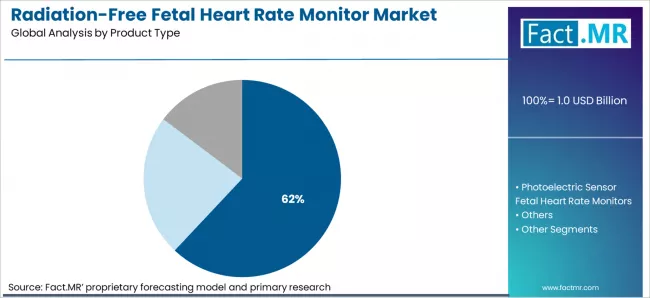
Radiation Free Fetal Heart Rate Monitor Market Analysis By Product Type | Source: Fact.MR
FACT.MR estimates Doppler fetal monitors will hold about 62% share in 2026 due to high clinical accuracy, early detection capability, and real-time audio feedback valued in both clinical and home settings.
- Philips Connected Doppler Investment: In 2025, Philips upgraded its Avalon CL monitoring platform with wireless data transmission and telehealth integration for hospital obstetrics departments. [1]
- Huntleigh Photoelectric Sensor Development: In 2024, Huntleigh Healthcare introduced a Bluetooth-enabled photoelectric fetal monitor designed for home use in the UK and German digital health markets. [5]
- CONTEC Home Doppler Export Trend: CONTEC Medical Systems reported strong export growth in 2024 for handheld home Doppler monitors across Southeast Asia and the Middle East. [6]
Radiation-Free Fetal Heart Rate Monitor Market Analysis by End User
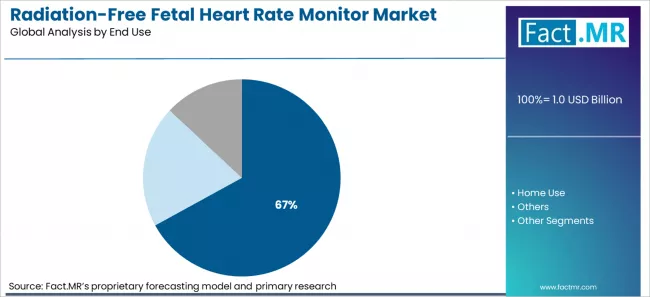
Radiation Free Fetal Heart Rate Monitor Market Analysis By End Use | Source: Fact.MR
FACT.MR estimates clinics will account for about 67% share in 2026 as routine antenatal visits rely on Doppler monitoring equipment in hospitals, maternity clinics, and midwife-led care centres.
- Nihon Kohden Hospital Supply: In 2025, Nihon Kohden expanded fetal monitor supply agreements with hospitals in Japan and Southeast Asia following updated obstetric monitoring guidelines. [7]
- Home Use Segment Growth: In 2024, Beurer launched a smartphone-connected home fetal Doppler targeting European maternal health consumers. [8]
- Telehealth Integration Trend: The American College of Obstetricians and Gynecologists reported in 2024 that over 35% of US obstetric practices use remote fetal monitoring devices within telehealth care programmes. [4]
Drivers, Restraints, and Opportunities
FACT.MR analysts view the radiation-free fetal heart rate monitor market as a steadily expanding medical device segment driven by government antenatal care expansion in emerging markets and growing home-use adoption supported by telehealth reimbursement in developed regions. Clinical Doppler monitoring remains the global standard, while connected home monitors are emerging as a new consumer and reimbursed healthcare segment.
- WHO Antenatal Care Contact Model: WHO recommends at least eight antenatal care contacts per pregnancy, increasing fetal monitoring frequency. Countries such as India adopted this model in National Health Mission guidelines, expanding Doppler monitor procurement at public health facilities. [2]
- Germany DiGA Reimbursement Expansion: Germany’s BfArM expanded the DiGA digital health directory in 2024 to include pregnancy monitoring apps, allowing connected fetal monitors to qualify for statutory health insurance reimbursement and strengthening the home-use market. [3]
- US Telehealth Reimbursement Permanence: The US Consolidated Appropriations Act 2024 extended telehealth reimbursement through 2026. CMS remote physiologic monitoring codes continue to support prescribing connected fetal monitors in virtual antenatal care programmes. [4]
Regional Analysis
The radiation-free fetal heart rate monitor market is analysed across Asia Pacific, Europe, North America, Latin America, and Middle East and Africa, spanning 40+ countries with distinct demand profiles shaped by maternal health programme reach, antenatal care infrastructure maturity, digital health reimbursement frameworks, and home-use consumer adoption rates. The full report offers market attractiveness analysis across all segments and countries.
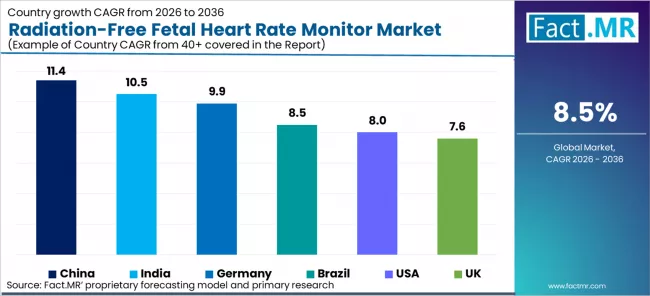
Radiation Free Fetal Heart Rate Monitor Market Cagr Analysis By Country | Source: Fact.MR
| Country | CAGR (2026-2036) |
|---|---|
| China | 11.4% |
| India | 10.5% |
| Germany | 9.9% |
| Brazil | 8.5% |
| USA | 8.0% |
| UK | 7.6% |
Source: Fact.MR analysis. Updated Mar 10, 2026
Source: Fact.MR (FACT.MR) analysis, based on proprietary forecasting model and primary research
Asia Pacific Radiation-Free Fetal Heart Rate Monitor Market Analysis
Asia Pacific is the fastest-growing region due to expanding maternal health programmes and rising home-use device adoption. Philips and Nihon Kohden lead hospital supply, while Chinese companies such as CONTEC and Banglijian dominate consumer Doppler manufacturing.
- China: Demand in China is projected to grow at 11.4% CAGR through 2036. National maternal health programmes require fetal heart rate monitoring at antenatal visits across thousands of public facilities, supporting institutional Doppler procurement. Updated maternal care standards issued in 2025 reinforced Doppler monitoring from the second trimester. CONTEC expanded production capacity in 2024 to meet growing domestic and export demand for handheld Doppler monitors used by hospitals and home users.
- India: Demand in India is expected to expand at 10.5% CAGR through 2036. Government programmes such as PMSMA and the National Health Mission are increasing Doppler monitor procurement across district hospitals and primary health centres. Adoption of the WHO eight-contact antenatal model is expanding monitoring requirements. Medtronic strengthened its distribution network in private hospitals, while Banglijian expanded home Doppler sales through online platforms.
FACT.MR's Asia Pacific analysis of the radiation-free fetal heart rate monitor market covers China, India, Japan, South Korea, ASEAN, Australia and New Zealand, and Rest of Asia Pacific with country growth forecasts and maternal programme procurement trends.
Europe Radiation-Free Fetal Heart Rate Monitor Market Analysis
Europe represents a premium market where digital health reimbursement and strict medical device standards influence both hospital procurement and home-use adoption. Philips and Dräger lead hospital systems, while Beurer and Huntleigh focus on home monitoring.
- Germany: Germany’s market is projected to grow at 9.9% CAGR through 2036. Structured antenatal programmes requiring multiple fetal heart assessments support steady hospital Doppler procurement. Expansion of the DiGA digital health framework in 2024 enabled reimbursement for connected fetal monitoring solutions. Beurer launched an app-connected home Doppler compatible with digital maternity care platforms, while Dräger expanded hospital monitoring upgrades.
- United Kingdom: The UK market is expected to grow at 7.6% CAGR through 2036. NHS maternity guidelines require Doppler availability in hospital and midwife-led care settings, supporting institutional procurement. Updated NHS Supply Chain procurement frameworks introduced connectivity and data logging standards for fetal monitors. Huntleigh Healthcare strengthened NHS supply coverage in 2024 through new contract expansions.
FACT.MR's European analysis covers Germany, the United Kingdom, France, Italy, Spain, the Nordics, and Rest of Europe including reimbursement trends, NHS procurement updates, and regulatory developments.
North America Radiation-Free Fetal Heart Rate Monitor Market Analysis
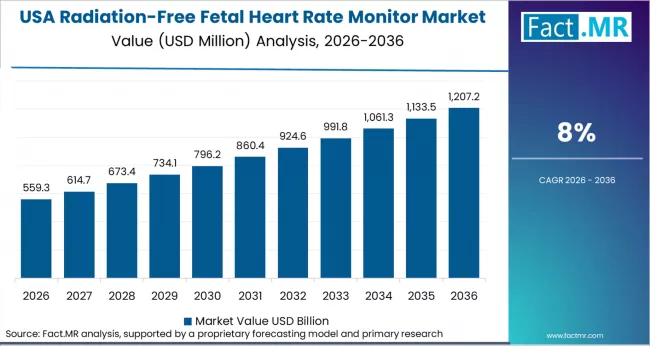
Radiation Free Fetal Heart Rate Monitor Market Country Value Analysis | Source: Fact.MR
North America remains the highest revenue region due to premium device pricing, telehealth reimbursement, and strong consumer demand for connected maternal health monitoring devices. Philips, Medtronic, and Natus Medical maintain strong hospital supply positions.
- United States: Demand in the United States is projected to rise at 8.0% CAGR through 2036. Continued CMS reimbursement for remote physiologic monitoring supports telehealth-based fetal monitoring programmes. Over one-third of obstetric practices now use remote fetal monitoring devices as part of antenatal care delivery. Philips expanded hospital fetal monitor upgrades across major health systems through GPO contract renewals covering numerous labour and delivery units.
FACT.MR's North American analysis covers the United States and Canada, including telehealth reimbursement trends, antenatal programme adoption benchmarks, and hospital procurement data.
Latin America Radiation-Free Fetal Heart Rate Monitor Market Analysis
Latin America is an emerging growth region supported by maternal mortality reduction programmes and expanding private maternity care infrastructure. Brazil represents the largest market in the region.
- Brazil: Brazil’s market is projected to grow at 8.5% CAGR through 2036. The Rede Cegonha maternal health programme is expanding antenatal services and increasing Doppler monitor procurement across public health facilities. Government funding allocated in 2024 for obstetric equipment upgrades includes fetal monitoring devices. Private hospital groups are also increasing investment in advanced maternal care equipment.
FACT.MR's Latin American analysis covers Brazil, Chile, Colombia, and Rest of Latin America with programme procurement timelines, private hospital investment trends, and country-level growth forecasts.
Competitive Aligners for Market Players
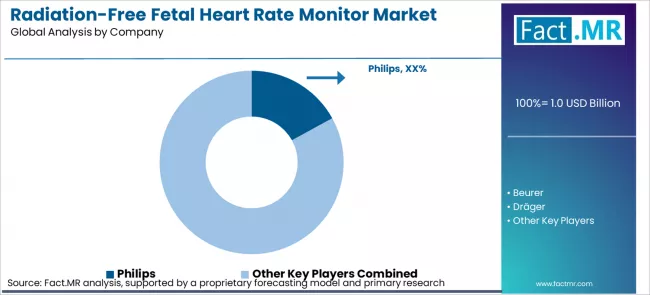
Radiation Free Fetal Heart Rate Monitor Market Analysis By Company | Source: Fact.MR
The global radiation-free fetal heart rate monitor market is moderately fragmented, with several types of companies competing across clinical and home-use segments. Large medical device manufacturers such as Philips, Dräger, and Medtronic dominate the hospital segment due to their long-standing relationships with obstetrics departments and group purchasing organization (GPO) contracts across North America and Europe. In contrast, the home-use segment is more competitive and price-sensitive.
Companies such as CONTEC, Banglijian, and Beurer supply handheld Doppler devices widely used by expectant mothers, with Chinese manufacturers accounting for a large share of global consumer-grade device volumes. Overall, no single company controls more than one-quarter of total market revenue.
Regulatory approvals also shape competition. Clinical suppliers benefit from holding certifications such as FDA 510(k) clearance, CE marking, and China NMPA approval, which are essential for hospital procurement eligibility. Philips gains an advantage through integrated obstetrics monitoring systems sold alongside other patient monitoring equipment. Nihon Kohden maintains strong positions in Japan and Southeast Asia through established hospital relationships. In the home-use market, differentiation increasingly depends on smartphone connectivity, app integration, and compatibility with telehealth platforms rather than hardware alone.
Recent Developments
- In January 2025, Philips Healthcare announced the commercial launch of its Avalon CL wireless fetal monitoring upgrade programme for US labour and delivery units, incorporating enhanced telehealth data integration and electronic health record connectivity, targeting hospital systems expanding virtual antenatal care programme capacity across outpatient and home monitoring settings.
- In November 2024, Huntleigh Healthcare confirmed expansion of its community midwifery Doppler monitor supply agreements under the updated NHS Supply Chain obstetric equipment framework, covering handheld and tabletop Doppler fetal monitor supply to NHS trust community and hospital midwifery services across England and Wales.
Key Players
- Philips
- Beurer
- Dräger
- Medtronic
- Nihon Kohden
- Huntleigh Healthcare
- Babyfun
- CONTEC
- Banglijian
Bibliography
- [1] Philips N.V. 2025. Q4 2024 Earnings Call Transcript: Connected Care and Maternal Monitoring Division Performance Commentary. Philips Investor Relations, January 2025. philips.com/investor-relations
- [2] Ministry of Health and Family Welfare, Government of India. 2024. National Health Mission Operational Guidelines 2024: Pradhan Mantri Surakshit Matritva Abhiyan Programme and Eight-Contact Antenatal Care Model Implementation. MoHFW Publications, August 2024. mohfw.gov.in
- [3] Federal Institute for Drugs and Medical Devices, Germany (BfArM). 2024. DiGA Directory Update: Maternity and Pregnancy Digital Health Applications with Connected Fetal Monitoring Hardware Compatibility. BfArM Publications, October 2024. bfarm.de
- [4] Centers for Medicare and Medicaid Services. 2024. 2025 Physician Fee Schedule Final Rule: Remote Physiologic Monitoring CPT Code Updates and Telehealth Reimbursement Permanence. CMS Publications, November 2024. cms.gov
- [5] Huntleigh Healthcare Ltd. 2024. Product Announcement: New Generation Photoelectric Sensor Home Fetal Monitor with Bluetooth Connectivity for UK and European Consumer Markets. Huntleigh Corporate Communications, September 2024. huntleigh-healthcare.com
- [6] CONTEC Medical Systems Co. Ltd. 2024. Annual Export Performance Report: Handheld Doppler Fetal Monitor International Market Expansion. CONTEC Corporate Disclosure, December 2024. contecmed.com
- [7] Nihon Kohden Corporation. 2025. FY2024 Annual Report: Maternal and Perinatal Monitoring System Supply Agreements and JSOG Guideline Compliance. Nihon Kohden Investor Relations, February 2025. nihonkohden.com
- [8] Beurer GmbH. 2024. Press Release: BY79 App-Connected Fetal Doppler Monitor Launch with DiGA-Compatible Data Export for German and Austrian Maternal Health Markets. Beurer Corporate Communications, April 2024. beurer.com
This Report Addresses
- Insights on maternal health programme procurement in China, India, and Brazil, Germany DiGA home-use reimbursement growth, US telehealth monitoring policies, NHS procurement updates, and photoelectric monitor entry barriers.
- Market size projected from USD 1.0 billion in 2026 to USD 2.3 billion by 2036 at an 8.5% CAGR, segmented by product type, end user, and region.
- Growth opportunities in connected Doppler devices for DiGA reimbursement, US telehealth monitoring programmes, India WHO eight-contact adoption, Brazil Rede Cegonha procurement, and China home-use consumer platforms.
- Country CAGR outlook including China (11.4%), India (10.5%), Germany (9.9%), Brazil (8.5%), United States (8.0%), and United Kingdom (7.6%).
- Competitive analysis of Philips, Dräger, Medtronic, Nihon Kohden, Huntleigh Healthcare, Beurer, CONTEC, and Banglijian across regulatory approvals, GPO contracts, telehealth integration, and government tenders.
- Technology trends including wireless Doppler connectivity, smartphone-linked home monitors, DiGA-compatible data export, and AI-based fetal heart rate analysis.
- Regulatory overview covering WHO antenatal care model adoption, Germany DiGA expansion, US CMS monitoring reimbursement, NHS maternity guidelines, EU MDR compliance, and China NMPA approvals.
- Report delivered via Excel datasets, PowerPoint summary, and detailed PDF supported by WHO records, OEM disclosures, government procurement data, CMS publications, and primary interviews.
Segmentation
Scope of Report
| Items | Values |
|---|---|
| Quantitative Units | USD 1.0 billion (2026) to USD 2.3 billion (2036), at a CAGR of 8.5% |
| Market Definition | Radiation-free fetal heart rate monitors are non-ionising devices using Doppler ultrasound or photoelectric sensor technology to detect fetal heartbeat during pregnancy, used in clinical antenatal settings and home monitoring by expectant mothers across hospitals, clinics, midwife-led units, and home-use channels. |
| Product Type Segmentation | Doppler Fetal Heart Rate Monitors (62%), Photoelectric Sensor Fetal Heart Rate Monitors, Others |
| End User Segmentation | Clinics (67%), Home Use, Others |
| Application Coverage | Scheduled antenatal clinic fetal heart rate assessment, continuous intrapartum Doppler monitoring, home between-visit fetal wellbeing monitoring, virtual antenatal telehealth programme device prescription, government maternal health programme facility procurement, and midwife-led community antenatal examination. |
| Regions Covered | Asia Pacific, Europe, North America, Latin America, Middle East and Africa |
| Countries Covered | United States, China, India, Germany, United Kingdom, Brazil, Japan, South Korea, Canada, France, Italy, Spain, ASEAN, Australia & New Zealand, Rest of regions |
| Key Companies Profiled | Philips, Beurer, Dräger, Medtronic, Nihon Kohden, Huntleigh Healthcare, Babyfun, CONTEC, Banglijian |
| Forecast Period | 2026 to 2036 |
| Approach | A hybrid top-down and bottom-up model was used. Top-down inputs included national antenatal visit volumes, maternal health programme coverage targets, and government facility procurement budgets. Bottom-up analysis used device selling prices by product type and end-user channel, telehealth reimbursement adoption rates, home-use penetration benchmarks, and regulatory clearance timelines from OEM interviews and government health ministry records. |
Source: Fact.MR analysis. Updated Mar 10, 2026
Radiation-Free Fetal Heart Rate Monitor Market by Segments
Product Type:
- Doppler Fetal Heart Rate Monitors
- Photoelectric Sensor Fetal Heart Rate Monitors
- Others
End User:
- Clinics
- Home Use
- Others
Region:
- North America
- USA
- Canada
- Mexico
- Latin America
- Brazil
- Chile
- Rest of Latin America
- Western Europe
- Germany
- UK
- Italy
- Spain
- France
- Nordic
- BENELUX
- Rest of Western Europe
- Eastern Europe
- Russia
- Poland
- Rest of Eastern Europe
- East Asia
- China
- Japan
- South Korea
- South Asia and Pacific
- India
- ASEAN
- Australia & New Zealand
- Rest of South Asia and Pacific
- Middle East & Africa
- Kingdom of Saudi Arabia
- Other GCC Countries
- Turkiye
- South Africa
- Rest of Middle East & Africa
Frequently Asked Questions
How large is the radiation-free fetal heart rate monitor market in 2025?
What will the market size be in 2026?
What is the projected market size by 2036?
What is the expected CAGR for the forecast period 2026 to 2036?
Which product type segment holds the leading share?
Which end-user segment commands the largest share?
Which country is projected to grow the fastest?
What is the expected growth rate for India?
What is the forecast CAGR for Germany's radiation-free fetal heart rate monitor market?
How is the radiation-free fetal heart rate monitor market in the United States expected to grow?
Who worked on this report


Preview the report firsthand - request a free sample
Free SampleGet the brochure for pricing and purchase details
Download PDF