- Base Value(2026): 1.7 Bn
- Estimated Value(2026): 1.7 Bn
- Forecast Value (2036): 5.5 Bn
- CAGR (2026 - 2036): 12.5%
Heat-Resistant PCR ABS Market Forecast Outlook 2026 to 2036
The heat-resistant PCR ABS market is valued at USD 1.7 billion in 2026 and is projected to reach USD 5.5 billion by 2036, reflecting a CAGR of 12.5%.
Key Takeaways from Heat-Resistant PCR ABS Market
- Heat-Resistant PCR ABS Market Value (2026): USD 1.7 billion
- Heat-Resistant PCR ABS Market Forecast Value (2036): USD 5.5 billion
- Heat-Resistant PCR ABS Market Forecast CAGR 2026 to 2036: 12.5%
- Leading Segment in Heat-Resistant PCR ABS Market: Heat-stabilized PCR-ABS (60%)
- Key Growth Region in Heat-Resistant PCR ABS Market: Asia Pacific
- Key Players in Heat-Resistant PCR ABS Market: LANXESS AG, BASF SE, Avient Corporation, SABIC (Saudi Basic Industries Corporation), Toray Industries, Inc., Mitsubishi Chemical Group Corporation, Kingfa Science & Technology Group Co., Ltd., Wanhua Chemical Group Co., Ltd.
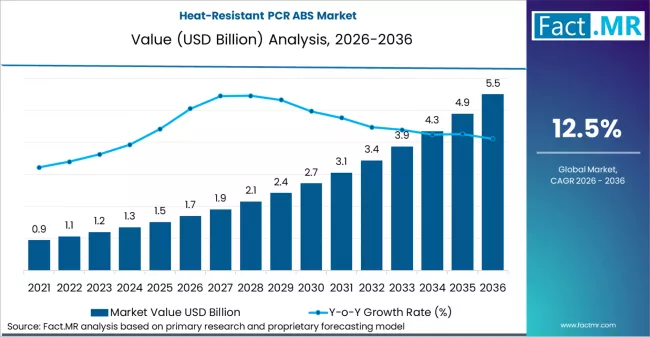
Heat Resistant Pcr Abs Market Market Value Analysis | Source: Fact.MR
Dominant players in this market defend their pricing power through technological leadership and the ability to offer specialized, high-performance products that justify premium pricing. Barriers to entry are high, driven by the need for significant capital investment in manufacturing facilities and the development of proprietary formulations that meet rigorous industry standards.
Additionally, the complexity of ensuring consistent material performance under high temperatures and environmental conditions further limits the number of viable competitors. While fragmentation remains, particularly in niche sectors, this is likely to narrow as larger firms consolidate their position through acquisitions or strategic partnerships. As demand for heat-resistant PCR ABS continues to grow, market control will be increasingly concentrated in the hands of a few well-capitalized players who can meet both quality and regulatory demands at scale.
Heat-Resistant PCR ABS Market
| Metric | Value |
|---|---|
| Estimated Value in (2026E) | USD 1.7 billion |
| Forecast Value in (2036F) | USD 5.5 billion |
| Forecast CAGR 2026 to 2036 | 12.5% |
Source: Fact.MR analysis. Updated Jan 22, 2026
Category
| Category | Segments |
|---|---|
| End-use | Electronics and appliances; Small appliances and IT; Precision electronics; Mass electronics; Appliance housings; Domestic appliances |
| Application Segment | Housings and structural parts; Functional components; High-temp housings; Injection-molded parts; Others |
| Material Grade | Heat-stabilized PCR-ABS; PCR-ABS blends; PCR-ABS or PC-ABS; PCR-ABS; Others |
| Performance Technology | Thermal stabilizers and impact modification; Controlled rheology and ageing resistance; Tight thermal stability control; Cost-optimized stabilization; Others |
| Region | North America; Europe; Asia Pacific; Latin America; Middle East & Africa |
Source: Fact.MR analysis. Updated Jan 22, 2026
Segmental Analysis
What Is the Impact of Material Grade on the Heat-Resistant PCR ABS Market?
Heat Resistant Pcr Abs Market Analysis By Material Grade | Source: Fact.MR
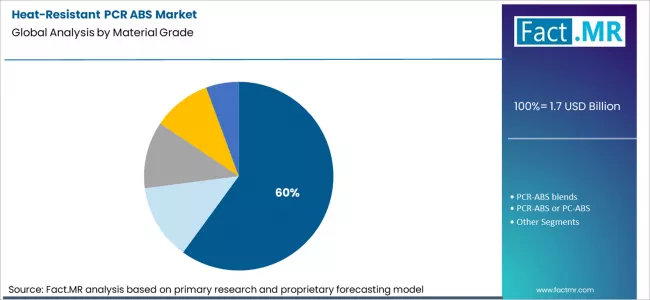
In the heat-resistant PCR ABS market, material grade plays a critical role in determining the suitability and performance of the product for various applications. Heat-stabilized PCR-ABS leads the market with a 60% share, as it provides enhanced resistance to high temperatures while maintaining the necessary mechanical properties. This material grade is essential for applications where heat stability is a primary concern, such as automotive parts, electronics, and consumer goods. As industries continue to prioritize sustainable, high-performance materials, heat-stabilized PCR-ABS will remain a key driver of market growth, offering both heat resistance and recyclability in critical applications.
How Does Performance Technology Influence the Heat-Resistant PCR ABS Market?
Heat Resistant Pcr Abs Market Analysis By Performance Technology | Source: Fact.MR
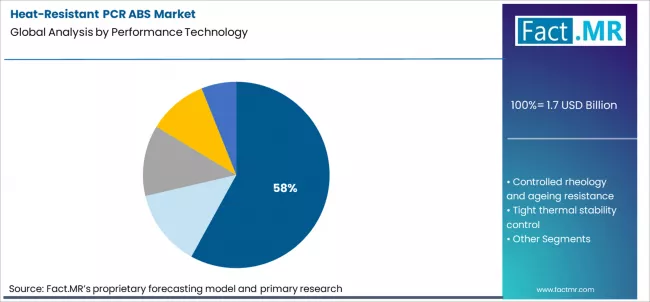
Performance technology significantly impacts the heat-resistant PCR ABS market, with thermal stabilizers and impact modification holding a 58% share. These technologies are crucial for enhancing the material's resistance to heat, oxidation, and mechanical stress, ensuring that the PCR-ABS retains its properties under demanding conditions. Thermal stabilizers help extend the material’s lifespan, while impact modification improves its toughness. As demand for high-performance, heat-resistant materials continues to rise in industries such as automotive, electronics, and packaging, the adoption of advanced thermal stabilisation and impact modification technologies will drive the market's growth, ensuring the production of durable, long-lasting products.
What are the Drivers, Restraints, and Key Trends in the Heat Resistant PCR ABS Market?
Demand for heat resistant post consumer recycled (PCR) acrylonitrile butadiene styrene (ABS) has been shaped by requirements from manufacturers of appliances, automotive interiors, and electronics enclosures that require elevated thermal performance with recycled content. Engineering teams specify PCR ABS grades that maintain dimensional stability, impact resistance, and surface quality at increased service temperatures. Procurement and quality groups prioritize suppliers that can demonstrate consistent heat distortion performance and documented traceability of recycled ABS feedstock, supporting compliance with regional recycled content mandates and product standards.
Variability in PCR ABS feedstock quality affects thermal properties and processing behavior, creating challenges in achieving tight tolerances and performance targets. Some converters adjust compounding ratios and processing conditions to mitigate property variations and meet specification criteria. Limited availability of validated, high heat deflection PCR ABS grades at scale has constrained broader adoption in applications where thermal reliability is critical. Efforts to improve feedstock sorting, decontamination, and consistent resin characterization are progressing. Collaboration among recyclers, compounders, and OEM technical teams aims to expand validated PCR ABS options that balance heat resistance with functional and regulatory requirements.
Analysis of the Heat-Resistant PCR ABS Market by Key Country
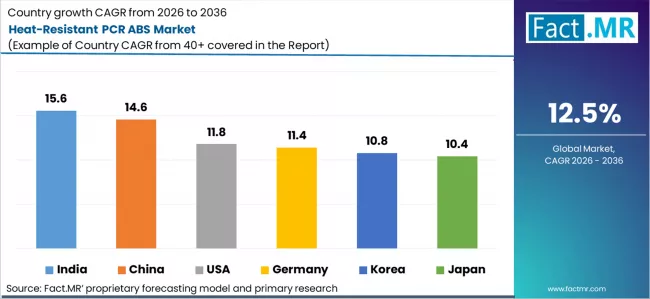
Heat Resistant Pcr Abs Market Cagr Analysis By Country | Source: Fact.MR
| Country | CAGR (2026–2036) |
|---|---|
| Germany | 11.4% |
| USA | 11.8% |
| Japan | 10.4% |
| China | 14.6% |
| Korea | 10.8% |
| India | 15.6% |
Source: Fact.MR analysis. Updated Jan 22, 2026
The report covers an in-depth analysis of 40+ countries; top-performing countries are highlighted below.
What is the Outlook on the Heat-Resistant PCR ABS Market in Germany?
Germany market in heat-resistant PCR ABS is projected to grow at a CAGR of 11.4% from 2026 to 2036. Demand for heat-resistant PCR ABS in Germany is increasing as industries, particularly automotive, electronics, and packaging, focus on sustainable and high-performance materials. Heat-resistant PCR ABS offers an eco-friendly solution that meets industry requirements for durability and performance. With Germany’s commitment to circular economy practices, sustainable manufacturing, and reducing plastic waste, the market for heat-resistant PCR ABS is expected to experience steady growth in the coming years.
What is the Demand for Heat-Resistant PCR ABS in the USA?
USA sales of heat-resistant PCR ABS are expected to grow at a CAGR of 11.8% from 2026 to 2036. The USA’s demand for heat-resistant PCR ABS is driven by the growing need for sustainable and durable materials across the automotive, electronics, and packaging industries. As regulations on plastic waste become stricter and consumer demand for eco-friendly products increases, heat-resistant PCR ABS offers an effective solution for high-performance applications. The market for heat-resistant PCR ABS in the USA is expected to grow steadily, supported by innovations in recycling technologies and sustainability efforts.
What is the Sales Outlook on Heat-Resistant PCR ABS in Japan?
Japan market in heat-resistant PCR ABS is forecast to grow at a CAGR of 10.4% from 2026 to 2036. The demand for heat-resistant PCR ABS in Japan is increasing as industries seek sustainable alternatives to traditional plastic materials that offer high heat resistance and durability. The automotive and electronics sectors, in particular, are driving the need for these materials to meet performance standards and reduce environmental impact. With Japan’s strong regulatory focus on sustainability and the circular economy, the market for heat-resistant PCR ABS is expected to grow steadily.
What is the Demand for Heat-Resistant PCR ABS in China?
China demand for heat-resistant PCR ABS is projected to grow at a CAGR of 14.6% from 2026 to 2036. As China’s manufacturing and automotive industries continue to expand, the need for durable, heat-resistant, and sustainable materials like PCR ABS is rising. The growing focus on sustainability and reducing plastic waste is driving the adoption of heat-resistant PCR ABS in various industrial applications. With China’s significant investments in recycling infrastructure and green manufacturing, the market for heat-resistant PCR ABS is expected to experience rapid growth over the next decade.
What is the Sales Outlook on Heat-Resistant PCR ABS in Korea?
Korea market in heat-resistant PCR ABS is expected to grow at a CAGR of 10.8% from 2026 to 2036. The demand for heat-resistant PCR ABS in Korea is increasing as industries such as automotive, electronics, and packaging focus on sustainability and performance. These industries are adopting eco-friendly materials to meet both regulatory standards and consumer expectations for greener products. Korea’s ongoing commitment to sustainable manufacturing practices and waste reduction will continue to drive the growth of the heat-resistant PCR ABS market.
What is the Market Expansion Outlook for Heat-Resistant PCR ABS in India?
India sales of heat-resistant PCR ABS are projected to grow at a CAGR of 15.6% from 2026 to 2036. As India’s industrial sectors, particularly automotive and electronics, continue to grow, the demand for sustainable and heat-resistant materials like PCR ABS is increasing. These materials provide high performance, durability, and eco-friendliness, making them an attractive option for various applications. With India’s regulatory push for sustainability and the increasing demand for circular economy solutions, the market for heat-resistant PCR ABS is expected to experience robust growth in the coming years.
How Are Key Players Competing in the HeatResistant PCR ABS Market?
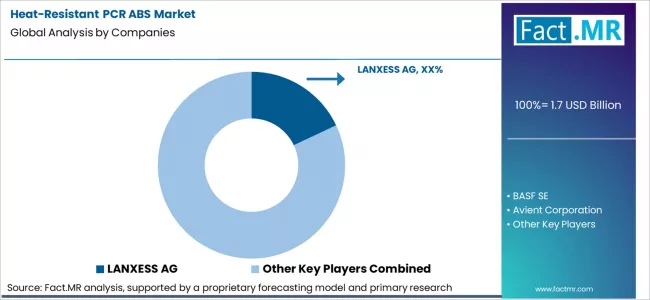
Heat Resistant Pcr Abs Market Analysis By Company | Source: Fact.MR
Competition in the heat resistant post consumer resin acrylonitrile butadiene styrene (PCR ABS) market is driven by material performance and compliance with thermal stability requirements. LANXESS AG and BASF SE are positioned with resin grades that demonstrate consistent heat resistance and dimensional stability. Avient Corporation and SABIC focus on PCR ABS compounds that support varied processing conditions and application needs. Toray Industries, Inc. and Mitsubishi Chemical Group Corporation pursue product portfolios that balance recycled content with mechanical performance. Kingfa Science & Technology Group Co., Ltd. and Wanhua Chemical Group Co., Ltd. emphasize scalable supply and uniform quality for global customers.
Product brochures are used to communicate technical specifications and performance attributes. LANXESS and BASF publications describe heat distortion temperatures and impact strength data. Avient and SABIC literature outlines processing guidelines for injection molding and extrusion. Toray and Mitsubishi Chemical materials specify resin grades suited for elevated temperature applications. Kingfa and Wanhua brochures present comparative property charts to assist material selection for engineering uses.
Key Players of the Heat-Resistant PCR ABS Market
- LANXESS AG
- BASF SE
- Avient Corporation
- SABIC (Saudi Basic Industries Corporation)
- Toray Industries, Inc.
- Mitsubishi Chemical Group Corporation
- Kingfa Science & Technology Group Co., Ltd.
- Wanhua Chemical Group Co., Ltd.
Bibliographies
- International Organization for Standardization. (2024). ISO 22095: Chain of custody - General terminology and models.
- International Electrotechnical Commission. (2023). IEC TR 62635: Guidelines for end-of-life treatment of electrical and electronic equipment.
- European Commission, Joint Research Centre. (2023). Recycled engineering plastics from WEEE: Performance and contamination constraints.
- National Institute of Standards and Technology. (2024). Material property variability in recycled thermoplastics.
- U.S. Environmental Protection Agency. (2023). Engineering plastics recycling and performance considerations.
Segmentation
Scope of the Report
| Items | Values |
|---|---|
| Quantitative Units (2026) | USD Billion |
| End-use | Electronics and appliances, Small appliances and IT, Precision electronics, Mass electronics, Appliance housings, Domestic appliances |
| Application Segment | Housings and structural parts, Functional components, High-temp housings, Injection-molded parts, Others |
| Material Grade | Heat-stabilized PCR-ABS, PCR-ABS blends, PCR-ABS or PC-ABS, PCR-ABS, Others |
| Performance Technology | Thermal stabilizers and impact modification, Controlled rheology and ageing resistance, Tight thermal stability control, Cost-optimized stabilization, Others |
| Regions Covered | North America, Europe, Asia Pacific, Latin America, Middle East & Africa |
| Countries Covered | United States, Canada, Mexico, Brazil, Germany, United Kingdom, France, Italy, Spain, China, Japan, South Korea, India, Australia & New Zealand |
| Key Companies Profiled | LANXESS AG, BASF SE, Avient Corporation, SABIC (Saudi Basic Industries Corporation), Toray Industries, Inc., Mitsubishi Chemical Group Corporation, Kingfa Science & Technology Group Co., Ltd., Wanhua Chemical Group Co., Ltd. |
| Additional Attributes | Dollar revenue by end-use, application segment, material grade, and performance technology; regional demand trends, competitive landscape, technological advancements in heat-resistant PCR ABS, and innovations in thermal stability and material modification |
Source: Fact.MR analysis. Updated Jan 22, 2026
Heat-Resistant PCR ABS Market Key Segments
-
End-use :
- Electronics and appliances
- Small appliances and IT
- Precision electronics
- Mass electronics
- Appliance housings
- Domestic appliances
-
Application Segment :
- Housings and structural parts
- Functional components
- High-temp housings
- Injection-molded parts
- Others
-
Material Grade :
- Heat-stabilized PCR-ABS
- PCR-ABS blends
- PCR-ABS or PC-ABS
- PCR-ABS
- Others
-
Performance Technology :
- Thermal stabilizers and impact modification
- Controlled rheology and ageing resistance
- Tight thermal stability control
- Cost-optimized stabilization
- Others
-
Region :
- North America
- USA
- Canada
- Mexico
- Europe
- Germany
- UK
- France
- Italy
- Spain
- Nordic Countries
- BENELUX
- Rest of Europe
- Asia Pacific
- China
- Japan
- South Korea
- India
- Australia
- Rest of Asia Pacific
- Latin America
- Brazil
- Argentina
- Rest of Latin America
- Middle East and Africa
- Kingdom of Saudi Arabia
- United Arab Emirates
- South Africa
- Rest of Middle East and Africa
- Other Regions
- Oceania
- Central Asia
- Other Markets
- North America
Frequently Asked Questions
How big is the heat-resistant pcr abs market in 2026?
What will be the size of heat-resistant pcr abs market in 2036?
How much will be the heat-resistant pcr abs market growth between 2026 and 2036?
What are the key product types in the heat-resistant pcr abs market?
Which application segment segment to contribute significant share in the heat-resistant pcr abs market in 2026?
Who worked on this report


Preview the report firsthand - request a free sample
Free SampleGet the brochure for pricing and purchase details
Download PDF