Hemoglobinopathy Market Size, Share, Growth and Forecast (2026 - 2036)

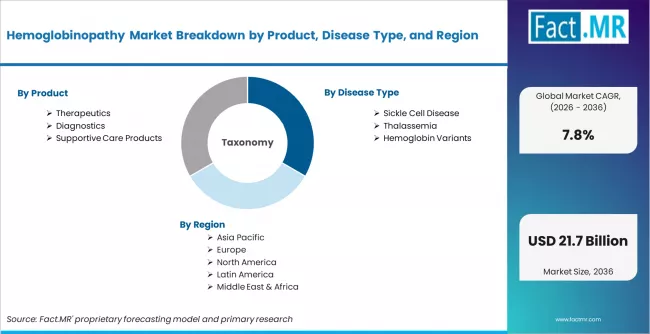
Hemoglobinopathy Market is segmented by Product (Therapeutics, Diagnostics, Supportive Care Products), Disease Type (Sickle Cell Disease, Thalassemia, Hemoglobin Variants), Diagnostic Technology (Molecular Diagnostics, Biochemical Testing, Screening Technology), and Region, with forecasts covering the period from 2026 to 2036.

According to Fact.MR estimates, the global hemoglobinopathy market was valued at USD 9.5 billion in 2025. The market is projected to reach USD 10.2 billion in 2026 and is expected to grow to USD 21.7 billion by 2036, expanding at a CAGR of 7.8%. Therapeutics is anticipated to account for 38.9% of the product segment in 2026, while Sickle Cell Disease is expected to remain the leading application with around 42.1% share.

Hemoglobinopathy Market Analysis and Forecast by Fact.MR

  • The global hemoglobinopathy market is estimated at USD 9.5 billion in 2025 and is forecast to reach USD 10.2 billion in 2026 before expanding to USD 21.7 billion by 2036, progressing at a CAGR of 7.8% over the 2026 to 2036 forecast period.
  • Therapeutics is anticipated to account for 38.9% share of the product segment in 2026, supported by expanding approved treatment options for sickle cell disease and thalassemia, including gene therapies and disease-modifying agents that command premium pricing.
  • India (9.0%) and USA (8.5%) are the fastest growing country markets through 2036.
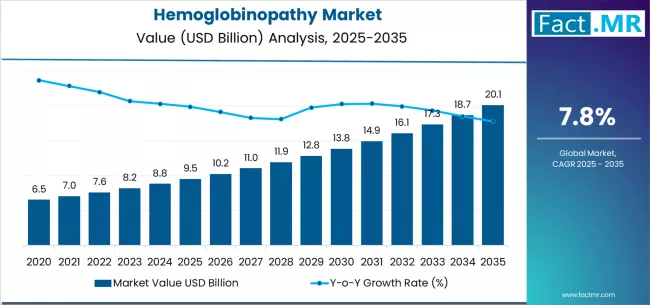
Hemoglobinopathy Market Market Value Analysis

Summary of Hemoglobinopathy Market

  • Market Snapshot
    • In 2025, the global Hemoglobinopathy Market was valued at approximately USD 9.5 billion.
    • The market is estimated to reach USD 10.2 billion in 2026 and is projected to attain USD 21.7 billion by 2036.
    • The hemoglobinopathy market is likely to expand at a CAGR of 7.8% during the forecast period.
    • The market is anticipated to create an absolute dollar opportunity of USD 11.5 billion between 2026 and 2036.
    • Therapeutics account for 38.9% of market share in 2026.
    • India (9.0%) and USA (8.5%) are the key growth markets during the forecast period.
  • Demand and Growth Drivers
    • Approval and commercial launch of gene therapies for sickle cell disease and transfusion-dependent thalassemia create a premium therapeutic tier that generates disproportionate revenue growth relative to patient volumes.
    • Rising diagnosis rates through newborn screening programs in India, Africa, and the Middle East are expanding the identified patient population and increasing treatment initiation rates.
    • Development of disease-modifying agents beyond hydroxyurea, including voxelotor, crizanlizumab, and L-glutamine, broadens the available treatment options and supports higher per-patient pharmaceutical spending.
    • Rising institutional procurement volumes across hospitals, government programs, and organized care networks create a sustained base-level demand less sensitive to short-term economic cycles.
    • Expanding distribution through specialized channels and technology-enabled platforms is improving accessibility across underpenetrated geographies.
  • Product and Segment View
    • Therapeutics accounts for 38.9% of the product segment in 2026.
    • Hospitals represents 44.3% of the end use segment in 2026.
    • The hemoglobinopathy market is segmented by product, disease type, diagnostic technology, treatment modality, end use, and region.
  • Geography and Competitive Outlook
    • India leads growth at 9.0%.
    • The USA at 8.5% reflects a mature market with established procurement.
    • Germany at 6.9% supported by regulatory standards and institutional procurement.
    • Vertex Pharmaceuticals, bluebird bio, CRISPR Therapeutics hold strong positions through broad portfolios and distribution networks.
  • Analyst Opinion
    • Shambhu Nath Jha, Principal Consultant at Fact.MR, says 'The hemoglobinopathy market is undergoing a fundamental transformation driven by the arrival of curative gene therapies. The FDA approval of CRISPR-based and lentiviral gene therapies for sickle cell disease and transfusion-dependent thalassemia represents a paradigm shift from lifelong disease management to potential one-time curative intervention. These therapies command pricing in the range of USD 1 million to USD 3 million per patient, creating outsized revenue contribution per treated individual despite small initial patient volumes. The commercial challenge is access and affordability, as most affected populations reside in low-income countries where healthcare systems cannot support gene therapy pricing. India has the world's largest sickle cell disease burden but the lowest per-patient treatment expenditure. The market therefore operates on two tiers: a high-value curative therapy tier concentrated in the USA, UK, and Germany; and a high-volume disease management tier in India, Africa, and the Middle East where hydroxyurea, transfusion therapy, and supportive care remain the treatment backbone.'

Key Growth Drivers, Constraints, and Opportunities
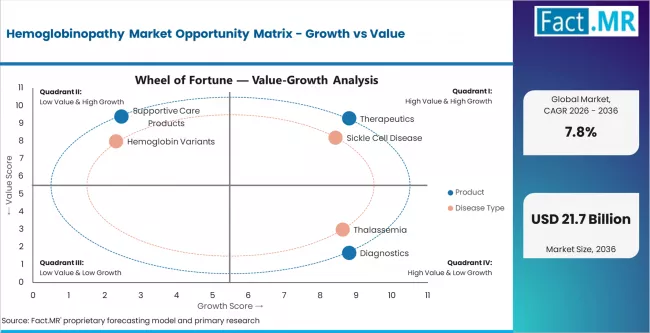
Hemoglobinopathy Market Opportunity Matrix Growth Vs Value

Key Factors Driving Growth

  • Approval and commercial launch of gene therapies for sickle cell disease and transfusion-dependent thalassemia create a premium therapeutic tier that generates disproportionate revenue growth relative to patient volumes.
  • Rising diagnosis rates through newborn screening programs in India, Africa, and the Middle East are expanding the identified patient population and increasing treatment initiation rates.
  • Development of disease-modifying agents beyond hydroxyurea, including voxelotor, crizanlizumab, and L-glutamine, broadens the available treatment options and supports higher per-patient pharmaceutical spending.

Key Market Constraints

  • Gene therapy pricing in the USD 1 million to USD 3 million range restricts access to healthcare systems with advanced infrastructure and reimbursement capacity, excluding the majority of affected populations globally.
  • Manufacturing complexity and limited treatment center capacity for gene therapy administration constrain the number of patients who can be treated annually.
  • Healthcare infrastructure gaps in high-prevalence regions including sub-Saharan Africa, South Asia, and the Middle East limit diagnostic screening and treatment delivery capacity.

Key Opportunity Areas

  • Expansion of newborn screening programs in India and Africa creates the largest global opportunity for early diagnosis and treatment initiation in sickle cell disease and thalassemia.
  • Development of in-vivo gene therapy approaches that do not require bone marrow conditioning could simplify treatment delivery and improve global accessibility.
  • Growth of regional centers of excellence for hemoglobinopathy management creates coordinated care pathways that improve clinical outcomes and support treatment adoption.

Segment-wise Analysis of the Hemoglobinopathy Market

  • Therapeutics holds 38.9% of the product segment in 2026.
  • Hospitals represents 44.3% of the end use segment in 2026.

The hemoglobinopathy market is segmented by product, disease type, diagnostic technology, treatment modality, end use, and region.

Which Product Segment Leads the Hemoglobinopathy Market?
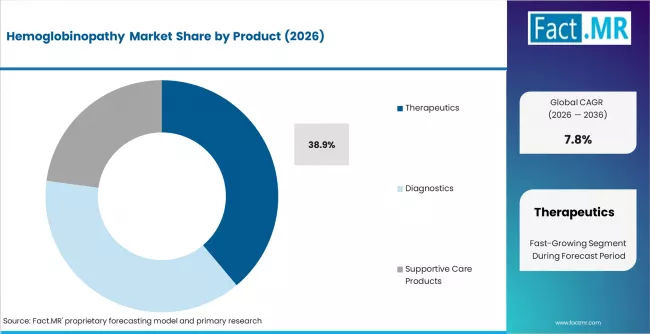
Hemoglobinopathy Market Analysis By Product

Therapeutics accounts for 38.9% of the product segment in 2026. This position reflects expanding approved treatment options for sickle cell disease and thalassemia, including gene therapies and disease-modifying agents that command premium pricing.

Which End Use Segment Leads the Hemoglobinopathy Market?
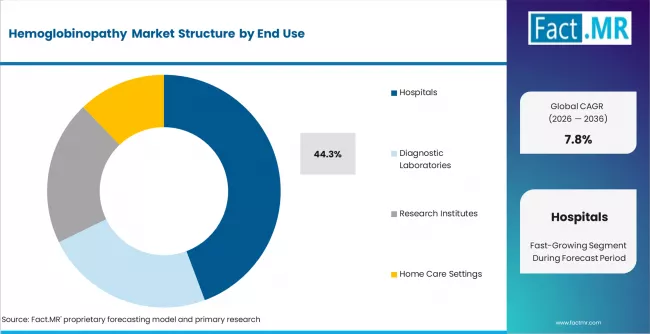
Hemoglobinopathy Market Analysis By End Use

Hospitals is expected to account for 44.3% of the end use segment in 2026. This segment represents the largest concentration of demand.

Which Trend is Shaping the Next Phase of Growth in the Hemoglobinopathy Market?

Gene therapy represents the most transformative product trend in the hemoglobinopathy market. CRISPR-based therapies (exagamglogene autotemcel) and lentiviral gene therapies (lovotibeglogene autotemcel) have received regulatory approval for sickle cell disease and transfusion-dependent thalassemia, marking the first potentially curative treatments for these conditions. These one-time therapies command pricing that reflects their curative potential but creates reimbursement and access challenges. The commercial rollout is focused on specialized treatment centers in the United States and Europe, with patient volumes limited by manufacturing capacity and the complexity of the conditioning and administration process. As manufacturing scales, pricing discussions evolve, and next-generation in-vivo approaches advance, gene therapy is positioned to capture an increasing share of hemoglobinopathy treatment value.

Regional Outlook Across Key Markets

Top Country Growth Comparison Hemoglobinopathy Market Cagr (2026 2036)

  • India leads growth at 9.0%.
  • The USA at 8.5% reflects mature demand with established procurement.
  • Germany at 6.9% supported by regulatory frameworks.
  • Asia Pacific is the fastest growing region overall.

Country CAGR Table

Country CAGR (%)
India 9.0%
USA 8.5%
China 8.2%
Brazil 7.5%
UK 7.1%
Germany 6.9%
Italy 6.7%

Source: Fact.MR analysis, based on proprietary forecasting model and primary research.
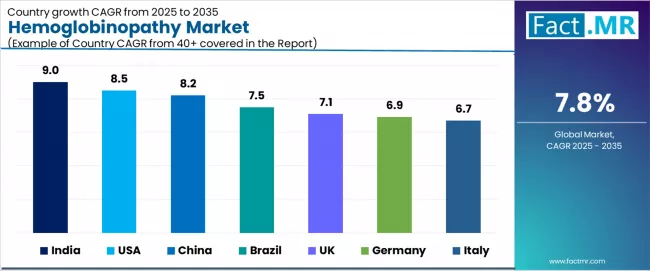
Hemoglobinopathy Market Cagr Analysis By Country

Hemoglobinopathy Market in India

India leads global market expansion with a projected CAGR of 9.0% through 2036. India has the world's largest sickle cell disease burden and a significant thalassemia population. Growth reflects expanding newborn screening, increasing hydroxyurea adoption, growing diagnosis rates, and early-stage gene therapy access exploration.

  • World's largest sickle cell disease burden creates the biggest addressable patient population globally.
  • Newborn screening program expansion improves early diagnosis and treatment initiation.
  • Hydroxyurea adoption is increasing as awareness and affordable generic supply improve.

Hemoglobinopathy Market in USA
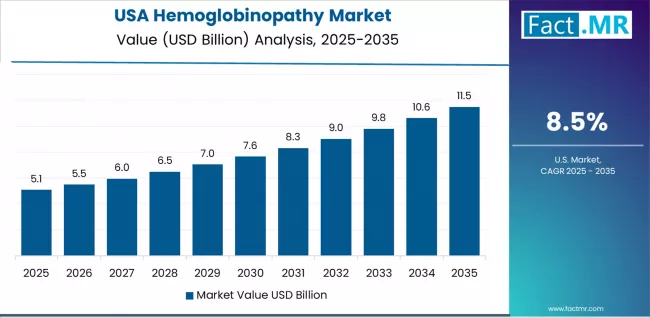
Hemoglobinopathy Market Country Value Analysis

The United States is projected to grow at a CAGR of 8.5% through 2036. The market benefits from gene therapy commercial availability, expanding disease-modifying drug options, established treatment center infrastructure, and insurance coverage for specialty hemoglobinopathy treatments.

  • Gene therapy availability creates a premium revenue tier with high per-patient value.
  • Disease-modifying drug adoption beyond hydroxyurea increases per-patient pharmaceutical spending.
  • Specialty treatment center infrastructure supports complex therapy administration.

Hemoglobinopathy Market in China

China is projected to grow at a CAGR of 8.2% through 2036. Demand reflects thalassemia prevalence in southern provinces, expanding screening programs, growing pharmaceutical availability, and domestic gene therapy development activity.

  • Thalassemia prevalence in southern provinces creates a concentrated patient population.
  • Screening program expansion improves early identification and treatment planning.
  • Domestic gene therapy development contributes to future treatment access pathways.

Hemoglobinopathy Market in Brazil

Brazil is projected to grow at a CAGR of 7.5% through 2036. Expansion reflects significant sickle cell disease prevalence, established newborn screening through the national program, and improving access to disease-modifying therapies.

  • National newborn screening program supports early sickle cell disease diagnosis.
  • Significant disease prevalence creates sustained demand for treatment and supportive care products.
  • Improving access to newer pharmacological agents supports per-patient treatment value growth.

Hemoglobinopathy Market in UK

The United Kingdom is projected to grow at a CAGR of 7.1% through 2036. Growth reflects NHS investment in hemoglobinopathy treatment, early access to gene therapies through specialist treatment centers, and comprehensive screening programs.

  • NHS investment supports access to both conventional and gene therapy treatments.
  • Specialist treatment centers provide infrastructure for gene therapy administration.
  • Comprehensive screening ensures high diagnosis rates and early treatment initiation.

Hemoglobinopathy Market in Germany

Germany is projected to grow at a CAGR of 6.9% through 2036. Demand reflects early gene therapy access through AMNOG reimbursement, established hematology care infrastructure, and clinical trial participation.

  • AMNOG reimbursement framework supports early access to approved gene therapies.
  • Established hematology infrastructure maintains consistent treatment volumes.
  • Clinical trial participation provides early access to emerging treatment options.

Hemoglobinopathy Market in Italy

Italy is projected to grow at a CAGR of 6.7% through 2036. Growth reflects thalassemia prevalence in Mediterranean populations, established transfusion medicine infrastructure, and early gene therapy adoption.

  • Thalassemia prevalence in Mediterranean populations creates sustained treatment demand.
  • Established transfusion medicine infrastructure supports conventional and emerging therapies.
  • Gene therapy adoption reflects early treatment center activation in major university hospitals.

Competitive Benchmarking and Company Positioning
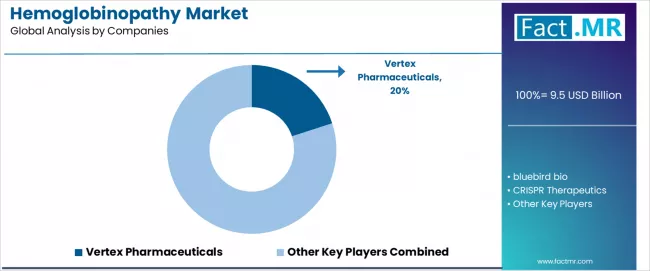
Hemoglobinopathy Market Analysis By Company

Hemoglobinopathy Market Analysis By Company

  • Vertex Pharmaceuticals, bluebird bio, CRISPR Therapeutics hold strong positions.
  • Novartis, GSK, Sangamo participate meaningfully across specific segments.

Vertex Pharmaceuticals and CRISPR Therapeutics hold transformative positions through exagamglogene autotemcel (Casgevy), the first approved CRISPR-based gene therapy for sickle cell disease and transfusion-dependent thalassemia.

bluebird bio competes through lovotibeglogene autotemcel (Lyfgenia), an approved lentiviral gene therapy that offers an alternative curative approach with a differentiated manufacturing process.

Novartis, GSK, and Pfizer participate through disease-modifying pharmaceutical portfolios and clinical pipeline programs targeting hemoglobin disorders through non-gene-therapy mechanisms.

The competitive landscape is uniquely structured, with gene therapy companies competing at the curative tier on pricing, manufacturing capacity, and treatment center access, while pharmaceutical companies compete in the disease management tier on drug efficacy, safety profiles, and global distribution reach.

Recent Industry Developments

  • Vertex Pharmaceuticals expanded commercial rollout of Casgevy in early 2026, activating additional authorized treatment centers in the United States and Europe for sickle cell disease and transfusion-dependent thalassemia patients.
  • CRISPR Therapeutics reported updated long-term follow-up data in 2025 demonstrating sustained clinical benefit in patients treated with exagamglogene autotemcel, supporting ongoing commercial adoption.
  • Novartis advanced its sickle cell disease pipeline in 2025 with clinical data for a next-generation disease-modifying agent targeting vaso-occlusive crisis prevention.

Leading Companies in the Hemoglobinopathy Market

Major Players

  • Vertex Pharmaceuticals
  • bluebird bio
  • CRISPR Therapeutics
  • Novartis
  • GSK
  • Sangamo
  • Editas Medicine
  • Bioverativ (Sanofi)

Emerging Players

  • Pfizer
  • Orchard Therapeutics
  • Forma Therapeutics
  • Global Blood Therapeutics
  • Agios Pharmaceuticals
  • Emmaus Medical
  • Vifor Pharma

Sources and Research References

  • World Health Organization (WHO). Sickle Cell Disease and Thalassemia Global Burden Reports.
  • National Heart, Lung, and Blood Institute (NHLBI). Sickle Cell Disease Treatment Guidelines.
  • Vertex Pharmaceuticals. Gene Therapy Pipeline and Hemoglobinopathy Treatment Updates.
  • U.S. Food and Drug Administration (FDA). Approved Biologic and Gene Therapy Products for Blood Disorders.
  • Primary interviews with hematologists, hospital pharmacists, diagnostic laboratory directors, and patient advocacy organizations.

This bibliography is provided for reader reference and is not exhaustive.

Key Questions This Report Addresses

  • What is the current and future size of the hemoglobinopathy market?
  • How fast is the market expected to grow between 2026 and 2036?
  • Which product is likely to lead by 2026?
  • Which end use segment accounts for the highest demand?
  • What factors are driving demand globally?
  • Which countries show the fastest growth?
  • Who are the key companies?
  • How does Fact.MR validate the forecast?

Hemoglobinopathy Market Definition

The hemoglobinopathy market covers therapeutic agents, diagnostic platforms, and supportive care products used in the management of sickle cell disease, thalassemia, and other hemoglobin disorders across hospital, diagnostic laboratory, research, and home care settings.

Hemoglobinopathy Market Inclusions

The scope covers global and regional market size and forecasts for 2026 to 2036 across product, disease type, diagnostic technology, treatment modality, end use, and region.

Hemoglobinopathy Market Exclusions

The scope excludes general-purpose devices, products, or services not purpose-built for the applications defined within this market.

Hemoglobinopathy Market Research Methodology

  • Primary research includes interviews with manufacturers, service providers, end users, and procurement teams.
  • Secondary research draws on industry publications, regulatory filings, and company reports.
  • Market sizing follows a demand-side model supported by top-down validation across 30 plus countries.
  • Final estimates are validated through trade-flow checks, pricing analysis, and sensitivity testing.

Scope of Analysis

Hemoglobinopathy Market Breakdown By Product, Disease Type, And Region

Parameter Details
Quantitative Units USD 10.2 billion to USD 21.7 billion, at a CAGR of 7.8%
Market Definition The hemoglobinopathy market covers therapeutic agents, diagnostic platforms, and supportive care products used in the management of sickle cell disease, thalassemia, and other hemoglobin disorders across hospital, diagnostic laboratory, research, and home care settings.
Regions Covered North America, Latin America, Europe, East Asia, South Asia and Pacific, Middle East and Africa
Countries Covered USA, India, China, Brazil, UK, Germany, Italy, and 30 plus countries
Key Companies Vertex Pharmaceuticals, bluebird bio, CRISPR Therapeutics, Novartis, GSK, Sangamo, Editas Medicine, Bioverativ (Sanofi), Pfizer, Orchard Therapeutics
Forecast Period 2026 to 2036
Approach Hybrid demand-side and top-down methodology built on country-level disease prevalence data, treatment penetration rates, drug pricing analysis, and primary interviews across hematologists, hospital procurement teams, diagnostic companies, and patient advocacy organizations

Market Segmentation Analysis

  • Hemoglobinopathy Market Segmented by Product:

    • Therapeutics
      • Disease Modifying Therapies
      • Hydroxyurea Based Therapy
      • Blood Transfusion Therapy
      • Iron Chelation Therapy
      • Gene Therapy
      • Stem Cell Therapy
    • Diagnostics
      • Hemoglobin Electrophoresis
      • High Performance Liquid Chromatography Testing
      • Molecular Genetic Testing
      • Newborn Screening Programs
      • Point of Care Testing Kits
    • Supportive Care Products
      • Folic Acid Supplementation
      • Pain Management Medications
      • Oxygen Therapy Supplies
      • Hydration and Infusion Solutions
  • Hemoglobinopathy Market Segmented by Disease Type:

    • Sickle Cell Disease
      • Sickle Cell Anemia
      • Sickle Cell Trait Management
    • Thalassemia
      • Beta Thalassemia
      • Alpha Thalassemia
    • Hemoglobin Variants
      • Hemoglobin C Disease
      • Hemoglobin E Disease
      • Unstable Hemoglobin Disorders
  • Hemoglobinopathy Market Segmented by Diagnostic Technology:

    • Molecular Diagnostics
      • Polymerase Chain Reaction Testing
      • Next Generation Sequencing
      • Hybridization Based Assays
    • Biochemical Testing
      • Hemoglobin Quantification Assays
      • Electrophoretic Separation Methods
    • Screening Technology
      • Newborn Screening Panels
      • Population Screening Programs
  • Hemoglobinopathy Market Segmented by Treatment Modality:

    • Pharmacological Treatment
      • Disease Modifying Drugs
      • Symptomatic Treatment Drugs
    • Biological Therapy
      • Gene Editing Therapy
      • Cell Based Therapy
    • Transfusion Based Therapy
      • Regular Blood Transfusion Programs
      • Exchange Transfusion Procedures
    • Curative Treatment
      • Hematopoietic Stem Cell Transplantation
  • Hemoglobinopathy Market Segmented by End Use:

    • Hospitals
      • Tertiary Care Hospitals
      • Specialty Hematology Centers
    • Diagnostic Laboratories
      • Hospital Based Labs
      • Independent Diagnostic Chains
    • Research Institutes
      • Hematology Research Centers
      • Clinical Trial Organizations
    • Home Care Settings
      • Infusion Therapy at Home
      • Long Term Care Support
  • Hemoglobinopathy Market by Region:

    • North America
      • USA
      • Canada
      • Mexico
    • Latin America
      • Brazil
      • Chile
      • Rest of Latin America
    • Western Europe
      • Germany
      • UK
      • Italy
      • Spain
      • France
      • Nordic
      • BENELUX
      • Rest of Western Europe
    • Eastern Europe
      • Russia
      • Poland
      • Hungary
      • Balkan & Baltic
      • Rest of Eastern Europe
    • East Asia
      • China
      • Japan
      • South Korea
    • South Asia and Pacific
      • India
      • ASEAN
      • Australia & New Zealand
      • Rest of South Asia and Pacific
    • Middle East & Africa
      • Kingdom of Saudi Arabia
      • Other GCC Countries
      • Turkiye
      • South Africa
      • Other African Union
      • Rest of Middle East & Africa

- Frequently Asked Questions -

How big is the hemoglobinopathy market in 2025?

The global hemoglobinopathy market is estimated at USD 9.5 billion in 2025.

What will be the market size in 2036?

The hemoglobinopathy market is projected to reach USD 21.7 billion by 2036.

What is the expected CAGR?

The market is expected to grow at a 7.8% CAGR between 2026 and 2036.

What are the key product types?

Key types include therapeutics, diagnostics, supportive care products.

Which end use segment leads?

Hospitals is expected to account for 44.3% share in 2026.

Which countries grow fastest?

India (9.0%) and USA (8.5%) lead through 2036.

What is the market definition?

The hemoglobinopathy market covers therapeutic agents, diagnostic platforms, and supportive care products used in the management of sickle cell disease, thalassemia, and other hemoglobin disorders across hospital, diagnostic laboratory, research, and home care settings.

What methodology is used?

The methodology combines secondary research, primary interviews, and forecast modelling across 30 plus countries.

How big is the hemoglobinopathy market in 2025?

The global hemoglobinopathy market is estimated at USD 9.5 billion in 2025.

What will be the market size in 2036?

The hemoglobinopathy market is projected to reach USD 21.7 billion by 2036.

What is the expected CAGR?

The market is expected to grow at a 7.8% CAGR between 2026 and 2036.

What are the key product types?

Key types include therapeutics, diagnostics, supportive care products.

Which end use segment leads?

Hospitals is expected to account for 44.3% share in 2026.

Which countries grow fastest?

India (9.0%) and USA (8.5%) lead through 2036.

What is the market definition?

The hemoglobinopathy market covers therapeutic agents, diagnostic platforms, and supportive care products used in the management of sickle cell disease, thalassemia, and other hemoglobin disorders across hospital, diagnostic laboratory, research, and home care settings.

What methodology is used?

The methodology combines secondary research, primary interviews, and forecast modelling across 30 plus countries.

Table of Content

  1. Executive Summary
    • Global Market Outlook
    • Demand to side Trends
    • Supply to side Trends
    • Technology Roadmap Analysis
    • Analysis and Recommendations
  2. Market Overview
    • Market Coverage / Taxonomy
    • Market Definition / Scope / Limitations
  3. Research Methodology
    • Chapter Orientation
    • Analytical Lens and Working Hypotheses
      • Market Structure, Signals, and Trend Drivers
      • Benchmarking and Cross-market Comparability
      • Market Sizing, Forecasting, and Opportunity Mapping
    • Research Design and Evidence Framework
      • Desk Research Programme (Secondary Evidence)
        • Company Annual and Sustainability Reports
        • Peer-reviewed Journals and Academic Literature
        • Corporate Websites, Product Literature, and Technical Notes
        • Earnings Decks and Investor Briefings
        • Statutory Filings and Regulatory Disclosures
        • Technical White Papers and Standards Notes
        • Trade Journals, Industry Magazines, and Analyst Briefs
        • Conference Proceedings, Webinars, and Seminar Materials
        • Government Statistics Portals and Public Data Releases
        • Press Releases and Reputable Media Coverage
        • Specialist Newsletters and Curated Briefings
        • Sector Databases and Reference Repositories
        • Fact.MR Internal Proprietary Databases and Historical Market Datasets
        • Subscription Datasets and Paid Sources
        • Social Channels, Communities, and Digital Listening Inputs
        • Additional Desk Sources
      • Expert Input and Fieldwork (Primary Evidence)
        • Primary Modes
          • Qualitative Interviews and Expert Elicitation
          • Quantitative Surveys and Structured Data Capture
          • Blended Approach
        • Why Primary Evidence is Used
        • Field Techniques
          • Interviews
          • Surveys
          • Focus Groups
          • Observational and In-context Research
          • Social and Community Interactions
        • Stakeholder Universe Engaged
          • C-suite Leaders
          • Board Members
          • Presidents and Vice Presidents
          • R&D and Innovation Heads
          • Technical Specialists
          • Domain Subject-matter Experts
          • Scientists
          • Physicians and Other Healthcare Professionals
        • Governance, Ethics, and Data Stewardship
          • Research Ethics
          • Data Integrity and Handling
      • Tooling, Models, and Reference Databases
    • Data Engineering and Model Build
      • Data Acquisition and Ingestion
      • Cleaning, Normalisation, and Verification
      • Synthesis, Triangulation, and Analysis
    • Quality Assurance and Audit Trail
  4. Market Background
    • Market Dynamics
      • Drivers
      • Restraints
      • Opportunity
      • Trends
    • Scenario Forecast
      • Demand in Optimistic Scenario
      • Demand in Likely Scenario
      • Demand in Conservative Scenario
    • Opportunity Map Analysis
    • Product Life Cycle Analysis
    • Supply Chain Analysis
    • Investment Feasibility Matrix
    • Value Chain Analysis
    • PESTLE and Porter’s Analysis
    • Regulatory Landscape
    • Regional Parent Market Outlook
    • Production and Consumption Statistics
    • Import and Export Statistics
  5. Global Market Analysis 2021 to 2025 and Forecast, 2026 to 2036
    • Historical Market Size Value (USD Million) Analysis, 2021 to 2025
    • Current and Future Market Size Value (USD Million) Projections, 2026 to 2036
      • Y to o to Y Growth Trend Analysis
      • Absolute $ Opportunity Analysis
  6. Global Market Pricing Analysis 2021 to 2025 and Forecast 2026 to 2036
  7. Global Market Analysis 2021 to 2025 and Forecast 2026 to 2036, By Product
    • Introduction / Key Findings
    • Historical Market Size Value (USD Million) Analysis By Product , 2021 to 2025
    • Current and Future Market Size Value (USD Million) Analysis and Forecast By Product , 2026 to 2036
      • Therapeutics
        • Disease Modifying Therapies
        • Hydroxyurea Based Therapy
        • Blood Transfusion Therapy
        • Iron Chelation Therapy
        • Gene Therapy
        • Stem Cell Therapy
      • Diagnostics
        • Hemoglobin Electrophoresis
        • High Performance Liquid Chromatography Testing
        • Molecular Genetic Testing
        • Newborn Screening Programs
        • Point of Care Testing Kits
      • Supportive Care Products
        • Folic Acid Supplementation
        • Pain Management Medications
        • Oxygen Therapy Supplies
        • Hydration and Infusion Solutions
    • Y to o to Y Growth Trend Analysis By Product , 2021 to 2025
    • Absolute $ Opportunity Analysis By Product , 2026 to 2036
  8. Global Market Analysis 2021 to 2025 and Forecast 2026 to 2036, By Disease Type
    • Introduction / Key Findings
    • Historical Market Size Value (USD Million) Analysis By Disease Type, 2021 to 2025
    • Current and Future Market Size Value (USD Million) Analysis and Forecast By Disease Type, 2026 to 2036
      • Sickle Cell Disease
        • Sickle Cell Anemia
        • Sickle Cell Trait Management
      • Thalassemia
        • Beta Thalassemia
        • Alpha Thalassemia
      • Hemoglobin Variants
        • Hemoglobin C Disease
        • Hemoglobin E Disease
        • Unstable Hemoglobin Disorders
    • Y to o to Y Growth Trend Analysis By Disease Type, 2021 to 2025
    • Absolute $ Opportunity Analysis By Disease Type, 2026 to 2036
  9. Global Market Analysis 2021 to 2025 and Forecast 2026 to 2036, By Diagnostic Technology
    • Introduction / Key Findings
    • Historical Market Size Value (USD Million) Analysis By Diagnostic Technology, 2021 to 2025
    • Current and Future Market Size Value (USD Million) Analysis and Forecast By Diagnostic Technology, 2026 to 2036
      • Molecular Diagnostics
        • Polymerase Chain Reaction Testing
        • Next Generation Sequencing
        • Hybridization Based Assays
      • Biochemical Testing
        • Hemoglobin Quantification Assays
        • Electrophoretic Separation Methods
      • Screening Technology
        • Newborn Screening Panels
        • Population Screening Programs
    • Y to o to Y Growth Trend Analysis By Diagnostic Technology, 2021 to 2025
    • Absolute $ Opportunity Analysis By Diagnostic Technology, 2026 to 2036
  10. Global Market Analysis 2021 to 2025 and Forecast 2026 to 2036, By Treatment Modality
    • Introduction / Key Findings
    • Historical Market Size Value (USD Million) Analysis By Treatment Modality, 2021 to 2025
    • Current and Future Market Size Value (USD Million) Analysis and Forecast By Treatment Modality, 2026 to 2036
      • Pharmacological Treatment
        • Disease Modifying Drugs
        • Symptomatic Treatment Drugs
      • Biological Therapy
        • Gene Editing Therapy
        • Cell Based Therapy
      • Transfusion Based Therapy
        • Regular Blood Transfusion Programs
        • Exchange Transfusion Procedures
      • Curative Treatment
        • Hematopoietic Stem Cell Transplantation
    • Y to o to Y Growth Trend Analysis By Treatment Modality, 2021 to 2025
    • Absolute $ Opportunity Analysis By Treatment Modality, 2026 to 2036
  11. Global Market Analysis 2021 to 2025 and Forecast 2026 to 2036, By End Use
    • Introduction / Key Findings
    • Historical Market Size Value (USD Million) Analysis By End Use, 2021 to 2025
    • Current and Future Market Size Value (USD Million) Analysis and Forecast By End Use, 2026 to 2036
      • Hospitals
        • Tertiary Care Hospitals
        • Specialty Hematology Centers
      • Diagnostic Laboratories
        • Hospital Based Labs
        • Independent Diagnostic Chains
      • Research Institutes
        • Hematology Research Centers
        • Clinical Trial Organizations
      • Home Care Settings
        • Infusion Therapy at Home
        • Long Term Care Support
    • Y to o to Y Growth Trend Analysis By End Use, 2021 to 2025
    • Absolute $ Opportunity Analysis By End Use, 2026 to 2036
  12. Global Market Analysis 2021 to 2025 and Forecast 2026 to 2036, By Region
    • Introduction
    • Historical Market Size Value (USD Million) Analysis By Region, 2021 to 2025
    • Current Market Size Value (USD Million) Analysis and Forecast By Region, 2026 to 2036
      • North America
      • Latin America
      • Western Europe
      • Eastern Europe
      • East Asia
      • South Asia and Pacific
      • Middle East & Africa
    • Market Attractiveness Analysis By Region
  13. North America Market Analysis 2021 to 2025 and Forecast 2026 to 2036, By Country
    • Historical Market Size Value (USD Million) Trend Analysis By Market Taxonomy, 2021 to 2025
    • Market Size Value (USD Million) Forecast By Market Taxonomy, 2026 to 2036
      • By Country
        • USA
        • Canada
        • Mexico
      • By Product
      • By Disease Type
      • By Diagnostic Technology
      • By Treatment Modality
      • By End Use
    • Market Attractiveness Analysis
      • By Country
      • By Product
      • By Disease Type
      • By Diagnostic Technology
      • By Treatment Modality
      • By End Use
    • Key Takeaways
  14. Latin America Market Analysis 2021 to 2025 and Forecast 2026 to 2036, By Country
    • Historical Market Size Value (USD Million) Trend Analysis By Market Taxonomy, 2021 to 2025
    • Market Size Value (USD Million) Forecast By Market Taxonomy, 2026 to 2036
      • By Country
        • Brazil
        • Chile
        • Rest of Latin America
      • By Product
      • By Disease Type
      • By Diagnostic Technology
      • By Treatment Modality
      • By End Use
    • Market Attractiveness Analysis
      • By Country
      • By Product
      • By Disease Type
      • By Diagnostic Technology
      • By Treatment Modality
      • By End Use
    • Key Takeaways
  15. Western Europe Market Analysis 2021 to 2025 and Forecast 2026 to 2036, By Country
    • Historical Market Size Value (USD Million) Trend Analysis By Market Taxonomy, 2021 to 2025
    • Market Size Value (USD Million) Forecast By Market Taxonomy, 2026 to 2036
      • By Country
        • Germany
        • UK
        • Italy
        • Spain
        • France
        • Nordic
        • BENELUX
        • Rest of Western Europe
      • By Product
      • By Disease Type
      • By Diagnostic Technology
      • By Treatment Modality
      • By End Use
    • Market Attractiveness Analysis
      • By Country
      • By Product
      • By Disease Type
      • By Diagnostic Technology
      • By Treatment Modality
      • By End Use
    • Key Takeaways
  16. Eastern Europe Market Analysis 2021 to 2025 and Forecast 2026 to 2036, By Country
    • Historical Market Size Value (USD Million) Trend Analysis By Market Taxonomy, 2021 to 2025
    • Market Size Value (USD Million) Forecast By Market Taxonomy, 2026 to 2036
      • By Country
        • Russia
        • Poland
        • Hungary
        • Balkan & Baltic
        • Rest of Eastern Europe
      • By Product
      • By Disease Type
      • By Diagnostic Technology
      • By Treatment Modality
      • By End Use
    • Market Attractiveness Analysis
      • By Country
      • By Product
      • By Disease Type
      • By Diagnostic Technology
      • By Treatment Modality
      • By End Use
    • Key Takeaways
  17. East Asia Market Analysis 2021 to 2025 and Forecast 2026 to 2036, By Country
    • Historical Market Size Value (USD Million) Trend Analysis By Market Taxonomy, 2021 to 2025
    • Market Size Value (USD Million) Forecast By Market Taxonomy, 2026 to 2036
      • By Country
        • China
        • Japan
        • South Korea
      • By Product
      • By Disease Type
      • By Diagnostic Technology
      • By Treatment Modality
      • By End Use
    • Market Attractiveness Analysis
      • By Country
      • By Product
      • By Disease Type
      • By Diagnostic Technology
      • By Treatment Modality
      • By End Use
    • Key Takeaways
  18. South Asia and Pacific Market Analysis 2021 to 2025 and Forecast 2026 to 2036, By Country
    • Historical Market Size Value (USD Million) Trend Analysis By Market Taxonomy, 2021 to 2025
    • Market Size Value (USD Million) Forecast By Market Taxonomy, 2026 to 2036
      • By Country
        • India
        • ASEAN
        • Australia & New Zealand
        • Rest of South Asia and Pacific
      • By Product
      • By Disease Type
      • By Diagnostic Technology
      • By Treatment Modality
      • By End Use
    • Market Attractiveness Analysis
      • By Country
      • By Product
      • By Disease Type
      • By Diagnostic Technology
      • By Treatment Modality
      • By End Use
    • Key Takeaways
  19. Middle East & Africa Market Analysis 2021 to 2025 and Forecast 2026 to 2036, By Country
    • Historical Market Size Value (USD Million) Trend Analysis By Market Taxonomy, 2021 to 2025
    • Market Size Value (USD Million) Forecast By Market Taxonomy, 2026 to 2036
      • By Country
        • Kingdom of Saudi Arabia
        • Other GCC Countries
        • Turkiye
        • South Africa
        • Other African Union
        • Rest of Middle East & Africa
      • By Product
      • By Disease Type
      • By Diagnostic Technology
      • By Treatment Modality
      • By End Use
    • Market Attractiveness Analysis
      • By Country
      • By Product
      • By Disease Type
      • By Diagnostic Technology
      • By Treatment Modality
      • By End Use
    • Key Takeaways
  20. Key Countries Market Analysis
    • USA
      • Pricing Analysis
      • Market Share Analysis, 2025
        • By Product
        • By Disease Type
        • By Diagnostic Technology
        • By Treatment Modality
        • By End Use
    • Canada
      • Pricing Analysis
      • Market Share Analysis, 2025
        • By Product
        • By Disease Type
        • By Diagnostic Technology
        • By Treatment Modality
        • By End Use
    • Mexico
      • Pricing Analysis
      • Market Share Analysis, 2025
        • By Product
        • By Disease Type
        • By Diagnostic Technology
        • By Treatment Modality
        • By End Use
    • Brazil
      • Pricing Analysis
      • Market Share Analysis, 2025
        • By Product
        • By Disease Type
        • By Diagnostic Technology
        • By Treatment Modality
        • By End Use
    • Chile
      • Pricing Analysis
      • Market Share Analysis, 2025
        • By Product
        • By Disease Type
        • By Diagnostic Technology
        • By Treatment Modality
        • By End Use
    • Germany
      • Pricing Analysis
      • Market Share Analysis, 2025
        • By Product
        • By Disease Type
        • By Diagnostic Technology
        • By Treatment Modality
        • By End Use
    • UK
      • Pricing Analysis
      • Market Share Analysis, 2025
        • By Product
        • By Disease Type
        • By Diagnostic Technology
        • By Treatment Modality
        • By End Use
    • Italy
      • Pricing Analysis
      • Market Share Analysis, 2025
        • By Product
        • By Disease Type
        • By Diagnostic Technology
        • By Treatment Modality
        • By End Use
    • Spain
      • Pricing Analysis
      • Market Share Analysis, 2025
        • By Product
        • By Disease Type
        • By Diagnostic Technology
        • By Treatment Modality
        • By End Use
    • France
      • Pricing Analysis
      • Market Share Analysis, 2025
        • By Product
        • By Disease Type
        • By Diagnostic Technology
        • By Treatment Modality
        • By End Use
    • India
      • Pricing Analysis
      • Market Share Analysis, 2025
        • By Product
        • By Disease Type
        • By Diagnostic Technology
        • By Treatment Modality
        • By End Use
    • ASEAN
      • Pricing Analysis
      • Market Share Analysis, 2025
        • By Product
        • By Disease Type
        • By Diagnostic Technology
        • By Treatment Modality
        • By End Use
    • Australia & New Zealand
      • Pricing Analysis
      • Market Share Analysis, 2025
        • By Product
        • By Disease Type
        • By Diagnostic Technology
        • By Treatment Modality
        • By End Use
    • China
      • Pricing Analysis
      • Market Share Analysis, 2025
        • By Product
        • By Disease Type
        • By Diagnostic Technology
        • By Treatment Modality
        • By End Use
    • Japan
      • Pricing Analysis
      • Market Share Analysis, 2025
        • By Product
        • By Disease Type
        • By Diagnostic Technology
        • By Treatment Modality
        • By End Use
    • South Korea
      • Pricing Analysis
      • Market Share Analysis, 2025
        • By Product
        • By Disease Type
        • By Diagnostic Technology
        • By Treatment Modality
        • By End Use
    • Russia
      • Pricing Analysis
      • Market Share Analysis, 2025
        • By Product
        • By Disease Type
        • By Diagnostic Technology
        • By Treatment Modality
        • By End Use
    • Poland
      • Pricing Analysis
      • Market Share Analysis, 2025
        • By Product
        • By Disease Type
        • By Diagnostic Technology
        • By Treatment Modality
        • By End Use
    • Hungary
      • Pricing Analysis
      • Market Share Analysis, 2025
        • By Product
        • By Disease Type
        • By Diagnostic Technology
        • By Treatment Modality
        • By End Use
    • Kingdom of Saudi Arabia
      • Pricing Analysis
      • Market Share Analysis, 2025
        • By Product
        • By Disease Type
        • By Diagnostic Technology
        • By Treatment Modality
        • By End Use
    • Turkiye
      • Pricing Analysis
      • Market Share Analysis, 2025
        • By Product
        • By Disease Type
        • By Diagnostic Technology
        • By Treatment Modality
        • By End Use
    • South Africa
      • Pricing Analysis
      • Market Share Analysis, 2025
        • By Product
        • By Disease Type
        • By Diagnostic Technology
        • By Treatment Modality
        • By End Use
  21. Market Structure Analysis
    • Competition Dashboard
    • Competition Benchmarking
    • Market Share Analysis of Top Players
      • By Regional
      • By Product
      • By Disease Type
      • By Diagnostic Technology
      • By Treatment Modality
      • By End Use
  22. Competition Analysis
    • Competition Deep Dive
      • Vertex Pharmaceuticals
        • Overview
        • Product Portfolio
        • Profitability by Market Segments (Product/Age /Sales Channel/Region)
        • Sales Footprint
        • Strategy Overview
          • Marketing Strategy
          • Product Strategy
          • Channel Strategy
      • bluebird bio
      • CRISPR Therapeutics
      • Novartis
      • GSK
      • Sangamo
      • Editas Medicine
      • Bioverativ (Sanofi)
      • Pfizer
      • Orchard Therapeutics
  23. Assumptions & Acronyms Used

List Of Table

  • Table 1: Global Market Value (USD Million) Forecast by Region, 2021 to 2036
  • Table 2: Global Market Value (USD Million) Forecast by Product , 2021 to 2036
  • Table 3: Global Market Value (USD Million) Forecast by Disease Type, 2021 to 2036
  • Table 4: Global Market Value (USD Million) Forecast by Diagnostic Technology, 2021 to 2036
  • Table 5: Global Market Value (USD Million) Forecast by Treatment Modality, 2021 to 2036
  • Table 6: Global Market Value (USD Million) Forecast by End Use, 2021 to 2036
  • Table 7: North America Market Value (USD Million) Forecast by Country, 2021 to 2036
  • Table 8: North America Market Value (USD Million) Forecast by Product , 2021 to 2036
  • Table 9: North America Market Value (USD Million) Forecast by Disease Type, 2021 to 2036
  • Table 10: North America Market Value (USD Million) Forecast by Diagnostic Technology, 2021 to 2036
  • Table 11: North America Market Value (USD Million) Forecast by Treatment Modality, 2021 to 2036
  • Table 12: North America Market Value (USD Million) Forecast by End Use, 2021 to 2036
  • Table 13: Latin America Market Value (USD Million) Forecast by Country, 2021 to 2036
  • Table 14: Latin America Market Value (USD Million) Forecast by Product , 2021 to 2036
  • Table 15: Latin America Market Value (USD Million) Forecast by Disease Type, 2021 to 2036
  • Table 16: Latin America Market Value (USD Million) Forecast by Diagnostic Technology, 2021 to 2036
  • Table 17: Latin America Market Value (USD Million) Forecast by Treatment Modality, 2021 to 2036
  • Table 18: Latin America Market Value (USD Million) Forecast by End Use, 2021 to 2036
  • Table 19: Western Europe Market Value (USD Million) Forecast by Country, 2021 to 2036
  • Table 20: Western Europe Market Value (USD Million) Forecast by Product , 2021 to 2036
  • Table 21: Western Europe Market Value (USD Million) Forecast by Disease Type, 2021 to 2036
  • Table 22: Western Europe Market Value (USD Million) Forecast by Diagnostic Technology, 2021 to 2036
  • Table 23: Western Europe Market Value (USD Million) Forecast by Treatment Modality, 2021 to 2036
  • Table 24: Western Europe Market Value (USD Million) Forecast by End Use, 2021 to 2036
  • Table 25: Eastern Europe Market Value (USD Million) Forecast by Country, 2021 to 2036
  • Table 26: Eastern Europe Market Value (USD Million) Forecast by Product , 2021 to 2036
  • Table 27: Eastern Europe Market Value (USD Million) Forecast by Disease Type, 2021 to 2036
  • Table 28: Eastern Europe Market Value (USD Million) Forecast by Diagnostic Technology, 2021 to 2036
  • Table 29: Eastern Europe Market Value (USD Million) Forecast by Treatment Modality, 2021 to 2036
  • Table 30: Eastern Europe Market Value (USD Million) Forecast by End Use, 2021 to 2036
  • Table 31: East Asia Market Value (USD Million) Forecast by Country, 2021 to 2036
  • Table 32: East Asia Market Value (USD Million) Forecast by Product , 2021 to 2036
  • Table 33: East Asia Market Value (USD Million) Forecast by Disease Type, 2021 to 2036
  • Table 34: East Asia Market Value (USD Million) Forecast by Diagnostic Technology, 2021 to 2036
  • Table 35: East Asia Market Value (USD Million) Forecast by Treatment Modality, 2021 to 2036
  • Table 36: East Asia Market Value (USD Million) Forecast by End Use, 2021 to 2036
  • Table 37: South Asia and Pacific Market Value (USD Million) Forecast by Country, 2021 to 2036
  • Table 38: South Asia and Pacific Market Value (USD Million) Forecast by Product , 2021 to 2036
  • Table 39: South Asia and Pacific Market Value (USD Million) Forecast by Disease Type, 2021 to 2036
  • Table 40: South Asia and Pacific Market Value (USD Million) Forecast by Diagnostic Technology, 2021 to 2036
  • Table 41: South Asia and Pacific Market Value (USD Million) Forecast by Treatment Modality, 2021 to 2036
  • Table 42: South Asia and Pacific Market Value (USD Million) Forecast by End Use, 2021 to 2036
  • Table 43: Middle East & Africa Market Value (USD Million) Forecast by Country, 2021 to 2036
  • Table 44: Middle East & Africa Market Value (USD Million) Forecast by Product , 2021 to 2036
  • Table 45: Middle East & Africa Market Value (USD Million) Forecast by Disease Type, 2021 to 2036
  • Table 46: Middle East & Africa Market Value (USD Million) Forecast by Diagnostic Technology, 2021 to 2036
  • Table 47: Middle East & Africa Market Value (USD Million) Forecast by Treatment Modality, 2021 to 2036
  • Table 48: Middle East & Africa Market Value (USD Million) Forecast by End Use, 2021 to 2036

List Of Figures

  • Figure 1: Global Market Pricing Analysis
  • Figure 2: Global Market Value (USD Million) Forecast 2021-2036
  • Figure 3: Global Market Value Share and BPS Analysis by Product,2026 and 2036
  • Figure 4: Global Market Y-o-Y Growth Comparison by Product,2026 to 2036
  • Figure 5: Global Market Attractiveness Analysis by Product
  • Figure 6: Global Market Value Share and BPS Analysis by Disease Type,2026 and 2036
  • Figure 7: Global Market Y-o-Y Growth Comparison by Disease Type,2026 to 2036
  • Figure 8: Global Market Attractiveness Analysis by Disease Type
  • Figure 9: Global Market Value Share and BPS Analysis by Diagnostic Technology,2026 and 2036
  • Figure 10: Global Market Y-o-Y Growth Comparison by Diagnostic Technology,2026 to 2036
  • Figure 11: Global Market Attractiveness Analysis by Diagnostic Technology
  • Figure 12: Global Market Value Share and BPS Analysis by Treatment Modality,2026 and 2036
  • Figure 13: Global Market Y-o-Y Growth Comparison by Treatment Modality,2026 to 2036
  • Figure 14: Global Market Attractiveness Analysis by Treatment Modality
  • Figure 15: Global Market Value Share and BPS Analysis by End Use,2026 and 2036
  • Figure 16: Global Market Y-o-Y Growth Comparison by End Use,2026 to 2036
  • Figure 17: Global Market Attractiveness Analysis by End Use
  • Figure 18: Global Market Value (USD Million) Share and BPS Analysis by Region,2026 and 2036
  • Figure 19: Global Market Y-o-Y Growth Comparison by Region,2026 to 2036
  • Figure 20: Global Market Attractiveness Analysis by Region
  • Figure 21: North America Market Incremental Dollar Opportunity,2026 to 2036
  • Figure 22: Latin America Market Incremental Dollar Opportunity,2026 to 2036
  • Figure 23: Western Europe Market Incremental Dollar Opportunity,2026 to 2036
  • Figure 24: Eastern Europe Market Incremental Dollar Opportunity,2026 to 2036
  • Figure 25: East Asia Market Incremental Dollar Opportunity,2026 to 2036
  • Figure 26: South Asia and Pacific Market Incremental Dollar Opportunity,2026 to 2036
  • Figure 27: Middle East & Africa Market Incremental Dollar Opportunity,2026 to 2036
  • Figure 28: North America Market Value Share and BPS Analysis by Country,2026 and 2036
  • Figure 29: North America Market Value Share and BPS Analysis by Product,2026 and 2036
  • Figure 30: North America Market Y-o-Y Growth Comparison by Product,2026 to 2036
  • Figure 31: North America Market Attractiveness Analysis by Product
  • Figure 32: North America Market Value Share and BPS Analysis by Disease Type,2026 and 2036
  • Figure 33: North America Market Y-o-Y Growth Comparison by Disease Type,2026 to 2036
  • Figure 34: North America Market Attractiveness Analysis by Disease Type
  • Figure 35: North America Market Value Share and BPS Analysis by Diagnostic Technology,2026 and 2036
  • Figure 36: North America Market Y-o-Y Growth Comparison by Diagnostic Technology,2026 to 2036
  • Figure 37: North America Market Attractiveness Analysis by Diagnostic Technology
  • Figure 38: North America Market Value Share and BPS Analysis by Treatment Modality,2026 and 2036
  • Figure 39: North America Market Y-o-Y Growth Comparison by Treatment Modality,2026 to 2036
  • Figure 40: North America Market Attractiveness Analysis by Treatment Modality
  • Figure 41: North America Market Value Share and BPS Analysis by End Use,2026 and 2036
  • Figure 42: North America Market Y-o-Y Growth Comparison by End Use,2026 to 2036
  • Figure 43: North America Market Attractiveness Analysis by End Use
  • Figure 44: Latin America Market Value Share and BPS Analysis by Country,2026 and 2036
  • Figure 45: Latin America Market Value Share and BPS Analysis by Product,2026 and 2036
  • Figure 46: Latin America Market Y-o-Y Growth Comparison by Product,2026 to 2036
  • Figure 47: Latin America Market Attractiveness Analysis by Product
  • Figure 48: Latin America Market Value Share and BPS Analysis by Disease Type,2026 and 2036
  • Figure 49: Latin America Market Y-o-Y Growth Comparison by Disease Type,2026 to 2036
  • Figure 50: Latin America Market Attractiveness Analysis by Disease Type
  • Figure 51: Latin America Market Value Share and BPS Analysis by Diagnostic Technology,2026 and 2036
  • Figure 52: Latin America Market Y-o-Y Growth Comparison by Diagnostic Technology,2026 to 2036
  • Figure 53: Latin America Market Attractiveness Analysis by Diagnostic Technology
  • Figure 54: Latin America Market Value Share and BPS Analysis by Treatment Modality,2026 and 2036
  • Figure 55: Latin America Market Y-o-Y Growth Comparison by Treatment Modality,2026 to 2036
  • Figure 56: Latin America Market Attractiveness Analysis by Treatment Modality
  • Figure 57: Latin America Market Value Share and BPS Analysis by End Use,2026 and 2036
  • Figure 58: Latin America Market Y-o-Y Growth Comparison by End Use,2026 to 2036
  • Figure 59: Latin America Market Attractiveness Analysis by End Use
  • Figure 60: Western Europe Market Value Share and BPS Analysis by Country,2026 and 2036
  • Figure 61: Western Europe Market Value Share and BPS Analysis by Product,2026 and 2036
  • Figure 62: Western Europe Market Y-o-Y Growth Comparison by Product,2026 to 2036
  • Figure 63: Western Europe Market Attractiveness Analysis by Product
  • Figure 64: Western Europe Market Value Share and BPS Analysis by Disease Type,2026 and 2036
  • Figure 65: Western Europe Market Y-o-Y Growth Comparison by Disease Type,2026 to 2036
  • Figure 66: Western Europe Market Attractiveness Analysis by Disease Type
  • Figure 67: Western Europe Market Value Share and BPS Analysis by Diagnostic Technology,2026 and 2036
  • Figure 68: Western Europe Market Y-o-Y Growth Comparison by Diagnostic Technology,2026 to 2036
  • Figure 69: Western Europe Market Attractiveness Analysis by Diagnostic Technology
  • Figure 70: Western Europe Market Value Share and BPS Analysis by Treatment Modality,2026 and 2036
  • Figure 71: Western Europe Market Y-o-Y Growth Comparison by Treatment Modality,2026 to 2036
  • Figure 72: Western Europe Market Attractiveness Analysis by Treatment Modality
  • Figure 73: Western Europe Market Value Share and BPS Analysis by End Use,2026 and 2036
  • Figure 74: Western Europe Market Y-o-Y Growth Comparison by End Use,2026 to 2036
  • Figure 75: Western Europe Market Attractiveness Analysis by End Use
  • Figure 76: Eastern Europe Market Value Share and BPS Analysis by Country,2026 and 2036
  • Figure 77: Eastern Europe Market Value Share and BPS Analysis by Product,2026 and 2036
  • Figure 78: Eastern Europe Market Y-o-Y Growth Comparison by Product,2026 to 2036
  • Figure 79: Eastern Europe Market Attractiveness Analysis by Product
  • Figure 80: Eastern Europe Market Value Share and BPS Analysis by Disease Type,2026 and 2036
  • Figure 81: Eastern Europe Market Y-o-Y Growth Comparison by Disease Type,2026 to 2036
  • Figure 82: Eastern Europe Market Attractiveness Analysis by Disease Type
  • Figure 83: Eastern Europe Market Value Share and BPS Analysis by Diagnostic Technology,2026 and 2036
  • Figure 84: Eastern Europe Market Y-o-Y Growth Comparison by Diagnostic Technology,2026 to 2036
  • Figure 85: Eastern Europe Market Attractiveness Analysis by Diagnostic Technology
  • Figure 86: Eastern Europe Market Value Share and BPS Analysis by Treatment Modality,2026 and 2036
  • Figure 87: Eastern Europe Market Y-o-Y Growth Comparison by Treatment Modality,2026 to 2036
  • Figure 88: Eastern Europe Market Attractiveness Analysis by Treatment Modality
  • Figure 89: Eastern Europe Market Value Share and BPS Analysis by End Use,2026 and 2036
  • Figure 90: Eastern Europe Market Y-o-Y Growth Comparison by End Use,2026 to 2036
  • Figure 91: Eastern Europe Market Attractiveness Analysis by End Use
  • Figure 92: East Asia Market Value Share and BPS Analysis by Country,2026 and 2036
  • Figure 93: East Asia Market Value Share and BPS Analysis by Product,2026 and 2036
  • Figure 94: East Asia Market Y-o-Y Growth Comparison by Product,2026 to 2036
  • Figure 95: East Asia Market Attractiveness Analysis by Product
  • Figure 96: East Asia Market Value Share and BPS Analysis by Disease Type,2026 and 2036
  • Figure 97: East Asia Market Y-o-Y Growth Comparison by Disease Type,2026 to 2036
  • Figure 98: East Asia Market Attractiveness Analysis by Disease Type
  • Figure 99: East Asia Market Value Share and BPS Analysis by Diagnostic Technology,2026 and 2036
  • Figure 100: East Asia Market Y-o-Y Growth Comparison by Diagnostic Technology,2026 to 2036
  • Figure 101: East Asia Market Attractiveness Analysis by Diagnostic Technology
  • Figure 102: East Asia Market Value Share and BPS Analysis by Treatment Modality,2026 and 2036
  • Figure 103: East Asia Market Y-o-Y Growth Comparison by Treatment Modality,2026 to 2036
  • Figure 104: East Asia Market Attractiveness Analysis by Treatment Modality
  • Figure 105: East Asia Market Value Share and BPS Analysis by End Use,2026 and 2036
  • Figure 106: East Asia Market Y-o-Y Growth Comparison by End Use,2026 to 2036
  • Figure 107: East Asia Market Attractiveness Analysis by End Use
  • Figure 108: South Asia and Pacific Market Value Share and BPS Analysis by Country,2026 and 2036
  • Figure 109: South Asia and Pacific Market Value Share and BPS Analysis by Product,2026 and 2036
  • Figure 110: South Asia and Pacific Market Y-o-Y Growth Comparison by Product,2026 to 2036
  • Figure 111: South Asia and Pacific Market Attractiveness Analysis by Product
  • Figure 112: South Asia and Pacific Market Value Share and BPS Analysis by Disease Type,2026 and 2036
  • Figure 113: South Asia and Pacific Market Y-o-Y Growth Comparison by Disease Type,2026 to 2036
  • Figure 114: South Asia and Pacific Market Attractiveness Analysis by Disease Type
  • Figure 115: South Asia and Pacific Market Value Share and BPS Analysis by Diagnostic Technology,2026 and 2036
  • Figure 116: South Asia and Pacific Market Y-o-Y Growth Comparison by Diagnostic Technology,2026 to 2036
  • Figure 117: South Asia and Pacific Market Attractiveness Analysis by Diagnostic Technology
  • Figure 118: South Asia and Pacific Market Value Share and BPS Analysis by Treatment Modality,2026 and 2036
  • Figure 119: South Asia and Pacific Market Y-o-Y Growth Comparison by Treatment Modality,2026 to 2036
  • Figure 120: South Asia and Pacific Market Attractiveness Analysis by Treatment Modality
  • Figure 121: South Asia and Pacific Market Value Share and BPS Analysis by End Use,2026 and 2036
  • Figure 122: South Asia and Pacific Market Y-o-Y Growth Comparison by End Use,2026 to 2036
  • Figure 123: South Asia and Pacific Market Attractiveness Analysis by End Use
  • Figure 124: Middle East & Africa Market Value Share and BPS Analysis by Country,2026 and 2036
  • Figure 125: Middle East & Africa Market Value Share and BPS Analysis by Product,2026 and 2036
  • Figure 126: Middle East & Africa Market Y-o-Y Growth Comparison by Product,2026 to 2036
  • Figure 127: Middle East & Africa Market Attractiveness Analysis by Product
  • Figure 128: Middle East & Africa Market Value Share and BPS Analysis by Disease Type,2026 and 2036
  • Figure 129: Middle East & Africa Market Y-o-Y Growth Comparison by Disease Type,2026 to 2036
  • Figure 130: Middle East & Africa Market Attractiveness Analysis by Disease Type
  • Figure 131: Middle East & Africa Market Value Share and BPS Analysis by Diagnostic Technology,2026 and 2036
  • Figure 132: Middle East & Africa Market Y-o-Y Growth Comparison by Diagnostic Technology,2026 to 2036
  • Figure 133: Middle East & Africa Market Attractiveness Analysis by Diagnostic Technology
  • Figure 134: Middle East & Africa Market Value Share and BPS Analysis by Treatment Modality,2026 and 2036
  • Figure 135: Middle East & Africa Market Y-o-Y Growth Comparison by Treatment Modality,2026 to 2036
  • Figure 136: Middle East & Africa Market Attractiveness Analysis by Treatment Modality
  • Figure 137: Middle East & Africa Market Value Share and BPS Analysis by End Use,2026 and 2036
  • Figure 138: Middle East & Africa Market Y-o-Y Growth Comparison by End Use,2026 to 2036
  • Figure 139: Middle East & Africa Market Attractiveness Analysis by End Use
  • Figure 140: Global Market - Tier Structure Analysis
  • Figure 141: Global Market - Company Share Analysis

Hemoglobinopathy Market