- Base Value(2026): 150.2 Mn
- Estimated Value(2026): 150.2 Mn
- Forecast Value (2036): 386.2 Mn
- CAGR (2026 - 2036): 9.9%
Hexane-free Protein Market Forecast
Valuation of the hexane-free protein market stood at USD 136.7 million in 2025. According to Fact MR, demand for hexane-free protein is expected to reach USD 150.2 million in 2026 and USD 386.2 million by 2036. A CAGR of 9.9% is projected for the forecast timeline.
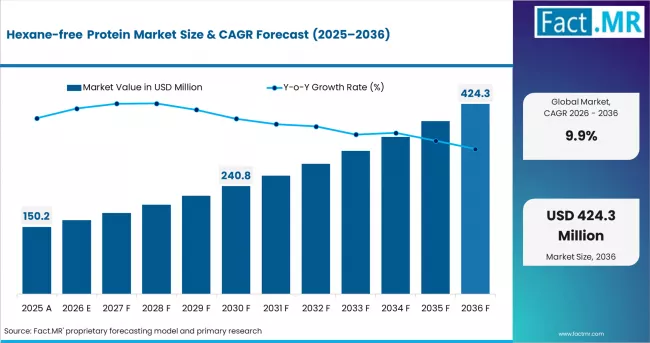
Hexane Free Protein Market Value Analysis | Source: Fact.MR
Summary of the Hexane-free Protein Market
- Market Definition
- The market includes plant based protein ingredients produced without the use of hexane solvent during oil extraction or protein isolation processes. Mechanical pressing and aqueous extraction methods are used to improve ingredient purity and align with clean label processing requirements. Hexane free proteins are used in beverages, sports nutrition products, bakery applications, dairy alternatives, and personal care formulations.
- Demand Drivers
- Increasing preference for clean label protein ingredients produced without solvent based extraction methods
- Rising demand for plant derived proteins in sports nutrition and functional food formulations
- Expansion of protein fortification across beverages, bakery products, and dairy alternatives
- Growing regulatory scrutiny regarding chemical solvent residues in food ingredient processing
- Key Segments Analyzed
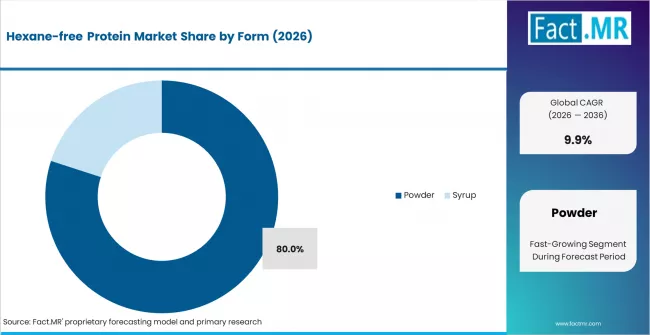
- Form: Powder form leads with around 80% share in 2026 supported by stability and formulation compatibility
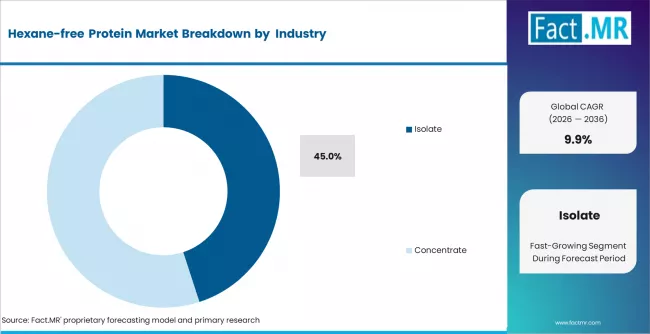
- Type: Protein isolate holds approximately 45% share due to high protein concentration and purity levels
- End Use: Energy and sports nutrition along with beverages represent key application areas
- Geography: North America and Europe show stable adoption, while Asia Pacific supports processing capacity expansion
- Analyst Opinion at Fact MR
- Shambhu Nath Jha, Principal Consultant, Fact MR, opines, "In this updated edition of the Hexane-free Protein Market report, industry participants will observe a structural transition toward solvent-free extraction technologies aligned with ingredient transparency requirements. Hexane-free protein ingredients support formulation strategies across plant-based foods, beverages, and nutrition products where processing methods influence procurement decisions. Companies that strengthen mechanical extraction capabilities and raw material traceability are expected to maintain competitive positioning through 2036."
- Strategic Implications/Executive Takeaways
- Invest in solvent free extraction technologies to align with clean label ingredient sourcing standards
- Strengthen supply chain integration for oilseed and plant protein raw materials
- Expand application development across sports nutrition, beverages, and dairy alternative formulations
- Focus on cost optimization strategies to address pricing pressure relative to conventional protein isolates
- Methodology
- Primary interviews conducted with plant protein manufacturers, ingredient suppliers, and food processors
- Desk research based on food ingredient publications, company reports, agricultural datasets, and trade statistics
- Market sizing derived using a hybrid approach combining bottom up production analysis with top down demand assessment
- Data validation performed through cross verification with industry datasets and internal peer review aligned with Fact MR standards
Hexane-free Protein Market
| Metric | Details |
|---|---|
| Industry Size (2026E) | USD 150.2 million |
| Industry Value (2036F) | USD 386.2 million |
| CAGR (2026 to 2036) | 9.9% |
Source: Fact.MR analysis. Updated Apr 15, 2026
A CAGR of 9.9% indicates transformational expansion, suggesting a structural shift toward solvent-free extraction methods driven by clean-label positioning and regulatory scrutiny of hexane residues. Growth momentum is reinforced by reformulation demand in sports nutrition and functional foods, while scaling constraints persist due to higher processing costs, supply chain adjustment for non-hexane oilseed processing, and price sensitivity in mass-market applications.
China leads with a projected CAGR of 8.1%, supported by expansion of plant protein processing capacity and increasing use in functional beverage formulations. The United States follows with a CAGR of 7.2%, driven by strong adoption of solvent-free protein ingredients in sports nutrition and clean label food products. The United Kingdom records a CAGR of 6.5%, reflecting growing use of plant-derived proteins across dairy alternatives and fortified foods. Germany shows a CAGR of 6.4%, supported by stable demand for non-solvent extracted protein ingredients in bakery and nutritional product formulations. France records the slowest growth at 6.3%, reflecting a mature market where demand is largely tied to replacement of conventional protein isolates with solvent-free alternatives. Mature markets generate a significant share of replacement demand as reformulation strategies emphasize solvent-free processing standards across plant protein applications.
Segmental Analysis
Hexane-free Protein Market Analysis by Form
Hexane Free Protein Market Analysis By Form | Source: Fact.MR
- Market Overview: Based on Fact MR assessment, powder form is projected to account for 80% share of the hexane-free protein market in 2026. Dry protein formats are widely incorporated across functional food, sports nutrition, and dairy alternative formulations due to extended shelf stability and simplified transportation requirements. Powder protein ingredients are compatible with spray drying and mechanical extraction processes that avoid solvent-based separation techniques. Demand concentration is supported by manufacturers seeking clean label protein inputs aligned with solvent-free processing specifications and traceable ingredient sourcing frameworks across plant protein value chains.
- Demand Drivers:
- Processing Compatibility: Powder protein formats support blending uniformity across beverage premixes, protein bars, bakery applications, and fortified cereal formulations requiring consistent dispersion properties.
- Shelf Stability Performance: Reduced moisture content enables longer storage duration across ambient and controlled storage environments, supporting global ingredient distribution networks.
- Label Transparency Requirements: Solvent-free extraction declarations are incorporated into product labeling frameworks where ingredient traceability and minimal processing claims influence procurement specifications.
Hexane-free Protein Market Analysis by Type
Hexane Free Protein Market Analysis By Type | Source: Fact.MR
- Market Overview: Protein isolate is estimated to hold 45% share of the hexane-free protein market in 2026, supported by higher protein concentration and reduced carbohydrate content relative to concentrate variants. Isolate protein ingredients are utilized across performance nutrition and medical nutrition formulations where controlled macronutrient composition is required. Mechanical separation and aqueous processing methods are applied to achieve high purity protein fractions without hexane exposure during oil separation stages in oilseed protein extraction workflows.
- Demand Drivers:
- Protein Concentration Requirements: Isolate variants support formulation of high protein content products aligned with clinical nutrition, muscle maintenance, and weight management dietary protocols.
- Functional Solubility Properties: Improved dispersibility characteristics support application across ready-to-mix beverages, dairy alternatives, and emulsified nutrition formulations.
- Specification Compliance: Food manufacturers incorporate isolate proteins meeting solvent-free processing criteria aligned with clean ingredient sourcing standards across plant-derived protein categories.
Key Dynamics
Hexane-free Protein Market Drivers, Restraints, and Opportunities
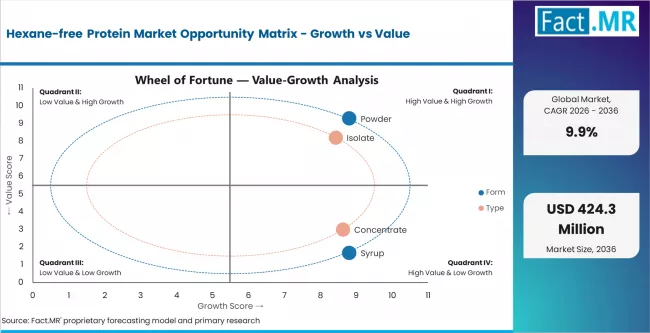
Hexane Free Protein Market Opportunity Matrix Growth Vs Value | Source: Fact.MR
Fact MR analysis indicates that the hexane-free protein market developed from oilseed processing technologies where solvent extraction methods traditionally used hexane to separate protein from oil. Conventional protein isolates derived from soy and other oilseeds often relied on hexane-based extraction due to cost efficiency and high protein yield. The current market valuation reflects the emergence of mechanical and water-based extraction processes that eliminate hexane use in protein production. Demand persists because food manufacturers require protein ingredients produced through alternative processing methods that align with formulation transparency and ingredient sourcing preferences.
A structural shift is occurring as conventional solvent-extracted protein ingredients face competition from mechanically processed and solvent-free protein concentrates. Standard protein isolates remain widely used in large-scale food production where price efficiency and supply consistency remain dominant factors. Hexane-free protein ingredients require additional processing controls and specialized extraction technologies that increase manufacturing costs relative to traditional methods. These proteins are often used in plant-based foods, beverages, and nutrition products positioned around ingredient processing methods. Even with moderate adoption volumes, higher per-unit pricing supports gradual market value expansion.
- Solvent Free Processing: Manufacturers adopt mechanical pressing and aqueous extraction methods to produce protein ingredients without hexane-based solvents.
- Food Ingredient Compliance: Regulatory frameworks such as U.S. Food and Drug Administration food processing guidelines and European Food Safety Authority ingredient safety evaluations influence processing standards and labeling practices.
- North America Plant Protein Demand: The United States maintains strong demand for plant-based protein ingredients used in beverages, meat alternatives, and nutrition products.
Regional Analysis
The hexane-free protein market is assessed across North America, Europe, Asia Pacific, Latin America, and Middle East & Africa, segmented by country-level plant protein adoption, clean-label processing demand, and food ingredient innovation. Regional demand reflects solvent-free extraction preference, protein fortification trends, and regulatory compliance frameworks. The full report offers market attractiveness analysis.
.webp "Top Country Growth Comparison Hexane Free Protein Market Cagr (2026 2036)")
Top Country Growth Comparison Hexane Free Protein Market Cagr (2026 2036) | Source: Fact.MR
| Country | CAGR (2026–2036) |
|---|---|
| China | 8.1% |
| USA | 7.2% |
| UK | 6.5% |
| Germany | 6.4% |
| France | 6.3% |
Source: Fact.MR analysis. Updated Apr 15, 2026
Source: Fact MR analysis, based on proprietary forecasting model and primary research
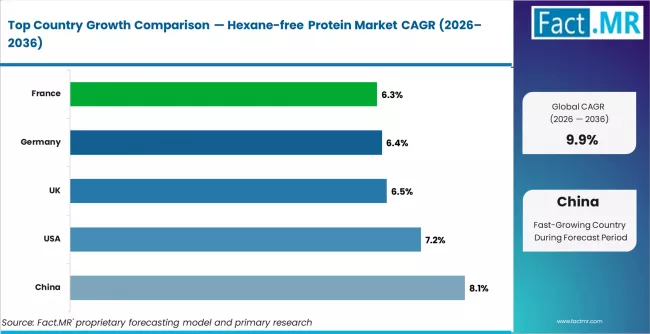
Hexane Free Protein Market Cagr Analysis By Country | Source: Fact.MR
North America
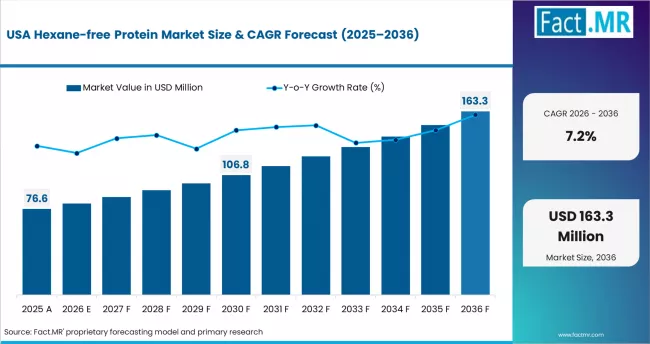
Hexane Free Protein Market Country Value Analysis | Source: Fact.MR
North America functions as the clean-label protein innovation and ingredient processing hub, supported by strong demand for solvent-free protein extraction technologies. Axiom Foods, Inc. maintains a strong position in hexane-free extraction solutions. Archer Daniels Midland Company expands plant-based protein production capabilities. Cargill, Incorporated strengthens alternative protein ingredient portfolio.
- USA: Demand for hexane-free protein in USA is projected to rise at 7.2% CAGR through 2036. Growth is supported by FDA food ingredient safety regulations (U.S. FDA, ongoing), governing processing standards. Archer Daniels Midland Company expanded solvent-free protein processing capabilities (March 2023), supporting supply.
Europe
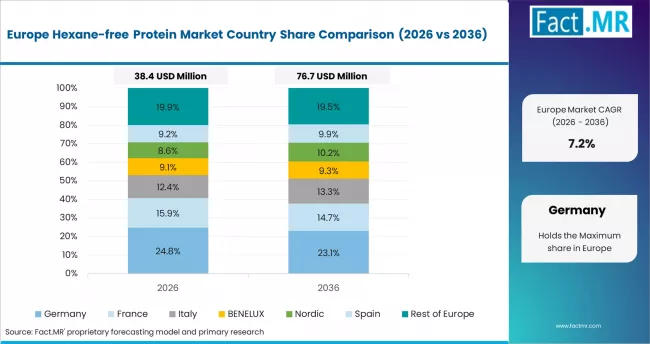
Hexane Free Protein Market Europe Country Market Share Analysis, 2026 & 2036 | Source: Fact.MR
Europe operates as the regulatory and clean-label ingredient development base, shaped by strict food processing standards and plant-based product demand. Kerry Group plc leads in alternative protein solutions. Roquette Frères S.A. supports protein ingredient innovation. Cosucra Groupe Warcoing SA expands plant-based ingredient offerings.
- UK: Demand for hexane-free protein in UK is projected to rise at 6.5% CAGR through 2036. The UK National Food Strategy (updated 2021) supports alternative protein adoption. Kerry Group plc expanded plant protein ingredient solutions (February 2023), supporting market growth.
- Germany: Demand for hexane-free protein in Germany is projected to rise at 6.4% CAGR through 2036. EU food processing regulations (European Commission, updated 2022) support clean-label ingredient production. Roquette Frères S.A. expanded plant protein processing capacity (January 2023), supporting demand.
- France: Demand for hexane-free protein in France is projected to rise at 6.3% CAGR through 2036. The French National Protein Strategy (Ministry of Agriculture, ongoing) supports plant protein development. Cosucra Groupe Warcoing SA expanded protein ingredient production (March 2023), supporting adoption.
Asia Pacific
Asia Pacific serves as the high-growth plant protein production and food ingredient market, supported by expanding functional food demand and processing capacity. Wilmar International Limited strengthens plant protein ingredient production. SunOpta Inc. expands plant protein processing capabilities. Devansoy Inc. supports alternative protein supply chains.
- China: Demand for hexane-free protein in China is projected to rise at 8.1% CAGR through 2036. The Healthy China initiative (State Council, ongoing) promotes alternative protein consumption. Wilmar International Limited expanded plant protein processing operations (April 2023), supporting market growth.
Fact MR's analysis of hexane-free protein market in global regions consists of country-wise assessment that includes China, USA, UK, Germany, and France. Readers can find clean-label processing trends, ingredient innovation patterns, regulatory developments, and competitive positioning across key markets.
Competitive Landscape
Competitive Structure and Buyer Dynamics in the Hexane-free Protein Market
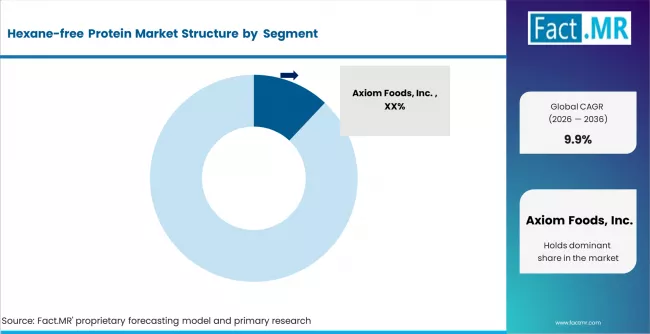
Hexane Free Protein Market Analysis By Company | Source: Fact.MR
The competitive structure of the Hexane-free Protein Market is moderately fragmented, with a mix of global agribusiness firms and specialized plant protein producers participating in supply. Companies such as Archer Daniels Midland Company, Cargill, Incorporated, Kerry Group plc, SunOpta Inc., and Wilmar International Limited maintain strong positions through established oilseed processing infrastructure and global ingredient distribution networks. These firms supply hexane free protein ingredients derived from soy, peas, and other plant sources used in food and beverage applications. Additional participants including Axiom Foods, Inc., Nutiva, Inc., Parabel USA Inc., DuPont de Nemours, Inc., Devansoy Inc., Ag Processing Inc., and BioPress S.A.S. contribute through specialized extraction technologies and identity preserved raw material sourcing. Competition is primarily influenced by protein purity, extraction method efficiency, flavor profile, and compliance with clean label formulation requirements.
Several companies maintain structural advantages through integrated agricultural sourcing and advanced mechanical or water based extraction processes. Firms such as Archer Daniels Midland Company, Cargill, Incorporated, and Wilmar International Limited benefit from vertically integrated oilseed supply chains and large scale processing infrastructure. Kerry Group plc and DuPont de Nemours, Inc. maintain advantages through formulation expertise and established relationships with food manufacturers. Buyers in plant based food production often adopt multi supplier procurement strategies to reduce dependence on a single ingredient provider and ensure supply continuity. Procurement decisions evaluate suppliers based on protein functionality, traceability, and long term availability. This purchasing behavior moderates supplier pricing leverage, while producers with proprietary extraction technologies and stable raw material sourcing retain moderate negotiating influence.
Key Players of the Hexane-free Protein Market
- Axiom Foods, Inc.
- Nutiva, Inc.
- Cargill, Incorporated
- Parabel USA Inc.
- DuPont de Nemours, Inc. (DuPont Nutrition & Health business)
- Kerry Group plc
- Devansoy Inc.
- SunOpta Inc.
- Archer Daniels Midland Company
- BioPress S.A.S.
- Wilmar International Limited
- Ag Processing Inc.
Report Scope
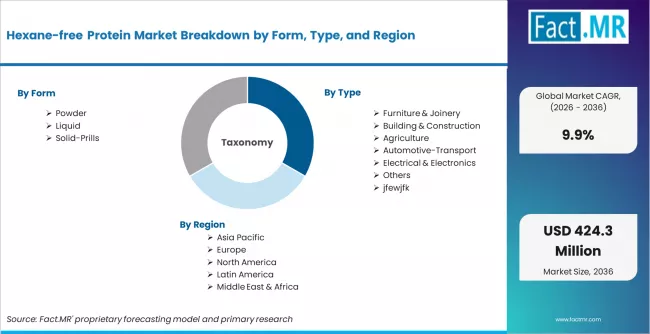
Hexane Free Protein Market Breakdown By Form, Type, And Region | Source: Fact.MR
| Metric | Value |
|---|---|
| Quantitative Units | USD 150.2 million (2026) to USD 386.2 million (2036), at a CAGR of 9.9% |
| Market Definition | The hexane-free protein market includes plant-derived protein ingredients produced without the use of hexane solvent extraction, ensuring clean label processing standards and suitability for food, beverage, and personal care applications requiring solvent-free protein sources. |
| Type Segmentation | Isolate, Concentrate, Flour |
| Form Segmentation | Powder, Syrup |
| End Use Segmentation | Beverages, Cosmetics and Personal Care, Breakfast Cereal and Cereal Bars, Energy and Sports Nutrition, Bakery Products, Dairy Products, Others |
| Regions Covered | North America, Latin America, Europe, East Asia, South Asia, Oceania, Middle East and Africa |
| Countries Covered | United States, Canada, Mexico, Brazil, Germany, United Kingdom, France, Italy, Spain, China, India, Japan, South Korea, Australia, and 40+ countries |
| Key Companies Profiled | Axiom Foods, Inc., Nutiva, Inc., Cargill, Incorporated, Parabel USA Inc., DuPont de Nemours, Inc., Kerry Group plc, Devansoy Inc., SunOpta Inc., Archer Daniels Midland Company, BioPress S.A.S., Wilmar International Limited, Ag Processing Inc. |
| Forecast Period | 2026 to 2036 |
| Approach | Hybrid top-down and bottom-up market modeling supported by plant protein demand trends, solvent-free processing adoption analysis, ingredient supply chain assessment, and validation through interviews with manufacturers, ingredient suppliers, and food processing companies. |
Source: Fact.MR analysis. Updated Apr 15, 2026
Hexane-free Protein Market Key Segments
-
Type:
- Isolate
- Concentrate
- Flour
-
Form:
- Powder
- Syrup
-
End Use:
- Beverages
- Dairy based Beverages
- Functional Beverages
- Others
- Cosmetics and Personal Care
- Breakfast Cereal and Cereal Bars
- Energy and Sports Nutrition
- Bakery Products
- Dairy Products
- Others
- Beverages
-
Region:
- North America
- USA
- Canada
- Mexico
- Europe
- Germany
- UK
- France
- Italy
- Spain
- Nordic Countries
- BENELUX
- Rest of Europe
- Asia Pacific
- China
- Japan
- South Korea
- India
- Australia
- Rest of Asia Pacific
- Latin America
- Brazil
- Argentina
- Rest of Latin America
- Middle East and Africa
- Kingdom of Saudi Arabia
- United Arab Emirates
- South Africa
- Rest of Middle East and Africa
- Other Regions
- Oceania
- Central Asia
- Other Markets
- North America
Bibliographies
- [1] Tang, J. (2024, June 9). Recent progress in plant-based proteins: From extraction and processing to functional and structural properties. Elsevier / Food Science and Nutrition. Retrieved March 23, 2026.
- [2] Chandran, A. S., et al. (2023, July 19). Sustainable plant protein: An up-to-date overview of sources, isolation/extraction techniques, and applications in the food industry. Royal Society of Chemistry (Food and Bioprocessing Technology). Retrieved March 23, 2026.
- [3] Cravotto, C., et al. (2022, October 27). Towards substitution of hexane as extraction solvent of food ingredients: A review of residue concerns and alternatives. Elsevier / Food Chemistry. Retrieved March 23, 2026.
- [4] European Food Safety Authority (EFSA). (2025, June 22). Call for data for the re-evaluation of technical hexane used as extraction solvent in food and food ingredients (EFSA-Q-2025-00358). EFSA. Retrieved March 23, 2026.
- [5] Good Food Institute India (GFI-India). (2024, July). Plant protein extraction guide: Industrially relevant plant protein extraction technologies and clean-label considerations. GFI-India. Retrieved March 23, 2026.
This Report Addresses
- Market size estimation and revenue forecasts for the Chelated Selenium Market from 2026 to 2036, supported by micronutrient demand trends and trace mineral consumption benchmarks.
- Growth opportunity mapping across organic and inorganic chelated selenium compounds, reflecting demand for improved bioavailability and formulation stability in nutritional and feed applications.
- Segment and regional revenue forecasts covering types, end use industries, distribution channels, and key markets including India, China, Germany, United Kingdom, and United States.
- Competition strategy assessment of leading companies such as Jost Chemical Co., Sumitomo Metal Mining Co., Ltd., Salvi Chemical Industries Ltd., JX Nippon Mining & Metals Corporation, and Nutri-West, Inc., including production capability and purity benchmarking.
- Regulatory impact analysis covering EFSA feed additive approvals, FDA dietary supplement regulations, and trace mineral compliance standards influencing formulation and commercialization.
- Market report delivery in PDF, Excel, PPT, and interactive dashboard formats designed for ingredient sourcing, formulation planning, and market evaluation.
- Supply chain vulnerability assessments examining raw material price variability in selenium intermediates, regulatory compliance costs, and dependency on mining and refining capacity impacting production stability.
Hexane-free Protein Market Definition
The Hexane-free Protein Market includes plant based protein ingredients produced without the use of hexane solvent during oil extraction or protein isolation processes. Hexane free processing methods use mechanical pressing, water extraction, or other solvent free techniques to maintain ingredient purity and reduce chemical residue concerns. These proteins are commonly derived from sources such as soy, pea, rice, and other plant materials. Hexane free protein ingredients are widely used in beverages, sports nutrition products, bakery items, dairy alternatives, and personal care formulations. The primary function of hexane free protein is to provide plant based protein content produced through alternative extraction processes.
Hexane-free Protein Market Inclusions
This report covers global and regional market sizes for hexane free protein ingredients with forecast analysis for the study period. The market is segmented by type including isolate, concentrate, and flour forms. Form segmentation includes powder and syrup based products. Application segments include beverages, cosmetics and personal care, breakfast cereals and cereal bars, energy and sports nutrition, bakery products, dairy products, and other food applications. End users include food manufacturers, nutraceutical companies, and personal care product developers. The report also evaluates pricing patterns, production trends, and selected trade flow analysis across major plant protein markets.
Hexane-free Protein Market Exclusions
The report excludes protein ingredients produced using hexane solvent extraction methods. Animal derived protein products such as whey protein and casein are not included. The scope also excludes finished consumer food products that contain plant proteins as minor ingredients. Oil extraction processes unrelated to protein ingredient production are outside the defined market scope, as the analysis focuses strictly on plant protein ingredients manufactured without hexane solvent use.
Hexane-free Protein Market Research Methodology
- Primary Research
- Interviews were conducted with plant protein manufacturers, ingredient suppliers, food processors, and nutraceutical developers.
- Desk Research
- Public information was collected from food ingredient industry publications, company reports, agricultural data, and trade statistics.
- Market-Sizing and Forecasting
- A hybrid model combining bottom up production analysis with top down demand assessment across food, nutrition, and personal care sectors was applied.
- Data Validation and Update Cycle
- Findings were cross verified using multiple industry data sources and expert inputs, with periodic updates conducted as new market information becomes available.
Frequently Asked Questions
How large is the demand for Hexane-free Protein in the global market in 2026?
What will be the market size of Hexane-free Protein in the global market by 2036?
What is the expected demand growth for Hexane-free Protein in the global market between 2026 and 2036?
Which Form Segment is poised to lead global demand by 2026?
Which Company is Identified as a Leading Participant in the Hexane-free Protein Market?
What is Driving Hexane-free Protein Demand in the United States?
What is the United States Growth Outlook in this Report?
Why is China an Important Market for Hexane-free Protein?
What is the China Growth Outlook in this Report?
What Factors Support Hexane-free Protein Adoption in the United Kingdom?
What is the United Kingdom Growth Outlook in this Report?
Why is Germany Considered an Important Market for Hexane-free Protein in Europe?
What is the Germany Growth Outlook in this Report?
Why is France Included in the Hexane-free Protein Market Outlook?
What is the France Growth Outlook in this Report?
What is Hexane-free Protein and What is It Mainly Used For?
What does Hexane-free Protein Market Mean in this Report?
What is Included in the Scope of this Hexane-free Protein Market Report?
What is Excluded from the Scope of this Report?
What does Market Forecast Mean on this Page?
How is the Hexane-free Protein Market Forecast Developed in this Report?
Who worked on this report


Preview the report firsthand - request a free sample
Free SampleGet the brochure for pricing and purchase details
Download PDF