- Base Value(2025): 0.24 Bn
- Estimated Value(2026): 0.26 Bn
- Forecast Value (2036): 0.60 Bn
- CAGR (2026 - 2036): 8.7%
High Airtight Storage Cabinets Market Forecast and Outlook 2026 to 2036
In 2025, the high airtight storage cabinets market was valued at approximately USD 0.24 billion. Based on Fact.MR analysis, demand for high airtight storage cabinets is estimated to reach around USD 0.26 billion in 2026 and expand to nearly USD 0.60 billion by 2036, reflecting a CAGR of 8.7% during the forecast period. As Charles Giancarlo, Chairman and CEO of Pure Storage, stated,
“When you believe a technology is a commodity, you stop investing in it or you focus only on cost, whereas if you look at it as high technology you want to consistently be doing two things.”
Fact.MR analysis applies this perspective to airtight storage infrastructure, where laboratories, semiconductor facilities, and medical institutions increasingly treat cabinet systems as precision environmental control equipment rather than standard furniture-grade storage.
The market is expected to add roughly USD 0.36 billion in incremental value over the forecast window, reflecting steady capacity expansion in research laboratories, advanced manufacturing, and healthcare facilities. Early-period growth is supported by stainless steel and aluminum cabinets deployed in regulated laboratory environments. Mid-period expansion aligns with electronics protection and moisture-sensitive material storage in semiconductor manufacturing. In later years, value realization is shaped by adoption of large and extra-large capacity cabinets in centralized pharmaceutical and medical supply storage systems.
The United States leads growth at 9.1% CAGR, supported by research infrastructure investment and healthcare upgrades. Germany follows at 8.9%, driven by regulated industrial manufacturing and laboratory expansion. Japan records 8.5%, reflecting electronics sector demand for controlled environments. China posts 8.2%, supported by large-scale manufacturing growth, while South Korea at 7.8% benefits from semiconductor fabrication and institutional research facility development.
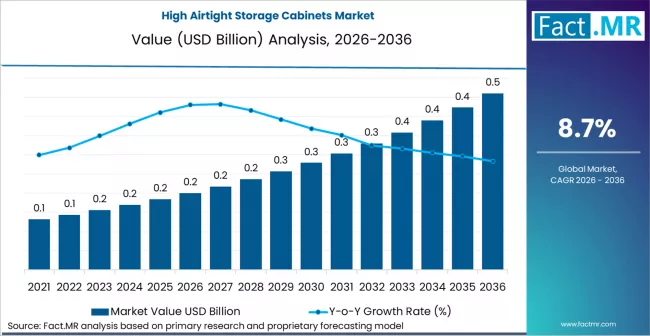
High Airtight Storage Cabinets Market Market Value Analysis | Source: Fact.MR
Summary of High Airtight Storage Cabinets Market
- Market Definition
- The high airtight storage cabinets market comprises sealed storage systems engineered to restrict air exchange and control internal humidity, protecting moisture-sensitive, chemical, electronic, and medical materials in regulated environments.
- Primary Demand Drivers
- Expansion of semiconductor fabrication, pharmaceutical laboratories, and advanced research facilities increases demand for cabinets with validated sealing performance and controlled atmospheric stability.
- Rising enforcement of workplace safety and hazardous material handling standards supports procurement of certified airtight storage infrastructure.
- Growth in electronics manufacturing and precision component storage drives adoption of humidity-controlled and corrosion-resistant cabinet systems.
- Key Segments Analyzed
- Material Type: Stainless steel cabinets hold the largest share due to corrosion resistance, structural durability, and compatibility with laboratory and cleanroom standards.
- Capacity: Small-capacity cabinets up to 50 liters dominate, reflecting benchtop laboratory usage and localized containment requirements.
- Geography: North America and Europe lead value realization, while East Asia demonstrates strong demand tied to semiconductor and electronics manufacturing expansion.
- Analyst Opinion at Fact.MR
- Shambhu Nath Jha, Principal Consultant at Fact.MR, opines, ‘Decision-makers should evaluate airtight storage cabinets not as passive furniture assets but as compliance-linked infrastructure, where sealing validation, humidity stability metrics, and material certification directly influence laboratory audit outcomes and operational risk exposure.’
- Strategic Implications
- Manufacturers should prioritize documented sealing performance and compliance certification to strengthen positioning in regulated sectors.
- End users benefit from aligning cabinet specifications with occupational safety and hazardous material standards to reduce inspection risk.
- Investment focus should target semiconductor and pharmaceutical clusters where contamination control requirements are expanding.
- Methodology
- Insights derived from interviews with laboratory managers, safety officers, and industrial procurement teams.
- Regulatory context. [1]
- Consumer and product safety benchmarks. [2]
High Airtight Storage Cabinets Market
| Metric | Value |
|---|---|
| Market Value (2026) | USD 0.26 billion |
| Forecast Value (2036) | USD 0.60 billion |
| Forecast CAGR (2026-2036) | 8.7% |
Source: Fact.MR analysis. Updated Feb 26, 2026
High Airtight Storage Cabinets Market Definition
The high airtight storage cabinets market covers enclosed storage units designed to limit air exchange and protect stored contents from moisture, dust, fumes, or contamination. These cabinets use sealed doors, gaskets, and controlled construction to maintain internal conditions. They are used in laboratories, industrial facilities, healthcare settings, and chemical storage areas to safeguard sensitive materials and comply with safety practices. Product safety, workplace use, and storage requirements align with regulations enforced by the US Occupational Safety and Health Administration and consumer product safety oversight by the US Consumer Product Safety Commission. [3]
High Airtight Storage Cabinets Market Inclusions
The report covers global and regional market size estimates in volume and value with a forecast from 2026 to 2036. Segmentation includes cabinet size, material type, sealing mechanism, application across laboratories and industrial storage, and end use by healthcare, manufacturing, and research facilities. Regional demand patterns and pricing trends are included.
High Airtight Storage Cabinets Market Exclusions
The scope excludes standard office cabinets, shelving units, and lockers without airtight sealing features. Refrigerated storage units, hazardous material safety cabinets with active ventilation systems, and cleanroom furniture are not included. Installation services, facility design services, and custom built one off storage systems are outside the scope.
High Airtight Storage Cabinets Market Research Methodology
- Primary Research: Interviews were conducted with cabinet manufacturers, laboratory managers, safety officers, and industrial procurement teams.
- Desk Research: Desk research reviewed workplace storage and safety guidance issued by the US Occupational Safety and Health Administration and consumer product safety rules from the US Consumer Product Safety Commission, along with company disclosures.
- Market Sizing and Forecasting: Estimates were developed using facility count data, storage equipment adoption rates, and replacement cycles across end use sectors.
- Data Validation and Update Cycle: Data was cross checked against procurement records, regulatory documentation, trade data, and manufacturer shipment disclosures before updates were finalized.
Segmental Analysis
High Airtight Storage Cabinets Market Analysis by Material Type
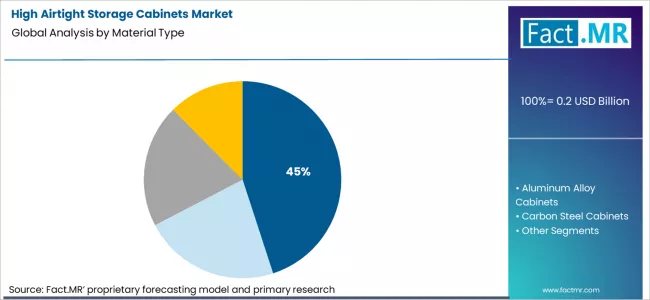
High Airtight Storage Cabinets Market Analysis By Material Type | Source: Fact.MR
Based on Fact.MR analysis, consumption of stainless steel cabinets is estimated to hold 45% share of the global high airtight storage cabinets market. Fact.MR analysts note stainless steel leads due to corrosion resistance, structural strength, and compatibility with controlled environments. As per Fact.MR, this material type addresses laboratory, pharmaceutical, and electronics storage requirements where airtight sealing, contamination control, and chemical resistance are necessary for preserving sensitive materials under regulated storage conditions worldwide today.
- Workplace compliance: Storage of hazardous and sensitive materials is governed by occupational safety standards. [4]
- Material resilience: Fact.MR analysts note stainless steel resists chemical exposure and moisture damage.
- Cleanroom suitability: Stainless steel cabinets align with cleanroom and controlled facility requirements.
High Airtight Storage Cabinets Market Analysis by Capacity
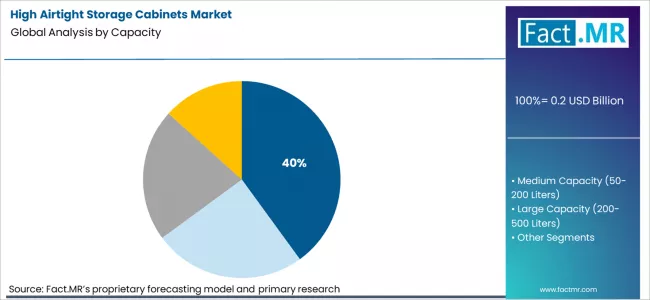
High Airtight Storage Cabinets Market Analysis By Capacity | Source: Fact.MR
Based on Fact.MR analysis, consumption of small capacity cabinets up to 50 liters is estimated to hold 40% share of the global market. Fact.MR analysts note this capacity range leads due to suitability for benchtop laboratories, research units, and compact storage spaces. As per Fact.MR, small capacity cabinets address user needs for localized airtight containment, ease of placement, and lower acquisition cost, supporting adoption across research institutions, testing facilities, and small-scale production environments worldwide today.
- Laboratory standards: Laboratory storage practices are guided by national safety and containment frameworks.
- Space efficiency: Fact.MR analysts note compact cabinets fit constrained laboratory layouts.
- Cost accessibility: Smaller units require lower initial investment compared with large systems.
High Airtight Storage Cabinets Market Drivers, Restraints, and Opportunities
Fact.MR analysis indicates that the high airtight storage cabinets market exists as a specialised industrial storage solutions segment used in laboratories, pharmaceutical facilities, electronics manufacturing, and hazardous material handling environments where controlled containment is essential. As per Fact.MR assessment, airtight storage cabinets are engineered to protect contents from moisture, dust, and gas exchange, and their performance expectations intersect with workplace safety and hazardous material containment guidance such as the U.S. Occupational Safety and Health Administration (OSHA) Hazard Communication Standard, which outlines requirements for safe storage and labelling of hazardous chemicals in facilities. [5] Fact.MR analysts observe that the current market scale is shaped by stringent safety protocols in regulated environments where materials must be stored under defined atmospheric conditions to mitigate risk and ensure product integrity.
Fact.MR is of the opinion that current market dynamics reflect a transition from basic enclosed storage cabinets toward high airtight designs that offer precise environmental control, compliance documentation support, and integration with facility monitoring systems. Based on Fact.MR assessment, conventional cabinets with simple seals remain prevalent where basic containment suffices, but demand is growing for high airtight cabinets in sectors such as pharmaceuticals and electronics where moisture and particulate exclusion are tightly specified. High airtight storage cabinets typically carry higher per-unit pricing because of enhanced sealing systems, controlled desiccant integration, and performance testing to meet safety protocols, meaning realised market value can rise even where shipment volumes grow at a measured pace. Fact.MR analysis suggests this combination of evolving application requirements and premium value placement will shape near-term market progression.
- Regulated safety and containment expectations: Fact.MR analysts note that frameworks such as the OSHA Hazard Communication Standard influence how facilities specify and deploy airtight storage solutions to safely contain hazardous and sensitive materials.
- Shift to high-performance containment: Based on Fact.MR assessment, increasing need for controlled atmospheric storage in pharmaceutical and electronics manufacturing supports demand for airtight cabinets with enhanced sealing and monitoring capabilities.
- Asia Pacific industrial and lab infrastructure growth: Fact.MR opines that expanding laboratory, manufacturing, and healthcare infrastructure in China, India, and Southeast Asia supports regional uptake of high airtight storage cabinets as part of facility safety and quality systems.
Regional Analysis
Based on regional assessment, the high airtight storage cabinets sector is analyzed across North America, Europe, East Asia, and other advanced laboratory and industrial markets, spanning more than 40 countries. Regional performance varies according to laboratory safety requirements, growth in pharmaceutical and electronics manufacturing, and adoption of controlled-environment storage solutions.
High Airtight Storage Cabinets Market CAGR Analysis by Country (2026-2036)
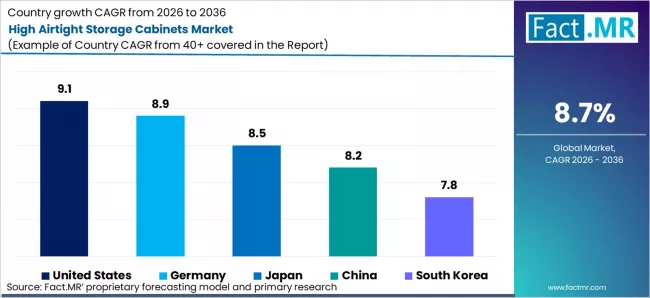
High Airtight Storage Cabinets Market Cagr Analysis By Country | Source: Fact.MR
| Country | CAGR |
|---|---|
| United States | 9.1% |
| Germany | 8.9% |
| Japan | 8.5% |
| China | 8.2% |
| South Korea | 7.8% |
Source: Fact.MR analysis. Updated Feb 26, 2026
Source: Fact.MR analysis, based on proprietary forecasting models and primary research.
Demand for High Airtight Storage Cabinets in Asia Pacific
Asia Pacific reflects growing demand for high airtight storage cabinets supported by semiconductor manufacturing laboratory research and electronics production. Sales growth is linked to humidity control requirements contamination prevention and expansion of cleanroom facilities. China Japan and South Korea anchor regional volume through advanced manufacturing and research infrastructure. Procurement favors cabinets with precise humidity regulation and sealed environments. Market expansion reflects investment in chip fabrication pharmaceutical laboratories and precision component storage across regulated industrial clusters regionwide.
- China: Demand for high airtight storage cabinets in China is projected to rise at 8.2% CAGR through 2036. Growth reflects semiconductor manufacturing expansion and increasing need for controlled humidity storage in electronics production, as per Fact.MR.
- Japan: Demand for high airtight storage cabinets in Japan is projected to rise at 8.5% CAGR through 2036. Usage is supported by advanced manufacturing and laboratory storage requirements, according to Fact.MR.
- South Korea: Demand for high airtight storage cabinets in South Korea is projected to rise at 7.8% CAGR through 2036. Adoption reflects semiconductor fabrication activity and contamination control standards, as per Fact.MR.
Fact.MR’s analysis of the High Airtight Storage Cabinets Market in Asia Pacific consists of country-wise assessment that includes China, Japan, and South Korea. Readers can find manufacturing trends and cleanroom storage insights.
Analysis On High Airtight Storage Cabinet Sales in North America
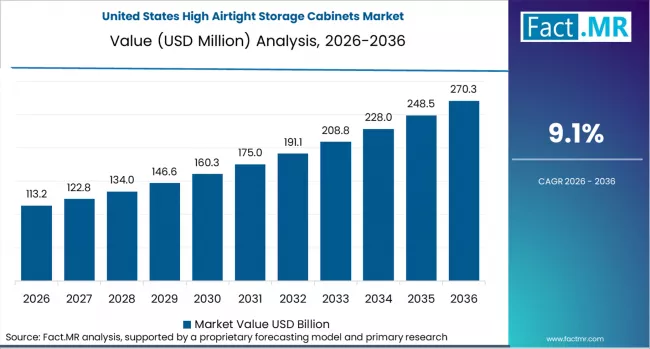
High Airtight Storage Cabinets Market Country Value Analysis | Source: Fact.MR
North America demonstrates steady sales of high airtight storage cabinets supported by semiconductor fabrication pharmaceutical research and advanced manufacturing sectors. Demand is driven by humidity sensitive component storage laboratory compliance and quality assurance standards. The United States anchors regional consumption through chip fabrication plants biotechnology laboratories and aerospace manufacturing facilities. Procurement emphasizes sealed enclosures monitoring systems and regulatory compliance. Market growth reflects facility upgrades research expansion and contamination control requirements across high precision industries nationwide.
- United States: Demand for high airtight storage cabinets in the United States is projected to rise at 9.1% CAGR through 2036. Sales are supported by semiconductor production biotechnology laboratories and precision manufacturing needs, as per Fact.MR.
Fact.MR’s analysis of the High Airtight Storage Cabinets Market in North America consists of country-wise assessment that includes the United States. Readers can find cleanroom infrastructure and laboratory investment insights.
Outlook On High Airtight Storage Cabinet Demand in Europe
Europe reflects structured demand for high airtight storage cabinets supported by pharmaceutical production semiconductor research and laboratory compliance standards. Sales are shaped by EU quality regulations contamination control norms and industrial precision requirements. Germany anchors regional growth through advanced manufacturing and research institutions. Procurement focuses on humidity control validation and long term durability. Market expansion reflects investment in medical research electronics production and laboratory modernization across Western European industrial and scientific facilities regionwide.
- Germany: Demand for high airtight storage cabinets in Germany is projected to rise at 8.9% CAGR through 2036. Adoption reflects laboratory modernization and advanced manufacturing storage requirements, according to Fact.MR.
Fact.MR’s analysis of the High Airtight Storage Cabinets Market in Europe consists of country-wise assessment that includes Germany. Readers can find regulatory compliance and research facility demand insights.
Competitive Landscape for Market Players
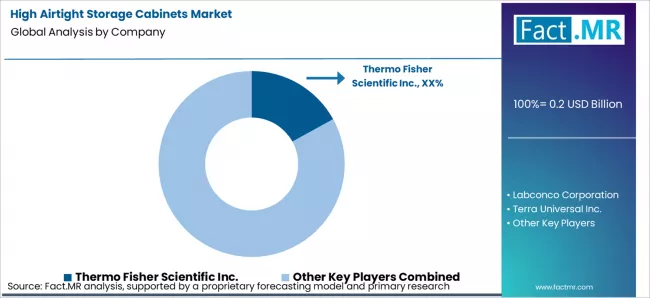
High Airtight Storage Cabinets Market Analysis By Company | Source: Fact.MR
As per Fact.MR analysis, the 2026 high airtight storage cabinets market is defined by validated sealing performance, temperature and humidity stability, and regulatory compliance, which determine competitive advantage. Thermo Fisher Scientific Inc. and Labconco Corporation lead with high-precision airtight storage solutions certified for laboratory and industrial use, which strengthens adoption in pharmaceuticals, biotechnology, and research facilities. Terra Universal Inc. and Memmert GmbH focus on multi-chamber, validated climate control systems, which improve specimen and material preservation under varied conditions. Binder GmbH and Weiss Technik GmbH provide cabinets with documented reliability and corrosion-resistant materials, which reduce operational risk and maintenance requirements. Shimadzu Corporation and Hitachi High-Tech deliver validated sensor integration and monitoring systems, which enhance usability and compliance with laboratory safety standards. Panasonic Corporation and Cole-Parmer Instrument Company emphasize modular designs and multi-region regulatory approvals, which support global adoption. Across the market, validated airtight performance, material durability, and regulatory adherence form enduring competitive moats, reducing reliance on pricing or isolated feature claims.
Recent Industry Developments
- Totech Europe: Facility Expansion & FIFO Modules: In early 2025, Totech Europe began a major expansion of its headquarters in Hattem, Netherlands, to house a new Long Term Storage (LTS) facility. Additionally, they recently launched the XSDC Series FIFO Modules, an innovative airtight solution specifically for First-In-First-Out storage of solder paste and sensitive components. [6]
- Dr. Storage: Smart IoT-Enabled Dry Cabinets: At Productronica 2025, Dr. Storage showcased its latest iF1IoT and iX2B series. These "Smart Dry Cabinets" integrate ultra-low humidity control ($\le 1\% \text{RH}$) with IoT monitoring systems. This allows manufacturers to track moisture-sensitive levels remotely via their "SensorLook" platform, addressing the industry shift toward Industry 4.0 standards. [7]
Key Players in High Airtight Storage Cabinets Market
- Thermo Fisher Scientific Inc.
- Labconco Corporation
- Terra Universal Inc.
- Memmert GmbH
- Binder GmbH
- Weiss Technik GmbH
- Shimadzu Corporation
- Hitachi High-Tech Corporation
- Panasonic Corporation
- Cole-Parmer Instrument Company
Bibliography
- [1] U.S. Occupational Safety and Health Administration. (2024). Occupational safety and health laws and regulations. U.S. Department of Labor.
- [2] U.S. Consumer Product Safety Commission. (2024). Regulations, laws, and standards for consumer products. U.S. Consumer Product Safety Commission.
- [3] U.S. Occupational Safety and Health Administration. (2024). Workplace safety and storage requirements; U.S. Consumer Product Safety Commission. (2024). Consumer product safety standards. U.S. Department of Labor; U.S. Consumer Product Safety Commission.
- [4] U.S. Occupational Safety and Health Administration. (2024). General industry standards (29 CFR Part 1910). U.S. Department of Labor.
- [5] U.S. Occupational Safety and Health Administration. (2024). Hazard Communication Standard (29 CFR 1910.1200). U.S. Department of Labor.
- [6] Totech Europe B.V. (2025). Building for the future: Expansion of long-term storage facilities and FIFO modules [Company news release]. Totech Europe.
- [7] Dr. Storage. (2025). Smart dry cabinets with IoT-enabled humidity control showcased at Productronica [Company product announcement]. Dr. Storage.
This Report Addresses
- Market intelligence to support structured strategic decision-making in contamination-controlled storage infrastructure, where sealing validation and humidity stability drive procurement more than general storage expansion
- Global market size assessment and 10-year revenue forecasts from 2026 to 2036, developed using facility counts, adoption rates across regulated end uses, and replacement/upgrade cycles for controlled-environment cabinets
- Growth opportunity mapping across material types (stainless steel, aluminum alloy, carbon steel, composite) with emphasis on corrosion resistance, cleanroom compatibility, and durability under regulated operating conditions
- Capacity-wise assessment spanning small (up to 50 L), medium (50-200 L), large (200-500 L), and extra-large (above 500 L) cabinets, highlighting where centralized storage and high-throughput facilities expand installed base
- Application-level demand analysis across chemical storage, electronics protection, food preservation, medical supplies storage, and document archival, with focus on moisture-sensitive and contamination-critical use cases
- End-use benchmarking across laboratories, hospitals and clinics, manufacturing facilities, research institutes, and other regulated environments, linking cabinet specification to audit readiness and operational risk exposure
- Competitive landscape assessment benchmarking suppliers on validated sealing performance, humidity regulation capability, material certification, monitoring integration, and after-sales service support
- Technology roadmap tracking covering gasket and sealing designs, desiccant and humidity control configurations, corrosion-resistant construction, sensor-enabled monitoring, and IoT connectivity for compliance documentation
- Regulatory and compliance context review aligned to workplace safety and storage guidance under U.S. OSHA frameworks and product safety oversight under U.S. CPSC standards
- Regional and country-level growth mapping across North America, Europe, and East Asia, highlighting differentiated demand in the United States, Germany, Japan, China, and South Korea
- Multi-format market report delivery in PDF, Excel datasets, PPT formats, and interactive dashboards for executive, EHS, lab operations, procurement, and facility management teams
Segmentation
Scope of the Report
| Metric | Value |
|---|---|
| Quantitative Units | USD 0.26 billion (2026) to USD 0.60 billion (2036), CAGR 8.7% |
| Market Definition | The high airtight storage cabinets market covers sealed storage units designed to limit air exchange and protect contents from moisture, dust, fumes, or contamination. These cabinets use gaskets, controlled construction, and environmental regulation features. Applications span laboratories, industrial facilities, healthcare, semiconductor manufacturing, and chemical storage. Product safety and workplace use align with US OSHA and CPSC regulations. |
| Material Type Segmentation | Stainless Steel Cabinets, Aluminum Alloy Cabinets, Carbon Steel Cabinets, Composite Material Cabinets |
| Capacity Segmentation | Small Capacity (Up to 50 Liters), Medium Capacity (50-200 Liters), Large Capacity (200-500 Liters), Extra Large Capacity (Above 500 Liters) |
| Application Segmentation | Chemical Storage, Electronics Protection, Food Preservation, Medical Supplies Storage, Document Archival |
| End Use Segmentation | Laboratories, Hospitals and Clinics, Manufacturing Facilities, Research Institutes, Others |
| Regions Covered | Asia Pacific, Europe, North America, Latin America, Middle East & Africa |
| Countries Covered | India, China, Japan, South Korea, Indonesia, Australia & New Zealand, Germany, Italy, France, United Kingdom, Spain, Benelux, Nordics, Central & Eastern Europe, United States, Canada, Mexico, Brazil, Argentina, Chile, Kingdom of Saudi Arabia, United Arab Emirates, South Africa, Turkey |
| Key Companies Profiled | Thermo Fisher Scientific Inc., Labconco Corporation, Terra Universal Inc., Memmert GmbH, Binder GmbH, Weiss Technik GmbH, Shimadzu Corporation, Hitachi High-Tech Corporation, Panasonic Corporation, Cole-Parmer Instrument Company |
| Forecast Period | 2026 to 2036 |
| Approach | Hybrid top-down and bottom-up modeling validated with primary interviews of cabinet manufacturers, laboratory managers, and industrial procurement teams; cross-checked with facility adoption data, cleanroom infrastructure investment, and regulatory compliance references. |
Source: Fact.MR analysis. Updated Feb 26, 2026
High Airtight Storage Cabinets Market Analysis by Segments
-
Material Type :
- Stainless Steel Cabinets
- Aluminum Alloy Cabinets
- Carbon Steel Cabinets
- Composite Material Cabinets
-
Capacity :
- Small Capacity (Up to 50 Liters)
- Medium Capacity (50-200 Liters)
- Large Capacity (200-500 Liters)
- Extra Large Capacity (Above 500 Liters)
-
Application :
- Chemical Storage
- Electronics Protection
- Food Preservation
- Medical Supplies Storage
- Document Archival
-
End Use :
- Laboratories
- Hospitals and Clinics
- Manufacturing Facilities
- Research Institutes
- Others
-
Region :
- Asia Pacific
- India
- China
- Japan
- South Korea
- Indonesia
- Australia & New Zealand
- ASEAN
- Rest of Asia Pacific
- Europe
- Germany
- Italy
- France
- United Kingdom
- Spain
- Benelux
- Nordics
- Central & Eastern Europe
- Rest of Europe
- North America
- United States
- Canada
- Mexico
- Latin America
- Brazil
- Argentina
- Chile
- Rest of Latin America
- Middle East & Africa
- Kingdom of Saudi Arabia
- United Arab Emirates
- South Africa
- Turkey
- Rest of Middle East & Africa
- Asia Pacific
Frequently Asked Questions
What is the market size of high airtight storage cabinets in 2026?
What is the projected market value by 2036?
What is the expected CAGR for 2026–2036?
How much incremental value will the market add over the forecast window?
What does “high airtight storage cabinet” mean in this market?
What is the core structural driver of this market (Fact.MR view)?
Why is “sealing validation” so important in buying decisions?
Which material type holds the largest share and why?
Why do aluminum alloy cabinets matter in regulated environments?
Which capacity range is most widely used?
Why do small cabinets dominate even though large cabinets are growing?
Which applications are most relevant to airtight performance?
What end-use categories drive demand the most?
Why is semiconductor manufacturing specifically highlighted?
What is the market’s early-period growth story (2026–2029)?
What drives mid-period expansion (around 2030–2033)?
What shapes later-year value realization (2034–2036)?
Which countries lead growth in your outlook?
Why are North America and Europe said to “lead value realization”?
What is the key long-term takeaway for this market?
Who worked on this report


Preview the report firsthand - request a free sample
Free SampleGet the brochure for pricing and purchase details
Download PDF