- Market Value (2025): USD 2.63 Bn
- Estimated Value (2026): USD 2.78 Bn
- Forecast Value (2036): USD 4.93 Bn
- CAGR (2026-2036): 5.9%
What is the High Barrier Shrink Wrap Market forecast to be worth by 2036?
USD 2.78 billion in 2026 to USD 4.93 billion by 2036, at a 5.9% CAGR.
- As per Fact.MR analysis, the high barrier shrink wrap market reached USD 2.63 billion in 2025.
- Demand will increase from USD 2.78 billion in 2026 to USD 4.93 billion in 2036.
- The market is forecast to record a 5.9% CAGR during 2026 to 2036 as food processors and pharmaceutical packers adopt multi-layer barrier packaging films.
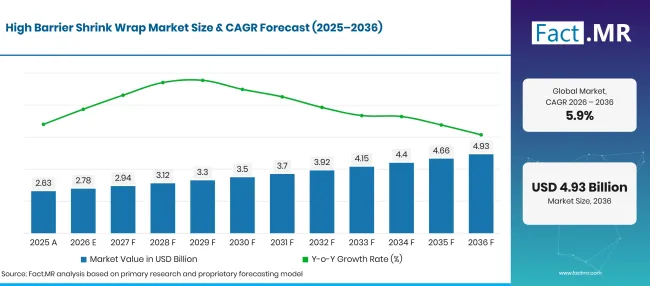
Factmr High Barrier Shrink Wrap Market Forecast Global | Source: Fact.MR
| Year | Basis | Market Value (USD billion) |
|---|---|---|
| 2025 | Actual | 2.63 |
| 2026 | Estimate | 2.78 |
| 2036 | Forecast | 4.93 |
| CAGR 2026 to 2036 | Forecast period | 5.9% |
Source: Fact.MR analysis. Updated Oct 15, 2026
What are the defining numbers behind High Barrier Shrink Wrap Market growth?
USD 2.15 billion absolute chance between 2026 and 2036, with polyethylene barrier films and fresh protein packaging forming the main purchasing base.
- Demand Drivers in the Market
- Meat and poultry processing plants increasingly rely on high-barrier shrink films to prevent food discoloration and spoilage. Consistent oxygen barrier layers protect fresh proteins during long storage cycles and refrigerated transport. Packaging converters favor barrier grades that maintain tight seal integrity across high-speed packaging equipment.
- Brand packaging managers require certified barrier protection to meet export hygiene standards across international retail chains. Multi-layer film structures help processors achieve extended shelf life without adding chemical preservatives to perishable items. Documented barrier ratings simplify supplier qualification and ensure reliable moisture retention during cold distribution.
- Film extrusion facilities use co-extruded polymers to balance mechanical strength with high gas barrier efficiency. Consistent resin quality allows converters to run thinner gauge films without increasing puncture failures on sharp bone-in cuts. Reliable material delivery schedules help commercial packaging operations prevent downtime during seasonal processing peaks.
- Pharmaceutical and medical manufacturers select barrier shrink films that comply with sterile medical containment requirements. Clear barrier specifications and traceable resin sources guide purchasing decisions when sensitive medical devices require moisture-proof protection. Validated puncture strength remains essential when transporting fragile medical components through commercial supply networks.
- Key Segments Analyzed
- By Material Type: Polyethylene holds 42.1% share in 2026, as multi-layer co-extruded films supply protein packaging and industrial wrapping operations.
- By Application: Food and Beverage accounts for 38.2% share in 2026 because fresh meat and cheese processors buy large volumes of barrier shrink film.
- By End-User: Manufacturing represents 47.3% share in 2026, reflecting repeat orders from automated packaging lines in food processing plants.
- Analyst Opinion at Fact.MR
- Shambhu Nath Jha, Principal Consultant at Fact.MR, states, “High barrier shrink wrap demand depends on seal integrity and gas barrier stability under automated cold-chain packaging conditions. Converters look for reliable co-extrusion quality to avoid film rupture during rapid heat-tunnel contraction. Film extruders that supply consistent barrier performance while supporting down-gauging goals gain stronger traction among packaging converters managing strict food safety mandates.”
- Strategic Implications
- Film extruders are developing thinner co-extruded structures that combine polyolefin sealing layers with high ethylene vinyl alcohol gas barrier layers. Thinner film structures reduce plastic consumption while maintaining essential oxygen barrier properties for perishable products.
- Packaging converters are testing seal strength and shrink temperature windows on automated packaging machinery before switching barrier suppliers. Rigorous pre-production qualification confirms that new shrink films run smoothly without slowing packaging lines.
- Distributors are keeping documented barrier certifications and resin technical sheets readily available for commercial food processors. Transparent product data simplifies film comparisons and accelerates supplier approval across commercial accounts.
- Brand owners are aligning barrier shrink film specifications with cold-chain transport requirements before signing multi-year supply contracts. Coordinated packaging planning across retail partners minimizes transit damage and extends retail display life.
The United Kingdom is poised to record a 7.3% CAGR, while Brazil reaches 6.7% as cold-chain food distribution expands across regional supply networks. The United States posts 6.3% growth, supported by large-scale protein processing and continuous demand for vacuum packaging solutions. Japan records 5.8%, while Germany reaches 4.5%, backed by strict packaging recycling frameworks and high barrier material testing.
How does the High Barrier Shrink Wrap Market break down by segment?
Polyethylene 42.1%; Food and Beverage 38.2%; Manufacturing 47.3% in 2026.
Which Material Type dominates?
Polyethylene holds 42.1% share in 2026.
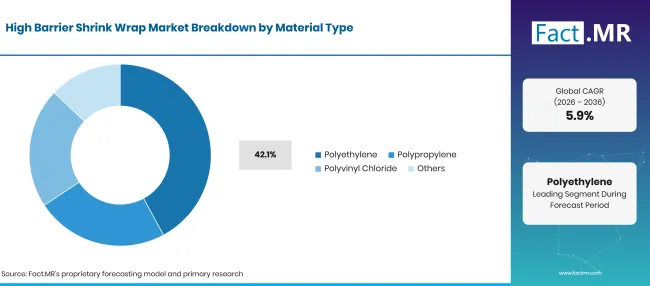
Factmr High Barrier Shrink Wrap Market Breakdown Material Type | Source: Fact.MR
| Material Type | Share (2026) |
|---|---|
| Polyethylene (Leading segment) | 42.1% |
| Other segments combined | 57.9%* |
| Total | 100.0% |
Source: Fact.MR analysis. Updated Oct 15, 2026
Polyethylene leads barrier shrink wrap production because it offers strong puncture resistance and flexible heat-sealing characteristics. Extruders blend polyethylene resins with functional barrier polymers to supply durable multi-layer films for meat packaging applications. Polypropylene provides higher clarity and stiffness for retail display applications. Polyvinyl chloride remains in use where specific shrink temperature curves match legacy shrink equipment.
What leads the Application segment?
Food and Beverage accounts for 38.2% share in 2026.
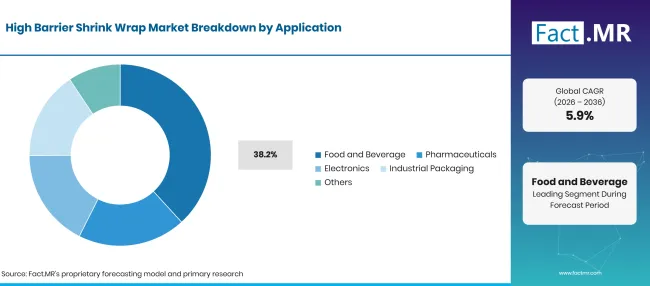
Factmr High Barrier Shrink Wrap Market Breakdown Application | Source: Fact.MR
| Application | Share (2026) |
|---|---|
| Food and Beverage (Leading segment) | 38.2% |
| Other segments combined | 61.8%* |
| Total | 100.0% |
Source: Fact.MR analysis. Updated Oct 15, 2026
Food processors use barrier shrink wrap for fresh meat, poultry, seafood, and block cheese requiring strict moisture and oxygen control. Barrier films preserve product freshness and reduce purge loss during cold storage and supermarket handling. Pharmaceutical firms use barrier films to shield sensitive diagnostic kits and medical tools from ambient humidity. Industrial packaging operations rely on shrink film solutions for protective wrapping of sensitive electronics.
How does End-User purchasing shape sales?
Manufacturing represents 47.3% share in 2026.
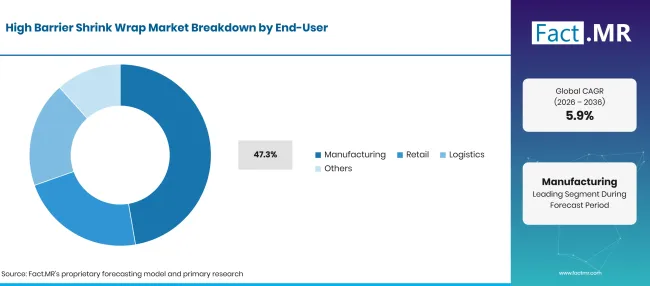
Factmr High Barrier Shrink Wrap Market Breakdown End User | Source: Fact.MR
| End-User | Share (2026) |
|---|---|
| Manufacturing (Leading segment) | 47.3% |
| Other segments combined | 52.7%* |
| Total | 100.0% |
Source: Fact.MR analysis. Updated Oct 15, 2026
Industrial manufacturing buyers purchase barrier shrink film in master rolls for automated packaging operations. Consistent tensile properties prevent line interruptions during high-speed vacuum packaging and heat shrinking. Retail buyers procure pre-cut barrier bags for in-store butcher and deli counters. Logistics providers select puncture-resistant shrink wrap to prevent load shifting and product damage during long-distance freight transit.
What is accelerating High Barrier Shrink Wrap Market adoption, and what is holding it back?
Rising demand for extended protein shelf life and centralized meat processing supports wider adoption of barrier shrink wrap. High recycling complexity in multi-layer structures and fluctuating resin costs can slow commercial adoption.
Drivers Impact Analysis
| DRIVER | (~) % IMPACT ON CAGR | GEOGRAPHIC RELEVANCE | IMPACT TIMELINE |
|---|---|---|---|
| Fresh protein shelf life extension | +1.0% | Global | Medium term (2–4 years) |
| Automated vacuum packaging adoption | +0.8% | North America, Europe | Short term (<= 2 years) |
| Multi-layer co-extrusion technology | +0.7% | Global | Medium term (2–4 years) |
| Export meat hygiene standards | +0.5% | Latin America, North America | Medium term (2–4 years) |
| Down-gauging resin formulation | +0.4% | Europe, East Asia | Long term (>= 4 years) |
Source: Fact.MR analysis. Updated Oct 15, 2026
Opportunity Impact Analysis
| OPPORTUNITY | (~) % IMPACT ON CAGR | GEOGRAPHIC RELEVANCE | IMPACT TIMELINE |
|---|---|---|---|
| Recyclable mono-material barrier films | +0.8% | Europe, United States | Medium term (2–4 years) |
| High-barrier poultry packaging systems | +0.6% | Global | Medium term (2–4 years) |
| Medical and sterile tool containment | +0.5% | North America, Europe | Short term (<= 2 years) |
| Local converter customization orders | +0.4% | Latin America, Asia | Medium term (2–4 years) |
Source: Fact.MR analysis. Updated Oct 15, 2026
Restraints Impact Analysis
| RESTRAINT | (~) % IMPACT ON CAGR | GEOGRAPHIC RELEVANCE | IMPACT TIMELINE |
|---|---|---|---|
| Multi-material recycling challenges | -0.8% | Europe, North America | Short term (<= 2 years) |
| Polymer resin price volatility | -0.6% | Global | Medium term (2–4 years) |
| Capital cost of multi-layer extrusion | -0.5% | Global | Medium term (2–4 years) |
| Strict packaging waste regulations | -0.4% | Europe | Long term (>= 4 years) |
Source: Fact.MR analysis. Updated Oct 15, 2026
Which countries are scaling the High Barrier Shrink Wrap Market through 2036?
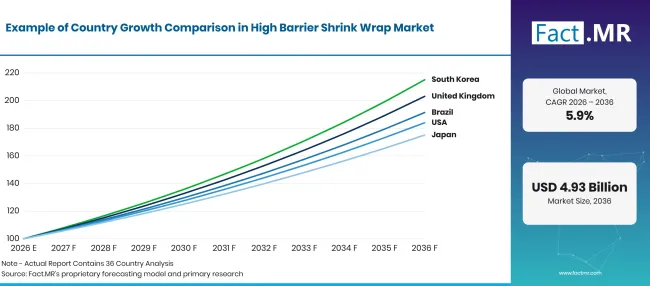
Factmr High Barrier Shrink Wrap Market Growth Index | Source: Fact.MR
| Country | CAGR (2026–2036) |
|---|---|
| United Kingdom | 7.3% |
| Brazil | 6.7% |
| United States | 6.3% |
| Japan | 5.8% |
| Germany | 4.5% |
Source: Fact.MR analysis. Updated Oct 15, 2026
Why is the United Kingdom leading high barrier shrink wrap expansion?
7.3% CAGR, driven by modern supermarket supply chains and strict meat freshness specifications.
UK food processors and packaging facilities rely on barrier shrink wrap to protect chilled protein products across commercial grocery networks. Defra reported that 1.207 million tonnes of plastic packaging waste were recycled in 2025, reaching a 57.3% recycling rate [2]. Processors continue to qualify barrier films that balance extended display life with emerging packaging recyclability standards.
How is Brazil expanding high barrier shrink wrap use?
6.7% CAGR, shaped by large-scale protein processing and expanding meat export volumes.
Brazilian meatpackers utilize multi-layer barrier shrink bags to preserve beef and poultry cuts during intercontinental marine transport. ABIPLAST reported that mechanical recycling of plastic packaging reached 31.4% in 2025, yielding 1.064 million tonnes of recycled resin [4]. Export-oriented slaughterhouses mandate dependable puncture resistance and gas barrier performance to prevent package tears during freezing and shipping.
What is driving high barrier shrink wrap sales in the United States?
6.3% CAGR, linked to centralized protein processing and expanding chilled food distribution.
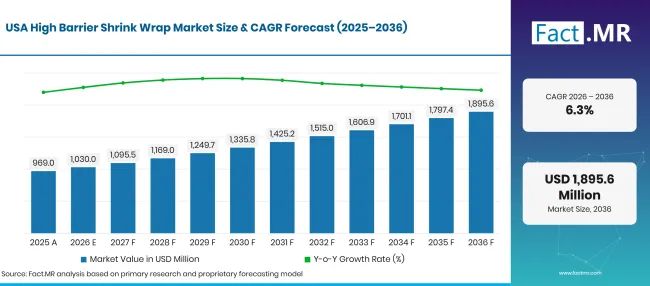
Factmr High Barrier Shrink Wrap Market Forecast Usa | Source: Fact.MR
U.S. meat packing plants purchase large volumes of high-barrier shrink rollstock for automated packaging lines. The Flexible Packaging Association reported that U.S. flexible packaging industry revenue reached USD 42.9 billion in 2025, supported by multi-layer barrier films used in food preservation [1]. Processors evaluate resin down-gauging and film sealing speeds to reduce packaging costs while maintaining product hygiene.
Why is Japan maintaining steady high barrier shrink wrap growth?
5.8% CAGR, influenced by advanced food preservation standards and automated packaging operations.
Japanese food processors use high-barrier shrink films to supply single-serve portions and fresh seafood across convenience store networks. The Ministry of the Environment and PWMI reported that containers and packaging accounted for 64.2% of plastic waste generation in 2025 [5]. Packaging converters focus on high-clarity barrier formulations that enhance retail appearance while preventing oxygen exposure.
Why is Germany advancing high barrier shrink wrap adoption?
4.5% CAGR, supported by industrial packaging automation and circular economy testing.
German packaging converters serve demanding domestic and regional food producers that require certified barrier integrity. Umweltbundesamt reported that the mechanical recycling rate for system-participating plastic packaging reached 70.0% in 2024, with 5.5 million tonnes collected through dual systems [3]. Manufacturers are testing mono-material barrier films that satisfy strict European recyclability mandates while maintaining barrier performance.
Who leads the High Barrier Shrink Wrap Market?
Sealed Air Corporation and Amcor plc supply specialized barrier shrink films for protein and food packaging, where oxygen barrier consistency and puncture strength dictate repeat purchase agreements. Berry Global Group and Mondi Group manufacture flexible packaging formats and co-extruded films designed for industrial and consumer packaging operations. Winpak Ltd. and Wipak Group deliver specialized high-barrier shrink films engineered for automated vacuum packing lines.
Huhtamaki Group, Polyplex Corporation, Coveris Holdings, and Uflex Limited supply engineered barrier films for food, medical, and industrial end-users. Competition centers on film puncture resistance, sealing reliability across heat tunnels, and resin formulation efficiency rather than commodity pricing alone.
Which companies are the key providers?
Key companies include Sealed Air Corporation; Amcor plc; Berry Global Group; Mondi Group; Huhtamaki Group; Wipak Group; Polyplex Corporation; Uflex Limited; Coveris Holdings; and Winpak Ltd.
- Sealed Air Corporation
- Amcor plc
- Berry Global Group
- Mondi Group
- Huhtamaki Group
- Wipak Group
- Polyplex Corporation
- Uflex Limited
- Coveris Holdings
- Winpak Ltd.
Bibliography
- [1] Flexible Packaging Association. (2025, March 18). State of the U.S. flexible packaging industry annual report.
- [2] Department for Environment, Food & Rural Affairs. (2025, September 24). Official statistics on UK packaging waste and recycling.
- [3] Umweltbundesamt. (2026, January 27). Packaging waste and mechanical recycling rates in Germany.
- [4] Associação Brasileira da Indústria do Plástico. (2026, March 12). Perfil da reciclagem mecânica de plásticos pós-consumo no Brasil.
- [5] Ministry of the Environment, Japan, & Plastic Waste Management Institute. (2025, December 15). Annual survey on plastic container and packaging material circulation in Japan.
This Report Answers
- The report assesses product selection across polyethylene, polypropylene, and specialty polymer barrier shrink formulations.
- Application analysis explains why fresh protein and dairy packaging accounts for the primary share of barrier film shipments.
- The country comparison examines the relationship between automated food processing plants and regional barrier film consumption.
- Competitive analysis outlines technical differentiation across co-extrusion extruders, barrier bag converters, and industrial film suppliers.
- End-user purchasing reviews demonstrate why industrial food manufacturing facilities dominate bulk rollstock procurement.
What does the High Barrier Shrink Wrap Market cover?
The market covers multi-layer polymer shrink films designed with functional barrier layers to prevent oxygen, moisture, and aroma transmission. It evaluates materials used in perishable meat packaging, cheese processing, medical device wrapping, and industrial protective containment. The analysis includes related Fact.MR assessments of food packaging sector trends and retort packaging formats.
What is included in the scope?
The scope includes co-extruded barrier shrink films, shrink tubing, and pre-formed barrier shrink bags sold to converters and processing plants.
It includes barrier films containing ethylene vinyl alcohol, polyamide, or PVDC barrier layers. Sales are counted as finished barrier film revenue and exclude unformed plastic polymer resin trading.
What is excluded from the scope?
The scope excludes standard monolayer shrink films lacking barrier properties used solely for secondary collation.
Stretch films, shrink sleeves without barrier resins, and rigid thermoformed plastic trays are excluded from market sizing. Packaging machinery sales and contract packaging service charges are outside the report boundary.
How Was the Analysis Built?
The analysis draws on 120+ sources, 35+ company portfolios, 25+ countries, and more than 20 industry interviews.
- Primary Research: Primary research includes discussions with manufacturers, service providers, technology developers, distributors, end users, and subject-matter experts. These conversations examine purchasing priorities, product adoption, operational challenges, approval requirements, competitive positioning, and the factors that influence wider market acceptance.
- Desk Research: Desk research covers government statistics, regulatory publications, company filings, trade data, technical studies, industry associations, standards, public policy, and other authoritative sources. Every source used in the analysis is documented in the bibliography.
- Market Sizing and Forecasting: Market estimates combine historical performance, demand indicators, pricing and volume trends, segment shares, company participation, country-level growth, adoption patterns, investment activity, and barriers to market expansion.
- Data Validation and Update Cycle: Findings are validated by comparing primary interviews with public data, company activity, regulatory changes, trade patterns, and industry developments. Regular updates review new product launches, capacity changes, partnerships, approvals, and shifts in commercial adoption.
Segmentation
What is the report’s scope and coverage?
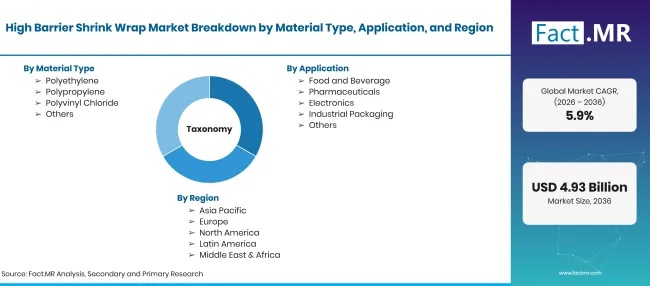
Factmr High Barrier Shrink Wrap Market Taxonomy | Source: Fact.MR
| Attribute | Details |
|---|---|
| Quantitative Units | USD billion |
| Market Definition | Co-extruded and multi-layer plastic shrink wrap engineered with gas and moisture barrier layers for perishable and industrial packaging. |
| Material Type | Polyethylene; Polypropylene; Polyvinyl Chloride; Others |
| Application | Food and Beverage; Pharmaceuticals; Electronics; Industrial Packaging; Others |
| End-User | Manufacturing; Retail; Logistics; Others |
| Regions Covered | North America; Latin America; Western Europe; Eastern Europe; East Asia; South Asia & Pacific; Middle East & Africa |
| Countries Covered | United Kingdom; Brazil; United States; Japan; Germany |
| Companies Profiled | Sealed Air Corporation; Amcor; Berry Global; Mondi; Huhtamaki; Wipak; Polyplex; Uflex; Coveris; Winpak |
| Forecast Period | 2026 to 2036 |
| Approach | Assessment of polymer resin consumption, barrier layer technologies, packaging converter surveys, and publicly reported manufacturer capacity |
Source: Fact.MR analysis. Updated Oct 15, 2026
How is the market segmented?
-
By Material Type:
- Polyethylene
- Polypropylene
- Polyvinyl Chloride
- Others
-
By Application:
- Food and Beverage
- Pharmaceuticals
- Electronics
- Industrial Packaging
- Others
-
By End-User:
- Manufacturing
- Retail
- Logistics
- Others
-
By Region:
- North America
- Latin America
- Western Europe
- Eastern Europe
- East Asia
- South Asia & Pacific
- Middle East & Africa
Frequently Asked Questions
How big is the high barrier shrink wrap market in 2026?
What is the CAGR from 2026 to 2036?
Which material type leads?
Which application leads?
Which companies participate in high barrier shrink wrap?
Who worked on this report


Preview the report firsthand - request a free sample
Free SampleGet the brochure for pricing and purchase details
Download PDF