- Base Value(2026): 5.3 Bn
- Estimated Value(2026): 5.3 Bn
- Forecast Value (2036): 15.0 Bn
- CAGR (2026 - 2036): 11.0%
High-Clarity PCR Market Forecast and Outlook 2026 to 2036
The high-clarity PCR market stands at USD 5.3 billion in 2026 and advances to USD 15.0 billion by 2036 at an 11.00% CAGR.
High-Clarity PCR Market Key Takeaways
- High-Clarity PCR Market Value (2026): USD 5.3 billion
- High-Clarity PCR Market Forecast Value (2036): USD 15.0 billion
- High-Clarity PCR Market Forecast CAGR 2026 to 2036: 11.0%
- Leading Product Type in High-Clarity PCR Market: Bottles and rigid containers
- Key Growth Regions in High-Clarity PCR Market: Asia Pacific, North America, Europe, Latin America, Middle East & Africa
- Top Players in High-Clarity PCR Market: Indorama Ventures Public Company Limited, Plastipak Holdings, Inc., ALPLA Group, Borealis AG, Far Eastern New Century Corporation, JEPLAN, Inc., Suntory Holdings Limited
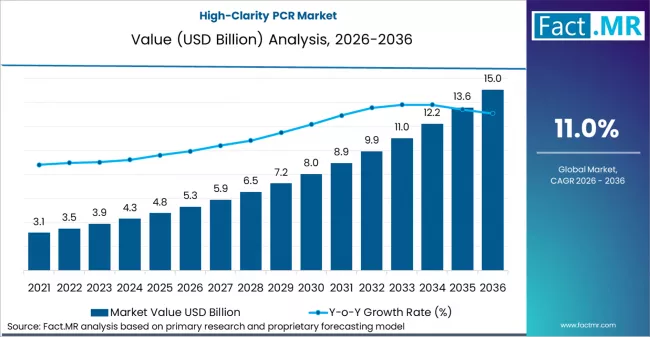
High Clarity Pcr Market Market Value Analysis | Source: Fact.MR
This segment supports packaging and product lines where visual appearance remains critical even when recycled content is used. Material choice centers on transparency, surface finish, and control of haze or color shift across production batches. Companies that place products on shelves rely on a narrow set of approved material streams since any change requires fresh trials and customer acceptance.
Processing teams also focus on melt behavior and filtration stability to avoid defects during molding or forming. Adoption increases as more premium formats accept recycled content without visible compromise. Expansion comes from wider use in bottles, rigid containers, and display applications rather than frequent switching between resin sources or grades.
High-Clarity PCR Market
| Metric | Value |
|---|---|
| Market Value (2026) | USD 5.3 billion |
| Forecast Value (2036) | USD 15.0 billion |
| Forecast CAGR 2026 to 2036 | 11.0% |
Source: Fact.MR analysis. Updated Jan 27, 2026
Category
| Category | Segments |
|---|---|
| End-use | Beverage and cosmetics packaging; Food packaging; Mass FMCG; Premium packaging; Bottled water; Soft drinks; Others |
| Product Type | Bottles and rigid containers; High-clarity trays; Clear containers; Ultra-clear bottles; Others |
| Material | PCR-PET; rPET; Others |
| Clarity Technology | De-yellowing and IV control; Advanced SSP; High-throughput purification; Precision melt filtration; Others |
| Region | North America; Europe; Asia Pacific; Latin America; Middle East & Africa |
Source: Fact.MR analysis. Updated Jan 27, 2026
Segmental Analysis
Why Does Beverage and Cosmetics Packaging Concentrate Most of the Demand for High-Clarity PCR?
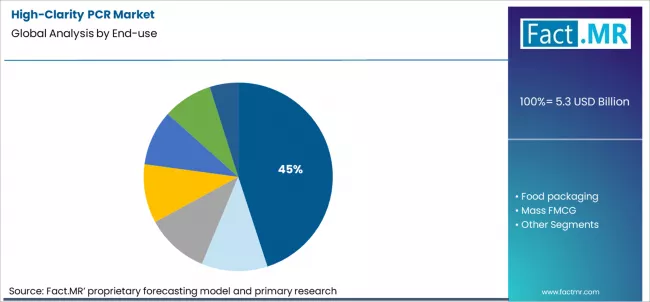
High Clarity Pcr Market Analysis By End Use | Source: Fact.MR
Beverage and cosmetics packaging accounts for 45% of end-use demand in the high-clarity PCR market. These categories depend on visual appearance to signal cleanliness, quality, and product safety at the point of sale. Packaging teams in these sectors specify materials that maintain transparency across molding, filling, and shelf display. Product ranges also move in large, steady volumes, which supports dedicated resin sourcing programs. Changeovers in shape or label design still rely on the same clarity targets, keeping material requirements stable. Food, mass FMCG, and premium packs contribute additional volume. The combination of high throughput and strong visual standards keeps beverage and cosmetics packaging as the main driver of high-clarity PCR usage.
What Finished Product Form Uses the Largest Share of High-Clarity PCR Material?
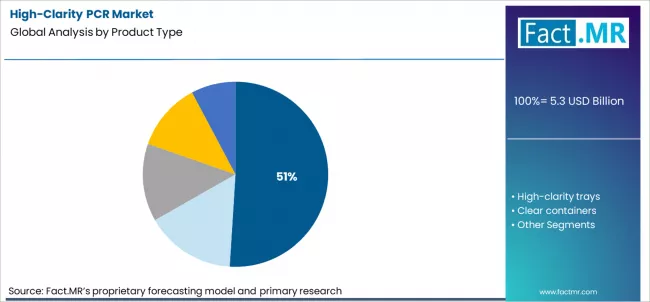
High Clarity Pcr Market Analysis By Product Type | Source: Fact.MR
Bottles and rigid containers represent 51% of product type usage in this market. This format appears across beverages, personal care, and household liquids that require impact resistance and shape stability along with transparency. Production lines for these containers operate at high speed and long run lengths, which suits consistent resin inputs. Mold design and wall thickness targets remain similar across many brands, which supports reuse of the same material grades. Trays, clear containers, and ultra-clear bottles serve defined niches. Most large scale programs still channel high-clarity PCR into rigid bottle and container formats as the primary outlet for volume conversion.
What are the Drivers, Restraints, and Key Trends of the High-Clarity PCR Market?
- Drivers: Demand for visually appealing packaging in food, personal care, and consumer goods that also meets recycled content targets is supporting use of high-clarity post-consumer recycled (PCR) resins that maintain transparency while addressing material compliance criteria.
- Restraint: Supply constraints in obtaining consistent high-clarity PCR feedstock and higher production costs compared with conventional clear polymers limit adoption in price-sensitive applications.
- Trend 1: Development of advanced sorting and washing technologies that improve the quality and visual consistency of PCR streams used for clarity-focused applications.
- Trend 2: Expansion of specialized high-clarity PCR grades tailored for bottles, thermoformed trays, and high-visibility labels to align performance with virgin resin counterparts.
Analysis of the High-Clarity PCR Market by Key Country
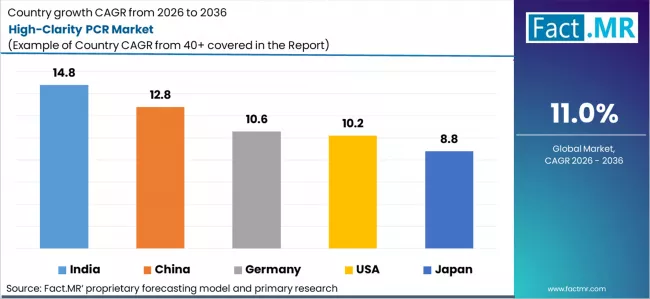
High Clarity Pcr Market Cagr Analysis By Country | Source: Fact.MR
| Country | CAGR 2026 to 2036 |
|---|---|
| USA | 10.2% |
| Germany | 10.6% |
| China | 12.8% |
| Japan | 8.8% |
| India | 14.8% |
Source: Fact.MR analysis. Updated Jan 27, 2026
The report covers an in-depth analysis of 40+ countries; top-performing countries are highlighted below.
How Are Brand Risk Policies and Shelf Standards Shaping High-Clarity PCR Use in USA?
Adoption decisions in USA are governed primarily by tolerance limits for visual defects in transparent packaging. The market expands at about 10.2% per year through 2036 as large brands convert selected high visibility SKUs first. Haze control, color stability, and speck risk are treated as commercial issues, not technical details. Qualification cycles often mirror virgin resin approvals and extend across several production runs. Procurement teams prefer suppliers that can guarantee batch consistency over long contracts. Volume growth follows portfolio redesign schedules rather than isolated launches. Market progress depends more on process stability improvements than on regulatory pressure alone.
Why Do Engineering Approval Systems Control High-Clarity PCR Scaling in Germany?
Material selection in Germany is filtered through strict internal quality gates used by food and personal care producers. With growth near 10.6% annually through 2036, expansion remains controlled and methodical. High clarity recycled resin is handled as a precision input rather than a simple substitute. Engineering teams focus on filtration efficiency, melt stability, and odor control before approving broader use. Supplier audits and traceability requirements shape procurement contracts. Volume increases occur line by line rather than through portfolio mandates. Capacity is absorbed first by premium formats. Market development is driven by technical yield improvement, not marketing commitments.
What Structural Factors Are Accelerating High-Clarity PCR Adoption in China?
Scale and infrastructure investment define how this market develops in China. Growth runs close to 12.8% per year through 2036, supported by large sorting, washing, and decontamination complexes. Brand owners prioritize supply reliability and throughput over marginal differences in optical performance. Many conversions are synchronized with installation of new bottle and container lines. Procurement strategies favor vertically integrated groups that control feedstock and processing. Volume ramps follow commissioning schedules of new capacity. Market momentum is linked to industrial buildout and manufacturing scale advantages rather than retailer pressure or consumer facing sustainability messaging.
How Do Qualification Culture and Risk Management Shape This Market in Japan?
Material approval processes in Japan place heavy weight on consistency and defect avoidance. With growth near 8.8% annually through 2036, adoption proceeds cautiously and in stages. High clarity recycled material is introduced first in secondary or lower risk applications. Validation cycles extend across multiple production lots before wider use is permitted. Purchasing decisions emphasize long term technical partnerships rather than short term pricing. Volume growth follows gradual expansion of approved use cases. Supply chains remain intentionally narrow. Market development is constrained more by internal approval systems and risk management practices than by material availability or policy pressure.
What Is Pulling High-Clarity PCR into Mainstream Packaging in India?
Brand competition and packaging premiumization are reshaping material choices in India. The market advances near 14.8% per year through 2036 as beverage and personal care brands seek visual parity with virgin resin. Procurement teams focus first on securing predictable volumes, then on refining optical performance. Qualification standards are tightening as national distribution scales. Volume growth tracks expansion of branded packaging and organized retail. Processing consistency and feedstock quality still vary by supplier. Market progress depends more on rapid improvement in operational reliability than on formal compliance programs or externally imposed recycled content targets.
How Do Optical Standards and Collection Systems Shape Competition in the High Clarity PCR Market?
High Clarity Pcr Market Analysis By Company | Source: Fact.MR
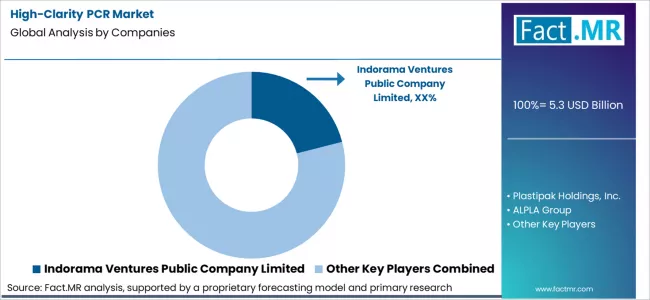
Participation in the high clarity PCR market is governed by access to suitable bottle streams, sorting precision, and decontamination performance rather than by resin price. Brand owners first set haze limits, color tolerances, and inclusion rates before any supplier is shortlisted. Indorama, Plastipak, ALPLA, Borealis, Far Eastern New Century, JEPLAN, and Suntory compete through integrated collection, washing, and reprocessing systems that protect optical properties. Technical teams compare suppliers using haze stability, yellowing control, and lot consistency across production runs. Procurement also weighs regional bottle deposit systems and long term feedstock contracts. Once a grade is approved for a packaging platform, volumes follow brand conversion schedules. Supplier shifts usually occur after collection expansion, plant upgrades, or changes in return schemes.
Key Players in High-Clarity PCR Market
- Indorama Ventures Public Company Limited
- Plastipak Holdings, Inc.
- ALPLA Group
- Borealis AG
- Far Eastern New Century Corporation
- JEPLAN, Inc.
- Suntory Holdings Limited
References
- European Commission. (2024). Commission Regulation (EU) 2022/1616 on recycled plastic materials and articles intended to come into contact with foods: Implementation and application guidance. European Commission.
- European Food Safety Authority. (2023). Guidance on the safety assessment of a recycling process to produce recycled plastic materials intended for food contact applications. EFSA Journal.
- European Commission, Joint Research Centre. (2023). Safe and sustainable use of recycled plastics in food contact materials. Publications Office of the European Union.
- U.S. Food and Drug Administration. (2023). Recycled plastics in food packaging: Chemistry considerations and guidance for industry. U.S. Department of Health and Human Services.
- Codex Alimentarius Commission. (2023). General standard for food contact materials and articles (CXS 386-2023). FAO/WHO Codex Alimentarius.
Segmentation
Scope of the Report
| Items | Values |
|---|---|
| Quantitative Units (2026) | USD billion |
| End-use | Beverage and cosmetics packaging, food packaging, mass FMCG, premium packaging, bottled water, soft drinks, others |
| Product Type | Bottles and rigid containers, high-clarity trays, clear containers, ultra-clear bottles |
| Material | PCR-PET, rPET, others |
| Clarity Technology | De-yellowing and IV control, advanced SSP, high-throughput purification, precision melt filtration |
| Regions Covered | Asia Pacific, Europe, North America, Latin America, Middle East & Africa |
| Countries Covered | United States, Canada, Mexico, Germany, United Kingdom, France, Italy, Spain, Nordics, BENELUX, China, Japan, South Korea, India, Australia & New Zealand, ASEAN, Brazil, Chile, Saudi Arabia, Turkey, South Africa, and other regional markets |
| Key Companies Profiled | Indorama Ventures, Plastipak, ALPLA, Borealis, Far Eastern New Century, JEPLAN, Suntory Holdings |
| Additional Attributes | Dollar value by product type and material; focus on haze control, color stability, and optical consistency; demand driven by premium packaging adoption and feedstock quality improvements |
Source: Fact.MR analysis. Updated Jan 27, 2026
High-Clarity PCR Market Segmentation
-
End-use :
- Beverage & cosmetics packaging
- Food packaging
- Mass FMCG
- Premium packaging
- Bottled water
- Soft drinks
- Others
-
Product Type :
- Bottles & rigid containers
- High-clarity trays
- Clear containers
- Ultra-clear bottles
- Others
-
Material :
- PCR-PET
- rPET
- Others
-
Clarity Technology :
- De-yellowing & IV control
- Advanced SSP
- High-throughput purification
- Precision melt filtration
- Others
-
Region :
- Asia Pacific
- China
- Japan
- South Korea
- India
- Australia & New Zealand
- ASEAN
- Rest of Asia Pacific
- Europe
- Germany
- United Kingdom
- France
- Italy
- Spain
- Nordic
- BENELUX
- Rest of Europe
- North America
- United States
- Canada
- Mexico
- Latin America
- Brazil
- Chile
- Rest of Latin America
- Middle East & Africa
- Kingdom of Saudi Arabia
- Other GCC Countries
- Turkey
- South Africa
- Other African Union
- Rest of Middle East & Africa
- Asia Pacific
Frequently Asked Questions
How big is the high-clarity pcr market in 2026?
What will be the size of high-clarity pcr market in 2036?
How much will be the high-clarity pcr market growth between 2026 and 2036?
What are the key product types in the high-clarity pcr market?
Which product type segment to contribute significant share in the high-clarity pcr market in 2026?
Who worked on this report


Preview the report firsthand - request a free sample
Free SampleGet the brochure for pricing and purchase details
Download PDF