- Market Value (2025): USD 4.0 Bn
- Estimated Value (2026): USD 4.4 Bn
- Forecast Value (2036): USD 11.0 Bn
- CAGR (2026-2036): 9.7%
What is the High-Leucine Whey Isolates Market forecast to be worth by 2036?
USD 4.4 billion in 2026 to USD 11.0 billion by 2036, at a 9.7% CAGR.
- The High-Leucine Whey Isolates Market crossed a valuation of USD 4.0 billion in 2025.
- Demand is projected to increase from USD 4.4 billion in 2026 to USD 11.0 billion by 2036.
- The market is forecast to record a 9.7% CAGR from 2026 to 2036 as sports nutrition, healthy aging and medical nutrition emphasize protein quality per serving.
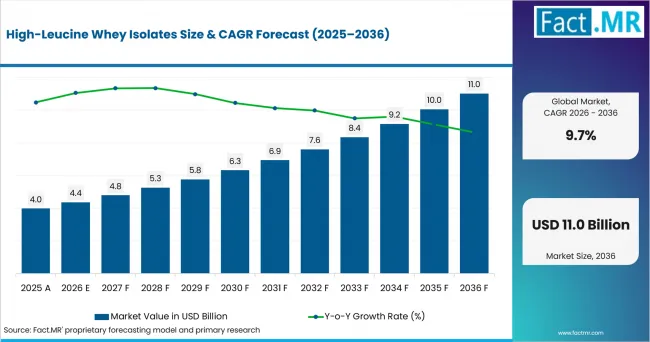
High Leucine Whey Isolates Value Analysis | Source: Fact.MR
What are the defining numbers behind High-Leucine Whey Isolates Market growth?
USD 6.7 billion absolute opportunity by 2036, led by WPI, <10% protein-basis leucine products and sports nutrition.
- Demand Drivers in the Market
- Sports-nutrition formulators need high-purity whey that delivers a complete amino-acid profile in compact servings. USDA National Agricultural Statistics Service reported 213.524 million pounds of U.S. whey protein isolate production in 2025, up 10.9% from 2024.
- Healthy-aging product teams need concentrated protein that fits smaller serving volumes and simple preparation. Higher protein density is expected to support powders and drinks designed for older adults who prefer manageable portions.
- Medical-nutrition developers need consistent protein composition and controlled sensory performance. High-leucine whey isolates are expected to fit formulations where protein quality and serving efficiency have to work together.
- Beverage brands need isolates that disperse quickly and retain a clean appearance. Clear drinks and low-pH concepts are expected to widen the use of whey isolate beyond conventional shake formats.
- Key Segments Analyzed
- By Whey Fraction: WPI is expected to hold 29.0% share in 2026 because its high protein concentration gives formulators room to manage flavor, carbohydrate and fat targets.
- By Leucine Level: <10% protein basis is projected to account for 36.0% share in 2026. Whey-isolate leucine specifications vary by product and reporting basis, so classification should use the declared leucine content of individual ingredients rather than a universal conventional-WPI benchmark.
- By Application: Sports nutrition is anticipated to capture 31.0% share in 2026 as protein powders, recovery beverages and performance foods already use whey isolate extensively.
- By Format: Instant powder is estimated to represent 37.0% share in 2026 due to familiar manufacturing routes and the need for quick dispersion in consumer-prepared drinks.
- Analyst Opinion at Fact.MR
- Shambhu Nath Jha, Principal Consultant at Fact.MR, states, “Protein percentage alone no longer separates specialized whey ingredients. Demand is expected to favor isolates that pair leucine density with solubility and clean taste. Suppliers need clear composition data and application support across powders and beverages.”
- Strategic Implications
- Ingredient manufacturers should state amino-acid specifications and explain whether leucine content comes from the whey fraction or added formulation. FrieslandCampina Ingredients launched Nutri Whey™ ProHeat into the performance and active nutrition market in March 2025. The company positioned the heat-stable whey protein for ready-to-drink applications where controlling viscosity during heat treatment is a key formulation challenge.
- Sports-nutrition brands should match isolate selection to serving size and final format. Product teams are expected to compare amino-acid density with flavor performance and dispersion behavior across powder and beverage concepts.
- Clinical and healthy-aging formulators should assess dispersibility and sensory performance alongside protein density. Easy preparation and manageable texture are expected to influence repeat use in compact nutrition products.
- Beverage developers should test heat and acid tolerance early so higher leucine positioning retains clarity and limits sediment during scale-up. This screening is expected to reduce reformulation work before commercial production.
China is projected to record 11.4% CAGR through 2036 as domestic dairy output supports protein ingredient processing. Japan is anticipated to post 9.8% as healthy-aging nutrition expands. France is estimated at 9.4% through dairy availability and specialized nutrition use. The USA is forecast at 9.0% through established whey processing. Germany is expected to record 8.8% as active-aging nutrition develops.
How does the High-Leucine Whey Isolates Market break down by segment?
WPI leads Whey Fraction at 29.0%; Instant powder leads Format at 37.0%.
Which Whey Fraction dominates?
WPI is expected to hold 29.0% share in 2026.
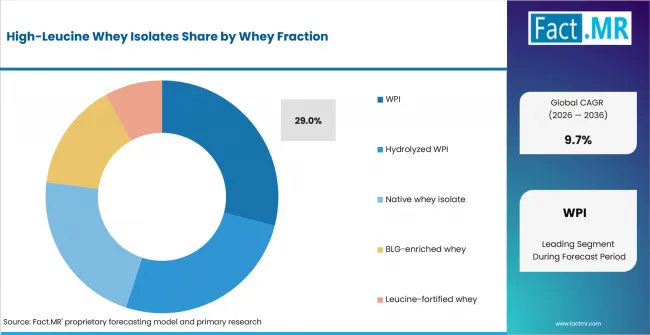
High Leucine Whey Isolates Analysis By Whey Fraction | Source: Fact.MR
WPI provides high protein with low fat and lactose, giving formulators room for flavor systems and other ingredients. Hydrolyzed WPI, native whey isolate, BLG-enriched whey and leucine-fortified whey serve more specialized performance needs.
Arla Foods Ingredients announced in March 2025 that it would present its whey protein isolates for clear protein beverages at the Nutri Ingredients Summit in São Paulo. The company highlighted powder-shake and ready-to-drink solutions rich in essential and branched-chain amino acids. These applications demonstrate the use of whey protein isolates in clear performance-nutrition beverage formats.
What leads the Leucine Level segment?
<10% protein basis is projected to account for 36.0% share in 2026.
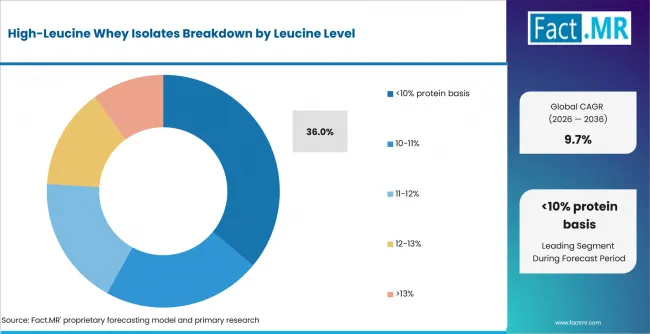
High Leucine Whey Isolates Analysis By Leucine Level | Source: Fact.MR
Conventional whey protein isolates do not fit a single leucine range. Supplier specifications vary by product and reporting basis. Agropur's BiPRO 9500 lists 12.7 g leucine per 100 g protein, while Hilmar 9010 lists 9.7 g leucine per 100 g product. Leucine-level segmentation should therefore use product-specific analytical specifications.
How does Application shape demand?
Sports nutrition is anticipated to capture 31.0% share in 2026.
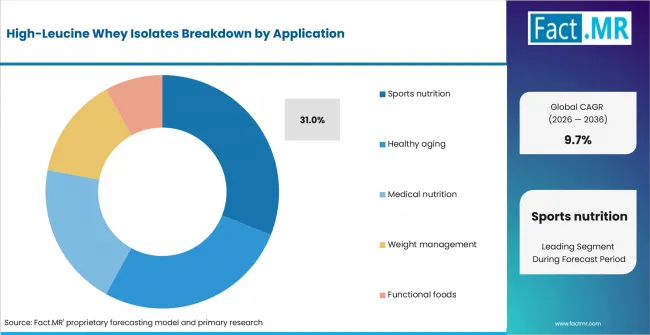
High Leucine Whey Isolates Analysis By Application | Source: Fact.MR
Sports nutrition fits the market directly because amino-acid delivery is already a core formulation criterion. Whey isolate supports powders and clear beverages that need high protein with limited fat or carbohydrate. Healthy aging and medical nutrition extend the same protein-quality requirement into smaller serving volumes.
What supports Instant powder within Format?
Instant powder is estimated to represent 37.0% share in 2026.
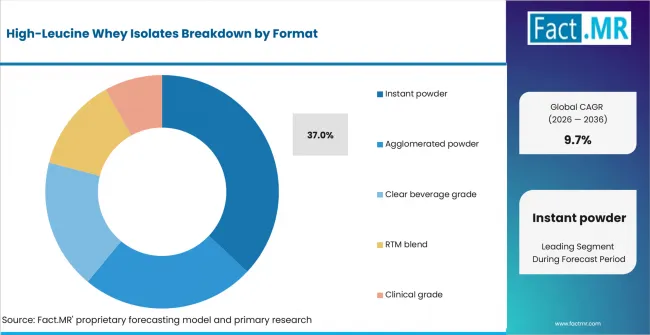
High Leucine Whey Isolates Analysis By Format | Source: Fact.MR
Instant powder combines concentrated protein with consumer-controlled serving size. Agglomeration is expected to improve wetting and dispersion during simple mixing. Clear-beverage and clinical grades serve applications where process tolerance or sensory control carries more weight than standard instant-powder handling.
What is accelerating High-Leucine Whey Isolates Market adoption, and what is holding it back?
Adoption is supported by protein-density requirements, aging nutrition and new beverage formats; constraints center on raw-material economics, sensory limits and specification consistency.
Drivers Impact Analysis
| DRIVER | (~) % IMPACT ON CAGR | GEOGRAPHIC RELEVANCE | IMPACT TIMELINE |
|---|---|---|---|
| Sports and active-nutrition use of high-purity whey | +1.8% | Global | Short term (<= 2 years) |
| Healthy-aging demand for concentrated protein servings | +1.5% | North America, Europe, East Asia | Medium term (2-4 years) |
| Clear and convenient protein beverage development | +1.0% | North America, Europe, East Asia | Medium term (2-4 years) |
| Fractionation that raises leucine density or isolates BLG | +0.8% | Global | Long term (>= 4 years) |
Source: Fact.MR analysis. Updated Sep 21, 2026
Opportunity Impact Analysis
| OPPORTUNITY | (~) % IMPACT ON CAGR | GEOGRAPHIC RELEVANCE | IMPACT TIMELINE |
|---|---|---|---|
| Native and BLG-enriched high-leucine fractions | +1.2% | Europe, North America | Medium term (2-4 years) |
| Healthy-aging and medical-nutrition powder systems | +0.9% | Europe, Japan, USA | Medium term (2-4 years) |
| Clear protein and low-viscosity beverage applications | +1.1% | Global | Short term (<= 2 years) |
Source: Fact.MR analysis. Updated Sep 21, 2026
Restraints Impact Analysis
| RESTRAINT | (~) % IMPACT ON CAGR | GEOGRAPHIC RELEVANCE | IMPACT TIMELINE |
|---|---|---|---|
| Whey and dairy input price variability | -0.7% | Global | Short term (<= 2 years) |
| Flavor and bitterness at high protein or peptide loads | -0.5% | Global | Medium term (2-4 years) |
| Need to verify leucine specification by source and process | -0.4% | Global | Long term (>= 4 years) |
Source: Fact.MR analysis. Updated Sep 21, 2026
Which countries are scaling the High-Leucine Whey Isolates Market fastest through 2036?
- The country comparison spans 2.6 percentage points and forms three practical growth bands across the forecast period.
- China remains 1.6 percentage points above Japan as domestic dairy output and expanding sports and wellness nutrition formats support broader use of high-purity whey isolates.
- Japan remains 0.4 percentage point above France through healthy-aging demand and compact protein formats suited to powders and clinical-style beverages.
- France remains 0.4 percentage point above the USA as dairy availability and specialized nutrition applications support demand for high-quality whey fractions across sports and medical nutrition.
- The USA remains 0.2 percentage point above Germany through its mature whey-processing base, established protein-supplement use and growing healthy-aging applications.
- Germany closes the displayed range as active-aging nutrition, established dairy processing and demand for concentrated complete protein support high-leucine whey isolate adoption.
Comparable CAGRs can create different entry conditions due to dairy-processing depth, aging demographics, sports-nutrition demand, beverage-format development and amino-acid specification requirements. Full report coverage includes North America, Latin America, Western Europe, Eastern Europe, East Asia, South Asia & Pacific, Middle East & Africa.
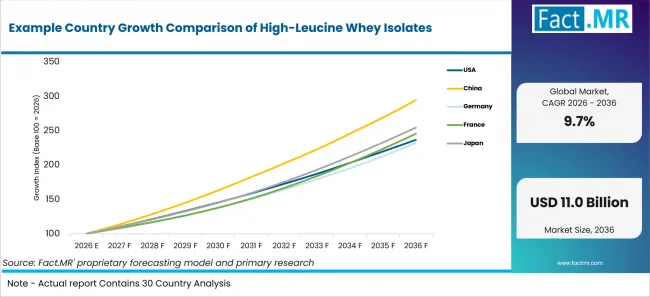
Example Country Growth Comparison Of High Leucine Whey Isolates | Source: Fact.MR
| Country | CAGR (2026-2036) |
|---|---|
| China | 11.4% |
| Japan | 9.8% |
| France | 9.4% |
| United States | 9.0% |
| Germany | 8.8% |
Source: Fact.MR analysis. Updated Sep 21, 2026
How is China scaling demand?
11.4% CAGR, supported by dairy output and nutrition-format expansion.
China's National Bureau of Statistics reported on January 19, 2026 that milk production reached 40.91 million tonnes in 2025, up 0.3% year on year. High-purity WPI is expected to benefit as local nutrition brands expand sports and wellness formats. Clear drinks and ready-to-mix powders give formulators more ways to use isolates beyond traditional shakes. The country CAGR therefore reflects both dairy-market context and a wider set of protein delivery formats.
How does Japan perform?
9.8% CAGR, led by healthy-aging needs and compact protein formats.
Japan presents a demographic fit for concentrated protein products that deliver nutrition in smaller servings. The Statistics Bureau published the Statistical Handbook of Japan 2025 in September 2025 and reported 36.24 million people aged 65 or older in 2024. That group represented 29.3% of the population. High-leucine whey isolates are expected to fit powders and clinical-style drinks that emphasize protein quality per serving. Instant formats also suit portion control and shelf-stable distribution across an aging consumer base.
What supports France adoption?
9.4% CAGR, backed by dairy collection and specialized nutrition use.
France combines established dairy processing with nutrition applications that use high-quality whey fractions. Agreste reported in June 2026 that French cow-milk collection reached 2.11075 billion liters in April 2026, up 1.2% from April 2025. Sports nutrition and medical nutrition are expected to provide higher-value routes where isolate purity and amino-acid composition are commercially relevant. Beverage-grade products add another path when clarity and solubility meet formulation targets.
What supports USA adoption?
9.0% CAGR, driven by a mature whey-processing base and healthy-aging demand.
The USA combines large-scale dairy production with substantial commercial whey-protein processing. USDA National Agricultural Statistics Service reported 213.524 million pounds of whey protein isolate production in 2025, up 10.9% from 2024. In June 2025 the U.S. Census Bureau reported 61.2 million people aged 65 or older in 2024. The group represented 18.0% of the population. Healthy-aging products are expected to widen the use of concentrated whey beyond performance nutrition. Clear beverages and ready-to-mix powders create additional channels where leucine density can be paired with convenient preparation.
How is Germany developing demand?
8.8% CAGR, shaped by active-aging nutrition and established dairy processing.
Germany presents a strong aging-demographic context for specialized nutrition formulations. Destatis reported in August 2026 that 19.3 million people in Germany were aged 65 or older in 2025. That represented 23% of the population. High-leucine whey isolates are expected to fit active-aging and medical-nutrition products that need concentrated complete protein. Sports powders and functional foods add a separate application route. Supplier selection is expected to focus on amino-acid specification and dependable dispersion across finished formats.
Who leads the High-Leucine Whey Isolates Market?
Arla Foods Ingredients is active in whey protein isolates for sports nutrition and clear beverage applications. Glanbia Nutritionals and Hilmar maintain whey protein isolate portfolios for sports, performance and nutritional formulations. Lactalis Ingredients supplies whey protein isolates and native whey protein options, including Pronativ®, which it positions as naturally rich in leucine.
Agropur remains active in whey protein isolates for sports, beverage and food applications. FrieslandCampina Ingredients supplies whey protein isolates and specialized whey solutions across performance, active and medical nutrition. In May 2026, FrieslandCampina announced an investment program of more than EUR 90 million covering its Bedum, Veghel and Workum sites. The program includes capacity expansion and technological upgrades to support advanced protein products.
Competition is expected to center on amino-acid composition and solubility. Sensory performance and process stability are expected to carry equal weight where isolates move into clear drinks or concentrated clinical formats. Suppliers with application support across powders and beverages are positioned to address a broader set of formulation requirements.
Competitive positioning overlaps with dairy nutritional ingredients and protein ingredients where functionality shapes supplier qualification. Adjacent markets also include functional beverages when clear or heat-stable whey is used to raise protein density.
Which companies are the key providers?
Key companies include Arla Foods Ingredients; Glanbia Nutritionals; Hilmar Ingredients; Lactalis Ingredients; Agropur; and FrieslandCampina Ingredients.
- Arla Foods Ingredients
- Glanbia Nutritionals
- Hilmar Ingredients
- Lactalis Ingredients
- Agropur
- FrieslandCampina Ingredients
Bibliography
- U.S. Department of Agriculture, National Agricultural Statistics Service. (2026, April). Dairy products 2025 summary.
- FrieslandCampina Ingredients. (2025, March 18). FrieslandCampina Ingredients launches Nutri Whey™ ProHeat for the performance and active nutrition market.
- Arla Foods Ingredients. (2025, March 25). Arla Foods Ingredients aborda las bebidas de proteína clara en Nutri Ingredients Summit [Arla Foods Ingredients focuses on clear protein beverages at Nutri Ingredients Summit].
- National Bureau of Statistics of China. (2026, January 19). National economy pushed forward with innovation-led and high-quality development and expected targets achieved successfully in 2025.
- Statistics Bureau, Ministry of Internal Affairs and Communications. (2025, September). Statistical handbook of Japan 2025.
- Touati-Houari, N. (2026, June 12). Lait. Avril 2026 : la collecte de lait toujours en hausse sur un an. Agreste.
- U.S. Census Bureau. (2025, June 26). Older adults outnumber children in 11 states and nearly half of U.S. counties.
- FrieslandCampina. (2026, May 5). FrieslandCampina announces major investment programme to accelerate growth in high-value whey proteins.
- Hilmar. (2026, July 27). Hilmar 9010 instantized whey protein isolate [Product bulletin].
This Report Answers
- The report explains how whey fraction, leucine level, application and format shape demand for high-leucine whey isolates across major regional markets.
- Segment analysis identifies the leading subsegments and explains why protein concentration, amino-acid density and dispersibility affect formulation choices.
- Country analysis compares China, Japan, France, the United States and Germany using the stated country CAGRs and current official evidence on dairy supply and demographics.
- Competitive analysis reviews the six named providers and verifies their active whey-protein or whey-isolate portfolios using official company sources.
- Application analysis considers sports nutrition, healthy aging, medical nutrition, weight management and functional foods.
What does the High-Leucine Whey Isolates Market cover?
The High-Leucine Whey Isolates Market covers specialized dairy-protein ingredients used where protein quality and leucine delivery are commercially relevant. It overlaps with functional foods when whey isolate is used to raise protein density in food applications.
The assessment includes conventional WPI, hydrolyzed WPI, native whey isolate, BLG-enriched whey and leucine-fortified whey across sports nutrition, healthy aging, medical nutrition, weight management and functional foods.
What is included in the scope?
The scope includes whey-derived isolates and enriched fractions sold as B2B nutrition ingredients. Downstream comparison includes weight management packaged foods where high-protein positioning supports satiety-focused formulation. It also connects with amino acids where leucine is evaluated as part of protein-quality positioning.
It includes ingredients that reach elevated leucine density through whey composition, fractionation or fortification, together with requirements such as instantization and clear-beverage performance.
What is excluded from the scope?
Finished retail supplements fall outside market revenue. Standard whey concentrates outside the isolate boundary are outside scope together with casein-only proteins and plant isolates. Free leucine sold without a whey-protein base is outside the market boundary.
Ordinary dairy foods remain outside scope when whey protein serves only as a minor formulation aid. Consumer-brand revenue remains outside the market boundary except where finished applications inform ingredient use.
How Was the Analysis Built?
The analysis draws on 120+ sources, 35+ company portfolios, 25+ countries, and more than 20 industry interviews.
- Primary Research: Primary research includes discussions with manufacturers, service providers, technology developers, distributors, end users, and subject-matter experts. These conversations examine purchasing priorities, product adoption, operational challenges, approval requirements, competitive positioning, and the factors that influence wider market acceptance.
- Desk Research: Desk research covers government statistics, regulatory publications, company filings, trade data, technical studies, industry associations, standards, public policy, and other authoritative sources. Every source used in the analysis is documented in the bibliography.
- Market Sizing and Forecasting: Market estimates combine historical performance, demand indicators, pricing and volume trends, segment shares, company participation, country-level growth, adoption patterns, investment activity, and barriers to market expansion.
- Data Validation and Update Cycle: Findings are validated by comparing primary interviews with public data, company activity, regulatory changes, trade patterns, and industry developments. Regular updates review new product launches, capacity changes, partnerships, approvals, and shifts in commercial adoption.
Segmentation
What is the report’s scope and coverage?
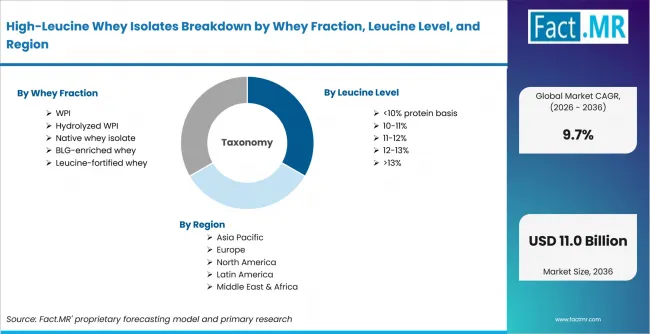
High Leucine Whey Isolates Breakdown By Whey Fraction, Leucine Level, And Region | Source: Fact.MR
| Attribute | Details |
|---|---|
| Quantitative Units | USD billion |
| Market Definition | Whey-isolate and specialized whey-protein ingredients positioned around elevated or formulation-relevant leucine delivery, including conventional WPI, hydrolyzed WPI, native whey isolate, BLG-enriched whey and leucine-fortified whey. |
| Whey Fraction | WPI; Hydrolyzed WPI; Native whey isolate; BLG-enriched whey; Leucine-fortified whey |
| Leucine Level | <10% protein basis; 10-11%; 11-12%; 12-13%; >13% |
| Application | Sports nutrition; Healthy aging; Medical nutrition; Weight management; Functional foods |
| Format | Instant powder; Agglomerated powder; Clear beverage grade; RTM blend; Clinical grade |
| Regions Covered | North America; Latin America; Western Europe; Eastern Europe; East Asia; South Asia & Pacific; Middle East & Africa |
| Countries Covered | United States; China; Germany; France; Japan |
| Key Companies Profiled | Arla Foods Ingredients; Glanbia Nutritionals; Hilmar Ingredients; Lactalis Ingredients; Agropur; FrieslandCampina Ingredients |
| Forecast Period | 2026 to 2036 |
| Approach | Hybrid top-down and bottom-up review using market values and shares, dairy and demographic indicators, application demand, company portfolio verification and country-level adoption factors. |
Source: Fact.MR analysis. Updated Sep 21, 2026
How is the market segmented?
-
By Whey Fraction
- WPI
- Hydrolyzed WPI
- Native whey isolate
- BLG-enriched whey
- Leucine-fortified whey
-
By Leucine Level
- <10% protein basis
- 10-11%
- 11-12%
- 12-13%
- >13%
-
By Application
- Sports nutrition
- Healthy aging
- Medical nutrition
- Weight management
- Functional foods
-
By Format
- Instant powder
- Agglomerated powder
- Clear beverage grade
- RTM blend
- Clinical grade
-
By Region
- North America
- Latin America
- Western Europe
- Eastern Europe
- East Asia
- South Asia & Pacific
- Middle East & Africa
Frequently Asked Questions
How big is the High-Leucine Whey Isolates Market in 2026?
What is the CAGR of the High-Leucine Whey Isolates Market from 2026 to 2036?
Which whey fraction leads the High-Leucine Whey Isolates Market?
Which application leads the High-Leucine Whey Isolates Market?
Who are the leading companies in the High-Leucine Whey Isolates Market?
Who worked on this report


Preview the report firsthand - request a free sample
Free SampleGet the brochure for pricing and purchase details
Download PDF