- Market Value (2025): USD 3.8 Bn
- Estimated Value (2026): USD 4.3 Bn
- Forecast Value (2036): USD 12.2 Bn
- CAGR (2026-2036): 11.1%
What is the High-Performance Molded Fiber Market forecast to be worth by 2036?
USD 4.3 billion in 2026 to USD 12.2 billion by 2036, at 11.1% CAGR.
- The High-Performance Molded Fiber Market reached USD 3.8 billion in 2025.
- Demand is projected to increase from USD 4.3 billion in 2026 to USD 12.2 billion by 2036.
- The market is forecast to record 11.1% CAGR from 2026 to 2036 as quick-service restaurants and institutional kitchens shift toward coated fiber formats.
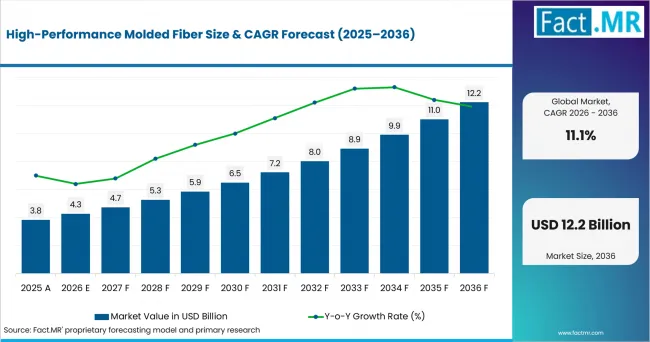
High Performance Molded Fiber Value Analysis | Source: Fact.MR
What are the defining numbers behind High-Performance Molded Fiber Market growth?
USD 7.9603 billion absolute opportunity is expected between 2026 and 2036.
- Demand Drivers in the Market
- Quick-service restaurant operators need oil-resistant trays as fried foods and sauced meals expose weak fiber coatings during delivery.
- Demand for portion-ready bowls and clamshells is supported by the scale of the U.S. foodservice market, with USDA Economic Research Service reporting that inflation-adjusted food-away-from-home spending reached USD 1.41 trillion in 2025.
- Packaging converters supplying food-contact applications must ensure compliance with new PFAS limits. From 12 August 2026, the PPWR prohibits food-contact packaging from being placed on the EU market when PFAS concentrations are at or above specified limit values.
- Fresh-food brands need stronger chilled trays because refrigerated meals place moisture and edge-strength pressure on molded fiber packs.
- Key Segments Analyzed
- By Fiber Feedstock: Bagasse is expected to hold 33.0% share in 2026 due to its fit with trays, bowls and foodservice packs.
- By Performance Treatment: Grease resistant is projected to account for 34.0% share in 2026 since hot meals place oil directly against the pack surface.
- By Format: Trays are anticipated to capture 37.0% share in 2026 owing to their use in ready meals and fresh-food counters.
- By Application: Hot meals are estimated to represent 29.0% share in 2026, supported by delivery menus that need heat and grease control.
- Analyst Opinion at Fact.MR
- Shambhu Nath Jha, Principal Consultant at Fact.MR, states, “High-performance molded fiber is now judged by the meal it protects. Foodservice accounts are expected to compare heat hold, oil resistance and lid fit before wider conversion. Suppliers need reliable forming and clear food-contact documentation.”
- Strategic Implications
- Converters should qualify grease barriers against hot oil, steam and chilled storage before pitching molded fiber as a plastic replacement.
- Foodservice distributors should match trays, bowls and lids to menu temperature so operators avoid extra testing during rollouts.
- U.S. recycling infrastructure will require substantial investment as packaging recovery systems expand. EPA estimated that USD 36.5 billion to USD 43.4 billion in investment would be needed to improve curbside collection, drop-off and processing infrastructure across the United States by 2030.
China is projected to post 12.7% CAGR through 2036 due to catering scale. The USA is expected to record 12.2% CAGR, supported by foodservice spending. France is forecast to reach 11.5% CAGR through reuse rules. Japan is anticipated to advance at 10.3% CAGR, driven by tourism-linked foodservice. Germany is estimated to post 10.1% CAGR, shaped by EU packaging rules.
How does the High-Performance Molded Fiber Market break down by segment?
Trays lead Format at 37.0% share; grease resistant leads Performance Treatment at 34.0% share.
Which Fiber Feedstock dominates?
Bagasse holds 33.0% share in 2026.
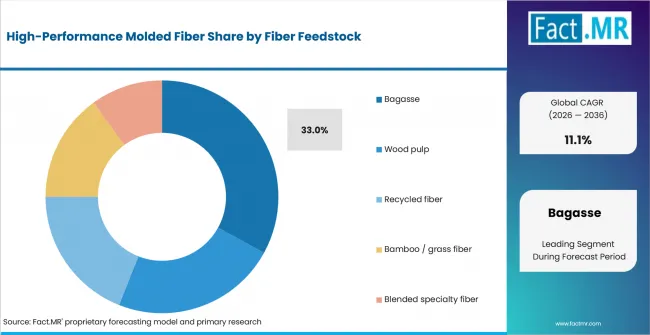
High Performance Molded Fiber Analysis By Fiber Feedstock | Source: Fact.MR
Bagasse is expected to lead fiber feedstock with 33.0% share in 2026 due to its fit with molded trays and bowls. Wood pulp supports smoother surfaces. Recycled fiber helps cost control, while bamboo and grass fiber add a visible plant-based claim.
What leads Performance Treatment?
Grease resistant accounts for 34.0% share in 2026.
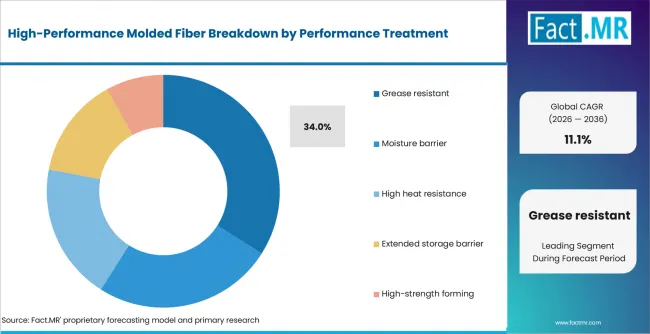
High Performance Molded Fiber Analysis By Performance Treatment | Source: Fact.MR
Grease-resistant treatment is projected to account for 34.0% share in 2026 because hot meals place oil against the fiber surface. Moisture barriers serve chilled foods and sauced items. Sabert reported in November 2025 that Pulp Ultra handles hot oil and grease up to 185°F.
How does Format shape demand?
Trays lead with 37.0% share in 2026.
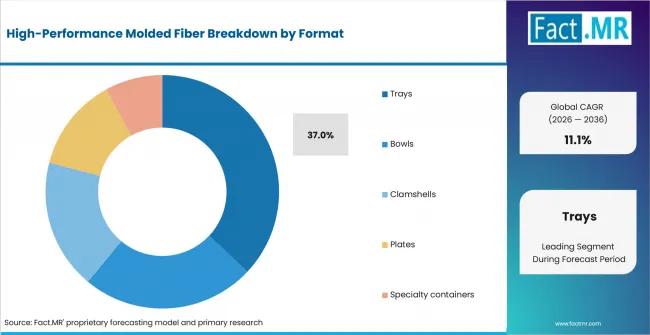
High Performance Molded Fiber Analysis By Format | Source: Fact.MR
Trays are anticipated to capture 37.0% share in 2026 owing to use across hot meals and fresh-food counters. Bowls support soups and rice meals. Clamshells serve delivery meals where lid fit and stacking strength are tested together.
What supports hot meals within Application?
Hot meals represent 29.0% share in 2026.
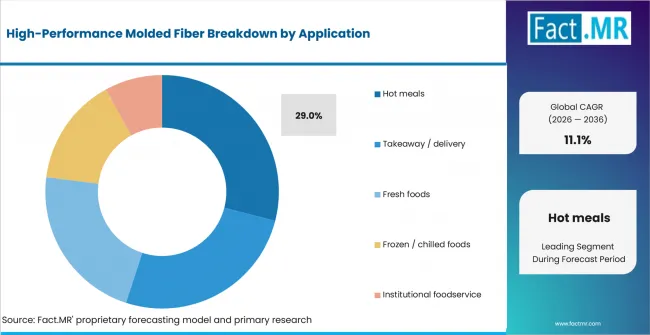
High Performance Molded Fiber Analysis By Application | Source: Fact.MR
Hot meals are estimated to represent 29.0% share in 2026 since heated foods combine steam and movement during delivery. Takeaway follows through frequent restaurant use. Fresh and chilled foods need barriers that protect tray shape.
What is accelerating High-Performance Molded Fiber Market adoption, and what is holding it back?
Hot-meal substitution drives it; barrier cost restrains it.
Drivers Impact Analysis
| DRIVER | (~) % IMPACT ON CAGR | GEOGRAPHIC RELEVANCE | IMPACT TIMELINE |
|---|---|---|---|
| Hot-meal plastic substitution | +1.4% | North America, Europe, East Asia | Short term (<= 2 years) |
| Food-away-from-home spending | +1.1% | USA, China, Japan | Medium term (2-4 years) |
| PFAS and plastic rules | +0.9% | EU, France, Germany | Medium term (2-4 years) |
| Barrier-coated fiber qualification | +0.7% | Global | Long term (>= 4 years) |
Opportunity Impact Analysis
| OPPORTUNITY | (~) % IMPACT ON CAGR | GEOGRAPHIC RELEVANCE | IMPACT TIMELINE |
|---|---|---|---|
| PFAS-free grease systems | +1.2% | North America, Europe | Short term (<= 2 years) |
| School and institutional meal trays | +0.8% | USA, France, Japan | Medium term (2-4 years) |
| Bagasse and bamboo fiber blends | +0.6% | China, East Asia | Medium term (2-4 years) |
| Cold-chain molded fiber bowls | +0.5% | Japan, Germany, France | Long term (>= 4 years) |
Restraints Impact Analysis
| RESTRAINT | (~) % IMPACT ON CAGR | GEOGRAPHIC RELEVANCE | IMPACT TIMELINE |
|---|---|---|---|
| Barrier cost and coating limits | -0.6% | Global | Short term (<= 2 years) |
| Recycling and composting variability | -0.5% | North America, Europe, Japan | Medium term (2-4 years) |
| Plastic price competition | -0.4% | USA, China | Short term (<= 2 years) |
| Wet-strength performance gaps | -0.3% | Global | Long term (>= 4 years) |
Which countries are scaling the High-Performance Molded Fiber Market through 2036?
- The USA remains 0.7 percentage point above France as restaurant spending supports high-volume tray replacement.
- France remains 1.2 percentage points above Japan through food retail demand and packaging-reuse rules.
- Japan remains 0.2 percentage point above Germany as tourism-linked foodservice traffic supports packaged meals.
- Germany closes the displayed range through EU food-contact rules and paperboard recovery systems.
High-Performance Molded Fiber Market is segmented into North America, Latin America, Western Europe, Eastern Europe, East Asia, South Asia & Pacific, and Middle East & Africa.
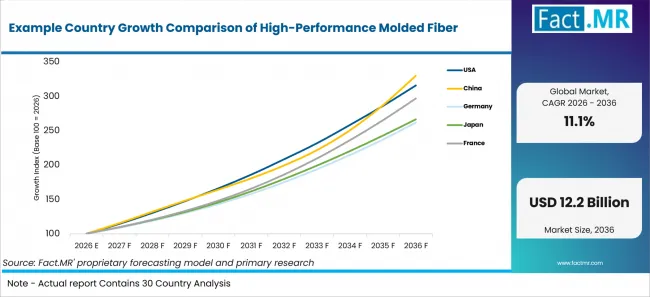
Example Country Growth Comparison Of High Performance Molded Fiber | Source: Fact.MR
| Country | CAGR |
|---|---|
| United States | 12.2% |
| France | 11.5% |
| Japan | 10.3% |
| Germany | 10.1% |
What supports USA adoption?
12.2% CAGR, driven by restaurant spending and coating change.
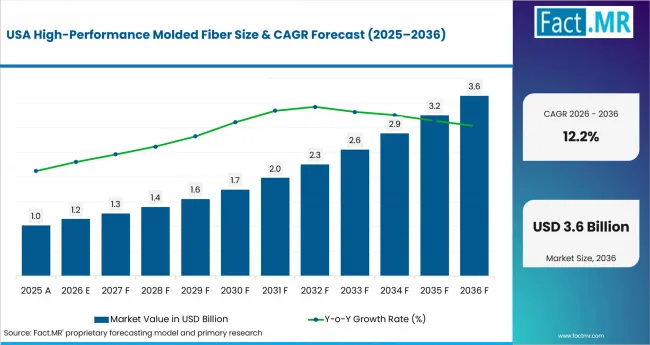
High Performance Molded Fiber Country Value Analysis | Source: Fact.MR
USDA Economic Research Service reported inflation-adjusted total U.S. food spending of USD 2.51 trillion in 2025. This scale supports continued demand for molded-fiber foodservice packaging as restaurant chains evaluate trays and containers that preserve meal presentation while accommodating alternative grease-resistant coatings and regional disposal requirements.
How is France developing demand?
11.5% CAGR, backed by food-retail demand and reusable-packaging rules.
INSEE reported that store-based food retail sales increased 1.8% in volume in 2025. This supports demand for molded-fiber trays and containers across fresh food, takeaway and institutional applications as operators balance lightweight serving formats with reusable-packaging requirements, recyclable-material options and clear material declarations.
How does Japan perform?
10.3% CAGR, supported by tourism recovery and municipal collection plans.
JNTO estimated 42,683,600 visitor arrivals to Japan in 2025, up 15.8% from 2024 and the highest annual total on record, providing a substantial inbound-travel base relevant to foodservice demand. Convenience stores, bento operators and other food outlets can support molded-fiber tray adoption where packaging must remain stackable, compact and suitable for hot or short-shelf-life meals.
What is supporting Germany’s adoption?
10.1% CAGR, shaped by EU packaging rules and paperboard recovery.
Destatis reported that 1,841.110 thousand tonnes of paper, paperboard and cardboard packaging were sent for recycling in Germany in 2024. This established recovery environment supports molded-fiber trays and bowls where foodservice operators want formats that align with paper-based sorting expectations while maintaining grease resistance, coating integrity and consistent quality.
Who leads the High-Performance Molded Fiber Market?
Huhtamaki and Sabert provide direct molded fiber coverage, while Novolex, including the former Pactiv Evergreen business strengthen formed fiber packaging.
Huhtamaki, Sabert, Genpak and CKF are active across molded-fiber foodservice and food-packaging formats. Novolex expanded its food and beverage packaging operations following the completion of its combination with Pactiv Evergreen in April 2025.
Which companies are the key providers?
Huhtamaki, Novolex (including the former Pactiv Evergreen business), Sabert, Genpak, and CKF.
- Huhtamaki
- Novolex (former Pactiv Evergreen)
- Sabert
- Genpak
- CKF
Bibliography
- ADEME. (2026, April 7). Emballages ménagers et papiers graphiques : données 2024.
- Directorate-General for Environment. (2026, August 11). New EU rules on packaging enter into application. European Commission.
- Eurostat. (2025, October 22). Plastic packaging waste in the EU: 35.3 kg per person.
- Statistisches Bundesamt. (2026, February 23). Abfallentsorgung 2024: Art, Menge und Verbleib der im Berichtsjahr 2024 entsorgten Verpackungen.
- Ministères Transition écologique, Aménagement du Territoire, Transports, Ville et Logement. (2026, August 4). Emballages professionnels.
- Huhtamäki Oyj. (2025, April 24). Huhtamaki acquires Zellwin Farms Company.
- Bonfils, J., Ceci-Renaud, N., Finot, J., Gallot, P., Gamrasni, A., & Lépine, N. (2026, June 18). Le compte du commerce en 2025 : L’activité accélère dans le commerce de détail et se contracte de nouveau dans le commerce de gros et dans le commerce et la réparation d’automobiles. Institut national de la statistique et des études économiques.
- Ministry of Economy, Trade and Industry. (2025, August 26). Results of FY2024 E-Commerce Market Survey compiled.
- Japan National Tourism Organization. (2026, January 21). Number of visitor arrivals to Japan 3,617,700 in December 2025.
- National Bureau of Statistics of China. (2026, January 20). Total retail sales of consumer goods in December 2025.
- Novolex. (2025, April 1). Novolex and Pactiv Evergreen Inc. complete combination, creating a leading manufacturer in food, beverage and specialty packaging.
- Novolex. (2025, May 1). Eco-Products and DNO Produce help bring environmental sustainability to K-12 school cafeterias.
- Sabert Corporation. (2025, November 19). Sabert Corporation’s Pulp Ultra® wins 2025 U.S. Plastics Pact Packaging Innovation Award for Compostability.
- Stora Enso. (2025a, June 12). Stora Enso and Matrix Pack partner to accelerate formed fiber packaging innovation.
- Stora Enso. (2025b, June 27). Performa Nova: Helping brands navigate plastic reduction, cold chain resilience, and sustainability compliance.
- U.S. Census Bureau. (2026, February 10). Advance monthly sales for retail and food services, December 2025 (Release No. CB26-26).
- Zeballos, E., & Sinclair, W. (2026, June 11). Total U.S. food spending reached $2.51 trillion in 2025. U.S. Department of Agriculture, Economic Research Service.
- U.S. Environmental Protection Agency. (2026, July 31). U.S. Recycling Infrastructure Assessment and State Data Collection Reports.
- U.S. Food and Drug Administration. (2025, January 3). FDA determines authorization for 35 food contact notifications related to PFAS are no longer effective.
- U.S. Food and Drug Administration. (2026, May 31). Inventory of Effective Food Contact Substance (FCS) Notifications: FCN No. 2409 [Database record].
This Report Answers
- The report explains where high-performance molded fiber is used across feedstock, performance treatment, format and application.
- Segment analysis identifies the main subsegments and the operating reasons foodservice accounts choose them.
- Country analysis reviews China, USA, France, Japan and Germany across demand drivers and restraints.
- Competitive analysis covers Huhtamaki, Novolex (including the former Pactiv Evergreen business), Sabert, Genpak, and CKF.
- Application analysis assesses how heat, grease, moisture and delivery handling influence purchasing decisions.
What does the High-Performance Molded Fiber Market cover?
The High-Performance Molded Fiber Market covers fiber-based trays, bowls, clamshells, plates and specialty containers for foodservice use. It includes versions with grease resistance, moisture control, heat stability or extended-storage barrier properties.
The assessment covers molded fiber made from bagasse, wood pulp, recycled fiber and bamboo or grass fiber. Fact.MR pages on next-generation paper-based packaging and biodegradable packaging material frame the wider paper conversion space.
What is included in the scope?
The scope includes molded fiber containers sold as trays, bowls, clamshells, plates and specialty containers. Coated formats are included when treatment supports container performance. Fact.MR coverage of foodservice packaging, biodegradable foodservice disposables and home-compostable food serviceware connects direct downstream use cases.
The scope covers formats used for hot meals, takeaway, fresh foods and institutional foodservice. It includes bagasse and wood-pulp structures, while specialty blends link with waste fibre trays in adjacent analysis.
What is excluded from the scope?
Standard paperboard cartons, corrugated cases, plastic trays, foam containers and aluminum trays are outside the scope when sold without a molded fiber body. Raw fiber pulp is outside the scope unless sold as part of a formed container program.
Flexible films, loose lidding films and separate coating ingredients are outside the scope. Fact.MR pages on paper trays, pulp molding machines, compostable food service coatings and bio barrier coatings cover adjacent areas.
How Was the Analysis Built?
The analysis draws on 120+ sources, 35+ company portfolios, 25+ countries, and more than 20 industry interviews.
- Primary Research: Primary research includes discussions with manufacturers, service providers, technology developers, distributors, end users, and subject-matter experts. These conversations examine purchasing priorities, product adoption, operational challenges, approval requirements, competitive positioning, and the factors that influence wider market acceptance.
- Desk Research: Desk research covers government statistics, regulatory publications, company filings, trade data, technical studies, industry associations, standards, public policy, and other authoritative sources. Every source used in the analysis is documented in the bibliography.
- Market Sizing and Forecasting: Market estimates combine historical performance, demand indicators, pricing and volume trends, segment shares, company participation, country-level growth, adoption patterns, investment activity, and barriers to market expansion.
- Data Validation and Update Cycle: Findings are validated by comparing primary interviews with public data, company activity, regulatory changes, trade patterns, and industry developments. Regular updates review new product launches, capacity changes, partnerships, approvals, and shifts in commercial adoption.
What is the report’s scope and coverage?
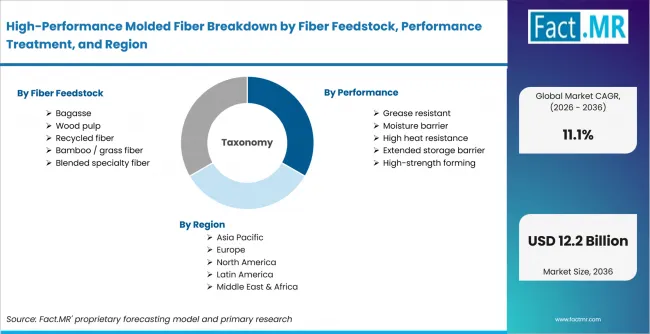
High Performance Molded Fiber Breakdown By Fiber Feedstock, Performance Treatment, And Region | Source: Fact.MR
| Attribute | Details |
|---|---|
| Quantitative Units | USD billion |
| Market Definition | Molded fiber trays, bowls, clamshells, plates and specialty containers designed for higher heat, grease, moisture or strength needs in foodservice and fresh-food packaging. |
| Fiber Feedstock | Bagasse; Wood pulp; Recycled fiber; Bamboo / grass fiber; Blended specialty fiber |
| Performance Treatment | Grease resistant; Moisture barrier; High heat resistance; Extended storage barrier; High-strength forming |
| Format | Trays; Bowls; Clamshells; Plates; Specialty containers |
| Application | Hot meals; Takeaway / delivery; Fresh foods; Frozen / chilled foods; Institutional foodservice |
| Regions Covered | North America; Latin America; Western Europe; Eastern Europe; East Asia; South Asia & Pacific; Middle East & Africa |
| Countries Covered | United States; Germany; Japan; France |
| Key Companies Profiled | Huhtamaki; Novolex (including the former Pactiv Evergreen business); Sabert; Genpak; CKF |
| Forecast Period | 2026 to 2036 |
| Approach | Hybrid top-down and bottom-up approach using foodservice demand; fiber feedstock mix; treatment qualification; format adoption; country growth; and provider portfolio review. |
How is the market segmented?
-
By Fiber Feedstock
- Bagasse
- Wood pulp
- Recycled fiber
- Bamboo / grass fiber
- Blended specialty fiber
-
By Performance Treatment
- Grease resistant
- Moisture barrier
- High heat resistance
- Extended storage barrier
- High-strength forming
-
By Format
- Trays
- Bowls
- Clamshells
- Plates
- Specialty containers
-
By Application
- Hot meals
- Takeaway / delivery
- Fresh foods
- Frozen / chilled foods
- Institutional foodservice
-
By Region
- North America
- Latin America
- Western Europe
- Eastern Europe
- East Asia
- South Asia & Pacific
- Middle East & Africa