- Base Value(2025): 1.8 Bn
- Estimated Value(2026): 1.9 Bn
- Forecast Value (2036): 3.6 Bn
- CAGR (2026 - 2036): 6.7%
Home ICP Monitoring Devices Market Forecast and Outlook By FACT.MR
In 2025, the home ICP monitoring devices market was valued at USD 1.8 billion. Based on Fact.MR analysis, demand for home ICP monitoring devices is estimated to grow to USD 1.9 billion in 2026 and USD 3.6 billion by 2036. FACT.MR projects a CAGR of 6.7% during the forecast period.
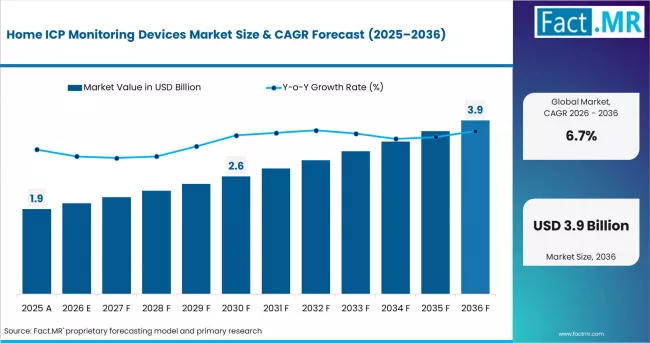
Home Icp Monitoring Devices Market Market Value Analysis | Source: Fact.MR
Summary of Home ICP Monitoring Devices Market
- Market Definition
- The market covers non-invasive wearable, portable handheld, and implantable home-compatible ICP monitoring devices supplied for post-discharge TBI, hydrocephalus, stroke, and chronic neurological patient management globally.
- Demand Drivers
- China is scaling home medical device adoption across neurological care. Driven by large TBI and stroke patient population and government digital health infrastructure investment.
- NHS remote monitoring expansion is increasing home ICP device procurement in the UK. Driven by post-discharge neurological care pathways and integrated care system commissioning.
- U.S. CMS remote physiologic monitoring reimbursement codes are expanding coverage. Driving hospital and home care provider investment in connected ICP monitoring platforms.
- Key Segments Analyzed
- By Device Type: Non-invasive wearable monitors lead at 61% in 2026. Dominant for post-discharge TBI and chronic hydrocephalus home monitoring.
- By Technology: Ultrasound-based monitoring leads at 38% in 2026. Preferred for clinical validation depth and non-invasive measurement accuracy.
- By Application: Traumatic brain injury leads at 34% in 2026. Driven by post-discharge monitoring requirements and rising TBI incidence globally.
- Analyst Opinion at FACT.MR
- Shambhu Nath Jha, Principal Consultant at Fact.MR, opines, 'CXOs will find that non-invasive accuracy validation and reimbursement pathway depth define competitive positioning. Devices with published clinical equivalence data and telehealth integration hold a structural advantage over unvalidated alternatives.'
- Strategic Implications
- Invest in clinical equivalence validation programmes for non-invasive wearable ICP monitors. This supports FDA 510(k) clearance and CMS reimbursement eligibility in the United States.
- Develop telehealth-integrated ICP monitoring platforms with remote alert capability. This captures NHS remote monitoring contract opportunities in the UK and digital health programme demand in Germany.
- Expand distributor partnerships in China and India. This supports growing home neuro-care device demand and government telehealth infrastructure investment.
- Methodology
- Market sizing is based on manufacturer revenues and unit shipments by device type. Validated using 2024–2025 financials and clinical procurement benchmarks.
- Demand and country analysis use FDA clearance data, NHS commissioning records, CMS reimbursement codes, and China digital health programme statistics.
- Forecasts incorporate neurological patient population trends, reimbursement expansion cycles, and telehealth adoption. Supported by expert interviews with neurologists and procurement teams.
| Metric | Value |
|---|---|
| Estimated Value in 2026 | USD 1.9 billion |
| Forecast Value in 2036 | USD 3.6 billion |
| Forecast CAGR (2026 to 2036) | 6.7% |
Source: Fact.MR analysis. Updated Apr 22, 2026
Between 2026 and 2036, the market is expected to generate USD 1.7 billion in absolute opportunity. Growth is steady and driven by reimbursement support. Demand is increasing due to an aging population. Cases of traumatic brain injury and hydrocephalus are rising. Post-discharge monitoring is also expanding. Growth is limited by long clinical validation timelines. Reimbursement gaps in emerging markets also remain a challenge.
Procurement is becoming more stringent. Buyers require proven non-invasive accuracy. Devices must integrate with electronic health records. Remote monitoring and alert features are essential. Hospitals prefer clinically validated solutions. Telehealth compatibility and regulatory approval are key. Low-cost devices without validation face limited adoption.
China leads country-level growth at 10.8% CAGR through 2036, driven by a large TBI and stroke patient base and rapid home medical device adoption. India follows at 10.2%, supported by expanding telehealth infrastructure and rising home-care penetration. Germany records 9.1%, anchored by advanced neuro-monitoring reimbursement frameworks and clinical infrastructure support. The United Kingdom grows at 9.0%, driven by NHS-supported remote monitoring programmes and post-discharge neurological care expansion. The United States records 8.9%, supported by strong remote patient monitoring adoption and established neuro-care infrastructure. Japan records 8.7% through aging population pressure and rising neurological disorder prevalence in a mature home medical device market.
Segmental Analysis
Home ICP Monitoring Devices Market Analysis by Device Type
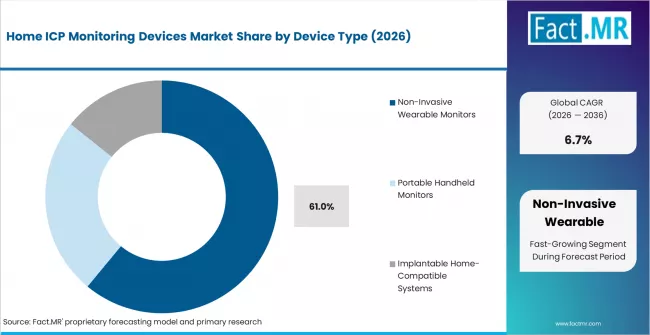
Home Icp Monitoring Devices Market Analysis By Device Type | Source: Fact.MR
Based on FACT.MR analysis, non-invasive wearable monitors hold 61% share in 2026. This segment leads due to patient comfort. It avoids surgical risks. It supports continuous monitoring. Wearables enable home-based care. Adoption is increasing in telehealth systems.
- Vittamed Investment: Vittamed expanded manufacturing in 2024. It targets Europe and the U.S. The expansion supports clinical study supply [4].
- Brain4care Technology: Brain4care launched an updated wearable platform in 2025. It includes wireless EHR integration. Remote alerts are also supported [2].
- Wearable Adoption Trend: Wearable ICP device use grew 14% in 2024. Adoption is rising in North America and Europe. Home care protocols are expanding [5].
Home ICP Monitoring Devices Market Analysis by Technology
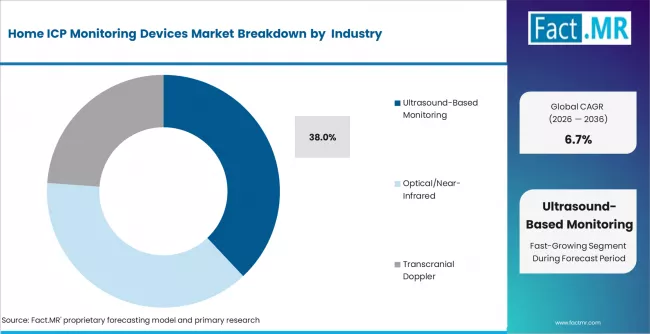
Home Icp Monitoring Devices Market Analysis By Technology | Source: Fact.MR
Based on FACT.MR analysis, ultrasound-based monitoring holds 38% share in 2026. This technology has strong clinical validation. It provides non-invasive measurements. It avoids radiation exposure. It fits existing reimbursement systems.
- Vittamed Ultrasound Platform: Vittamed expanded validation studies in 2024. Multi-centre data supports regulatory approval. CE and FDA processes are ongoing.
- HeadSense Optical Technology: HeadSense advanced its optical platform in 2025. It targets stroke and rehabilitation monitoring. Deployment is focused in the U.S. and Israel [6].
- TCD Adoption Trend: TCD device registrations increased 18% in 2024. Adoption is rising in home care. It is used for hydrocephalus monitoring.
Drivers, Restraints, and Opportunities
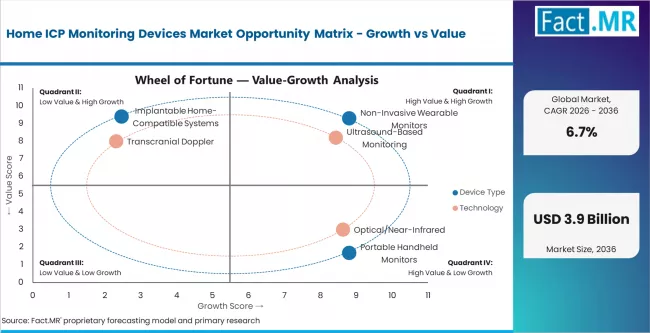
Home Icp Monitoring Devices Market Opportunity Matrix Growth Vs Value | Source: Fact.MR
FACT.MR notes that the home ICP monitoring devices market is clinically driven. It is also dependent on reimbursement support. Demand is led by TBI post-discharge monitoring. Chronic hydrocephalus care is another key driver. Continuous monitoring outside hospitals is required. Regulatory approval and payer coverage support demand.
The market shows a clear capability gap. Low-accuracy devices face resistance and exclusion. Validated wearable monitors are gaining adoption. EHR connectivity is becoming essential. Remote alerts and data logging are now standard requirements. Aging populations are increasing demand. Post-discharge care models are expanding usage.
- U.S. CMS Remote Monitoring Expansion: CMS updated reimbursement codes in 2024. These now include neurological monitoring. This supports structured procurement. Medtronic reported higher engagement in home care channels [1].
- EU MDR Compliance Driver: EU MDR Class IIb rules tightened in 2024. Clinical validation is now mandatory. Certified devices gain preference. Brain4care expanded its compliant portfolio in 2025 [2].
Asia Pacific Telehealth Expansion: China expanded digital home care in 2024. Neurological monitoring is included in pilot programmes. India updated telehealth integration guidelines. This supports device adoption [3].
Regional Analysis
The home ICP monitoring devices market is assessed across Asia Pacific, Europe, North America, Latin America, and Middle East and Africa, covering 40+ key countries with distinct demand profiles shaped by neurological disease prevalence, reimbursement framework maturity, telehealth infrastructure scale, and home care regulatory environments. The full report offers market attractiveness analysis by region and country.
.webp "Top Country Growth Comparison Home Icp Monitoring Devices Market Cagr (2026 2036)")
Top Country Growth Comparison Home Icp Monitoring Devices Market Cagr (2026 2036) | Source: Fact.MR
| Country | CAGR (2026 to 2036) |
|---|---|
| China | 10.8% |
| India | 10.2% |
| Germany | 9.1% |
| United Kingdom | 9.0% |
| United States | 8.9% |
| Japan | 8.7% |
Source: Fact.MR analysis. Updated Apr 22, 2026
Source: Fact.MR (FACT.MR) analysis, based on proprietary forecasting model and primary research
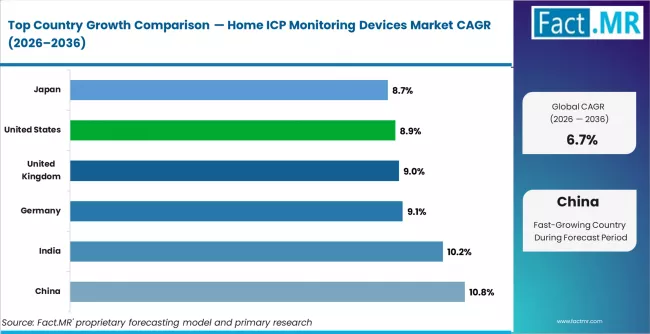
Home Icp Monitoring Devices Market Cagr Analysis By Country | Source: Fact.MR
Asia Pacific Home ICP Monitoring Devices Market Analysis
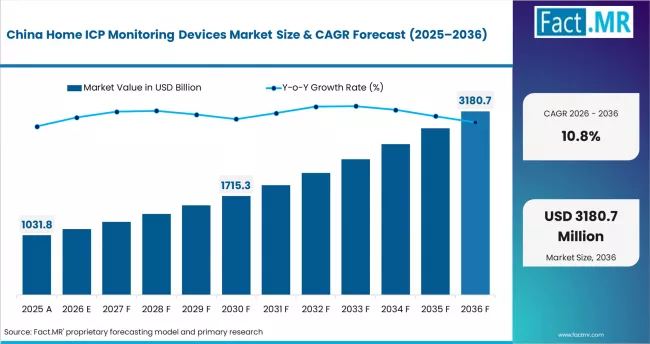
Home Icp Monitoring Devices Market Country Value Analysis | Source: Fact.MR
Asia Pacific is seeing rapid expansion in home-based neurological monitoring. Growth patterns differ by country. Policy support and telehealth integration are key drivers.
- China: China’s expansion is being fuelled by large-scale public healthcare digitisation and state-backed deployment models. Growth is projected at 10.8% CAGR through 2036. In 2024, neurological monitoring devices were added to reimbursement pilots covering millions of patients. Hospital networks in major provinces are increasing device procurement. Domestic manufacturers are also ramping up output under localisation policies, intensifying supply competition.
- India: India is advancing through digital health integration and wide insurance coverage under government programmes. The market is forecast to rise at 10.2% CAGR through 2036. Updated telehealth guidelines in 2024 enabled structured device integration. National programmes are prioritising TBI and stroke monitoring. Expansion of home care partnerships is improving accessibility across key regions.
- Japan: Japan’s trajectory is shaped by demographic pressure and structured reimbursement frameworks. Expansion continues at an estimated 8.7% CAGR through 2036. Policy updates in 2024 brought non-invasive monitoring under long-term care coverage. Clinical validation efforts are strengthening physician confidence. Hospitals are gradually embedding home monitoring into standard care pathways.
Fact.MR covers China, India, Japan, South Korea, ASEAN, and ANZ. The analysis includes digital health programmes, reimbursement trends, and device adoption forecasts.
Europe Home ICP Monitoring Devices Market Analysis
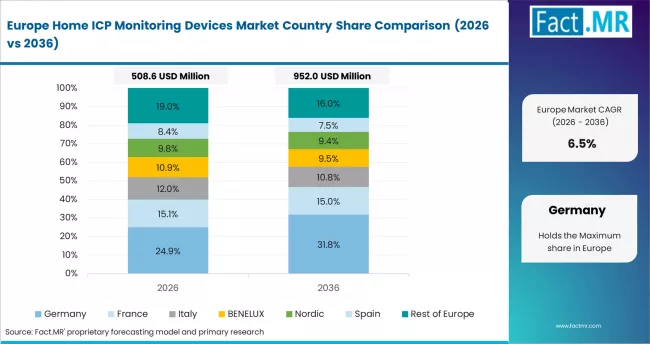
Home Icp Monitoring Devices Market Europe Country Market Share Analysis, 2026 & 2036 | Source: Fact.MR
Europe operates within a highly regulated and evidence-driven environment. Market access depends on compliance and clinical validation.
- Germany: Germany’s growth is supported by well-defined reimbursement structures and digital health adoption. A CAGR of 9.1% is anticipated through 2036. Reimbursement reforms introduced in 2024 enabled coverage for home neurological monitoring. Integration with digital health applications is improving care coordination. Hospitals are expanding pilot deployments across multiple states.
- United Kingdom: The UK is progressing through system-led healthcare transformation initiatives. Growth is likely to register close to 9.0% CAGR through 2036. NHS programmes are prioritising remote neurological monitoring. Updated clinical guidance in 2024 reinforced post-discharge tracking. Procurement activity is rising through regional care systems. Vendors are strengthening local clinical support infrastructure.
Fact.MR covers Germany, France, the UK, Italy, Spain, and Rest of Europe. The analysis includes EU MDR compliance, NHS frameworks, and reimbursement trends.
North America Home ICP Monitoring Devices Market Analysis
North America reflects a structured and reimbursement-led ecosystem. Adoption is closely tied to policy and clinical validation standards.
- United States: The U.S. market is evolving through reimbursement expansion and faster regulatory pathways. Growth is expected to reach around 8.9% CAGR through 2036. CMS revisions in 2024 expanded coverage for neurological monitoring. FDA process improvements in 2025 reduced approval timelines. Healthcare providers are increasing adoption in home-based care settings. Long-term procurement agreements are becoming more common.
Fact.MR covers the U.S., Canada, and Mexico. The analysis includes CMS data, FDA trends, and procurement patterns.
Competitive Aligners for Market Players
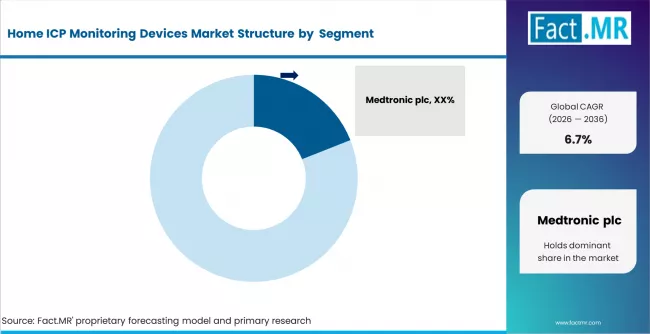
Home Icp Monitoring Devices Market Analysis By Company | Source: Fact.MR
The home ICP monitoring devices market is shaped by a focused group of clinically established players rather than a highly fragmented base. Companies like Medtronic plc, Integra LifeSciences, Brain4care, and Vittamed Neuroscience have built strong positions through years of clinical research and hospital partnerships. Their advantage comes from proven device accuracy, regulatory approvals, and integration into neurology care systems.
Competition in this space is no longer about offering lower-cost devices. It is increasingly about clinical trust and validation. Hospitals and home care providers now prioritise devices that can deliver reliable, non-invasive readings comparable to invasive methods. Features such as real-time monitoring, wireless data transfer to health records, and remote alert systems are becoming standard expectations. Devices with FDA clearance or CE marking are gaining faster acceptance, while those without strong validation struggle to be included in procurement lists.
Another key shift is how buyers select suppliers. Healthcare systems are moving toward fewer, more reliable partners. Long-term contracts are being awarded to companies that can support reimbursement requirements and provide ongoing technical and clinical support. Operational strength now depends on more than just product quality. Leading players are investing in clinical trials, physician engagement, and telehealth integration services. While regional manufacturers, especially in Asia, compete on pricing, they often face barriers in entering premium markets where validation and regulatory compliance are critical.
Key Players
- Medtronic plc
- Integra LifeSciences
- RAUMEDIC AG
- Spiegelberg GmbH
- Sophysa Ltd.
- HeadSense Medical
- Vittamed Neuroscience
- Brain4care
Bibliography
- [1] U.S. Centers for Medicare and Medicaid Services. (2024). Remote Physiologic Monitoring Reimbursement Code Update 2024: Expanded Coverage for Continuous Neurological Parameter Monitoring Devices Including Non-Invasive ICP Monitoring in Home and Post-Discharge Settings. cms.gov/medicare-coverage-database
- [2] Brain4care. (Early 2025). Product Launch Announcement: Updated Wearable ICP Monitoring Platform with Wireless EHR Transmission and Remote Clinician Alert Features Validated Under EU MDR Class IIb Requirements for Home Neurological Monitoring. brain4care.com/news
- [3] National Health Commission of China. (2024). Digital Home Healthcare Programme Expansion 2024: Neurological Monitoring Device Reimbursement Pilot Scheme Including Provincial Coverage Targets and Home ICP Device Procurement Guidelines. nhc.gov.cn/english
- [4] Vittamed Neuroscience. (2024). Clinical Validation Programme Update: Multi-Centre European Data Expansion for Ultrasound-Based Non-Invasive ICP Monitoring System Supporting CE Mark and FDA 510(k) Regulatory Submissions. vittamed.com/news
- [5] American Stroke Association and Neurocritical Care Society. (2024). Home Neurological Monitoring Device Utilisation Report 2024: Non-Invasive ICP Wearable Procurement Growth and Telestroke Programme Integration Trends in the United States and United Kingdom. strokeassociation.org/professional-resources
- [6] HeadSense Medical. (2025). Technology Development Announcement: Advancement of Near-Infrared Optical ICP Monitoring Platform Targeting Ambulatory Stroke Rehabilitation Monitoring Programmes in the United States and Israel. headsensemedical.com
This Report Addresses
- Strategic intelligence on home ICP monitoring device demand across non-invasive wearable, portable handheld, and implantable formats for TBI, hydrocephalus, and stroke patient management globally.
- Market forecast from USD 1.9 billion in 2026 to USD 3.6 billion by 2036, at a CAGR of 6.7%.
- Growth opportunity mapping across China digital health expansion, India Ayushman Bharat telehealth integration, U.S. CMS reimbursement coding, Germany statutory insurance pathway, UK NHS remote monitoring commissioning, and Japan long-term care insurance coverage.
- Segment analysis by device type (wearable, handheld, implantable), technology (ultrasound, optical, TCD), and application (TBI, hydrocephalus, stroke) across global and regional markets.
- Regional outlook covering Asia Pacific telehealth-led volume growth, Europe MDR compliance-driven premium demand, and North America reimbursement-structured adoption.
- Competitive analysis of Medtronic, Integra LifeSciences, Brain4care, Vittamed, Sophysa, and others. Focus on clinical validation depth, regulatory clearance status, and reimbursement pathway alignment.
- Regulatory analysis covering FDA 510(k) non-invasive ICP device clearance, EU MDR Class IIb requirements, CMS remote physiologic monitoring codes, NHS commissioning guidelines, and Japan MHLW home device reimbursement classifications.
- Report delivered in PDF, Excel, and presentation formats. Supported by primary interviews, clinical registry data, regulatory records, and reimbursement procurement benchmarks.
Home ICP Monitoring Devices Market Definition
The home ICP monitoring devices market includes non-invasive wearable monitors, portable handheld devices, and implantable home-compatible systems used to measure intracranial pressure outside clinical settings. These devices serve patients with TBI, hydrocephalus, stroke, and related neurological conditions requiring ongoing pressure monitoring post-discharge.
Home ICP Monitoring Devices Market Inclusions
Includes global and regional forecasts from 2026 to 2036 by device type, technology, and application. Covers non-invasive wearable, portable handheld, and implantable home-compatible ICP monitoring devices used in post-discharge, home care, and remote patient monitoring programmes across all neurological end-use indications.
Home ICP Monitoring Devices Market Exclusions
Excludes invasive hospital-based ICP monitoring catheters and bolt systems not designed for home use. Also excludes general-purpose neurology diagnostic equipment, brain imaging systems, and ICP data management software sold independently. Focus remains on standalone home-use ICP monitoring device hardware sold through neuro-care channels.
Home ICP Monitoring Devices Market Research Methodology
- Primary Research
- Interviews with neurologists, home care procurement teams, medical device distributors, and telehealth programme managers across key markets.
- Desk Research
- Analysis of Medtronic plc, Integra LifeSciences, and Brain4care annual reports, FDA 510(k) ICP device clearance records, NHS remote monitoring procurement data, and home ICP monitoring clinical trial registrations from 2024 to 2025.
- Market-Sizing and Forecasting
- Hybrid model integrating top-down estimates from device manufacturer revenues with bottom-up application-level volume forecasts by device type and neurological indication segment.
- Data Validation and Update Cycle
- Validated through manufacturer revenue disclosures, clinical registry data, reimbursement approval records, and expert interviews with neuro-care procurement and telehealth integration specialists.
Segmentation
Scope of Report
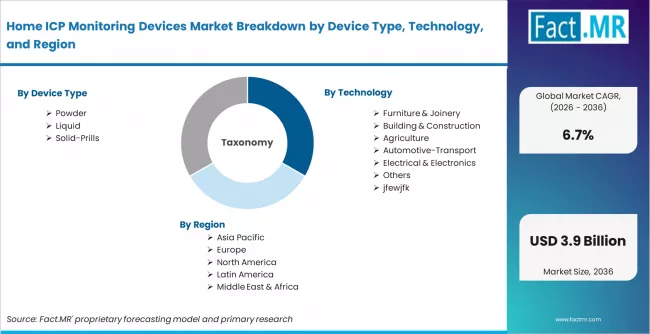
Home Icp Monitoring Devices Market Breakdown By Device Type Technology And Region | Source: Fact.MR
| Attribute | Details |
|---|---|
| Quantitative Units | USD 1.9 billion (2026) to USD 3.6 billion (2036), at a CAGR of 6.7% |
| Market Definition | Non-invasive wearable monitors, portable handheld monitors, and implantable home-compatible ICP monitoring systems supplied for post-discharge and chronic neurological patient management including TBI, hydrocephalus, and stroke globally. |
| Device Type Segmentation | Non-Invasive Wearable Monitors, Portable Handheld Monitors, Implantable Home-Compatible Systems |
| Technology Segmentation | Ultrasound-Based Monitoring, Optical/Near-Infrared, Transcranial Doppler, Others |
| Application Segmentation | Traumatic Brain Injury, Hydrocephalus, Stroke, Others |
| Application Coverage | Post-discharge TBI continuous ICP surveillance, chronic hydrocephalus shunt function monitoring, stroke rehabilitation neurological parameter tracking, and home care telehealth-integrated neurological monitoring programmes. |
| Regions Covered | North America, Europe, Asia Pacific, Latin America, Middle East and Africa |
| Countries Covered | USA, Canada, Mexico, Germany, UK, France, Italy, Spain, Nordic, BENELUX, China, Japan, South Korea, India, ASEAN, Australia and New Zealand, Brazil, Argentina, Chile, Saudi Arabia, GCC, Turkey, South Africa, Rest of MEA |
| Key Companies Profiled | Medtronic plc, Integra LifeSciences, RAUMEDIC AG, Spiegelberg GmbH, Sophysa Ltd., HeadSense Medical, Vittamed Neuroscience, Brain4care |
| Forecast Period | 2026 to 2036 |
| Approach | Hybrid top-down and bottom-up model using device manufacturer revenues, unit shipment volumes by device type and technology, average selling prices by application and reimbursement segment, clinical procurement benchmarks, and primary interviews with neurologists and home care procurement managers. |
Source: Fact.MR analysis. Updated Apr 22, 2026
Home ICP Monitoring Devices Market by Segments
-
By Device Type:
- Non-Invasive Wearable Monitors
- Portable Handheld Monitors
- Implantable Home-Compatible Systems
-
By Technology:
- Ultrasound-Based Monitoring
- Optical/Near-Infrared
- Transcranial Doppler
- Others
-
By Application:
- Traumatic Brain Injury
- Hydrocephalus
- Stroke
- Others
-
By Region:
- North America
- United States
- Canada
- Mexico
- Latin America
- Brazil
- Mexico
- Argentina
- Chile
- Rest of Latin America
- Western Europe
- Germany
- United Kingdom
- France
- Italy
- Spain
- Nordic Countries
- BENELUX
- Rest of Western Europe
- Eastern Europe
- Russia
- Poland
- Hungary
- Balkan and Baltic
- Rest of Eastern Europe
- East Asia
- China
- Japan
- South Korea
- South Asia and Pacific
- India
- ASEAN
- Australia and New Zealand
- Rest of South Asia and Pacific
- Middle East and Africa
- Kingdom of Saudi Arabia
- Other GCC Countries
- Turkey
- South Africa
- Rest of Middle East and Africa
- North America
Frequently Asked Questions
How large is the global home ICP monitoring devices market in 2025?
What will the market size be in 2026?
What is the projected market size by 2036?
What is the expected CAGR from 2026 to 2036?
Which device type segment is poised to lead the home ICP monitoring devices market?
Which technology segment holds the largest share?
Which application segment is poised to lead?
Which country shows the fastest growth in the home ICP monitoring devices market?
What are home ICP monitoring devices used for?
What drives demand in this market?
What are the major restraints?
Who worked on this report


Preview the report firsthand - request a free sample
Free SampleGet the brochure for pricing and purchase details
Download PDF