- Base Value(2026): 3.1 Bn
- Estimated Value(2026): 3.1 Bn
- Forecast Value (2036): 7.2 Bn
- CAGR (2026 - 2036): 8.8%
Hydro Fiber Pads Market Forecast and Outlook 2026 to 2036
The hydro fiber pads market is anticipated to expand from USD 3.1 billion in 2026 to USD 7.2 billion in 2036, demonstrating a CAGR of 8.8% during the forecast period.
Key Takeaways from Hydro Fiber Pads Market
- Hydro Fiber Pads Market Value (2026): USD 3.1 billion
- Hydro Fiber Pads Market Forecast Value (2036): USD 7.2 billion
- Hydro Fiber Pads Market Forecast CAGR: 8.8%
- Leading Application in Hydro Fiber Pads Market: Chronic Wounds (65.0%)
- Key Growth Countries in Hydro Fiber Pads Market: China, India, Germany, Brazil, USA, UK, Japan
- Key Players in Hydro Fiber Pads Market: Convatec Group, Smith And Nephew, 3M Health Care, Mölnlycke Health Care, Paul Hartmann AG, Coloplast, B. Braun Melsungen, Medline Industries, Derma Sciences, Integra LifeSciences
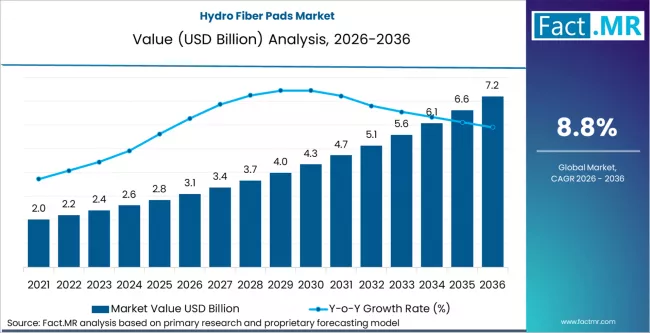
Hydro Fiber Pads Market Market Value Analysis | Source: Fact.MR
Growth is driven by increasing adoption of hydro fiber dressings across China, India, Germany, Brazil, the United States, the United Kingdom, and Japan, where advanced wound management solutions are increasingly used in hospitals, clinics, and home-care settings.
Product type segmentation highlights silver impregnated hydro fiber pads as the leading category, followed by standard hydro fiber pads, antimicrobial hydro fiber pads, and high absorbency hydro fiber pads, each designed to address specific clinical needs. Application analysis shows chronic wounds as the largest treatment area, supported by surgical wounds, burns, traumatic wounds, and pressure ulcers, reflecting the versatility of hydro fiber pads in wound management.
Hydro Fiber Pads Market
| Metric | Value |
|---|---|
| Market Value 2026 | USD 3.1 Billion |
| Market Forecast Value 2036 | USD 7.2 Billion |
| Forecast CAGR 2026 to 2036 | 8.8% |
Source: Fact.MR analysis. Updated Jan 29, 2026
Category
| Category | Segments |
|---|---|
| Product Type | Silver Impregnated Hydro Fiber Pads; Standard Hydro Fiber Pads; Antimicrobial Hydro Fiber Pads; High Absorbency Hydro Fiber Pads; Other |
| Application | Chronic Wounds; Surgical Wounds; Burns; Traumatic Wounds; Pressure Ulcers |
| Material Type | Silver Infused; Standard Fibers; Antimicrobial Treated; High Absorbency Fibers; Other |
| End User | Hospitals; Clinics; Home Care Settings; Specialty Wound Care Centers; Other |
| Region | North America; Europe; Asia Pacific; Latin America; Middle East & Africa |
Source: Fact.MR analysis. Updated Jan 29, 2026
Segmental analysis
Which Product Type Holds the Largest Share in the Hydro Fiber Pads Market?
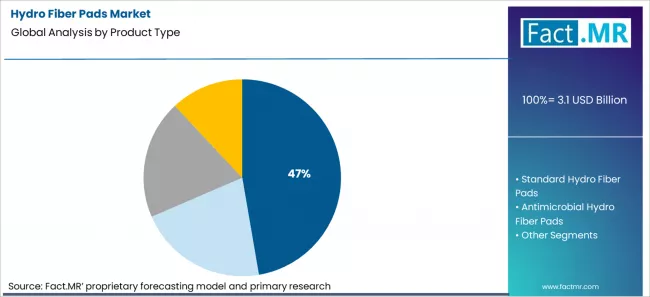
Hydro Fiber Pads Market Analysis By Product Type | Source: Fact.MR
Silver impregnated hydro fiber pads lead the market with a 47.3% share. These pads are designed to provide antimicrobial protection while effectively managing wound exudate, making them highly preferred in hospitals, clinics, and home-care settings. Their ability to reduce infection risk while supporting healing has strengthened adoption across long-term and high-risk wound management cases.
- Companies are improving fiber structure and absorption efficiency to enhance clinical outcomes.
- The focus on infection control and reliable performance maintains silver impregnated pads as the dominant product type.
Which Wound Type Drives the Highest Demand for Hydro Fiber Pads?
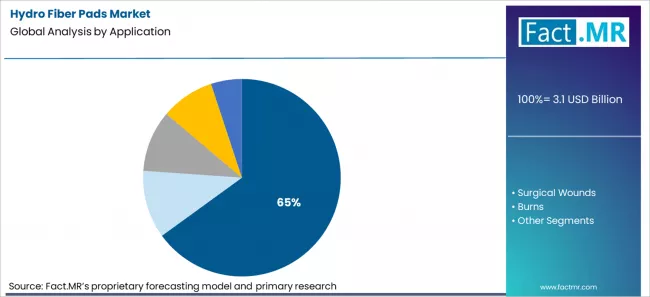
Hydro Fiber Pads Market Analysis By Application | Source: Fact.MR
Chronic wounds account for the largest share at 65.0%, reflecting the critical role hydro fiber pads play in managing long-lasting wounds such as diabetic ulcers and venous leg ulcers. The pads’ moisture-retentive properties and antimicrobial protection make them particularly effective in prolonged treatment protocols.
- Healthcare providers increasingly integrate hydro fiber pads into chronic wound care strategies for better healing and reduced complications.
- Rising prevalence of chronic wounds and emphasis on advanced, infection-resistant dressings reinforce this segment’s market dominance.
What are the Drivers, Restraints, and Key Trends in the Hydro Fiber Pads Market?
- Drivers: Rising incidence of chronic wounds, pressure ulcers, diabetic foot ulcers and surgical wounds is increasing clinician reliance on advanced absorbent dressings that create moist healing environments and manage exudate effectively. Products using hydrofiber technology transform into a gel upon contact with wound fluid, enhance fluid retention, and protect surrounding tissue, prompting hospitals and wound care specialists to expand procurement as clinical evidence of improved healing outcomes grows. Investment in wound care infrastructure and targeted product launches by major manufacturers further support demand in advanced dressings globally.
- Restraints: High formulation and development costs for hydrofiber dressings and related pads, combined with strict regulatory requirements for medical devices, restrict wider adoption among smaller care facilities and in price-sensitive regions. Manufacturers face technical challenges in maintaining consistent absorbency performance and stability across diverse wound types, which can delay product approvals and limit integration into existing care protocols.
- Trend 1: Increased development of multifunctional hydro fiber pads that integrate antimicrobial features and enhanced exudate management to address complex wound care needs across acute and chronic wound segments.
- Trend 2: Growth of online clinical procurement platforms and direct supply agreements with healthcare systems that improve availability of advanced wound dressings and support broader uptake across inpatient and outpatient care settings.
Analysis of the Hydro Fiber Pads Market by Key Country
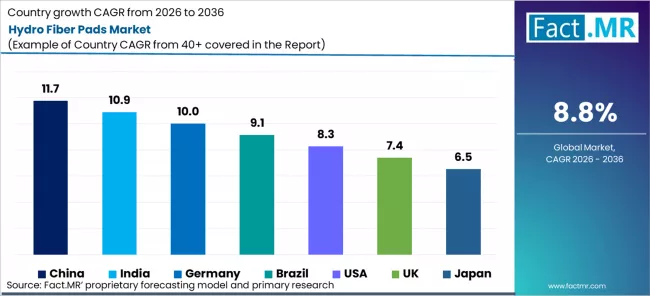
Hydro Fiber Pads Market Cagr Analysis By Country | Source: Fact.MR
| Country | CAGR |
|---|---|
| China | 11.7% |
| India | 10.9% |
| Germany | 10.0% |
| Brazil | 9.1% |
| USA | 8.3% |
| UK | 7.4% |
| Japan | 6.5% |
Source: Fact.MR analysis. Updated Jan 29, 2026
How Is Clinical Evidence Shaping Hydro Fiber Pads Demand in China?
China’s Hydro Fiber Pads market is expected to expand at a CAGR of 11.7% from 2026 to 2036. Hospitals and specialist clinics are increasingly adopting hydrofiber dressings due to superior exudate management and reduced maceration compared with conventional gauze. Advanced wound care programs, combined with rising awareness of antimicrobial and high-absorbency pads, support broader adoption across urban medical centers. Clinical consensus emphasizes fluid control and wound healing efficacy, which positions hydrofiber pads as a preferred solution for chronic, surgical, and traumatic wounds.
Why Is India Emerging as a High-Growth Market for Hydro Fiber Pads?
Adoption of hydrofiber pads in India is projected to grow at a CAGR of 10.9% from 2026 to 2036. Hospitals, clinics, and professional caregivers are increasingly relying on silver-impregnated and multifunctional hydrofiber dressings for chronic and diabetic wounds. Rising awareness of evidence-based wound management, urban healthcare infrastructure expansion, and higher disposable income in metropolitan areas are driving uptake. Functional pads that improve patient comfort and reduce dressing change frequency are becoming a key choice for clinicians and care providers.
What Factors Are Influencing Hydro Fiber Pads Demand in Germany?
Germany’s hydrofiber pads market is expected to expand at a CAGR of 10.0% from 2026 to 2036. Hospitals and surgical centers increasingly favor absorbent dressings for post-operative and chronic wound care. Clinicians prioritize scientifically validated products that provide efficient exudate management and protect peri-wound skin. Adoption is supported by the integration of hydrofiber pads into standard clinical protocols and evidence from randomized trials demonstrating their advantages over traditional gauze. Specialty stores and hospital formularies facilitate access to premium options.
How Are Antimicrobial Solutions Driving Hydro Fiber Pads Sales in Brazil?
In Brazil, hydrofiber pads are projected to grow at a CAGR of 9.1% from 2026 to 2036. Burn centers, trauma units, and surgical wards increasingly integrate antimicrobial and high-absorbency dressings into wound care protocols. Studies confirm superior fluid absorption, reduced dressing trauma, and better healing outcomes compared with conventional materials. Urban hospitals and specialty clinics are leading adoption, while growing clinical awareness across semi-urban healthcare facilities reinforces steady growth.
Why Does the USA Remain a Key Market for Hydro Fiber Pads?
The USA Hydro Fiber Pads market is projected to grow at a CAGR of 8.3% from 2026 to 2036. High-absorbency pads are widely used for traumatic, chronic, and post-surgical wounds in hospitals and trauma centers. Clinicians prioritize evidence-backed performance, patient comfort, and reduced dressing changes. Urban healthcare facilities are increasingly integrating advanced hydrofiber pads into standard wound care regimens, and premium adoption is supported by both hospital procurement protocols and professional guidelines.
What Is Supporting Hydro Fiber Pads Adoption in the UK?
The UK market for hydrofiber pads is expected to expand at a CAGR of 7.4% from 2026 to 2036. Advanced absorbent dressings are incorporated into NHS wound care protocols for pressure ulcers, chronic wounds, and post-operative management. Hospitals and community care providers increasingly rely on hydrofiber pads to improve healing outcomes and reduce dressing change frequency. Clinically validated products with multifunctional benefits are favored in urban healthcare settings, reinforcing adoption of premium pads.
How Is Market Maturity Affecting Hydro Fiber Pads Demand in Japan?
Japan’s hydrofiber pads market is projected to grow at a CAGR of 6.5% from 2026 to 2036. Hospitals and clinics emphasize advanced wound care solutions that provide reliable fluid absorption and antimicrobial protection. Mature clinical practices, high consumer safety expectations, and strong presence of domestic and international brands influence purchasing decisions. Multifunctional pads are preferred for chronic, surgical, and pressure ulcer care, ensuring stable demand in both metropolitan and specialty medical facilities.
How Have Competitive Strategies in Skincare and Advanced Facial Care Markets Evolved and What Is Driving Change from 2026 onwards?
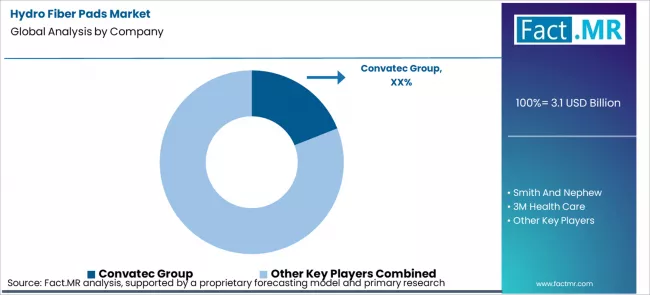
Hydro Fiber Pads Market Analysis By Company | Source: Fact.MR
Across advanced skincare and facial care categories, including BioSignal Serums, MicroRNA Masks, Proteome Balms, Gene Repair Creams, Spora Face Oils, and Hydro Fiber Pads, companies have shifted toward highly differentiated formulations and technology-enabled delivery systems. Leading players such as L’Oréal Group, Estée Lauder Companies, Shiseido, and SkinCeuticals have invested in peptide-based, bioactive, and microRNA-driven products addressing anti-aging, hydration, and skin repair needs. Distribution has expanded across e-commerce platforms, specialty retail, and professional channels, while portfolio diversification has targeted multiple skin types and treatment applications. Brand credibility is increasingly anchored in clinical validation, proprietary technologies, and research-backed formulations.
From 2026 onwards, strategies are expected to focus on precision, personalization, and integrated digital-physical offerings. Companies will likely leverage AI-assisted skin diagnostics, bioelectric and nano-carrier technologies, and highly targeted formulations that respond to individual skin conditions. Cross-category approaches may emerge, combining serums, creams, and masks into coordinated treatment protocols supported by professional guidance or connected devices. Buyers will prioritize visible outcomes, formulation transparency, and reliability. Market leaders will continue to differentiate through research agility, scalable production, and global reach, while smaller innovators may capture niche opportunities with specialized, technology-driven solutions that address unmet consumer needs.
Key Players Driving Strategy in Skincare and Advanced Facial Care Markets
- L’Oréal Group
- Estée Lauder Companies
- Shiseido Company
- Procter & Gamble
- Beiersdorf AG
- Johnson and Johnson
- Amorepacific Corporation
- Kiehl’s (L’Oréal Group)
- DECIEM Beauty Group Inc.
- SkinCeuticals
- SkinMedica
- Tatcha
- Dr. Dennis Gross Skincare
- Alastin Skincare
- ZO Skin Health
Bibliography
- World Health Organization. (2023). Global report on diabetes. World Health Organization.
- European Wound Management Association. (2023). Antimicrobials and antiseptics in wound management. EWMA.
- National Institute for Health and Care Excellence. (2023). Diabetic foot problems: prevention and management (NG19). NICE.
- National Institute for Health and Care Excellence. (2023). Pressure ulcers: prevention and management (NG179). NICE.
- Organisation for Economic Co-operation and Development. (2023). Health at a glance 2023. OECD.
Segmentation
Scope of the Report
| Items | Values |
|---|---|
| Quantitative Units (2026) | USD 3.1 Billion |
| Product Type | Silver Impregnated Hydro Fiber Pads, Standard Hydro Fiber Pads, Antimicrobial Hydro Fiber Pads, High Absorbency Hydro Fiber Pads, Other |
| Application | Chronic Wounds, Surgical Wounds, Burns, Traumatic Wounds, Pressure Ulcers, Other |
| Regions Covered | Asia Pacific, North America, Europe, Latin America, and Middle East & Africa |
| Countries Covered | China, India, Germany, Brazil, USA, UK, Japan, and other countries |
| Key Companies Profiled | Convatec Group, Smith and Nephew, 3M Health Care, Mölnlycke Health Care, Paul Hartmann AG, Coloplast, B. Braun Melsungen, Medline Industries, Derma Sciences, Integra LifeSciences, and other leading wound care companies |
| Additional Attributes | Dollar revenue by product type, application, and region; regional demand trends, competitive landscape, innovations in hydro fiber pad materials, antimicrobial and silver-impregnation technologies, absorbency and patient care efficacy, and premium wound care strategies |
Source: Fact.MR analysis. Updated Jan 29, 2026
Hydro Fiber Pads Market by Segments
-
Product Type :
- Silver Impregnated Hydro Fiber Pads
- Standard Hydro Fiber Pads
- Antimicrobial Hydro Fiber Pads
- High Absorbency Hydro Fiber Pads
-
Application :
- Chronic Wounds
- Surgical Wounds
- Burns
- Traumatic Wounds
- Pressure Ulcers
-
Region :
- North America
- U.S.
- Canada
- Mexico
- Europe
- Germany
- Italy
- UK
- France
- Spain
- Netherlands
- Switzerland
- Rest of Europe
- Asia Pacific
- Japan
- Australia
- South Korea
- China
- India
- Rest of Asia Pacific
- Latin America
- Brazil
- Argentina
- Rest of Latin America
- Middle East and Africa
- United Arab Emirates
- South Africa
- Rest of Middle East and Africa
- North America
Frequently Asked Questions
How big is the hydro fiber pads market in 2026?
What will be the size of hydro fiber pads market in 2036?
How much will be the hydro fiber pads market growth between 2026 and 2036?
What are the key product types in the hydro fiber pads market?
Which application segment to contribute significant share in the hydro fiber pads market in 2026?
Who worked on this report


Preview the report firsthand - request a free sample
Free SampleGet the brochure for pricing and purchase details
Download PDF