- Base Value(2025): 605.8 Mn
- Estimated Value(2025): 605.8 Mn
- Forecast Value (2035): 924.6 Mn
- CAGR (2025 - 2035): 4.3%
Sodium Sulfide Market Forecast and Outlook 2025 to 2035
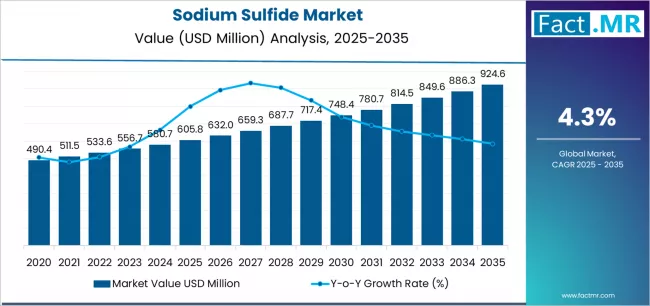
The global sodium sulfide market is projected to reach USD 924.6 million by 2035, recording an absolute increase of USD 318.8 million over the forecast period. The market is valued at USD 605.8 million in 2025 and is set to rise at a CAGR of 4.3% during the assessment period.
The overall market size is expected to grow by approximately 1.5 times during the same period, supported by increasing demand for chemical processing applications and expanding pulp and paper production capacity worldwide, driving demand for effective delignification agents and increasing investments in wastewater treatment infrastructure with enhanced heavy metal precipitation capabilities across industrial and municipal applications globally.
Quick Stats for Sodium Sulfide Market
- Sodium Sulfide Market Value (2025): USD 605.8 million
- Sodium Sulfide Market Forecast Value (2035): USD 924.6 million
- Sodium Sulfide Market Forecast CAGR: 4.3%
- Leading Product Type in Sodium Sulfide Market: Anhydrous (47.5%)
- Key Growth Regions in Sodium Sulfide Market: Asia Pacific, North America, and Europe
- Top Players in Sodium Sulfide Market: Solvay S.A., Nippon Chemical Industrial Co., Ltd., TIB Chemicals AG, Rongyuan Chemical Co., Ltd., Gujarat Alkalies and Chemicals Ltd (GACL), Shaanxi Fuhua Chemical Co., Ltd., Weifang Yidu Chemical Co., Ltd., Tessenderlo Group, Sichuan Shenhong Chemical Industry Co., Ltd., NaFine Chemical Industry Group Co., Ltd.
Sodium Sulfide Market Market Value Analysis | Source: Fact.MR
Chemical processors and manufacturing facilities face mounting pressure to optimize production efficiency and meet environmental compliance standards while managing diverse raw material requirements and operational constraints, with modern sodium sulfide products providing documented performance advantages including superior sulfur content consistency, controlled moisture levels, and reliable reactivity profiles compared to alternative sulfur compounds.
Rising industrialization and expanding textile manufacturing development across emerging economies create substantial opportunities for chemical manufacturers and distribution partners. However, handling safety concerns and transportation regulatory complexity may pose obstacles to market expansion in certain geographic regions.
The anhydrous segment dominates market activity, driven by superior chemical purity characteristics and concentrated sulfur content enabling efficient utilization across demanding industrial applications worldwide. Chemical processors increasingly recognize the technical advantages of anhydrous formulations, with typical product offerings providing maximum active ingredient concentration and extended storage stability through established handling protocols.
The crystal segment demonstrates robust growth potential, supported by handling convenience and dissolution characteristics enabling effective performance across diverse processing applications in modern chemical manufacturing. Pulp & paper applications emerge as the dominant end-use segment, reflecting extensive sodium sulfide requirements for kraft pulping and chemical recovery processes. Anhydrous sodium sulfide maintains market leadership among product forms, while water treatment applications gain momentum through environmental compliance requirements.
Regional dynamics show significant growth potential across Asia Pacific, supported by rapid industrialization and expanding paper manufacturing capacity across China, India, and Southeast Asian markets.
North America demonstrates strong market presence driven by established pulp and paper industry and comprehensive wastewater treatment infrastructure, while Europe emphasizes environmental regulations and sustainable chemical processing practices. India leads country-level growth through extensive textile manufacturing expansion and water treatment infrastructure development, followed by China supported by massive industrial chemical consumption.
The competitive landscape features moderate concentration with Solvay S.A. maintaining market leadership position, while established players including Nippon Chemical Industrial Co., Ltd., TIB Chemicals AG, and Rongyuan Chemical Co., Ltd. compete through comprehensive production capabilities and advanced manufacturing expertise across diverse industrial applications.
Sodium Sulfide Market Year-over-Year Forecast 2025 to 2035
Between 2025 and 2029, the sodium sulfide market is projected to expand from USD 605.8 million to USD 719.7 million, resulting in a value increase of USD 113.9 million, which represents 35.7% of the total forecast growth for the period. This phase of development will be shaped by rising demand for kraft pulping chemicals and delignification agents in paper manufacturing applications, product innovation in low ferric formulations with enhanced purity specifications, as well as expanding integration with industrial wastewater treatment systems and heavy metal precipitation protocols. Companies are establishing competitive positions through investment in production capacity expansion, advanced purification technologies, and strategic market expansion across pulp and paper mills, textile processing facilities, and water treatment operations.
From 2029 to 2035, the market is forecast to grow from USD 719.7 million to USD 924.6 million, adding another USD 204.9 million, which constitutes 64.3% of the overall expansion. This period is expected to be characterized by the expansion of specialized product applications, including ultra-pure grades for pharmaceutical intermediates and customized formulations tailored for specific leather tanning requirements, strategic collaborations between chemical manufacturers and end-user industries, and an enhanced focus on safe handling systems and transportation compliance standards. The growing emphasis on sustainable textile processing and rising adoption of advanced wastewater treatment technologies will drive demand for comprehensive sodium sulfide solutions across diverse industrial manufacturing environments.
Sodium Sulfide Market Key Takeaways
| Metric | Value |
|---|---|
| Market Value (2025) | USD 605.8 million |
| Market Forecast Value (2035) | USD 924.6 million |
| Forecast CAGR (2025-2035) | 4.3% |
Source: Fact.MR analysis. Updated Dec 1, 2025
Why is the Sodium Sulfide Market Growing?
The sodium sulfide market grows by enabling pulp and paper manufacturers, textile processors, and water treatment facilities to achieve effective chemical processing and treatment objectives while maintaining operational efficiency without extensive raw material complexity requirements.
Industrial chemical users and process engineers face mounting pressure to optimize production yields and ensure regulatory compliance while managing safety protocols and environmental standards, with modern sodium sulfide formulations typically providing superior reactivity, consistent quality specifications, and reliable supply availability compared to alternative sulfur-containing reagents, making sodium sulfide utilization essential for competitive industrial operations.
The chemical processing industry's need for versatile reducing agents and sulfur source capabilities creates demand for comprehensive sodium sulfide solutions that can provide effective delignification, efficient heavy metal precipitation, and reliable chemical synthesis intermediates without compromising process performance or environmental safety standards.
Industrial demand growth and manufacturing capacity expansion drive adoption in paper mills, textile dyeing facilities, and municipal wastewater treatment plants, where chemical performance has direct impact on production efficiency and environmental compliance outcomes.
The expanding pulp and paper production globally, particularly in emerging markets, creates growing consumption requirements for kraft pulping chemicals. Rising environmental regulations enable greater adoption of effective heavy metal removal technologies utilizing sodium sulfide precipitation chemistry.
Handling safety requirements and corrosive material management challenges may limit accessibility of sodium sulfide products among smaller-scale processors with limited hazardous material handling infrastructure and technical expertise for safe chemical operations.
Segmental Analysis
The market is segmented by product, application, and region. By product, the market is divided into anhydrous, crystal, and low ferric. Based on application, the market is categorized into pulp and paper, water treatment, textiles, tanneries, and others. Regionally, the market is divided into Asia Pacific, Europe, North America, Central & South America, and Middle East & Africa.
By Product, Which Segment Accounts for the Dominant Market Share?
Sodium Sulfide Market Analysis By Product | Source: Fact.MR
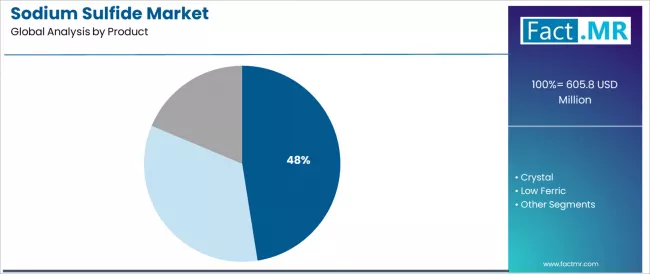
The anhydrous segment represents the dominant force in the sodium sulfide market, capturing approximately 47.5% of total market share in 2025. This established product category encompasses solutions featuring maximum sulfur content and minimum moisture levels, including advanced production processes and quality control systems that enable superior chemical performance and storage stability across kraft pulping and industrial chemical synthesis applications worldwide.
The anhydrous segment's market leadership stems from its superior concentration characteristics, with solutions capable of providing maximum active ingredient delivery, reduced transportation costs per unit of active material, and extended shelf life while maintaining excellent handling properties and dissolution performance standards across diverse industrial processing environments.
The crystal segment maintains a substantial 38.0% market share, serving industrial processors who require convenient handling characteristics and controlled dissolution rates for batch processing applications and water treatment operations. These solutions offer practical advantages for manual handling and dosing systems while providing sufficient chemical activity to meet contemporary pulping and textile processing demands. The crystal segment demonstrates solid market presence, driven by established usage patterns in smaller-scale operations and applications requiring gradual chemical addition protocols.
Within the product category, low ferric formulations demonstrate growing adoption in specialty applications, driven by stringent purity requirements for pharmaceutical intermediates and high-grade textile processing where iron contamination must be minimized. This sub-segment benefits from quality-conscious end-users willing to pay premium prices for enhanced purity specifications.
Key technical advantages driving the anhydrous segment include:
- Advanced concentration characteristics with maximum sulfur content enabling efficient chemical utilization and reduced storage volume requirements across industrial applications
- Established stability profiles allowing extended storage periods and reliable chemical activity without extensive moisture control complexity
- Enhanced economic benefits enabling optimal transportation efficiency and reduced handling frequency while maintaining product integrity and performance consistency
- Superior process efficiency providing concentrated chemical delivery through precise dosing systems for various industrial processing requirements
By Application, Which Segment Accounts for the Largest Market Share?
Sodium Sulfide Market Analysis By Application | Source: Fact.MR
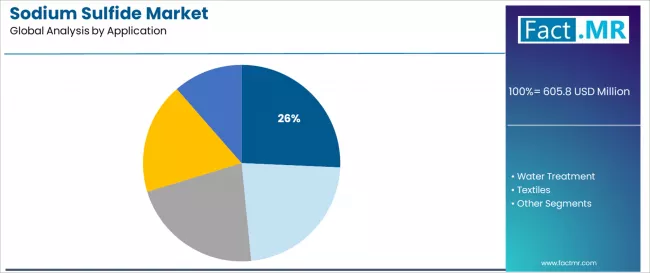
Pulp & paper dominates the sodium sulfide application landscape with a 25.7% market share in 2025, reflecting the critical role of sodium sulfide in supporting kraft pulping processes and chemical recovery systems across paper manufacturing operations worldwide.
The pulp & paper segment's market leadership is reinforced by extensive consumption requirements spanning wood chip digestion, lignin dissolution, and chemical recovery cycles requiring consistent sodium sulfide supply and reliable quality specifications.
Within this segment, kraft pulping operations represent the primary consumption category, driven by global paper and paperboard production volumes requiring effective delignification chemicals for converting wood biomass into cellulose fibers. This sub-segment benefits from established chemical processing protocols and continuous pulping operations demanding reliable sodium sulfide availability.
The water treatment segment represents an important application category with approximately 22.0% market share, demonstrating steady demand through specialized requirements for heavy metal precipitation, including chromium, copper, and other toxic metal removal from industrial wastewater streams. This segment benefits from environmental regulations mandating effective wastewater treatment before discharge and expanding industrial water treatment infrastructure.
The textiles segment maintains meaningful presence through dyeing and finishing applications requiring sulfur-based reducing agents, while the tanneries category serves leather processing operations utilizing sodium sulfide for hair removal and hide preparation processes.
Key market dynamics supporting application growth include:
- Pulp and paper manufacturing expansion driven by packaging demand and tissue product consumption, requiring reliable kraft pulping chemical supply
- Water treatment sector modernization trends require effective heavy metal removal technologies and industrial effluent treatment capabilities
- Integration of environmental compliance requirements enabling demand for proven wastewater treatment chemicals across industrial operations
- Growing emphasis on sustainable textile processing driving adoption of effective chemical reducing agents without compromising environmental standards
What are the Drivers, Restraints, and Key Trends of the Sodium Sulfide Market?
The market is driven by three concrete demand factors tied to industrial processing outcomes. First, expanding pulp and paper production capacity creates increasing demand for kraft pulping chemicals, with sodium sulfide representing a critical component in chemical recovery systems requiring comprehensive supply availability. Second, stringent environmental regulations mandating heavy metal removal from industrial wastewater drive water treatment chemical adoption, with many jurisdictions implementing discharge limits and treatment standards by 2030. Third, growing textile manufacturing activity and leather processing operations enable sustained demand for effective reducing agents and chemical processing intermediates that support industrial production efficiency.
Market restraints include handling safety requirements and corrosive material management challenges that can limit adoption among processors with inadequate safety infrastructure and material handling equipment, particularly in smaller facilities where capital investment in specialized storage and handling systems proves economically challenging. Raw material availability fluctuations and production cost volatility pose another significant challenge, as sodium sulfide manufacturing depends on sulfur feedstock and energy-intensive production processes, potentially affecting price stability and supply reliability. Transportation regulatory complexity and hazardous material shipping requirements create additional barriers for market expansion, demanding specialized logistics capabilities and compliance documentation initiatives.
Key trends indicate accelerated adoption in emerging market paper mills, particularly across Asia Pacific, where expanding packaging industry and tissue product consumption drive kraft pulping capacity additions requiring sodium sulfide supply chains. Production technology advancement trends toward improved purity control and reduced iron content specifications that optimize product quality and expand application possibilities in pharmaceutical intermediates and specialty chemicals. However, the market thesis could face disruption if significant advances in alternative pulping technologies or major shifts in paper production toward recycled fiber processing reduce reliance on traditional kraft pulping chemical requirements.
Analysis of the Sodium Sulfide Market by Key Countries
Sodium Sulfide Market Cagr Analysis By Country | Source: Fact.MR
| Country | CAGR (2025 to 2035) |
|---|---|
| India | 5.4% |
| China | 4.9% |
| USA | 3.8% |
| South Korea | 3.6% |
| Canada | 3.5% |
| Germany | 3.2% |
| Japan | 3.1% |
Source: Fact.MR analysis. Updated Dec 1, 2025
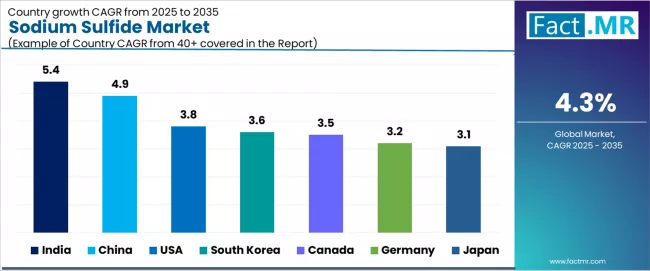
The global sodium sulfide market is expanding steadily, with India leading at a 5.4% CAGR through 2035, driven by rapid textile manufacturing growth, expanding paper production capacity, and rising industrial wastewater treatment requirements. China follows at 4.9%, supported by massive chemical processing industry, paper manufacturing dominance, and environmental compliance initiatives.
USA records 3.8%, reflecting established pulp and paper industry and comprehensive water treatment infrastructure. South Korea advances at 3.6%, anchored by chemical manufacturing expertise and industrial processing capabilities. Canada posts 3.5%, focusing on pulp and paper sector strength, while Germany grows at 3.2%, emphasizing quality standards and environmental compliance. Japan demonstrates 3.1% growth, driven by specialty chemical applications and quality-focused manufacturing.
How is India Leading Global Market Expansion?
India demonstrates the strongest growth potential in the sodium sulfide market with a CAGR of 5.4% through 2035. The country's leadership position stems from rapidly expanding textile manufacturing industry, growing paper production capacity, and increasing water treatment infrastructure requirements driving adoption of industrial chemicals.
Growth is concentrated in major industrial regions and manufacturing clusters, including Gujarat, Maharashtra, Tamil Nadu, and Andhra Pradesh, where textile processing facilities and paper mills utilize sodium sulfide for dyeing operations and kraft pulping processes.
Distribution channels through chemical distributors, direct manufacturer relationships, and industrial chemical suppliers expand product accessibility across organized textile manufacturers and paper processing facilities. The country's growing integration of environmental wastewater treatment standards provides strong momentum for heavy metal precipitation chemicals, including comprehensive adoption across leather tanning operations and industrial effluent treatment plants.
Key market factors:
- Textile manufacturing expansion concentrated in traditional processing clusters and emerging manufacturing zones with rising chemical consumption
- Paper production growth through capacity additions and new mill establishments enabling comprehensive kraft pulping chemical demand
- Water treatment infrastructure development ecosystem, including industrial effluent treatment facilities with proven heavy metal removal capabilities
- Industrial chemical manufacturing presence featuring domestic sodium sulfide producers offering competitive pricing and local supply availability
Why is China Emerging as a High-Growth Market?
In major industrial regions including Shandong, Jiangsu, Zhejiang, and Hebei, the utilization of sodium sulfide solutions is substantial across paper manufacturing facilities and textile processing operations, driven by massive industrial production scale and chemical processing requirements.
The market demonstrates strong growth momentum with a CAGR of 4.9% through 2035, linked to comprehensive paper manufacturing capacity and domestic chemical production capabilities supporting consumption growth.
Chinese manufacturers are implementing environmental compliance measures and adopting quality chemical inputs to enhance production standards while meeting increasingly stringent pollution control regulations. The country's dominant position in global paper production creates ongoing demand for kraft pulping chemicals, while expanding textile industry drives consumption of reducing agents and processing chemicals.
Key development areas:
- Paper mills and textile processors leading sodium sulfide consumption with emphasis on production volume and cost efficiency
- Domestic chemical production capacity through established manufacturers supplying competitive products to industrial users
- Environmental regulation compliance requiring effective wastewater treatment and heavy metal removal in industrial zones
- Chemical industry integration enabling reliable supply chains and competitive pricing structures supporting end-user industries
What Drives USA’s Market Resilience?
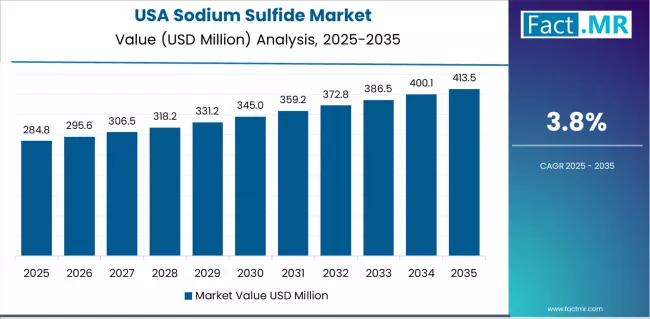
Sodium Sulfide Market Country Value Analysis | Source: Fact.MR
USA’s market expansion is driven by established pulp and paper manufacturing infrastructure, including integrated paper mills and specialty paper producers requiring consistent kraft pulping chemical supply. The country demonstrates steady growth potential with a CAGR of 3.8% through 2035, supported by ongoing paper production operations and comprehensive industrial water treatment requirements.
American chemical users face implementation challenges related to handling safety compliance and environmental regulations requiring specialized storage and transportation systems. However, established consumption patterns in paper manufacturing and reliable supply chain infrastructure create stable baseline demand for sodium sulfide, particularly in southeastern paper manufacturing regions where kraft pulping operations drive primary chemical consumption.
Market characteristics:
- Pulp and paper industry showing stable demand with established annual consumption across kraft pulping operations
- Water treatment applications emphasizing heavy metal removal and industrial wastewater compliance in manufacturing sectors
- Future projections indicate continued focus on operational safety and environmental stewardship in chemical handling practices
- Growing emphasis on supply chain reliability and quality consistency supporting long-term supplier relationships
How Does Germany Demonstrate Quality Leadership?
The German market leads in chemical quality standards based on integration with stringent manufacturing specifications and comprehensive product purity requirements for industrial applications. The country shows solid potential with a CAGR of 3.2% through 2035, driven by established chemical processing industry and quality-focused manufacturing practices in major regions, including North Rhine-Westphalia, Bavaria, Baden-Württemberg, and Lower Saxony.
German chemical users are adopting high-purity sodium sulfide formulations and implementing rigorous quality control procedures for optimal process performance, particularly in specialty chemical manufacturing and pharmaceutical intermediate production demanding comprehensive purity credentials. Distribution channels through specialized chemical distributors and technical service providers expand coverage across quality-conscious industrial processors and specialty manufacturing operations.
Leading market segments:
- Specialty chemical production in major manufacturing centers implementing comprehensive quality assurance programs
- Technical partnerships with chemical suppliers achieving high-performance product delivery and application support
- Strategic collaborations between chemical manufacturers and industrial processors expanding quality innovation
- Focus on safety management and environmental compliance addressing regulatory requirements and operational standards
What Positions Canada for Pulp Industry Leadership?
In British Columbia, Quebec, Ontario, and Alberta, pulp and paper manufacturing operations demonstrate substantial sodium sulfide consumption through kraft pulping processes and chemical recovery systems, with documented integration of reliable chemical supply chains achieving operational efficiency across forest products manufacturing. The market shows steady potential with a CAGR of 3.5% through 2035, linked to established pulp and paper industry and ongoing production operations in major forest products regions.
Canadian paper manufacturers are maintaining consistent sodium sulfide utilization through integrated mill operations and chemical recovery protocols to optimize pulping efficiency while managing operational costs. The country's significant pulp production capacity creates ongoing demand for kraft pulping chemicals, while quality standards drive adoption of reliable chemical formulations with consistent specifications.
Market development factors:
- Pulp and paper mills leading sodium sulfide consumption across established kraft pulping operations in Canada
- Forest products industry providing stable demand through continuous production operations and chemical recovery systems
- Strategic supplier relationships ensuring reliable chemical availability and quality consistency for mill operations
- Emphasis on operational efficiency and cost management supporting optimized chemical utilization protocols
How Does Japan Show Specialty Application Leadership?
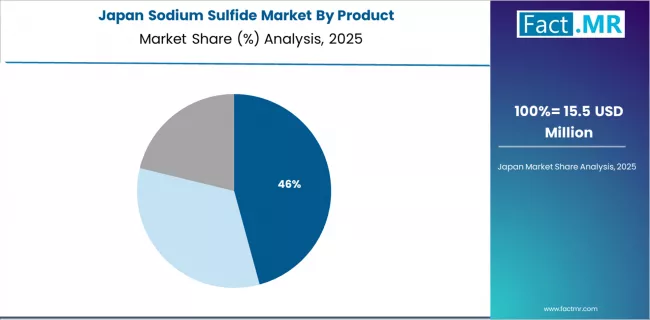
Sodium Sulfide Market Japan Market Share Analysis By Product | Source: Fact.MR
Japan's sodium sulfide market demonstrates sophisticated chemical processing focused on high-purity applications and specialty manufacturing requirements, with documented integration of quality control systems achieving substantial improvements in product consistency and application performance across chemical synthesis operations.
The country maintains steady growth momentum with a CAGR of 3.1% through 2035, driven by mature market dynamics emphasizing product quality and precise specifications that align with Japanese manufacturing standards applied to chemical intermediates and specialty applications.
Major industrial regions, including Tokyo, Osaka, Aichi, and Fukuoka, showcase selective adoption of sodium sulfide products where pharmaceutical intermediate production and specialty chemical synthesis require rigorous purity standards and comprehensive quality documentation.
Key market characteristics:
- Specialty chemical manufacturers driving demand for high-purity formulations with emphasis on low iron content specifications
- Quality partnerships enabling consistent product excellence with comprehensive testing and certification programs
- Technology collaboration between Japanese chemical companies and industrial users expanding application capabilities
- Emphasis on safety management and environmental responsibility addressing operational risk mitigation requirements
What Characterizes South Korea's Market Development?
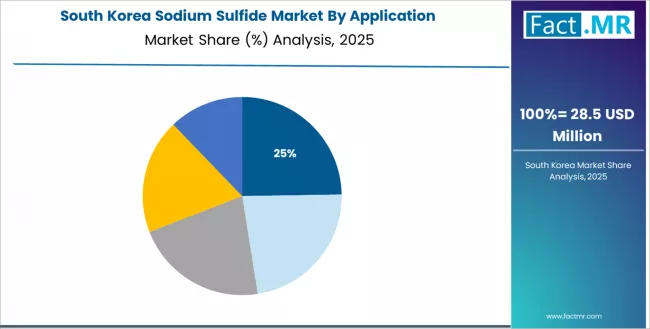
Sodium Sulfide Market South Korea Market Share Analysis By Application | Source: Fact.MR
South Korea's sodium sulfide market demonstrates industrial chemical utilization focused on textile processing and chemical manufacturing applications, with established consumption patterns across dyeing operations and industrial synthesis processes.
The country maintains solid growth momentum with a CAGR of 3.6% through 2035, driven by chemical processing industry and textile manufacturing activities supporting consistent sodium sulfide demand.
Major industrial regions, including Seoul metropolitan area, Ulsan, Busan, and Daegu, showcase sodium sulfide consumption where textile processing facilities and chemical manufacturers utilize reducing agents and synthesis intermediates in production operations.
Key market characteristics:
- Textile and chemical manufacturing driving sodium sulfide consumption with emphasis on processing efficiency
- Industrial chemical supply chains enabling reliable product availability and competitive pricing
- Quality control emphasis supporting consistent product specifications and application performance
- Environmental compliance integration addressing wastewater treatment and emission control requirements
Competitive Landscape of the Sodium Sulfide Market
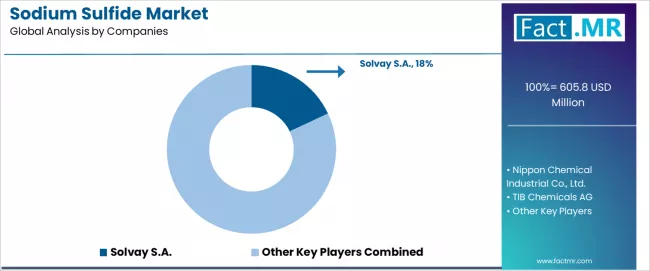
Sodium Sulfide Market Analysis By Company | Source: Fact.MR
The sodium sulfide market features approximately 15-20 meaningful players with moderate concentration, where the top three companies control roughly 25-30% of global market share through established production capacity, comprehensive distribution networks, and technical expertise. Competition centers on production reliability, quality consistency, and logistics capabilities rather than price competition alone.
Market leaders include Solvay S.A., Nippon Chemical Industrial Co., Ltd., and TIB Chemicals AG, which maintain competitive advantages through comprehensive sodium sulfide production capabilities, advanced manufacturing technologies, and deep expertise in chemical processing serving pulp and paper, textile, and water treatment industries, creating high customer confidence among industrial chemical users.
These companies leverage established quality control systems and ongoing production optimization initiatives to defend market positions while expanding into emerging geographic markets and specialty application segments.
Challengers encompass Rongyuan Chemical Co., Ltd. and Gujarat Alkalies and Chemicals Ltd (GACL), which compete through regional manufacturing presence and competitive cost positioning in key growth markets. Specialized chemical manufacturers, including Shaanxi Fuhua Chemical Co., Ltd., Weifang Yidu Chemical Co., Ltd., and Tessenderlo Group, focus on specific geographic markets or application segments, offering differentiated capabilities in custom formulation development, technical service support, and specialized purity grades.
Regional producers and emerging manufacturers create competitive pressure through localized production advantages and responsive customer service, particularly in high-growth markets including India and China, where proximity to end-users and understanding of local market requirements provide commercial advantages.
Market dynamics favor companies that combine reliable production capacity with comprehensive technical support capabilities that address the complete value chain from manufacturing quality control through logistics optimization and application technical assistance. Strategic emphasis on production safety, environmental compliance, and supply chain reliability enables differentiation in increasingly regulated industrial chemical markets across developed and emerging economies.
Global Sodium Sulfide Market - Stakeholder Contribution Framework
Sodium sulfide represents a critical industrial chemical that enables paper manufacturers, textile processors, and water treatment facilities to achieve effective chemical processing and treatment outcomes without complex alternative reagent requirements, typically providing superior reactivity, consistent quality specifications, and proven performance capabilities compared to substitute sulfur compounds while ensuring improved operational efficiency and regulatory compliance outcomes.
With the market projected to grow from USD 605.8 million in 2025 to USD 924.6 million by 2035 at a 4.3% CAGR, these solutions offer compelling advantages for pulp & paper applications, anhydrous product formulations, and diverse industrial processing requirements seeking reliable chemical performance. Scaling market penetration and safe utilization requires coordinated action across chemical safety regulation, quality standards, chemical manufacturers, industrial users, and logistics service providers.
How Could Governments Spur Local Development and Adoption?
- Chemical Industry Development: Include industrial chemical manufacturing in economic development strategies, providing targeted support for production capacity expansion and supporting domestic manufacturers through technology assistance and investment incentives.
- Safety Regulation & Compliance: Implement clear handling and transportation regulations promoting safe sodium sulfide utilization, provide guidance on storage requirements and emergency response protocols, and establish enforcement mechanisms ensuring industry compliance.
- Environmental Standards Development: Create comprehensive wastewater treatment standards requiring effective heavy metal removal, establish discharge limits driving sodium sulfide adoption in water treatment applications, and develop monitoring programs ensuring environmental protection.
- Industrial Infrastructure Investment: Fund transportation network improvements supporting hazardous material logistics, invest in industrial chemical storage facilities and distribution hubs, and support safety training programs for chemical handlers and emergency responders.
- Trade Policy Support: Establish appropriate tariff structures encouraging domestic production and responsible importation, support export development for competitive manufacturers, and create regional trade agreements facilitating chemical commerce.
How Could Industry Bodies Support Market Development?
- Quality Standards & Specifications: Define standardized product grades for sodium sulfide across purity levels, moisture content, and iron specifications, establish universal testing protocols and quality documentation requirements, and create certification programs ensuring product quality.
- Safety Best Practices: Lead messaging demonstrating proper handling procedures, emphasizing storage requirements, personal protective equipment needs, and emergency response protocols compared to unsafe handling approaches.
- Application Technical Guidance: Develop guidelines for optimal dosing rates across pulping, water treatment, and textile applications, ensuring effective utilization and cost efficiency across industrial operations.
- Professional Development: Run training programs for chemical handlers, process engineers, and safety managers on optimizing sodium sulfide utilization, handling safety, and emergency response in diverse industrial environments.
How Could Manufacturers and Technology Players Strengthen the Ecosystem?
- Production Quality Excellence: Develop consistent manufacturing processes with enhanced quality control, improved purity specifications, and reliable product characteristics that ensure performance while addressing customer application requirements.
- Technical Service Support: Provide comprehensive application assistance, dosing optimization guidance, and troubleshooting support that help industrial users achieve optimal processing results aligned with operational objectives.
- Safety Innovation Programs: Offer improved packaging solutions, handling equipment recommendations, and safety documentation that minimize risks and support customer compliance with regulatory requirements.
- Supply Chain Reliability: Build comprehensive production capacity, inventory management systems, and logistics capabilities that ensure sodium sulfide availability and consistent delivery performance across diverse customer locations.
How Could Industrial Users and Processors Navigate the Market?
- Safe Handling Implementation: Establish comprehensive safety protocols, appropriate storage infrastructure, and trained personnel ensuring proper sodium sulfide handling aligned with regulatory requirements and industry best practices.
- Quality Procurement Strategies: Implement supplier qualification programs, quality testing procedures, and long-term partnership development ensuring consistent product quality and reliable supply availability.
- Process Optimization: Adopt efficient dosing systems, monitoring technologies, and control strategies maximizing sodium sulfide utilization efficiency while minimizing waste and operational costs.
- Environmental Compliance: Integrate effective wastewater treatment, emission control, and waste management practices demonstrating environmental responsibility and regulatory adherence.
How Could Investors and Financial Enablers Unlock Value?
- Production Capacity Financing: Provide growth capital for established companies like Solvay S.A. and regional manufacturers to expand production facilities and upgrade manufacturing technologies, particularly in high-growth markets with expanding industrial demand.
- Technology Investment: Back companies developing improved production processes, enhanced purification technologies, and sustainable manufacturing approaches that improve product quality and environmental performance.
- Supply Chain Development: Finance logistics infrastructure improvements, storage facility construction, and distribution network expansion supporting reliable chemical delivery across diverse geographic markets.
- Market Consolidation Support: Support strategic acquisitions and regional consolidation initiatives that create economies of scale, improve supply chain efficiency, and enhance competitive positioning across fragmented regional markets.
Key Players in the Sodium Sulfide Market
- Solvay S.A.
- Nippon Chemical Industrial Co., Ltd.
- TIB Chemicals AG
- Rongyuan Chemical Co., Ltd.
- Gujarat Alkalies and Chemicals Ltd (GACL)
- Shaanxi Fuhua Chemical Co., Ltd.
- Weifang Yidu Chemical Co., Ltd.
- Tessenderlo Group
- Sichuan Shenhong Chemical Industry Co., Ltd.
- NaFine Chemical Industry Group Co., Ltd.
Segmentation
Scope of the Report
| Items | Values |
|---|---|
| Quantitative Units | USD 605.8 Million |
| Product | Anhydrous, Crystal, Low Ferric |
| Application | Pulp and Paper, Water Treatment, Textiles, Tanneries, Others |
| Regions Covered | Asia Pacific, Europe, North America, Central & South America, Middle East & Africa |
| Country Covered | USA, Canada, Germany, China, India, Japan, South Korea, and 40+ countries |
| Key Companies Profiled | Solvay S.A., Nippon Chemical Industrial Co., Ltd., TIB Chemicals AG, Rongyuan Chemical Co., Ltd., Gujarat Alkalies and Chemicals Ltd (GACL), Shaanxi Fuhua Chemical Co., Ltd., Weifang Yidu Chemical Co., Ltd., Tessenderlo Group, Sichuan Shenhong Chemical Industry Co., Ltd., NaFine Chemical Industry Group Co., Ltd. |
| Additional Attributes | Dollar sales by product and application categories, regional adoption trends across Asia Pacific, Europe, and North America, competitive landscape with chemical manufacturers and distribution companies, product specifications and quality requirements, integration with industrial processing systems and wastewater treatment technologies, innovations in production processes and purity enhancement, and development of specialized applications with safety management and environmental compliance capabilities. |
Source: Fact.MR analysis. Updated Dec 1, 2025
Sodium Sulfide Market by Segments
-
Product :
- Anhydrous
- Crystal
- Low Ferric
-
Application :
- Pulp and Paper
- Water Treatment
- Textiles
- Tanneries
- Others
-
Region :
- Asia Pacific
- China
- Japan
- South Korea
- India
- Australia
- Thailand
- Rest of Asia Pacific
- Europe
- Germany
- UK
- France
- Italy
- Spain
- Denmark
- Sweden
- Norway
- Rest of Europe
- North America
- USA
- Canada
- Mexico
- Central & South America
- Brazil
- Argentina
- Rest of Central & South America
- Middle East & Africa
- South Africa
- Saudi Arabia
- UAE
- Kuwait
- Rest of Middle East & Africa
- Asia Pacific
Frequently Asked Questions
How big is the sodium sulfide market in 2025?
What will be the size of sodium sulfide market in 2035?
How much will be the sodium sulfide market growth between 2025 and 2035?
What are the key product types in the sodium sulfide market?
Which application segment to contribute significant share in the sodium sulfide market in 2025?
Who worked on this report


Preview the report firsthand - request a free sample
Free SampleGet the brochure for pricing and purchase details
Download PDF