- Market Value (2025): USD 79.1 Mn
- Estimated Value (2026): USD 81.9 Mn
- Forecast Value (2036): USD 117.0 Mn
- CAGR (2026-2036): 3.6%
What is the Ice Hockey Puck Market forecast to be worth by 2036?
USD 81.9 million in 2026 to USD 117.0 million by 2036 at a 3.6% CAGR.
- The valuation of the ice hockey puck market was USD 79.1 million in 2025, a base formed mainly by game and practice pucks bought in bulk by teams and rinks.
- Revenue will advance from USD 81.9 million in 2026 to USD 117.0 million in 2036 as youth programs, adult leagues and off-ice drills raise yearly puck use.
- Hockey puck sales will compound at a 3.6% CAGR between 2026 and 2036, held back by the long life of rubber but lifted by steady replacement.
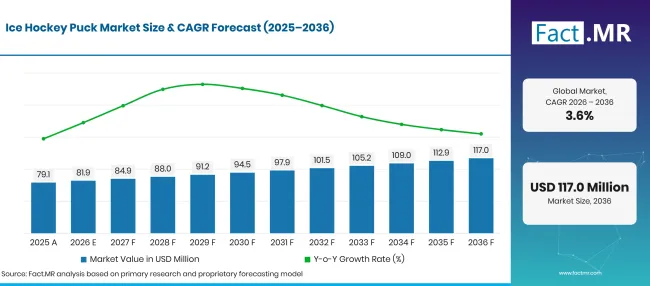
Ice Hockey Puck Market Forecast Global | Source: Fact.MR
| Year | Basis | Market Value (USD million) |
|---|---|---|
| 2025 | Actual | 79.1 |
| 2026 | Estimate | 81.9 |
| 2036 | Forecast | 117.0 |
| CAGR 2026 to 2036 | Forecast period | 3.6% |
Source: Fact.MR analysis. Updated Oct 23, 2026
What are the defining numbers behind Ice Hockey Puck Market growth?
From 2026 to 2036, the market will gain USD 35.1 million, led by replacement orders from teams and training programs.
- Demand Drivers in the Market
- Hockey puck replacement is the core of demand. A puck that hits posts, boards and skates loses its edge and shape, and many end up in the stands or outside the rink. Clubs keep buckets of 50 to 100 pucks for each practice and refill them several times a season.
- Imported sporting goods keep shelf prices within reach of families. Eurostat reported that extra-EU imports of sporting goods reached EUR 10.8 billion in 2024, with China the main partner at EUR 4.5 billion [1]. Much of the low-cost practice puck supply follows the same Asian sourcing routes as other team sports gear.
- Online shopping for hockey gear lowers the effort of buying pucks in packs of 12, 50 or 100. In Great Britain, the Office for National Statistics reported that online sales made up 28.8% of all retail sales in August 2026 [2]. Players far from a hockey shop can now order game pucks and training aids to their door.
- Off-ice training is a growing habit among youth and junior players. Coaches assign shooting and stickhandling work at home, which calls for pucks that slide on concrete, asphalt and synthetic panels.
- Branded and souvenir pucks widen the buyer base beyond players. Fans buy team-logo pucks at arenas and online, and leagues order commemorative pucks for openers, outdoor games and anniversaries.
- Key Segments Analyzed
- By Material Type: Rubber will command 62.4% share in 2026, since league rules call for vulcanized rubber in every sanctioned game.
- By Application: Professional will take 34.0% share in 2026 as top-tier clubs freeze, rotate and discard pucks in large numbers each game.
- By Sales Channel: Online Retail will capture 38.0% share in 2026, given that bulk packs ship easily and compare well on price.
- By End-User: Sports Teams will hold 35.0% share in 2026 through season orders placed by clubs, schools and leagues.
- Analyst Opinion at Fact.MR
- Shambhu Nath Jha, Principal Consultant at Fact.MR, states, “A puck is a low-cost item that gets used up quietly, and that is what keeps orders flowing year after year. Rubber game pucks will stay the volume base because rulebooks fix their size and weight. The extra growth will come from training formats that let players shoot every day without ice time.”
- Strategic Implications
- Puck manufacturers should qualify their vulcanized rubber compounds with national federations and leagues, since an official approval opens repeat team contracts.
- Online sellers should list pucks in team-size packs with clear weight and hardness data, because coaches compare value per puck before ordering.
- Training brands should build weighted, light and off-ice pucks around age groups and drill types, with packs sized for academies.
- Rink operators and clubs should hold a shared reserve of game pucks for each season, which cuts rush orders when stock runs low.
At 4.5% CAGR, Brazil will lead the five listed countries, where near-universal home internet access lets new inline and ice players order pucks online. The United States comes next at 3.8% with deep youth and adult league programs. Germany will grow at 3.5% with its professional DEL clubs and steady online retail. For the United Kingdom, a 2.9% pace rests on rising adult participation in team sports. Japan follows at 2.6%, helped by a mature e-commerce system and a small but loyal hockey base.
How does the Ice Hockey Puck Market break down by segment?
Rubber will lead Material Type at 62.4%; Professional will top Application at 34.0%; Online Retail will head Sales Channel at 38.0%; Sports Teams will hold first place in End-User at 35.0%.
Which Material Type dominates?
Rubber accounts for 62.4% of 2026 sales.
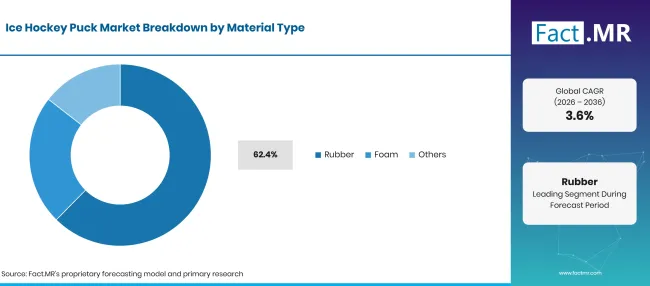
Ice Hockey Puck Market Breakdown Material Type | Source: Fact.MR
| Material Type | Share (2026) |
|---|---|
| Rubber (Leading segment) | 62.4% |
| Other segments combined | 37.6%* |
| Total | 100.0% |
Source: Fact.MR analysis. Updated Oct 23, 2026
Hard rubber pucks deliver the glide, rebound and weight that players expect on ice. Makers compound natural or synthetic rubber with carbon black and cure the mix in steel molds. Each puck is frozen before play to cut bounce, which makes rubber the only accepted material for official games. Players buy these pucks alongside other ice hockey equipment each season. Raw material costs feed straight into the price of a rubber puck. The World Bank reported that the RSS3 natural rubber price averaged USD 2.18 per kg in 2025 and reached USD 2.51 per kg in April 2026 [3]. Foam pucks use soft polymers for young children and indoor play, while some off-ice pucks use thermoplastic polyurethane or similar plastics to slide on dry floors.
What leads the Application segment?
Professional play holds 34.0% of 2026 demand.
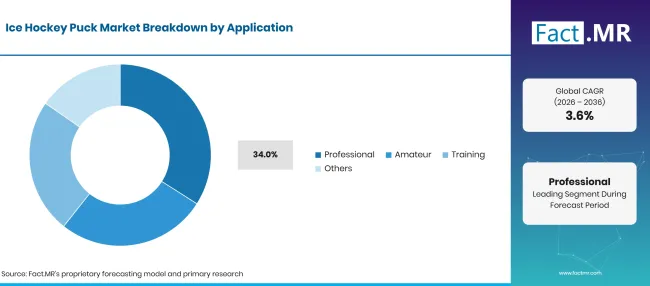
Ice Hockey Puck Market Breakdown Application | Source: Fact.MR
| Application | Share (2026) |
|---|---|
| Professional (Leading segment) | 34.0% |
| Other segments combined | 66.0%* |
| Total | 100.0% |
Source: Fact.MR analysis. Updated Oct 23, 2026
Top leagues use pucks fast. Officials swap a puck after it leaves the playing surface or warms up, and teams keep frozen batches in coolers at the bench. Official game pucks carry league and team logos, and many are later sold as souvenirs. Amateur leagues and recreational players form the next group of buyers. The U.S. Bureau of Economic Analysis reported that snow activities generated USD 7.6 billion in value added in 2024 within the outdoor recreation economy [4]. Training pucks serve drills, goalie work and summer camps, and they are often bought by the dozen along with ice skating equipment at the start of a season.
How does Sales Channel shape demand?
Online Retail makes up 38.0% of 2026 purchases.
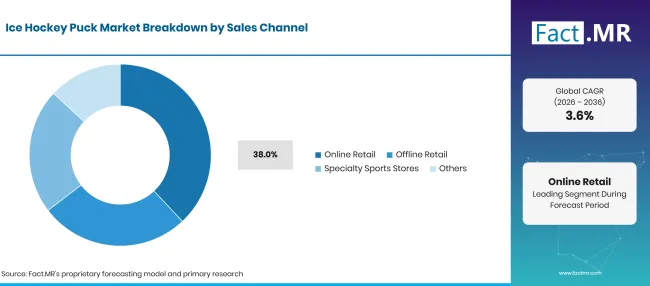
Ice Hockey Puck Market Breakdown Sales Channel | Source: Fact.MR
| Sales Channel | Share (2026) |
|---|---|
| Online Retail (Leading segment) | 38.0% |
| Other segments combined | 62.0%* |
| Total | 100.0% |
Source: Fact.MR analysis. Updated Oct 23, 2026
Ice hockey pucks online are easy to compare by weight, hardness and pack size. A buyer can order 100 pucks in one box and have them shipped to a rink or home. Brand stores, hockey e-shops and general marketplaces all carry game, practice and logo pucks. Offline retail through sporting goods chains serves walk-in buyers who need a few pucks before a game. Specialty sports stores sell pro-grade pucks, puck bags and training aids with fitting advice. Pucks there share shelf space with sticks, tape and other sports equipment that hockey families buy together.
What supports Sports Teams within End-User?
Sports Teams buy 35.0% of 2026 volume.
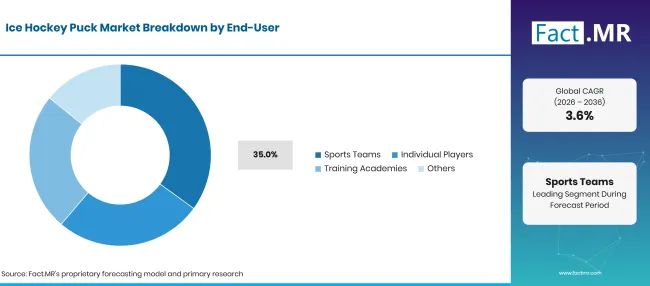
Ice Hockey Puck Market Breakdown End User | Source: Fact.MR
| End-User | Share (2026) |
|---|---|
| Sports Teams (Leading segment) | 35.0% |
| Other segments combined | 65.0%* |
| Total | 100.0% |
Source: Fact.MR analysis. Updated Oct 23, 2026
Clubs, school programs and leagues need a constant stock of pucks for games and practice. Equipment managers place orders before each season and top them up in mid-season. Many contracts specify an approved puck brand for every sanctioned game. Individual players buy pucks for driveway shooting, stickhandling and lessons. Training academies order weighted, light and colored pucks for drills by age group. Fans and collectors add demand for team-logo pucks and other licensed sports merchandise sold at arenas and online.
What is accelerating Ice Hockey Puck Market adoption, and what is holding it back?
Demand will grow through steady replacement, online ordering and the spread of off-ice training. Growth is limited by the long service life of rubber pucks, raw material price swings and the small player base outside traditional hockey regions.
Drivers Impact Analysis
| DRIVER | (~) % IMPACT ON CAGR | GEOGRAPHIC RELEVANCE | IMPACT TIMELINE |
|---|---|---|---|
| Replacement of lost and worn pucks in games and practice | +1.1% | North America, Western Europe, Eastern Europe | Short term (<= 2 years) |
| Growth of youth and adult amateur leagues | +0.9% | North America, Western Europe | Medium term (2-4 years) |
| Online sales of bulk puck packs | +0.7% | Global | Short term (<= 2 years) |
| Off-ice shooting and stickhandling training | +0.6% | North America, Western Europe, East Asia | Medium term (2-4 years) |
| Souvenir and team-logo pucks for fans | +0.4% | North America, Western Europe | Long term (>= 4 years) |
Source: Fact.MR analysis. Updated Oct 23, 2026
Opportunity Impact Analysis
| OPPORTUNITY | (~) % IMPACT ON CAGR | GEOGRAPHIC RELEVANCE | IMPACT TIMELINE |
|---|---|---|---|
| Weighted and light training pucks for academies | +0.6% | North America, Western Europe | Medium term (2-4 years) |
| Off-ice pucks for roller rinks and synthetic ice panels | +0.5% | Latin America, North America | Medium term (2-4 years) |
| Custom printed pucks for clubs and events | +0.4% | Global | Short term (<= 2 years) |
Source: Fact.MR analysis. Updated Oct 23, 2026
Restraints Impact Analysis
| RESTRAINT | (~) % IMPACT ON CAGR | GEOGRAPHIC RELEVANCE | IMPACT TIMELINE |
|---|---|---|---|
| Long service life of vulcanized rubber pucks | -0.5% | Global | Long term (>= 4 years) |
| Natural rubber and carbon black price swings | -0.4% | Global | Short term (<= 2 years) |
| Limited ice rink access in warm-climate regions | -0.3% | Latin America, South Asia & Pacific, Middle East & Africa | Long term (>= 4 years) |
Source: Fact.MR analysis. Updated Oct 23, 2026
Which countries are scaling the Ice Hockey Puck Market through 2036?
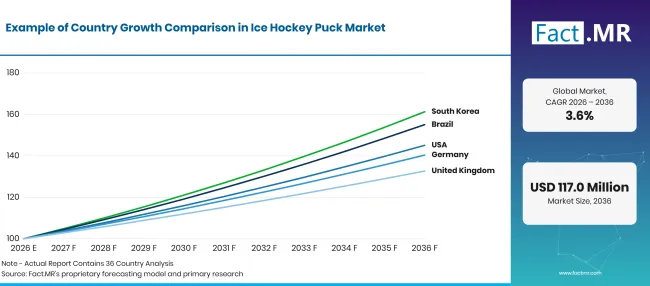
Ice Hockey Puck Market Growth Index | Source: Fact.MR
| Country | CAGR (2026 to 2036) |
|---|---|
| Brazil | 4.5% |
| United States | 3.8% |
| Germany | 3.5% |
| United Kingdom | 2.9% |
| Japan | 2.6% |
Source: Fact.MR analysis. Updated Oct 23, 2026
What supports Brazil’s adoption?
4.5% CAGR, driven by wide home internet access and a young inline and ice hockey community.
Hockey pucks in Brazil reach most buyers through online stores, since few cities have a dedicated hockey shop. IBGE reported that 95.0% of Brazilian households, about 76.0 million homes, had internet access in 2025 [5]. Players in Sao Paulo and southern states train on inline courts and a small number of ice rinks. This base starts from a low level, so each new club adds a visible share of puck orders.
How is the United States scaling demand?
3.8% CAGR, backed by deep youth league programs and strong online sporting goods sales.
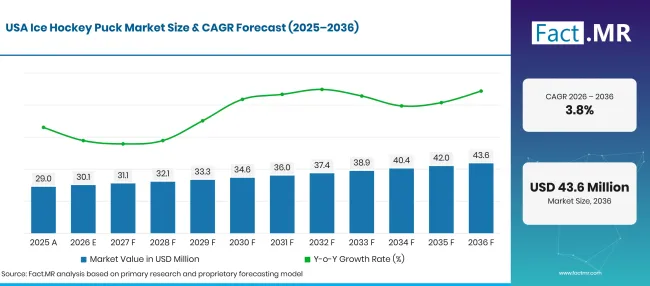
Ice Hockey Puck Market Forecast Usa | Source: Fact.MR
The United States has a large network of youth, high school, college and adult hockey programs. Most buy pucks in bulk for each season. The U.S. Census Bureau reported that e-commerce made up 17.1% of total retail sales in the second quarter of 2026, worth USD 340.2 billion [6]. Online hockey stores ship case packs to rinks and homes across the country.
What supports Germany’s growth?
3.5% CAGR, helped by a professional league structure and steady online retail.
Puck demand in Germany comes from the DEL and lower professional leagues, club youth teams and recreational players. Online buying adds to store sales. Destatis reported that real sales in internet and mail-order retail rose 4.9% in June 2026 from a year earlier [7]. Clubs often buy pucks made in Central Europe that meet IIHF standards.
How is the United Kingdom developing demand?
2.9% CAGR, as more adults take part in team sports.
Ice hockey in the United Kingdom runs through the Elite League, regional leagues and university clubs. Sport England reported that 63.7% of adults in England were active in the year to November 2024 [8]. About 3.4 million adults took part in team sports at least twice in the previous 28 days [8]. Rink access remains the main limit, so many players add off-ice drills at home.
How does Japan perform?
2.6% CAGR, reflecting a mature e-commerce system and a stable hockey base.
Japan has corporate and university hockey teams, with most rinks in Hokkaido and the Kanto region. The Japan Sports Agency reported that 51.7% of adults aged 20 and over played sports at least one day a week in fiscal 2025 [9]. METI reported that Japan’s business-to-consumer e-commerce market reached JPY 26.1 trillion in 2024 [10]. Online stores carry imported pucks and training aids for these players.
Who leads the Ice Hockey Puck Market?
The ice hockey puck industry splits into three groups. Official puck makers supply leagues with certified rubber pucks. Inglasco describes itself as the official puck provider for the NHL, AHL and ECHL, and its site lists 2026-27 official game pucks for the NHL and AHL [11].
Rubena makes vulcanized rubber pucks at its plant in Náchod and offers classic, junior, heavy, white and promotional versions [12]. Equipment brands sell pucks under their own names. Bauer Hockey offers an official-size 6 oz rubber puck, and Franklin Sports sells regulation pucks along with foam and street pucks. Howies Hockey sells game, practice and colored training pucks with custom printing. Green Biscuit targets off-ice practice with pucks built for concrete and asphalt, including an NHL team collection [13]. League approvals, consistent hardness and online reach will separate the stronger suppliers.
Which companies are the key providers?
Key companies include Inglasco; Rubena; Bauer Hockey; Franklin Sports; Howies Hockey; and Green Biscuit.
- Inglasco
- Rubena
- Bauer Hockey
- Franklin Sports
- Howies Hockey
- Green Biscuit
Bibliography
- [1] Eurostat. (2025, September 24). How does sport contribute to trade in the EU?.
- [2] Office for National Statistics. (2026, September 18). Retail sales, Great Britain: August 2026.
- [3] World Bank. (2026, May 4). World Bank Commodities Price Data (The Pink Sheet), May 2026.
- [4] U.S. Bureau of Economic Analysis. (2026, March 5). Outdoor Recreation Economic Statistics, U.S. and States, 2024.
- [5] Instituto Brasileiro de Geografia e Estatística (IBGE). (2026, July 2). Internet chega a 95% de domicílios do país em 2025 [Internet reaches 95% of the country’s households in 2025].
- [6] U.S. Census Bureau. (2026, August 18). Quarterly Retail E-Commerce Sales: 2nd Quarter 2026.
- [7] Statistisches Bundesamt (Destatis). (2026, August 7). KORREKTUR: Einzelhandelsumsatz im Juni 2026 real um 0,7 % (alt: 1,1 %) niedriger als im Vormonat [CORRECTION: Retail sales in June 2026 0.7% (previously 1.1%) lower in real terms than in the previous month].
- [8] Sport England. (2025, April 24). Record numbers playing sport and taking part in physical activity.
- [9] Japan Sports Agency. (2026, March 11). 令和7年度「スポーツの実施状況等に関する世論調査」の結果を公表します [Results of the FY2025 Public Opinion Survey on Sports Participation].
- [10] Ministry of Economy, Trade and Industry, Japan. (2025, August 26). 令和6年度電子商取引に関する市場調査の結果を取りまとめました [Results of the FY2024 market survey on electronic commerce].
- [11] Inglasco. (2026). Inglasco.
- [12] Rubena. (2026). Ice Hockey Pucks.
- [13] Green Biscuit. (2026). The Best Off Ice Hockey Puck.
This Report Answers
- How large is ice hockey puck demand in 2026, and how much will it add by 2036?
- Which material, application, sales channel and end-user lead puck sales, and why do buyers choose them?
- How do replacement cycles, rubber costs and online buying shape puck orders?
- What separates growth in Brazil, the United States, Germany, the United Kingdom and Japan?
- Which puck makers and hockey brands compete for team and retail orders, and on what terms?
What does the Ice Hockey Puck Market cover?
Hockey pucks of every type used in ice hockey fall within this market. That covers official game pucks, practice pucks, junior and weighted pucks, foam pucks and pucks designed for off-ice training.
Revenue is tracked across professional, amateur and training use. Sales are measured through online stores, general sporting goods retail, specialty hockey shops and direct team supply.
What is included in the scope?
Vulcanized rubber pucks made to league size and weight are counted, along with custom printed and souvenir pucks sold by makers and brands. Light blue youth pucks, orange heavy pucks and white goalie training pucks are also covered.
Off-ice pucks sold for ice hockey training on concrete, asphalt or synthetic panels are included. Foam pucks for young children and indoor play count when sold as hockey products, even when they come in sets with smart training aids.
What is excluded from the scope?
Field hockey balls, floorball balls and dedicated roller hockey balls are excluded. Puck bags, display cubes and shooting pads count only when sold as part of a puck bundle.
Sticks, skates, protective gear and goals fall outside the revenue boundary. Second-hand and game-used collectible pucks resold at auction are also excluded.
How Was the Analysis Built?
The analysis draws on 120+ sources, 35+ company portfolios, 25+ countries, and more than 20 industry interviews.
- Primary Research: Primary research includes discussions with manufacturers, service providers, technology developers, distributors, end users, and subject-matter experts. These conversations examine purchasing priorities, product adoption, operational challenges, approval requirements, competitive positioning, and the factors that influence wider market acceptance.
- Desk Research: Desk research covers government statistics, regulatory publications, company filings, trade data, technical studies, industry associations, standards, public policy, and other authoritative sources. Every source used in the analysis is documented in the bibliography.
- Market Sizing and Forecasting: Market estimates combine historical performance, demand indicators, pricing and volume trends, segment shares, company participation, country-level growth, adoption patterns, investment activity, and barriers to market expansion.
- Data Validation and Update Cycle: Findings are validated by comparing primary interviews with public data, company activity, regulatory changes, trade patterns, and industry developments. Regular updates review new product launches, capacity changes, partnerships, approvals, and shifts in commercial adoption.
Segmentation
What is the report’s scope and coverage?
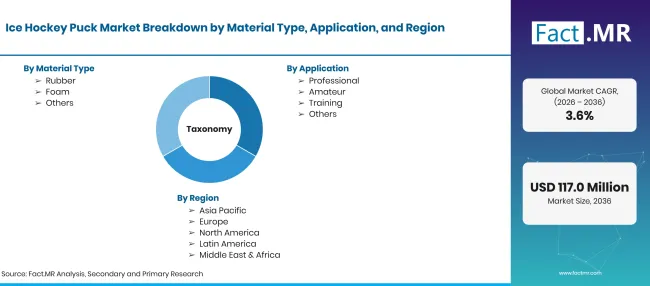
Ice Hockey Puck Market Taxonomy | Source: Fact.MR
| Attribute | Details |
|---|---|
| Quantitative Units | USD million in 2026 to USD million by 2036 at CAGR |
| Market Definition | Pucks used for ice hockey games, practice and off-ice training, including official game pucks, practice pucks, weighted and light training pucks, foam pucks and logo pucks. Value is counted at the first point of sale to teams, retailers and individual buyers. |
| Material Type | Rubber; Foam; Others |
| Application | Professional; Amateur; Training; Others |
| Sales Channel | Online Retail; Offline Retail; Specialty Sports Stores; Others |
| End-User | Sports Teams; Individual Players; Training Academies; Others |
| Regions Covered | North America; Latin America; Western Europe; Eastern Europe; East Asia; South Asia & Pacific; Middle East & Africa |
| Countries Covered | Brazil; United States; Germany; United Kingdom; Japan |
| Companies Profiled | Inglasco; Rubena; Bauer Hockey; Franklin Sports; Howies Hockey; Green Biscuit |
| Forecast Period | 2026 to 2036 |
| Approach | Hybrid top-down and bottom-up approach using registered players and teams by country; pucks used per game and practice; replacement cycles; rubber input costs; channel price points; and supplier portfolio review. |
Source: Fact.MR analysis. Updated Oct 23, 2026
How is the market segmented?
-
By Material Type
- Rubber
- Foam
- Others
-
By Application
- Professional
- Amateur
- Training
- Others
-
By Sales Channel
- Online Retail
- Offline Retail
- Specialty Sports Stores
- Others
-
By End-User
- Sports Teams
- Individual Players
- Training Academies
- Others
-
By Region
- North America
- Latin America
- Western Europe
- Eastern Europe
- East Asia
- South Asia & Pacific
- Middle East & Africa
Frequently Asked Questions
How big is the ice hockey puck market in 2026?
What is the CAGR of the ice hockey puck market from 2026 to 2036?
Which material type leads the ice hockey puck market?
Which application leads the ice hockey puck market?
Which sales channel leads the ice hockey puck market?
Which end-user leads the ice hockey puck market?
Which country will grow the most in the ice hockey puck market?
Who are the main companies in the ice hockey puck market?
Who worked on this report


Preview the report firsthand - request a free sample
Free SampleGet the brochure for pricing and purchase details
Download PDF