Implantable Cardiac Fluorine-Free Resins Market

Implantable Cardiac Fluorine-Free Resins Market Size and Share Forecast Outlook 2026 to 2036

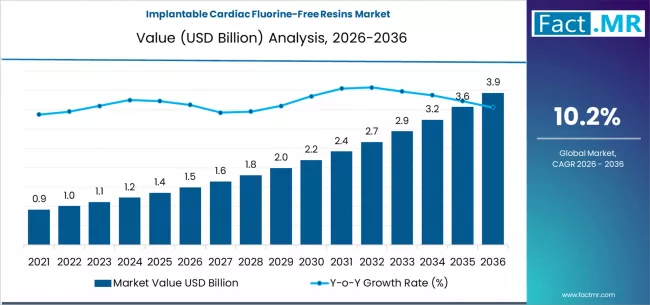
Implantable cardiac fluorine-free resins market is projected to grow from USD 1.5 billion in 2026 to USD 3.9 billion by 2036, at a CAGR of 10.2%. Medical‑Grade Fluorine‑Free Polymers will dominate with a 40.9% market share, while cardiac pacing leads will lead the application segment with a 37.2% share.

Implantable Cardiac Fluorine-Free Resins Market Forecast and Outlook 2026 to 2036

Projected to surge from USD 1.49 billion in 2026 to USD 3.94 billion by 2036, the implantable cardiac fluorine-free resins market is advancing at a significant 10.2% CAGR. The global market for implantable cardiac fluorine-free resins is undergoing a pivotal transformation, driven by intensifying regulatory scrutiny of per- and polyfluoroalkyl substances (PFAS) and a clinical push for next-generation biocompatible materials.

Key Takeaways from the Implantable Cardiac Fluorine-Free Resins Market

  • Market Value for 2026: USD 1.49 Billion
  • Market Value for 2036: USD 3.94 Billion
  • Forecast CAGR (2026-2036): 10.2%
  • Leading Resin Type Segment (2026): Medical-Grade Fluorine-Free Polymers (41%)
  • Leading Application Segment (2026): Cardiac Pacing Leads (37%)
  • Leading End-User Segment (2026): Hospitals & Cardiac Clinics (45%)
  • Key Growth Countries: China (11.20% CAGR), USA (10.80% CAGR), Germany (9.60% CAGR), South Korea (9.40% CAGR), Japan (9.10% CAGR)
  • Key Players in the Market: Solvay SA, Evonik Industries, Röchling Medical, Quadrant AG, Synthomer plc

Implantable Cardiac Fluorine Free Resins Market Market Value Analysis

This growth is fueled by the urgent need in cardiology to replace traditional fluoropolymers, prized for their chemical inertness, with advanced alternatives that offer comparable performance without associated environmental and potential bio-accumulation concerns. The shift is most critical in long-term implant applications where material durability and flawless biocompatibility are non-negotiable.

Innovation focuses on developing high-performance resins that meet stringent ISO 10993 standards for chronic implantation while providing essential properties like tensile strength, flexibility, and electrical insulation for leads, valves, and structural components. China's remarkable 11.20% CAGR underscores its dual role as a massive demand center and an agile manufacturing hub for new materials.

The market's trajectory is defined by the convergence of regulatory mandates, advanced polymer science, and the escalating global burden of cardiovascular diseases, creating a pressing need for safer, sustainable material platforms in life-saving devices.

Metric

Metric Value
Market Value (2026) USD 1.49 Billion
Market Forecast Value (2036) USD 3.94 Billion
Forecast CAGR (2026 to 2036) 10.2%

Category

Category Segments
Resin Type Medical-Grade Fluorine-Free Polymers, Polyether Ether Ketone (PEEK) Alternatives, Bio-Derived High-Performance Resins, Acrylic & Styrenic Resins, Others
Application Cardiac Pacing Leads, Heart Valve Components, Vascular Support Structures, Electrode Insulation, Others
End-User Hospitals & Cardiac Clinics, Medical Device OEMs, Research & Academic Institutions, Others
Region North America, Latin America, Western Europe, Eastern Europe, East Asia, South Asia & Pacific, MEA

Segmental Analysis

By Resin Type, Which Material Category is the Immediate Replacement Standard?
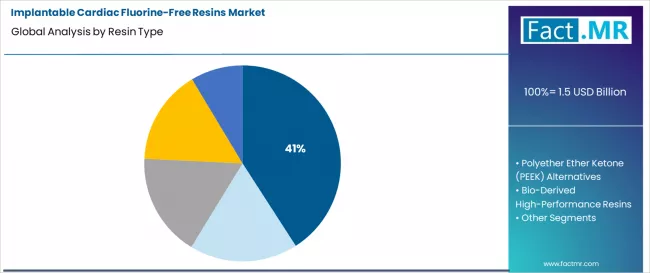
Implantable Cardiac Fluorine Free Resins Market Analysis By Resin Type

Medical-grade fluorine-free polymers hold a commanding 41% share, forming the foundational response to PFAS phase-out initiatives. This segment encompasses a range of engineered thermoplastics and specialty polymers Such as advanced polyolefins, polysulfones, and novel co-polymers, designed specifically to meet Class VI/USP <88> and ISO 10993 biocompatibility criteria.

Their dominance stems from being validated, drop-in solutions for many existing device designs, offering a direct path to regulatory compliance without necessitating complete device re-engineering, thus providing manufacturers with a critical bridge material during this transition.

By Application, Which Device Component is Most Sensitive to This Material Shift?
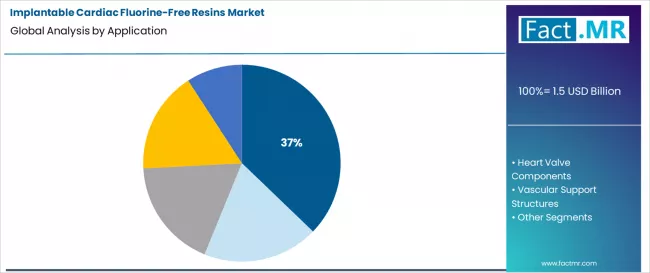
Implantable Cardiac Fluorine Free Resins Market Analysis By Application

Cardiac pacing leads represent the largest application segment at 37%. This critical interface between the pulse generator and the heart requires insulation materials with exceptional dielectric strength, long-term flex fatigue resistance, and absolute biostability.

The move away from fluoropolymers like ETFE is particularly acute here due to the lead's direct and permanent contact with cardiac tissue and blood. The development of fluorine-free resins that can withstand millions of flex cycles in the aggressive physiological environment without cracking or degrading is a central technical challenge and driver of material innovation in the market.

By End-User, Where is the Primary Point of Clinical Integration?
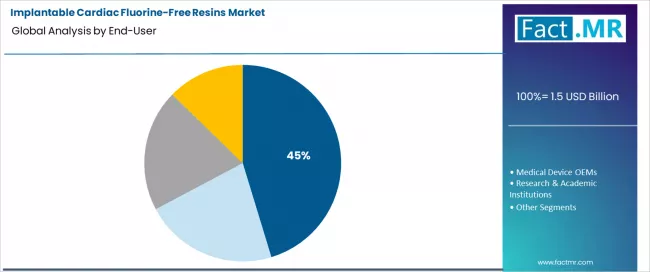
Implantable Cardiac Fluorine Free Resins Market Analysis By End User

Hospitals and cardiac clinics lead the end-user segment with a 45% share. This reflects the critical role these institutions play not only as care providers but also as key partners in the adoption loop.

Surgeons and interventional cardiologists in these settings provide essential feedback on device handling, implant performance, and patient outcomes, which directly influences OEM material selection. The trend towards customizable patient-specific devices, sometimes facilitated by point-of-care manufacturing, deepens the clinical integration and makes hospital preferences a powerful market force.

What are the Drivers, Restraints, and Key Trends of the Implantable Cardiac Fluorine-Free Resins Market?

The primary market driver is the accelerating global regulatory push to restrict or ban PFAS chemicals. Proposed regulations in the EU, USA, and other regions are compelling medical device OEMs to proactively reformulate products years ahead of compliance deadlines.

Growing clinical awareness and patient safety advocacy regarding long-term implant material stability are creating a pull for more sustainable and transparent material choices. The rising prevalence of cardiovascular diseases and increased implantation rates for devices like pacemakers and valve repairs provide a steady demand base for these advanced materials.

A significant market restraint is the formidable performance benchmark set by incumbent fluoropolymers. Matching their unique combination of hydrophobicity, chemical resistance, lubricity, and dielectric properties in a fluorine-free chemistry is a complex scientific and engineering challenge.

The extensive and costly re-validation process required for any new implantable material creates a high barrier to entry and slows adoption speed. There is also a risk aversion among OEMs when altering materials for flagship, life-dependent devices, prioritizing proven safety over innovation.

Key trends include the rapid development of bio-derived and bio-resorbable high-performance resins that offer an ultimate sustainability profile. There is intense R&D focused on surface-modification technologies for fluorine-free polymers, aiming to impart specific lubricious or thrombo-resistant properties through coatings or bulk modification.

The integration of additive manufacturing with these new resins is emerging, enabling the production of complex, patient-specific cardiac device components. Furthermore, material informatics and high-throughput screening are being employed to accelerate the discovery and optimization of novel polymer chemistries fit for cardiac implantation.

Analysis of the Implantable Cardiac Fluorine-Free Resins Market by Key Countries
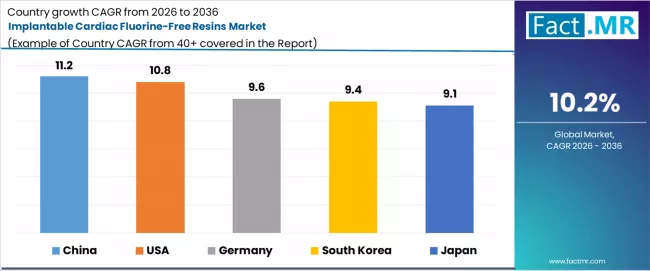
Implantable Cardiac Fluorine Free Resins Market Cagr Analysis By Country

Country CAGR (2026-2036)
China 11.20%
USA 10.80%
Germany 9.60%
South Korea 9.40%
Japan 9.10%

How is China's Regulatory Alignment and Manufacturing Agility Catalyzing Growth?

A vast and growing patient population requiring cardiac implants and a proactive regulatory stance towards adopting international environmental and safety standards drives China’s leading 11.20% CAGR.

Domestic chemical and material companies are demonstrating remarkable agility in developing and scaling production of cost-competitive fluorine-free alternatives. The government's strategic focus on achieving self-sufficiency in high-tech medical materials further accelerates domestic R&D and manufacturing, positioning China as both a massive consumer and a future exporter in this market.

What is the Impact of the USA's Stringent Regulatory Environment and Litigation Landscape?
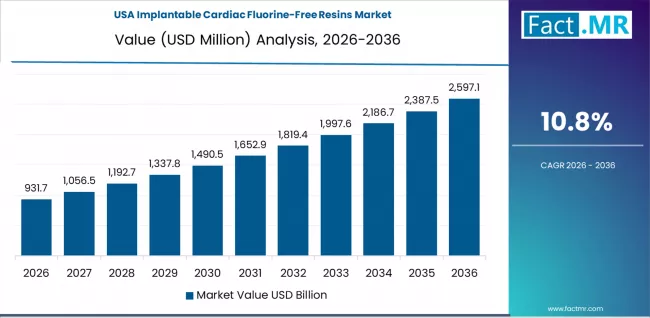
Implantable Cardiac Fluorine Free Resins Market Country Value Analysis

Stringent FDA expectations and an active litigation environment concerning chemical safety heavily influence the USA’s 10.80% growth. Major US-based medical device OEMs, seeking to mitigate regulatory and reputational risk, are leading the charge in sourcing and validating fluorine-free alternatives.

The presence of a robust ecosystem of specialized polymer R&D firms and a strong venture capital interest in green chemistry startups fuels innovation. Market dynamics are characterized by a race to secure FDA Master File or Drug Master File (DMF) approvals for new resin systems.

Why is Germany's MedTech Regulatory Leadership a Critical Factor?

Germany's 9.60% CAGR reflects its central role in the European MedTech industry and the early influence of the EU's strict PFAS restriction proposals. German engineering precision extends to material science, with a demand for resins that not only meet but exceed the forthcoming EU MDR requirements.

The market is characterized by a focus on developing high-purity, consistently performing materials with complete traceability and comprehensive validation dossiers, supporting the premium, export-oriented German medical device sector.

How is Japan's Demographics and Precision Manufacturing Shaping Demand?

Japan's 9.10% growth is underpinned by its super-aged society, which creates sustained, high-volume demand for cardiac implants like pacemakers. Japanese device manufacturers are known for their miniaturization expertise and relentless pursuit of reliability.

The market demand is for fluorine-free resins that enable ultra-precise molding of intricate micro-components, exhibit exceptional long-term stability over decades, and meet Japan's own rigorous pharmaceutical and medical device standards, which often parallel or exceed international benchmarks.

What Role Does South Korea's Advanced Healthcare System and Elective Procedure Culture Play?

South Korea's 9.40% growth is supported by its technologically advanced healthcare infrastructure and a high cultural acceptance of elective and advanced medical procedures. The country boasts world-leading rates of cardiac screening and early intervention.

This environment drives demand for the latest device technologies, including those using novel biomaterials. South Korean OEMs and material suppliers are particularly active in developing resins for next-generation, less invasive implant procedures and for devices with enhanced patient comfort and aesthetic outcomes.

Competitive Landscape of the Implantable Cardiac Fluorine-Free Resins Market
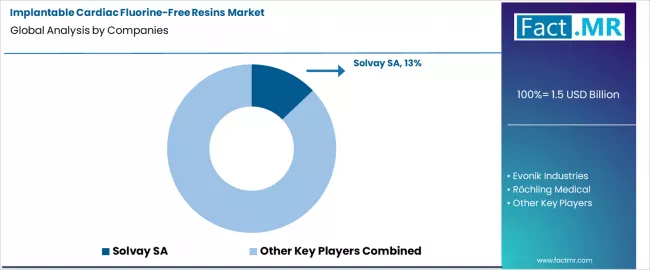
Implantable Cardiac Fluorine Free Resins Market Analysis By Company

The competitive landscape features established specialty chemical giants with deep polymer expertise alongside niche innovators focused on biomedical materials. Competition centers on proprietary polymer chemistry, the ability to provide comprehensive regulatory support and validation data, and the establishment of strategic, exclusive partnerships with leading cardiac device OEMs.

Success is increasingly dependent on demonstrating not just material parity with fluoropolymers, but tangible advantages in processability, device integration, or long-term clinical outcomes. Building a robust intellectual property portfolio around novel monomer structures and polymerization processes is a key strategic activity.

Key Players in the Implantable Cardiac Fluorine-Free Resins Market

  • Solvay SA
  • Evonik Industries
  • Röchling Medical
  • Quadrant AG
  • Synthomer plc

Scope of Report

Items Values
Quantitative Units USD Billion
Resin Type Medical-Grade Fluorine-Free Polymers, Polyether Ether Ketone (PEEK) Alternatives, Bio-Derived High-Performance Resins, Acrylic & Styrenic Resins, Others
Application Cardiac Pacing Leads, Heart Valve Components, Vascular Support Structures, Electrode Insulation, Others
End-User Hospitals & Cardiac Clinics, Medical Device OEMs, Research & Academic Institutions, Others
Key Countries China, USA, Germany, South Korea, Japan
Key Companies Solvay SA, Evonik Industries, Röchling Medical, Quadrant AG, Synthomer plc
Additional Analysis Long-term (10+ year) in-vivo degradation studies of alternative resins; comparative analysis of thrombosis and fibrotic encapsulation rates versus fluoropolymers; impact of sterilization methods (EtO, gamma, e-beam) on material properties of new resins; cost-impact analysis of material substitution on total device manufacturing; detailed regulatory pathway mapping for novel implantable polymers in USA (FDA), EU (MDR), and China (NMPA).

Market by Segments

  • Resin Type :

    • Medical-Grade Fluorine-Free Polymers
    • Polyether Ether Ketone (PEEK) Alternatives
    • Bio-Derived High-Performance Resins
    • Acrylic & Styrenic Resins
    • Others
  • Application :

    • Cardiac Pacing Leads
    • Heart Valve Components
    • Vascular Support Structures
    • Electrode Insulation
    • Others
  • End-User :

    • Hospitals & Cardiac Clinics
    • Medical Device OEMs
    • Research & Academic Institutions
    • Others
  • Region :

    • North America
      • USA
      • Canada
    • Latin America
      • Brazil
      • Mexico
      • Argentina
      • Rest of Latin America
    • Western Europe
      • Germany
      • UK
      • France
      • Spain
      • Italy
      • BENELUX
      • Rest of Western Europe
    • Eastern Europe
      • Russia
      • Poland
      • Czech Republic
      • Rest of Eastern Europe
    • East Asia
      • China
      • Japan
      • South Korea
      • Rest of East Asia
    • South Asia & Pacific
      • India
      • ASEAN
      • Australia
      • Rest of South Asia & Pacific
    • MEA
      • Saudi Arabia
      • UAE
      • Turkiye
      • Rest of MEA

References

  • European Chemicals Agency. (2023). Restriction proposal report for per- and polyfluoroalkyl substances (PFAS). ECHA.
  • Gardin, C., & Ferroni, L. (2022). Biocompatibility and cytotoxic evaluation of new-generation implantable polymers. Journal of Functional Biomaterials, 13(4), 215.
  • Khang, G. (2021). Handbook of intelligent scaffolds for tissue engineering and regenerative medicine (2nd ed.). Pan Stanford Publishing.
  • Kurtz, S. M. (2023). The UHMWPE handbook: Ultra-high molecular weight polyethylene in total joint replacement and medical devices. Academic Press.
  • Mano, J. F., & Reis, R. L. (2024). Biodegradable polymers in cardiac tissue engineering: Concepts and applications. Nature Reviews Cardiology, 21(2), 83-99.
  • National Toxicology Program. (2022). Systematic review of the immunotoxicity of perfluorooctanoic acid (PFOA) and perfluorooctanesulfonic acid (PFOS). U.S. Department of Health and Human Services.
  • O’Brien, F. J. (2023). Biomaterials & scaffolds for tissue engineering. Materials Today, 14(3), 88-95.
  • U.S. Food and Drug Administration. (2024). *Guidance for industry and FDA staff: Use of international standard ISO 10993-1, "Biological evaluation of medical devices - Part 1: Evaluation and testing within a risk management process"*. FDA.
  • Vert, M., & Li, S. M. (2022). Complexity of biocompatibility and the European Medical Device Regulation. European Journal of Pharmaceuticals and Biopharmaceutics, 181, 1-7.
  • Williams, D. F. (2023). Specifications for innovative, enabling biomaterials based on the principles of biocompatibility mechanisms. Frontiers in Bioengineering and Biotechnology, 11, 1187392.

Table of Content

  1. Executive Summary
    • Global Market Outlook
    • Demand to side Trends
    • Supply to side Trends
    • Technology Roadmap Analysis
    • Analysis and Recommendations
  2. Market Overview
    • Market Coverage / Taxonomy
    • Market Definition / Scope / Limitations
  3. Market Background
    • Market Dynamics
      • Drivers
      • Restraints
      • Opportunity
      • Trends
    • Scenario Forecast
      • Demand in Optimistic Scenario
      • Demand in Likely Scenario
      • Demand in Conservative Scenario
    • Opportunity Map Analysis
    • Product Life Cycle Analysis
    • Supply Chain Analysis
    • Investment Feasibility Matrix
    • Value Chain Analysis
    • PESTLE and Porter’s Analysis
    • Regulatory Landscape
    • Regional Parent Market Outlook
    • Production and Consumption Statistics
    • Import and Export Statistics
  4. Global Market Analysis 2021 to 2025 and Forecast, 2026 to 2036
    • Historical Market Size Value (USD Million) Analysis, 2021 to 2025
    • Current and Future Market Size Value (USD Million) Projections, 2026 to 2036
      • Y to o to Y Growth Trend Analysis
      • Absolute $ Opportunity Analysis
  5. Global Market Pricing Analysis 2021 to 2025 and Forecast 2026 to 2036
  6. Global Market Analysis 2021 to 2025 and Forecast 2026 to 2036, By Resin Type
    • Introduction / Key Findings
    • Historical Market Size Value (USD Million) Analysis By Resin Type, 2021 to 2025
    • Current and Future Market Size Value (USD Million) Analysis and Forecast By Resin Type, 2026 to 2036
      • Medical‑Grade Fluorine‑Free Polymers
      • Polyether Ether Ketone (PEEK) Alternatives
      • Bio‑Derived High‑Performance Resins
      • Acrylic & Styrenic Resins
      • Others
    • Y to o to Y Growth Trend Analysis By Resin Type, 2021 to 2025
    • Absolute $ Opportunity Analysis By Resin Type, 2026 to 2036
  7. Global Market Analysis 2021 to 2025 and Forecast 2026 to 2036, By Application
    • Introduction / Key Findings
    • Historical Market Size Value (USD Million) Analysis By Application, 2021 to 2025
    • Current and Future Market Size Value (USD Million) Analysis and Forecast By Application, 2026 to 2036
      • Cardiac Pacing Leads
      • Heart Valve Components
      • Vascular Support Structures
      • Electrode Insulation
      • Others
    • Y to o to Y Growth Trend Analysis By Application, 2021 to 2025
    • Absolute $ Opportunity Analysis By Application, 2026 to 2036
  8. Global Market Analysis 2021 to 2025 and Forecast 2026 to 2036, By End‑User
    • Introduction / Key Findings
    • Historical Market Size Value (USD Million) Analysis By End‑User, 2021 to 2025
    • Current and Future Market Size Value (USD Million) Analysis and Forecast By End‑User, 2026 to 2036
      • Hospitals & Cardiac Clinics
      • Medical Device OEMs
      • Research & Academic Institutions
      • Others
    • Y to o to Y Growth Trend Analysis By End‑User, 2021 to 2025
    • Absolute $ Opportunity Analysis By End‑User, 2026 to 2036
  9. Global Market Analysis 2021 to 2025 and Forecast 2026 to 2036, By Region
    • Introduction
    • Historical Market Size Value (USD Million) Analysis By Region, 2021 to 2025
    • Current Market Size Value (USD Million) Analysis and Forecast By Region, 2026 to 2036
      • North America
      • Latin America
      • Western Europe
      • Eastern Europe
      • East Asia
      • South Asia and Pacific
      • Middle East & Africa
    • Market Attractiveness Analysis By Region
  10. North America Market Analysis 2021 to 2025 and Forecast 2026 to 2036, By Country
    • Historical Market Size Value (USD Million) Trend Analysis By Market Taxonomy, 2021 to 2025
    • Market Size Value (USD Million) Forecast By Market Taxonomy, 2026 to 2036
      • By Country
        • USA
        • Canada
        • Mexico
      • By Resin Type
      • By Application
      • By End‑User
    • Market Attractiveness Analysis
      • By Country
      • By Resin Type
      • By Application
      • By End‑User
    • Key Takeaways
  11. Latin America Market Analysis 2021 to 2025 and Forecast 2026 to 2036, By Country
    • Historical Market Size Value (USD Million) Trend Analysis By Market Taxonomy, 2021 to 2025
    • Market Size Value (USD Million) Forecast By Market Taxonomy, 2026 to 2036
      • By Country
        • Brazil
        • Chile
        • Rest of Latin America
      • By Resin Type
      • By Application
      • By End‑User
    • Market Attractiveness Analysis
      • By Country
      • By Resin Type
      • By Application
      • By End‑User
    • Key Takeaways
  12. Western Europe Market Analysis 2021 to 2025 and Forecast 2026 to 2036, By Country
    • Historical Market Size Value (USD Million) Trend Analysis By Market Taxonomy, 2021 to 2025
    • Market Size Value (USD Million) Forecast By Market Taxonomy, 2026 to 2036
      • By Country
        • Germany
        • UK
        • Italy
        • Spain
        • France
        • Nordic
        • BENELUX
        • Rest of Western Europe
      • By Resin Type
      • By Application
      • By End‑User
    • Market Attractiveness Analysis
      • By Country
      • By Resin Type
      • By Application
      • By End‑User
    • Key Takeaways
  13. Eastern Europe Market Analysis 2021 to 2025 and Forecast 2026 to 2036, By Country
    • Historical Market Size Value (USD Million) Trend Analysis By Market Taxonomy, 2021 to 2025
    • Market Size Value (USD Million) Forecast By Market Taxonomy, 2026 to 2036
      • By Country
        • Russia
        • Poland
        • Hungary
        • Balkan & Baltic
        • Rest of Eastern Europe
      • By Resin Type
      • By Application
      • By End‑User
    • Market Attractiveness Analysis
      • By Country
      • By Resin Type
      • By Application
      • By End‑User
    • Key Takeaways
  14. East Asia Market Analysis 2021 to 2025 and Forecast 2026 to 2036, By Country
    • Historical Market Size Value (USD Million) Trend Analysis By Market Taxonomy, 2021 to 2025
    • Market Size Value (USD Million) Forecast By Market Taxonomy, 2026 to 2036
      • By Country
        • China
        • Japan
        • South Korea
      • By Resin Type
      • By Application
      • By End‑User
    • Market Attractiveness Analysis
      • By Country
      • By Resin Type
      • By Application
      • By End‑User
    • Key Takeaways
  15. South Asia and Pacific Market Analysis 2021 to 2025 and Forecast 2026 to 2036, By Country
    • Historical Market Size Value (USD Million) Trend Analysis By Market Taxonomy, 2021 to 2025
    • Market Size Value (USD Million) Forecast By Market Taxonomy, 2026 to 2036
      • By Country
        • India
        • ASEAN
        • Australia & New Zealand
        • Rest of South Asia and Pacific
      • By Resin Type
      • By Application
      • By End‑User
    • Market Attractiveness Analysis
      • By Country
      • By Resin Type
      • By Application
      • By End‑User
    • Key Takeaways
  16. Middle East & Africa Market Analysis 2021 to 2025 and Forecast 2026 to 2036, By Country
    • Historical Market Size Value (USD Million) Trend Analysis By Market Taxonomy, 2021 to 2025
    • Market Size Value (USD Million) Forecast By Market Taxonomy, 2026 to 2036
      • By Country
        • Kingdom of Saudi Arabia
        • Other GCC Countries
        • Turkiye
        • South Africa
        • Other African Union
        • Rest of Middle East & Africa
      • By Resin Type
      • By Application
      • By End‑User
    • Market Attractiveness Analysis
      • By Country
      • By Resin Type
      • By Application
      • By End‑User
    • Key Takeaways
  17. Key Countries Market Analysis
    • USA
      • Pricing Analysis
      • Market Share Analysis, 2025
        • By Resin Type
        • By Application
        • By End‑User
    • Canada
      • Pricing Analysis
      • Market Share Analysis, 2025
        • By Resin Type
        • By Application
        • By End‑User
    • Mexico
      • Pricing Analysis
      • Market Share Analysis, 2025
        • By Resin Type
        • By Application
        • By End‑User
    • Brazil
      • Pricing Analysis
      • Market Share Analysis, 2025
        • By Resin Type
        • By Application
        • By End‑User
    • Chile
      • Pricing Analysis
      • Market Share Analysis, 2025
        • By Resin Type
        • By Application
        • By End‑User
    • Germany
      • Pricing Analysis
      • Market Share Analysis, 2025
        • By Resin Type
        • By Application
        • By End‑User
    • UK
      • Pricing Analysis
      • Market Share Analysis, 2025
        • By Resin Type
        • By Application
        • By End‑User
    • Italy
      • Pricing Analysis
      • Market Share Analysis, 2025
        • By Resin Type
        • By Application
        • By End‑User
    • Spain
      • Pricing Analysis
      • Market Share Analysis, 2025
        • By Resin Type
        • By Application
        • By End‑User
    • France
      • Pricing Analysis
      • Market Share Analysis, 2025
        • By Resin Type
        • By Application
        • By End‑User
    • India
      • Pricing Analysis
      • Market Share Analysis, 2025
        • By Resin Type
        • By Application
        • By End‑User
    • ASEAN
      • Pricing Analysis
      • Market Share Analysis, 2025
        • By Resin Type
        • By Application
        • By End‑User
    • Australia & New Zealand
      • Pricing Analysis
      • Market Share Analysis, 2025
        • By Resin Type
        • By Application
        • By End‑User
    • China
      • Pricing Analysis
      • Market Share Analysis, 2025
        • By Resin Type
        • By Application
        • By End‑User
    • Japan
      • Pricing Analysis
      • Market Share Analysis, 2025
        • By Resin Type
        • By Application
        • By End‑User
    • South Korea
      • Pricing Analysis
      • Market Share Analysis, 2025
        • By Resin Type
        • By Application
        • By End‑User
    • Russia
      • Pricing Analysis
      • Market Share Analysis, 2025
        • By Resin Type
        • By Application
        • By End‑User
    • Poland
      • Pricing Analysis
      • Market Share Analysis, 2025
        • By Resin Type
        • By Application
        • By End‑User
    • Hungary
      • Pricing Analysis
      • Market Share Analysis, 2025
        • By Resin Type
        • By Application
        • By End‑User
    • Kingdom of Saudi Arabia
      • Pricing Analysis
      • Market Share Analysis, 2025
        • By Resin Type
        • By Application
        • By End‑User
    • Turkiye
      • Pricing Analysis
      • Market Share Analysis, 2025
        • By Resin Type
        • By Application
        • By End‑User
    • South Africa
      • Pricing Analysis
      • Market Share Analysis, 2025
        • By Resin Type
        • By Application
        • By End‑User
  18. Market Structure Analysis
    • Competition Dashboard
    • Competition Benchmarking
    • Market Share Analysis of Top Players
      • By Regional
      • By Resin Type
      • By Application
      • By End‑User
  19. Competition Analysis
    • Competition Deep Dive
      • Solvay SA
        • Overview
        • Product Portfolio
        • Profitability by Market Segments (Product/Age /Sales Channel/Region)
        • Sales Footprint
        • Strategy Overview
          • Marketing Strategy
          • Product Strategy
          • Channel Strategy
      • Evonik Industries
      • Röchling Medical
      • Quadrant AG
      • Synthomer plc
      • Others
  20. Assumptions & Acronyms Used
  21. Research Methodology

List Of Table

  • Table 1: Global Market Value (USD Million) Forecast by Region, 2021 to 2036
  • Table 2: Global Market Value (USD Million) Forecast by Resin Type, 2021 to 2036
  • Table 3: Global Market Value (USD Million) Forecast by Application, 2021 to 2036
  • Table 4: Global Market Value (USD Million) Forecast by End‑User, 2021 to 2036
  • Table 5: North America Market Value (USD Million) Forecast by Country, 2021 to 2036
  • Table 6: North America Market Value (USD Million) Forecast by Resin Type, 2021 to 2036
  • Table 7: North America Market Value (USD Million) Forecast by Application, 2021 to 2036
  • Table 8: North America Market Value (USD Million) Forecast by End‑User, 2021 to 2036
  • Table 9: Latin America Market Value (USD Million) Forecast by Country, 2021 to 2036
  • Table 10: Latin America Market Value (USD Million) Forecast by Resin Type, 2021 to 2036
  • Table 11: Latin America Market Value (USD Million) Forecast by Application, 2021 to 2036
  • Table 12: Latin America Market Value (USD Million) Forecast by End‑User, 2021 to 2036
  • Table 13: Western Europe Market Value (USD Million) Forecast by Country, 2021 to 2036
  • Table 14: Western Europe Market Value (USD Million) Forecast by Resin Type, 2021 to 2036
  • Table 15: Western Europe Market Value (USD Million) Forecast by Application, 2021 to 2036
  • Table 16: Western Europe Market Value (USD Million) Forecast by End‑User, 2021 to 2036
  • Table 17: Eastern Europe Market Value (USD Million) Forecast by Country, 2021 to 2036
  • Table 18: Eastern Europe Market Value (USD Million) Forecast by Resin Type, 2021 to 2036
  • Table 19: Eastern Europe Market Value (USD Million) Forecast by Application, 2021 to 2036
  • Table 20: Eastern Europe Market Value (USD Million) Forecast by End‑User, 2021 to 2036
  • Table 21: East Asia Market Value (USD Million) Forecast by Country, 2021 to 2036
  • Table 22: East Asia Market Value (USD Million) Forecast by Resin Type, 2021 to 2036
  • Table 23: East Asia Market Value (USD Million) Forecast by Application, 2021 to 2036
  • Table 24: East Asia Market Value (USD Million) Forecast by End‑User, 2021 to 2036
  • Table 25: South Asia and Pacific Market Value (USD Million) Forecast by Country, 2021 to 2036
  • Table 26: South Asia and Pacific Market Value (USD Million) Forecast by Resin Type, 2021 to 2036
  • Table 27: South Asia and Pacific Market Value (USD Million) Forecast by Application, 2021 to 2036
  • Table 28: South Asia and Pacific Market Value (USD Million) Forecast by End‑User, 2021 to 2036
  • Table 29: Middle East & Africa Market Value (USD Million) Forecast by Country, 2021 to 2036
  • Table 30: Middle East & Africa Market Value (USD Million) Forecast by Resin Type, 2021 to 2036
  • Table 31: Middle East & Africa Market Value (USD Million) Forecast by Application, 2021 to 2036
  • Table 32: Middle East & Africa Market Value (USD Million) Forecast by End‑User, 2021 to 2036

List Of Figures

  • Figure 1: Global Market Pricing Analysis
  • Figure 2: Global Market Value (USD Million) Forecast 2021 to 2036
  • Figure 3: Global Market Value Share and BPS Analysis by Resin Type, 2026 and 2036
  • Figure 4: Global Market Y to o to Y Growth Comparison by Resin Type, 2026 to 2036
  • Figure 5: Global Market Attractiveness Analysis by Resin Type
  • Figure 6: Global Market Value Share and BPS Analysis by Application, 2026 and 2036
  • Figure 7: Global Market Y to o to Y Growth Comparison by Application, 2026 to 2036
  • Figure 8: Global Market Attractiveness Analysis by Application
  • Figure 9: Global Market Value Share and BPS Analysis by End‑User, 2026 and 2036
  • Figure 10: Global Market Y to o to Y Growth Comparison by End‑User, 2026 to 2036
  • Figure 11: Global Market Attractiveness Analysis by End‑User
  • Figure 12: Global Market Value (USD Million) Share and BPS Analysis by Region, 2026 and 2036
  • Figure 13: Global Market Y to o to Y Growth Comparison by Region, 2026 to 2036
  • Figure 14: Global Market Attractiveness Analysis by Region
  • Figure 15: North America Market Incremental Dollar Opportunity, 2026 to 2036
  • Figure 16: Latin America Market Incremental Dollar Opportunity, 2026 to 2036
  • Figure 17: Western Europe Market Incremental Dollar Opportunity, 2026 to 2036
  • Figure 18: Eastern Europe Market Incremental Dollar Opportunity, 2026 to 2036
  • Figure 19: East Asia Market Incremental Dollar Opportunity, 2026 to 2036
  • Figure 20: South Asia and Pacific Market Incremental Dollar Opportunity, 2026 to 2036
  • Figure 21: Middle East & Africa Market Incremental Dollar Opportunity, 2026 to 2036
  • Figure 22: North America Market Value Share and BPS Analysis by Country, 2026 and 2036
  • Figure 23: North America Market Value Share and BPS Analysis by Resin Type, 2026 and 2036
  • Figure 24: North America Market Y to o to Y Growth Comparison by Resin Type, 2026 to 2036
  • Figure 25: North America Market Attractiveness Analysis by Resin Type
  • Figure 26: North America Market Value Share and BPS Analysis by Application, 2026 and 2036
  • Figure 27: North America Market Y to o to Y Growth Comparison by Application, 2026 to 2036
  • Figure 28: North America Market Attractiveness Analysis by Application
  • Figure 29: North America Market Value Share and BPS Analysis by End‑User, 2026 and 2036
  • Figure 30: North America Market Y to o to Y Growth Comparison by End‑User, 2026 to 2036
  • Figure 31: North America Market Attractiveness Analysis by End‑User
  • Figure 32: Latin America Market Value Share and BPS Analysis by Country, 2026 and 2036
  • Figure 33: Latin America Market Value Share and BPS Analysis by Resin Type, 2026 and 2036
  • Figure 34: Latin America Market Y to o to Y Growth Comparison by Resin Type, 2026 to 2036
  • Figure 35: Latin America Market Attractiveness Analysis by Resin Type
  • Figure 36: Latin America Market Value Share and BPS Analysis by Application, 2026 and 2036
  • Figure 37: Latin America Market Y to o to Y Growth Comparison by Application, 2026 to 2036
  • Figure 38: Latin America Market Attractiveness Analysis by Application
  • Figure 39: Latin America Market Value Share and BPS Analysis by End‑User, 2026 and 2036
  • Figure 40: Latin America Market Y to o to Y Growth Comparison by End‑User, 2026 to 2036
  • Figure 41: Latin America Market Attractiveness Analysis by End‑User
  • Figure 42: Western Europe Market Value Share and BPS Analysis by Country, 2026 and 2036
  • Figure 43: Western Europe Market Value Share and BPS Analysis by Resin Type, 2026 and 2036
  • Figure 44: Western Europe Market Y to o to Y Growth Comparison by Resin Type, 2026 to 2036
  • Figure 45: Western Europe Market Attractiveness Analysis by Resin Type
  • Figure 46: Western Europe Market Value Share and BPS Analysis by Application, 2026 and 2036
  • Figure 47: Western Europe Market Y to o to Y Growth Comparison by Application, 2026 to 2036
  • Figure 48: Western Europe Market Attractiveness Analysis by Application
  • Figure 49: Western Europe Market Value Share and BPS Analysis by End‑User, 2026 and 2036
  • Figure 50: Western Europe Market Y to o to Y Growth Comparison by End‑User, 2026 to 2036
  • Figure 51: Western Europe Market Attractiveness Analysis by End‑User
  • Figure 52: Eastern Europe Market Value Share and BPS Analysis by Country, 2026 and 2036
  • Figure 53: Eastern Europe Market Value Share and BPS Analysis by Resin Type, 2026 and 2036
  • Figure 54: Eastern Europe Market Y to o to Y Growth Comparison by Resin Type, 2026 to 2036
  • Figure 55: Eastern Europe Market Attractiveness Analysis by Resin Type
  • Figure 56: Eastern Europe Market Value Share and BPS Analysis by Application, 2026 and 2036
  • Figure 57: Eastern Europe Market Y to o to Y Growth Comparison by Application, 2026 to 2036
  • Figure 58: Eastern Europe Market Attractiveness Analysis by Application
  • Figure 59: Eastern Europe Market Value Share and BPS Analysis by End‑User, 2026 and 2036
  • Figure 60: Eastern Europe Market Y to o to Y Growth Comparison by End‑User, 2026 to 2036
  • Figure 61: Eastern Europe Market Attractiveness Analysis by End‑User
  • Figure 62: East Asia Market Value Share and BPS Analysis by Country, 2026 and 2036
  • Figure 63: East Asia Market Value Share and BPS Analysis by Resin Type, 2026 and 2036
  • Figure 64: East Asia Market Y to o to Y Growth Comparison by Resin Type, 2026 to 2036
  • Figure 65: East Asia Market Attractiveness Analysis by Resin Type
  • Figure 66: East Asia Market Value Share and BPS Analysis by Application, 2026 and 2036
  • Figure 67: East Asia Market Y to o to Y Growth Comparison by Application, 2026 to 2036
  • Figure 68: East Asia Market Attractiveness Analysis by Application
  • Figure 69: East Asia Market Value Share and BPS Analysis by End‑User, 2026 and 2036
  • Figure 70: East Asia Market Y to o to Y Growth Comparison by End‑User, 2026 to 2036
  • Figure 71: East Asia Market Attractiveness Analysis by End‑User
  • Figure 72: South Asia and Pacific Market Value Share and BPS Analysis by Country, 2026 and 2036
  • Figure 73: South Asia and Pacific Market Value Share and BPS Analysis by Resin Type, 2026 and 2036
  • Figure 74: South Asia and Pacific Market Y to o to Y Growth Comparison by Resin Type, 2026 to 2036
  • Figure 75: South Asia and Pacific Market Attractiveness Analysis by Resin Type
  • Figure 76: South Asia and Pacific Market Value Share and BPS Analysis by Application, 2026 and 2036
  • Figure 77: South Asia and Pacific Market Y to o to Y Growth Comparison by Application, 2026 to 2036
  • Figure 78: South Asia and Pacific Market Attractiveness Analysis by Application
  • Figure 79: South Asia and Pacific Market Value Share and BPS Analysis by End‑User, 2026 and 2036
  • Figure 80: South Asia and Pacific Market Y to o to Y Growth Comparison by End‑User, 2026 to 2036
  • Figure 81: South Asia and Pacific Market Attractiveness Analysis by End‑User
  • Figure 82: Middle East & Africa Market Value Share and BPS Analysis by Country, 2026 and 2036
  • Figure 83: Middle East & Africa Market Value Share and BPS Analysis by Resin Type, 2026 and 2036
  • Figure 84: Middle East & Africa Market Y to o to Y Growth Comparison by Resin Type, 2026 to 2036
  • Figure 85: Middle East & Africa Market Attractiveness Analysis by Resin Type
  • Figure 86: Middle East & Africa Market Value Share and BPS Analysis by Application, 2026 and 2036
  • Figure 87: Middle East & Africa Market Y to o to Y Growth Comparison by Application, 2026 to 2036
  • Figure 88: Middle East & Africa Market Attractiveness Analysis by Application
  • Figure 89: Middle East & Africa Market Value Share and BPS Analysis by End‑User, 2026 and 2036
  • Figure 90: Middle East & Africa Market Y to o to Y Growth Comparison by End‑User, 2026 to 2036
  • Figure 91: Middle East & Africa Market Attractiveness Analysis by End‑User
  • Figure 92: Global Market - Tier Structure Analysis
  • Figure 93: Global Market - Company Share Analysis

- FAQs -

How big is the implantable cardiac fluorine-free resins market in 2026?

The global implantable cardiac fluorine-free resins market is estimated to be valued at USD 1.5 billion in 2026.

What will be the size of implantable cardiac fluorine-free resins market in 2036?

The market size for the implantable cardiac fluorine-free resins market is projected to reach USD 3.9 billion by 2036.

How much will be the implantable cardiac fluorine-free resins market growth between 2026 and 2036?

The implantable cardiac fluorine-free resins market is expected to grow at a 10.2% CAGR between 2026 and 2036.

What are the key product types in the implantable cardiac fluorine-free resins market?

The key product types in implantable cardiac fluorine-free resins market are medical‑grade fluorine‑free polymers, polyether ether ketone (peek) alternatives, bio‑derived high‑performance resins, acrylic & styrenic resins and others.

Which application segment to contribute significant share in the implantable cardiac fluorine-free resins market in 2026?

In terms of application, cardiac pacing leads segment to command 37.2% share in the implantable cardiac fluorine-free resins market in 2026.

Implantable Cardiac Fluorine-Free Resins Market