- Base Value(2025): 4.5 Bn
- Forecast Value (2035): 14.4 Bn
- CAGR (2035): 13.4%
Implantable Glucose Monitors Market Outlook 2025 to 2035
Global implantable glucose monitors market is expected to reach USD 14.4 billion by 2035, up from USD 4.5 billion in 2025. During the forecast period 2025 to 2035, the industry is projected to expand at a CAGR of 12.3%.
The market of implantable glucose monitors is fueled by the increased prevalence of diabetes in the world population that poses high demand on constant and uninterrupted monitoring equipment. The development of sensor technology, device life and digital health integration further promote adoption by making it more accurate and convenient. Moreover, in the new economies, healthcare policies are favorable, reimbursement is favorable, and infrastructure is increasing, which is speeding up the market growth globally.
Quick Stats for Implantable Glucose Monitors Market
- Industry Value (2025): USD 4.5 billion
- Projected Value (2035): USD 14.4 billion
- Forecast CAGR (2025 to 2035): 12.3%
- Leading Segment (2025): Continuous Glucose Monitors (57.0% Market Share)
- Fastest Growing Country (2025-2035): U.K. (12.3% CAGR)
- Top Key Players: Dexcom, Abbott, Senseonics, Medtronics, and GluSense
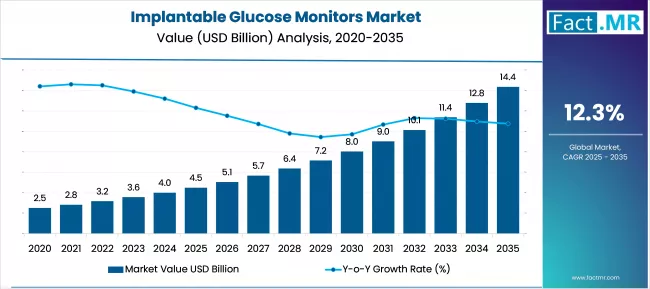
Implantable Glucose Monitors Market Market Value Analysis | Source: Fact.MR
What are the drivers of the implantable glucose monitors market?
The increasing incidence of diabetes in the world is a significant force of the implantable glucose monitors industry. Continuous and reliable glucose monitoring is a necessity currently because millions of people are being diagnosed every year. The traditional finger-prick testing is not as convenient and long-term compared to implantable devices which can provide patients with an improved solution.
Glucose monitors that can be implanted are also growing due to technological advancements. More appealing to patients and healthcare providers, these systems are offered with innovations like miniaturized sensors, better accuracy, increased the life of the device, and a combination with digital health platforms. Patient compliance is advanced by these developments and better overall diabetes management outcomes are achieved.
Favorable healthcare policies and reimbursement plans also enhance the use of implantable glucose monitors. In the developed markets, good insurance cover and regulatory clearances enhance accessibility among the patients. Simultaneously, the increasing investments in healthcare infrastructure in the developing economies are widening the scope of market penetration.
What are the regional trends of the implantable glucose monitors market?
The market of implantable glucose monitors is dominated by North America, which has a high rate of diabetes, high level of healthcare facilities and high level of reimbursement. The US is dominating, and they have a high use of new medical technologies.
Europe is the second largest with such countries as Germany, UK and France leading the demand. Friendly regulatory grants and government healthcare programs promote wider uptake of the same within the region.
Asia-Pacific is currently undergoing a high growth due to the increased cases of diabetes in China, India, and Japan. The market is growing as a result of increased healthcare expenditure, awareness, and implementation of more sophisticated monitoring solutions.
There is a stable growth in Latin America and Brazil and Mexico are the key contributors. The gradual adoption of implantable monitoring systems is supported by the improvement of healthcare access and an increased number of diabetic people.
Middle East and Africa are still smaller markets but the demand is also increasing particularly in GCC countries. There is a growth in these areas as healthcare investments are increasing, and awareness programs are established.
What are the challenges and restraining factors of implantable glucose monitors market?
Deficiency in the market of implantable glucose monitors is the expensive cost of the device and implantation surgeries. These systems tend to be much more costly than more conventional glucose monitoring systems, and thus are unavailable to patients who do not have complete insurance cover. The clinical advantage is also hampered by the cost barrier that is sluggish to adoption in price-sensitive areas.
The issue of patient acceptance and awareness is another difficulty because implantable systems need some minor surgeries and maintenance. Some of the patients are reluctant to use invasive solutions and will opt to use less complicated methods such as external continuous glucose monitors. The lack of knowledge regarding the long-term advantages of the implantable systems has further negative effects on market penetration.
One of the major limitations in this industry is that, the regulatory standards and the process of approvals are very strict and time consuming. As any implantable glucose monitor is a medical device that requires invasive surgical interventions, it is subject to a long period of clinical trials and compliance inspections. Such regulatory barriers tend to slow down product releases and limit the innovativeness of the industry.
Country-Wise Insights
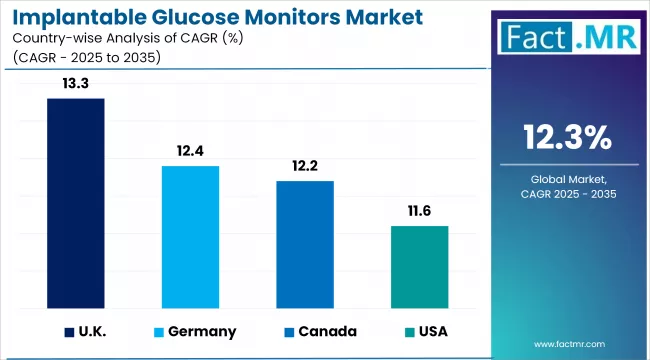
Implantable Glucose Monitors Market Cagr Analysis By Country | Source: Fact.MR
| Country | CAGR (2025 to 2035) |
|---|---|
| U.S.A. | 11.6% |
| Germany | 12.4% |
| U.K. | 13.3% |
Source: Fact.MR analysis. Updated Sep 27, 2025
Rising demand for long-term and reliable glucose monitoring drives the USA implantable glucose monitors market
The USA market of implantable glucose monitors is in its maturity phase caused by the surge in diabetes and the rising demand of continuous and convenient glucose monitoring facilities. The increasing popularity of implantable devices is informed by the necessity to have long-term, low-maintenance, and accurate glucose monitoring to enhance patient quality of life. The market is growing as consumers and healthcare providers are favoring more advanced systems that are more reliable, safer, and with digital health integration.
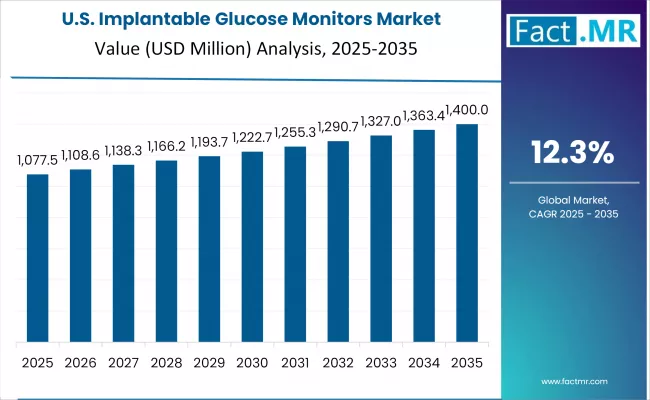
Implantable Glucose Monitors Market Country Value Analysis | Source: Fact.MR
Innovations in technology in sensor design, connectivity, and device life are enhancing the functionality and usage of such devices, which also enhances confidence among the patients and clinicians. Further, the business-friendly environment, the growth of reimbursement and availability of major medical device manufacturers are supporting the development, commercialization, and internationalization of next-generation implantable glucose monitoring systems in all healthcare applications.
Growing adoption of advanced diabetes management solutions drives the Germany implantable glucose monitors market
Implantable glucose monitors have a market in Germany that is at growing stage in the sense that the cases of diabetes are on the rise, and the awareness regarding continuous glucose monitoring is also on the rise. The increasing popularity of implantable systems is informed by desire to better monitor the progress over time, which requires more precise monitoring and avoids the frequent finger-prick testing that is burdensome and may be more effectively done using implantable systems.
Patients and healthcare providers are increasing the market with preference on those devices which are highly reliable, comfortable and compatible with digital health applications. The usability and clinical efficiency are increasing due to sensor technology innovations, long-term device durability, and real-time data integration, which increases confidence with the end-users.
Moreover, the established healthcare system, favorable regulatory environment, and the existence of major medical device manufacturers are facilitating the development, process of commercialization, and globalization of the next-generation implantable glucose monitoring systems in multiple healthcare uses.
Rising preference for continuous glucose monitoring fuels the UK implantable glucose monitors market
UK market on implantable glucose monitors is at its growth stage as the rising cases of diabetes are stimulating demands of sophisticated and trusted monitoring systems. The increasing use of implantable devices is informed by the desire to have long-term and convenient but accurate glucose monitoring that improves patient care and adherence to therapy.
The widening of the market to high-performance, safety, and smooth integration with digital health platforms is expanding the market of patients and healthcare providers in favor of systems. Usability and clinical outcomes Improvements in accuracy of sensors, durability of the devices, and real-time data management are enhancing technology, which give confidence to the end-users.
Moreover, the favorable regulatory environment, reimbursements, and availability of leading medical devices manufacturers are supporting the creation, commercialization and internationalization of the next generation of implantable glucose monitoring systems through the healthcare industry.
Category-Wise Analysis
Rising adoption of continuous glucose monitoring drives the segment
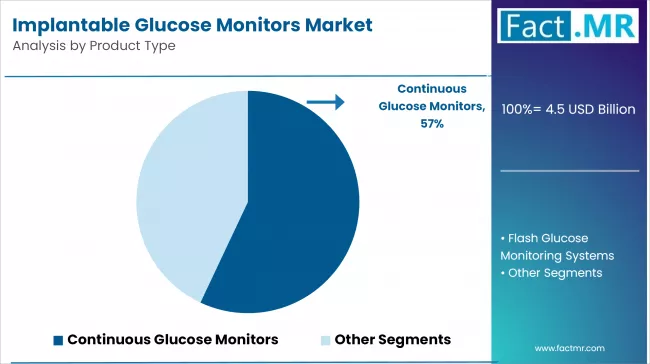
Implantable Glucose Monitors Market Analysis By Product Type | Source: Fact.MR
Continuous Glucose Monitors (CGM) segment is still in its growth phase because of the rising cases of diabetes and the rising need of precise and real time monitoring of glucose. The reasons behind preference of CGM devices are the necessity to measure blood glucose continuously to lessen the workload of regular finger-prick glucose monitoring and improve patient outcomes. Healthcare providers and patients are growing the market by preferring systems that are trustworthy, secure, and those that are integrated with electronic health systems.
The increased usability and clinical performance of sensor accuracy, device durability, and connectivity are increasing and boosting confidence among the end-users due to the technological advancements. Besides, favorable regulatory environments, enhanced reimbursement initiatives and the availability of major medical device manufacturers are supporting the creation, commercialization and cross-border adoption of next-generation CGM systems in healthcare applications.
Advancements in sensor technology drive the growth of the implantable glucose monitors market
The Sensor technology segment is at the growth phase because of the rising demand of real time and accurate glucose monitoring and better diabetes management. The rising popularity of sensor-related systems is predetermined by the necessity to monitor glucose constantly and reliably and improve patient care and minimize the use of manual tests.
The industry is also being broadened by healthcare providers and patients who are preferring systems to deliver accuracy, longevity and integration with digital health systems. New sensor designs, miniaturization and connectivity enhance usability, clinical performance and general safety that further boost end-user confidence.
Increasing hospital and clinic adoption drives the implantable glucose monitors market
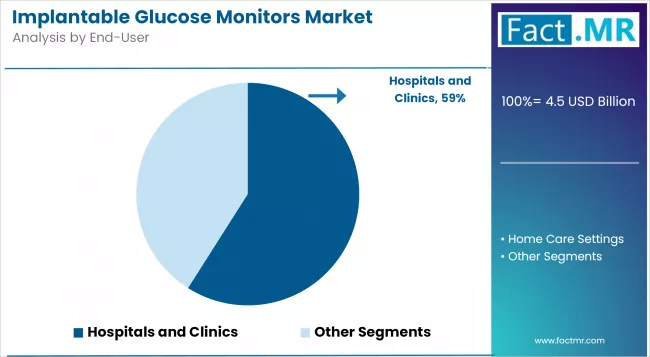
Implantable Glucose Monitors Market Analysis By End User | Source: Fact.MR
The hospitals and clinics segment is at a stage of growth as the demand to continuously and correctly monitor glucose requirements continues to grow in a clinical environment. The increasing popularity of implantable glucose monitoring systems is conditioned by the requirement to provide the effective management of patients, to ensure better treatment results, and simplify the working process.
The healthcare providers are enhancing the market by implementing systems that provide reliability, safety, and integration with the hospital information and digital health platforms. The accuracy of the devices, durability, and connectivity are increasing usability and clinical efficiency and strengthening the confidence of the medical professionals.
Competitive Analysis
The glucose monitor implants market is very competitive with the key players having dominance in it whereby they are concentrating on sensor technology development, extending the device life, and accuracy to make their product unique. Recent FDA approval, and favourable regulatory frameworks are allowing quicker market entry and rapid growth as increasing consumer demands of continuous, easy-to-use and consistent glucose monitoring at both clinical and home care are leading to usage in both clinical and home care environments.
Many manufacturers are also adopting digital health platforms and mobile apps to improve user experience and facilitate personalized management of diabetes by linking their devices with them. The market presence and the expansion of the customer base is swelling with the introduction of the over-the-counter systems, as well as as a result of the collaborations and strategic alliances.
Key players in the implantable glucose monitors market are Dexcom, Abbott, Senseonics, Medtronics, GluSense, and others.
Recent Developments
- In July 2025, US researchers have developed a tiny implantable device that automatically releases glucagon to prevent life-threatening low blood sugar in Type 1 diabetics, eliminating the need for emergency injections
- In September 2024, Eversense 365 Receives FDA Clearance: The World’s First One Year CGM
Fact.MR has provided detailed information about the price points of key manufacturers of Implantable Glucose Monitors Market positioned across regions, sales growth, production capacity, and speculative technological expansion, in the recently published report.
Methodology and Industry Tracking Approach
The Global Implantable Glucose Monitors Market 2025 report is on the basis of extensive research carried out amongst business professionals in domains like diabetes care, medical devices, digital health, and hospital and home care environments. The sample comprises endocrinologists, R&D scientists, biomedical engineers, regulatory affairs professionals, clinical trial managers, quality control analysts, and supply chain members who are directly engaged in the research, production, and commercialization of implantable glucose monitoring systems.
The study will adopt a horizontal format with the use of structured questionnaires from September 2024 through to August 2025. The study addresses trends in adoption, accuracy in devices, longevity in sensors, connectivity with digital platforms, clinical performance, and usability by patients. It assesses various technologies, such as sensor-based systems, transmitter modules, and integration with insulin delivery systems, and their use in hospitals, clinics, and home care settings.
With Fact.MR monitoring consumer behavior, product efficacy, industry trends, and market opportunities since 2018, this report is becoming an authoritative source of information that stakeholders can rely on.
Segmentation
Segmentation of Implantable Glucose Monitors Market
-
By Product Type :
- Continuous Glucose Monitors
- Flash Glucose Monitoring Systems
-
By Technology :
- Sensor
- Transmittors
-
By End-User :
- Hospitals and Clinics
- Home Care Settings
-
By Patient Type :
- Type 1 Diabetic Patients
- Type 2 Diabetic Patients
-
By Distribution Channel :
- Pharmacies
- Online Retailers
-
By Region :
- North America
- Latin America
- Western Europe
- Eastern Europe
- East Asia
- South Asia & Pacific
- Middle East & Africa
Frequently Asked Questions
What was the implantable glucose monitors market size reported by Fact.MR for 2025?
Who are the major players operating in the implantable glucose monitors market?
What is the estimated valuation of the implantable glucose monitors market in 2035?
What value CAGR did the implantable glucose monitors market exhibit over the last five years?
Who worked on this report


Preview the report firsthand - request a free sample
Free SampleGet the brochure for pricing and purchase details
Download PDF