- Base Value(2025): 5.5 Bn
- Forecast Value (2036): 14.5 Bn
- CAGR (2036): 9.1%
Self-service Analytics Market Forecast and Outlook 2026 to 2036
In 2025, the self-service analytics market was valued at approximately USD 5.5 billion. Based on Fact.MR analysis, demand for self-service analytics solutions is estimated to reach around USD 6.1 billion in 2026 and expand to nearly USD 14.5 billion by 2036, registering a CAGR of 9.1% during the forecast period. Adoption is expanding beyond core data teams into operational and business units that require faster insight generation. As Sudheesh Nair, Chief Executive Officer of ThoughtSpot, stated,“It’s absolutely critical to equip these new decision makers with the right tools to find their own data-driven insights, and more importantly empower them to act on these insights. The key to making this possible is self-service analytics.” [1] Fact.MR analysis interprets this as a reflection of enterprise demand for intuitive analytics platforms that reduce dependency on IT-led reporting cycles.
The market is projected to add nearly USD 9.0 billion in incremental value over the forecast window, reflecting rapid cloud migration and subscription-based licensing models. Early-period growth is supported by software platform upgrades and embedded analytics within CRM and ERP systems. Mid-period performance aligns with expansion into small and medium enterprises adopting cloud-native solutions. In later years, value realization is increasingly shaped by AI-assisted query interfaces, natural language processing, and governed data catalogs that enable wider non-technical adoption.
The United States leads growth at 10.1% CAGR, supported by enterprise cloud maturity and analytics-driven business models. Germany follows at 9.4%, driven by industrial digitization and manufacturing analytics. Japan records 9.2%, reflecting corporate digital transformation initiatives. China posts 8.7%, supported by expanding SME cloud adoption, while South Korea at 8.3% remains influenced by technology-enabled retail and telecommunications analytics demand.
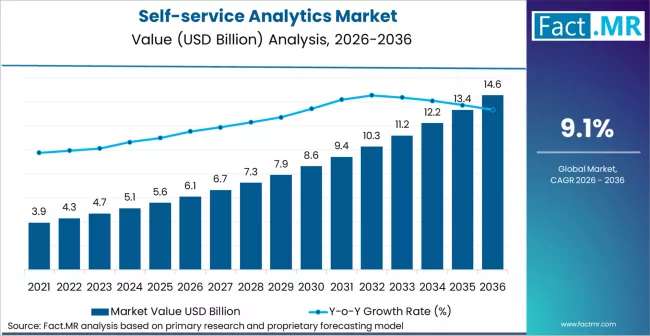
Self Service Analytics Market Market Value Analysis | Source: Fact.MR
Self-service Analytics Market
| Metric | Value |
|---|---|
| Market Value (2026) | USD 6.1 billion |
| Forecast Value (2036) | USD 14.5 billion |
| Forecast CAGR (2026-2036) | 9.1% |
Source: Fact.MR analysis. Updated Feb 27, 2026
Summary of Self-service Analytics Market
- Market Definition
- The self-service analytics market refers to software platforms that enable business users to access, analyze, and visualize enterprise data independently through graphical interfaces, automated data preparation, and governed access controls without continuous reliance on IT teams.
- Demand Drivers
- Enterprises are expanding self-service analytics adoption as business teams require faster query turnaround and real-time dashboards for operational and financial decisions.
- Cloud migration and subscription licensing models support deployment across distributed workforces and hybrid operating environments.
- Data governance and security requirements encourage organizations to adopt platforms aligned with standardized cybersecurity and privacy frameworks.
- Key Segments Analyzed
- Component: Software platforms account for the leading share due to widespread use of dashboards, visual analytics, and no-code reporting across departments.
- Deployment Mode: Cloud-based solutions dominate adoption as they allow scalability, remote access, and reduced infrastructure management.
- Geography: North America leads demand, supported by mature enterprise IT environments and early adoption of cloud analytics tools.
- Analyst Opinion at Fact.MR
- Shambhu Nath Jha, Principal Consultant at Fact.MR, opines, ‘CXOs will find this report useful for understanding how governed self-service analytics platforms are reshaping enterprise decision workflows, data access accountability, and IT operating models.’
- Strategic Implications / Executive Takeaways
- Organizations should align self-service analytics deployment with formal data governance and cybersecurity policies to manage enterprise risk.
- Vendors must prioritize ease of use for non-technical users while maintaining centralized control over data access and compliance.
- Enterprises can accelerate return on analytics investments by integrating self-service tools with existing ERP and CRM systems.
- Methodology
- Market sizing is based on enterprise software adoption rates, license deployments, and usage intensity across business functions.
- Security and governance assumptions were validated.
Self Service Analytics Market Definition
The self-service analytics market covers software platforms that allow business users to access, analyze, and visualize data without reliance on dedicated data science or IT teams. These tools enable users to create dashboards, reports, and data queries through graphical interfaces and automated data preparation features. Self-service analytics is used across enterprises to support operational monitoring, financial analysis, and decision support. Data governance, privacy, and digital system use are guided by frameworks and policies issued by government and standards bodies such as the US National Institute of Standards and Technology and public data protection authorities. [2]
Self Service Analytics Market Inclusions
The report covers global and regional market size estimates in volume and value with a forecast from 2026 to 2036. Segmentation includes deployment type, on premises and cloud based, application across business intelligence and reporting, and end use across enterprises in sectors such as finance, retail, manufacturing, and healthcare. Regional adoption patterns, pricing trends, and enterprise usage indicators are included.
Self Service Analytics Market Exclusions
The scope excludes custom built analytics software developed internally by organizations. Advanced data science platforms requiring specialized coding expertise are not included. Data storage infrastructure, database management systems, and enterprise resource planning software are excluded. Consulting services, system integration projects, training programs, and data governance advisory services are also outside the scope.
Self Service Analytics Market Research Methodology
- Primary Research: Interviews were conducted with analytics software vendors, enterprise IT managers, data governance officers, and business users.
- Desk Research: Desk research used digital governance and data management guidance issued by the US National Institute of Standards and Technology and privacy and data security publications from the US Federal Trade Commission, along with company disclosures.
- Market Sizing and Forecasting: Estimates were developed using enterprise software adoption data, license deployment volumes, and usage intensity across business functions.
- Data Validation and Update Cycle: Data was cross checked against regulatory documentation, enterprise IT spending data, vendor disclosures, and publicly available digital economy statistics before updates were finalized.
Segmental Analysis
Self-service Analytics Market Analysis by Component
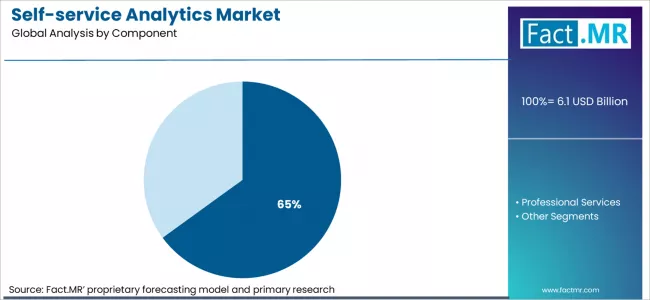
Self Service Analytics Market Analysis By Component | Source: Fact.MR
Based on Fact.MR analysis, consumption of self-service analytics software platforms is estimated to hold 65% share of the global market. Fact.MR analysts note software platforms lead due to demand for user-driven data visualization, dashboarding, and reporting without reliance on centralized IT teams. As per Fact.MR, this component addresses enterprise needs for faster insights, broader analytics access across business functions, and integration with existing data sources, supporting adoption across finance, operations, sales, and marketing teams worldwide today in organizations pursuing decentralized decision-making models.
- Data governance: Use of analytics software is influenced by national data privacy and consumer protection guidelines.
- User enablement: Fact.MR analysts note platforms emphasize drag-and-drop and no-code analytics features.
- Enterprise scale: Software platforms support large user bases across departments.
Self-service Analytics Market Analysis by Deployment Mode
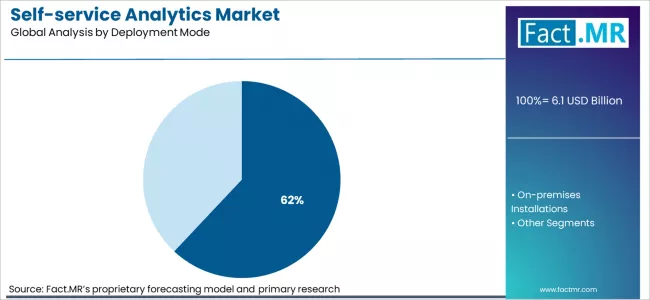
Self Service Analytics Market Analysis By Deployment Mode | Source: Fact.MR
Based on Fact.MR analysis, consumption of cloud-based self-service analytics solutions is estimated to hold 62% share of the global market. Fact.MR analysts note cloud deployment leads due to scalability, remote access, and reduced infrastructure management requirements. As per Fact.MR, this deployment mode addresses organizational needs for faster implementation, elastic computing resources, and accessibility for distributed workforces, supporting analytics usage across geographically dispersed teams and hybrid work environments worldwide today with growing reliance on cloud-native data platforms.
- Cloud security framework: Government cybersecurity agencies provide guidance on secure cloud computing practices.
- Operational flexibility: Fact.MR analysts note cloud platforms allow rapid user onboarding.
- Cost structure: Cloud deployment reduces upfront infrastructure investment.
Self-service Analytics Market Drivers, Restraints, and Opportunities
Fact.MR analysis indicates that the self-service analytics market exists as a business intelligence and data exploration segment that enables business users to perform analysis without heavy reliance on IT or data science teams. As per Fact.MR assessment, adoption of self-service analytics platforms is influenced by data governance and security frameworks such as the U.S. National Institute of Standards and Technology (NIST) Cybersecurity Framework, which provides voluntary guidelines for managing cybersecurity risks in information systems and helps organisations establish secure analytics environments. Fact.MR analysts observe that the current market scale is driven by enterprises’ need for faster decision-making, growing data volumes from digital transformation initiatives, and the shift toward cloud-based analytics tools that support flexible, real-time insights without extensive technical dependencies.
Fact.MR is of the opinion that current market dynamics reflect a transition toward more integrated, governed, and automated self-service analytics capabilities that blend ease of use with enterprise-grade security and compliance. Based on Fact.MR assessment, traditional BI tools that require specialist support continue to be used in many organisations because of existing investments and familiarity, but demand for modern self-service analytics grows where data literacy and business user empowerment are prioritised in corporate strategies. Advanced self-service platforms with natural language querying, augmented analytics, and governed data access generally carry higher per-unit pricing because of AI-assisted features and robust security, meaning realised market value can grow even where base licence adoption increases at a measured pace. Fact.MR analysis suggests that this blend of user-centric capabilities and secure deployment will shape near-term market progression.
- Secure analytics readiness: Fact.MR analysts note that frameworks such as the NIST Cybersecurity Framework influence how organisations deploy self-service analytics platforms with governance, data protection, and risk management expectations. [3]
- Shift to user-centric BI tools: Based on Fact.MR assessment, growing demand for self-service analytics features such as drag-and-drop visualisation, natural language queries, and real-time dashboards supports market growth where business agility and insight speed are prioritised.
- Cloud adoption and data modernisation: Fact.MR opines that increased cloud analytics adoption, hybrid data architectures, and enterprise data modernisation initiatives in North America, Europe, and Asia Pacific drive uptake of self-service analytics solutions in both mid-market and large enterprises.
Regional Analysis
Based on regional assessment, the self-service analytics sector is analyzed across North America, Europe, East Asia, and other major digital transformation markets, spanning more than 40 countries. Regional performance varies according to enterprise data maturity, adoption of cloud based analytics platforms, demand for decentralized data access, and investment in business intelligence tools across industries.
Self Service Analytics Market CAGR Analysis by Country (2026-2036)
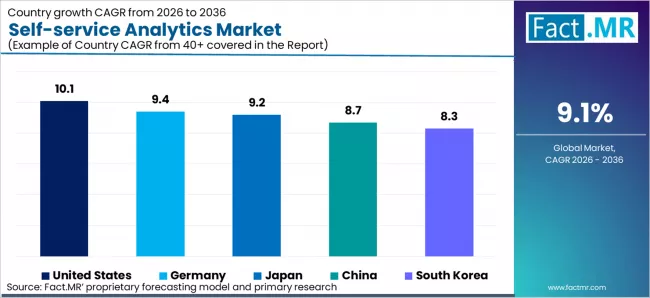
Self Service Analytics Market Cagr Analysis By Country | Source: Fact.MR
| Country | CAGR |
|---|---|
| United States | 10.1% |
| Germany | 9.4% |
| Japan | 9.2% |
| China | 8.7% |
| South Korea | 8.3% |
Source: Fact.MR analysis. Updated Feb 27, 2026
Source: Fact.MR analysis, based on proprietary forecasting models and primary research.
Demand for Self-Service Analytics Platforms in Asia Pacific
Asia Pacific shows rising demand for self-service analytics platforms supported by enterprise digitization cloud adoption and expansion of data driven decision making. Sales growth reflects increased deployment across banking retail manufacturing and telecom sectors. China Japan and South Korea anchor regional usage through large enterprise IT investments and SaaS adoption. Procurement emphasizes ease of integration visualization capability and data governance compliance. Market expansion reflects workforce upskilling API connectivity and migration from legacy reporting tools across corporate environments regionwide.
- China: Demand for self-service analytics platforms in China is projected to rise at 8.7% CAGR through 2036. Growth reflects enterprise cloud adoption and integration of data visualization tools within large organizations, as per Fact.MR.
- Japan: Demand for self-service analytics platforms in Japan is projected to rise at 9.2% CAGR through 2036. Usage reflects digitization of business processes and modernization of corporate reporting systems, according to Fact.MR.
- South Korea: Demand for self-service analytics platforms in South Korea is projected to rise at 8.3% CAGR through 2036. Adoption is supported by strong IT infrastructure and enterprise level digital transformation initiatives, as per Fact.MR.
Fact.MR’s analysis of the Self-service Analytics Market in Asia Pacific consists of country-wise assessment that includes China, Japan, and South Korea. Readers can find enterprise IT adoption and cloud migration insights.
Analysis On Self-Service Analytics Sales in North America
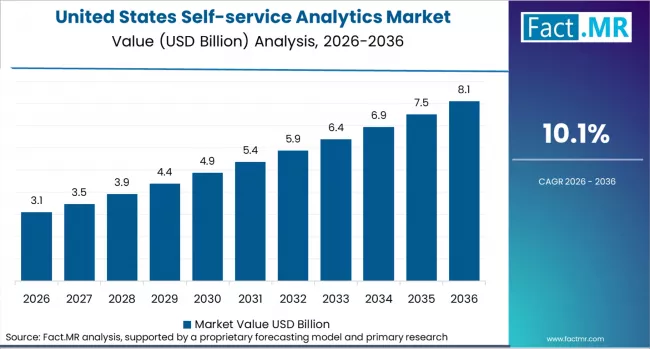
Self Service Analytics Market Country Value Analysis | Source: Fact.MR
North America demonstrates strong sales of self-service analytics platforms supported by advanced enterprise IT infrastructure and early adoption of business intelligence tools. Demand is driven by need for decentralized data access dashboard creation and real time reporting. The United States anchors regional volume through SaaS penetration and widespread use in finance healthcare retail and technology sectors. Procurement favors scalability compliance and integration with existing data warehouses. Market growth reflects analytics democratization and ongoing migration to cloud based data platforms nationally.
- United States: Demand for self-service analytics platforms in the United States is projected to rise at 10.1% CAGR through 2036. Sales are driven by strong SaaS adoption and widespread enterprise deployment of data visualization tools, as per Fact.MR.
Fact.MR’s analysis of the Self-service Analytics Market in North America consists of country-wise assessment that includes the United States. Readers can find SaaS penetration and enterprise analytics adoption references.
Outlook On Self-Service Analytics Demand in Europe
Europe reflects structured demand for self-service analytics platforms shaped by data protection regulation and enterprise modernization. Sales are influenced by GDPR compliance integration with enterprise resource planning systems and increased use of cloud infrastructure. Germany anchors regional adoption through manufacturing finance and industrial analytics applications. Procurement emphasizes governance security and interoperability. Market expansion reflects gradual replacement of legacy reporting systems and wider deployment of interactive dashboards across medium and large enterprises within European digital transformation frameworks.
- Germany: Demand for self-service analytics platforms in Germany is projected to rise at 9.4% CAGR through 2036. Adoption reflects industrial digitization and integration of analytics within enterprise systems, according to Fact.MR.
Fact.MR’s analysis of the Self-service Analytics Market in Europe consists of country-wise assessment that includes Germany. Readers can find regulatory compliance and enterprise modernization insights.
Competitive Landscape for Self-service Analytics Market Players
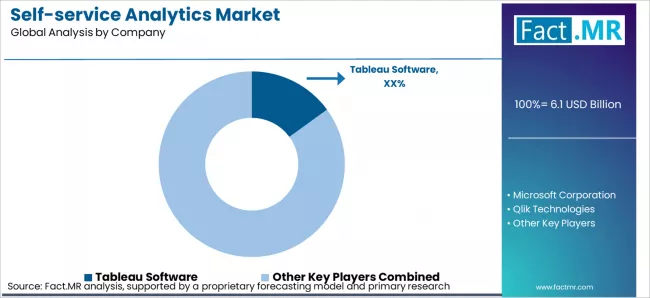
Self Service Analytics Market Analysis By Company | Source: Fact.MR
As per Fact.MR analysis, the 2026 self-service analytics market is defined by validated data integration capabilities, user experience, and multi-platform compatibility, which determine competitive advantage. Tableau Software and Microsoft Corporation lead with intuitive visualization tools and validated connection to diverse data sources, which strengthens adoption across enterprise and mid-market organizations. Qlik Technologies and IBM Corporation focus on associative analytics engines and proven scalability, which improves data accuracy and reduces IT bottlenecks. SAS Institute and Sisense Ltd. provide validated predictive analytics and AI-assisted insights, which enhances decision-making efficiency. TIBCO Software and Alteryx Inc. emphasize workflow automation and verified data blending capabilities, which increases productivity and reduces preparation time. Domo Inc. and Looker (Google Cloud) offer cloud-native platforms with multi-region compliance and secure access, which improves adoption across global operations. Across the market, validated platform performance, integration reliability, and user experience form enduring competitive moats, reducing reliance on pricing or isolated feature claims.
Recent Industry Developments
- In January 2026, Microsoft announced to acquire Osmos, an agentic AI data engineering platform designed to help simplify complex and time-consuming data workflows. [4]
- In December 2025, IBM and Confluent, Inc., the data streaming pioneer, announced they have entered into a definitive agreement under which IBM will acquire all of the issued and outstanding common shares of Confluent capabilities. [5]
Key Players in Self-service Analytics Market
- Tableau Software
- Microsoft Corporation
- Qlik Technologies
- IBM Corporation
- SAS Institute
- Sisense Ltd.
- TIBCO Software
- Alteryx Inc.
- Domo Inc.
- Looker (Google Cloud)
Bibliography
- [1] ThoughtSpot Inc. (2023). Empowering business users through self-service analytics: Interview with Sudheesh Nair, Chief Executive Officer [Executive interview]. ThoughtSpot Inc.
- [2] National Institute of Standards and Technology. (2024). Data management and digital governance resources. U.S. Department of Commerce; Federal Trade Commission. (2024). Privacy and data security guidance for businesses. U.S. Federal Trade Commission.
- [3] National Institute of Standards and Technology. (2024). Cybersecurity Framework (CSF 2.0): Managing cybersecurity risk. U.S. Department of Commerce.
- [4] Microsoft Corporation. (2026). Microsoft to acquire Osmos to accelerate agentic AI data engineering workflows [Corporate announcement]. Microsoft Corporation.
- [5] IBM Corporation. (2025). IBM announces agreement to acquire Confluent to expand data streaming and analytics capabilities [Press release]. IBM Corporation.
This Report Addresses
- Market intelligence to enable structured strategic decision-making in enterprise analytics, where data democratization, usability, and governance controls drive adoption more than traditional centralized BI models
- Global market size estimation and 10-year revenue forecasts from 2026 to 2036, based on enterprise software adoption trends, cloud migration rates, and analytics usage intensity across business functions
- Growth opportunity mapping across self-service analytics components, including software platforms and professional services, highlighting value capture from visualization, dashboarding, and no-code analytics tools
- Deployment-mode analysis covering cloud-based and on-premises solutions, assessing scalability, cost structure, security, and suitability for hybrid enterprise IT environments
- Organization-size benchmarking across small and medium enterprises and large enterprises, linking cloud-native adoption and subscription pricing to faster penetration in mid-market segments
- Vertical-specific demand assessment across BFSI, healthcare and life sciences, retail and eCommerce, manufacturing and industrial, government and public sector, and other industries, connecting analytics use cases to operational decision needs
- End-use analysis covering business analysts, data scientists, marketing teams, and operations teams, illustrating how self-service platforms reshape decision workflows beyond core data teams
- Competitive landscape assessment benchmarking vendors on ease of use, query performance, data integration breadth, AI-assisted features, and governance and security capabilities
- Technology roadmap tracking including natural language query interfaces, augmented analytics, AI-driven insights, and governed data catalogs enabling non-technical user adoption
- Regulatory and governance impact review covering data privacy, cybersecurity, and enterprise data management frameworks influencing platform selection and deployment
- Regional and country-level growth analysis highlighting differentiated adoption across the United States, Germany, Japan, China, and South Korea, alongside broader enterprise cloud maturity trends
- Multi-format market report delivery in PDF, Excel datasets, PPT presentations, and interactive dashboards for executives, IT leaders, analytics teams, and enterprise strategy stakeholders
Segmentation
Scope of the Report
| Metric | Value |
|---|---|
| Quantitative Units | USD 6.1 billion (2026) to USD 14.5 billion (2036), CAGR 9.1% |
| Market Definition | The self-service analytics market covers software platforms and related professional services that allow business users to access, analyze, and visualize data independently of IT or data science teams. Tools enable dashboard creation, reporting, and automated data preparation to support operational, financial, and marketing decisions. Governance, privacy, and cybersecurity compliance follow guidelines from the US National Institute of Standards and Technology (NIST) and data protection authorities. |
| Component Segmentation | Software Platforms, Professional Services |
| Deployment Mode Segmentation | Cloud-based Solutions, On-premises Installations |
| Organization Size Segmentation | Small and Medium Enterprises (SMEs), Large Enterprises |
| Vertical Segmentation | Banking, Financial Services and Insurance (BFSI), Healthcare and Life Sciences, Retail and eCommerce, Manufacturing and Industrial, Government and Public Sector, Others (Education, Media, Telecommunications) |
| End Use Segmentation | Business Analysts, Data Scientists, Marketing Teams, Operations Teams |
| Regions Covered | Asia Pacific, Europe, North America, Latin America, Middle East & Africa |
| Countries Covered | India, China, Japan, South Korea, Indonesia, Australia & New Zealand, Germany, Italy, France, United Kingdom, Spain, Benelux, Nordics, Central & Eastern Europe, United States, Canada, Mexico, Brazil, Argentina, Chile, Kingdom of Saudi Arabia, United Arab Emirates, South Africa, Turkey |
| Key Companies Profiled | Tableau Software, Microsoft Corporation, Qlik Technologies, IBM Corporation, SAS Institute, Sisense Ltd., TIBCO Software, Alteryx Inc., Domo Inc., Looker (Google Cloud) |
| Forecast Period | 2026 to 2036 |
| Approach | Market sizing and forecasting based on enterprise adoption, license deployment volumes, cloud migration, AI and NLP integration, and enterprise IT investment. Validation through interviews with vendors, IT managers, data governance officers, and business users, combined with regulatory and digital economy data. |
Source: Fact.MR analysis. Updated Feb 27, 2026
Market Analysis by Segments
-
Component :
- Software Platforms
- Professional Services
-
Deployment Mode :
- Cloud-based Solutions
- On-premises Installations
-
Organization Size :
- Small and Medium Enterprises
- Large Enterprises
-
Vertical :
- Banking, Financial Services and Insurance (BFSI)
- Healthcare and Life Sciences
- Retail and eCommerce
- Manufacturing and Industrial
- Government and Public Sector
- Others (Education, Media, Telecommunications)
-
End Use :
- Business Analysts
- Data Scientists
- Marketing Teams
- Operations Teams
-
Region :
- Asia Pacific
- India
- China
- Japan
- South Korea
- Indonesia
- Australia & New Zealand
- ASEAN
- Rest of Asia Pacific
- Europe
- Germany
- Italy
- France
- United Kingdom
- Spain
- Benelux
- Nordics
- Central & Eastern Europe
- Rest of Europe
- North America
- United States
- Canada
- Mexico
- Latin America
- Brazil
- Argentina
- Chile
- Rest of Latin America
- Middle East & Africa
- Kingdom of Saudi Arabia
- United Arab Emirates
- South Africa
- Turkey
- Rest of Middle East & Africa
- Asia Pacific
Frequently Asked Questions
How big is the self-service analytics market in 2026?
What will the self-service analytics market be worth by 2036?
What is the CAGR of the self-service analytics market from 2026 to 2036?
How much incremental value will the market add over the forecast period?
What is driving demand for self-service analytics platforms?
What is included in self-service analytics solutions?
Which component leads the self-service analytics market?
Why do software platforms dominate over services in this market?
Which deployment mode leads the self-service analytics market?
What is supporting early-period market growth (2026–2028)?
What drives mid-period growth in self-service analytics adoption?
What will shape later-stage value realization toward 2036?
Which country is projected to grow fastest in this market?
What is the growth outlook for Germany in self-service analytics?
How fast is the market expected to grow in Japan?
What is China’s projected growth rate in self-service analytics platforms?
What is the projected CAGR for South Korea in this market?
Who are the key end users of self-service analytics tools?
What are the main barriers to wider self-service analytics adoption?
What is the long-term outlook for the self-service analytics market?
Who worked on this report


Preview the report firsthand - request a free sample
Free SampleGet the brochure for pricing and purchase details
Download PDF