Model-Based Manufacturing Technologies Market (2026 - 2036)

The Model-Based Manufacturing Technologies Market is segmented by Solution (Software and Services), Deployment (Cloud and On-Premises), Enterprise Size (Small & Medium Enterprises (SMEs) and Large Enterprises), Industry (Automotive, Electronics & Semiconductors, Aerospace & Defense, Oil & Gas, Healthcare & Pharmaceuticals, Food & Beverages, and Others) and Region. Forecast for 2026 to 2036.

Core Findings

    Model-Based Manufacturing Technologies Market Forecast and Outlook By Fact.MR

    In 2025, the model-based manufacturing technologies market was valued at USD 60.3 billion. Based on Fact.MR analysis, demand for model-based manufacturing technologies is estimated to grow to USD 56.4 billion in 2026 and USD 118.6 billion by 2036. FACT.MR projects a CAGR of 7.0% during the forecast period.

    The market is set to add around USD 62.2 billion in new revenue over the forecast period. Growth is being supported by increasing Industry 4.0 adoption, regulatory requirements like digital product passports in Europe, and rising demand for aerospace simulation tools. High implementation costs continue to slow adoption among smaller manufacturers. Integrating new systems into existing production setups remains challenging. Recent large acquisitions are also creating temporary pressure on licensing structures and vendor choices.

    India leads country growth at 9.7% CAGR through 2036, driven by the PLI scheme for advanced manufacturing and domestic aerospace programme expansion under ISRO and HAL. China follows at 9.5% CAGR, supported by MIIT's smart manufacturing standards and domestic digital twin platform investment. The USA at 9.0% CAGR reflects defence programme digital engineering mandates and semiconductor fab expansion. Australia at 8.1% CAGR is driven by mining automation and defence modernisation. Germany at 8.3% CAGR benefits from automotive MBSE adoption and EU Digital Product Passport mandates. Japan at 5.3% represents a mature market generating replacement demand constrained by legacy keiretsu procurement structures and cautious IT adoption cycles.
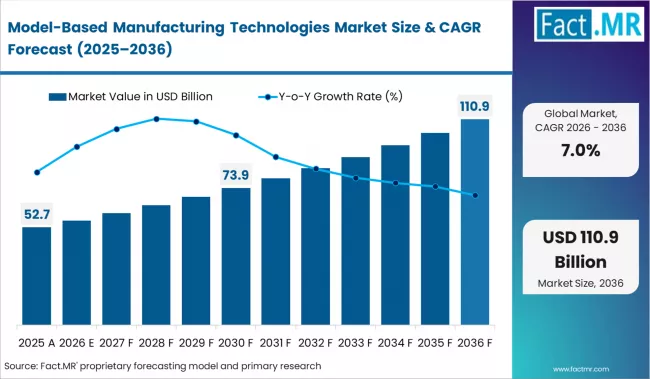
    Model Based Manufacturing Technologies Market Market Value Analysis

    Metric Value
    Estimated Value in 2026 USD 56.4 billion
    Forecast Value in 2036 USD 118.6 billion
    Forecast CAGR (2026 to 2036) 7.0%

    Model-Based Manufacturing Technologies Market Definition

    The model-based manufacturing technologies market includes software and tools using digital models like digital twins and MBSE. These tools help design, test, and optimise products and processes. They reduce the need for physical prototyping.

    Model-Based Manufacturing Technologies  Market Inclusions

    Covers global and regional forecasts from 2026 to 2036. Includes PLM, digital twin platforms, and simulation tools. Covers MBSE software and implementation services. Includes cloud and on-premise deployments. Applies across multiple industrial sectors.

    Model-Based Manufacturing Technologies Market Exclusions

    Excludes basic CAD tools without simulation features. Excludes hardware like sensors, PLCs, and robotics unless bundled. Excludes IoT and MES platforms without model-based integration.

    Model-Based Manufacturing Technologies  Market Research Methodology

    • Primary Research
      • Includes interviews with PLM managers, simulation leads, and manufacturing CIOs. Covers procurement and digital engineering experts. Regions include North America, Europe, India, and Asia Pacific.
    • Desk Research
      • Uses data from Siemens, Synopsys-Ansys filings, PTC, and Dassault Systèmes. Includes EU regulations and India government reports. Covers US DoD digital engineering strategies.
    • Market Sizing and Forecasting
      • Uses hybrid top-down and bottom-up models. Based on software revenue and adoption rates. Includes cloud migration and government programme data.
    • Data Validation and Update Cycle
      • Validated using revenue data from Siemens, Dassault, PTC, Synopsys, Oracle, SAP, and Rockwell. Supported by regulatory data and expert interviews.

    Summary Of Model-Based Manufacturing Technologies Market

    • Market Definition
      • The market covers software platforms and services enabling digital model-based design, simulation, and process optimisation across manufacturing industries, replacing physical prototyping with virtual validation tools.
    • Demand Drivers
      • EU Digital Product Passport rules from 2026 are making model-based tools mandatory for compliance in key industries
      • Large acquisitions like Siemens–Altair and Synopsys–Ansys are driving market consolidation and procurement shifts
      • India’s PLI scheme and aerospace programmes are boosting demand for digital manufacturing platforms
    • Key Segments Analyzed
      • By Solution: Software holds 65% share in 2026, driven by PLM and digital twin platforms
      • By Deployment: On-premises leads with 57% share due to data security and regulatory needs
      • By Geography: India leads growth at 9.7% CAGR, followed by China.
    • Analyst Opinion at FACT.MR
      • Shambhu Nath Jha, Principal Consultant at Fact.MR, opines that CXOs will find this report essential for navigating the post-acquisition landscape where Siemens-Altair and Synopsys-Ansys are redefining full-stack model-based manufacturing platform procurement, and identifying which verticals face mandatory compliance-driven adoption versus organic digital transformation investment.
    • Strategic Implications
      • Aerospace and automotive firms should evaluate MBSE platforms early before pricing rises after major acquisitions
      • SMEs in India and Australia should use government subsidies to reduce initial software costs
      • Vendors should offer cloud-based solutions tailored for SMEs in emerging markets
    • Methodology
      • Uses software licence and service revenue data validated with major vendor disclosures
      • Includes inputs from EU regulations, US DoD strategy, India PLI, and China MIIT
      • Considers Industry 4.0 trends, market consolidation impact, and expert interviews.

    Segmental Analysis

    Model-Based Manufacturing Technologies Market Analysis by Solution
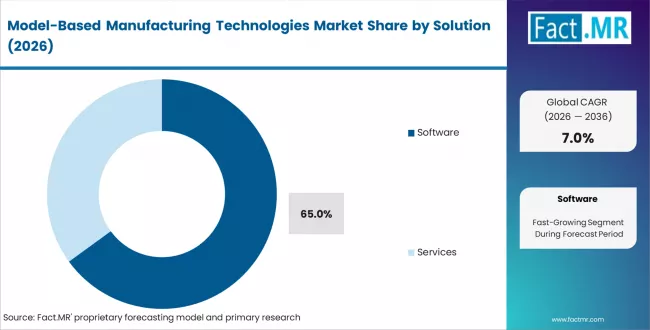
    Model Based Manufacturing Technologies Market Analysis By Solution

    Software holds 65% share in 2026. It dominates due to recurring licence revenue. Platforms offer continuous updates and advanced features. Digital twin and AI tools are increasing software value. Key platforms include Siemens Xcelerator, Dassault 3DEXPERIENCE, and PTC ThingWorx.

    • Siemens-Altair Software Integration: Siemens completed the Altair acquisition in 2025. This added strong software revenue and expanded capabilities. Market share increased significantly. The combined platform supports multi-physics simulation. It enables full digital twin solutions [1].
    • Synopsys-Ansys Simulation Software Merger: Synopsys acquired Ansys in 2025. The merger created a full-stack simulation leader. It covers semiconductor and system-level design. The combined platform increases pricing power. It strengthens integration across industries [2].
    • Cloud Software Adoption Trend: PTC is expanding its cloud PLM platform. Autodesk is growing its SME customer base. Cloud adoption is increasing across manufacturers. Many firms plan migration within two years. Cloud platforms are becoming a priority [3].

    Model-Based Manufacturing Technologies Market Analysis by Deployment
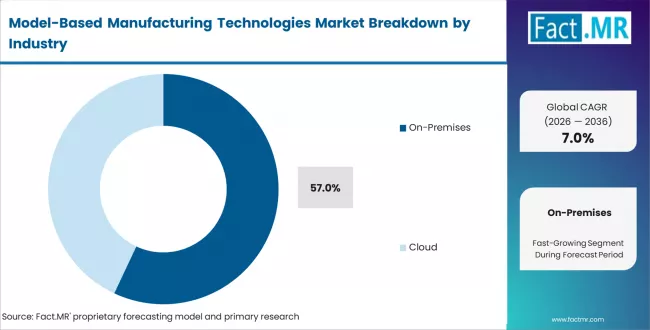
    Model Based Manufacturing Technologies Market Analysis By Deployment

    On-premises holds 57% share in 2026. It dominates due to strict security requirements. Aerospace and defence sectors require controlled environments. Regulations limit cloud adoption.

    • Dassault 3DEXPERIENCE Cloud Expansion: Dassault is expanding cloud-based platforms. Adoption is growing in healthcare and aerospace. Virtual twin applications are increasing. Cloud is gaining acceptance in regulated sectors. This shows gradual shift from on-premises [4].
    • On-Premises ITAR and Defence Compliance: US defence policies require secure deployment models. Sensitive programmes rely on on-premises systems. Major defence firms continue using local infrastructure. This sustains on-premises demand [5].
    • Hybrid Deployment Growth in Automotive: Automotive firms are adopting hybrid models. Design data stays on-premises for security. Simulation workloads move to cloud for scalability. BMW expanded cloud-based factory simulation. Hybrid models are increasing vendor revenue opportunities [6]

    Drivers, Restraints, and Opportunities
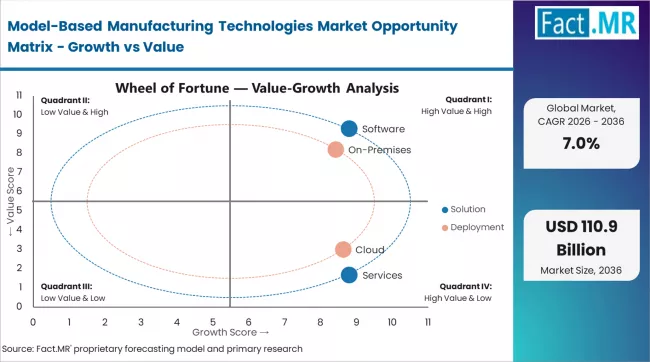
    Model Based Manufacturing Technologies Market Opportunity Matrix Growth Vs Value

    FACT.MR analysts note that the market has evolved in two phases. First was PLM adoption replacing manual processes. Second is digital twin and simulation growth under Industry 4.0. The current USD 60.3 billion market reflects mature PLM and rising digital twin use. Regulatory compliance is now creating a third demand wave.

    The market faces a balance between consolidation and affordability. Large acquisitions are concentrating advanced capabilities among fewer vendors. This increases pricing pressure for SMEs. On-premises still holds 57% share due to security needs. Cloud adoption is growing faster in less regulated industries. Flexible cloud licensing is improving SME access.

    • EU Digital Product Passport Mandate: EU regulations require digital product records from 2026. This is making model-based tools mandatory. Simulation-based certification is gaining acceptance. Siemens and UL reduced validation time using digital twins. Compliance is driving adoption across Europe.
    • Mega-Acquisition Consolidation Effect: Siemens acquired Altair and Synopsys acquired Ansys in 2025. These deals are reshaping the market. Vendors are expanding full-stack simulation capabilities. Enterprises are reviewing vendor contracts. Competitors are investing in cloud platforms to stay competitive.
    • India Smart Manufacturing Expansion: India’s PLI scheme is supporting advanced manufacturing. Aerospace and defence programmes are increasing demand. HAL and ISRO are adopting simulation tools. Dassault is expanding deployments in India. Government procurement is driving market growth.

    Regional Analysis

    The model-based manufacturing technologies market is analysed across North America, Europe, Asia Pacific, Latin America, and Middle East and Africa, covering 40+ country-level demand shaped by Industry 4.0 policy maturity, aerospace and defence programme investment, automotive EV transition timelines, and government-mandated digital manufacturing compliance requirements. The full report offers market attractiveness analysis based on software adoption rates, government programme funding, and vertical sector expansion benchmarks.
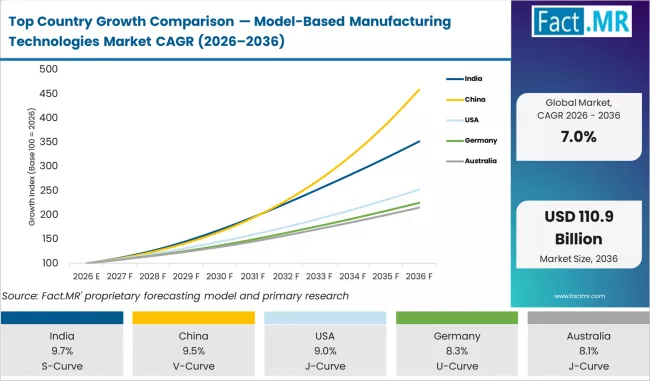
    Top Country Growth Comparison Model Based Manufacturing Technologies Market Cagr 2026 To 2036

    Country CAGR (2026 to 2036)
    India 9.7%
    China 9.5%
    USA 9.0%
    Germany 8.3%
    Australia 8.1%
    Japan 5.3%

    Source: Fact.MR (FACT.MR) analysis, based on proprietary forecasting model and primary research
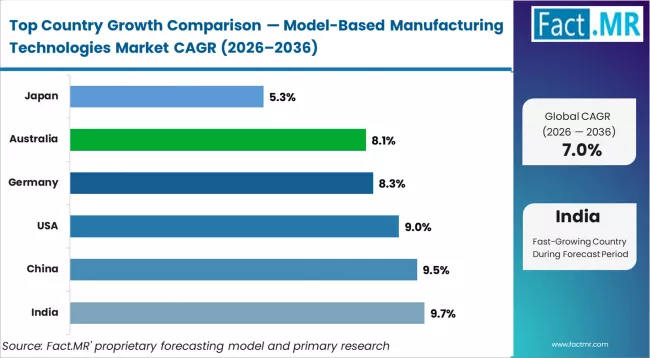
    Model Based Manufacturing Technologies Market Cagr Analysis By Country

    Asia Pacific Model-Based Manufacturing Technologies Market Analysis

    Asia Pacific is the fastest-growing region, driven by industrial expansion and government support. India and China lead adoption, while Australia contributes through defence investments. Global vendors compete with domestic players across the region.

    • India: India is seeing strong growth at a CAGR of 9.7% through 2036. Government PLI schemes are driving adoption in automotive, aerospace, and electronics. Defence and space programmes are increasing demand for simulation tools. Companies like HAL and ISRO are using model-based platforms. Industrial players are also expanding digital manufacturing capabilities. Policy support is aligning with technology adoption.
    • China: China is expanding steadily with a CAGR of 9.5% through 2036. Government standards are embedding simulation into smart manufacturing. EV manufacturers are increasing digital twin adoption. Large-scale investment under national plans is supporting growth. Domestic vendors are strong in mid-market segments. Global vendors remain dominant for large enterprises.

    FACT.MR's Asia Pacific analysis includes India, China, Japan, South Korea, Australia and New Zealand, and ASEAN. It covers policy impact, digital twin adoption, and regional forecasts.

    North America Model-Based Manufacturing Technologies Market Analysis
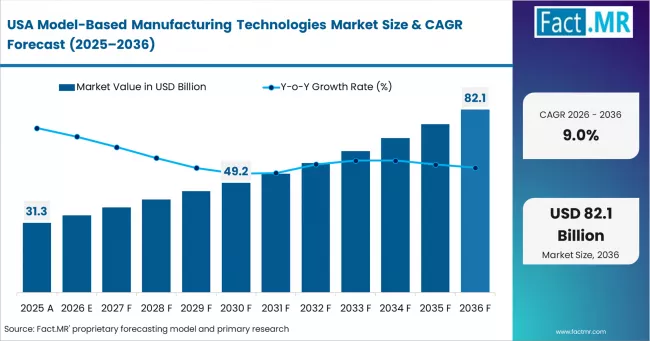
    Model Based Manufacturing Technologies Market Country Value Analysis

    North America is the largest revenue market, driven by aerospace, defence, and semiconductor industries. The region is both a major user and developer of advanced simulation technologies.

    • USA: The United States shows steady growth at a CAGR of 9.0% through 2036. Defence mandates are driving model-based engineering adoption. Semiconductor investments are increasing demand for simulation tools. Major vendors are headquartered in the region. Government programmes are supporting digital manufacturing. SME adoption is also rising with cloud platforms.

    FACT.MR's North America analysis includes the United States, Canada, and Mexico. It provides insights on defence demand, semiconductor growth, and adoption trends.

    Europe Model-Based Manufacturing Technologies Market Analysis
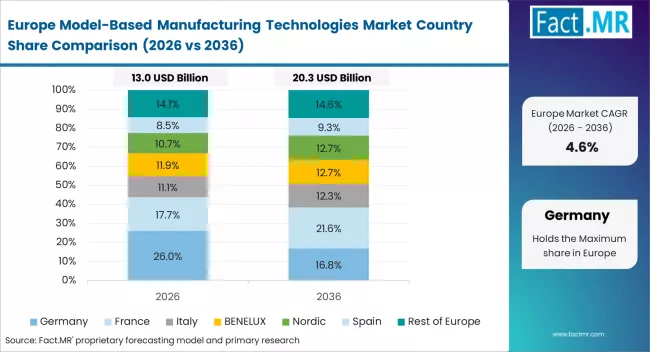
    Model Based Manufacturing Technologies Market Europe Country Market Share Analysis 2026 & 2036

    Europe is a regulation-driven market where compliance is a key adoption driver. Digital product passport rules are accelerating demand. Automotive and industrial sectors are leading adoption.

    • Germany: Germany remains a key market with a CAGR of 8.3% through 2036. Automotive OEMs are investing heavily in EV and simulation tools. Digital twin adoption is increasing across manufacturing. EU regulations are enforcing digital documentation. Local vendors are strengthening market position. The country is a hub for engineering software.
    • Australia: Australia is growing at a CAGR of 8.1% through 2036. Defence investments are driving adoption of model-based systems. Government funding supports advanced manufacturing. Mining companies are using digital twins for optimisation. Universities are supporting SME adoption through innovation hubs. New projects are increasing demand for simulation tools.

    FACT.MR's Europe analysis includes Germany, France, the UK, Italy, Spain, Nordic countries, and BENELUX. It covers regulatory impact, industry adoption, and regional forecasts.

    Competitive Aligners for Market Players
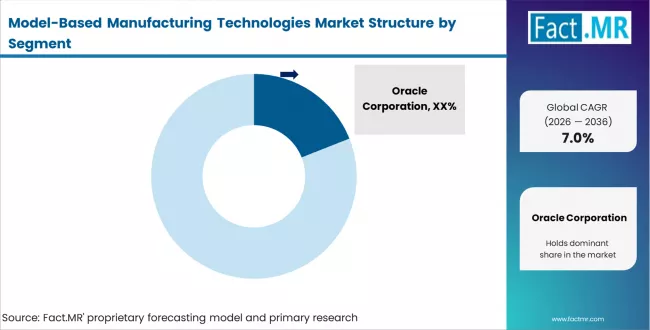
    Model Based Manufacturing Technologies Market Analysis By Company

    The model-based manufacturing technologies market is becoming more concentrated, especially after major acquisitions like Siemens–Altair and Synopsys–Ansys. Earlier, competition was spread across several vendors, but now a few large players control a significant share of enterprise simulation software. Siemens and the combined Synopsys–Ansys entity together hold a strong position, while companies like Dassault Systèmes, PTC, and Autodesk continue to compete for the remaining market. As a result, competition is shifting away from individual features toward how well platforms integrate across the entire product lifecycle.

    Siemens has a clear advantage with its broad ecosystem, combining PLM, IoT, and simulation into one platform. Dassault Systèmes stands out for its strong presence in aerospace and life sciences, where its platform is deeply embedded in engineering workflows. PTC focuses on mid-sized manufacturers, offering flexible solutions that connect legacy systems with modern digital tools.

    Large enterprises often use multiple platforms at the same time to reduce risk and meet compliance needs, which limits full vendor dominance. In contrast, smaller manufacturers tend to rely on a single vendor, giving companies like Siemens and PTC more pricing power in the mid-market segment.

    Key Players Of Model-Based Manufacturing Technologies Market

    • Oracle Corporation
    • SAP SE
    • Dassault Systèmes SE
    • Honeywell International, Inc.
    • Siemens Digital Industries Software
    • Rockwell Automation, Inc.
    • PTC Inc.
    • Ansys Inc. (Synopsys)
    • Autodesk, Inc.
    • Aspen Technology, Inc.
    • iBASEt Inc.
    • Schneider Electric SE

    Scope of Report

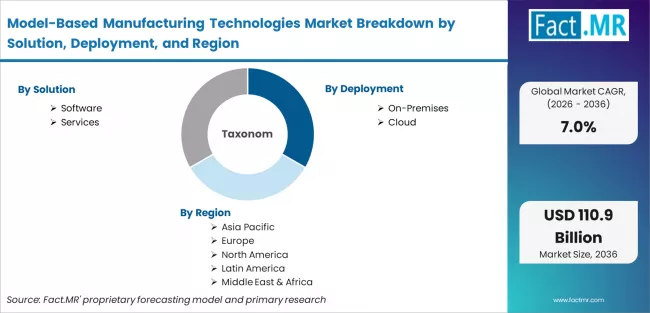
    Model Based Manufacturing Technologies Market Breakdown By Solution Deployment And Region

    Attribute Details
    Quantitative Units USD 56.4 billion (2026) to USD 118.6 billion (2036), at a CAGR of 7.0%
    Market Definition Software platforms, simulation tools, and services enabling digital model-based design, process optimisation, and virtual validation in manufacturing, including PLM, digital twins, MBSE suites, and physics-based simulation.
    Solution Segmentation Software, Services
    Deployment Segmentation Cloud, On-Premises
    Enterprise Size Segmentation Small & Medium Enterprises (SMEs), Large Enterprises
    Industry Segmentation Automotive, Electronics & Semiconductors, Aerospace & Defense, Oil & Gas, Healthcare & Pharmaceuticals, Food & Beverages, Others
    Regions Covered North America, Europe, Asia Pacific, Latin America, Middle East and Africa
    Countries Covered USA, Canada, Mexico, UK, Germany, France, Italy, Spain, Nordic, BENELUX, Japan, South Korea, China, India, Australia and New Zealand, ASEAN, Brazil, Argentina, Chile, Saudi Arabia, GCC, Turkey, South Africa, Rest of MEA
    Key Companies Profiled Oracle, SAP SE, Dassault Systèmes, Honeywell, Siemens Digital Industries, Rockwell Automation, PTC, Ansys (Synopsys), Autodesk, Aspen Technology, iBASEt, Schneider Electric
    Forecast Period 2026 to 2036
    Approach Hybrid top-down and bottom-up model using simulation software licence revenue by vertical, enterprise adoption rates, government programme valuations, and primary interviews with manufacturing digital transformation leads.

    Model-Based Manufacturing Technologies Market by Segments

    • By Solution:

      • Software
      • Services
    • By Deployment:

      • Cloud
      • On-Premises
    • By Enterprise Size:

      • Small & Medium Enterprises (SMEs)
      • Large Enterprises
    • By Industry:

      • Automotive
      • Electronics & Semiconductors
      • Aerospace & Defense
      • Oil & Gas
      • Healthcare & Pharmaceuticals
      • Food & Beverages
      • Others
    • By Region:

      • North America
        • United States
        • Canada
        • Mexico
      • Latin America
        • Brazil
        • Mexico
        • Argentina
        • Chile
        • Rest of Latin America
      • Western Europe
        • Germany
        • United Kingdom
        • France
        • Italy
        • Spain
        • Nordic Countries
        • BENELUX
        • Rest of Western Europe
      • Eastern Europe
        • Russia
        • Poland
        • Hungary
        • Balkan and Baltic
        • Rest of Eastern Europe
      • East Asia
        • China
        • Japan
        • South Korea
      • South Asia and Pacific
        • India
        • ASEAN
        • Australia and New Zealand
        • Rest of South Asia and Pacific
      • Middle East and Africa
        • Kingdom of Saudi Arabia
        • Other GCC Countries
        • Turkey
        • South Africa
        • Rest of Middle East and Africa

    Bibliography

    • [1] Siemens AG. Acquisition Announcement and Investor Presentation: Siemens Strengthens Leadership in Industrial Software and AI with Acquisition of Altair Engineering for USD 10.6 Billion, Market Share Increase from 9% to 15%, PLM Simulation Portfolio Enhancement. October 2024. press.siemens.com / news.siemens.com
    • [2] Synopsys Inc. / Engineering.com. Synopsys Completes USD 35 Billion Acquisition of Ansys Creating World's Largest Simulation Software Entity Spanning Semiconductor EDA and Systems-Level Physics Simulation. July 2025. engineering.com / synopsys.com/investor
    • [3] PTC Inc. Fiscal Year 2025 Annual Results and Gartner 2025 Industrial Technology Priorities Report: Cloud PLM Windchill+ ARR Growth, Autodesk Fusion SME Expansion, Cloud-Native Digital Manufacturing Top Priority. 2025. ptc.com/investor / gartner.com
    • [4] Dassault Systèmes SE. 2024 Annual Report: 3DEXPERIENCE Cloud Subscription Revenue Double-Digit Growth, Life Sciences Virtual Twin Platform Expansion, Healthcare and Aerospace Cloud Deployment Expansion. March 2025. investor.3ds.com
    • [5] US Department of Defense. Digital Engineering Strategy Update 2024: Model-Based Systems Engineering Mandate for Major Defence Acquisition Programmes, FedRAMP and On-Premises Requirements for Classified Digital Engineering Environments. 2024. ac.cto.mil/digital-engineering
    • [6] BMW Group. Annual Report 2024 and Siemens Xcelerator Partnership: Cloud-Based Virtual Factory Simulation Expansion for EV Production Line Optimisation, Hybrid On-Premises and Cloud Digital Twin Deployment Model. March 2025. bmwgroup.com/ir

    This Report Addresses

    • Strategic intelligence on EU Digital Product Passport mandates, US DoD Digital Engineering Strategy, India PLI Advanced Manufacturing scheme, China MIIT Smart Manufacturing Standards, and Australia Defence Strategic Review 2024 driving model-based technology adoption through 2036.
    • Market forecast projecting growth from USD 56.4 billion in 2026 to USD 118.6 billion by 2036 at a 7.0% CAGR, segmented by solution, deployment, enterprise size, industry vertical, and region.
    • Growth opportunity mapping across India's PLI and aerospace programme procurement, China's EV and smart factory investment, USA's defence digital engineering mandates, Germany's automotive MBSE adoption, and Australia's AUKUS defence manufacturing expansion.
    • Country CAGR outlook highlighting India 9.7%, China 9.5%, USA 9.0%, Germany 8.3%, Australia 8.1%, and Japan 5.3%, with government programme data and industry vertical adoption benchmarks per country.
    • Competitive landscape analysis covering Siemens, Dassault Systèmes, PTC, Ansys (Synopsys), Autodesk, Oracle, SAP, Rockwell Automation, and Honeywell, focusing on post-acquisition platform integration, cloud migration strategies, and vertical market positioning.
    • Technology tracking including AI-assisted simulation, physics-based digital twin certification for aerospace, EU Digital Product Passport compliance tooling, cloud-native PLM subscription models, and model-based medical device FDA submission pathways.
    • Regulatory analysis covering EU Digital Product Passport Regulation, US DoD Digital Engineering Strategy, CHIPS Act semiconductor simulation requirements, India National Manufacturing Policy 2024, and Australia Defence Strategic Review manufacturing mandates.

    Report deliverables include PDF report, Excel datasets, PowerPoint summary, and dashboards supported by Siemens investor filings, Synopsys-Ansys merger documents, Dassault annual reports, PTC earnings, and primary research interviews.

    Table of Content

    1. Executive Summary
      • Global Market Outlook
      • Demand to side Trends
      • Supply to side Trends
      • Technology Roadmap Analysis
      • Analysis and Recommendations
    2. Market Overview
      • Market Coverage / Taxonomy
      • Market Definition / Scope / Limitations
    3. Research Methodology
      • Chapter Orientation
      • Analytical Lens and Working Hypotheses
        • Market Structure, Signals, and Trend Drivers
        • Benchmarking and Cross-market Comparability
        • Market Sizing, Forecasting, and Opportunity Mapping
      • Research Design and Evidence Framework
        • Desk Research Programme (Secondary Evidence)
          • Company Annual and Sustainability Reports
          • Peer-reviewed Journals and Academic Literature
          • Corporate Websites, Product Literature, and Technical Notes
          • Earnings Decks and Investor Briefings
          • Statutory Filings and Regulatory Disclosures
          • Technical White Papers and Standards Notes
          • Trade Journals, Industry Magazines, and Analyst Briefs
          • Conference Proceedings, Webinars, and Seminar Materials
          • Government Statistics Portals and Public Data Releases
          • Press Releases and Reputable Media Coverage
          • Specialist Newsletters and Curated Briefings
          • Sector Databases and Reference Repositories
          • Fact.MR Internal Proprietary Databases and Historical Market Datasets
          • Subscription Datasets and Paid Sources
          • Social Channels, Communities, and Digital Listening Inputs
          • Additional Desk Sources
        • Expert Input and Fieldwork (Primary Evidence)
          • Primary Modes
            • Qualitative Interviews and Expert Elicitation
            • Quantitative Surveys and Structured Data Capture
            • Blended Approach
          • Why Primary Evidence is Used
          • Field Techniques
            • Interviews
            • Surveys
            • Focus Groups
            • Observational and In-context Research
            • Social and Community Interactions
          • Stakeholder Universe Engaged
            • C-suite Leaders
            • Board Members
            • Presidents and Vice Presidents
            • R&D and Innovation Heads
            • Technical Specialists
            • Domain Subject-matter Experts
            • Scientists
            • Physicians and Other Healthcare Professionals
          • Governance, Ethics, and Data Stewardship
            • Research Ethics
            • Data Integrity and Handling
        • Tooling, Models, and Reference Databases
      • Data Engineering and Model Build
        • Data Acquisition and Ingestion
        • Cleaning, Normalisation, and Verification
        • Synthesis, Triangulation, and Analysis
      • Quality Assurance and Audit Trail
    4. Market Background
      • Market Dynamics
        • Drivers
        • Restraints
        • Opportunity
        • Trends
      • Scenario Forecast
        • Demand in Optimistic Scenario
        • Demand in Likely Scenario
        • Demand in Conservative Scenario
      • Opportunity Map Analysis
      • Product Life Cycle Analysis
      • Supply Chain Analysis
      • Investment Feasibility Matrix
      • Value Chain Analysis
      • PESTLE and Porter’s Analysis
      • Regulatory Landscape
      • Regional Parent Market Outlook
      • Production and Consumption Statistics
      • Import and Export Statistics
    5. Global Market Analysis 2021 to 2025 and Forecast, 2026 to 2036
      • Historical Market Size Value (USD Million) Analysis, 2021 to 2025
      • Current and Future Market Size Value (USD Million) Projections, 2026 to 2036
        • Y to o to Y Growth Trend Analysis
        • Absolute $ Opportunity Analysis
    6. Global Market Pricing Analysis 2021 to 2025 and Forecast 2026 to 2036
    7. Global Market Analysis 2021 to 2025 and Forecast 2026 to 2036, By Solution
      • Introduction / Key Findings
      • Historical Market Size Value (USD Million) Analysis By Solution, 2021 to 2025
      • Current and Future Market Size Value (USD Million) Analysis and Forecast By Solution, 2026 to 2036
        • Software
        • Services
      • Y to o to Y Growth Trend Analysis By Solution, 2021 to 2025
      • Absolute $ Opportunity Analysis By Solution, 2026 to 2036
    8. Global Market Analysis 2021 to 2025 and Forecast 2026 to 2036, By Deployment
      • Introduction / Key Findings
      • Historical Market Size Value (USD Million) Analysis By Deployment, 2021 to 2025
      • Current and Future Market Size Value (USD Million) Analysis and Forecast By Deployment, 2026 to 2036
        • On-Premises
        • Cloud
      • Y to o to Y Growth Trend Analysis By Deployment, 2021 to 2025
      • Absolute $ Opportunity Analysis By Deployment, 2026 to 2036
    9. Global Market Analysis 2021 to 2025 and Forecast 2026 to 2036, By Region
      • Introduction
      • Historical Market Size Value (USD Million) Analysis By Region, 2021 to 2025
      • Current Market Size Value (USD Million) Analysis and Forecast By Region, 2026 to 2036
        • North America
        • Latin America
        • Western Europe
        • Eastern Europe
        • East Asia
        • South Asia and Pacific
        • Middle East & Africa
      • Market Attractiveness Analysis By Region
    10. North America Market Analysis 2021 to 2025 and Forecast 2026 to 2036, By Country
      • Historical Market Size Value (USD Million) Trend Analysis By Market Taxonomy, 2021 to 2025
      • Market Size Value (USD Million) Forecast By Market Taxonomy, 2026 to 2036
        • By Country
          • USA
          • Canada
          • Mexico
        • By Solution
        • By Deployment
      • Market Attractiveness Analysis
        • By Country
        • By Solution
        • By Deployment
      • Key Takeaways
    11. Latin America Market Analysis 2021 to 2025 and Forecast 2026 to 2036, By Country
      • Historical Market Size Value (USD Million) Trend Analysis By Market Taxonomy, 2021 to 2025
      • Market Size Value (USD Million) Forecast By Market Taxonomy, 2026 to 2036
        • By Country
          • Brazil
          • Chile
          • Rest of Latin America
        • By Solution
        • By Deployment
      • Market Attractiveness Analysis
        • By Country
        • By Solution
        • By Deployment
      • Key Takeaways
    12. Western Europe Market Analysis 2021 to 2025 and Forecast 2026 to 2036, By Country
      • Historical Market Size Value (USD Million) Trend Analysis By Market Taxonomy, 2021 to 2025
      • Market Size Value (USD Million) Forecast By Market Taxonomy, 2026 to 2036
        • By Country
          • Germany
          • UK
          • Italy
          • Spain
          • France
          • Nordic
          • BENELUX
          • Rest of Western Europe
        • By Solution
        • By Deployment
      • Market Attractiveness Analysis
        • By Country
        • By Solution
        • By Deployment
      • Key Takeaways
    13. Eastern Europe Market Analysis 2021 to 2025 and Forecast 2026 to 2036, By Country
      • Historical Market Size Value (USD Million) Trend Analysis By Market Taxonomy, 2021 to 2025
      • Market Size Value (USD Million) Forecast By Market Taxonomy, 2026 to 2036
        • By Country
          • Russia
          • Poland
          • Hungary
          • Balkan & Baltic
          • Rest of Eastern Europe
        • By Solution
        • By Deployment
      • Market Attractiveness Analysis
        • By Country
        • By Solution
        • By Deployment
      • Key Takeaways
    14. East Asia Market Analysis 2021 to 2025 and Forecast 2026 to 2036, By Country
      • Historical Market Size Value (USD Million) Trend Analysis By Market Taxonomy, 2021 to 2025
      • Market Size Value (USD Million) Forecast By Market Taxonomy, 2026 to 2036
        • By Country
          • China
          • Japan
          • South Korea
        • By Solution
        • By Deployment
      • Market Attractiveness Analysis
        • By Country
        • By Solution
        • By Deployment
      • Key Takeaways
    15. South Asia and Pacific Market Analysis 2021 to 2025 and Forecast 2026 to 2036, By Country
      • Historical Market Size Value (USD Million) Trend Analysis By Market Taxonomy, 2021 to 2025
      • Market Size Value (USD Million) Forecast By Market Taxonomy, 2026 to 2036
        • By Country
          • India
          • ASEAN
          • Australia & New Zealand
          • Rest of South Asia and Pacific
        • By Solution
        • By Deployment
      • Market Attractiveness Analysis
        • By Country
        • By Solution
        • By Deployment
      • Key Takeaways
    16. Middle East & Africa Market Analysis 2021 to 2025 and Forecast 2026 to 2036, By Country
      • Historical Market Size Value (USD Million) Trend Analysis By Market Taxonomy, 2021 to 2025
      • Market Size Value (USD Million) Forecast By Market Taxonomy, 2026 to 2036
        • By Country
          • Kingdom of Saudi Arabia
          • Other GCC Countries
          • Turkiye
          • South Africa
          • Other African Union
          • Rest of Middle East & Africa
        • By Solution
        • By Deployment
      • Market Attractiveness Analysis
        • By Country
        • By Solution
        • By Deployment
      • Key Takeaways
    17. Key Countries Market Analysis
      • USA
        • Pricing Analysis
        • Market Share Analysis, 2025
          • By Solution
          • By Deployment
      • Canada
        • Pricing Analysis
        • Market Share Analysis, 2025
          • By Solution
          • By Deployment
      • Mexico
        • Pricing Analysis
        • Market Share Analysis, 2025
          • By Solution
          • By Deployment
      • Brazil
        • Pricing Analysis
        • Market Share Analysis, 2025
          • By Solution
          • By Deployment
      • Chile
        • Pricing Analysis
        • Market Share Analysis, 2025
          • By Solution
          • By Deployment
      • Germany
        • Pricing Analysis
        • Market Share Analysis, 2025
          • By Solution
          • By Deployment
      • UK
        • Pricing Analysis
        • Market Share Analysis, 2025
          • By Solution
          • By Deployment
      • Italy
        • Pricing Analysis
        • Market Share Analysis, 2025
          • By Solution
          • By Deployment
      • Spain
        • Pricing Analysis
        • Market Share Analysis, 2025
          • By Solution
          • By Deployment
      • France
        • Pricing Analysis
        • Market Share Analysis, 2025
          • By Solution
          • By Deployment
      • India
        • Pricing Analysis
        • Market Share Analysis, 2025
          • By Solution
          • By Deployment
      • ASEAN
        • Pricing Analysis
        • Market Share Analysis, 2025
          • By Solution
          • By Deployment
      • Australia & New Zealand
        • Pricing Analysis
        • Market Share Analysis, 2025
          • By Solution
          • By Deployment
      • China
        • Pricing Analysis
        • Market Share Analysis, 2025
          • By Solution
          • By Deployment
      • Japan
        • Pricing Analysis
        • Market Share Analysis, 2025
          • By Solution
          • By Deployment
      • South Korea
        • Pricing Analysis
        • Market Share Analysis, 2025
          • By Solution
          • By Deployment
      • Russia
        • Pricing Analysis
        • Market Share Analysis, 2025
          • By Solution
          • By Deployment
      • Poland
        • Pricing Analysis
        • Market Share Analysis, 2025
          • By Solution
          • By Deployment
      • Hungary
        • Pricing Analysis
        • Market Share Analysis, 2025
          • By Solution
          • By Deployment
      • Kingdom of Saudi Arabia
        • Pricing Analysis
        • Market Share Analysis, 2025
          • By Solution
          • By Deployment
      • Turkiye
        • Pricing Analysis
        • Market Share Analysis, 2025
          • By Solution
          • By Deployment
      • South Africa
        • Pricing Analysis
        • Market Share Analysis, 2025
          • By Solution
          • By Deployment
    18. Market Structure Analysis
      • Competition Dashboard
      • Competition Benchmarking
      • Market Share Analysis of Top Players
        • By Regional
        • By Solution
        • By Deployment
    19. Competition Analysis
      • Competition Deep Dive
        • Oracle Corporation
          • Overview
          • Product Portfolio
          • Profitability by Market Segments (Product/Age /Sales Channel/Region)
          • Sales Footprint
          • Strategy Overview
            • Marketing Strategy
            • Product Strategy
            • Channel Strategy
        • SAP SE
        • Dassault Systèmes SE
        • Honeywell International, Inc.
        • Siemens Digital Industries Software
        • Rockwell Automation, Inc.
        • PTC Inc.
        • Ansys Inc. (Synopsys)
        • Autodesk, Inc.
        • Aspen Technology, Inc.
        • iBASEt Inc.
        • Schneider Electric SE
    20. Assumptions & Acronyms Used

    List Of Table

    • Table 1: Global Market Value (USD Million) Forecast by Region, 2021 to 2036
    • Table 2: Global Market Value (USD Million) Forecast by Solution, 2021 to 2036
    • Table 3: Global Market Value (USD Million) Forecast by Deployment, 2021 to 2036
    • Table 4: North America Market Value (USD Million) Forecast by Country, 2021 to 2036
    • Table 5: North America Market Value (USD Million) Forecast by Solution, 2021 to 2036
    • Table 6: North America Market Value (USD Million) Forecast by Deployment, 2021 to 2036
    • Table 7: Latin America Market Value (USD Million) Forecast by Country, 2021 to 2036
    • Table 8: Latin America Market Value (USD Million) Forecast by Solution, 2021 to 2036
    • Table 9: Latin America Market Value (USD Million) Forecast by Deployment, 2021 to 2036
    • Table 10: Western Europe Market Value (USD Million) Forecast by Country, 2021 to 2036
    • Table 11: Western Europe Market Value (USD Million) Forecast by Solution, 2021 to 2036
    • Table 12: Western Europe Market Value (USD Million) Forecast by Deployment, 2021 to 2036
    • Table 13: Eastern Europe Market Value (USD Million) Forecast by Country, 2021 to 2036
    • Table 14: Eastern Europe Market Value (USD Million) Forecast by Solution, 2021 to 2036
    • Table 15: Eastern Europe Market Value (USD Million) Forecast by Deployment, 2021 to 2036
    • Table 16: East Asia Market Value (USD Million) Forecast by Country, 2021 to 2036
    • Table 17: East Asia Market Value (USD Million) Forecast by Solution, 2021 to 2036
    • Table 18: East Asia Market Value (USD Million) Forecast by Deployment, 2021 to 2036
    • Table 19: South Asia and Pacific Market Value (USD Million) Forecast by Country, 2021 to 2036
    • Table 20: South Asia and Pacific Market Value (USD Million) Forecast by Solution, 2021 to 2036
    • Table 21: South Asia and Pacific Market Value (USD Million) Forecast by Deployment, 2021 to 2036
    • Table 22: Middle East & Africa Market Value (USD Million) Forecast by Country, 2021 to 2036
    • Table 23: Middle East & Africa Market Value (USD Million) Forecast by Solution, 2021 to 2036
    • Table 24: Middle East & Africa Market Value (USD Million) Forecast by Deployment, 2021 to 2036

    List Of Figures

    • Figure 1: Global Market Pricing Analysis
    • Figure 2: Global Market Value (USD Million) Forecast 2021 to 2036
    • Figure 3: Global Market Value Share and BPS Analysis by Solution, 2026 and 2036
    • Figure 4: Global Market Y-o-Y Growth Comparison by Solution, 2026 to 2036
    • Figure 5: Global Market Attractiveness Analysis by Solution
    • Figure 6: Global Market Value Share and BPS Analysis by Deployment, 2026 and 2036
    • Figure 7: Global Market Y-o-Y Growth Comparison by Deployment, 2026 to 2036
    • Figure 8: Global Market Attractiveness Analysis by Deployment
    • Figure 9: Global Market Value (USD Million) Share and BPS Analysis by Region, 2026 and 2036
    • Figure 10: Global Market Y-o-Y Growth Comparison by Region, 2026 to 2036
    • Figure 11: Global Market Attractiveness Analysis by Region
    • Figure 12: North America Market Incremental Dollar Opportunity, 2026 to 2036
    • Figure 13: Latin America Market Incremental Dollar Opportunity, 2026 to 2036
    • Figure 14: Western Europe Market Incremental Dollar Opportunity, 2026 to 2036
    • Figure 15: Eastern Europe Market Incremental Dollar Opportunity, 2026 to 2036
    • Figure 16: East Asia Market Incremental Dollar Opportunity, 2026 to 2036
    • Figure 17: South Asia and Pacific Market Incremental Dollar Opportunity, 2026 to 2036
    • Figure 18: Middle East & Africa Market Incremental Dollar Opportunity, 2026 to 2036
    • Figure 19: North America Market Value Share and BPS Analysis by Country, 2026 and 2036
    • Figure 20: North America Market Value Share and BPS Analysis by Solution, 2026 and 2036
    • Figure 21: North America Market Y-o-Y Growth Comparison by Solution, 2026 to 2036
    • Figure 22: North America Market Attractiveness Analysis by Solution
    • Figure 23: North America Market Value Share and BPS Analysis by Deployment, 2026 and 2036
    • Figure 24: North America Market Y-o-Y Growth Comparison by Deployment, 2026 to 2036
    • Figure 25: North America Market Attractiveness Analysis by Deployment
    • Figure 26: Latin America Market Value Share and BPS Analysis by Country, 2026 and 2036
    • Figure 27: Latin America Market Value Share and BPS Analysis by Solution, 2026 and 2036
    • Figure 28: Latin America Market Y-o-Y Growth Comparison by Solution, 2026 to 2036
    • Figure 29: Latin America Market Attractiveness Analysis by Solution
    • Figure 30: Latin America Market Value Share and BPS Analysis by Deployment, 2026 and 2036
    • Figure 31: Latin America Market Y-o-Y Growth Comparison by Deployment, 2026 to 2036
    • Figure 32: Latin America Market Attractiveness Analysis by Deployment
    • Figure 33: Western Europe Market Value Share and BPS Analysis by Country, 2026 and 2036
    • Figure 34: Western Europe Market Value Share and BPS Analysis by Solution, 2026 and 2036
    • Figure 35: Western Europe Market Y-o-Y Growth Comparison by Solution, 2026 to 2036
    • Figure 36: Western Europe Market Attractiveness Analysis by Solution
    • Figure 37: Western Europe Market Value Share and BPS Analysis by Deployment, 2026 and 2036
    • Figure 38: Western Europe Market Y-o-Y Growth Comparison by Deployment, 2026 to 2036
    • Figure 39: Western Europe Market Attractiveness Analysis by Deployment
    • Figure 40: Eastern Europe Market Value Share and BPS Analysis by Country, 2026 and 2036
    • Figure 41: Eastern Europe Market Value Share and BPS Analysis by Solution, 2026 and 2036
    • Figure 42: Eastern Europe Market Y-o-Y Growth Comparison by Solution, 2026 to 2036
    • Figure 43: Eastern Europe Market Attractiveness Analysis by Solution
    • Figure 44: Eastern Europe Market Value Share and BPS Analysis by Deployment, 2026 and 2036
    • Figure 45: Eastern Europe Market Y-o-Y Growth Comparison by Deployment, 2026 to 2036
    • Figure 46: Eastern Europe Market Attractiveness Analysis by Deployment
    • Figure 47: East Asia Market Value Share and BPS Analysis by Country, 2026 and 2036
    • Figure 48: East Asia Market Value Share and BPS Analysis by Solution, 2026 and 2036
    • Figure 49: East Asia Market Y-o-Y Growth Comparison by Solution, 2026 to 2036
    • Figure 50: East Asia Market Attractiveness Analysis by Solution
    • Figure 51: East Asia Market Value Share and BPS Analysis by Deployment, 2026 and 2036
    • Figure 52: East Asia Market Y-o-Y Growth Comparison by Deployment, 2026 to 2036
    • Figure 53: East Asia Market Attractiveness Analysis by Deployment
    • Figure 54: South Asia and Pacific Market Value Share and BPS Analysis by Country, 2026 and 2036
    • Figure 55: South Asia and Pacific Market Value Share and BPS Analysis by Solution, 2026 and 2036
    • Figure 56: South Asia and Pacific Market Y-o-Y Growth Comparison by Solution, 2026 to 2036
    • Figure 57: South Asia and Pacific Market Attractiveness Analysis by Solution
    • Figure 58: South Asia and Pacific Market Value Share and BPS Analysis by Deployment, 2026 and 2036
    • Figure 59: South Asia and Pacific Market Y-o-Y Growth Comparison by Deployment, 2026 to 2036
    • Figure 60: South Asia and Pacific Market Attractiveness Analysis by Deployment
    • Figure 61: Middle East & Africa Market Value Share and BPS Analysis by Country, 2026 and 2036
    • Figure 62: Middle East & Africa Market Value Share and BPS Analysis by Solution, 2026 and 2036
    • Figure 63: Middle East & Africa Market Y-o-Y Growth Comparison by Solution, 2026 to 2036
    • Figure 64: Middle East & Africa Market Attractiveness Analysis by Solution
    • Figure 65: Middle East & Africa Market Value Share and BPS Analysis by Deployment, 2026 and 2036
    • Figure 66: Middle East & Africa Market Y-o-Y Growth Comparison by Deployment, 2026 to 2036
    • Figure 67: Middle East & Africa Market Attractiveness Analysis by Deployment
    • Figure 68: Global Market - Tier Structure Analysis
    • Figure 69: Global Market - Company Share Analysis

    - FAQs -

    How large is the model-based manufacturing technologies market in 2025?

    The global model-based manufacturing technologies market was valued at USD 60.3 billion in 2025.

    What will the market size be in 2026?

    Based on Fact.MR analysis, the market is estimated to reach USD 56.4 billion in 2026.

    What is the projected market size by 2036?

    The market is projected to reach USD 118.6 billion by 2036, generating USD 62.2 billion in absolute revenue opportunity over the forecast period.

    What is the expected CAGR?

    The forecast CAGR from 2026 to 2036 is 7.0%.

    Which solution segment leads the market?

    Software holds approximately 65% share in 2026.

    Which deployment model dominates?

    On-premises deployment holds approximately 57% share in 2026.

    Which country shows the fastest growth?

    India leads at 9.7% CAGR through 2036.

    What are model-based manufacturing technologies?

    They are tools that use digital models and simulations to design and optimise manufacturing processes.

    What is a digital twin?

    A digital twin is a virtual replica of a product or process used for testing and optimisation.

    Why are these technologies important?

    They reduce physical prototyping costs and improve product quality and speed to market.

    Which industries use these technologies the most?

    Automotive, aerospace, semiconductor, and industrial manufacturing are the key users.

    What is driving market growth?

    Industry 4.0 adoption, regulatory compliance, and demand for simulation-based design.

    Who are the key players in this market?

    Major players include Siemens, Dassault Systèmes, PTC, Synopsys, and Autodesk.

    What is the role of PLM in this market?

    PLM manages the entire product lifecycle using digital models and data integration.

    Model-Based Manufacturing Technologies Market