- Market size in 2025:USD 0.2 billion
- Estimated market size in 2026:USD 0.3 billion
- Projected market size by 2036:USD 3.0 billion
- CAGR (2026-2036):25.9%
What is the industrial twin microservices market forecast to be worth by 2036?
USD 0.3 billion in 2026, USD 3.0 billion by 2036, CAGR of 25.9%.
- The industrial twin microservices market crossed a valuation of USD 0.2 billion in 2025.
- The market is estimated at USD 0.3 billion in 2026. It is projected to reach USD 3.0 billion by 2036.
- The market is forecast to record 25.9% CAGR during the forecast period as manufacturers move simulation and visualization work into reusable service layers.
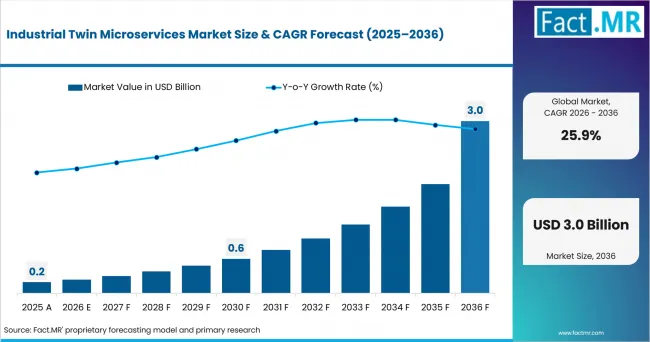
Industrial Twin Microservices Market Market Value Analysis | Source: Fact.MR
What are the defining numbers behind industrial twin microservices growth?
USD 2.7 billion absolute opportunity by 2036, led by South Korea and China.
- Demand Drivers in the Market
- Factory software teams need reusable twin functions instead of one-off visualization builds.
- Robot simulation teams need virtual test spaces before real equipment moves on the floor.
- System integrators need data federation that connects engineering models with sensor records.
- Enterprise developers need cloud APIs that shorten twin application assembly across plants.
- Key Segments Analyzed
- By Service Layer: Simulation Services are expected to hold 32.0% share in 2026 because buyers need scenario testing before site changes.
- By Deployment: Cloud APIs are projected to account for 38.0% share in 2026 as developers prefer managed endpoints.
- By Use Case: Industrial Twins are forecast to capture 36.0% share in 2026 because equipment, facility and process visibility sit in one use case.
- By Industry Vertical: Manufacturing is expected to hold 42.0% share in 2026 as plants have the clearest need for sensor feeds and production layouts.
- By Buyer Type: Independent software vendors are likely to account for 33.0% share in 2026 as they embed twin features into industrial software products.
- By Geography: South Korea is projected to record 31.8% CAGR through 2036 due to robot density and factory software readiness.
- Analyst Opinion at Fact.MR
- Shambhu Nath Jha, Senior Analyst at Fact.MR, states, “Industrial twins are being rebuilt as software services. I see plant teams asking for rendering, simulation and data connection that their developers can call directly. Providers that combine industrial context with usable APIs are likely to enter more factory software roadmaps.”
- Strategic Implications
- Cloud providers should package plant data connectors and rendering endpoints for industrial developers.
- Simulation vendors need reusable service layers that support robot and factory test workflows.
- Industrial Original Equipment Manufacturers should expose equipment data in formats that twin microservices can ingest.
- System integrators need security review templates before twin services enter production networks.
Industrial twin microservices form a sub-layer of industrial digital twin software. The National Institute of Standards and Technology reported in January 2025 that digital twin workshops were focused on standards and infrastructure for digital twin ecosystems. This supports demand for smaller service blocks that can be tested, connected and governed before wider deployment.
South Korea is projected to record 31.8% CAGR through 2036 due to robot density and factory software readiness. China is expected to expand at 31.0% CAGR because industrial users need faster plant simulation and asset ingestion. India is forecast to grow at 30.4% CAGR as enterprise developers build more factory apps. The United States is expected to advance at 29.1% CAGR through 2036 due to cloud platform strength.
How does the industrial twin microservices market break down by segment?
Simulation Services lead at 32.0%; Cloud APIs lead at 38.0%.
Which service layer dominates?
Simulation Services lead with 32.0% share in 2026.
Simulation Services lead because buyers need to test layout changes, robot routes and process flow before plant changes. Virtual launch work also connects with digital twin commissioning cells where controls teams validate behavior before installation. The service layer mix favors suppliers that expose functions through application programming interfaces and software kits.
Which deployment model dominates?
Cloud APIs hold 38.0% share in 2026.
Cloud APIs lead because independent software vendors and enterprise developers prefer hosted endpoints. Eurostat, the statistical office of the European Union, reported in January 2026 that 52.74% of European Union enterprises used paid cloud computing services in 2025. Edge microservices remain important where response time and data residency shape plant architecture. Factory buyers also compare cloud services with edge computing infrastructure when latency or local control rules limit cloud-only deployment.
Which use case dominates?
Industrial Twins account for 36.0% share in 2026.
Industrial Twins lead because they combine equipment, facility and process visibility in one use case. Adjacent Fact.MR research on digital twin platforms shows how twin budgets are shifting toward operating layers and live system context. Robot simulation and factory simulation follow because teams need safer test spaces before deployment.
Which industry vertical dominates?
Manufacturing holds 42.0% share in 2026.
Manufacturing leads because plants have the clearest need for sensor feeds, equipment models and production layouts. The International Federation of Robotics reported in September 2025 that 542,000 industrial robots were installed worldwide in 2024. This installed base creates more need for simulation, visualization and robot route testing. The same buyer logic connects with industrial automation control systems because control data becomes more useful once software teams can reuse it in twin services.
Which buyer type dominates?
Independent software vendors lead with 33.0% share in 2026.
Independent software vendors lead because they embed twin functions inside maintenance, simulation and control products. Industrial Original Equipment Manufacturers are the next buyer group because equipment makers use twin services to support remote diagnostics and commissioning. System integrators buy when they need connectors and deployment support for customer projects.
What is accelerating industrial twin microservices adoption, and what is holding it back?
Reusable twin functions, robot simulation before rollout and cloud API buying drive it, while data model mismatch and security review delays restrain it.
Drivers Impact Analysis
| DRIVER | (~) % IMPACT ON CAGR |
GEOGRAPHIC RELEVANCE | IMPACT TIMELINE |
|---|---|---|---|
| Factory app modularization | +6.4% | Global | Short term |
| Robot simulation before rollout | +5.9% | South Korea, China and United States | Medium term |
| Cloud API buying by developers | +5.5% | United States and Europe | Short term |
| Plant data federation needs | +5.1% | Germany and Japan | Medium term |
| Edge service deployment packs | +4.6% | South Korea, Japan and Germany | Long term |
Source: Fact.MR analysis. Updated Jul 2, 2026
- Factory app modularization
- Industrial teams are breaking twin projects into smaller software services. This reduces the approval burden for new applications. Eurostat reported in June 2026 that 63% of European Union enterprises used artificial intelligence, sophisticated or intermediate cloud computing services or data analytics in 2025. That base supports software teams that can reuse twin functions across sites.
- Robot simulation before rollout
- Robot projects need virtual testing before facility release. The buyer problem extends beyond visualization. Teams need scene data, motion checks and control context. The same use case connects with 3D machine vision as factories add depth data to inspection and robot guidance. Factory developers also compare twin services with robot control systems when simulation must reflect how real machines execute commands.
- Cloud API buying by developers
- Enterprise developers prefer managed endpoints because internal teams can test a service without buying a full twin suite. That pattern shifts supplier selection toward providers with clear documentation, stable interfaces and deployment support. Cloud API buying also helps smaller application teams add twin functions without running a complete platform stack.
Opportunity Impact Analysis
| OPPORTUNITY | (~) % IMPACT ON CAGR |
GEOGRAPHIC RELEVANCE | IMPACT TIMELINE |
|---|---|---|---|
| Twin service marketplaces | +5.8% | United States and Europe | Medium term |
| Edge deployment packs | +5.0% | Germany, Japan and South Korea | Medium term |
| Robot fleet test libraries | +4.8% | China and South Korea | Short term |
| Asset ingestion automation | +4.2% | Global | Long term |
| Infrastructure twin extensions | +3.9% | France and United States | Long term |
Source: Fact.MR analysis. Updated Jul 2, 2026
- Twin service marketplaces
- Software suppliers can package rendering, simulation and federation as callable services. This gives independent software vendors a way to add twin features without building the whole stack. Marketplace access also helps buyers compare pricing, service limits and documentation before pilot approval.
- Edge deployment packs
- Factories with latency limits need twin services that run near equipment. Edge packs can include local rendering, event filtering and asset ingestion. This opportunity connects with factory floor edge AI industrial PCs when plants keep simulation and inspection close to equipment.
- Robot fleet test libraries
- Robot fleets need reusable scene and motion libraries because every new workflow cannot start from zero. NVIDIA describes Omniverse as a collection of libraries and microservices for industrial digital twins and robotics simulation applications. That service structure gives suppliers a way to package test assets for repeated robot programs. Robot libraries also connect with synthetic data generation when camera data is limited during early testing.
Restraints Impact Analysis
| RESTRAINT | (~) % IMPACT ON CAGR |
GEOGRAPHIC RELEVANCE | IMPACT TIMELINE |
|---|---|---|---|
| Data model mismatch | -4.6% | Global | Short term |
| Security review delays | -3.9% | United States and Europe | Medium term |
| graphics processing unit and cloud cost exposure | -3.3% | Global | Medium term |
| Twin ownership ambiguity | -2.8% | Industrial sites | Long term |
| Legacy system integration | -2.5% | Manufacturing-heavy markets | Long term |
Source: Fact.MR analysis. Updated Jul 2, 2026
- Data model mismatch
- Industrial assets often use different naming, geometry and sensor structures. A microservice cannot add value if it cannot read the plant context. This slows adoption when facilities have old control systems and incomplete asset records. Suppliers need stronger ingestion templates to reduce this barrier.
- Security review delays
- Factory networks require careful review before cloud or edge services enter production systems. Security teams check identity control, data movement and supplier access before approving deployment. This can delay a pilot even when the technical case is clear. Providers that document data boundaries earlier can shorten approval cycles.
- graphics processing unit and cloud cost exposure
- Rendering and simulation services can carry high compute costs when scenes are large or users stream many sessions. Buyers may restrict usage until they understand service limits and pricing. This restraint is strongest where industrial teams need predictable budgets before expanding a twin service across sites.
Which countries are scaling industrial twin microservices fastest?
South Korea 31.8% CAGR; China 31.0% CAGR; India 30.4% CAGR; United States 29.1% CAGR; Germany 28.2% CAGR; Japan 27.4% CAGR; France 26.8% CAGR.
Based on regional analysis, the industrial twin microservices market is segmented into North America, Europe, East Asia, South Asia and Pacific, Latin America, and Middle East and Africa.
| Country | CAGR |
|---|---|
| South Korea | 31.8% |
| China | 31.0% |
| India | 30.4% |
| United States | 29.1% |
| Germany | 28.2% |
| Japan | 27.4% |
| France | 26.8% |
Source: Fact.MR analysis. Updated Jul 2, 2026
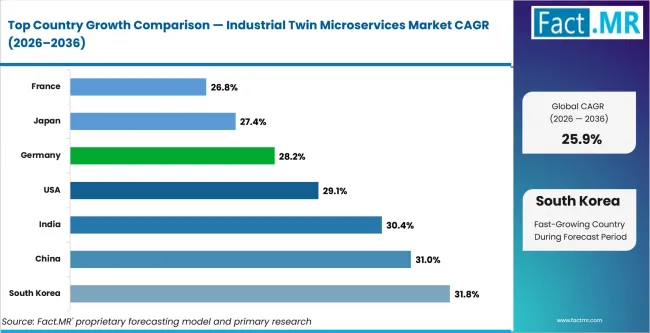
Industrial Twin Microservices Market Cagr Analysis By Country | Source: Fact.MR
What is powering South Korea’s lead?
31.8% CAGR, supported by robot density and factory software readiness.
South Korea has a concentrated manufacturing base with heavy exposure to electronics, batteries and robotics. South Korea is projected to record a 31.8% CAGR through 2036 due to robot density and factory software readiness. Buyers need twin services that test robot motion and facility changes before equipment reaches the floor. Suppliers with robot simulation libraries and local integration partners are better placed here.
How is China scaling demand?
31.0% CAGR, backed by industrial software expansion and factory simulation demand.
Chinese factories are scaling automation and industrial software at the same time. China is expected to expand at 31.0% CAGR through 2036 because industrial users need faster plant simulation and asset ingestion. Domestic original equipment manufacturers and system integrators can reuse twin microservices across repeated factory projects. Growth is constrained where data models differ between plants and suppliers.
What supports India’s outlook?
30.4% CAGR, supported by enterprise developer demand and factory app creation.
Indian enterprise developers are building more plant applications for manufacturers and logistics operators. India is forecast to grow at 30.4% CAGR through 2036 as enterprise developers build more factory apps. Buyers compare integration effort, cloud cost and local support before moving beyond pilots. The country offers room for suppliers that package lower-complexity application programming interfaces for system integrators.
Why is the United States a core buyer base?
29.1% CAGR, driven by cloud platform strength and industrial software depth.
United States buyers evaluate supplier documentation and ecosystem depth before selecting twin services. The United States is expected to advance at 29.1% CAGR through 2036 due to cloud platform strength. Microsoft describes Azure Digital Twins as a platform-as-a-service offering for twin graphs of whole environments. Suppliers win when they pair developer services with industrial account access.
What underpins Germany’s growth?
28.2% CAGR, led by factory software quality and automation engineering needs.
Germany’s manufacturing base places high weight on engineering evidence and secure deployment. Germany is projected to rise at 28.2% CAGR through 2036 because machinery and automotive plants use simulation before site changes. Siemens unveiled industrial AI and digital twin technology at CES 2025. Buyer decisions favor providers that connect twin services with established automation workflows.
Why does Japan remain important?
27.4% CAGR, supported by robotics suppliers and precision manufacturing workflows.
Japan has a deep robotics and precision manufacturing base that suits simulation-led twin services. Japan is forecast at 27.4% CAGR through 2036 because robotics suppliers need repeatable validation before customer deployment. Buyers favor stable software behavior and proven integration with shop-floor systems. Faster adoption depends on reducing setup effort for smaller factories.
How does France fit the European opportunity?
26.8% CAGR, driven by industrial software users and infrastructure twin extensions.
France combines industrial software demand with infrastructure and energy use cases. France is expected to post 26.8% CAGR through 2036 as factory and infrastructure teams test more twin services. Bentley’s iTwin Platform is positioned as application programming interfaces and services for infrastructure twins. This creates a channel opportunity for suppliers that bridge factory assets and infrastructure data.
Who leads the industrial twin microservices landscape?
NVIDIA, Siemens, Microsoft and Amazon Web Services lead through libraries, platforms and cloud account access.
Industrial twin microservices are used by software teams, industrial original equipment manufacturers and system integrators that need callable functions for twin applications. NVIDIA provides Omniverse libraries and microservices for physical AI development. Siemens connects industrial software and digital twin tools through Xcelerator. Microsoft supports twin graphs through Azure Digital Twins. Amazon Web Services supports operational twins through IoT TwinMaker. Dassault Systèmes and Bentley Systems add visualization, virtual twin and infrastructure context.
Competition through 2036 is expected to depend on application programming interface quality, simulation fidelity and access to industrial customers. Suppliers that help plants connect engineering data, control data and 3D scenes are likely to hold stronger account positions.
Infrastructure and logistics use cases broaden the competitive field. Factory twin services connect with factory robot planning when robot routes are tested before floor release. Warehouse and distribution users also create pull-through for logistics automation because facility views and equipment status need shared context.
Which companies are the key players?
NVIDIA, Siemens, Microsoft, Amazon Web Services, Dassault Systèmes, Synopsys/Ansys and Bentley Systems.
- NVIDIA
- Siemens
- Microsoft
- Amazon Web Services
- Dassault Systèmes
- Synopsys/Ansys
- Bentley Systems
Bibliography
- International Federation of Robotics. (2025, September 25). World Robotics 2025 report: Industrial robots.
- Eurostat. (2026, January 13). Cloud computing: Statistics on the use by enterprises.
- Eurostat. (2026, June). Towards Digital Decade targets for Europe.
- National Institute of Standards and Technology. (2025, January 1). NIST hosts second stakeholder workshop on digital twins.
- National Institute of Standards and Technology. (2024, September 24). Manufacturing digital twin standards.
- NVIDIA Corporation. (2026). Develop physical AI applications with NVIDIA Omniverse.
- NVIDIA Corporation. (2025, March 18). NVIDIA Omniverse physical AI operating system expands to more industries and partners.
- Siemens AG. (2025, January 6). Siemens unveils breakthrough innovations in industrial AI and digital twin technology at CES 2025.
- Siemens AG. (2026, January 6). Siemens unveils technologies to accelerate the industrial AI revolution at CES 2026.
- Microsoft Corporation. (2025, January 28). What is Azure Digital Twins?
- Bentley Systems, Incorporated. (2026). iTwin Platform.
This Report Addresses
- Strategic intelligence on industrial twin microservices across service layer, deployment, use case and buyer type.
- Segment analysis covering Simulation Services, Cloud APIs, Industrial Twins, Manufacturing and Independent Software Vendors.
- Regional outlook covering South Korea, China, India, United States, Germany, Japan and France.
- Competitive analysis of NVIDIA, Siemens, Microsoft, Amazon Web Services, Dassault Systèmes, Synopsys/Ansys and Bentley Systems.
- Service assessment covering rendering services, simulation services, data federation, spatial streaming and asset ingestion.
- Deployment assessment covering cloud APIs, edge microservices, hybrid deployment and containerized services.
- Primary interviews, provider checks, official source review and market value validation support the forecast.
What does the industrial twin microservices market cover?
Callable rendering, simulation and data services used to build industrial twins.
The industrial twin microservices market covers libraries, application programming interfaces and managed services used to build or extend industrial twins. It includes rendering services, simulation services, data federation, spatial streaming and asset ingestion. The market differs from complete twin platforms because the service focus is modular delivery and developer reuse.
What is included in the scope?
Rendering services, simulation services and plant data connection services.
The scope includes rendering services that support industrial scenes and facility views. It covers simulation services for robot routes, factory flow and facility changes. It also includes data federation, spatial streaming and asset ingestion when these services are sold as callable functions for industrial twin applications.
What is excluded from the scope?
Full software suites and hardware sales without separately priced twin microservices.
The scope excludes full industrial software suites unless revenue is tied to separately priced twin microservices. It excludes general cloud hosting without twin functions. It excludes consulting-only twin strategy work when no reusable service layer is delivered. It also excludes consumer virtual world tools unless they serve industrial asset or factory use cases.
How was the analysis built?
100+ sources. 40+ company portfolios. 25+ countries. 20+ interviews.
- Primary Research: Primary research includes interviews with industrial software buyers and cloud architects. It includes inputs from system integrators, manufacturing automation teams and enterprise developers that build plant software.
- Desk Research: Desk research reviews robotics data, cloud service use and digital twin standards sources. It covers official company portfolios and active service models across rendering, simulation and industrial data connection.
- Market-Sizing and Forecasting: Forecasting uses the 2025 and 2026 market value anchors. The model reconciles those values against automation intensity and cloud service use. Active industrial software portfolios and twin microservice availability shape the forecast.
- Data Validation and Update Cycle: Forecasts are validated through provider portfolio checks and service-launch evidence.
Segmentation
What is the report’s scope and coverage?
| Attribute | Details |
|---|---|
| Quantitative Units | USD Billion in 2026 to USD Billion by 2036 at CAGR |
| Market Definition | Callable rendering, simulation, data federation, spatial streaming and asset ingestion services used in industrial twins |
| Service Layer | Rendering Services, Simulation Services, Data Federation, Spatial Streaming, Asset Ingestion |
| Deployment | Cloud APIs, Edge Microservices, Hybrid Deployment, Containerized Services |
| Use Case | Industrial Twins, Robot Simulation, Factory Simulation, Facility Visualization |
| Industry Vertical | Manufacturing, Logistics, Energy, Automotive, Infrastructure |
| Buyer Type | Independent Software Vendors, Industrial Original Equipment Manufacturers, System Integrators, Enterprise Developers |
| Regions Covered | North America, Europe, East Asia, South Asia and Pacific, Latin America, Middle East and Africa |
| Countries Covered | South Korea, China, India, United States, Germany, Japan, France |
| Key Companies Profiled | NVIDIA, Siemens, Microsoft, Amazon Web Services, Dassault Systèmes, Synopsys/Ansys and Bentley Systems |
| Forecast Period | 2026 to 2036 |
| Approach | Hybrid top-down and bottom-up approach using market value anchors, service portfolio checks, cloud adoption signals and provider validation |
Source: Fact.MR analysis. Updated Jul 2, 2026
How is the market segmented?
-
By Service Layer:
- Rendering Services
- Simulation Services
- Data Federation
- Spatial Streaming
- Asset Ingestion
-
By Deployment:
- Cloud APIs
- Edge Microservices
- Hybrid Deployment
- Containerized Services
-
By Use Case:
- Industrial Twins
- Robot Simulation
- Factory Simulation
- Facility Visualization
-
By Industry Vertical:
- Manufacturing
- Logistics
- Energy
- Automotive
- Infrastructure
-
By Buyer Type:
- Independent Software Vendors
- Industrial Original Equipment Manufacturers
- System Integrators
- Enterprise Developers
-
By Region:
- North America
- United States
- Canada
- Mexico
- Latin America
- Brazil
- Argentina
- Rest of Latin America
- Europe
- Germany
- United Kingdom
- France
- Italy
- Spain
- Rest of Europe
- Asia Pacific
- China
- India
- Japan
- South Korea
- ASEAN
- Middle East & Africa
- GCC Countries
- South Africa
- UAE
- Rest of Middle East & Africa
- North America
Frequently Asked Questions
Which service layer leads the Industrial Twin Microservices Market?
Which deployment model leads the Industrial Twin Microservices Market?
How large is the Industrial Twin Microservices Market in 2026?
What is the 2036 forecast for the Industrial Twin Microservices Market?
Which country expands fastest in the Industrial Twin Microservices Market?
How does China perform in the Industrial Twin Microservices Market?
Who are the main competitors in the Industrial Twin Microservices Market?
What is the primary driver in the Industrial Twin Microservices Market?
What is the main restraint in the Industrial Twin Microservices Market?
Who worked on this report


Preview the report firsthand - request a free sample
Free SampleGet the brochure for pricing and purchase details
Download PDF