- Market Value (2025): USD 489.3 Mn
- Estimated Value (2026): USD 300.0 Mn
- Forecast Value (2036): USD 1465.9 Mn
- CAGR (2026-2036): 10.5%
Instantized Functional Protein Blends Market Forecast and Outlook 2026 to 2036
The instantized functional protein blends market was valued at approximately USD 489.3 million in 2025 and USD 300.0 million in 2026. It is projected to reach USD 1465.9 million by 2036, registering a 10.5% CAGR during the 2026–2036 assessment period.
Consumers are adding protein to everyday foods such as shakes, coffee and oats, increasing interest in powders that mix smoothly without clumping. Agglomeration and lecithin coating help whey, casein, pea and soy blends disperse quickly in different applications. In 2026, nutrition brands are placing greater emphasis on protein intake for people using GLP-1 weight-loss medicines, particularly to help preserve muscle mass. This shift is creating new opportunities for instantized functional protein blends across everyday nutrition products.
Key Takeaways from the Instantized Functional Protein Blends Market
- Sales of instantized functional protein blends stood at USD 489.3 million in 2025
- Instantized Functional Protein Blends Market Value (2026): USD 300.0 million
- Instantized Functional Protein Blends Market Forecast Value (2036): USD 1465.9 million
- Instantized Functional Protein Blends Market Forecast CAGR (2026-2036): 10.5%
- Leading Protein blend source: Whey (24.6%)
- Key Market Participants: Arla Foods Ingredients, Glanbia Nutritionals, Fonterra; Kerry Group; Roquette; Ingredion
- Key Growth Regions: United States, India, China; New Zealand; Germany
Fonterra’s 2025 agreement to sell its consumer brands business to Lactalis marked a shift toward dairy ingredients and food service, including protein-based solutions. This strategic move highlights the interest of major dairy groups in higher-value ingredient categories. Glanbia Nutritionals, Arla Foods Ingredients and Fonterra are strengthening their presence in instant whey and blended protein systems, targeting food and nutrition manufacturers seeking convenient; easy-to-use formulations.
Instantized Functional Protein Blends Market
| Metric | Value |
|---|---|
| Estimated Value in (2025) | USD 489.3 million |
| Estimated Value in (2026) | USD 300.0 million |
| Forecast Value in (2036) | USD 1465.9 million |
| Forecast CAGR (2026 to 2036) | 10.5% |
Source: Fact.MR analysis. Updated Nov 19, 2026
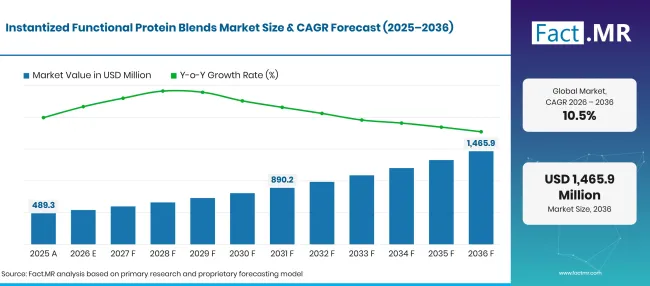
Instantized Functional Protein Blends Forecast Global | Source: Fact.MR
Category
| Category | Segments |
|---|---|
| Protein blend source | Whey, Casein, Pea; Soy; Mixed protein |
| Commercial form | Powder, Liquid concentrate, Granulate; Encapsulated bead; Ready-to-use premix |
| Food application | Bakery, Dairy / alternatives, Beverage; Meat / savory; Confectionery / snacks |
| Primary function | Shelf-life, Texture / rheology, Taste / color; Nutritional functionality; Processing stability |
| Region | United States; India; China; New Zealand; Germany |
Source: Fact.MR analysis. Updated Nov 19, 2026
Segmental Analysis
Why does Whey lead source demand in the Instantized Functional Protein Blends Market?
Whey holds a 24.6% revenue share in 2026, valued at approximately USD 73.8 million. Its complete essential amino acid profile and high leucine content make it a preferred ingredient in sports nutrition, recovery products and protein-fortified foods. Mixed protein and soy blends serve buyers seeking alternative formulations. The FSSAI's May 2025 dairy standards also specify composition requirements for whey powder, reinforcing the importance of ingredient quality and consistency in commercial applications.
Why does Powder lead commercial-form demand in the Instantized Functional Protein Blends Market?
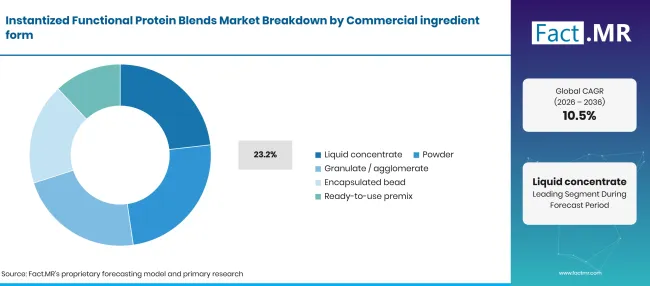
Instantized Functional Protein Blends Breakdown Commercial Ingredient Form | Source: Fact.MR
Powder captures 23.2% of market revenue in 2026, equivalent to around USD 91.8 million. Its suitability for bulk food manufacturing, retail tubs and single-use sachets gives it a wider range of applications than encapsulated formats. Manufacturers also find powder convenient to incorporate into existing production lines. A February 2026 study in npj Science of Food examined protein solubility as a key consideration in food formulation, highlighting why better dispersion remains important when developing instantized powder blends.
Why does Meat / savory lead application demand in the Instantized Functional Protein Blends Market?
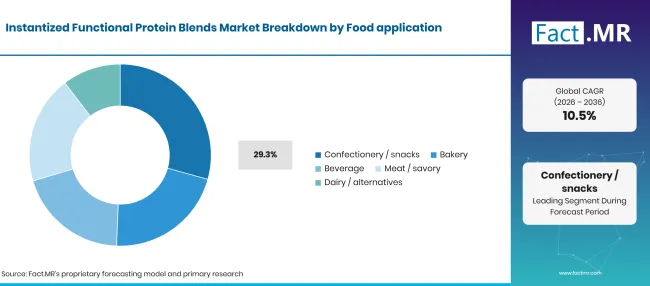
Instantized Functional Protein Blends Breakdown Food Application | Source: Fact.MR
Meat / savory applications account for 29.3% of revenue in 2026, reaching approximately USD 76.2 million. Protein blends are finding use in soups, sauces, meat preparations and plant-based alternatives; where nutritional enrichment must work alongside flavour and texture. Bakery and snacks follow closely as manufacturers explore protein fortification across everyday food categories. India's Economic Survey 2025–26 highlights the contribution of meat, poultry, fish and seafood to dietary protein intake; adding context to the importance of protein-rich savory food applications.
Why does Nutritional functionality lead function demand in the Instantized Functional Protein Blends Market?
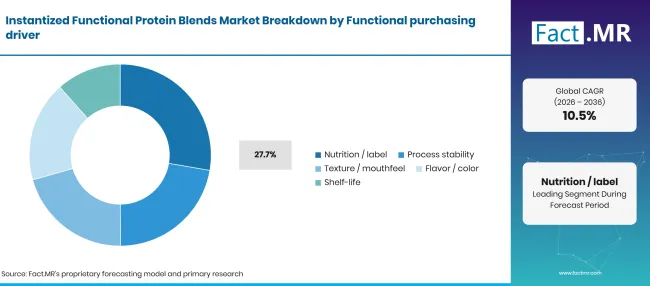
Instantized Functional Protein Blends Breakdown Functional Purchasing Driver | Source: Fact.MR
Nutritional functionality commands 27.7% of revenue in 2026, amounting to approximately USD 84.6 million. Protein concentration and essential amino acid composition carry greater weight in purchasing decisions than secondary attributes such as texture and taste. This makes nutritional value the central selling point for functional blends used in fortified foods and dietary products. The 2025–2030 US Dietary Guidelines scientific report, published in January 2026, also identifies essential amino acid composition and bioavailability as key measures of protein quality.
Instantized Functional Protein Blends Market-Drivers, Restraints & Trends
Driver
Rising Need for Protein Across Age Groups: The need for higher protein intake is extending beyond sports nutrition to older adults, weight-management consumers and people using GLP-1 medications. Appetite reduction during GLP-1 treatment can make it harder to meet daily protein needs, while aging consumers are paying closer attention to muscle maintenance. This overlap is widening the market for functional blends that combine protein quality with convenient preparation.
Restraint
Raw Material Price Volatility and Beverage Competition: Unstable whey prices make cost planning difficult for blend manufacturers, particularly when dairy ingredients account for a substantial part of formulation expenses. Smaller processors face additional pressure from limited purchasing power and inconsistent raw material costs. Ready-to-drink protein beverages create another challenge by offering convenience without mixing. These factors can narrow margins and complicate long-term pricing agreements.
Trend
Protein Nutrition for GLP-1 Users: GLP-1 treatments are bringing protein adequacy into sharper focus because reduced appetite can make it difficult to maintain muscle mass during weight loss. A 2026 joint advisory from nutrition organizations highlights adequate protein intake and strength training during GLP-1 treatment. This creates room for the instantized functional protein blends market to serve weight-management nutrition needs.
Trend
Growing Interest in Plant-Dairy Hybrid Blends: Combining dairy and plant proteins is attracting attention as manufacturers look for a balance between amino acid quality, ingredient costs, taste and sustainability. The opportunity lies in developing formulations that accommodate different dietary preferences without compromising nutritional quality or processing performance. Wider adoption across food manufacturing could open new avenues for multi-source protein blends.
Instantized Functional Protein Blends Market by Analysis by Key Country
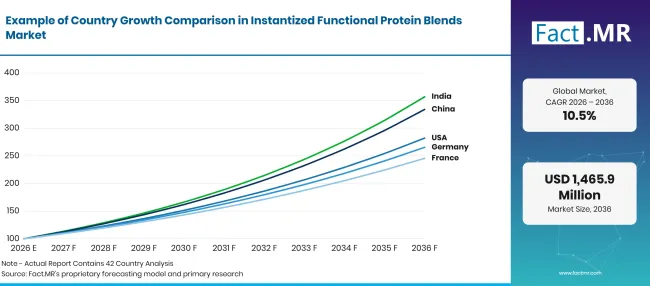
Instantized Functional Protein Blends Growth Index | Source: Fact.MR
| Country | CAGR (2026-2036) |
|---|---|
| United States | 12.0% |
| India | 12.0% |
| China | 11.3%a |
| New Zealand | 9.8% |
| Germany | 9.1% |
Source: Fact.MR analysis. Updated Nov 19, 2026
Why is the United States among the fastest-growing markets for instantized protein blends?
The United States is seeing stronger interest in protein-rich nutrition as consumers pay more attention to muscle preservation, weight management and healthy aging.
The January 2026 Dietary Guidelines for Americans (2025–2030) place greater emphasis on high-quality protein foods across dietary patterns. This creates a favourable environment for functional protein blends used in fortified foods and nutrition products. Sales are also supported by established sports nutrition consumption and demand for convenient protein formats.
What is driving instantized protein blend demand in India?
India's protein nutrition market has room to expand as awareness of balanced diets reaches households beyond urban fitness consumers.
During Rashtriya Poshan Maah in September 2025, the government promoted nutrition literacy and healthier food choices through nationwide community activities. The 2026 Poshan Maah themes also include dietary diversity and adequate protein from plant and animal sources. These initiatives are strengthening awareness, while demand for affordable fortified foods and convenient nutrition formats is creating commercial opportunities for protein blend manufacturers.
What is driving instantized protein blend demand in China?
China's focus on improving everyday dietary quality is creating opportunities for protein ingredient manufacturers.
In March 2025, the Ministry of Agriculture and Rural Affairs, National Health Commission and Ministry of Industry and Information Technology introduced the Food and Nutrition Development Guideline (2025–2030); which calls for higher consumption of protein-rich foods; including dairy; eggs; legumes and seafood. Food fortification, changing eating habits and wider interest in sports nutrition are supporting sales of instantized blends across consumer food applications.
What is shaping instantized protein blend demand in New Zealand?
New Zealand's strong dairy processing base gives protein blend manufacturers access to an important ingredient supply chain.
The Ministry for Primary Industries reported that export revenue from casein and protein products increased 30% in the September 2025 quarter compared with the previous year, driven by higher export volumes. The ministry also projected a 10% increase in annual casein and protein product export revenue to NZD 3.2 billion by June 2026. Dairy processing expertise and international ingredient trade are key sales drivers.
Why is instantized protein blend growth slower in Germany?
Germany's interest in alternative protein sources is opening additional avenues for functional blend manufacturers.
A March 2026 report published in the German Ministry of Agriculture's agricultural policy journal examined the role of alternatives to animal-based foods in sustainable diets. The country's established food processing industry, interest in plant-based nutrition and demand for products with varied protein sources are creating opportunities for hybrid formulations. Sales are being shaped by manufacturers seeking nutritional quality alongside ingredient flexibility and more sustainable food production.
Competitive Landscape for Instantized Functional Protein Blends Market
For instantized protein blends, the 2025 manufacturing agreement between Arla Foods Ingredients and Valley Queen provides a relevant commercial example. The arrangement concerns Nutrilac® ProteinBoost and adds a route for scaling protein ingredients in food applications.
Recent Developments
- For instantized protein blends, the 2025 manufacturing agreement between Arla Foods Ingredients and Valley Queen provides a relevant commercial example. The arrangement concerns Nutrilac® ProteinBoost and adds a route for scaling protein ingredients in food applications.
- In February 2026, Glanbia reported the acquisitions of Sweetmix and Scicore, expanding its global Health & Nutrition business.
- On March 31, 2026, Fonterra completed the sale of its Mainland Group consumer business to Lactalis; allowing it to focus on its core dairy ingredients and foodservice operations.
- Kerry introduced its Smart Taste™ platform in September 2025. For instantized protein blends, taste management remains an important formulation consideration as manufacturers work to incorporate concentrated protein ingredients into consumer products.
- On June 17, 2025, Roquette launched two new plant protein ingredients; NUTRALYS® T WHEAT 600L and NUTRALYS® T PEA 700XC; for high-protein food formulations.
- On May 28, 2026, Ingredion announced a strategic joint venture with Sanstar Limited in India to expand its specialty food and pharmaceutical ingredient business.
Key Players in Instantized Functional Protein Blends Market
Key companies profiled include Arla Foods Ingredients; Glanbia Nutritionals; Fonterra; Kerry Group; Roquette; and Ingredion.
- Arla Foods Ingredients
- Glanbia Nutritionals
- Fonterra
- Kerry Group
- Roquette
- Ingredion
Bibliography
- Cao, R., Wang; W.; Zhang; Z.; Wang; C.; Huang; Q.; Yan; L.; Zhang; J.; & Cheng; J. (2026). Strategies for enhancing protein solubility: Methods, applications, and prospects. npj Science of Food, 10, Article 86
- China Daily. (2025, March 19). Guideline aims to promote balanced nutrition, healthier lifestyles. China Government Network. https://english.www.gov.cn/policies/policywatch/202503/19/content_WS67da21e3c6d0868f4e8f0f6b.htmlhttps://english.www.gov.cn/policies/policywatch/202503/19/content_WS67da21e3c6d0868f4e8f0f6b.html
- Government of India, Ministry of Finance, Department of Economic Affairs. (2026). Economic survey 2025–26. https://www.indiabudget.gov.in/economicsurvey/doc/echapter.pdfhttps://www.indiabudget.gov.in/economicsurvey/doc/echapter.pdf
- Ministry for Primary Industries, New Zealand. (2025). Situation and outlook for primary industries: December 2025. https://www.mpi.govt.nz/dmsdocument/70984/directhttps://www.mpi.govt.nz/dmsdocument/70984/direct
- Mozaffarian, D., Agarwal; M.; Aggarwal; M.; Alexander; L.; Apovian; C. M., Bindlish, S.; Bonnet; J.; Butsch; W. S., Christensen, S.; Gianos; E.; Gulati; M.; Gupta; A.; Horn; D.; Kane; R. M., Saluja, J.; Sannidhi; D.; Stanford; F. C., & Callahan, E. A. (2026). Nutritional priorities to support GLP-1 therapy for obesity: A joint advisory from the American College of Lifestyle Medicine, the American Society for Nutrition, the Obesity Medicine Association; and The Obesity Society. Obesity Pillars, 18, Article 100269.
- Press Information Bureau, Government of India. (2025, September 18). Poshan Maah: Building a healthier, stronger nation through nutrition.
- Richter, M., Klug; A.; Breidenassel; C.; Schäfer; A. C., Conrad, J.; & Watzl; B. (2026). Potential contribution of plant-based milk alternatives to the nutrient supply in sustainable diets. Annals of Nutrition and Metabolism, 82(1), 60–61
- U.S. Department of Agriculture. (2026, January 7). Kennedy, Rollins unveil historic reset of U.S. nutrition policy, put real food back at center of health
- U.S. Department of Agriculture, & U.S. Department of Health and Human Services. (2026). The scientific foundation for the Dietary Guidelines for Americans, 2025–2030: Appendices.
Segmentation
Scope of Report
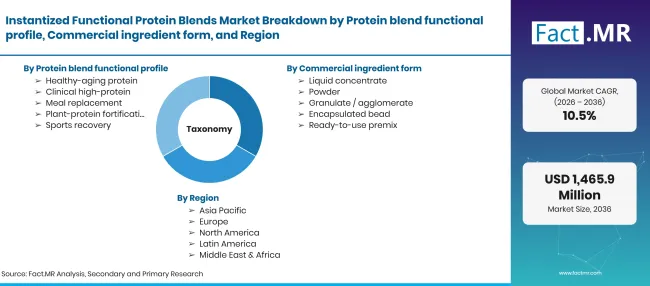
Instantized Functional Protein Blends Taxonomy | Source: Fact.MR
| Items | Values |
|---|---|
| Quantitative Units (2026) | USD 300.0 Million |
| Protein blend source | Whey, Casein, Pea; Soy; Mixed protein |
| Commercial form | Powder, Liquid concentrate, Granulate; Encapsulated bead; Ready-to-use premix |
| Food application | Bakery, Dairy / alternatives, Beverage; Meat / savory; Confectionery / snacks |
| Primary function | Shelf-life, Texture / rheology, Taste / color; Nutritional functionality; Processing stability |
| Regions Covered | North America, Latin America, Europe; East Asia; South Asia and Pacific; Middle East & Africa |
| Countries Covered | United States, India, China; New Zealand; Germany; and other countries |
| Key Companies Profiled | Arla Foods Ingredients, Glanbia Nutritionals, Fonterra; Kerry Group; Roquette; Ingredion |
| Additional Attributes | Dollar revenue in the Instantized Functional Protein Blends Market is segmented by protein blend source (whey, casein, pea; soy; mixed protein); commercial form (powder; liquid concentrate; granulate; encapsulated bead; ready-to-use premix); food application (bakery; dairy / alternatives; beverage; meat / savory; confectionery / snacks); primary function (shelf-life; texture / rheology; taste / color; nutritional functionality; processing stability) and region. |
Source: Fact.MR analysis. Updated Nov 19, 2026
Instantized Functional Protein Blends Market by Segments
-
Protein blend source
- Whey
- Casein
- Pea
- Soy
- Mixed protein
-
Commercial form
- Powder
- Liquid concentrate
- Granulate
- Encapsulated bead
- Ready-to-use premix
-
Food application
- Bakery
- Dairy / alternatives
- Beverage
- Meat / savory
- Confectionery / snacks
-
Primary function
- Shelf-life
- Texture / rheology
- Taste / color
- Nutritional functionality
- Processing stability
-
Region
- North America
- United States
- Canada
- Mexico
- Europe
- Germany
- United Kingdom
- France
- Italy
- Spain
- Rest of Europe
- Asia Pacific
- China
- India
- Japan
- South Korea
- Australia
- Rest of Asia Pacific
- Latin America
- Brazil
- Mexico
- Argentina
- Rest of Latin America
- Middle East & Africa
- GCC Countries
- South Africa
- Rest of Middle East & Africa
- North America
Frequently Asked Questions
How big is the global Instantized Functional Protein Blends Market in 2026?
What will be the size of the Instantized Functional Protein Blends Market by 2036?
How fast will the Instantized Functional Protein Blends Market grow during the forecast period?
Which protein blend source segment holds the largest share of the Instantized Functional Protein Blends Market?
Who worked on this report


Preview the report firsthand - request a free sample
Free SampleGet the brochure for pricing and purchase details
Download PDF