- Market Value (2025): USD 537.2 Mn
- Estimated Value (2026): USD 300.0 Mn
- Forecast Value (2036): USD 1379.3 Mn
- CAGR (2026-2036): 8.9%
Plant-Based Whipping Agents Market Forecast and Outlook 2026 to 2036
The plant-based whipping agents market was valued at approximately USD 537.2 million in 2025 and USD 300.0 million in 2026. It is projected to reach USD 1379.3 million by 2036, registering a 8.9% CAGR during the 2026–2036 assessment period.
Food manufacturers are turning to plant-based whipping agents to create the texture and volume traditionally achieved with egg whites and dairy cream. Pea, potato, soy; faba and aquafaba-based ingredients are finding applications in vegan toppings; mousses; meringues and foamed beverages; where foam stability is essential. The sharp rise in US egg prices in early 2025, following avian influenza outbreaks, also encouraged bakers to explore alternatives to conventional whipping ingredients. Such disruptions are bringing greater attention to plant-based formulations as food manufacturers look for more flexible ingredient options through 2036.
Key Takeaways from the Plant-Based Whipping Agents Market
- Sales of plant-based whipping agents stood at USD 537.2 million in 2025
- Plant-Based Whipping Agents Market Value (2026): USD 300.0 million
- Plant-Based Whipping Agents Market Forecast Value (2036): USD 1379.3 million
- Plant-Based Whipping Agents Market Forecast CAGR (2026-2036): 8.9%
- Leading Plant whipping base: Pea (29.4%)
- Key Market Participants: Arla Foods Ingredients, Glanbia Nutritionals, Fonterra; Kerry Group; Roquette; Ingredion
- Key Growth Regions: China, United States, United Kingdom; France; Germany
- Ingredient innovation is widening the use of plant proteins in commercial whipping applications.
Avebe's Solanic potato proteins and Roquette's pea proteins, for instance, offer food manufacturers alternatives for creating aerated desserts and stable toppings. Kerry, Roquette and Ingredion are also working across bakery and beverage applications, where texture; taste and whipping performance influence formulation choices. As these ingredients become easier to incorporate into finished products without compromising mouthfeel, more manufacturers can introduce plant-based versions of conventional whipped foods.
Plant-Based Whipping Agents Market
| Metric | Value |
|---|---|
| Estimated Value in (2025) | USD 537.2 million |
| Estimated Value in (2026) | USD 300.0 million |
| Forecast Value in (2036) | USD 1379.3 million |
| Forecast CAGR (2026 to 2036) | 8.9% |
Source: Fact.MR analysis. Updated Nov 19, 2026
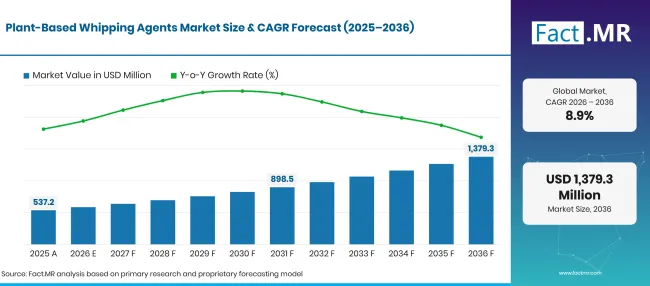
Plant Based Whipping Agents Forecast Global | Source: Fact.MR
Category
| Category | Segments |
| Plant whipping base | Pea, Soy, Faba bean; Potato; Aquafaba / other |
| Commercial form | Powder, Liquid concentrate, Granulate; Encapsulated bead; Ready-to-use premix |
| Food application | Bakery, Dairy / alternatives, Beverage; Meat / savory; Confectionery / snacks |
| Primary function | Shelf-life, Texture / rheology, Taste / color; Nutritional functionality; Processing stability |
| Region | China; United States; United Kingdom; France; Germany |
Source: Fact.MR analysis. Updated Nov 19, 2026
Segmental Analysis
Why does Pea lead base demand in the Plant-Based Whipping Agents Market?
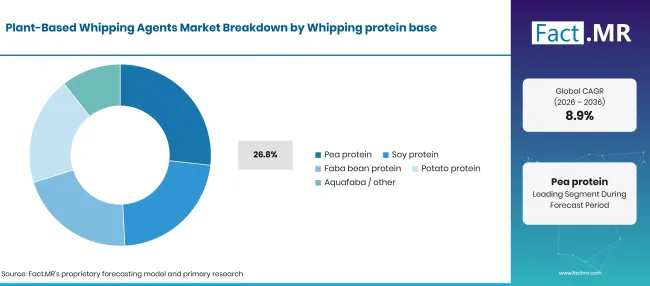
Plant Based Whipping Agents Breakdown Whipping Protein Base | Source: Fact.MR
Pea protein holds a 26.8% revenue share in 2026, equivalent to USD 88.2 million, supported by its availability; neutral formulation potential and ability to create aerated food textures. Potato protein and aquafaba offer alternatives, but pea-based ingredients have wider formulation applications across desserts and toppings. The allergen profile also matters: the FDA's January 2025 guidance identifies nine major food allergens, including soy but not pea. pea proteins still need appropriate allergen assessment and labelling.
Why do Liquid concentrates lead commercial-form demand in the Plant-Based Whipping Agents Market?
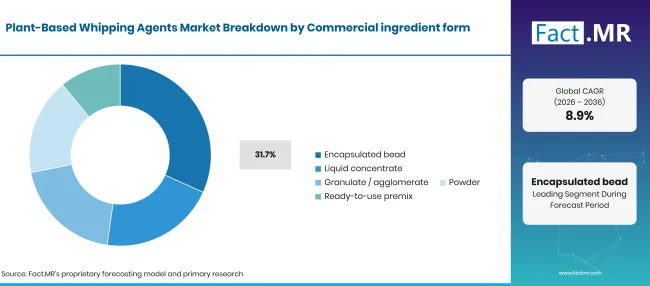
Plant Based Whipping Agents Breakdown Commercial Ingredient Form | Source: Fact.MR
Liquid concentrates capture 31.7% of the market in 2026, valued at USD 69.0 million. Their pourable format suits foodservice kitchens, beverage counters and commercial bakeries that prepare whipped toppings in batches or immediately before serving. Unlike powders, liquid systems avoid a separate hydration step, making preparation more convenient in high-volume operations. Powdered ingredients continue to serve dry bakery mixes and longer-storage formulations. The FDA's January 2025 allergen guidance also highlights the importance of ingredient identification in packaged food formulations.
Why does Meat / savory lead application demand in the Plant-Based Whipping Agents Market?
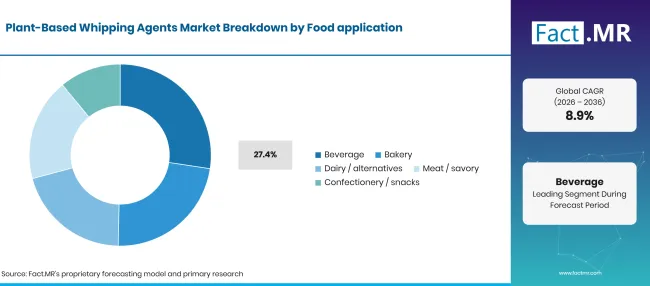
Plant Based Whipping Agents Breakdown Food Application | Source: Fact.MR
Meat and savory applications account for 27.4% of revenue in 2026, reaching USD 84.3 million. Manufacturers use whipping proteins to improve air incorporation, binding and texture in plant-based meat preparations, savory mousses and formulated fillings. Beverages and desserts also use these ingredients, although savory formulations create additional opportunities for protein functionality beyond conventional toppings. In 2025, USDA's National Agricultural Library listed a research project on improving pulse-based meat alternatives through protein pre-processing, highlighting continued technical work in this application area.
Why does Texture / rheology lead function demand in the Plant-Based Whipping Agents Market?
Plant Based Whipping Agents Breakdown Whipping Protein Base | Source: Fact.MR
Texture and rheology represent 26.8% of market revenue in 2026, equivalent to USD 76.8 million. Food manufacturers focus on foam volume, air retention and structural stability because these properties determine whether plant-based toppings and desserts can match conventional whipped products. Taste and nutritional enhancement serve as additional formulation objectives. A 2025 study indexed by FAO AGRIS examined foaming capacity, foam stability, viscosity and other functional properties of commercial plant proteins; including pea and chickpea preparations. Such research highlights why functional performance remains central to ingredient selection.
Plant-Based Whipping Agents Market-Drivers, Restraints & Trends
Drivers
Expansion of Plant-Based Bakery and Beverage Applications: Plant-based whipping agents are gaining commercial attention as bakeries, cafés and dessert manufacturers introduce egg-free and dairy-free menu options. Their ability to create aerated toppings, creamy fillings and stable dessert textures makes them useful across several food categories. The Good Food Institute reported growth in US plant-based baked goods and desserts in 2025. This wider acceptance creates opportunities for whipping ingredients that deliver the texture consumers associate with conventional formulations.
Restraints
Flavor and Formulation Limitations: Beany aftertastes, inconsistent foam formation and higher formulation costs can make plant-based whipping agents difficult to adopt in price-sensitive food applications. Some proteins also struggle to maintain volume and stability after processing or storage. Manufacturers may need additional masking ingredients or blending techniques, increasing formulation complexity. These limitations can affect finished-product quality and discourage food businesses from replacing conventional whipping ingredients entirely.
Trend
Egg-White Replacement in Bakery Formulations: The sharp increase in egg prices during 2025 brought greater attention to alternatives for meringues, whipped fillings and aerated desserts. USDA reported that avian influenza led to the loss of 50.7 million egg-laying hens between mid-October 2024 and early March 2025. This disruption highlighted the vulnerability of conventional egg-based formulations. Future opportunities lie in plant-derived whipping systems that reproduce egg-white functionality without compromising volume, taste or shelf stability.
Trend
Foamed Toppings for Coffee and Specialty Beverage: Coffee shops are expanding plant-based beverage choices, creating room for dairy-free foams and whipped toppings beyond conventional milk alternatives. The Good Food Institute reported a 16% increase in US foodservice sales of plant-based milk in dollar terms in 2025. This wider acceptance opens opportunities for whipping agents designed for specialty coffee, iced drinks and tea-based refreshments. Future market expansion will depend on foam consistency, taste and compatibility with different beverage bases.
Plant-Based Whipping Agents Market by Analysis by Key Country
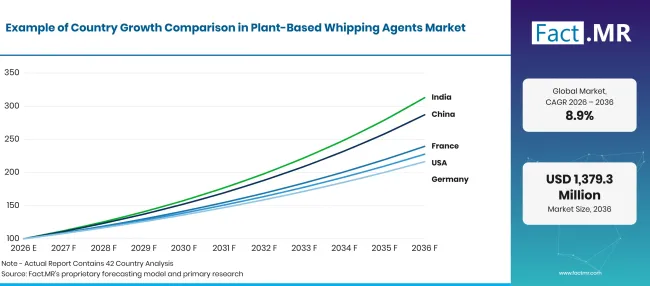
Plant Based Whipping Agents Growth Index | Source: Fact.MR
| Country | CAGR (2026-2036) |
|---|---|
| China | 10.9% |
| United States | 9.4% |
| United Kingdom | 8.9% |
| France | 8.8% |
| Germany | 8.7% |
Source: Fact.MR analysis. Updated Nov 19, 2026
Why is China the fastest-growing market for plant-based whipping agents?
China's plant-based whipping agents market is set to expand at a CAGR of 10.9% during 2026–2036.
Food innovation and interest in diversified protein sources are creating opportunities for plant-derived ingredients across processed foods and beverages. In February 2025, China's Ministry of Agriculture and Rural Affairs issued the 2025–2030 Food and Nutrition Development Outline, emphasizing food supply diversification and nutrition-led innovation. Expansion of plant-protein beverages and modern bakery applications should create further sales opportunities.
What is shaping plant-based whipping agent sales in the United States?
At a 9.4% CAGR through 2036, the US market is benefiting from food manufacturers' efforts to reduce dependence on conventional egg-based formulations.
The 2025 avian influenza outbreak caused the loss of 50.7 million egg-laying hens between October 2024 and March 2025, pushing egg prices to record levels. USDA documented the resulting supply disruption in June 2025. Bakery reformulation, dairy-free desserts and specialty beverage applications are creating additional commercial opportunities for plant-based whipping ingredients.
What is shaping plant-based whipping agent demand in the United Kingdom?
Food manufacturers' interest in alternative proteins is strengthening the country's position, with the market registering an 8.9% CAGR over the assessment period.
In June 2025, the UK Government Chemist published a review of sustainable novel food production, examining alternative protein sources and their commercial potential. This research activity, alongside interest in lower-resource food ingredients, is encouraging formulation innovation. Demand from plant-based bakery products, dessert manufacturers and foodservice operators will help widen the application base.
What is shaping plant-based whipping agent demand in France?
France is recording an 8.8% CAGR, supported by national efforts to strengthen plant-protein production and diversify food choices.
In March 2025, ANSES published dietary recommendations for adults following vegetarian diets, including guidance on pulses; grains and plant-based dairy alternatives. The French government's National Food, Nutrition and Climate Strategy, published in February 2026; further reinforces sustainable food priorities. These developments create opportunities for plant-based whipping ingredients in bakery, dessert and institutional foodservice applications.
Why is plant-based whipping agent growth slower in Germany?
Germany's plant-based whipping agents market is advancing at an 8.7% CAGR.
A broad market for meat alternatives, dairy substitutes and plant-based desserts gives ingredient manufacturers several routes to expand their presence. According to Germany's Federal Statistical Office, domestic production of vegetarian and vegan meat alternatives reached 124,900 tonnes in 2025; retaining a substantial industrial processing base despite a slight annual decline. Wider use of plant-based dairy alternatives and bakery formulations is creating opportunities for functional whipping ingredients.
Competitive Landscape for Plant-Based Whipping Agents Market
Competition in the plant-based whipping agents market is divided between dairy-origin ingredient groups and plant ingredient suppliers. Arla Foods Ingredients, Glanbia Nutritionals and Fonterra compete on protein expertise and hybrid systems, while Kerry Group; Roquette and Ingredion compete on plant proteins and texture solutions. Buyers select agents on foam stability, taste, label and price.
From 2025 onward, competition shifted toward egg replacement. Suppliers with clean-tasting, stable whipping systems are best placed to grow.
Recent Developments
- The Arla Foods Ingredients and Valley Queen agreement announced in March 2025 concerns Nutrilac® ProteinBoost production. Its relevance to whipping systems lies in the wider use of functional dairy proteins across formulated food applications.
- In November 2025, Glanbia agreed to acquire Scicore Nutra, an Indian health and nutrition ingredients company; to expand its product portfolio and strengthen its presence in the Indian market.
- Fonterra's 2025 consumer brands transaction with Lactalis formed part of a broader portfolio focus on dairy ingredients and foodservice. The change is relevant to whipping agents through the role of dairy-based functional ingredients in commercial food formulations.
- On June 17, 2025, Kerry Group introduced new textured wheat and pea protein ingredients under its NUTRALYS™ portfolio to help food manufacturers develop nutritious and affordable protein products.
- On October 31, 2025, Roquette launched AMYSTA™ L 123; a label-friendly; thermally soluble pea starch designed for food manufacturers seeking plant-based starch ingredients.
Key Players in Plant-Based Whipping Agents Market
Key companies profiled include Arla Foods Ingredients; Glanbia Nutritionals; Fonterra; Kerry Group; Roquette; and Ingredion.
- Arla Foods Ingredients
- Glanbia Nutritionals
- Fonterra
- Kerry Group
- Roquette
- Ingredion
Bibliography
- Agence nationale de sécurité sanitaire de l'alimentation, de l'environnement et du travail. (2025). Opinion on the establishment of dietary guidelines for people following a diet that excludes some or all foods of animal origin
- Destatis. (2026, May 18). Nach jahrelangem Anstieg: Fleischersatz-Produktion sinkt 2025 um 1,2 % gegenüber dem Vorjahr
- Food and Agriculture Organization of the United Nations. (2025). Plant proteins as alternative natural emulsifiers in food emulsions. FAO AGRIS
- Government Chemist. (2025, June 16). Quantitative review of sustainable novel food production. GOV.UK
- Kaczmarek, D., Pokora-Carzynska; M.; Juszczak; L.; Jamroz; E.; & Kapusniak; J. (2025). Plant proteins as alternative natural emulsifiers in food emulsions. Foods, 14(24), 4291
- Ministry of Agriculture and Rural Affairs of the People's Republic of China. (2025). Outline for food and nutrition development in China (2025–2030). Gazette of the Ministry of Agriculture and Rural Affairs of the People's Republic of China, 5(260).
- Ministère de l'Agriculture, de l'Agro-alimentaire et de la Souveraineté alimentaire. (2026, February 11). Stratégie nationale pour l'alimentation, la nutrition et le climat 2025/2030
- National Agricultural Library. (2025). Enhancing nutrition and safety of extruded pulse-based meat alternatives through protein pre-processing and food side stream integration. U.S. Department of Agriculture.
- U.S. Department of Agriculture, Economic Research Service. (2025, March 17). Livestock, dairy, and poultry outlook: March 2025 (LDP-M-369)
- U.S. Food and Drug Administration. (2025a, January). Guidance for industry: Questions and answers regarding food allergen labeling (Edition 5).
Segmentation
Scope of Report
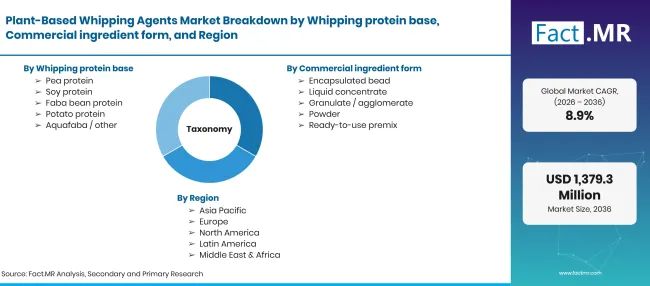
Plant Based Whipping Agents Taxonomy | Source: Fact.MR
| Items | Values |
|---|---|
| Quantitative Units (2026) | USD 300.0 Million |
| Plant whipping base | Pea, Soy, Faba bean; Potato; Aquafaba / other |
| Commercial form | Powder, Liquid concentrate, Granulate; Encapsulated bead; Ready-to-use premix |
| Food application | Bakery, Dairy / alternatives, Beverage; Meat / savory; Confectionery / snacks |
| Primary function | Shelf-life, Texture / rheology, Taste / color; Nutritional functionality; Processing stability |
| Regions Covered | North America, Latin America, Europe; East Asia; South Asia and Pacific; Middle East & Africa |
| Countries Covered | China, United States, United Kingdom; France; Germany; and other countries |
| Key Companies Profiled | Arla Foods Ingredients, Glanbia Nutritionals, Fonterra; Kerry Group; Roquette; Ingredion |
| Additional Attributes | Dollar revenue in the Plant-Based Whipping Agents Market is segmented by plant whipping base (pea, soy, faba bean; potato; aquafaba / other); commercial form (powder; liquid concentrate; granulate; encapsulated bead; ready-to-use premix); food application (bakery; dairy / alternatives; beverage; meat / savory; confectionery / snacks); primary function (shelf-life; texture / rheology; taste / color; nutritional functionality; processing stability) and region. |
Source: Fact.MR analysis. Updated Nov 19, 2026
Plant-Based Whipping Agents Market by Segments
-
Plant whipping base
- Pea
- Soy
- Faba bean
- Potato
- Aquafaba / other
-
Commercial form
- Powder
- Liquid concentrate
- Granulate
- Encapsulated bead
- Ready-to-use premix
-
Food application
- Bakery
- Dairy / alternatives
- Beverage
- Meat / savory
- Confectionery / snacks
-
Primary function
- Shelf-life
- Texture / rheology
- Taste / color
- Nutritional functionality
- Processing stability
-
Region
- North America
- United States
- Canada
- Mexico
- Europe
- Germany
- United Kingdom
- France
- Italy
- Spain
- Rest of Europe
- Asia Pacific
- China
- India
- Japan
- South Korea
- Australia
- Rest of Asia Pacific
- Latin America
- Brazil
- Mexico
- Argentina
- Rest of Latin America
- Middle East & Africa
- GCC Countries
- South Africa
- Rest of Middle East & Africa
- North America
Frequently Asked Questions
How big is the global Plant-Based Whipping Agents Market in 2026?
What will be the size of the Plant-Based Whipping Agents Market by 2036?
How fast will the Plant-Based Whipping Agents Market grow during the forecast period?
Which plant whipping base segment holds the largest share of the Plant-Based Whipping Agents Market?
Who worked on this report


Preview the report firsthand - request a free sample
Free SampleGet the brochure for pricing and purchase details
Download PDF