- Market Value (2025): USD 1.5 Bn
- Estimated Value (2026): USD 1.8 Bn
- Forecast Value (2036): USD 9.1 Bn
- CAGR (2026-2036): 17.9%
What is the Intelligent Healthcare Network Automation Market forecast to be worth by 2036?
USD 1.8 billion in 2026 to USD 9.1 billion by 2036, at 17.9% CAGR.
- The market crossed a valuation of USD 1.5 billion in 2025, supported by hospital spending on connected-care infrastructure, network visibility and stronger security controls.
- Demand is projected to increase from USD 1.8 billion in 2026 to USD 9.1 billion by 2036.
- The market is forecast to record a 17.9% CAGR from 2026 to 2036 as hospitals move selected network tasks from manual review to policy-based automation with human approval and rollback controls.
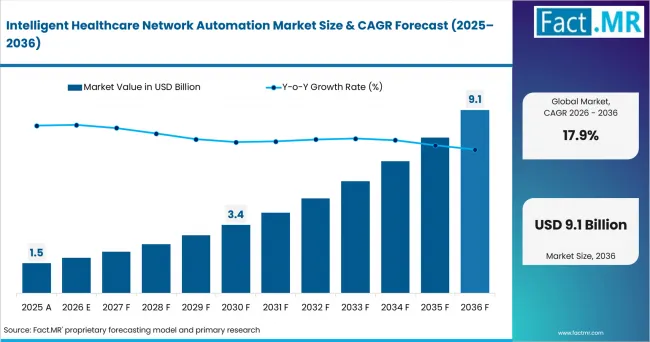
Intelligent Healthcare Network Automation Market Value Analysis | Source: Fact.MR
What are the defining numbers behind Intelligent Healthcare Network Automation Market growth?
The market is expected to create USD 7.3 billion in absolute opportunity by 2036.
- Demand Drivers in the Market
- Hospitals need clear risk records, current technology inventories and network maps so security gaps are easier to identify and address.
- Stronger access controls, encryption, and routine security testing help healthcare network staff protect connected systems and restore operations after an incident.
- Secure change-management processes allow hospitals and connected-care providers to exchange data safely, maintain system compatibility, and keep routers, firewalls, and other network equipment working reliably.
- Key Segments Analyzed
- By Component: Solutions is expected to hold 30.0% share in 2026 supported by demand for network visibility, policy control and automated change management.
- By Deployment Mode: On-premise is projected to account for 30.0% share in 2026 owing to hospital requirements for direct control over sensitive systems and network data.
- By Application: Network Management is anticipated to capture 25.0% share in 2026 due to the need for stable connectivity across clinical devices, applications and hospital infrastructure.
- By End User: Hospitals are estimated to represent 25.0% share in 2026 attributable to large connected-device environments and growing security requirements.
- By Technology: Artificial Intelligence is forecast to hold 30.0% share in 2026 driven by wider use in fault detection, network monitoring and policy-based automation.
- Analyst Opinion at Fact.MR
- Shambhu Nath Jha, Senior Analyst at Fact.MR, states, “Hospitals are looking for network systems that do more than show alerts. These systems must identify connected devices and keep patient-care data away from other network activity. They must also apply security settings and reverse a failed change without stopping care. Companies with clear records on system reliability and security are more likely to pass hospital checks, especially when staff must approve important changes.”
- Strategic Implications
- Keeping clinical systems running is the first test for any automatic network change. Hospitals must identify which systems cannot be stopped. They also record who approves each change and how service is restored when something goes wrong.
- A full device list covers medical equipment, network switches, servers, cloud services, and outside connections. Missing items make it harder for the system to judge whether a routine change could interrupt patient care.
- Clinical, office, research, and building-control systems work best when kept in separate parts of the network. This limits the spread of a security problem or setup error across services used for patient care.
- Automatic fixes must include a safe way to stop and undo a failed change. Hospitals are more likely to choose systems that record every action, pause when staff approval is required, and return the network to its last working state.
How does the Intelligent Healthcare Network Automation Market break down by segment?
Solutions leads at 30.0% by component segment, while On-premise leads at 30.0% by deployment mode segment in 2026.
Why does Solutions lead Component?
Solutions is expected to hold 30.0% share of the Component segment in 2026.
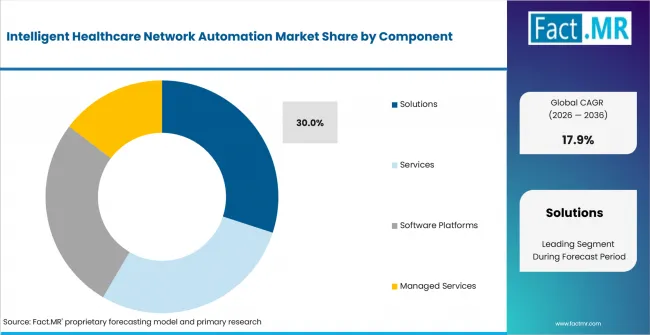
Intelligent Healthcare Network Automation Market Analysis By Component | Source: Fact.MR
Hospitals often prefer one system that can identify connected devices, apply network rules, and respond when something goes wrong. This makes Solutions the largest spending area because these functions support the daily work of hospital network automation. Services help with installation, system changes, and testing. Software Platforms suit hospitals that want to build their own work processes around existing tools. Managed Services help organizations that do not have full-time network staff.
Why does On-premise lead Deployment Mode?
On-premise is projected to account for 30.0% share of Deployment Mode demand in 2026.
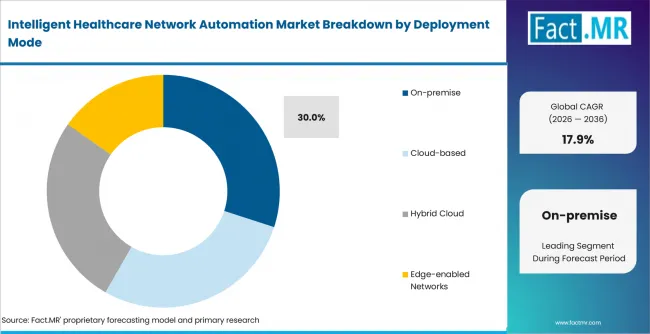
Intelligent Healthcare Network Automation Market Analysis By Deployment Mode | Source: Fact.MR
On-premise systems allow hospitals to keep direct control over clinical systems, medical devices, and sensitive network activity. Key network functions stay inside the hospital, which also limits outside access. Cloud-based systems give staff a wider view across several locations. Hybrid Cloud combines local control with shared data review. Edge-enabled Networks handle urgent data close to wards, imaging rooms, and connected medical devices.
Why does Network Management lead Application?
Network Management is anticipated to capture 25.0% share of the Application segment in 2026.
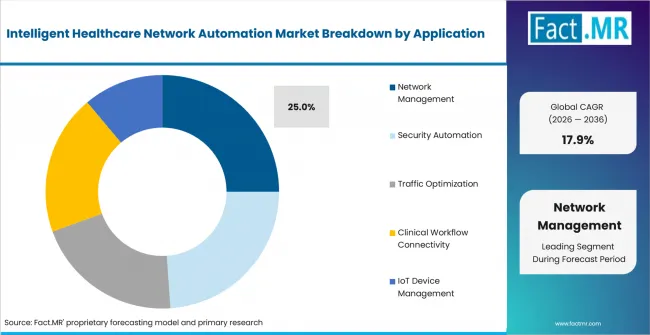
Intelligent Healthcare Network Automation Market Analysis By Application | Source: Fact.MR
Hospitals require a clear view of network switches, wireless points, medical devices, and cloud links. Network Management brings this information together and helps staff find problems before patient care is affected. Security Automation checks network rules and looks for unusual activity. Traffic Optimization protects voice calls, medical images, and patient-record access during busy periods. Clinical Workflow Connectivity and IoT Device Management help connected healthcare systems work without interruption.
Why does Hospitals lead End User?
Hospitals are estimated to represent 25.0% share of End User demand in 2026.
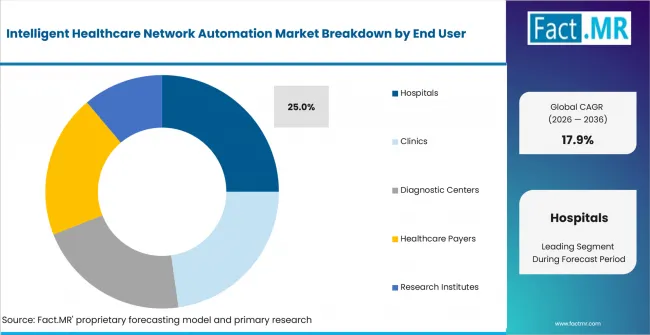
Intelligent Healthcare Network Automation Market Analysis By End User | Source: Fact.MR
Hospitals operate some of the largest and most varied healthcare networks. Bedside equipment, imaging systems, laboratories, pharmacies, patient records, and staff communication all use the same network. Clinics usually run smaller systems and often use simpler remote controls. Diagnostic Centers depend on the fast transfer of images and test results. Healthcare Payers and Research Institutes mainly use network automation for safe access and controlled data sharing.
Why does Artificial Intelligence lead Technology?
Artificial Intelligence is forecast to hold 30.0% share of the Technology segment in 2026.
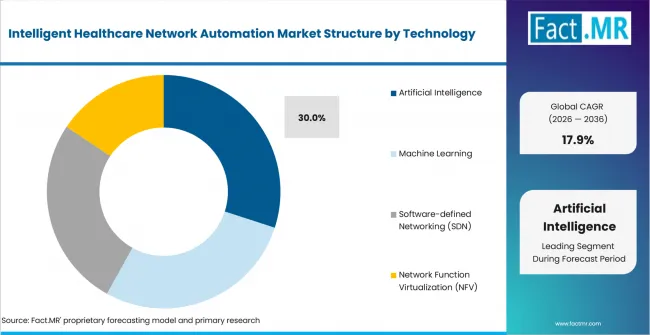
Intelligent Healthcare Network Automation Market Analysis By Technology | Source: Fact.MR
Artificial Intelligence helps network staff review large numbers of alerts, spot unusual activity, and find the likely cause of a service problem. It can also suggest the next action while leaving final approval with hospital staff. Machine Learning studies traffic patterns and helps with future capacity planning. Software-defined Networking lets staff apply the same rules across many devices from one control point. Network Function Virtualization moves selected network tasks from fixed equipment into software.
What is accelerating Intelligent Healthcare Network Automation Market adoption, and what is holding it back?
Stronger cybersecurity rules and the growing number of connected medical devices are driving demand for hospital network automation. Hospitals also want to reduce network outages that can delay care. Growth may be slower where device records are incomplete and network changes are allowed only during limited time periods. Another challenge is the shortage of staff who understand both hospital work and network systems.
Drivers Impact Analysis
| DRIVER | (~) % IMPACT ON CAGR | GEOGRAPHIC RELEVANCE | IMPACT TIMELINE |
|---|---|---|---|
| Mandatory cyber resilience rules | +3.0% | USA | Short term (<=2 years) |
| AI governance and oversight | +2.4% | Germany | Medium term (2-4 years) |
| Health-data interoperability mandates | +1.8% | Germany and Japan | Medium term (2-4 years) |
| Complete asset discovery | +1.3% | Brazil and Latin America | Long term (>=4 years) |
| Closed-loop automated remediation | +0.9% | South Korea | Long term (>=4 years) |
Source: Fact.MR analysis. Updated Jul 21, 2026
- Stronger cybersecurity rules: The proposed HIPAA Security Rule update was published on January 6, 2025. It covers full asset lists, network maps, multifactor login, encryption, security testing, and plans for restoring systems after a problem. These rules are likely to increase demand for tools that record security controls and apply them across hospital networks.
- Health-data sharing rules: Regulation (EU) 2025/327 sets a common framework for electronic health data across Europe. Hospitals will require tighter control over system links and user access. Network changes will also face closer checks as patient information moves between approved systems and across national borders.
- A complete list of connected systems: On January 8, 2026, HHS explained that current IT records help healthcare organizations find systems that require stronger protection. In hospitals, this includes routers, firewalls, servers, and connected medical devices. All of these systems must appear in one clear view before staff can protect them properly.
Opportunity Impact Analysis
| OPPORTUNITY | (~) % IMPACT ON CAGR | GEOGRAPHIC RELEVANCE | IMPACT TIMELINE |
|---|---|---|---|
| Cloud and hybrid deployment | +0.9% | South Korea and USA | Medium term (2-4 years) |
| Security automation adoption | +0.7% | USA and Germany | Short term (<=2 years) |
| Identity and access governance | +0.6% | U.K. | Medium term (2-4 years) |
| Diagnostic center expansion | +0.5% | Japan and Brazil | Long term (>=4 years) |
Source: Fact.MR analysis. Updated Jul 21, 2026
- Cloud and hybrid deployment: On-premise is projected to lead 2026 demand at 30.0%, yet Cloud-based and Hybrid Cloud models are expected to expand centralized oversight across hospital groups. Edge-enabled Networks are anticipated to handle time-sensitive traffic close to wards and diagnostic equipment.
- Security automation adoption: Hospitals are expected to use automated policy checks for encryption and identity controls. Vulnerability response and network segmentation are anticipated to follow the same documented rules. Adoption is projected to be strongest where each automated action produces an audit record and retains human approval for high-risk changes.
- Identity and access governance: Healthcare networks connect employees and clinicians. They also connect contractors, devices, and third-party services. The opportunity is projected to center on platforms that tie each identity to a defined network role and remove access when the clinical or operational need ends.
Restraints Impact Analysis
| RESTRAINT | (~) % IMPACT ON CAGR | GEOGRAPHIC RELEVANCE | IMPACT TIMELINE |
|---|---|---|---|
| Incomplete remediation pathway | -1.2% | Global | Short term (<=2 years) |
| Staffing and safety-management gaps | -0.9% | Brazil and mixed public-private systems | Medium term (2-4 years) |
| Reimbursement and ownership ambiguity | -0.7% | Global | Medium term (2-4 years) |
| Cautious local validation cycles | -0.5% | Japan | Long term (>=4 years) |
Source: Fact.MR analysis. Updated Jul 21, 2026
- Incomplete remediation pathway: Automation loses value when a hospital cannot stop or reverse a change safely. Procurement is expected to slow where failover procedures and maintenance windows have not been agreed. Downtime plans and restoration tests need to be settled before deployment.
- Staffing and safety gaps: A platform may perform correctly but still face delayed approval when network staff and clinical engineering staff work through separate review paths. Adoption is anticipated to move faster where both groups share one change record and one escalation process.
- Ownership ambiguity: Hospitals often divide responsibility across infrastructure and cybersecurity groups. Clinical engineering and application groups may control different parts of the same change. Purchasing is expected to take longer when no single owner can approve exceptions or accept the operating risk created by an automated action.
Where is Intelligent Healthcare Network Automation Market demand growing across key countries?
Germany 24.2%; Brazil 22.4%; USA 20.6%; South Korea 18.8%; U.K. 17.0%; Japan 15.2%.
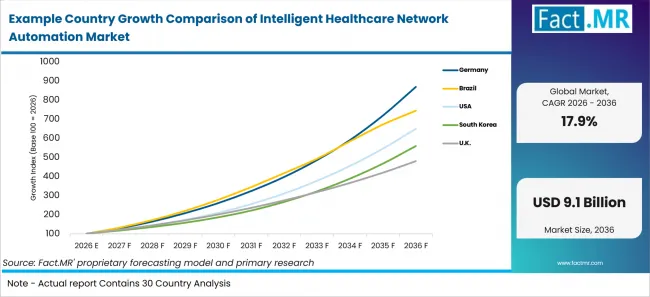
Example Country Growth Comparison Of Intelligent Healthcare Network Automation Market | Source: Fact.MR
| COUNTRY | CAGR |
|---|---|
| Germany | 24.2% |
| Brazil | 22.4% |
| USA | 20.6% |
| South Korea | 18.8% |
| U.K. | 17.0% |
| Japan | 15.2% |
Source: Fact.MR analysis. Updated Jul 21, 2026
What is driving Germany’s growth through 2036?
24.2% CAGR, driven by secure data exchange and tighter control over hospital network changes.
Germany is expected to place strong weight on system compatibility, network records and local approval before changes reach clinical systems. Regulation (EU) 2025/327 creates clearer duties for secure electronic health-data exchange across connected care settings. The market is projected to record a 24.2% CAGR from 2026 to 2036 as hospitals invest in network automation that supports data exchange without weakening service continuity.
How is Brazil scaling healthcare network automation demand?
22.4% CAGR, supported by the need for better asset visibility across mixed hospital networks.
Brazil has public and private healthcare facilities with different equipment ages, network layouts and levels of technical support. This makes accurate asset discovery an important first step before hospitals apply common security rules or automated changes. Demand is expected to post a 22.4% CAGR through 2036 as providers seek platforms that adjust to each facility instead of assuming that every site uses the same network design.
What supports the USA outlook?
20.6% CAGR, owing to stronger cybersecurity controls and tested recovery procedures.
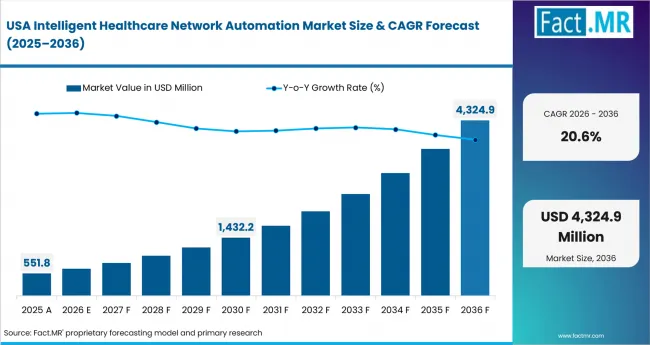
Intelligent Healthcare Network Automation Market Country Value Analysis | Source: Fact.MR
The proposed HIPAA Security Rule update places greater attention on technology inventories, network maps, identity controls, encryption and security testing. Hospitals also need clear restoration plans for systems that support patient care. The USA market is anticipated to expand at a 20.6% CAGR from 2026 to 2036 as healthcare providers adopt platforms that record network changes, support repeatable security checks and keep human approval for high-risk actions.
What underpins South Korea’s growth?
18.8% CAGR, driven by dense wireless networks and highly connected clinical systems.
South Korean hospitals often operate broad wireless coverage alongside connected medical devices and centralized digital systems. This creates a need to find faults quickly and keep network settings consistent across departments and locations. The market is estimated to record an 18.8% CAGR by 2036 as hospitals adopt automation that improves oversight across several sites while preserving local control over critical services.
How is the U.K. developing healthcare network automation demand?
17.0% CAGR, supported by common network controls across NHS organizations and care settings.
NHS trusts, clinics and shared services need a clear way to manage privileged access, outside connections and configuration changes. Local staff also need records showing what changed, who approved it and whether the action affected care delivery. The U.K. market is forecast to post a 17.0% CAGR from 2026 to 2036 as healthcare organizations move toward common control frameworks that still allow review at the local level.
What shapes Japan’s growth through 2036?
15.2% CAGR, backed by careful integration with established clinical and diagnostic systems.
Japanese hospitals are expected to follow strict approval paths before automation reaches imaging, laboratory, pharmacy and patient-record systems. Existing maintenance routines and local validation remain important where network changes could affect clinical equipment. Demand is projected to increase at a 15.2% CAGR through 2036 as hospitals choose tools that improve visibility while fitting established operating procedures.
Who leads the Intelligent Healthcare Network Automation Market?
Cisco Systems, Inc. and Hewlett Packard Enterprise lead broad network automation coverage, while Extreme Networks, Inc. strengthens AI-based monitoring and control for hospital networks.
Cisco combines networking, security, system visibility and collaboration across its healthcare portfolio. In June 2025, the company presented its Networking App Marketplace as a route for adding specialized automation applications to Cisco-managed infrastructure.
Extreme Networks offers cloud-managed networking, network fabric automation and AI-supported security for healthcare facilities. In May 2026, the company highlighted Extreme Platform ONE for combining network management, security and automation in one operating system. Competition through 2036 is expected to center on accurate asset records, faster fault detection, controlled policy changes and dependable rollback when an automated action affects clinical services.
Which companies are the key providers?
The company landscape includes Cisco Systems, Hewlett Packard Enterprise Company, Extreme Networks, Infoblox, Arista Networks, Inc., Fortinet, Inc., Palo Alto Networks, Inc., and Forescout Technologies, Inc.
- Cisco Systems
- Hewlett Packard Enterprise Company
- Extreme Networks
- Infoblox
- Arista Networks, Inc.
- Fortinet, Inc.
- Palo Alto Networks, Inc.
- Forescout Technologies, Inc.
Bibliography
- Cisco Systems, Inc. (2025, June 4). Cisco Networking App Marketplace partners at Cisco Live 2025
- Extreme Networks, Inc. (2026, May 5). Extreme solidifies networking leadership with major enhancements to Extreme Platform ONE.
- European Parliament and Council of the European Union. (2025, March 5). Regulation (EU) 2025/327 of the European Parliament and of the Council of 11 February 2025 on the European Health Data Space and amending Directive 2011/24/EU and Regulation (EU) 2024/2847. Official Journal of the European Union.
- Hewlett Packard Enterprise. (2025, July 2). Hewlett Packard Enterprise closes acquisition of Juniper Networks to offer industry-leading comprehensive, cloud-native, AI-driven portfolio.
- U.S. Department of Health and Human Services. (2025, January 6). HIPAA Security Rule to strengthen the cybersecurity of electronic protected health information. Federal Register.
This Report Addresses
- Clinical uptime requirements and the patient-safety effect of network changes across hospital environments.
- Asset discovery across medical devices, switches, servers, cloud services, and third-party connections.
- Segmentation of clinical, administrative, research, and operational technology traffic.
- Closed-loop remediation with approval points and action records, including safe stopping and rollback when a network change does not produce the intended result.
- Identity and logging controls across healthcare networks. Configuration, privileged access, and third-party access governance are included.
What does the Intelligent Healthcare Network Automation Market cover?
Software, platforms and managed services used to automate healthcare network monitoring, configuration, security response and connected-device control.
The Intelligent Healthcare Network Automation Market covers systems designed to improve visibility and control across hospital and healthcare networks. Coverage includes network monitoring, automated configuration, policy enforcement, traffic optimization, security response and clinical-device connectivity across hospitals, clinics and diagnostic environments.
The market differs from general healthcare software because commercial value comes from automating network operations and controlling how connected systems communicate. Medical devices, imaging equipment and patient-record platforms remain outside the boundary unless the purchased product is specifically designed to monitor, secure or automate the network supporting those systems.
What is included in the scope?
Healthcare network automation systems used across clinical, administrative and connected-care environments.
The scope includes Solutions, Services, Software Platforms and Managed Services across On-premise, Cloud-based, Hybrid Cloud and Edge-enabled Networks. Coverage spans Network Management, Security Automation, Traffic Optimization, Clinical Workflow Connectivity and IoT Device Management. Hospitals, Clinics, Diagnostic Centers, Healthcare Payers and Research Institutes are included where the purchased function involves automated network control, monitoring or security.
The scope also covers Artificial Intelligence, Machine Learning, Software-defined Networking and Network Function Virtualization when these technologies are applied to healthcare network operations. Asset discovery, network segmentation, identity control, change approval, incident response and rollback are included because they form part of the operating requirements for safe automation across healthcare infrastructure.
What is excluded from the scope?
Standalone medical equipment and healthcare software without a network-automation function are outside the scope.
The scope excludes imaging systems, bedside devices, laboratory equipment and other medical hardware sold primarily for diagnosis, monitoring or treatment. Electronic health-record systems, clinical applications and general cloud services are also excluded unless their main purchased function is automated network monitoring, configuration, security response or traffic control.
The market does not include total hospital IT spending, general cybersecurity services unrelated to network operations or clinical communication products that do not provide direct network visibility and control. Installation and support work remain outside the boundary when they are sold without a defined healthcare network-automation product or managed-service offering.
How Was the Analysis Built?
The analysis draws on 120+ sources, 35+ company portfolios, 25+ countries, and more than 20 industry interviews.
- Primary Research: Primary research includes discussions with manufacturers, service providers, technology developers, distributors, end users, procurement teams, and subject-matter experts. These conversations examine purchasing priorities, product adoption, operational challenges, approval requirements, competitive positioning, and the factors that influence wider market acceptance.
- Desk Research: Desk research covers government statistics, regulatory publications, company filings, trade data, technical studies, industry associations, standards, public policy, and other authoritative sources. Every source used in the analysis is documented in the bibliography.
- Market Sizing and Forecasting: Market estimates combine historical performance, demand indicators, pricing and volume trends, segment shares, company participation, country-level growth, adoption patterns, investment activity, and barriers to market expansion.
- Data Validation and Update Cycle: Findings are validated by comparing primary interviews with public data, company activity, regulatory changes, trade patterns, and industry developments. Regular updates review new product launches, capacity changes, partnerships, approvals, procurement trends, and shifts in commercial adoption.
Segmentation
What is the report's scope and coverage?
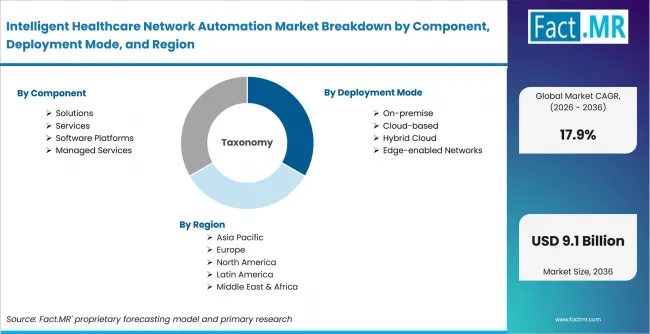
Intelligent Healthcare Network Automation Market Breakdown By Component, Deployment Mode, And Region | Source: Fact.MR
| Attribute | Details |
|---|---|
| Quantitative Units | USD Billion in 2026 to USD Billion by 2036 at a CAGR |
| Market Definition | Software, platforms and managed services designed to automate healthcare network monitoring, configuration, security response, traffic control and clinical-device connectivity across hospitals and other healthcare environments |
| Component | Solutions; Services; Software Platforms; Managed Services |
| Deployment Mode | On-premise; Cloud-based; Hybrid Cloud; Edge-enabled Networks |
| Application | Network Management; Security Automation; Traffic Optimization; Clinical Workflow Connectivity; IoT Device Management |
| End User | Hospitals; Clinics; Diagnostic Centers; Healthcare Payers; Research Institutes |
| Technology | Artificial Intelligence; Machine Learning; Software-defined Networking (SDN); Network Function Virtualization (NFV) |
| Regions Covered | North America; Latin America; Western Europe; Eastern Europe; East Asia; South Asia and Pacific; Middle East and Africa |
| Countries Covered | Germany; Brazil; USA; South Korea; United Kingdom; Japan |
| Key Companies Profiled | Cisco Systems; Hewlett Packard Enterprise Company; Extreme Networks; Infoblox; Arista Networks, Inc.; Fortinet, Inc.; Palo Alto Networks, Inc.; Forescout Technologies, Inc. |
| Forecast Period | 2026 to 2036 |
| Approach | Hybrid top-down and bottom-up approach using healthcare cybersecurity requirements; hospital network infrastructure; connected-device adoption; asset-discovery needs; deployment preferences; network-management applications; technology adoption; country growth conditions and company validation |
Source: Fact.MR analysis. Updated Jul 21, 2026
How is the market segmented?
-
By Component:
- Solutions
- Services
- Software Platforms
- Managed Services
-
By Deployment Mode:
- On-premise
- Cloud-based
- Hybrid Cloud
- Edge-enabled Networks
-
By Application:
- Network Management
- Security Automation
- Traffic Optimization
- Clinical Workflow Connectivity
- IoT Device Management
-
By End User:
- Hospitals
- Clinics
- Diagnostic Centers
- Healthcare Payers
- Research Institutes
-
By Technology
- Artificial Intelligence
- Machine Learning
- Software-defined Networking (SDN)
- Network Function Virtualization (NFV)
-
By Region:
- North America
- Latin America
- Western Europe
- Eastern Europe
- East Asia
- South Asia and Pacific
- Middle East and Africa
Frequently Asked Questions
Which Component leads the Intelligent Healthcare Network Automation Market?
Which Deployment Mode leads the Intelligent Healthcare Network Automation Market?
Which Application leads the Intelligent Healthcare Network Automation Market?
Which End User leads the Intelligent Healthcare Network Automation Market?
Which Technology leads the Intelligent Healthcare Network Automation Market?
Which country records the highest CAGR in the Intelligent Healthcare Network Automation Market?
How does Brazil perform in the Intelligent Healthcare Network Automation Market?
How does the USA perform in the Intelligent Healthcare Network Automation Market?
How does South Korea perform in the Intelligent Healthcare Network Automation Market?
How does the U.K. perform in the Intelligent Healthcare Network Automation Market?
How does Japan perform in the Intelligent Healthcare Network Automation Market?
What is the primary driver in the Intelligent Healthcare Network Automation Market?
What is the main restraint in the Intelligent Healthcare Network Automation Market?
Why are Solutions important?
Why do hospitals dominate demand?
Why is On-premise deployment important?
Why is Network Management important?
Why is Artificial Intelligence important?
Who worked on this report


Preview the report firsthand - request a free sample
Free SampleGet the brochure for pricing and purchase details
Download PDF