- Market Value (2025): USD 1.1 Bn
- Estimated Value (2026): USD 1.3 Bn
- Forecast Value (2036): USD 8.6 Bn
- CAGR (2026-2036): 20.8%
What is the interactive video checkout market forecast to be worth by 2036?
USD 1.3 billion in 2026, USD 8.6 billion by 2036, CAGR of 20.8%.
- The interactive video checkout market crossed a valuation of USD 1.1 billion in 2025. It is estimated to reach USD 1.3 billion in 2026. The market is projected to reach USD 8.6 billion by 2036.
- The market is forecast to record a 20.8% CAGR from 2026 to 2036 as retailers, creators and marketplaces move purchase steps into shoppable video paths.
- Shoppable video checkout forms the core of this market. The United States Census Bureau reported in May 2026 that e-commerce accounted for 16.9% of United States retail sales in the first quarter of 2026.
- This gives retailers a large online base for video-led checkout tools that connect product discovery with payment routing.
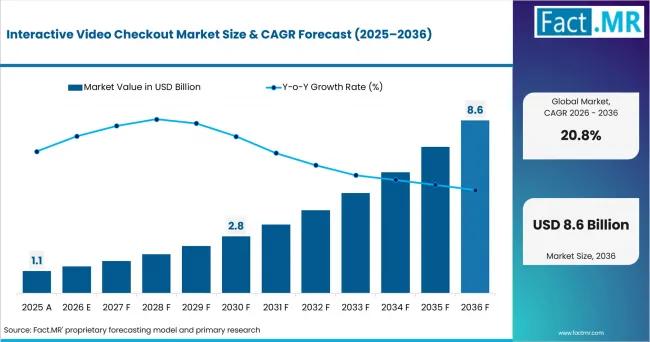
Interactive Video Checkout Market Market Value Analysis | Source: Fact.MR
What are the defining numbers behind interactive video checkout growth?
USD 7.3 billion absolute opportunity by 2036.
- Demand Drivers in the Market
- Retailers are expected to test video checkout because product discovery is shifting into short clips and live sessions.
- Creators need affiliate links, product tags and sales attribution before they can justify repeat brand partnerships.
- Brands are likely to favor embedded checkout because it keeps the shopper closer to the content that created purchase intent.
- Marketplaces are expected to support native checkout tools because seller acquisition depends on measurable conversion paths.
- Agencies are likely to package video checkout with content production and commerce analytics for campaign-based sellers.
- Key Segments Analyzed
- By Checkout Experience: Embedded checkout is expected to hold 31.0% share in 2026 because retailers want the buying step inside the video path.
- By User Group: Retailers are likely to account for 34.0% share in 2026 as owned-store conversion remains a budget priority.
- By Functional Module: Checkout is projected to capture 38.0% share in 2026 because product tags have limited value without a completed transaction.
- By Deployment: Shopify apps are estimated to hold 30.0% share in 2026 due to faster merchant onboarding.
- By Revenue Model: Software-as-a-service subscription is forecast to hold 36.0% share in 2026 as merchants prefer fixed platform costs.
- By Geography: India is projected to record 25.4% CAGR through 2036 because mobile payments and creator commerce lower checkout friction.
- Analyst Opinion at Fact.MR
- Shambhu Nath Jha, Senior Analyst at Fact.MR, states, "Interactive video checkout is becoming a conversion layer for merchants that already spend on content. The strongest tools go beyond video playback. They show which creator, clip and checkout path moved the shopper to purchase."
- Strategic Implications
- Retailers should test embedded checkout on product categories that already perform well in short-form content.
- Creator teams need attribution rules before expanding affiliate product tagging.
- Checkout vendors should prioritize catalog sync, payment routing and return-policy visibility.
- Marketplaces can use shoppable video tools to recruit sellers that already invest in social content.
- Brands should separate entertainment metrics from transaction metrics before approving larger video commerce budgets.
India is projected to record 25.4% CAGR through 2036 as mobile payments and creator commerce reduce checkout friction. The United States is expected to expand at 23.7% CAGR as creator affiliate programs and Shopify-based selling support testing. China is forecast to grow at 22.9% CAGR as content-led retail and marketplace-native checkout remain familiar. South Korea is expected to advance at 22.4% CAGR as mobile-first shopping supports video-led purchase journeys. The United Kingdom is projected to rise at 21.8% CAGR as online retail and creator commerce support shoppable video conversion. Germany is forecast at 19.7% CAGR as retailers review data protection and checkout control carefully. Japan is expected to post 18.9% CAGR as video checkout expands from beauty, hobby and electronics demonstrations at a measured pace.
How does the interactive video checkout market break down by segment?
Embedded checkout leads at 31.0% and retailers lead at 34.0%.
Which checkout experience dominates?
Embedded checkout holds 31.0% share in 2026.
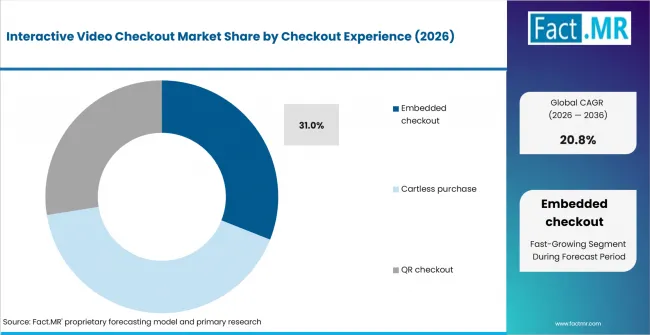
Interactive Video Checkout Market Analysis By Checkout Experience | Source: Fact.MR
Embedded checkout leads because the purchase step remains close to the product demonstration. Buyers can move from interest to order without opening a separate product page. This matters for short video and live selling because attention drops when shoppers are redirected. Vendors that keep catalog, inventory and payment steps synchronized are expected to gain stronger merchant retention.
Which user group dominates?
Retailers account for 34.0% share in 2026.
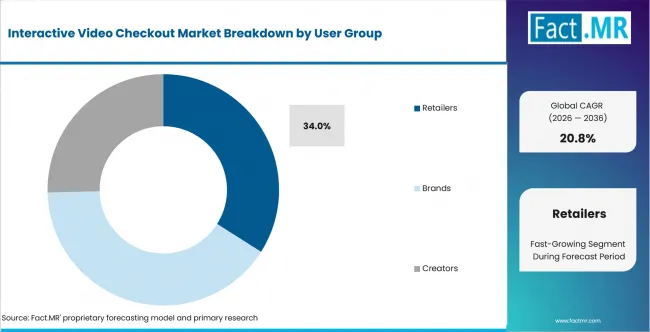
Interactive Video Checkout Market Analysis By User Group | Source: Fact.MR
Retailers lead because they control product inventory, pricing and return rules. Brand and creator partnerships work better when the merchant owns the final checkout path. Retailers are also able to compare video checkout performance against product-page conversion. This makes budget approval easier for owned-store deployments.
Which functional module dominates?
Checkout holds 38.0% share in 2026.
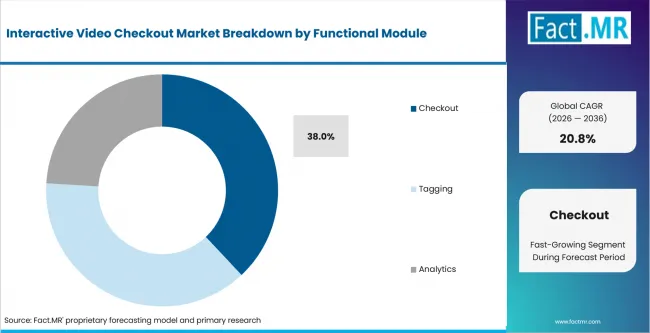
Interactive Video Checkout Market Analysis By Functional Module | Source: Fact.MR
Checkout is the main module because product tagging alone does not record revenue. Merchants need cart creation, coupon logic and payment movement inside the same path. Analytics become more valuable after the transaction layer is in place. Suppliers that connect checkout data to creator attribution are expected to defend account access.
Which deployment model dominates?
Shopify apps lead with 30.0% share in 2026.
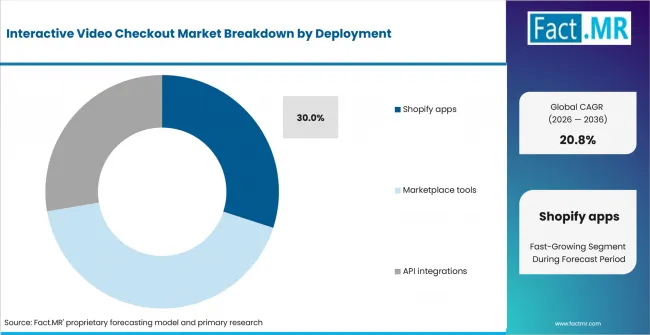
Interactive Video Checkout Market Analysis By Deployment | Source: Fact.MR
Shopify apps lead because merchants can add shoppable video tools without rebuilding the store. App-based installation also lowers testing risk for small and mid-sized brands. Marketplace-native tools remain important when sellers rely on in-app traffic. API integrations gain weight once enterprise brands need custom control.
Which revenue model dominates?
Software-as-a-service subscription holds 36.0% share in 2026.
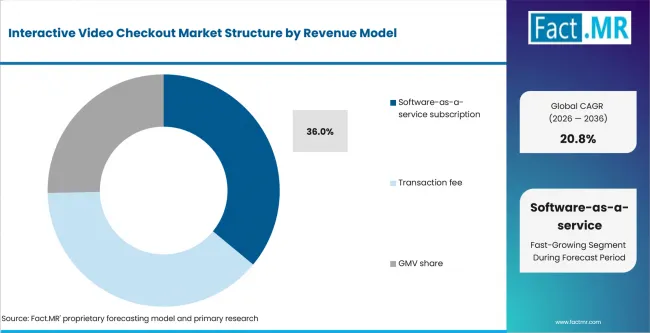
Interactive Video Checkout Market Analysis By Revenue Model | Source: Fact.MR
Software-as-a-service subscriptions lead because merchants can plan monthly software spending before traffic volumes are proven. Transaction fees remain common in marketplace-native tools. Gross merchandise value share attracts vendors when the seller base is small but sales intensity is high. Enterprise licenses are likely to expand for brands that require white-label control.
What is accelerating interactive video checkout adoption, and what is holding it back?
Video discovery, creator attribution and mobile payment rails drive it. Platform checkout rules, content workload and attribution gaps restrain it.
Drivers Impact Analysis
| DRIVER | (~) % IMPACT ON CAGR |
GEOGRAPHIC RELEVANCE | IMPACT TIMELINE |
|---|---|---|---|
| Video discovery moving closer to checkout | +4.7% | Global, strongest in China and USA | Short term |
| Creator attribution becoming a commerce requirement | +4.2% | USA, United Kingdom and Europe | Medium term |
| Mobile payment rails reducing checkout friction | +3.8% | India, China and South Korea | Short term |
| Owned-site video conversion becoming measurable | +3.4% | North America and Western Europe | Medium term |
| Marketplace-native shopping normalizing in-app purchase | +3.0% | China, United Kingdom and European Union | Long term |
Source: Fact.MR analysis. Updated Jul 1, 2026
- Video discovery moves checkout upstream
- Retailers are no longer treating video only as awareness content. A product clip can carry the shopper from discovery to cart when checkout is embedded inside the same path. This shift also raises the value of payment gateway services because a video-led order still needs reliable payment routing. The commercial effect is clear for suppliers. Tools that connect the player, product tag and payment step reduce the handoff that often breaks purchase intent.
- Creators need transaction attribution
- Creator commerce depends on proof that a video generated an order. Brands cannot scale affiliate programs when product views and purchase records stay in different systems. YouTube reported in August 2024 that people watched more than 30 billion hours of shopping-related videos in 2023. That viewing base gives merchants a clear reason to connect product tags with checkout outcomes. The result is a stronger role for checkout platforms that can pass product and order signals back to the merchant. Vendors with reliable attribution logic are expected to win larger creator-led programs.
- Wallet rails shorten payment steps
- Mobile wallets make video checkout easier because the buyer can complete payment without typing card details. This matters in countries where mobile-first commerce is already the default behavior. The Press Information Bureau, Government of India reported 18.39 billion Unified Payments Interface transactions in June 2025. A payment base of that scale lowers the friction that usually limits impulse purchases from shoppable clips.
Opportunity Impact Analysis
| OPPORTUNITY | (~) % IMPACT ON CAGR |
GEOGRAPHIC RELEVANCE | IMPACT TIMELINE |
|---|---|---|---|
| Retained shoppable clips from live sessions | +4.5% | USA, Japan and South Korea | Short term |
| QR checkout for screen-to-phone journeys | +3.9% | India, Japan and United Kingdom | Medium term |
| API checkout for creator storefronts | +3.7% | USA and Europe | Long term |
| Recommendation engines for product tagging | +3.2% | Global | Medium term |
| Affiliate attribution bundled with checkout | +2.8% | USA and United Kingdom | Short term |
Source: Fact.MR analysis. Updated Jul 1, 2026
- Live content becomes reusable inventory
- A live shopping session can produce product clips that remain useful after the event ends. This gives merchants a second use for content that once disappeared after the broadcast. The same logic connects shoppable clips with video streaming platforms that already manage content delivery and viewer engagement. Bambuser released a shoppable video update in January 2024 that lets users publish one video playlist across unlimited web pages and app screens. Reusable video inventory gives merchants a reason to pay for checkout features beyond the live event itself.
- Recommendation logic improves product tagging
- Product tags become more valuable when the platform can match clips with the right product or offer. This is not only a content task because the wrong tag can send buyers to an unavailable item. AI recommendation engines can support product matching when sellers manage large catalogs. The opportunity is strongest for retailers that already have product data, inventory feeds and campaign calendars. Checkout vendors can charge more when they reduce tagging work and improve order traceability.
- QR checkout reaches larger screens
- QR checkout helps convert viewers on television, out-of-home screens and long-form video sessions. The buyer scans the code and completes the order on a phone. This path is useful for brands that cannot place a full checkout form inside every video surface. It also gives agencies a measurable commerce action during product demonstrations and launch campaigns.
Restraints Impact Analysis
| RESTRAINT | (~) % IMPACT ON CAGR |
GEOGRAPHIC RELEVANCE | IMPACT TIMELINE |
|---|---|---|---|
| Platform checkout rules changing by channel | -3.8% | USA and European Union | Medium term |
| Payment and return rules differing by country | -3.2% | European Union and India | Short term |
| Video production burden for smaller sellers | -2.6% | Global | Short term |
| Checkout ownership disputes between platforms and brands | -2.3% | USA and Europe | Medium term |
| Attribution gaps across social apps | -2.0% | Global | Long term |
Source: Fact.MR analysis. Updated Jul 1, 2026
- Platform rules can shift suddenly
- Interactive video checkout depends on policies set by app stores, marketplaces and social platforms. A merchant can lose a preferred checkout path if a platform changes where a transaction must occur. This creates a restraint for suppliers building frictionless retail infrastructure because each channel applies its own checkout limits. Expansion of this type can help sellers. It also adds market-by-market operating rules.
- Content workload limits smaller sellers
- Small sellers may accept the checkout tool but struggle to produce enough video content. A shoppable player needs clips and product tags before it can affect sales. Offers and moderation create additional work for smaller merchant teams. This restraint favors vendors that bundle content reuse, catalog import and simple publishing controls. It also limits pure transaction-fee models when merchant teams cannot maintain a steady video pipeline.
- Attribution breaks across channel borders
- A shopper can discover a product in one social app and complete the order on a retailer site. The transaction may be recorded, but the creator influence can disappear from the reporting path. This is why commerce cloud platforms are becoming relevant to video checkout planning. Suppliers that connect product feeds, campaign tags and order records are better placed to support enterprise buyers. Smaller tools can lose bids when reporting stops at the video view.
Which countries are scaling interactive video checkout fastest?
India records 25.4%. The United States records 23.7%. China records 22.9%. South Korea records 22.4%. The United Kingdom records 21.8%. Germany records 19.7%. Japan records 18.9%.
Based on regional analysis, the interactive video checkout market is segmented into North America and East Asia. It also covers South Asia and Pacific, Western Europe and Latin America. Middle East and Africa is included as a developing regional cluster.
| Country | CAGR |
|---|---|
| India | 25.4% |
| United States | 23.7% |
| China | 22.9% |
| South Korea | 22.4% |
| United Kingdom | 21.8% |
| Germany | 19.7% |
| Japan | 18.9% |
Source: Fact.MR analysis. Updated Jul 1, 2026
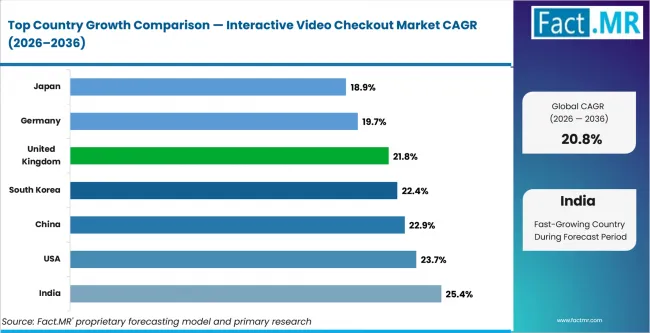
Interactive Video Checkout Market Cagr Analysis By Country | Source: Fact.MR
What makes India the fastest market?
25.4% CAGR, supported by mobile payments and creator commerce.
India is projected to record 25.4% CAGR through 2036 because mobile payments already support high-frequency online purchase behavior. The country has a large base of mobile-first consumers and creator-led commerce is moving into beauty, fashion and small business categories. Unified Payments Interface scale reduces the payment-entry barrier that usually slows video-led impulse purchases. Suppliers that localize wallet checkout and language support can win accounts earlier than tools built only for card-based flows.
Why does the United States scale through creator commerce?
23.7% CAGR, driven by affiliate programs and Shopify-based selling.
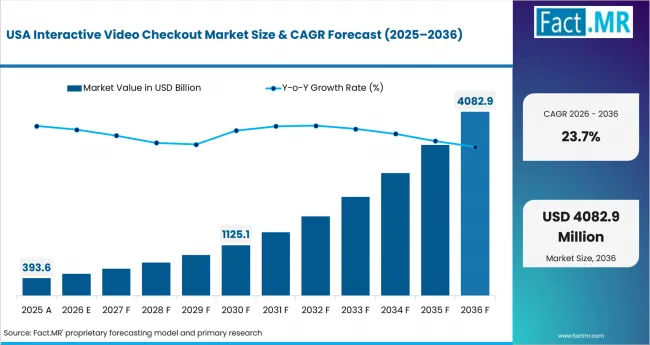
Interactive Video Checkout Market Country Value Analysis | Source: Fact.MR
The United States is expected to expand at 23.7% CAGR through 2036 because creator affiliate programs and Shopify-based selling lower deployment friction. Retailers compare video checkout tools against conversion uplift, creator attribution and platform reach. Brands are likely to fund video checkout when order reporting is tied to campaign spend. Suppliers that prove which creator and clip created the transaction can secure stronger account access.
How does China shape checkout inside video feeds?
22.9% CAGR, supported by content-led retail and marketplace-native checkout.
China is forecast to grow at 22.9% CAGR through 2036 because video commerce is already part of mainstream retail discovery. Online retail sales reached RMB 15,972.2 billion in 2025 according to the National Bureau of Statistics of China. Sellers compete on entertainment and price inside the same session. Suppliers entering China need platform partnerships before standalone video checkout tools can scale.
Why does South Korea favor mobile-first checkout?
22.4% CAGR, backed by mobile shopping and entertainment commerce.
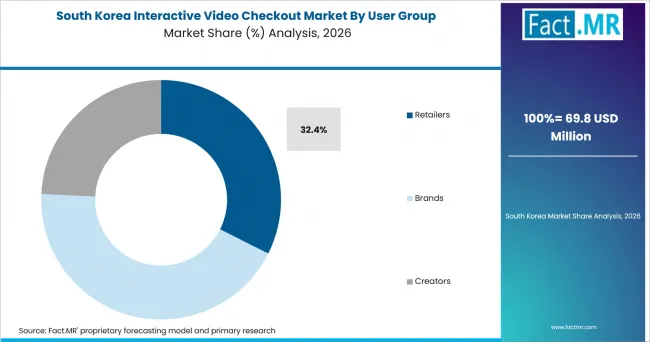
Interactive Video Checkout Market South Korea Market Share Analysis By User Group | Source: Fact.MR
South Korea is expected to advance at 22.4% CAGR through 2036 because mobile-first behavior supports video-led purchase journeys. The Ministry of Data and Statistics reported that mobile shopping accounted for 79.4% of online shopping transaction value in August 2025. Beauty, fashion and lifestyle sellers give platforms natural categories for livestream and short clip conversion. Suppliers can win brand-owned site projects when they connect video systems with checkout modules.
What supports the UK route to shoppable video conversion?
21.8% CAGR, driven by online retail use and creator commerce testing.
The United Kingdom is projected to rise at 21.8% CAGR through 2036 because retailers already use online channels for discovery and purchase. The Office for National Statistics reported that online sales accounted for 27.6% of retail sales in May 2026. LiveMeUp tools give sellers more routes to pair content with checkout. Suppliers that manage returns, taxes and creator attribution inside one workflow can gain stronger merchant interest.
Why does Germany expand below the global pace?
19.7% CAGR, constrained by data protection and checkout control review.
Germany is forecast at 19.7% CAGR through 2036 because adoption is slower than India and the United States. German retailers weigh data protection, payment clarity and checkout control before adding new transaction paths. The Federal Statistical Office of Germany reported that Germany ranked eighth among European Union states for online shopping in 2024. Growth below the global average reflects stricter buyer review rather than weak online retail readiness.
How does Japan balance service depth with checkout restraint?
18.9% CAGR, supported by product demonstrations and measured checkout testing.
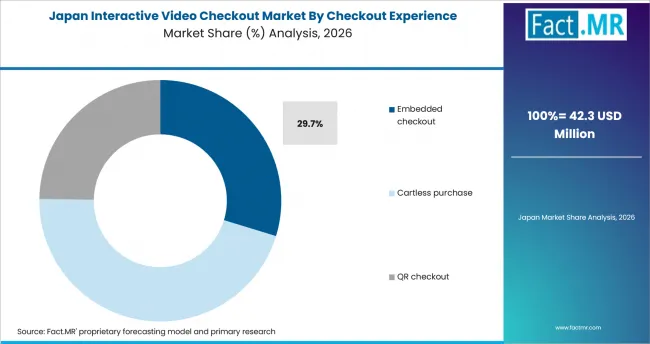
Interactive Video Checkout Market Japan Market Share Analysis By Checkout Experience | Source: Fact.MR
Japan is expected to post 18.9% CAGR through 2036 because video checkout expands from beauty, hobby and electronics demonstrations at a measured pace. The Ministry of Economy, Trade and Industry of Japan reported that Japan’s business-to-consumer e-commerce market reached 26.1 trillion yen in 2024. Shoppers often expect detailed product information before purchase. Suppliers that support QR checkout can bridge television, livestream and mobile purchase journeys.
Who leads the interactive video checkout landscape?
LiveMeUp lead through merchant access.
Interactive Video Checkout Market Analysis By Company | Source: Fact.MR
Interactive video checkout services are used by retailers and creators that need measurable purchase paths from content. LiveMeUp competes through merchant access because its app ecosystem lets sellers test shoppable video without rebuilding the store.
CommentSold, Bambuser and Firework compete through specialist video commerce tools. CommentSold supports video-led selling workflows for merchants. Bambuser supports shoppable video and live commerce use cases. Firework is relevant because it connects live sessions and shoppable clips for brand-owned sites.
Sprii and Channelize.io add marketplace and livestream commerce depth. Channelize.io also includes LiveScale after bringing it into the Channelize.io family in December 2025. Competition through 2036 depends on checkout ownership, catalog sync and attribution depth.
Providers that combine product tagging, payment routing and order attribution are better placed. Larger platforms can win when buyers need creator access and checkout control. Specialist vendors can win when retailers need video commerce tools that fit owned websites and campaign workflows.
Which companies are the key players?
LiveMeUp, CommentSold, Bambuser, Firework, Sprii, Channelize.io including LiveScale
- LiveMeUp
- CommentSold
- Bambuser
- Firework
- Sprii
- Channelize.io including LiveScale
Bibliography
- United States Census Bureau. (2026, May 18). Quarterly retail e-commerce sales, 1st quarter 2026.
- National Bureau of Statistics of China. (2026, January 20). Total retail sales of consumer goods in December 2025.
- Federal Statistical Office of Germany. (2025, January 14). European Union: 8 out of 10 internet users shop online.
- Office for National Statistics. (2026, June 19). Internet sales as a percentage of total retail sales.
- Ministry of Economy, Trade and Industry of Japan. (2025, August 26). Results of FY2024 E-Commerce Market Survey Compiled.
- Ministry of Data and Statistics, Republic of Korea. (2025, October). Online Shopping in August 2025.
- Channelize.io. (2025, December). Live Shopping Platform Channelize.io acquires LiveScale.
- CommentSold. (2024, April 4). CommentSold Revolutionizes Video Commerce with the Launch of PopClips.
- Bambuser AB. (2024, January 16). Shoppable Video just got a major upgrade.
This Report Addresses
- Strategic intelligence covers checkout experience and user groups. It also covers functional module, deployment and revenue model.
- Segment analysis covers embedded checkout and retailers. It also reviews checkout modules, Shopify apps and subscription models.
- Regional outlook covers India and the United States. It also covers China, South Korea and selected European markets.
- Competitive analysis covers LiveMeUp and CommentSold. It also reviews Bambuser, Firework and Channelize.io including LiveScale.
- Service assessment covers product tagging and checkout routing. It also reviews couponing, analytics and affiliate attribution.
- Platform assessment covers marketplace-native tools and Shopify apps. It also reviews API integrations and white-label SaaS readiness.
- Official source review, company-owned source checks and market anchor validation support the forecast.
What does the interactive video checkout market cover?
Checkout flows that let viewers buy directly from shoppable video, livestreams and creator-led product clips.
The interactive video checkout market covers software and platform services that embed purchase steps inside video-led selling. It includes one-click checkout and embedded checkout. It also includes cartless purchase, QR checkout and social wallet checkout. It differs from general video hosting because the service focus is transaction completion and attribution.
What is included in the scope?
Product tagging, checkout routing and transaction attribution are included.
The scope includes video player checkout and livestream cart functions. It also includes clickable product tags, coupon application and affiliate attribution. Shopify app deployments and marketplace-native tools are included. Application programming interface integrations and white-label software-as-a-service tools are also included. Services linked to demo hosting and creator storefront support are included when the workflow records a purchase path.
What is excluded from the scope?
General video hosting and standard checkout without video-led purchase intent are excluded.
The scope excludes ordinary payment gateways when they are not linked to a video commerce workflow. It excludes social media advertising without a checkout function. It also excludes creator management tools that do not tag products or capture transaction attribution. General livestreaming software is excluded unless it supports product selection and purchase routing.
How was the analysis built?
100+ sources. 40+ company portfolios. 25+ countries. 20+ interviews.
- Primary Research: Primary research includes interviews with retailer commerce teams and creator commerce operators. It also includes inputs from video commerce vendors, marketplace sellers, payment integration teams and agencies managing shoppable content campaigns.
- Desk Research: Desk research reviews official e-commerce indicators, payment infrastructure data and platform commerce updates. It covers company portfolios across shoppable video, livestream selling, creator attribution and checkout integration models.
- Market-Sizing and Forecasting: Forecasting uses the 2025 and 2026 market value anchors. The model reconciles those values against e-commerce penetration, mobile payment readiness and video-led commerce activity. Checkout intensity, merchant onboarding speed and platform-native shopping tools shape the forecast.
- Data Validation and Update Cycle: Forecasts are validated through company participation checks and platform capability reviews. Channelize.io’s LiveScale acquisition keep the competitive mapping sensitive to changes in video commerce ownership.
Segmentation
What is the report’s scope and coverage?
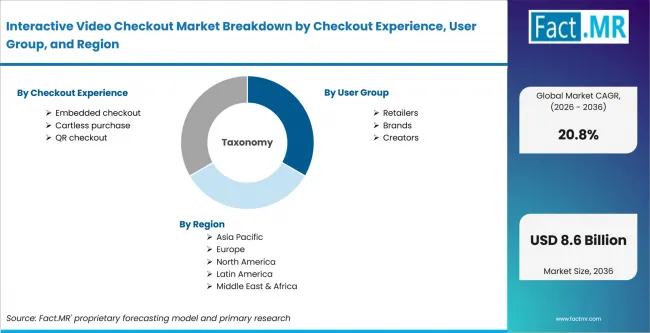
Interactive Video Checkout Market Breakdown By Checkout Experience, User Group, And Region | Source: Fact.MR
| Attribute | Details |
|---|---|
| Quantitative Units | USD Billion in 2026 to USD Billion by 2036 at CAGR. |
| Market Definition | Software and services that connect shoppable video, live selling and creator clips with checkout completion. |
| Checkout Experience | One-click checkout, embedded checkout, cartless purchase, QR checkout and social wallet checkout. |
| User Group | Creators, brands, retailers, marketplaces, agencies and social commerce teams. |
| Functional Module | Checkout, tagging, analytics, couponing, demo hosting and affiliate attribution. |
| Deployment | Shopify apps, marketplace-native tools, application programming interface integrations and white-label software-as-a-service. |
| Revenue Model | Software-as-a-service subscription, transaction fee, gross merchandise value share, enterprise license and creator tool bundles. |
| Regions Covered | North America, Latin America, Europe, Asia Pacific, Middle East and Africa. |
| Countries Covered | India, United States, China, South Korea, United Kingdom, Germany and Japan. |
| Key Companies Profiled | LiveMeUp, CommentSold, Bambuser, Firework, Sprii and Channelize.io including LiveScale. |
| Forecast Period | 2026 to 2036 |
| Approach | Hybrid top-down and bottom-up approach using market value anchors, platform activity, e-commerce indicators and vendor capability checks |
Source: Fact.MR analysis. Updated Jul 1, 2026
How is the market segmented?
-
By Checkout Experience:
- One-click checkout
- Embedded checkout
- Cartless purchase
- QR checkout
- Social wallet checkout
-
By User Group:
- Creators
- Brands
- Retailers
- Marketplaces
- Agencies
- Social commerce teams
-
By Functional Module:
- Checkout
- Tagging
- Analytics
- Couponing
- Demo hosting
- Affiliate attribution
-
By Deployment:
- Shopify apps
- Marketplace tools
- API integrations
- White-label SaaS
-
By Revenue Model:
- SaaS subscription
- Transaction fee
- GMV share
- Enterprise license
- Creator bundles
-
By Region:
- North America
- United States
- Canada
- Mexico
- Latin America
- Brazil
- Argentina
- Rest of Latin America
- Europe
- Germany
- United Kingdom
- France
- Italy
- Spain
- Rest of Europe
- Asia Pacific
- China
- India
- Japan
- South Korea
- ASEAN
- Middle East & Africa
- GCC Countries
- South Africa
- UAE
- Rest of Middle East & Africa
- North America
Frequently Asked Questions
Which checkout experience leads the Interactive Video Checkout Market?
Which country expands fastest in the Interactive Video Checkout Market?
How does the United States perform in the Interactive Video Checkout Market?
How does China perform in the Interactive Video Checkout Market?
How does South Korea perform in the Interactive Video Checkout Market?
How does the United Kingdom perform in the Interactive Video Checkout Market?
How does Germany perform in the Interactive Video Checkout Market?
How does Japan perform in the Interactive Video Checkout Market?
What is the primary driver in the Interactive Video Checkout Market?
What is the main restraint in the Interactive Video Checkout Market?
Why are Shopify apps important in this market?
Who worked on this report


Preview the report firsthand - request a free sample
Free SampleGet the brochure for pricing and purchase details
Download PDF