- Market Value (2025): USD 612.4 Bn
- Estimated Value (2026): USD 652.9 Bn
- Forecast Value (2036): USD 1238.6 Bn
- CAGR (2026-2036): 6.6%
What is the Internet Service Providers (ISP) Market forecast to be worth by 2036?
USD 652.9 billion in 2026 to USD 1238.6 billion by 2036, at a 6.6% CAGR.
- As per Fact.MR analysis, the internet service providers market reached USD 612.4 billion in 2025.
- Demand will increase from USD 652.9 billion in 2026 to USD 1238.6 billion in 2036.
- The market is forecast to record a 6.6% CAGR during 2026 to 2036 as corporate enterprises and digital platforms deploy fiber optic broadband.
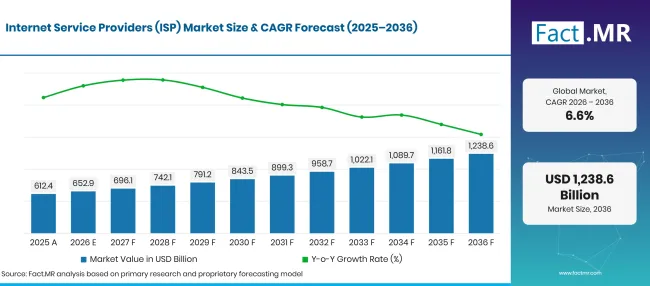
Factmr Internet Service Providers Isp Market Forecast Global | Source: Fact.MR
| Year | Basis | Market Value (USD billion) |
|---|---|---|
| 2025 | Actual | 612.4 |
| 2026 | Estimate | 652.9 |
| 2036 | Forecast | 1238.6 |
| CAGR 2026 to 2036 | Forecast period | 6.6% |
Source: Fact.MR analysis. Updated Oct 15, 2026
What are the defining numbers behind Internet Service Providers (ISP) Market growth?
USD 585.69 billion absolute chance between 2026 and 2036, with system integration and corporate enterprise connectivity forming the main purchasing base.
- Demand Drivers in the Market
- Global corporations increasingly rely on high-capacity fiber networks to interconnect hybrid cloud architectures and remote branch offices. Carrier-grade connections ensure stable low-latency access to mission-critical enterprise resource planning software. Corporate procurement leads favor tier-one carriers offering redundant transport routes to prevent operational downtime.
- E-commerce and financial trading firms mandate high-speed symmetrical bandwidth to process millions of transactions without data packet loss. Direct fiber links to hyperscale cloud providers allow trading platforms to execute microsecond data operations reliably. Documented uptime guarantees and continuous traffic monitoring guide carrier selection for institutional financial operations.
- Telecommunications network operators invest billions in fiber-to-the-premise rollouts to replace legacy copper and coaxial broadband networks. Dense optical fiber lines support growing symmetrical data traffic driven by high-definition video streaming and artificial intelligence workloads. Reliable fiber delivery schedules help internet providers capture high-average-revenue enterprise and residential accounts.
- Media and gaming corporations require ultra-broadband pipelines capable of handling sustained multi-terabit live streaming traffic. Content delivery networks partner directly with major ISPs to install edge caching servers within local exchange points. Validated peering bandwidth prevents network bottlenecks during global sports broadcasts and digital entertainment launches.
- Key Segments Analyzed
- By Product Types: System Integration holds 61.3% share in 2026, as enterprise clients bundle carrier connectivity with managed network solutions.
- By Application: Global Corporations accounts for 33.6% share in 2026 because multi-national enterprises contract dedicated gigabit leased lines and private circuits.
- Analyst Opinion at Fact.MR
- Shambhu Nath Jha, Principal Consultant at Fact.MR, states, “Internet service provider expansion depends on network resilience and low-latency edge cloud interconnectivity. Enterprise customers look beyond raw transit speeds to demand integrated cyber security and automated traffic routing. Telecom providers that combine high-density fiber backbones with turnkey managed SD-WAN architectures secure multi-year corporate connectivity contracts.”
- Strategic Implications
- Telecommunications carriers are deploying 10G optical networks and automated optical switching to meet accelerating enterprise artificial intelligence traffic. Dense fiber networks enable seamless data exchange between regional edge data centers and centralized hyperscale computing nodes.
- Corporate chief technology officers are transitioning legacy private networks to software-defined architectures before renewing telecommunications service contracts. Flexible network provisioning allows businesses to scale bandwidth dynamically across global branch offices without installing new physical cabling.
- Network equipment vendors and telecom operators are bundling cloud security services with business broadband connections. Integrated secure access service edge solutions protect corporate data against distributed denial-of-service attacks and cyber intrusions.
- Enterprise procurement directors are negotiating comprehensive service level agreements that guarantee low latency thresholds across international data routes. Enforceable service credits hold carriers accountable for network performance, reducing corporate risk during critical digital operations.
Germany is poised to record a 7.6% CAGR, while Brazil reaches 6.9% as gigabit fiber expansion scales across commercial corridors. The United States posts 6.3% growth, supported by heavy enterprise cloud adoption and federal investments in broadband network services. The United Kingdom records 5.6%, while Japan reaches 5.0%, backed by extensive nationwide fiber penetration and 5G fixed wireless access.
How does the Internet Service Providers (ISP) Market break down by segment?
System Integration 61.3%; Global Corporations 33.6% in 2026.
Which Product Types dominate?
System Integration holds 61.3% share in 2026.
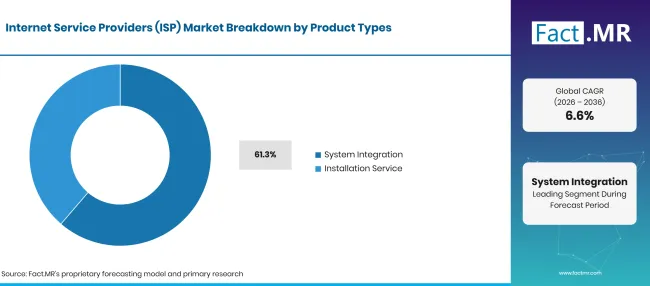
Factmr Internet Service Providers Isp Market Breakdown Product Types | Source: Fact.MR
| Product Types | Share (2026) |
|---|---|
| System Integration (Leading segment) | 61.3% |
| Other segments combined | 38.7%* |
| Total | 100.0% |
Source: Fact.MR analysis. Updated Oct 15, 2026
System integration leads internet provider spending because commercial enterprises demand end-to-end management of routers, firewalls, and cloud access nodes. Telecom carriers bundle broadband access with enterprise networking configuration and unified communications support. Installation services account for initial cabling, fiber trenching, and optical termination at customer premises. Other services include ongoing maintenance, network monitoring, and technical helpdesk operations.
What leads the Application segment?
Global Corporations accounts for 33.6% share in 2026.
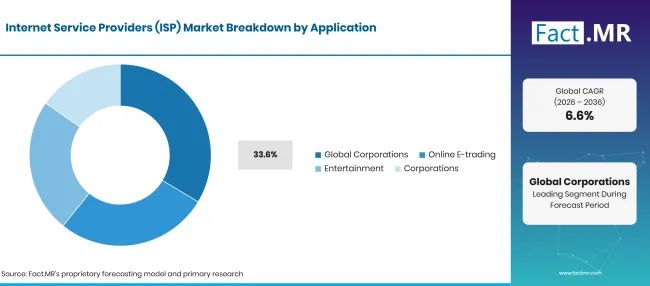
Factmr Internet Service Providers Isp Market Breakdown Application | Source: Fact.MR
| Application | Share (2026) |
|---|---|
| Global Corporations (Leading segment) | 33.6% |
| Other segments combined | 66.4%* |
| Total | 100.0% |
Source: Fact.MR analysis. Updated Oct 15, 2026
Global enterprises purchase multi-gigabit dedicated internet access, virtual private networks, and direct cloud on-ramps across multiple continents. E-trading platforms deploy specialized low-latency routes to facilitate automated financial clearing. Media and entertainment companies require burstable capacity to support high-definition video distribution. Domestic corporations utilize commercial fiber connections to support localized office automation and employee connectivity.
What is accelerating Internet Service Providers (ISP) Market adoption, and what is holding it back?
Exponential cloud data traffic and enterprise digitization accelerate internet service provider revenues. High capital expenditure requirements for rural fiber trenching and complex municipal right-of-way permitting can restrict rollout velocity.
Drivers Impact Analysis
| DRIVER | (~) % IMPACT ON CAGR | GEOGRAPHIC RELEVANCE | IMPACT TIMELINE |
|---|---|---|---|
| Hyperscale cloud connectivity demand | +1.0% | Global | Medium term (2–4 years) |
| Full-fiber FTTH network deployment | +0.8% | Europe, North America | Short term (<= 2 years) |
| Enterprise SD-WAN and cybersecurity bundling | +0.7% | North America, Europe | Medium term (2–4 years) |
| Government universal broadband subsidies | +0.5% | United States, Latin America | Medium term (2–4 years) |
| 5G mobile backhaul densification | +0.4% | Global | Long term (>= 4 years) |
Source: Fact.MR analysis. Updated Oct 15, 2026
Opportunity Impact Analysis
| OPPORTUNITY | (~) % IMPACT ON CAGR | GEOGRAPHIC RELEVANCE | IMPACT TIMELINE |
|---|---|---|---|
| Edge computing and data center interconnects | +0.8% | North America, Europe | Medium term (2–4 years) |
| Satellite internet connectivity for remote sites | +0.6% | Latin America, Asia | Medium term (2–4 years) |
| Multi-gigabit symmetrical residential broadband | +0.5% | North America, Europe | Short term (<= 2 years) |
| Private 5G network integration for factories | +0.4% | Japan, Germany | Medium term (2–4 years) |
Source: Fact.MR analysis. Updated Oct 15, 2026
Restraints Impact Analysis
| RESTRAINT | (~) % IMPACT ON CAGR | GEOGRAPHIC RELEVANCE | IMPACT TIMELINE |
|---|---|---|---|
| High civil engineering and fiber civil works costs | -0.8% | Global | Short term (<= 2 years) |
| Municipal right-of-way permitting bottlenecks | -0.6% | North America, Europe | Medium term (2–4 years) |
| Price competition and broadband commoditization | -0.5% | Europe, Latin America | Medium term (2–4 years) |
| Spectrum licensing and regulatory compliance costs | -0.4% | Global | Long term (>= 4 years) |
Source: Fact.MR analysis. Updated Oct 15, 2026
Which countries are scaling the Internet Service Providers (ISP) Market through 2036?
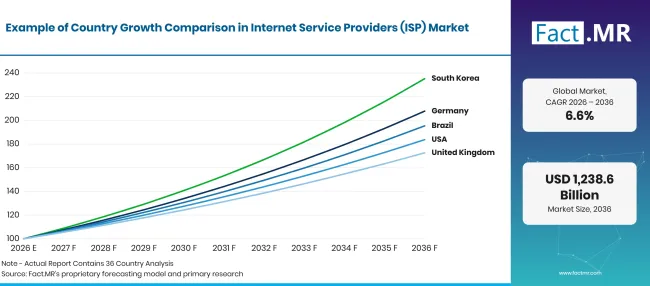
Factmr Internet Service Providers Isp Market Growth Index | Source: Fact.MR
| Country | CAGR (2026–2036) |
|---|---|
| Germany | 7.6% |
| Brazil | 6.9% |
| United States | 6.3% |
| United Kingdom | 5.6% |
| Japan | 5.0% |
Source: Fact.MR analysis. Updated Oct 15, 2026
Why is Germany leading internet service provider growth?
7.6% CAGR, driven by national full-fiber network rollouts and industrial digitization.
German telecommunications providers are rapidly expanding optical fiber networks to replace aging copper lines across commercial districts. Bundesnetzagentur reported that active fiber connections (FTTH/FTTB) reached 6.4 million at the end of 2025, with FTTH accounting for 5.2 million connections and fiber’s share of fixed broadband rising to 16.5% [3]. Industrial manufacturers contract high-bandwidth leased lines to support automated Industry 4.0 factories.
How is Brazil expanding internet service provider revenues?
6.9% CAGR, shaped by regional fiber provider consolidation and expanding cloud data centers.
Brazilian regional internet service providers deploy thousands of kilometers of fiber to connect secondary cities and commercial farming hubs. World Bank data sourced from the International Telecommunication Union recorded 51,047,559 fixed broadband subscriptions in Brazil in 2024 [4]. Enterprise demand for cloud access drives multi-carrier connections across São Paulo and Rio de Janeiro.
What is driving internet service provider sales in the United States?
6.3% CAGR, linked to corporate cloud migration, BEAD federal funding, and enterprise telecom cloud services.
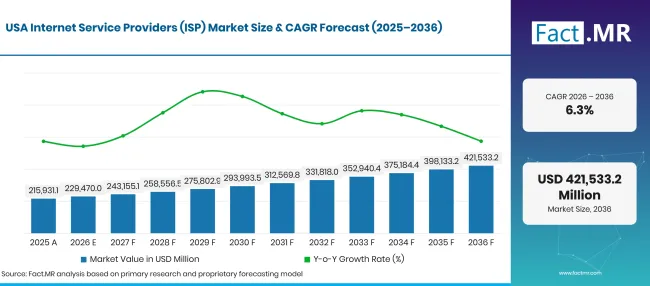
Factmr Internet Service Providers Isp Market Forecast Usa | Source: Fact.MR
U.S. carriers invest heavily in gigabit broadband networks to serve data-intensive commercial corporations and suburban households. The Federal Communications Commission reported that 96.9% of Americans had access to fixed terrestrial broadband at 100/20 Mbps, while the population without access fell by about 23% between June 2024 and June 2025 [1]. Hyperscale data center construction creates continuous demand for dark fiber and high-capacity backhaul.
How is the United Kingdom developing internet service provider demand?
5.6% CAGR, influenced by rapid alternative network full-fiber expansion and commercial cloud adoption.
UK telecommunications operators and independent network builders expand gigabit fiber coverage across metropolitan business hubs. Ofcom reported that full-fibre availability reached 78% of UK residential premises in July 2025 and that 42% of premises where full fibre was available had adopted it [2]. Commercial enterprises upgrade from copper broadband to symmetrical full-fiber lines to support hybrid cloud workplace software.
Why is Japan maintaining steady internet service provider growth?
5.0% CAGR, influenced by mature nationwide optical fiber infrastructure and high enterprise cloud connectivity.
Japanese telecom operators deliver high-speed optical broadband across dense metropolitan corridors and regional prefectures. The Ministry of Internal Affairs and Communications reported 40,994,746 FTTH subscriptions nationwide as of March 2025, equivalent to a 66.9% household penetration rate [5]. Financial institutions and electronics manufacturers prioritize low-latency routes to connect Tokyo data centers with international financial hubs.
Who leads the Internet Service Providers (ISP) Market?
Comcast Corporation and Charter Communications Inc. dominate U.S. residential and commercial broadband services, providing high-bandwidth DOCSIS and optical fiber connectivity. AT&T Inc. and Verizon Communications Inc. operate extensive national fiber networks paired with 5G wireless connectivity to serve global enterprise clients. Deutsche Telekom AG and Orange S.A. lead European telecommunications infrastructure, deploying cross-border fiber rings and managed services.
NTT Corporation, Telefónica S.A., Vodafone Group Plc, and BT Group plc provide comprehensive international connectivity, subsea cables, and enterprise cloud integration. Competition centers on fiber network coverage, routing latency, bundled cybersecurity offerings, and service level agreement reliability.
Which companies are the key providers?
Key companies include Comcast Corporation; AT&T Inc.; Verizon Communications Inc.; Charter Communications Inc.; Deutsche Telekom AG; Vodafone Group Plc; Orange S.A.; NTT Corporation; Telefónica S.A.; and BT Group plc.
- Comcast Corporation
- AT&T Inc.
- Verizon Communications Inc.
- Charter Communications Inc.
- Deutsche Telekom AG
- Vodafone Group Plc
- Orange S.A.
- NTT Corporation
- Telefónica S.A.
- BT Group plc
Bibliography
- [1] Federal Communications Commission. (2026, August 14). FCC broadband report shows rapid expansion of high-speed internet.
- [2] Office of Communications. (2025, November 19). Connected Nations UK report 2025.
- [3] Bundesnetzagentur. (2026, June 5). Telecoms annual report 2025.
- [4] World Bank. (n.d.). Fixed broadband subscriptions—Brazil [Data set]. International Telecommunication Union. Retrieved October 14, 2026.
- [5] Ministry of Internal Affairs and Communications. (2025). Fixed broadband service penetration status as of March 2025.
This Report Answers
- The report assesses technical delivery across optical fiber, cable broadband, fixed wireless, and commercial satellite links.
- Application analysis details why global corporate enterprise connectivity commands high-margin carrier revenue.
- The country comparison highlights how national gigabit infrastructure targets accelerate private fiber construction.
- Competitive benchmarking reviews carrier backbone capacity, peering relationships, and managed cybersecurity portfolios.
- Product analysis outlines why managed system integration generates recurring revenues above pure internet transit.
What does the Internet Service Providers (ISP) Market cover?
The market covers commercial entities operating network routing equipment, transmission towers, and fiber backbones to provide public and private internet connectivity. It evaluates services supplied to multinational enterprises, financial trading exchanges, small commercial businesses, and residential consumers. The research links with related Fact.MR studies on telecom cloud services and broadband network services.
What is included in the scope?
The scope includes fixed-line broadband, dedicated leased lines, ethernet private lines, fiber-to-the-home, and commercial satellite internet.
Managed enterprise networking hardware, router configuration, installation fees, and bundled recurring connectivity services are included. Revenues represent telecommunications service billing and connectivity subscription receipts.
What is excluded from the scope?
The scope excludes standalone mobile cellular handset voice plans, hardware-only optical cable manufacturing, and independent streaming video subscription fees.
Web hosting server hosting fees and third-party software-as-a-service application charges are excluded from internet connectivity market sizing.
How Was the Analysis Built?
The analysis draws on 120+ sources, 35+ company portfolios, 25+ countries, and more than 20 industry interviews.
- Primary Research: Primary research includes discussions with manufacturers, service providers, technology developers, distributors, end users, and subject-matter experts. These conversations examine purchasing priorities, product adoption, operational challenges, approval requirements, competitive positioning, and the factors that influence wider market acceptance.
- Desk Research: Desk research covers government statistics, regulatory publications, company filings, trade data, technical studies, industry associations, standards, public policy, and other authoritative sources. Every source used in the analysis is documented in the bibliography.
- Market Sizing and Forecasting: Market estimates combine historical performance, demand indicators, pricing and volume trends, segment shares, company participation, country-level growth, adoption patterns, investment activity, and barriers to market expansion.
- Data Validation and Update Cycle: Findings are validated by comparing primary interviews with public data, company activity, regulatory changes, trade patterns, and industry developments. Regular updates review new product launches, capacity changes, partnerships, approvals, and shifts in commercial adoption.
Segmentation
What is the report’s scope and coverage?
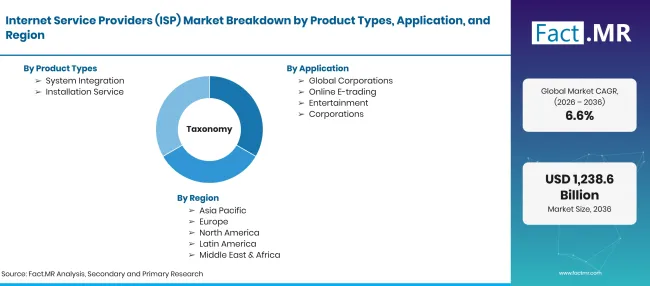
Factmr Internet Service Providers Isp Market Taxonomy | Source: Fact.MR
| Attribute | Details |
|---|---|
| Quantitative Units | USD billion |
| Market Definition | Commercial provisioning of fixed, wireless, and satellite telecommunications connectivity delivering internet access and data transmission. |
| Product Types | System Integration; Installation Service; Others |
| Application | Global Corporations; Online E-trading; Entertainment; Corporations; Others |
| Regions Covered | North America; Latin America; Western Europe; Eastern Europe; East Asia; South Asia & Pacific; Middle East & Africa |
| Countries Covered | Germany; Brazil; United States; United Kingdom; Japan |
| Companies Profiled | Comcast; AT&T; Verizon; Charter; Deutsche Telekom; Vodafone; Orange; NTT; Telefónica; BT Group |
| Forecast Period | 2026 to 2036 |
| Approach | Quantitative synthesis of telecommunications carrier revenues, regulatory subscription registries, capital expenditure reports, and enterprise service billing |
Source: Fact.MR analysis. Updated Oct 15, 2026
How is the market segmented?
-
By Product Types:
- System Integration
- Installation Service
- Others
-
By Application:
- Global Corporations
- Online E-trading
- Entertainment
- Corporations
- Others
-
By Region:
- North America
- Latin America
- Western Europe
- Eastern Europe
- East Asia
- South Asia & Pacific
- Middle East & Africa
Frequently Asked Questions
How big is the internet service providers market in 2026?
What is the CAGR from 2026 to 2036?
Which product type leads?
Which application leads?
Which companies participate in internet service providers?
Who worked on this report


Preview the report firsthand - request a free sample
Free SampleGet the brochure for pricing and purchase details
Download PDF