- Market Value (2025): USD 39.6 Bn
- Estimated Value (2026): USD 42.6 Bn
- Forecast Value (2036): USD 88.5 Bn
- CAGR (2026-2036): 7.6%
What is the Inverter Technology Refrigerators Market forecast to be worth by 2036?
USD 42.6 billion in 2026 to USD 88.5 billion by 2036, at a 7.6% CAGR.
- According to Fact.MR analysis, the inverter technology refrigerators market reached USD 39.6 billion in 2025.
- Sales are projected to increase from USD 42.6 billion in 2026 to USD 88.5 billion by 2036.
- The market is forecast to grow at a 7.6% CAGR during 2026 to 2036 as households choose models with variable-speed compressors.
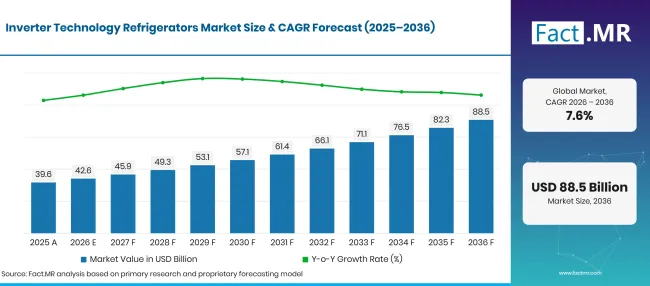
Factmr Inverter Technology Refrigerators Market Forecast Global | Source: Fact.MR
| Year | Basis | Market Value (USD billion) |
|---|---|---|
| 2025 | Historical | 39.6 |
| 2026 | Estimate | 42.6 |
| 2036 | Forecast | 88.5 |
| CAGR 2026 to 2036 | Forecast period | 7.6% |
Source: Fact.MR analysis. Updated Oct 16, 2026
What are the defining numbers behind Inverter Technology Refrigerators Market growth?
USD 45.9 billion absolute opportunity between 2026 and 2036, with double-door models and residential purchases forming the main sales base.
- Demand Drivers in the Market
- Households compare annual electricity use because refrigerators run throughout the day. The U.S. Environmental Protection Agency’s ENERGY STAR guidance explains that certified refrigerators use about 9% less energy than models meeting the federal minimum.
- European retailers use energy labels to compare refrigerator energy use and capacity. In November 2025, the European Commission reported that 17 of 18 refrigerators passed an EU testing exercise covering energy performance and related requirements [2].
- Variable-speed compressors adjust cooling output during normal use instead of treating every cooling cycle alike. Samsung publishes model-level information for its AI Inverter Compressor, allowing shoppers to examine the feature alongside storage size and electricity ratings.
- Key Segments Analyzed
- By Product Type: Double Door holds 42.5% share in 2026 as households seek separate cooling and freezer compartments.
- By Application: Residential accounts for 78.5% share in 2026 due to routine household replacement purchases.
- By Distribution Channel: Offline Retail accounts for 63.2% share in 2026 as shoppers compare dimensions and service arrangements in person.
- By Capacity: 300-500 Liters account for 58.3% share in 2026 because it serves households seeking moderate storage volume.
- Analyst Opinion at Fact.MR
- Shambhu Nath Jha, Principal Consultant at Fact.MR, states, “Inverter refrigerator purchases increasingly depend on how clearly households can compare annual electricity use, storage space, and long-term service costs. Manufacturers that combine variable-speed compressor technology with practical cabinet sizes, transparent energy ratings, and reliable repair support are better positioned to win replacement sales.”
- Strategic Implications
- Refrigerator makers should present annual energy consumption alongside usable volume and cabinet dimensions. Detailed product information helps customers compare energy performance against price without relying on broad promotional claims.
- Retailers should explain how inverter speed control changes cooling use and where shoppers can find the official energy rating. pairing product demonstrations with clear repair terms is expected to make model comparisons more useful.
- Compressor and electronics suppliers should adapt controllers to the cabinet sizes offered in each country. simple access to approved replacement parts is expected to help appliance manufacturers maintain service coverage after installation.
- Service teams should explain the repair process for inverter compressor electronics before a customer chooses a model. Clear warranty periods and parts availability help households compare ownership costs over a longer period.
Germany is forecast to grow at 8.3% CAGR as energy labels shape refrigerator reviews. Brazil follows at 7.6% as shoppers examine running costs and refrigerator capacity.
How does the Inverter Technology Refrigerators Market break down by segment?
Double Door 42.5%; Residential 78.5%; Offline Retail 63.2%; 300-500 Liters 58.3% in 2026.
Which Product Type?
Double Door holds 42.5% share in 2026.
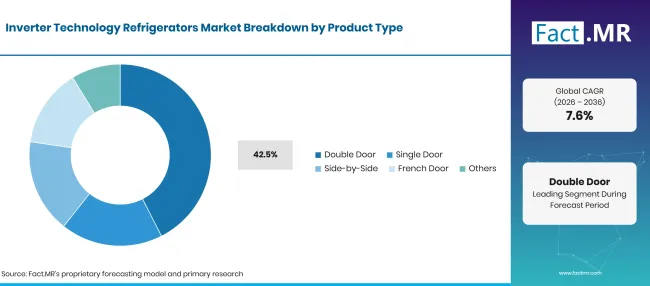
Factmr Inverter Technology Refrigerators Market Breakdown Product Type | Source: Fact.MR
| Product Type | Share (2026) |
|---|---|
| Double Door (Leading segment) | 42.5% |
| Other segments combined | 57.5% |
| Total | 100.0% |
Source: Fact.MR analysis. Updated Oct 16, 2026
Double-door refrigerators separate fresh-food and freezer storage in a format familiar to many households. Variable compressor use helps the cooling system respond as conditions change.
What leads the Application?
Residential holds 78.5% share in 2026.
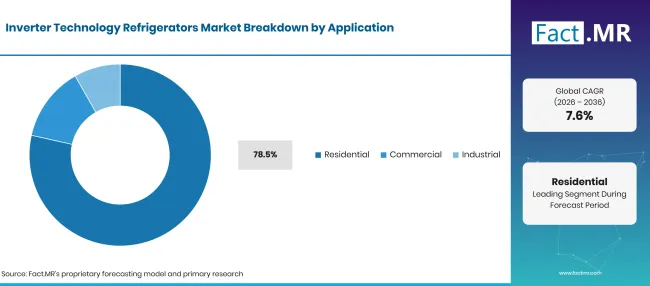
Factmr Inverter Technology Refrigerators Market Breakdown Application | Source: Fact.MR
| Application | Share (2026) |
|---|---|
| Residential (Leading segment) | 78.5% |
| Other segments combined | 21.5% |
| Total | 100.0% |
Source: Fact.MR analysis. Updated Oct 16, 2026
Residential buyers account for the stated 78.5% of 2026 applications. Households compare food-storage space and the amount of electricity used in normal use. ENERGY STAR reports that certified refrigerators are about 9% more efficient than standard-compliant models [5].
Which Distribution Channel serves the largest share?
Offline Retail holds 63.2% share in 2026.
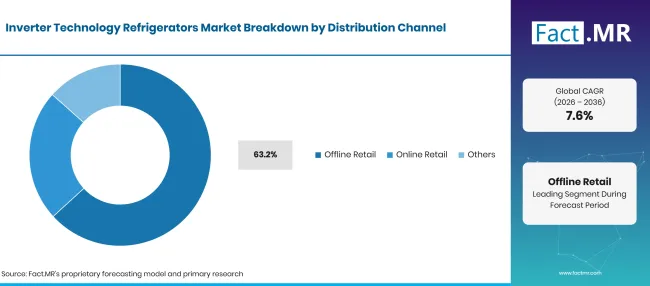
Factmr Inverter Technology Refrigerators Market Breakdown Distribution Channel | Source: Fact.MR
| Distribution Channel | Share (2026) |
|---|---|
| Offline Retail (Leading segment) | 63.2% |
| Other segments combined | 36.8% |
| Total | 100.0% |
Source: Fact.MR analysis. Updated Oct 16, 2026
Refrigerators take up a fixed space in the kitchen, making dimensions and door clearance important during shopping. Physical stores let families inspect shelf layouts and ask about delivery arrangements.
Which Capacity segment leads purchasing?
300-500 Liters holds 58.3% share in 2026.
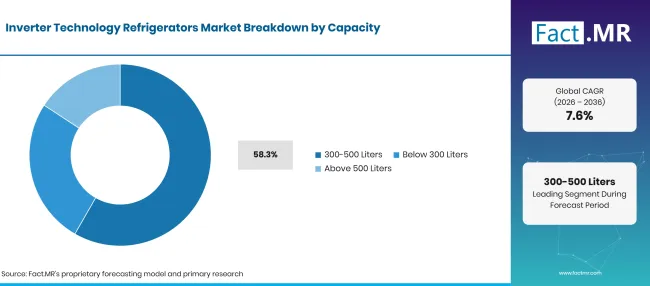
Factmr Inverter Technology Refrigerators Market Breakdown Capacity | Source: Fact.MR
| Capacity | Share (2026) |
|---|---|
| 300-500 Liters (Leading segment) | 58.3% |
| Other segments combined | 41.7% |
| Total | 100.0% |
Source: Fact.MR analysis. Updated Oct 16, 2026
A 300-500 Liter refrigerator offers separate food and freezer storage for households seeking a balanced cabinet size. Customers still need to check exact dimensions and stated annual electricity use because energy performance changes by model.
What is accelerating Inverter Technology Refrigerators Market adoption, and what is holding it back?
Energy performance reviews and usable storage needs support purchases, while upfront prices and repair considerations shape the replacement cycle.
Drivers Impact Analysis
| DRIVER | (~) % IMPACT ON CAGR | GEOGRAPHIC RELEVANCE | IMPACT TIMELINE |
|---|---|---|---|
| Electricity operating costs | +1.0% | Global | Medium term (2–4 years) |
| Energy labels | +0.8% | Europe, Brazil | Medium term (2–4 years) |
| Adjustable compressor control | +0.7% | Global | Long term (>= 4 years) |
| Household replacement | +0.6% | Global | Medium term (2–4 years) |
| Retail demonstrations | +0.4% | Global | Short term (<= 2 years) |
Source: Fact.MR analysis. Updated Oct 16, 2026
Opportunity Impact Analysis
| OPPORTUNITY | (~) % IMPACT ON CAGR | GEOGRAPHIC RELEVANCE | IMPACT TIMELINE |
|---|---|---|---|
| Clear annual energy data | +0.8% | Global | Short term (<= 2 years) |
| Mid-size cabinet upgrades | +0.7% | Global | Medium term (2–4 years) |
| Online model filters | +0.5% | Global | Short term (<= 2 years) |
| Repair and service plans | +0.4% | Global | Long term (>= 4 years) |
Source: Fact.MR analysis. Updated Oct 16, 2026
Restraints Impact Analysis
| RESTRAINT | (~) % IMPACT ON CAGR | GEOGRAPHIC RELEVANCE | IMPACT TIMELINE |
|---|---|---|---|
| Upfront appliance cost | -0.8% | Global | Short term (<= 2 years) |
| Specialist electronics repair | -0.6% | Global | Medium term (2–4 years) |
| Kitchen size limits | -0.5% | Global | Long term (>= 4 years) |
| Label compliance work | -0.4% | Europe, Brazil | Medium term (2–4 years) |
Source: Fact.MR analysis. Updated Oct 16, 2026
Which countries are scaling the Inverter Technology Refrigerators Market through 2036?
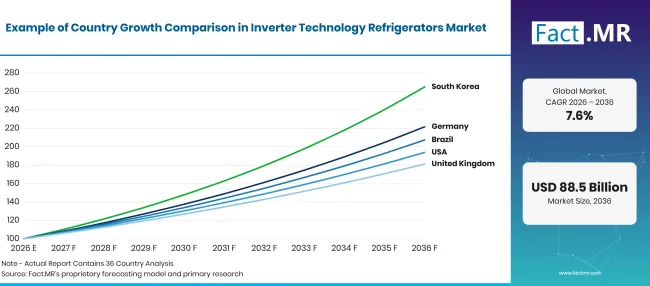
Factmr Inverter Technology Refrigerators Market Growth Index | Source: Fact.MR
| Country | CAGR (2026–2036) |
|---|---|
| Germany | 8.3% |
| Brazil | 7.6% |
| United States | 6.8% |
| United Kingdom | 6.1% |
| Japan | 5.4% |
Source: Fact.MR analysis. Updated Oct 16, 2026
What supports inverter refrigerator sales in Germany?
8.3% CAGR, driven by household replacement, energy-label comparisons, and a large installed refrigerator base.
German households often compare electricity use, size, and warranty coverage before replacing a refrigerator. The reported a stock of 51.0 million household refrigerators and fridge-freezers in December 2025 [3]. This large installed base creates steady replacement demand across the country. Retailers use energy labels and appliance dimensions to help buyers compare different models, including inverter-equipped refrigerators.
What supports inverter refrigerator sales in Brazil?
7.6% CAGR, shaped by household replacement, energy-efficiency comparisons, and retail product labeling.
Brazilian families often compare electricity use and refrigerator size when buying a replacement. In February 2026, launched its public PBE model search service, making it easier for shoppers to compare refrigerators by capacity and energy rating [4]. Major appliance retailers also support sales through in-store demonstrations and home delivery options. Buyers often consider warranty coverage and the availability of local repair services before making a final decision.
What supports inverter refrigerator sales in the United States?
6.8% CAGR, linked to replacement purchases, energy-efficiency labels, and service support.
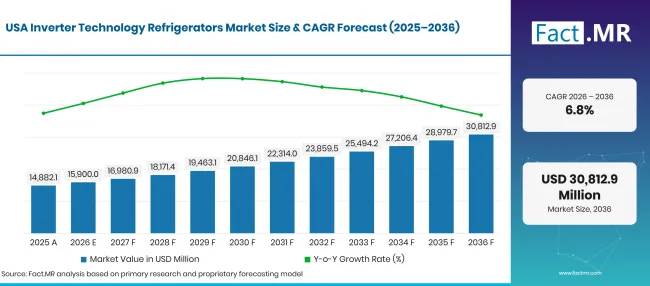
Factmr Inverter Technology Refrigerators Market Forecast Usa | Source: Fact.MR
U.S. refrigerator purchases are often driven by the need to replace aging appliances and manage household energy expenses. Shoppers usually review storage space, kitchen fit, and warranty coverage before selecting a model, while retailers emphasize energy-saving features.
What supports inverter refrigerator sales in the United Kingdom?
6.1% CAGR, influenced by household replacement, kitchen fit, and appliance running costs.
UK consumers often look at refrigerator size and energy ratings before making a purchase. The recorded a household-appliance consumer price index of 123.4 in December 2025 [6]. Retailers provide energy-label information and fitting measurements to help shoppers choose a suitable model. Many households also review cabinet dimensions online before arranging delivery.
What supports inverter refrigerator sales in Japan?
5.4% CAGR, shaped by compact kitchen layouts, energy-use comparisons, and practical storage design.
Japanese households often pay attention to refrigerator size, shelf access, and electricity use when replacing an existing unit. The reported in its 2025 refrigerator guidance that reducing excess food loading can save 43.84 kWh annually [7]. Multi-drawer designs appeal to buyers who want better organization in daily use. Home-delivery services also help households choose models that fit smaller entrances and existing kitchen layouts.
Who leads the Inverter Technology Refrigerators Market?
Samsung Electronics and LG Electronics offer variable-speed compressor refrigerator models across several cabinet formats. Samsung describes its AI Inverter Compressor as adjusting speed according to usage patterns. LG markets inverter compressor refrigerator technology in household product ranges. Their product reviews often focus on cabinet design as well as labelled electricity use [1].
Whirlpool Corporation, Haier Group, Panasonic and Electrolux offer household refrigerator ranges in their markets. BSH Home Appliances, Midea Group, Hitachi and Godrej & Boyce also supply refrigerators with model specifications varying by region.
Which companies are the key providers?
Key companies include Samsung Electronics; LG Electronics; Whirlpool Corporation; Haier Group; Panasonic; Electrolux; BSH Home Appliances (Bosch Siemens Hausgeräte); Midea Group; Hitachi; and Godrej & Boyce.
- Samsung Electronics
- LG Electronics
- Whirlpool Corporation
- Haier Group
- Panasonic
- Electrolux
- BSH Home Appliances (Bosch Siemens Hausgeräte)
- Midea Group
- Hitachi
- Godrej & Boyce
Bibliography
- [1] Samsung Electronics. (2025, July 1). 658 L Bespoke AI 4-Door French Door Refrigerator with Beverage Centre™ RM90F66CNC.
- [2] European Commission, Directorate-General for Internal Market, Industry, Entrepreneurship and SMEs. (2025, November 25). Tests of fridges show positive results.
- [3] Statistisches Bundesamt (Destatis). (n.d.). Equipment with consumer durables: Household appliances and others by territory.
- [4] Instituto Nacional de Metrologia, Qualidade e Tecnologia. (2026, February 2). Sistema PBE para consulta dos produtos etiquetados.
- [5] U.S. Environmental Protection Agency. (2025). ENERGY STAR Most Efficient 2025: Refrigerators.
- [6] Office for National Statistics. (2026, September 16). CPI INDEX 05.3: Household appliances, fitting and repairs 2015=100 [December 2025 observation].
- [7] Consumer Affairs Agency, Government of Japan. (n.d.). 冷蔵庫を整理する [Organize your refrigerator].
This Report Answers
- The report assesses product-type preferences across double-door, single-door and multi-door refrigerators.
- Application analysis compares residential purchases with commercial and industrial uses of inverter cooling.
- Country analysis reviews the effect of electricity labels and household replacement patterns in five countries.
- Competitive analysis covers refrigerator suppliers with product lines using variable-speed compressor technology.
- Capacity analysis explains how kitchen space and family requirements affect refrigerator selection.
What does the Inverter Technology Refrigerators Market cover?
The market covers refrigerators equipped with inverter-controlled or variable-speed compressor systems. The scope includes specified door layouts and capacity bands sold to household or useful professional users.
What is included in the scope?
The scope includes finished refrigerators sold through physical retailers and online channels. It covers residential refrigerator formats and qualifying equipment in the stated application taxonomy.
What is excluded from the scope?
The scope excludes standalone compressor components sold without a finished refrigerator, outside repair services and cold rooms. General freezer sales and air-conditioning systems remain outside the core refrigerator definition.
How Was the Analysis Built?
The analysis draws on 120+ sources, 35+ company portfolios, 25+ countries, and more than 20 industry interviews.
- Primary Research: Primary research includes discussions with manufacturers, service providers, technology developers, distributors, end users, and subject-matter experts. These conversations examine purchasing priorities, product adoption, operational challenges, approval requirements, competitive positioning, and the factors that influence wider market acceptance.
- Desk Research: Desk research covers government statistics, regulatory publications, company filings, trade data, technical studies, industry associations, standards, public policy, and other authoritative sources. Every source used in the analysis is documented in the bibliography.
- Market Sizing and Forecasting: Market estimates combine historical performance, demand indicators, pricing and volume trends, segment shares, company participation, country-level growth, adoption patterns, investment activity, and barriers to market expansion.
- Data Validation and Update Cycle: Findings are validated by comparing primary interviews with public data, company activity, regulatory changes, trade patterns, and industry developments. Regular updates review new product launches, capacity changes, partnerships, approvals, and shifts in commercial adoption.
Segmentation
What is the report’s scope and coverage?
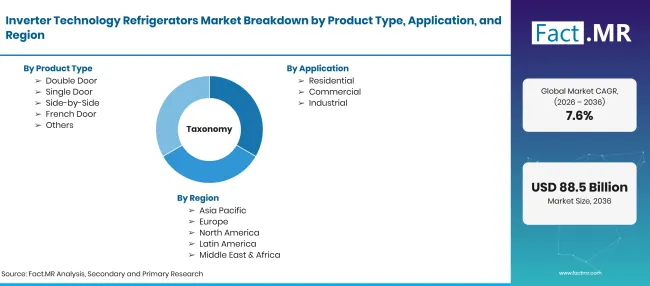
Factmr Inverter Technology Refrigerators Market Taxonomy | Source: Fact.MR
| Attribute | Details |
|---|---|
| Quantitative Units | USD billion in 2026 to USD billion by 2036 at a CAGR |
| Market Definition | Finished household and relevant commercial refrigerators equipped with inverter-controlled or variable-speed compressor systems. |
| Product Type | Double Door; Single Door; Side-by-Side; French Door; Others |
| Application | Residential; Commercial; Industrial |
| Distribution Channel | Offline Retail; Online Retail; Others |
| Capacity | Below 300 Liters; 300–500 Liters; Above 500 Liters |
| Regions Covered | North America; Latin America; Western Europe; Eastern Europe; East Asia; South Asia & Pacific; Middle East & Africa |
| Countries Covered | Germany; Brazil; United States; United Kingdom; Japan |
| Companies Profiled | Samsung Electronics; LG Electronics; Whirlpool Corporation; Haier Group; Panasonic; Electrolux; BSH Home Appliances (Bosch Siemens Hausgeräte); Midea Group; Hitachi; Godrej & Boyce |
| Forecast Period | 2026 to 2036 |
| Approach | Assessment of refrigerator product types, household and commercial applications, capacity preferences, sales channels, energy-label requirements, country replacement patterns, and documented manufacturer specifications. |
Source: Fact.MR analysis. Updated Oct 16, 2026
How is the market segmented?
-
By Product Type
- Double Door
- Single Door
- Side-by-Side
- French Door
- Others
-
By Application
- Residential
- Commercial
- Industrial
-
By Distribution Channel
- Offline Retail
- Online Retail
- Others
-
By Capacity
- Below 300 Liters
- 300-500 Liters
- Above 500 Liters
-
By Region
- North America
- Latin America
- Western Europe
- Eastern Europe
- East Asia
- South Asia & Pacific
- Middle East & Africa
Frequently Asked Questions
How big is the inverter technology refrigerators market in 2026?
What is the CAGR from 2026 to 2036?
Which product type leads?
Who are the main companies in the inverter technology refrigerators market?
Who worked on this report


Preview the report firsthand - request a free sample
Free SampleGet the brochure for pricing and purchase details
Download PDF