- Market Value (2025): USD 218.0 Mn
- Estimated Value (2026): USD 229.9 Mn
- Forecast Value (2036): USD 390.8 Mn
- CAGR (2026-2036): 5.5%
What is the Kayak Paddles Market forecast to be worth by 2036?
USD 229.9 million in 2026 to USD 390.8 million by 2036, at a 5.5% CAGR.
- According to Fact.MR analysis, the kayak paddles market reached USD 218.0 million in 2025.
- Sales are projected to reach from USD 229.9 million in 2026 to USD 390.8 million in 2036 as buyers replace worn paddles and select lighter designs for longer trips.
- The 2026 to 2036 outlook represents a 5.5% CAGR, with product selection shaped by paddle fit and the frequency of use.
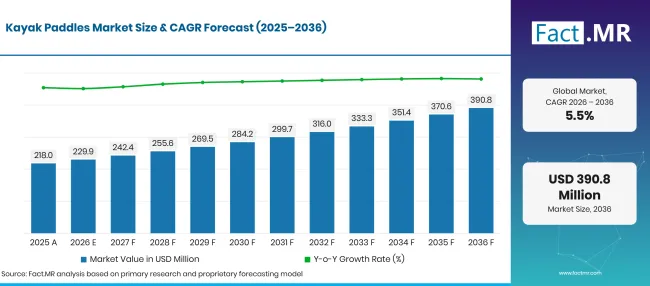
Kayak Paddles Market Forecast Global | Source: Fact.MR
| Year | Basis | Market Value (USD million) |
|---|---|---|
| 2025 | Actual | 218.0 |
| 2026 | Estimate | 229.9 |
| 2036 | Forecast | 390.8 |
| CAGR 2026 to 2036 | Forecast period | 5.5% |
Source: Fact.MR analysis. Updated Oct 30, 2026
What are the defining numbers behind Kayak Paddles Market growth?
USD 160.9 million in absolute value growth through 2036, with carbon fiber and touring paddles central to product mix.
- Demand Drivers in the Market
- Recreational paddlers create a broad equipment base. Outdoor Industry Association reported 15.3 million U.S. recreational kayaking participants in its 2026 Paddlesports Report [1].
- Touring paddlers place a premium on reduced weight during repeated strokes. Carbon fiber construction supports that preference, especially for longer outings where blade control and fatigue become more noticeable.
- Paddle length must suit boat width and paddler height. As skills improve, aluminum-paddle users can consider fiberglass or carbon fiber.
- Key Segments Analyzed
- By Material Type: Carbon Fiber represents 38.7% of 2026 revenue, reflecting interest in low-weight paddles used for repeated touring strokes.
- By Blade Design: Asymmetrical blades hold 42.3% of 2026 revenue, as their offset profile helps with common touring stroke patterns.
- By Application: Touring accounts for 38.7% of 2026 revenue, with buyers comparing balance and fatigue across longer trips.
- By Distribution Channel: Specialty Stores contribute 42.1% of 2026 revenue, since in-person paddle fitting helps narrow choices.
- Analyst Opinion at Fact.MR
- Shambhu Nath Jha, Principal Consultant at Fact.MR, states, “Kayak paddle selection is becoming more closely tied to how often people paddle, the type of water they use, and the weight they are comfortable handling. Recreational users may remain with basic aluminum models, while touring and experienced paddlers are more likely to compare lighter carbon fiber or fiberglass options.”
- Strategic Implications
- Specialty retailers should offer straightforward length-selection guidance and allow customers to compare grips and blade positions.
- Kayak brands can improve packaged equipment choices by matching bundled paddles to intended boat width and activity.
- Distributors should keep replacement shafts and commonly requested paddle lengths available during the seasonal sales cycle.
Across the five country markets, Germany is projected to register a 6.1% CAGR through 2036. Brazil follows at 5.6% and the United States at 5.0%. The United Kingdom has a 4.5% forecast while Japan records 4.0%. Each outlook reflects differences in watersports access and the balance between club-based activity and casual leisure purchases.
How does the Kayak Paddles Market break down by segment?
Carbon Fiber leads material at 38.7%; Asymmetrical leads blade design at 42.3%; Touring leads application at 38.7%.
Which Material Type holds the main revenue share?
Carbon Fiber accounts for 38.7% of 2026 market value.
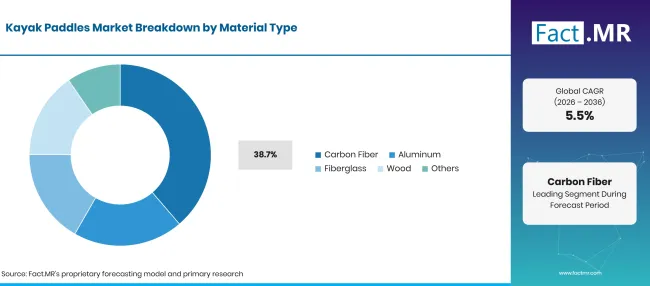
Kayak Paddles Market Breakdown Material Type | Source: Fact.MR
| Which Material Type holds the main revenue share | Share (2026) |
|---|---|
| Carbon Fiber (Leading segment) | 38.7% |
| Other segments combined | 61.3% |
| Total | 100.0% |
Source: Fact.MR analysis. Updated Oct 30, 2026
Carbon fiber paddles appeal to touring users seeking low weight. Aluminum serves casual outings and rental use. Fiberglass offers another balance of weight and blade stiffness. Wood remains relevant to traditional construction. Material choice follows trip duration and handling preference.
What leads the Blade Design segment?
Asymmetrical leads with 42.3% of 2026 market value.
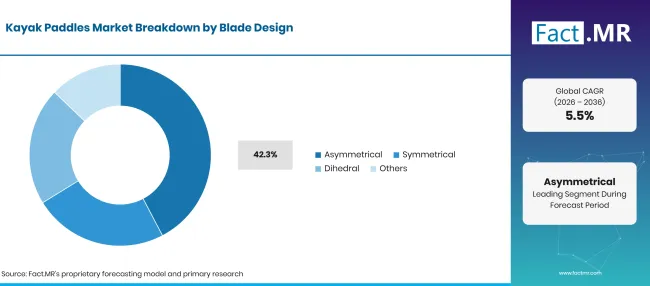
Kayak Paddles Market Breakdown Blade Design | Source: Fact.MR
| What leads the Blade Design segment | Share (2026) |
|---|---|
| Asymmetrical (Leading segment) | 42.3% |
| Other segments combined | 57.7% |
| Total | 100.0% |
Source: Fact.MR analysis. Updated Oct 30, 2026
Asymmetrical blades have an offset shape intended to enter and leave the water smoothly during a forward stroke. Touring paddlers may prefer that feel over longer distances, while symmetrical blades suit situations requiring frequent changes of direction. Shoppers also compare dihedral blade surfaces, which affect how water flows over the blade during a stroke.
How does Application shape the paddle mix?
Touring represents 38.7% of 2026 market value.
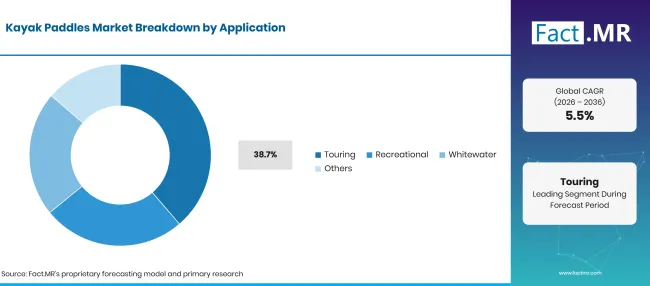
Kayak Paddles Market Breakdown Application | Source: Fact.MR
| How does Application shape the paddle mix | Share (2026) |
|---|---|
| Touring (Leading segment) | 38.7% |
| Other segments combined | 61.3% |
| Total | 100.0% |
Source: Fact.MR analysis. Updated Oct 30, 2026
Fact.MR analysis indicates that touring buyers typically plan longer sessions and pay attention to weight distribution across the shaft. Recreational paddles serve shorter leisure outings and first-time kayak ownership, where familiar handling and price guide purchases. Whitewater use creates different requirements for blade control and impact tolerance.
Where do paddlers purchase their equipment?
Specialty Stores capture 42.1% of 2026 market value.
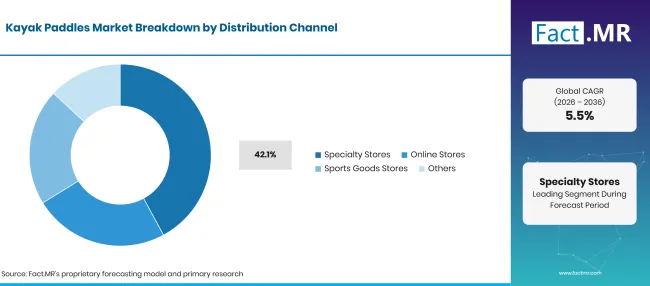
Kayak Paddles Market Breakdown Distribution Channel | Source: Fact.MR
| Where do paddlers purchase their equipment | Share (2026) |
|---|---|
| Specialty Stores (Leading segment) | 42.1% |
| Other segments combined | 57.9% |
| Total | 100.0% |
Source: Fact.MR analysis. Updated Oct 30, 2026
Fact.MR analysis indicates that specialty stores help paddlers compare grip and blade geometry. Fitting assistance benefits customers who know their kayak width. Online stores serve repeat buyers familiar with their preferred dimensions, while sporting-goods outlets provide access to basic equipment.
What is accelerating Kayak Paddles Market adoption, and what is holding it back?
Recreational access and lightweight paddle preferences support sales; fitting uncertainty and price sensitivity limit upgrades.
Drivers Impact Analysis
| DRIVER | (~) % IMPACT ON CAGR | GEOGRAPHIC RELEVANCE | IMPACT TIMELINE |
|---|---|---|---|
| Recreational kayaking participation | +1.1% | North America; Europe | Short term |
| Touring demand for lower paddle weight | +0.9% | Europe; North America | Medium term |
| Specialty-store fitting and guidance | +0.7% | Global | Short term |
| Replacement of entry-level paddles | +0.5% | Global | Medium term |
| Club and training access | +0.4% | Europe; Japan; Brazil | Long term |
Source: Fact.MR analysis. Updated Oct 30, 2026
Opportunity Impact Analysis
| OPPORTUNITY | (~) % IMPACT ON CAGR | GEOGRAPHIC RELEVANCE | IMPACT TIMELINE |
|---|---|---|---|
| Touring-oriented lightweight upgrades | +0.7% | Germany; UK; USA | Medium term |
| Retail fitting and demonstration services | +0.6% | Global | Short term |
| Repair and replacement assortments | +0.4% | Global | Medium term |
| Paddles for organized skills training | +0.3% | Japan; Brazil; Europe | Long term |
Source: Fact.MR analysis. Updated Oct 30, 2026
Restraints Impact Analysis
| RESTRAINT | (~) % IMPACT ON CAGR | GEOGRAPHIC RELEVANCE | IMPACT TIMELINE |
|---|---|---|---|
| Higher prices for carbon fiber | -0.5% | Global | Short term |
| Infrequent recreational use | -0.4% | North America; Europe | Medium term |
| Fit mistakes in remote purchases | -0.3% | Global | Short term |
| Seasonal access and weather | -0.2% | Temperate markets | Long term |
Source: Fact.MR analysis. Updated Oct 30, 2026
Which countries are scaling the Kayak Paddles Market through 2036?
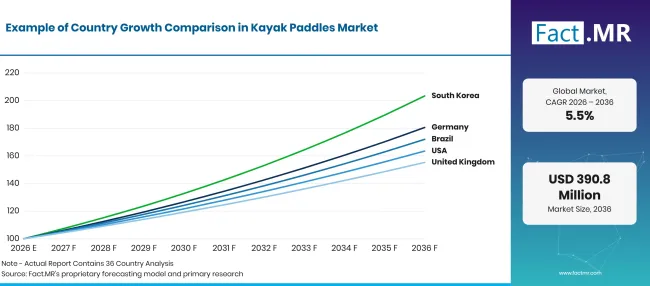
Kayak Paddles Market Growth Index | Source: Fact.MR
| Country | CAGR (2026 to 2036) |
|---|---|
| Germany | 6.1% |
| Brazil | 5.6% |
| United States | 5.0% |
| United Kingdom | 4.5% |
| Japan | 4.0% |
Source: Fact.MR analysis. Updated Oct 30, 2026
What supports paddle purchases in Germany?
6.1% CAGR, shaped by organized canoe access.
Germany's club-based touring routes give recreational kayakers regular chances to compare paddle weight and blade shape. Carbon fiber and fiberglass models have a clearer value for users who plan long sessions. Specialty retailers can help match shaft length to touring kayak width. Replacement purchases also arise when club users change from shared equipment to their own paddles.
How is Brazil building a market for kayak paddles?
5.6% CAGR, shaped by regional canoe training.
Kayak paddle demand in Brazil has a link to regional canoe training and competitive activity. Training groups offer a route into kayaking equipment purchases. Coaches can explain why paddle blade shape changes stroke control. Clubs also need replacement equipment for repeated practice sessions.
What shapes United States paddle demand?
5.0% CAGR, led by recreational scale.
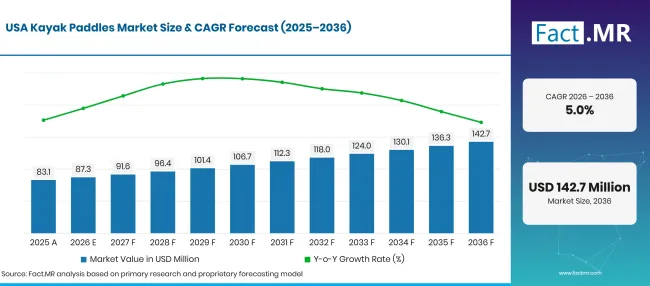
Kayak Paddles Market Forecast Usa | Source: Fact.MR
The United States combines a large recreational kayaking audience with specialist retail and online equipment channels. Regular kayakers have an incentive to compare fatigue and shaft weight on touring trips. A wide choice of kayak designs also creates demand for different shaft lengths. Replacement sales reach users who retain a boat but change its accessories.
What supports kayaking paddle demand in the United Kingdom?
4.5% CAGR, backed by paddlesports activity.
In the United Kingdom, waterways and local clubs give paddlers opportunities to try touring and recreational equipment. Paddle UK reported in July 2026 that 24% of U.K. adults took part in paddlesports during 2025 [3]. Shops can guide buyers through choices of blade size and shaft length. Touring on inland waterways favors comfortable repeated strokes. Equipment replacement provides another reason for paddlers to revisit specialist stores.
How does Japan support paddle use?
4.0% CAGR, supported by organized competition.
Japan's organized slalom and wildwater competitions create demand for paddles chosen for stroke control. The Japan Canoe Federation scheduled its national slalom and wildwater championship for October 2025 [2]. Youth canoe events give learners an early chance to compare equipment for different activities. Specialty retail advice can help users identify the right blade shape. Experienced whitewater paddlers also have reasons to select a responsive shaft.
Who competes in the Kayak Paddles Market?
Fact.MR analysis assesses product specialists compete on blade construction and fit. Aqua Bound and Bending Branches offer paddle ranges targeted at different paddling styles.
Werner Paddles is associated with touring and whitewater equipment. Carlisle Paddles serves more price-sensitive recreational use. Boat manufacturers and brands including Perception, Pelican / Pelican Intl Inc. participate in the equipment ecosystem through compatible paddles, branded accessories or dealer relationships. Competitive positioning depends on accessible product information and channel fit rather than unsupported revenue-share rankings.
Which companies are the key providers?
Key companies include Aqua Bound; Bending Branches; Werner Paddles; Carlisle Paddles; Perception; Pelican / Pelican Intl Inc.
- Aqua Bound
- Bending Branches
- Werner Paddles
- Carlisle Paddles
- Perception
- Pelican / Pelican Intl Inc.
Bibliography
- [1] Outdoor Industry Association. (2026). 2026 Paddlesports Report: Executive summary.
- [2] Japan Canoe Federation. (2025).[2025 Japan Canoe Slalom Championships and 48th NHK Cup All-Japan Canoe Slalom Competition].
- [3] Paddle UK. (2026, July 24). Survey shows growth in paddlesports and coastal activities.
- [4] U.S. Coast Guard. (2025, July 1). Coast Guard reports fewest boating fatalities in more than 50 years.
- [5] Environment Agency. (2026, March 20). Our waterways - a plan for 2025 – end of season report.
- [6] Japan Canoe Federation. (2025).[2025 National Boys and Girls Canoe Competition].
This Report Answers
- How material selection affects paddle weight and the cost of upgrading beyond aluminum.
- Why asymmetrical blades hold a prominent place in touring-focused purchases.
- How specialty stores support shaft-length selection and product comparisons.
- What differs between recreational, touring and whitewater buying decisions.
- How demand conditions differ across Germany, Brazil, the United States, the United Kingdom and Japan.
What does the Kayak Paddles Market cover?
Market covers double-bladed paddles sold for use with kayaks, including recreational and touring models and specialized whitewater designs. Revenue includes compatible paddles sold separately and as part of kayak equipment packages when the paddle value is identifiable. Paddle materials and blade geometry are treated as separate dimensions because each affects product choice differently. The wider product category is discussed in the kayak equipment market.
What is included in the scope?
Carbon fiber, aluminum, fiberglass and wooden kayak paddles are counted alongside other material options. Fixed-length and adjustable-length models are covered when they are intended for kayaking. The analysis considers purchase routes through specialty stores and online sellers as well as general sporting-goods shops. Touring, recreation and whitewater use define the application boundary.
What is excluded from the scope?
Single-bladed canoe paddles are outside the market boundary. Stand-up paddleboard paddles, oars and motorized propulsion systems are also excluded unless they are specifically sold as double-bladed kayak paddles. Kayak hulls, buoyancy aids and unrelated water-sports accessories do not contribute to paddle-only market revenue. Equipment categories also include kiteboarding equipment as a separate market.
How Was the Analysis Built?
The analysis draws on 120+ sources, 35+ company portfolios, 25+ countries, and more than 20 industry interviews.
- Primary Research: Primary research includes discussions with manufacturers, service providers, technology developers, distributors, end users, and subject-matter experts. These conversations examine purchasing priorities, product adoption, operational challenges, approval requirements, competitive positioning, and the factors that influence wider market acceptance.
- Desk Research: Desk research covers government statistics, regulatory publications, company filings, trade data, technical studies, industry associations, standards, public policy, and other authoritative sources. Every source used in the analysis is documented in the bibliography.
- Market Sizing and Forecasting: Market estimates combine historical performance, demand indicators, pricing and volume trends, segment shares, company participation, country-level growth, adoption patterns, investment activity, and barriers to market expansion.
- Data Validation and Update Cycle: Findings are validated by comparing primary interviews with public data, company activity, regulatory changes, trade patterns, and industry developments. Regular updates review new product launches, capacity changes, partnerships, approvals, and shifts in commercial adoption.
Segmentation
What is the report’s scope and coverage?
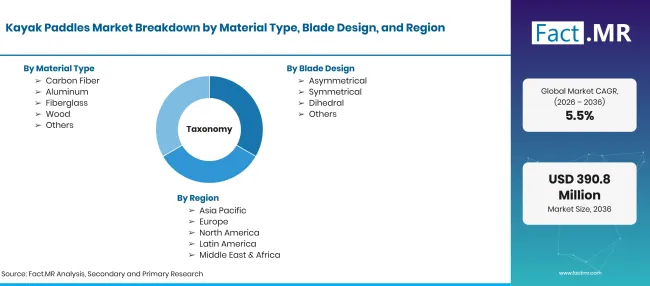
Kayak Paddles Market Taxonomy | Source: Fact.MR
| Attribute | Details |
|---|---|
| Quantitative Units | USD million |
| Market Definition | Standalone and bundled double-bladed paddles intended for kayaking; retail and manufacturer channels |
| Material Type | Carbon Fiber; Aluminum; Fiberglass; Wood; Others |
| Blade Design | Asymmetrical; Symmetrical; Dihedral |
| Application | Touring; Recreational; Whitewater; Others |
| Distribution Channel | Specialty Stores; Online Stores; Sports Goods Stores; Others |
| Regions Covered | North America; Latin America; Western Europe; Eastern Europe; East Asia; South Asia & Pacific; Middle East & Africa |
| Countries Covered | Germany; Brazil; United States; United Kingdom; Japan |
| Companies Profiled | Aqua Bound; Bending Branches; Werner Paddles; Carlisle Paddles; Perception; Pelican / Pelican Intl Inc. |
| Forecast Period | 2026 to 2036 |
| Approach | Market value interpretation informed by kayak participation; product mix; channel positioning; product portfolios |
Source: Fact.MR analysis. Updated Oct 30, 2026
How is the market segmented?
-
By Material Type
- Carbon Fiber
- Aluminum
- Fiberglass
- Wood
- Others
-
By Blade Design
- Asymmetrical
- Symmetrical
- Dihedral
-
By Application
- Touring
- Recreational
- Whitewater
- Others
-
By Distribution Channel
- Specialty Stores
- Online Stores
- Sports Goods Stores
- Others
-
By Region
- North America
- Latin America
- Western Europe
- Eastern Europe
- East Asia
- South Asia & Pacific
- Middle East & Africa
Frequently Asked Questions
How big is the Kayak Paddles Market in 2026?
What is the CAGR of the Kayak Paddles Market from 2026 to 2036?
Which material type leads the Kayak Paddles Market?
Which blade design leads the Kayak Paddles Market?
Who are the leading companies in the Kayak Paddles Market?
Who worked on this report


Preview the report firsthand - request a free sample
Free SampleGet the brochure for pricing and purchase details
Download PDF